Showing posts with label Auschwitz. Show all posts

Monday, September 5, 2022

June 20, 1942: Rommel Breaks Through At Tobruk

Saturday 20 June 1942
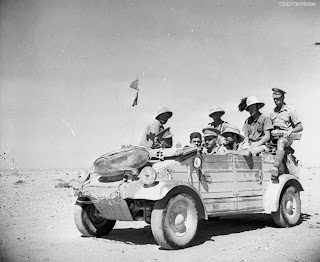
British troops in North Africa riding a captured German Kubelwagen, 20 June 1942 worldwartwo.filminspector.com
British troops drive a captured German Kubelwagen in North Africa, 20 June 1942.

Eastern Front: In Moscow on 20 June 1942, Joseph Stalin is in possession of the plans for the upcoming German Operation Blau, the planned offensive to capture the Soviet oil fields in the Caucasus. These papers were recovered from Major Joachim Reichel (now deceased) on 19 June 1942 after his plane was shot down by ground fire behind Soviet lines. While the plans are completely authentic and genuine, Stalin decides to disregard them because he believes they have been planted to deceive him.

In Crimea, both sides are experiencing supply shortages. Among other things, this compels a reduction in Luftwaffe flights by 40% and precise targeting of all bombs. The crews also are getting overworked, with some flying 25-30 missions per day. Fortunately for the Germans, Soviet resistance is crumbling and Luftwaffe war casualties are plummeting.

North of Severnaya Bay, the German 24th Infantry Division attacks the Lenin anti-aircraft and Northern Fort. While the Lenin position surrenders today, the Northern Fort holds out throughout the day despite the Germans using Goliath remote-controlled bombs and other techniques. In the south, the stalemate continues, with the Soviets retaining a firm grip on the critical Sapun Ridge and battering the nearby Wehrmacht forces with heavy artillery fire.

The Reichel Affair apparently has an immediate effect on German dispositions in Crimea. After many threats and indications that he would abandon the attempt to capture Sevastopol and turn it into a siege by transferring the essential Luftwaffe units to support Blau near Kharkov, Hitler suddenly tells Luftwaffe commander General von Richthofen that he can keep his air units in Crimea for the time being to finish the job. Richthofen joyfully writes in his diary, "Therefore, I feel reassured and can continue fighting in peace until we achieve final victory." This conclusion will turn out to be a bit premature but does reflect the upset and disequilibrium at Fuhrer Headquarters.

Luftwaffe attacks sink Royal Navy Landing Craft Tank HMS LCT-119 and LCT 150 off Tobruk.

Off Ak Mechet, Crimea, Romanian barge Danubius hits a mine laid by Soviet submarine L-6 and sinks.

Two women wearing the yellow Star of David badges in Paris, 20 June 1942 worldwartwo.filminspector.com
Women in Paris wearing the yellow Star of David badge, 20 June 1942 (Federal Archives Picture 183-B21356).

Battle of the Pacific: Japanese submarine I-26 (Yokota Minoru) shells the Estevan Point lighthouse on Vancouver Island in British Columbia. Accuracy is poor and nothing significant is hit. At the same time, I-26 first 25-30 5.5-inch (140 mm) rounds, then quickly escapes to the north and evades pursuit by five Royal Canadian Navy patrol vessels and a RCAF Supermarine Stranraer flying boat.

I-25 (Akiji Tagami) is also close to the North American coast and soon similarly will shell Fort Stevens, located at Columbia River, Oregon. During the early morning hours, it torpedoes Canadian freighter SS Fort Camosun off the coast of Washington. The freighter is badly damaged but survives to be towed into Puget Sound for repairs. It returns to service and the entire crew survives after abandoning the ship.

The U.S. Navy is still occupied with reorienting operations on an offensive footing following the dramatic success at Midway. So, local operations are the order of the day. Primarily, these are in the Aleutians, the one area of success for the Japanese.  USAAF 11th Air Force sends a bombing raid over Japanese-held Kiska Island that is hampered by poor weather conditions. Only three of nine bombers complete the mission, while three others abort and the final three divert to looking for a B-24 lost at sea on the 19th.

The crew of U.S. submarine USS S-27 (SS-132), which grounded and broke up on the 19th off Amchitka Island, makes it to a deserted village and awaits rescue. Much further south, B-17s of 5th Air Force bomb Lae Airfield on New Guinea. At Mubo, New Guinea, the 17th Australian Brigade repels a Japanese attack.

Janet Blair on the cover of Pix magazine, 20 June 1942 worldwartwo.filminspector.com
Singer/actress Janet Blair on the cover of Pix Magazine, 20 June 1942. Her most famous role was in "My Sister Eileen" (1942), for which undoubtedly this was some indirect publicity.

European Air Operations: During an RAF raid from Bourn to Emden, NF Oblt. G. Friedrich of III/NJG 1 shoots down British Wellington III bomber X3669 about 5 km southwest of Zandvoort. All four crew die.

Battle of the Atlantic: It is an oddly quiet day at sea in the Atlantic after many months of constant activity. There are no U-boat sinkings or major disasters at sea.

British 988-ton coaster Afon Dulais hits a mine and sinks near Beachy Head, East Sussex. There are no casualties.

German patrol boat V-1916 (Weser I) sinks from unknown causes somewhere in the Norwegian Sea.

Map of Tobruk battle, 20 June 1942 worldwartwo.filminspector.com
The battle of Tobruk, 20-21 June 1942.

Battle of the Mediterranean: General Erwin Rommel's Afrika Korps launches its assault on Tobruk only two days after reaching the port's perimeter. The Luftwaffe opens the attack at 05:20 by bombing the point of attack on Tobruk's southeastern defensive positions, with a theater-high 588 sorties. The Regia Aeronautica chips in with another 177 sorties. At 07:00, Gruppe Menny, positioned between the 15th and 21st Panzer Divisions, attacks in conjunction with a fierce artillery barrage. This achieves a breakthrough within 15 minutes, and the German 900th Engineer Battalion quickly enables a crossing of the port's anti-tank ditch. Panzers were rolling across by 08:30, and the infantry expands the breach.

The British defenders have not yet organized their defenses and are slow to respond to the unexpected onslaught. The defending 5th Mahratta Light Infantry immediately gives ground, and expected tank reinforcements never appear. The nearby Cameron Highlanders launch a counterattack, and then the 32nd Army Tank Brigade is ordered in, but it is too late. The British defensive effort is dispersed and overrun, aided by close German ground coordination with the Luftwaffe. By noon, the Germans have 113 tanks inside the perimeter, and by 13:30 they seize the critical Kings Cross road junction on Pilastrino Ridge. The British make a last stand by using 3.7-inch anti-aircraft guns as ground artillery, but this is ineffective. By 16:00, the port commander's headquarters, General Klopper, is under assault, and he has to escape hurriedly, losing contact with his command.

Having overcome the outer defenses, the panzers reach the port outskirts by 18:00. Realizing the developing catastrophe, British units begin blowing up port installations and ammunition dumps. By nightfall, the British defenses are in a chaotic state of disarray and the German 15th and 21st Panzer Divisions are poised to overcome all remaining defenses on the morrow.

USS Meade off NYC, 20 June 1942 worldwartwo.filminspector.com
U.S Navy destroyer USS Meade (DD-602) off New York City, 20 June 1942. This is during her delivery voyage from the Bethlehem Steel Company shipyard at Staten Island (Bureau of Ships Collection in the U.S. National Archives 19-N-30842).

Oddly, Fuhrer headquarters seems almost indifferent to Rommel's success. General Halder doesn't even mention it first in his list of the day's events, instead listing it fourth after "no change" on the Eastern Front, a mundane conference with the logistics chief, General Wagner, and a cursory description of the Reichel incident (which reflects poorly on OKH). When he finally does get to it, Halder writes:

Tobruk captured. Thus, the heavy battle in Cyrenaica has culminated on a victory that is of equally great value from the military and the political aspect.

This is one of the oddest entries in Halder's diary, completely distanced and remote from the actual state of affairs (Tobruk is not yet captured) and may reflect an underlying truth that seldom is brought out into the open. Halder and rest of OKH don't think highly of Rommel. He was not their first choice for command in Africa - General Paulus, now commander of Sixth Army, was. They view Rommel as a "loose cannon" whose victories are the result of insubordination and gambles. Rommel also has a reputation of not seeking approval for his operations. Finally, the OKH views the entire Mediterranean Theater as a sideshow that simply draws off forces that would be better employed on the theater of decision - the Eastern Front, which (not coincidentally) is completely under the control of the OKH and not the OKW (which controls western operations.

Thus, Rommel's successes are of far lesser import to the German High Command than to post-war Western accounts. Rommel only controls the equivalent of one corps, while OKH controls entire Army Groups. As long as Rommel stays out of trouble and doesn't require excess reinforcement, OKH really couldn't care less what he does. As to Hitler (who today, Halder notes, is back in East Prussia), he likely has a similar attitude but is simply happy that Rommel is keeping the Western Allies busy and giving him enough time to clear the table in the East.

Spy Stuff: The FBI picks up the German spies staying at a New York hotel following the surrender by leader George Dasch at FBI headquarters in Washington D.C. on the 19th. 

Allied Diplomacy: During discussions between Winston Churchill and President Roosevelt at the latter's Hyde Park, New York, estate, an agreement is reached to postpone an invasion of France (the Americans' preference) and instead invade North Africa (the British plan). This becomes Operation Torch and takes place in November 1942. 

US Military: Brigadier General Dwight D. Eisenhower is ordered to replace Major General James E. Chaney as Commanding General European Theater of Operations. This is a controversial choice, as Eisenhower thus leapfrogs over many more senior officers for such a prominent command. General George C. Marshall instructs Eisenhower to integrate all U.S. air units in the UK into the 8th Air Force and gives as the mission to attain "air supremacy over Western Continental Europe" in preparation for a future invasion of the Continent.

US Ninth Army under General Krueger establishes its headquarters at Milne Bay, New Guinea.
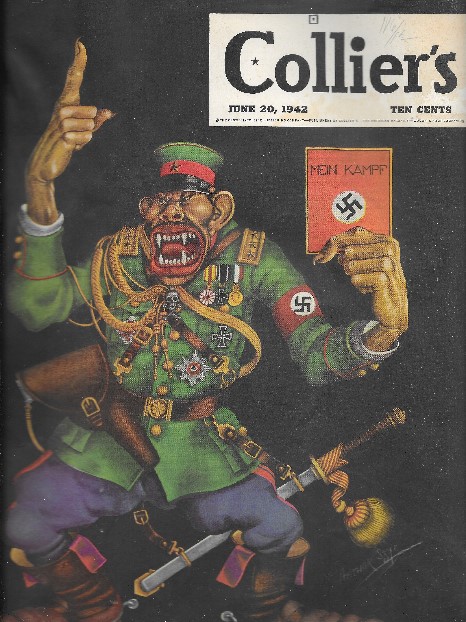
Collier's, 20 June 1942 worldwartwo.filminspector.com
Collier's, 20 June 1942 (Arthur Szyk).

Holocaust: Anne Frank discloses in her diary that she writes because she is lonely - there is nobody with whom she can share her secrets. She christens her diary "Kitty." Anne writes that she has a mother, father, and sister Margot, that they used to live in Frankfurt, Germany, and that they fled to Holland because of the persecution of people like them.

Four Polish prisoners at Auschwitz steal SS officer uniforms and drive a staff car out through the front gates. These are Eugeniusz Bendera, Stanisław Gustaw Jaster, Józef Lempart, and Kazimierz Piechowski. They are never recaptured and the last survivor, Piechowski, passes away on 15 December 2017 at the age of 98.

American Homefront: Comic book villain "Two-Face" is introduced in Detective Comics (the predecessor of DC Comics) issue #66 (the cover date is August 1942).

"Sleepy Lagoon" by Harry James and His Orchestra" becomes No. 1 on The Billboard National Best Selling Retail Records chart. It tops the chart for four weeks and becomes a standard.

Saturday Evening Post, 20 June 1942 worldwartwo.filminspector.com
"Women at Dude Ranch," Saturday Evening Post, 20 June 1942 (Fred Lukekens).

Future History: Brian Douglas Wilson is born in Inglewood, California. After moving to Hawthorne, California, Wilson begins to exhibit a special musical ability. He and his two younger brothers (Dennis, born 1944, and Carl, 1946) begin singing harmonies together while Brian plays the accordion or piano. At nine, Brian writes (or, more accurately, adapts) his first song, and writes his first independent song for a 4th-grade school project. He obsessively plays the piano and listens to the radio. After playing sports in high school, including being the quarterback of the Hawthorne football team, Brian attends El Camino Junior College, but drops out when he is disappointed at his teachers' attitudes toward pop music. In 1961, Brian and his brothers, cousin Mike Love, and friend Al Jardine form a musical group. With father Murry Wilson serving as manager, the group continues developing their skills. Brian's composition "Surfin," recorded by another act, becomes their first local LA hit. Their label, Candix Records, now changes the group's name to the "Beach Boys," but the label soon sells their contract to another label, but Murry decides to terminate it. They then attract the attention of Capitol Records, which begins releasing their tracks as singles, including "Surfin' Safari" and "409." When these become national hits, the future of the Beach Boys is assured and they become legendary performers, with their most famous album "Pet Sounds." Brian is recognized as a positive influence on The Beatles, whose Paul McCartney was born exactly two days before Brian on 18 June 1942. He thereafter battles mental health issues but largely overcomes them, with occasional relapses and continuing manageable stresses. As of writing, Brian Wilson continues touring and songwriting.  

The New Yorker, 20 June 1942 worldwartwo.filminspector.com
New Yorker, 20 June 1942 (Constantin Alajalov).

2022

Thursday, June 3, 2021

May 22, 1942: AF Is Midway!

Friday 22 May 1942

Stjepan Filipović about to be hanged, 22 May 1942 worldwartwo.filminspector.com
Stjepan Filipović shouting "Death to fascism, freedom to the People!" seconds before his execution on May 22 1942. Filipović was declared a National Hero of Yugoslavia on 14 December 1949.

Battle of the Pacific: In one of the most significant intelligence coups of World War II, US Navy cryptanalysts on 22 May 1942 decode a Japanese message from 20 May confirming that Midway is their next invasion target. Because of what it leads to, the decryption is the turning point of the war in the Pacific.

For weeks, American naval intelligence has known that a place codenamed "AF" by the Japanese is the next objective. Falling for a classic ruse in which US forces on Midway sent messages pretending to have a water shortage, the Japanese unknowingly blundered into the trap and gave the entire game away. The analysts today decode a routine Japanese message from later the same day as the phony radio messages from Midway were sent (20 May) from a low-level Japanese bureaucrat stating that "AF is short of water" so the invasion fleet should bring additional water supplies. This confirms growing US suspicions about Japanese intentions and helps the US Navy plan a strategy to defend the isolated island and turn the tables on the overly aggressive Japanese.

That's not all. The cryptanalysts today also decode portions of a lengthy message sent by Japanese Admiral Yamamoto (subject line "Operational Order 14") also sent on 20 May. The message details the invasion plans in great detail. Based on these interceptions, Commander Joseph Rochefort and his team at Station HYPO (also known as Fleet Radio Unit Pacific, or FRUPAC) in Hawaii are able to provide Admiral Chester Nimitz with precise details about the projected date of the invasion (4 or 5 June 1942). This information includes the Imperial Japanese Navy order of battle. Based on previous intelligence, Nimitz already has ordered Admiral "Bull" Halsey to bring his aircraft carriers USS Enterprise and Yorktown back to Pearl Harbor from the Southwest Pacific to prepare for the battle. Now, everyone can plan a trap at Midway when otherwise the US Navy might not even have had any ships in the area.
Ted Williams being sworn in, 22 May 1942 worldwartwo.filminspector.com
Baseball star Ted Williams is sworn in to the US Navy on 22 May 1942.

Meanwhile, the Japanese continue their methodical preparations for the upcoming battle. Cruiser Division 8 and the battleships Kongo and Kirishima depart the Inland Sea of Japan today. Other ships under Admiral Nagumo already are at sea.

US submarine Silversides (SS-236) torpedoes and damages 4550-ton Japanese Navy freighter Asahisan Maru in the Kii Strait. The ship loses its bow but the captain manages to beach it to prevent sinking. The Japanese refloat Asahisan Maru on 27 May 1942 and return it to service on 15 July 1943.

US submarine Tautog (SS-199) torpedoes and damages Japanese freighter Sanko Maru southwest of the large Japanese base at Truk.

The USAAF continues its attacks on Japanese bases in New Guinea. B-17s of the 5th Air Force attacks Lakunai Airfield, while B-25 and B-26 bombers attack shipping and the airfield at Lae. Two B-25s fail to return.
Roseburg, Oregon, News-Review, 22 May 1942 worldwartwo.filminspector.com
Like many other US newspapers, the 22 May 1942 Roseburg (Oregon) News-Review celebrates US Navy submarine successes.

Eastern Front: By now thoroughly aware of the peril facing his advanced units south of Kharkov in Army Group Kotenko, Soviet Marshal Timoshenko orders those troops to begin an orderly withdrawal to the east. He plans their departure for 23 May by the 9th and 57th Soviet armies through the narrow corridor to the east still held by Red Army troops.

The Wehrmacht forces attempting to cut Soviet Army Group Kotenko off, meanwhile, complete their encirclement late in the day. The 14th Panzer Division, advancing from Petrovskoye, lunges north and completes the final eight miles to make contact with Sixth Army units at Balakleya. At the same time, the 16th Panzer Division and 60th Motorized Divisions broaden the slender corridor the panzers have established between the massive Red Army forces to both east and west. They drive northwestward from Petrovskoye to meet other German troops ten miles west of Balakleya.

At Fuhrer Headquarters, General Franz Halder notes "The Izyum pocket has been weakly sealed on its eastern periphery." He notes disapprovingly that Field Marshal Fedor von Bock's plan to strengthen the encirclement:
is not well-conceived; it calls for an attack ... from the constricted bridgehead at Andreyyevka. To my mind, this is a very ineffectual solution. The right thing to do would be to have the armor now becoming available east of Kharkov strike for Savintai, on the north bank of the Donets. Bock had a talk with the Fuehrer and secured approval for his plan. I think it is wrong.
It is interesting that Halder, from his lofty position at the top of the military chain of command, feels so free to criticize decisions made by both a field marshal and Hitler in his official war diary. It probably helps that Hitler is in Berlin today (and for the next couple of days), giving Halder a sense of freedom from the oppressive twice-daily situation conferences. This incident also shows that Hitler was not always wrong and the generals right about military strategy, as the approved strategy turns out to be far from "ineffectual" and in fact leads to one of the greatest German victories of World War II.

Far to the north, German troops remain committed to the siege of Leningrad. Artillery fire sinks two Soviet Navy torpedo boats, TKA-103 and TKA-123. With the ice melting in the spring thaw, the Germans fear a Soviet naval breakout into the Baltic.

European Air Operations: Continuing a major lull in operations that lasts throughout May 1942, neither side launches any major attacks. The only significant activity is a mission by 27 Halifax bombers to attack the U-boat pens at St. Nazaire. Poor weather prevents all but three bombers from dropping their bombs. An additional 31 bombers lay mines off St. Nazaire and the German Baltic ports. No aircraft are lost.
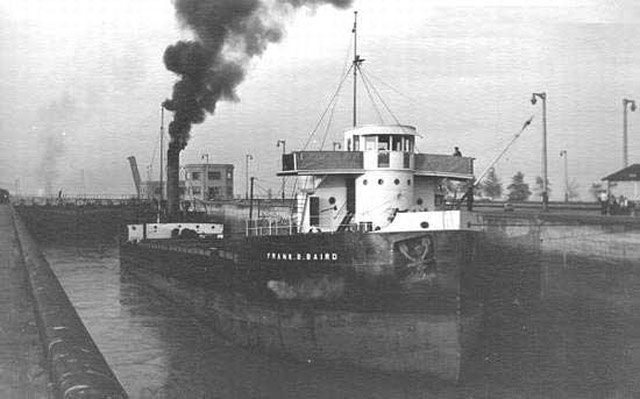
Canadian freighter Frank B. Baird, sunk on 22 May 1942 worldwartwo.filminspector.com
Canadian freighter Frank B. Baird, sunk by U-158 on 22 May 1942.

Battle of the Atlantic: U-753 (KrvKpt. Alfred Manhardt von Mannstein), on its fourth patrol out of La Pallice, surfaces and stops 326-ton British three-masted schooner E.P. Theriault in the Gulf of Mexico 55 miles west of Dry Tortuga. The Germans allow an orderly evacuation of the ship and then attempt to scuttle it, but they fail and it drifts ashore in the Bay of Cardenes, Cuba, on 27 May. The ship is refloated, repaired, and sold to Cuba, where it sails as the Ofelia Gancedo. The crew survives and makes landfall in Cuba in their lifeboats.

U-158 (Kptlt. Erwin Rostin), on its second patrol out of Lorient, surfaces and sinks 1748-ton Canadian freighter Frank B. Baird far south of Bermuda. Rostin uses his deck gun to sink the freighter. Norwegian freighter Talisman rescues the 23 crewmen and takes them to Point Noire, French Equatorial Africa.

U-588 (Kptlt. Victor Vogel), on its third patrol out of St. Nazaire, torpedoes and sinks 3282-ton US freighter Plow City 200 nautical miles (370 km) east of Cape May, New Jersey. There are one death and 30 survivors, who are picked up by USS Sapphire.

Battle of the Mediterranean: It is a quiet day at Malta, perhaps the first such day in months. There are a couple of Luftwaffe patrols near the island, but no bombing attacks and no fighter interceptions. RAF forces have been built up to previously unheard of strength recently.

Partisans: Serbian security forces hang partisan Stjepan Filipović, 26, at Valjevo, Yugoslavia (Serbia). Filipović, a communist and ethnic Croat, was commander of the Partisans' Tamnavsko-Kolubarski unit in Valjevo. A photo of him (top of this page) becomes famous worldwide as a symbol of resistance to tyrrany. There is a statue to Filipović in Valjevo. Both of his brothers also perish in the partisan operations.
El Paso, Texas, Herald-Post, 22 May 1942 worldwartwo.filminspector.com
As the 22 May 1942 El Paso Herald-Post headlines, Mexico takes a dim view of U-boat sinkings of Mexican ships.

Mexican/Axis Relations: As a consequence of U-boat sinkings of Mexican ships, including one on 20 May 1942 by U-106, Mexico declares war on Germany, Italy, and Japan.

US Military: The 19th Fighter Squadron, 18th Fighter Group, 7th Air Force transfers its P-40s from Bellows Field in Waimanalo to the new nearby Kualoa Field at Kualoa Ranch, Hawaii, while the 73rd Fighter Squadron transfers from Wheeler Field to Bellows Field to replace it. Kualoa is a satellite field used for training. Among its typical characteristics are that it is made of perforated high strength steel (Marston mats) and that the runway crosses a road (Kamehameha Highway) to the north shore.

Under General Orders 25, the US 1st Armored Division in Northern Ireland is divided into three units for training, discipline, and administration.

Former Ambassador to France Admiral William D. Leahy boards Swedish liner Drottningholm at Lisbon, Portugal, for his voyage home to New York. 

German Military: General Halder records that he has a meeting with Count Claus von Stauffenberg and Lt. Colonel Mueller-Hillebrand about staffing and "other current organization matters."

Halder also notes in his diary, "Preparation for chemical warfare." This is in reference to a meeting with Genera Wilhelm-Francis Ochsner. This is one of several oblique references in Halder's diary to the possible use of poison gas. There are allegations that the Wehrmacht used gas against Soviet partisans using catacombs south of Kerch, Crimea, around this time. To be fair, both sides make contingency preparations (including the production of large quantities of poison gas) for the possible use of chemical weapons throughout the war.
Adolf Hitler at the Carl Rover funeral, 22 May 1942 worldwartwo.filminspector.com
Adolf Hitler and Hermann Goering attend the funeral of Gauleiter Carl Röver in Berlin on 22 May 1942. It appears the widow is sitting next to Hitler in the place of honor. Also visible in the second row are Joseph Goebbels and Heinrich Himmler (mostly obscured).

German Government: In Berlin for a couple of days, Adolf Hitler attends the funeral of Gauleiter Carl Röver (Reichsstatthalter for the states of both Oldenburg and Bremen) in the mosaics room at the Chancellery. Röver, 53, officially died of either pneumonia or heart failure.

Why Obergruppenführer Röver, a relatively minor party functionary but longtime NSDAP member since 1924, merits Hitler's attention and lavish ceremony at the Chancellery is a bit unclear. Some historians, including David Irving, have claimed that Röver was assassinated on orders from Martin Bormann - ostensibly Röver's friend and sponsor - because Röver was proving to be an embarrassment to the NSDAP due to progressive dementia caused by advanced syphilis.

But there may be more to it. For years, Röver successfully has resisted Hermann Goering's (who also attends the funeral) attempts to incorporate Bremen into Prussia (Goering is Minister of the Interior for Prussia). Hitler consistently took Röver's side, and Goering could not have been too happy about that. This ceremony may be an oblique way for Hitler to signal that he still agrees with the deceased Röver and opposes Goering's empire-building plans.
The Carl Rover funeral, 22 May 1942 worldwartwo.filminspector.com
Reich Minister Alfred Rosenberg speaks during the Carl Röver funeral ceremony at the Chancellery, Berlin, on 22 May 1942.

Australian Homefront: In Townsville, Australia, about 600 African-American servicemen (laborers) of the 96th Battalion, US Army Corps of Engineers, mutiny. They do so after hearing a rumor that a white office had struck or murdered a black sergeant. The mutineers already had been banned from Townsville due to previous incidents. The mutineers fire machine guns at the tents of white officers, with at least one death and dozens injured (a contemporary report says that 19 men are killed). The mutiny lasts for eight hours. A Texas congressman visiting Australia, Lyndon B. Johnson, arranges to suppress news of the mutiny, which does not become public until 2012. The mutiny is put down with the assistance of Australian infantry units armed with live ammunition. This is considered one of the worst mutinies in United States military history and it is the first of several similar incidents during World War II (Port of Chicago in July 1944, Agana, Guam, in December 1944, Freeman Air Force Field in Indiana in 1945).
Adolf Hitler at the Carl Rover funeral, 22 May 1942 worldwartwo.filminspector.com
Adolf Hitler (center) attends the funeral of Gauleiter Carl Röver on 22 May 1942.

Holocaust: Transport trains arrive at Auschwitz carrying 1000 Slovak Jewish citizens transferred from Majadanek Concentration Camp at Lublin. Another nine previously arrested by the state security services (Sipo and SD) arrive from Helcl Prison in Krakow. Almost all of the new arrivals are dead by mid-August.

American Homefront: Baseball star Ted Williams enlists in the Navy Reserve after initially petitioning to be exempt from the draft as the sole source of support for his mother (Class 3-A). Pushback from sponsors and fans have contributed to his change of heart.

The Navy allows Williams to finish out the season. Williams will become a second lieutenant in the United States Marine Corps as a Naval Aviator. Having batted .406 in 1941 (the last player to best .400 to date), Williams is having another outstanding year and is on his way to the American League Triple Crown (leading in batting average, runs batted in, and home runs). After being called to duty in November 1942, Williams will miss the 1943, 1944, and 1945 baseball seasons.

The United Steel Workers of America is formed as a combination of smaller unions.
Poster celebrating Mexico's entry into the war on 22 May 1942 worldwartwo.filminspector.com
A poster celebrating the entry of Mexico in the war on 22 May 1942.

Future History: Theodore John Kaczynski is born in Chicago, Illinois. In high school, he shows a strong interest in mathematics and develops a reputation as a "walking brain." After participating in mind control experiments that may be part of the CIA's Project MKUlttra, he graduates from Harvard in 1962. He becomes a doctor of mathematics in 1967 but resigns from a teaching position abruptly in 1969. In the 1970s, he moves to a remote cabin in Lincoln, Montana, attempting to become self-sufficient. He develops obsessive views against development and begins acting violently, including setting booby traps and committing arson. This develops into his mailing or hand-delivering bombs to individuals he associates with trees and forests, including at least two individuals who apparently are targeted simply because their last names are "Wood."

For these violent acts, the as-yet-unidentified Kacynski becomes commonly known as the "Unabomber." This continues intermittently until 1995, when the Washington Post accedes to his demands and publishes his crazed manifesto condemning the Industrial Revolution. After a massive investigation, the FBI arrests Kaczynski on 3 April 1996. As of mid-2021, Ted Kaczynski is serving eight life sentences without the possibility of parole at a supermax prison in Florence, Colorado.

Barbara Parkins is born in Vancouver, British Columbia, Canada. At the age of 16, she moves with her mother to Los Angeles, California, where she studies acting. She makes her film debut in "20,000 Eyes" (1961). Later in the decade, she stars in ABC primetime soap opera "Peyton Place" and the film adaptation of Jacqueline Susann's novel "Valley of the Dolls." This begins an extensive acting career that lasts through the 1990s. As of mid-2021, Barbara Parkins is a photographer.  

Richard Raul "Richie" Garcia is born in Key West, Florida. After serving in the US Marine Corps as a combat engineer in the early 1960s, Garcia becomes a baseball umpire in 1970. He goes on to a prominent and popular career as a leading American League umpire that has several high-profile controversies, including his participation in the 1999 Major League Umpires Association mass resignation (which ends his umpiring career, though he returns to baseball in other capacities). As of mid-2021, Richie Garcia is retired in Florida.
Loyola college coeds support the war effort, 22 May 1942 worldwartwo.filminspector.com
College co-eds pitch in to help with the war effort. Skyscraper, 22 May 1942, Mundelein College Records, Loyola University Chicago Digital Special Collections, accessed June 3, 2021.

May 1942


2021

Thursday, April 22, 2021

May 12, 1942: Soviets Attack At Kharkov

Tuesday 12 May 1942

Winston Churchill 12 May 1942 worldwartwo.filminspector.com
A wartime press photograph of Prime Minister Winston S. Churchill on 12 May 1942. He is addressing the Parliamentary Home Guard in London while carrying his gas mask.
Battle of the Pacific: Despite the failure of Operation Mo during the Battle of the Coral Sea, the Japanese continue with Operation RY on 12 May 1942. This was intended as a follow-up to the Port Moresby invasion, but since that invasion was stopped by the US fleet, Operation Ry takes center stage. This is an invasion of Nauru and Ocean Island for their phosphate deposits.

Despite the fact that the Japanese invasion fleet is at sea from Rabaul, Operation RY already is in trouble. Just as the invasion of Port Moresby had to be postponed indefinitely (to 3 July), Operation RY also is postponed today. This is due to the sinking of the Japanese flagship, minelayer Okinoshima, by S-42. While the Japanese don't know this, US Admiral "Bull" Halsey is fast approaching with his Task Force 16 and is almost ready to engage the invasion force. The Japanese fix a new date of 17 May for the Operation RY invasion, but Halsey aboard USS Enterprise and accompanying aircraft carrier Hornet (the units that launched the Doolittle Raid on 18 April) will have something to say about that if it proceeds.
USS Charger 12 May 1942 worldwartwo.filminspector.com
The U.S. Navy escort carrier USS Charger (AVG-30) at anchor on 12 May 1942. She is painted in Camouflage Measure 12 (Modified) (Naval History and Heritage Command NH 55073).
Battle of the Indian Ocean: The monsoon season begins today in Burma, slowing operations just as the spring thaw ("rasputitsa") has done recently in the Soviet Union. The Japanese expand their control in eastern Burma by crossing the Salween River. Their next objective in this region is Kengtung. The 2nd Burma Infantry Brigade completes a long march north through the Myitha Valley and joins with the Chin Hills Battalion, Burma Frontier Force about 15 miles south of Kalemyo. Here, the 2nd Brigade can take trucks to the border town of Tamu where the British are assembling a frontier force to defend India.
Midway pilots May 1942 worldwartwo.filminspector.com
The pilots of the U.S. Marine Corps scout bomber squadron VMSB-241 on Midway between 17 April (when Henderson took command) and 28 May 1942 (when Frazer and Smith were detached). Those marked with an “x” were killed during the upcoming Battle of Midway, 4-6 June 1942 (U.S. Navy photo 80-G-40283/Everett Collection Historical (USN reference number may be wrong)).
Eastern Front: Marshal Semyon Timoshenko launches a major offensive to recover the Ukrainian city of Kharkov, a major industrial center and the fourth city of the Soviet Union. His military commissar is native Nikita Khrushchev, who has great powers as Timoshenko's political "minder." Timoshenko has built up a 3:2 advantage in infantry and 2:1 in tanks at the attack points.

The Soviet attack begins with an hour-long artillery barrage at 06:30, then a twenty-minute air assault. This effective preparation sharply limits the Wehrmacht's response, and the subsequent ground assault makes good progress. There are two main lines of attack, from the Volchansk (north of Kharkov) and Barvenkovo (south) areas, which are intended to converge and form a pincer trapping the German forward units. The infantry units make such good progress during the morning that Timoshenko prepares his second echelon, usually kept in reserve for an eventual breakthrough, for immediate use.

While caught largely by surprise (some Germans apparently did have some knowledge that an attack was coming), the Sixth Army under General Paulus recovers fairly quickly. The Luftwaffe has sufficient fighters in the area to establish aerial supremacy, but the bombers remain to the south in Crimea with General Erich von Manstein's 11th Army. Thus, the effectiveness of German control of the air is less than it could be. The Wehrmacht infantry also is able to launch some local counterattacks, including three near the Soviet village of Nepokrytaia.

The attack is proceeding north and south of Kharkov, with the main effort to the south. The goal is to engulf the city. Soviet tanks range within eleven miles of the city. To protect the city, Army Group South commander Field Marshal Fedor von Bock releases the 23rd Panzer Division and the 71st and 113th Infantry Divisions. At the end of the day, the Red Army has advanced 10 km (6.2 miles). However, it fails to score a clean breakthrough.
Panzer IV in Crimea May 1942 worldwartwo.filminspector.com
Russia, Crimea, Kerch peninsula - Panzer IV (turret number 924) and mounted infantry in combat, May 1942 (Federal Archive B 145 Fig. F016223-0024).
The May 1942 Soviet Kharkov offensive is doomed to failure even before it begins for a very specific reason. The Germans at Adolf Hitler's insistence have been flooding the Army Group South rear areas with troops preparing for the grand summer offensive, Case Blue, that he intends to be the decisive campaign of the war. Paulus has been planning a preliminary offensive in the exact area of the Soviet attack, Operation Fridericus, and thus has units that are at full strength. In fact, the three divisions that Bock releases today to save Kharkov were intended to spearhead Fridericus and thus are fully staffed and ready for action. The real question is what effect this Soviet attack will have on Hitler's grand strategy for the summer, but the Red Army offensive is driving into a dead end.

At Fuhrer Headquarters, General Franz Halder writes in his war diary, 

Heavy attacks at Volchansk and in VIII Corps sector against Sixth Army, objective Kharkov. The enemy used 100 tanks in each attack and has scored considerable initial successes. Air Force units must be diverted from the Crimea to this battle area. 23rd Armored Division is released for commitment at the front.

While Halder sees the necessity of transferring Luftwaffe units to the Kharkov battle, Hitler insists that they remain in Crimea until that battle is completely won.

In Crimea, Manstein's Operation Trappenjagd is proceeding toward a quick and successful conclusion. The Germans have trapped the Soviet 51st Army in a pocket on the northern half of the line (at the Parpach narrows) while other units (22nd Panzer Division and the 132nd and 170th Infantry Divisions) are making good progress toward the ultimate objective, Kerch. One German unit, the Grodeck Brigade, already has penetrated the second Soviet defensive line (the "Sultanovka Line") and that line shows little chance of holding once the other Wehrmacht divisions attack. Halder writes, "Good progress on the Kerch peninsula: 29,000 prisoners, 220 guns, 170 tanks, etc."

European Air Operations: There are no operations due to inclement weather.
USS Massachusetts 12 May 1942 worldwartwo.filminspector.com
USS Massachusetts. "Entering Boston Harbor, Massachusetts, after leaving the Fore River Shipyard at Quincy, 12 May 1942. Photographed from an altitude of approximately 400 feet. Note harbor defense net system at top, with a Net Tender (AN) in attendance." (Naval History and Heritage Command NH 97254).
Battle of the Atlantic: Wolfpack Hecht attacks Convoy ON-92 in the mid-Atlantic southeast of Cape Farewell with great success, sinking five ships and possibly damaging a sixth in a night of savagery. U-124 (Kptlt. Johann Mohr), on its ninth patrol out of Lorient, has a big night, sinking four ships of the convoy. The four victims of U-124 (16,100 tons in total) are:
  • 7065-ton British CAM ship Empire Dell (2 dead 46 survivors)
  • 4959-ton British freighter Llanover (all 46 survive)
  • 5389-ton British Cristales (all 82 survive)
  • 4371-ton Greek freighter Mount Parnes (all 33 survive)
U-94 (Oblt. Otto Ites), on its ninth patrol out of St. Nazaire, torpedoes accompanies U-124 and sinks 5630-ton Panamanian freighter Cocle, which is traveling with convoy ON 92 midway between Ireland and Nova Scotia. There are five deaths and 37 survivors, who are rescued by British freighter Bury. Cocle served as the flag ship for Admiral Richard E. Byrd during his Second Arctic Expedition. There are five dead and 37 survivors.

The "Battle of the St. Lawrence Seaway" opens today with the sinking of 5364-ton British freighter Nicoya by U-553. It sinks south of Anticosti, Quebec, Canada. There are six deaths and 82 survivors.

U-553 also torpedoes and sinks 4712-ton Dutch freighter Leto 8 nautical miles north of Cap-de-la-Madeleine, Quebec, Canada. There are 12 deaths and 41 survivors.

U-507 torpedoes and sinks 10,731-ton US tanker Virginia about one and a half miles off Southwest Pass, Louisiana, in the Gulf of Mexico. the three torpedoes set off a massive fireball that prevents the launch of lifeboats. There are 27 deaths and 14 survivors, who are rescued by motor torpedo boat USS PT-157.

German patrol boats UJ 1101, UJ 1108, and UJ 1110 sink Soviet Northern Fleet submarine K-23 off Nordkinn Cape in the Barents Sea. All 71 men aboard the submarine perish. 

Luftwaffe planes bomb and sink 424-ton Soviet patrol boat Brilliant in or near the Iokanga River near the Barents Sea. It is raised on 25 September 1942 and returned to service in June 1944.
Rhodesian soldiers training 12 May 1942 worldwartwo.filminspector.com
"Rhodesian troops of the 60th King's Royal Rifles training with a 2-inch mortar, 12 May 1942." North Africa. © IWM E 11699.
Battle of the Mediterranean: The Luftwaffe sends fourteen Junkers Ju 52 transport planes of III./KGzbV 1 from Maleme/Crete heading to Derna Cyrenaica. Each carries a standard complement of 20 soldiers. About 80 km off the North Africa coast, a formation of 14 Beaufighter and Kittyhawk fighters intercepts the German planes. A one-sided battle ensues in which nine of the virtually defenseless Ju 52 transport planes are shot down and another 2 are forced to land on the shoreline.

The Luftwaffe's raids on three Royal Navy destroyers north of Mersa Matruh, Egypt, claim their final victim during the early morning hours of 12 May. Badly damaged destroyer HMS Jackal is taken under tow by fellow destroyer Jervis, but the damage proves to be too great. After the Jackal's crew abandons the ship, Jervis scuttles it with a torpedo. There are nine dead. This completes the Luftwaffe's sinking of three of four destroyers that had been stalking an Italian convoy to North Africa.

The air battle over Malta heats up even further today as the Luftwaffe shoots down nine Supermarine Spitfires and damages another two on the ground. Despite the losses, the RAF planes still badly disrupt the Axis attempts to bomb the island. The British still have dozens of operational Spitfires after the recent deliveries.
US Marines in Ireland 12 May 1942 worldwartwo.filminspector.com
Men of US 1st Provisional Marine Battalion arriving at Belfast, Northern Ireland, United Kingdom, 12 May 1942 (The United States Marine Corps Frederick and Henry Strybing Collection).
Battle of the Black Sea: German aircraft sink several Soviet transport ships at or near Kerch that are ferrying wounded soldiers back to the mainland. They are:
  • Soviet ship Berezan
  • 712-ton Krasny Flot
  • 348-ton Krasny Moryak
  • Soviet patrol boat PK-083
  • Soviet patrol boat SKA-0133
  • Soviet patrol boat SKA-0183
  • Soviet patrol boat SKA-0411
  • Soviet patrol boat SKA-0611
  • Soviet patrol boat SKA-0811. 
German Military: Lt. Max-Hellmuth Ostermann of 7./JG 54 on the Eastern Front becomes the 6th fighter pilot in aviation history to reach 100 victories. While flying his Bf 109F-4, Ostermann is badly wounded in the right arm and upper thigh but makes it back to base and goes to the hospital for an extended stay. For this, Ostermann will receive the Knight's Cross of the Iron Cross with Oak Leaves and Swords at the hands of Adolf Hitler in June 1942.

US Military: Aircraft of the 8th Army Air Force begin arriving in Great Britain. Planes with sufficient range to fly use the South Atlantic air ferry route linking the US with West Africa via Natal, Brazil.

Holocaust: At Auschwitz Birkenau, 1500 Polish Jews are killed in gas chambers. This is considered the beginning of the final phase of mass murder in the Third Reich.
Japanese-American soldier 12 May 1942 worldwartwo.filminspector.com
Japanese-American soldier, 12 May 1942 (National Archives 537850).
American Homefront: 20th Century Fox and Darryl F. Zanuck release "This Above All," directed by Anatole Litvak and starring Tyrone Power and Joan Fontaine. It is a wartime romance that serves various propaganda purposes by showing a wealthy woman who joins the  Women's Auxiliary Air Force (WAAF), a hero who wins a medal at Dunkirk, and so forth. The film goes on to win an Oscar for art direction and is nominated in several other technical categories. 

Future History: Ian Robins Dury is born in Harrow, Middlesex, England, the son of a local bus driver. He becomes a major figure during the punk/new wave eras of rock music, including being the frontman for Ian Dury and the Blockheads. Dury also branches out into acting, including a role in Peter Greenaway's The Cook, the Thief, His Wife & Her Lover (1989). Ian Dury passes away in 2000 at the age of 57.
Auschwitz victim Artur Paraszewski 12 May 1942 worldwartwo.filminspector.com
21-year-old Artur Paraszewski, gassed at Auschwitz on 12 May 1942 (Auschwitz Memorial/Muzeum Auschwitz).

May 1942


2021

Thursday, April 1, 2021

April 26, 1942: Hitler Expands His Powers

Sunday 26 April 1942

Adolf Hitler, 26 April 1942 worldwartwo.filminspector.com
Adolf Hitler addressing the Reichstag, 26 April 1942 (Federal Archive Image 101I-811-1881-33).

Battle of the Pacific: The Allies are busy beefing up their air defenses in northern Australia and at Port Moresby on 26 April 1942, and not a moment too soon. Today, the 35th and 36th Pursuit Squadrons of 8th Pursuit Group transfer their P-39s and P-40s from Brisbane and Townsville, respectively, to Port Moresby, New Guinea. Everyone can see from the flow of Japanese invasions that Port Moresby is likely to be the next "hot spot" on the road to Australia. However, it remains unclear if the Japanese will try a seaborne invasion launched from their overseas headquarters at Rabaul or try to cross the forbidding Owen Stanley Mountain Range. The distance between the Japanese positions on the north coast and the Australian-held port on the south coast is not terribly much as the crow flies, but the crow would have to fly high over mountains and dense jungles to make the trip.
Auschwitz inmate executed on 26 April 1942 worldwartwo.filminspector.com
Polish Judge Karol Wrona (No. 29596), a native of Rudno, executed at Auschwitz on 26 April 1942.
Battle of the Indian Ocean: Pursuant to orders from General Harold Alexander, commander of all forces in Burma, British and Chinese troops withdraw to positions north of Mandalay. Chinese forces of the Sixty-Sixth Army and attached units are concentrating in Lashio, where there are warehouses full of supplies bound for China, as the Japanese rapidly approach.

The situation in Burma is murky to the world at large, many of whom could not find it on a map. A reporter for the Sunday Observer (now affiliated with The Guardian) in London attempts to summarize it on 26 April 1942:

The Japanese are practicing the advantages of mobility which they enjoyed in Malaya, and getting the full benefit of the lead which it gives them over our more cumbersomely equipped forces. They have been switching their attack from the east to the west and back again to the east, looking all the time for our weak spots. They found one at Taunggyi, ninety-five miles south-east of Mandalay, and they are now throwing their heavy forces into this railway terminus, which gives them a valuable springboard for the decisive attack on Mandalay.

While things look dire for the Allies due to the rapid Japanese advance, the weather is about to become their ally. The monsoon season is about to begin and that will stop the Japanese better than the Allies can.
Danish DNSAP members marching 26 April 1942 worldwartwo.filminspector.com
As losses mount on the Eastern Front (over a third of the initial troops of Operation Barbarossa have become casualties), the Wehrmacht is recruiting heavily in the Nordic nations. Here, soldiers from the Free Corps Denmark march out of the K.B. Hallen as part of the DNSAP's spring appeal on 26 April 1942. (National Museum of Denmark).
Eastern Front: As General Franz Halder notes in his diary entry for 26 April 1942, the spring thaw has brought operations on both sides to a temporary halt:

Situation: Unchanged quiet. Apparently, the effects of the seasonal mud are severely felt in Center and North [Army Groups]. In [Army Group] South, the enemy regrouping movements opposite our front continue.

Halder does not know this, but the Red Army is reshuffling its units to launch a major operation to retake Kharkiv. Stalin is determined to get in some more successes from the dying winter counteroffensive before the expected German summer offensive. Halder notes in his diary that he is leaving his headquarters at 20:05 to attend the Fuhrer's Reichstag speech in Berlin.
Bombardment of Bath 26 April 1942 worldwartwo.filminspector.com
While it did not receive much attention in the post-war world, the bombing of Bath was considered quite horrific at the time and resulted in this pamphlet, "The Bombardment of Bath." 
European Air Operations: The Luftwaffe returns to Bath on the night of 26/27 April 1942 for the second night in a row. The two raids cause widespread devastation and about 400 casualties.

During the day, the RAF sends a dozen Boston bombers to attack St. Omer and Hazebrouck railway yards. They return without loss.

After dark, RAF Bomber Command raids Rostock again for the fourth night in the row. The Germans use the phrase "Terrorangriff" (terror raid) for the first time to describe these attacks. Taken together, the four raids destroy 1765 buildings and cause serious damage to 513 others. This is the first time that Bomber Command begins destroying large swathes of German cities, with 130 acres (60 percent of the downtown area) obliterated. Tonight's raid kills 204 people and injures 89 others, an inversion of usual figures when more people are injured than killed. These casualty totals illustrate the enhanced effect of mass bombings when firestorms break out and local rescue services such as fire stations are overwhelmed.

While many point to raids on Cologne and Hamburg over the summer of 1943 as turning points in the air war, the German leadership already can read the writing on the wall. Propaganda Minister Joseph Goebbels confides in his diary that "community life in Rostock is practically at an end." That said, the results have required a full RAF commitment over several nights, though with minimal losses. Tonight they lose three bombers, which, considering the roughly 109 aircraft involved gives an "acceptable" loss rate of under 3%.

The RAF also launches subsidiary raids of 24 aircraft against Dunkirk, 2 Blenheim Intruders to Leeuwarden, 4 bombers on minelaying missions, and seven leaflet flights with no losses.
Crusader tank exits landing craft 26 April 1942 worldwartwo.filminspector.com
"A Crusader I tank emerges from a tank landing craft (TLC 124) during tests of a portable concrete roadway, in this case laid on the beach, 26 April 1942." © IWM H 19057.
Battle of the Atlantic: U-66 (KrvKpt. Richard Zapp), on its fifth patrol out of Lorient, torpedoes and sinks 5513-ton US freighter Alcoa Partner about 80 nautical miles (150 km) northwest of Bonaire in the Caribbean. The ship sinks quickly due to the heavy bauxite ore cargo. There are ten deaths and 25 survivors, who make it in their lifeboat to Bonaire on the 27th.

US Navy 1190-ton destroyer USS Sturtevant (DD-240) hits three mines in rapid succession and sinks off Key West, Florida while escorting a convoy. An investigation reveals that it blundered into a US Navy minefield about 8 miles (13 km) north of the Marquesas Keys. The loss is attributable to a lack of communication between different commands within the US Navy. There are 15 deaths and 115 survivors. The Sturtevant, resting in two pieces at a depth of 60 feet (18 meters), becomes a favored site for SCUBA divers.

Convoy PQ 15 sails from Reykjavík, Iceland, on 26 April 1942 with its local escort. It is bound for Murmansk, USSR. 
Italian POWs arrive in Liverpool 26 April 1942 worldwartwo.filminspector.com
An Italian POW, most likely captured in North Africa, arrives in Liverpool on 26 April 1942. "This prisoner brought his mandolin." © IWM A 8469.
Battle of the Mediterranean: U-81 (Kptlt. Friedrich Guggenberger), on its fifth patrol out of La Spezia, surfaces and shells 100-ton Egyptian sailing vessel Aziza off Palestine.

It is a quiet morning in Malta aside from some false air raid alerts. At 14:20, however, the bombers return with a total of 54 Junkers Ju 88 and 17 Junkers Ju 87 Stuka planes. The attackers break up into six separate groups and focus on the airfields at Ta Qali, Luqa, and Kalafrana as well as the Grand Harbour area. The damage is not confined to those areas, however, and affects many other portions of the island as well. 

The raid sinks 330-ton HMS Monkey, a Dockyard Water Tank vessel in the Malta Dockyard near the Sheer Bastion. Another vessel, HM Drifter Eddy being used to clear mines despite having a steel hull, sinks after hitting a mine just outside Grand Harbour.

The RAF is able to get three Spitfires into the air from Luqa and three from Ta Qali, but they do not down any enemy planes. The RAF loses two fighters from its dwindling force. Other air attacks follow throughout the evening.
Hitler addresses the Reichstag 26 April 1942 worldwartwo.filminspector.com
Adolf Hitler addresses the Reichstag at the Kroll Opera House, 26 April 1942. Many other leaders of the Third Reich also are visible, including Heinrich Himmler and Hermann Goering.
German Government: Adolf Hitler addresses the Reichstag for the final time (while he makes many more speeches, they are at Party gatherings). He gives a long oration that favorably compares the desperate German defense outside of Moscow with the Napoleonic retreat and catastrophe of 1812. This battle required sacrifices "far exceeding what should or could be expected in normal wars," he says, though the comparison falls flat since he cites the Napoleonic situation that in fact suggests bad Russian winters are completely normal during wartime. The speech is full of bravado but short on mentions of actual conquests. It strikes some (such as Italian Foreign Minister Count Ciano) as pessimistic, particularly when Hitler vows to be ready for the next winter "no matter where it finds us."

That was all standard boilerplate stuff. Let's step back a moment before going on to the key part of this speech. While Hitler holds seeming total control over the Third Reich, there are various gaps in his authority. These primarily lie in two areas, the Church and the Wehrmacht. The Church he can do nothing about because of widespread public support for it. The archbishops already have defeated Hitler on the euthanasia issue, though he successfully hid the program in the death camps after seemingly terminating it. Hitler does not like limits on his power and holds a powerful grudge against the Pope and the other clergy that he can do little about despite some occasional hostile comments at his "table talk." That issue remains unresolved throughout Hitler's tenure.

But the Wehrmacht is another matter entirely. The German Army has a long history of independence, particularly over promotions and demotions, but it ultimately is under the control of the chief executive and the law. Hitler chafes at the historical limits of his authority over the generals. His main grievance is that he can remove generals from their positions, but he cannot arbitrarily demote them or even execute them (as Stalin can). That must be done under a cloak of legality even within the Third Reich, after a court-martial. Any general can demand an honor court, just as General Werner von Fritsch had done before the war. That incident turned quite embarrassing for the Fuhrer because Fritsch showed conclusively that he had been framed. Hitler doesn't want scorned generals embarrassing him ever again. Eliminating this gap in his authority becomes the main purpose of Hitler's speech.

Thus, the 26 April 1942 speech is crafted to expand Hitler's legal powers over the military, despite the common misconception that he already holds absolute dictatorial control over all aspects of German life. In it, Hitler reveals what will become a common theme for the remainder of the war. He asks the Reichstag to give him:

... an explicit confirmation that I have the legal right to hold everyone to the fulfillment of his duty and to reduce to the common ranks or remove from post and position, without regard for acquired rights or status, anyone whom I find not to have done his duty.

In other words, Hitler wants (and receives) power to blame his generals for the army's failures. This is despite the fact that he increasingly is giving the generals detailed instructions on how to fight their battles. Blaming the generals, of course, is better than blaming himself. 

The Reichstag is presided over by Hermann Goering and naturally grants Hitler's requests by acclamation. It is the last vote of any substance the Reichstag will make. Tellingly, Hitler rarely if ever uses these new powers over his generals (he invariably just dismisses them and puts them in the "Fuhrer Reserve" until the 20 July 1944 Putsch). This suggests Hitler is just using this occasion as a pretext to cast the generals, many of whom he dislikes intensely for losing battles and occasionally not following his orders to the letter, obliquely as scapegoats for the hard winter of 1941-42. After the speech, Hitler boards his train and heads south to Salzburg for a strategy meeting with Mussolini.

There is a particular interested party listening to Hitler's speech over the radio: British Intelligence. They notice something odd about the tone of the speech, but they can't quite put their finger on it. They commission a pioneer social scientist, Mark Abrams, to analyze it and subsequent speeches. Abrams listens to Hitler's speeches closely and he notes certain tendencies in a report marked "Secret." His aim is "to reconstruct, if possible, what was in Hitler's mind when he composed and delivered the speech."

Abrams asks a fellow academic, Joseph McCurdy, to write up the report on these findings. McCurdy's report concludes that Hitler's speeches now have a "dull flatness of the delivery" and show "a man who is seriously contemplating the possibility of utter defeat." Hitler also is developing a "Jew phobia" and increasingly sees them as a "universal diabolical agency" versus himself, who represents "the incarnation of the spirit of good." All in all, it is not a pretty picture, rather a terrifying one of a man who thinks he sees the future and doesn't like it at all. And this man controls the fates of millions of people all across Europe and elsewhere.

Japanese Homefront: An explosion in the Benxihu Colliery (coal mine) in the puppet state of Manchukuo kills up to 1,549 miners.
Polish laborers about to be executed 26 April 1942 worldwartwo.filminspector.com
These nineteen Polish prisoners were executed (11 May 1942) in Buchenwald Forest, Germany, for an attack by two Poles on a German policeman on 26 April 1942. This spot was chosen because it was the spot where the Polish forced laborers stabbed the German to death. The nineteen men were hanged from gallows erected by the Buchenwald SS.
American Homefront: American communists are fully behind the war effort ever since the commencement of Operation Barbarossa. Susan Green writes an article in "Labor Action" of 26 April 1942 entitled "Here's How to Smash the Fascists." She singles out the "Coughlins, Pellys, Kullgrens, and other would-be American Hitlers" (they are all radio commentators) for scorn. Her concluding section is "We Must Ferret Out the Fascist Rats." Of course, just because the American communists are against Hitler does not mean they support the US status quo. She concludes that "Neither [Franklin] Roosevelt nor [Wendell] Wilkie is an insurance against the spread of American fascism." Susan Green, incidentally, was a confirmed Trotskyite who viewed Stalin's Soviet Union as a "totalitarian empire," so she ware more of a pure radical than a partisan.
Handley Page Hampden 26 April 1942 worldwartwo.filminspector.com
A Handley Page Hampden I bomber. RAAF No. 455 Squadron transferred from Bomber Command to Coastal Command on 26 April 1942 because its Hampdens were becoming obsolete. 
Future History: Robert Louis Ridarelli is born in Philadelphia, Pennsylvania. After winning a talent show on the television show "Paul Whiteman's TV Teen Club," Robert adopts the stage name "Bobby Rydell" and attempts to become a professional singer. He finally achieves some success in 1959 with "Kissin' Time," which leads to a tour of Australia with other artists. More successes follow, and he gets a big break by being cast as the central character of Hugo Peabody in the film version of "Bye Bye Birdie." This brings Bobby Rydell even greater fame, which leads to more hits. However, the British Invasion is not kind to Rydell's style of rock and so his singing and acting career plateaus and declines by the mid-1960s. As of 2021, Bobby Rydell continues to perform on occasion despite health issues.

Claudine Oger is born in Paris, France. After being named "Miss France Monde", Claudine is the first runner-up in the 1958 Miss World contest. She then tries her hand at acting while still in school, changes her name to Claudine Auger, and makes her screen debut in "Testament of Orpheus" (1960). Her most prominent film role becomes Domino in the James Bond movie "Thunderball" (1965). Claudine Auger passes away in Paris on 18 December 2019.
Allied troops in Iraq 26 April 1942 worldwartwo.filminspector.com
"Iraq. 26 April 1942. On the parade ground, Air Marshal Sir Arthur Tedder KCB, Air Officer in Commanding in Chief, RAF, Middle East, inspects Iraq levies during his tour of inspection of the Middle East area." Australian War Memorial MED0400.

April 1942

April 1, 1942: Convoys Come to the USA 
April 2, 1942: Doolittle Raiders Leave Port
April 3, 1942: Japanese Attack in Bataan
April 4, 1942: Luftwaffe Attacks Kronstadt
April 5, 1942: Japanese Easter Sunday Raid on Ceylon
April 6, 1942: Japanese Devastation In Bay of Bengal
April 7, 1942: Valletta, Malta, Destroyed
April 8, 1942: US Bataan Defenses Collapse
April 9, 1942: US Defeat in Bataan
April 10, 1942: The Bataan Death March
April 11, 1942: The Sea War Heats Up
April 12, 1942: Essen Raids Conclude Dismally
April 13, 1942: Convoy QP-10 Destruction
April 14, 1942: Demyansk Breakout Attempt
April 15, 1942: Sobibor Extermination Camp Opens
April 16, 1942: Oil Field Ablaze in Burma
April 17, 1942: The Disastrous Augsburg Raid
April 18, 1942: The Doolittle Raid bombs Japan
April 19, 1942: British in Burma Escape
April 20, 1942: The Operation Calendar Disaster
April 21, 1942: Germans Relieve Demyansk

2021