Showing posts with label Tobruk. Show all posts

Monday, September 5, 2022

June 20, 1942: Rommel Breaks Through At Tobruk

Saturday 20 June 1942
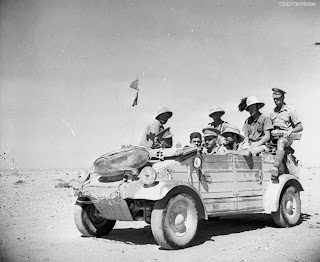
British troops in North Africa riding a captured German Kubelwagen, 20 June 1942 worldwartwo.filminspector.com
British troops drive a captured German Kubelwagen in North Africa, 20 June 1942.

Eastern Front: In Moscow on 20 June 1942, Joseph Stalin is in possession of the plans for the upcoming German Operation Blau, the planned offensive to capture the Soviet oil fields in the Caucasus. These papers were recovered from Major Joachim Reichel (now deceased) on 19 June 1942 after his plane was shot down by ground fire behind Soviet lines. While the plans are completely authentic and genuine, Stalin decides to disregard them because he believes they have been planted to deceive him.

In Crimea, both sides are experiencing supply shortages. Among other things, this compels a reduction in Luftwaffe flights by 40% and precise targeting of all bombs. The crews also are getting overworked, with some flying 25-30 missions per day. Fortunately for the Germans, Soviet resistance is crumbling and Luftwaffe war casualties are plummeting.

North of Severnaya Bay, the German 24th Infantry Division attacks the Lenin anti-aircraft and Northern Fort. While the Lenin position surrenders today, the Northern Fort holds out throughout the day despite the Germans using Goliath remote-controlled bombs and other techniques. In the south, the stalemate continues, with the Soviets retaining a firm grip on the critical Sapun Ridge and battering the nearby Wehrmacht forces with heavy artillery fire.

The Reichel Affair apparently has an immediate effect on German dispositions in Crimea. After many threats and indications that he would abandon the attempt to capture Sevastopol and turn it into a siege by transferring the essential Luftwaffe units to support Blau near Kharkov, Hitler suddenly tells Luftwaffe commander General von Richthofen that he can keep his air units in Crimea for the time being to finish the job. Richthofen joyfully writes in his diary, "Therefore, I feel reassured and can continue fighting in peace until we achieve final victory." This conclusion will turn out to be a bit premature but does reflect the upset and disequilibrium at Fuhrer Headquarters.

Luftwaffe attacks sink Royal Navy Landing Craft Tank HMS LCT-119 and LCT 150 off Tobruk.

Off Ak Mechet, Crimea, Romanian barge Danubius hits a mine laid by Soviet submarine L-6 and sinks.

Two women wearing the yellow Star of David badges in Paris, 20 June 1942 worldwartwo.filminspector.com
Women in Paris wearing the yellow Star of David badge, 20 June 1942 (Federal Archives Picture 183-B21356).

Battle of the Pacific: Japanese submarine I-26 (Yokota Minoru) shells the Estevan Point lighthouse on Vancouver Island in British Columbia. Accuracy is poor and nothing significant is hit. At the same time, I-26 first 25-30 5.5-inch (140 mm) rounds, then quickly escapes to the north and evades pursuit by five Royal Canadian Navy patrol vessels and a RCAF Supermarine Stranraer flying boat.

I-25 (Akiji Tagami) is also close to the North American coast and soon similarly will shell Fort Stevens, located at Columbia River, Oregon. During the early morning hours, it torpedoes Canadian freighter SS Fort Camosun off the coast of Washington. The freighter is badly damaged but survives to be towed into Puget Sound for repairs. It returns to service and the entire crew survives after abandoning the ship.

The U.S. Navy is still occupied with reorienting operations on an offensive footing following the dramatic success at Midway. So, local operations are the order of the day. Primarily, these are in the Aleutians, the one area of success for the Japanese.  USAAF 11th Air Force sends a bombing raid over Japanese-held Kiska Island that is hampered by poor weather conditions. Only three of nine bombers complete the mission, while three others abort and the final three divert to looking for a B-24 lost at sea on the 19th.

The crew of U.S. submarine USS S-27 (SS-132), which grounded and broke up on the 19th off Amchitka Island, makes it to a deserted village and awaits rescue. Much further south, B-17s of 5th Air Force bomb Lae Airfield on New Guinea. At Mubo, New Guinea, the 17th Australian Brigade repels a Japanese attack.

Janet Blair on the cover of Pix magazine, 20 June 1942 worldwartwo.filminspector.com
Singer/actress Janet Blair on the cover of Pix Magazine, 20 June 1942. Her most famous role was in "My Sister Eileen" (1942), for which undoubtedly this was some indirect publicity.

European Air Operations: During an RAF raid from Bourn to Emden, NF Oblt. G. Friedrich of III/NJG 1 shoots down British Wellington III bomber X3669 about 5 km southwest of Zandvoort. All four crew die.

Battle of the Atlantic: It is an oddly quiet day at sea in the Atlantic after many months of constant activity. There are no U-boat sinkings or major disasters at sea.

British 988-ton coaster Afon Dulais hits a mine and sinks near Beachy Head, East Sussex. There are no casualties.

German patrol boat V-1916 (Weser I) sinks from unknown causes somewhere in the Norwegian Sea.

Map of Tobruk battle, 20 June 1942 worldwartwo.filminspector.com
The battle of Tobruk, 20-21 June 1942.

Battle of the Mediterranean: General Erwin Rommel's Afrika Korps launches its assault on Tobruk only two days after reaching the port's perimeter. The Luftwaffe opens the attack at 05:20 by bombing the point of attack on Tobruk's southeastern defensive positions, with a theater-high 588 sorties. The Regia Aeronautica chips in with another 177 sorties. At 07:00, Gruppe Menny, positioned between the 15th and 21st Panzer Divisions, attacks in conjunction with a fierce artillery barrage. This achieves a breakthrough within 15 minutes, and the German 900th Engineer Battalion quickly enables a crossing of the port's anti-tank ditch. Panzers were rolling across by 08:30, and the infantry expands the breach.

The British defenders have not yet organized their defenses and are slow to respond to the unexpected onslaught. The defending 5th Mahratta Light Infantry immediately gives ground, and expected tank reinforcements never appear. The nearby Cameron Highlanders launch a counterattack, and then the 32nd Army Tank Brigade is ordered in, but it is too late. The British defensive effort is dispersed and overrun, aided by close German ground coordination with the Luftwaffe. By noon, the Germans have 113 tanks inside the perimeter, and by 13:30 they seize the critical Kings Cross road junction on Pilastrino Ridge. The British make a last stand by using 3.7-inch anti-aircraft guns as ground artillery, but this is ineffective. By 16:00, the port commander's headquarters, General Klopper, is under assault, and he has to escape hurriedly, losing contact with his command.

Having overcome the outer defenses, the panzers reach the port outskirts by 18:00. Realizing the developing catastrophe, British units begin blowing up port installations and ammunition dumps. By nightfall, the British defenses are in a chaotic state of disarray and the German 15th and 21st Panzer Divisions are poised to overcome all remaining defenses on the morrow.

USS Meade off NYC, 20 June 1942 worldwartwo.filminspector.com
U.S Navy destroyer USS Meade (DD-602) off New York City, 20 June 1942. This is during her delivery voyage from the Bethlehem Steel Company shipyard at Staten Island (Bureau of Ships Collection in the U.S. National Archives 19-N-30842).

Oddly, Fuhrer headquarters seems almost indifferent to Rommel's success. General Halder doesn't even mention it first in his list of the day's events, instead listing it fourth after "no change" on the Eastern Front, a mundane conference with the logistics chief, General Wagner, and a cursory description of the Reichel incident (which reflects poorly on OKH). When he finally does get to it, Halder writes:

Tobruk captured. Thus, the heavy battle in Cyrenaica has culminated on a victory that is of equally great value from the military and the political aspect.

This is one of the oddest entries in Halder's diary, completely distanced and remote from the actual state of affairs (Tobruk is not yet captured) and may reflect an underlying truth that seldom is brought out into the open. Halder and rest of OKH don't think highly of Rommel. He was not their first choice for command in Africa - General Paulus, now commander of Sixth Army, was. They view Rommel as a "loose cannon" whose victories are the result of insubordination and gambles. Rommel also has a reputation of not seeking approval for his operations. Finally, the OKH views the entire Mediterranean Theater as a sideshow that simply draws off forces that would be better employed on the theater of decision - the Eastern Front, which (not coincidentally) is completely under the control of the OKH and not the OKW (which controls western operations.

Thus, Rommel's successes are of far lesser import to the German High Command than to post-war Western accounts. Rommel only controls the equivalent of one corps, while OKH controls entire Army Groups. As long as Rommel stays out of trouble and doesn't require excess reinforcement, OKH really couldn't care less what he does. As to Hitler (who today, Halder notes, is back in East Prussia), he likely has a similar attitude but is simply happy that Rommel is keeping the Western Allies busy and giving him enough time to clear the table in the East.

Spy Stuff: The FBI picks up the German spies staying at a New York hotel following the surrender by leader George Dasch at FBI headquarters in Washington D.C. on the 19th. 

Allied Diplomacy: During discussions between Winston Churchill and President Roosevelt at the latter's Hyde Park, New York, estate, an agreement is reached to postpone an invasion of France (the Americans' preference) and instead invade North Africa (the British plan). This becomes Operation Torch and takes place in November 1942. 

US Military: Brigadier General Dwight D. Eisenhower is ordered to replace Major General James E. Chaney as Commanding General European Theater of Operations. This is a controversial choice, as Eisenhower thus leapfrogs over many more senior officers for such a prominent command. General George C. Marshall instructs Eisenhower to integrate all U.S. air units in the UK into the 8th Air Force and gives as the mission to attain "air supremacy over Western Continental Europe" in preparation for a future invasion of the Continent.

US Ninth Army under General Krueger establishes its headquarters at Milne Bay, New Guinea.
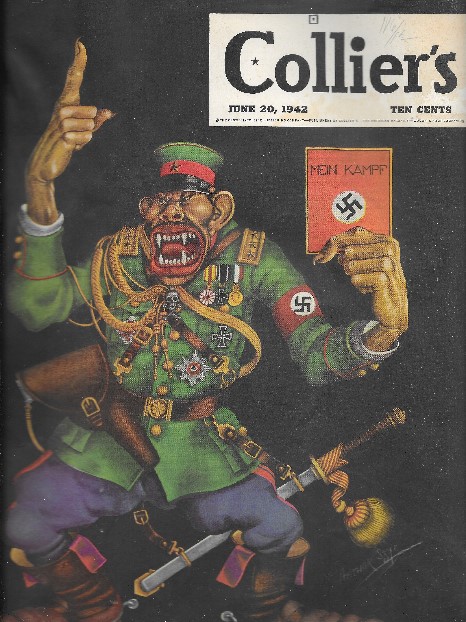
Collier's, 20 June 1942 worldwartwo.filminspector.com
Collier's, 20 June 1942 (Arthur Szyk).

Holocaust: Anne Frank discloses in her diary that she writes because she is lonely - there is nobody with whom she can share her secrets. She christens her diary "Kitty." Anne writes that she has a mother, father, and sister Margot, that they used to live in Frankfurt, Germany, and that they fled to Holland because of the persecution of people like them.

Four Polish prisoners at Auschwitz steal SS officer uniforms and drive a staff car out through the front gates. These are Eugeniusz Bendera, Stanisław Gustaw Jaster, Józef Lempart, and Kazimierz Piechowski. They are never recaptured and the last survivor, Piechowski, passes away on 15 December 2017 at the age of 98.

American Homefront: Comic book villain "Two-Face" is introduced in Detective Comics (the predecessor of DC Comics) issue #66 (the cover date is August 1942).

"Sleepy Lagoon" by Harry James and His Orchestra" becomes No. 1 on The Billboard National Best Selling Retail Records chart. It tops the chart for four weeks and becomes a standard.

Saturday Evening Post, 20 June 1942 worldwartwo.filminspector.com
"Women at Dude Ranch," Saturday Evening Post, 20 June 1942 (Fred Lukekens).

Future History: Brian Douglas Wilson is born in Inglewood, California. After moving to Hawthorne, California, Wilson begins to exhibit a special musical ability. He and his two younger brothers (Dennis, born 1944, and Carl, 1946) begin singing harmonies together while Brian plays the accordion or piano. At nine, Brian writes (or, more accurately, adapts) his first song, and writes his first independent song for a 4th-grade school project. He obsessively plays the piano and listens to the radio. After playing sports in high school, including being the quarterback of the Hawthorne football team, Brian attends El Camino Junior College, but drops out when he is disappointed at his teachers' attitudes toward pop music. In 1961, Brian and his brothers, cousin Mike Love, and friend Al Jardine form a musical group. With father Murry Wilson serving as manager, the group continues developing their skills. Brian's composition "Surfin," recorded by another act, becomes their first local LA hit. Their label, Candix Records, now changes the group's name to the "Beach Boys," but the label soon sells their contract to another label, but Murry decides to terminate it. They then attract the attention of Capitol Records, which begins releasing their tracks as singles, including "Surfin' Safari" and "409." When these become national hits, the future of the Beach Boys is assured and they become legendary performers, with their most famous album "Pet Sounds." Brian is recognized as a positive influence on The Beatles, whose Paul McCartney was born exactly two days before Brian on 18 June 1942. He thereafter battles mental health issues but largely overcomes them, with occasional relapses and continuing manageable stresses. As of writing, Brian Wilson continues touring and songwriting.  

The New Yorker, 20 June 1942 worldwartwo.filminspector.com
New Yorker, 20 June 1942 (Constantin Alajalov).

2022

Sunday, September 4, 2022

June 19, 1942: The Reichel Affair Threatens Blau

Friday 19 June 1942

Japanese POWs from the sunken Hiryu, picked up on 19 June 1942 worldwartwo.filminspector.com
Survivors of Japanese aircraft carrier Hiryu, sunk on 5 June, after being picked up by the U.S. Navy on 19 June 1942 (U.S. Navy).

Eastern Front: Adolf Hitler has been placing all of his hopes on the coming Summer offensive (Case Blau (Blue)) to capture the Soviet oil fields in the Caucasus and finally secure plentiful energy supplies. However, on 19 June 1942 the Germans receive terrible news that places the entire success of the offensive in question. Hitler himself, though, is kept in the dark about it until the 21st.

Contrary to well-known standing orders both in general and specifically put in place for Blau (War Directive ), a 23rd Panzer Division staff officer, Major Joachim Reichel, boarded a light transport aircraft (apparently a Fieseler FI-156 Storch) carrying a complete outline for the Blau offensive and specific plans for General der Panzertruppe Georg Stumme's Fortieth Panzer Corps. The pilot for some reason flies over the front lines, perhaps due to getting lost. A lucky shot by a Soviet rifleman pierces the fuel tank and forces the plane to crashland intact. 

Within hours, a German patrol finds the downed plane 4 km behind the Soviet lines but cannot find either Reichel or the pilot (they were shot after a brief firefight by a Soviet patrol and their bodies will be found by another German patrol two days from now). Most importantly, they do not find the briefcase containing the Blau plans.

The German high command now must assume that the plans for Blau have been compromised (they have, the plans are on Stalin's desk within a day). Field Marshal von Bock, commander of Army Group South, has the immediate reaction to start Blau immediately before the Red Army can react. OKH (General Franz Halder) agrees and tells him to put everything in readiness for a start on 26 June. However, the final decision is up to Hitler, and he is furious. He summons Bock to the Wolfschanzee in East Prussia for an explanation. Everything is now in doubt and nobody knows whether the grand offensive will even happen.

In his daily war diary, Halder's notes today do not mention the Reichel affair but do reflect upon more basic problems with the offensive:

The discussion with the top command on the efficient conduct of the Kupyansk-Izyum offensive follows a familiar and unpleasant pattern. Whereas von Bock, because of the terrain, wants to launch his tank drive directly from the west, top command considers that a mistake but feels no change ought to be ordered at this advanced stage of preparations, and approves von Bock's plan against its better judgment.

What Halder carefully skirts is identifying who this "top command" actually is - a sure sign it is Hitler himself, who according to Halder's notes (which may, of course, be inaccurate) briefly returned to headquarters in East Prussia on the 18th but now is back in Bavaria. This continues a pattern of Hitler doubting von Bock's judgment that began during the May Soviet counteroffensive at Kharkov and ultimately will lead to von Bock's final dismissal in mid-July.

Marilyn Monroe wedding day portrait 19 June 1942 worldwartwo.filminspector.com
The future Marilyn Monroe on her first wedding day, June 19, 1942.

Halder also mentions "very heavy economy attacks with local successes" from the trapped Soviet pocket on the Volkhov River in the north. This is Soviet General Andrei Vlasov's trapped 2nd Shock Army's last major attempt to break out. The attacks are aided in part by "adverse weather" that grounds the Luftwaffe.

In Crimea, General Manstein's 11th Army continues clearing out pockets of Soviet resistance, primarily a few remaining fortresses on "Battery Headland," the peninsula that dominates the bay's entrance. This is in preparation for the final assault on Sevastopol, but first, the 54th Army must take that peninsula. The final outcome in the sector north of Severnaya Bay is not in doubt following the fall of the key Soviet fortress Maxim Gorki. Luftwaffe air strikes are much less hazardous following the destruction of a key Soviet anti-aircraft platform in the bay. From first light, bombers based nearby conduct "rolling attacks" against all remaining valuable targets within the city. First, they use high explosive bombs, then, after noontime, incendiaries. 

Luftwaffe General von Richthofen, who is still in the theater prior to his transfer north to help with Blau, notes in his diary that Sevastopol is "a sea of flames," with smoke clouds stretching all the way to Feodosia, 150 km away. However, the chaotic supply situation soon will force a reduction in Luftwaffe sorties by around 40%.

Serbian partisans, 19 June 1942 worldwartwo.filminspector.com
Partisan soldiers of the 4th Proletarian Montenegrin Brigade and the Herzegovinian Detachment in the village of Lubina near Vrbnica on Zelengora, Serbia, June 19, 1942.

Battle of the Black Sea: Italian motor torpedo boat ("MTB") MAS-571 torpedoes and sinks Soviet 3000-ton transport evacuating wounded troops from Sevastopol. submarine Shch-214 off Crimea in the Black Sea. There are no survivors.

Separately, two other Italian MTBs based in Yalta chase a Soviet submarine, Shch-214, that has been spotted by reconnaissance aircraft near Cape Ay-Todor (five km west of Yalta). They catch up to it and sink the submarine near Cape Sarych. Everybody aboard, estimated at 39 crew and between 40-65 evacuees from Sevastopol, perishes. There are two survivors taken as POWs, one of whom perishes in captivity.

The two sinkings continue a series of similar Italian naval victories in the theater at little cost to themselves. These aggravating losses have forced Soviet Admiral Oktyabrskii to sharply curtail naval missions to Sevastopol, leading to German Admiral Schwarzes Meer (Black Sea Naval Command) war diary to include the entry today that "Enemy naval activity has greatly decreased."

The German Navy also gets a success when MTB S 102 torpedoes and sinks 2048-ton Soviet transport Belostok near Balaklava. There are 388 deaths. It is unclear if this happens on the 18th or 19th, so entries for this sinking are on both pages.

The Soviets have noticed the Italian successes, and after dark they send bombers of the Voyenno-vozdushnyye si/y (Soviet Air Force, or VVS) to attack German shipping at Yalta. The attack severely damages two Italian mini-submarines and cripples an MTB. 

German fishing schooner MFK-2263 hits a mine and sinks off Mariupol, Ukraine. Two men perish.

Battle of the Baltic: Soviet submarine Shch-317 torpedoes and sinks 2405-ton Danish freighter Orion off Visby, Sweden. There are one death and 21 survivors.

Danish 117-ton coaster Anna hits a mine and sinks in the Kattegat, off Paludian Flak. All four crewmen perish.

Canadian relocation notice, 19 June 1942 worldwartwo.filminspector.com
A relocation notice to Japanese Canadians issued in British Columbia newspapers on 19 June 1942 (Canadian government).

Battle of the Pacific: In one of the last direct consequences of the Battle of Midway, a U.S. PBY Catalina search plane spots a lifeboat east of the island and directs the destroyer U.S.S. Ballard to it. The lifeboat contains 35 sailors from the engineering room of fleet carrier Hiryū, sunk on 5 June 1942. After two weeks of exposure, one of the men passes away almost immediately. The POWs are taken to Midway, and then Pearl Harbor aboard the cargo ship USS Sirius.

U.S Navy submarine USS S-27 drifts toward shore during the night while recharging its batteries and at 00:43 grounds on rocks off St. Makarius Point, Kiska. The sub is gradually ground to pieces, and the crew abandons ship by 15:50 today.

The 11th Air Force sends B-24s to bomb Kiska but are forced to abort the mission due to heavy fog. One of the planes must make a crash-landing in the sea and two men are lost.

B-17s of the 5th Air Force attack Vunakanau Airfield, Rabaul, and nearby shipping.

U-552 returns to port, 19 June 1942 worldwartwo.filminspector.com
U-552, its Roter Teufel ("Red Devil") mascot plainly visible on the conning tower, returns to the typical warm welcome from German maidens at Saint Nazaire, France. Erich Topp is visible in the tower, with crew on deck. It has been a successful patrol, sinking five ships of 15,858 tons (Kramer, Federal Archive Image 101II-MW-6443-16A).

Battle of the Atlantic: Allied shipping losses off the American coast have been heavy for months now, and Allied leaders are starting to take notice. Today, U.S. Army Chief of Staff George Marshall writes to Admiral King:

The losses by submarines off our Atlantic seaboard and in the Caribbean now threaten our entire war effort....I am fearful that another month or two of this will so cripple our means of transport that we will be unable to bring sufficient men and planes to bear against the enemy in critical theaters to exercise a determining influence on the war.

Winston Churchill, currently visiting with President Roosevelt, is known to have this view as well, so it probably is not a coincidence that Marshall writes this grim note on this particular day.

U-701 (Kptlt. Horst Degen), on its third patrol out of Lorient, shells and sinks U.S. Navy trawler USS YP-389 (Lt R.J. Philips) 20 miles southeast of Cape Hatteras, North Carolina. The trawler is at a disadvantage because its main gun is out of commission due to a faulty firing spring. The U-boat's shelling starts a fire forward and floods the engine room, and the ship sinks by the stern at 10:15. There are six deaths and 18 survivors (some sources say 4 deaths and 21 survivors).

U-159 (Kptlt. Helmut Friedrich Witte), on its second patrol out of Lorient, shells and sinks 2710-ton Yugoslavian freighter Ante Matkovi in rough weather just north of Riohacha, Colombia. The ship quickly catches fire and sinks at 18:10. Rescue is not forthcoming because one of the first shells took out the radio mast, so the men must make shore in Colombia in their lifeboats. There are six dead and 23 survivors.

U-107 (Kptlt. Harald Gelhaus), on its sixth patrol out of Lorient, shells and sinks 35-ton U.S. schooner Cheerio eight miles off Mona, Puerto Rico. The crew sets the ship on fire after the first few shells and abandons ships - the flames attract the attention of a PBY Catalina. All nine crewmen, clinging to driftwood, then are rescued by USS CG-459.

British 758-ton passenger steamer Dalriada hits a mine in the Edinburgh Channel and sinks while clearing a wreck.

German 125-ton minesweeper R-41 is torpedoed and sunk in the Seine Estuary, France. It is unclear who did this, perhaps British MTBs, which have been in the general vicinity in recent days. In the same action, German surface units shell and sink British gun boat HM SGB-7 in the Seine Estuary.

A U.S. mine in the Gulf of Mexico sinks 3009-ton Yugoslavian freighter Boslijka northwest of Key West, Florida. 

U-552 returns to port showing her Red Devil mascot, 19 June 1942 worldwartwo.filminspector.com
Good view of U-552's deck gun as it comes into Saint Nazaire following its successful patrol on 19 June 1942 (Kramer, Federal Archive Image 101II-MW-6443-07A).

Battle of the Mediterranean: Having effectively surrounded the critical Allied port of Tobruk on the 18th, General Erwin Rommel begins final preparations for an assault to take it quickly. Reconnaissance of deployment areas takes place in the morning, and in the afternoon he sends his armored formations (15th and 21st Panzer Divisions on the right, the Italian Trieste and Ariete Divisions on the left) to the southeastern corner of the perimeter where he plans to make his main effort. The 90th Light Division occupying that area moves further east toward the coast to assume a defensive posture in case the British Eighth Army attempts a relief effort from its positions further south.

The attack is scheduled to begin early on the 20th. The plan is for a feint by XXI corps in the west before the two panzer divisions - 15th on the left and 21st on the right, with a motorized infantry group left behind by 90th Light commanded by Generalleutnant Erwin Menny in between - makes the main effort. The Germans are astonished when they arrive to find German ammunition depots left behind during their retreat from the area in November 1941 still in place and useable.

On the British side, the inexperienced 2nd Battalion, 5th Mahratta Light Infantry holds the key area in the southeastern corner of the perimeter. Inland from them are the 2/7th Gurka Rifles, while on the other side along the coast are the 2nd Cameron Highlands. The two panzer divisions are to attack the Mahrattas, while the two Italian armored divisions will take on the Cameron Highlands.

The British are confident, given how long they were able to hold the port in 1941, but the command is disorganized after the frantic retreat from the Gazala Line and does not yet have its forces properly disposed for counterattacks. The upcoming battle is a clear example of the value of speed in continuing offensive operations rather than pauses that allow the defenders to dig in and recover from past defeats.

Italian 778-ton coastal freighter Carlotta SS hits a mine and sinks off Cape Platamone, south of Cattaro.

Partisans: The Germans, in Operation Hannover and Hannover II, have been trying to eliminate a major partisan force led by Soviet general Below in the Bryansk region for some time. On the 18th, a patrol found orders on a dead Soviet officer stating that a breakout east across the "Rollbahn" (highway) that the Germans loosely control back toward Soviet-held territory will take place at a specific point at midnight on 18/19 June. With nothing else to go on, the Germans have reinforced the area with three lines of defense comprised of infantry and artillery. General Heinrici, a defensive specialist, is in command.

The partisan breakout begins right on time as the clock ticks into 19 June. The breakout force is massive, and fighting lasts into daylight. The Russians get about 1500 troops across the first defensive line, 500 across the second, and perhaps a few across the third line. Having taken massive casualties, the remaining Soviets are forced back into the pocket, and at noon, Heinrici orders immediate pursuit. However, it then begins to rain, and in the confusion and dense forests, Belov and his remaining troops (about 3000) find an undefended portion of the Rollbahn and cross over unmolested.

Cajon Blvd in San Diego, 19 June 1942 worldwartwo.filminspector.com
Looking west on El Cajon Boulevard from Alabama Street, San Diego, June 19, 1942 (The Boulevard).

Spy Stuff: The leader of the Operation Pastorius German saboteur group in New York City, George John Dasch, takes a train down to Washington, D.C., and walks into FBI headquarters. He experiences some skepticism until he shows Assistant Director D.M. Ladd a sack full of $84,000 of the operation's funds. FBI Director J. Edgar Hoover then begins arresting the German spies, which takes about two weeks. Hoover takes full credit for the arrests and neglects to mention to others that Dasch turned himself in.

Allied Relations: With Winston Churchill now in the United States,  the Second Washington Conference begins. It actually begins today in Hyde Park, New York, where Churchill travels to meet with President Roosevelt at his private residence. As he arrives, Churchill notices old warships from World War I tied up along the shoreline. In a flash of inspiration, he mentions to FDR that these sorts of obsolete vessels would be quite useful if sunk offshore to protect invasion landings from weather effects. FDR agrees and tells his naval authorities to make appropriate plans. This idea turns into the useful Mulberry Harbor at the D-Day (6 June 1944) landings.

The actual discussions revolve around the pressing question of where in Europe or Africa (and whether) the Western Allies should invade in 1942. The Americans want to open a Second Front in France, but Churchill and his generals demur. They prefer instead landings in the Mediterranean Theater - echoing German military experts such as Grand Admiral Raeder who have been advising Hitler to concentrate on the Mediterranean. This will remain the topic for discussion until the Second Washington Conference concludes (in Washington) on 25 June.

U.S. Military: Vice Admiral Robert L. Ghormley, USN, who has been recalled from a London post as "Special Naval Observer" for President Roosevelt for the assignment, assumes command of the South Pacific Area with headquarters at Auckland, New Zealand. He is the choice of both Admiral Nimitz, CINCPAC, and Admiral King. While Ghormley has a lot of experience, he has not commanded at sea since 1938 on the battleship Nevada and has no experience with aircraft carriers.

Picture Show Magazine, 19 June 1942 worldwartwo.filminspector.com
Picture Show Magazine for June 19, 1942, has Ray Milland and Paulette Goddard on the cover.

German Homefront: Alois Eliáš, the former Prime Minister of the Protectorate of Bohemia and Moravia who was arrested for partisan activities on 27 September 1941, is executed at the Kobylisy Shooting Range after a lengthy time on death row. Eliáš is the only head of state executed by the Germans during World War II. He receives a full state funeral on 7 May 2006 and is reburied at the National Monument in Vitkov, Prague.

The 1st Ranger Battalion is activated in Carrickfergus, North Ireland. It is led by William Orlando Darby, and his troops are sometimes called "Darby's Rangers." The unit is composed of approximately 500 volunteers chosen from units training in Ireland, and the vast majority of Darby's Rangers come from the five midwestern states of Minnesota, Iowa, Wisconsin, North Dakota, and South Dakota. This unit is designed to be elite, so elite that they use live ammunition during training.

American Homefront: Boston Braves outfielder Paul Waner collects his 3,000th career hit on June 19, 1942.

New York Yankees outfielder Joe DiMaggio strikes out three times in one game for the only time in his career against Mel Harder of the Cleveland Indians, who pitches a complete game victory.

The U.S. government urges United States pharmacies to turn in quinine supplies over 10 oz. Quinine is considered the best current cure for malaria, and heavy fighting in the southwest Pacific is set to take place in areas where malaria is prevalent.

At 432 S. Bentley Ave, in the West Los Angeles neighborhood of Westwood, the 16-year-old Norma Jeane Mortensen marries the 21-year-old "Big Jim" James Dougherty. Norma Jeane becomes better known in the 1950s by her stage name Marilyn Monroe. The house is still in existence and currently is valued at $2 million.

Marilyn Monroe wedding photo, 19 June 1942 worldwartwo.filminspector.com
The future Marilyn Monroe gets married on 19 June 1942 to James Dougherty in her Los Angeles home. They remain married throughout the war.

2022

Sunday, August 28, 2022

June 18, 1942: Rommel Reaches Tobruk

Thursday 18 June 1942

General Erwin Rommel, North Africa, 18 June 1942 worldwartwo.filminspector.com
Erwin Rommel in North Africa, 18 June 1942 (Gemini, Ernst A., Federal Archives Image 146-2002-010-05A).

Eastern Front: The German advance toward Sevastopol, Crimea, gains a second wind on 18 June 1942 following the fall of key Soviet fortress Maxim Gorki north of Severnaya Bay. Luftwaffe operations over the port become much less hazardous as bombers of KG 51 destroy an effective Soviet anti-aircraft platform in the bay.

The Germans continue their mopping up of Soviet resistance north of the bay. The 132nd Infantry Division accepts the surrender of the Soviet 95th Rifle Division and Coastal Battery 12 at 09:00, while the 24th Infantry Division captures Bartenyevka at the mouth of the bay and the 22nd ID catches up with them. The Soviet defenders counterattack with the 138th Naval Brigade, which has no artillery or air support and is wiped out. In the south, the Wehrmacht attack remains stalled before Sapun Ridge, though Romanian troops are moving up the Chernaya River toward Sevastopol.

At Fuhrer Headquarters, Hitler has returned from his vacation. General Franz Halder briefly notes in his war diary the success at Sevastopol, but lavished much more ink on the partisan situation farther north:

In [Army Group] Center, [Soviet] Corps Belov ... has been split into several groups. We must reckon with the ability of some elements to fight their way through the forests toward Kirov, and that the enemy at Kirov will support these breakout attempts by launching an attack of his own.

He also notes in passing that the Soviet troops trapped on the Volkhov "are running short of food."

Battle of the Black Sea: German Kriegsmarine motor torpedo boat S 102 torpedoes and sinks 2048-ton Soviet freighter Belostok near Balaklava, Crimea. There are 388 deaths.

An Italian mini-submarine scores another success when it sinks another Soviet submarine sailing on the surface near Cape Sarych, Crimea. This is the second such sinking in four nights.

British POWs in North Africa, 18 June 1942 worldwartwo.filminspector.com
British POWs under guard behind barbed wire, near Bir Hacheim, North Africa, 18 June 1942 (Bockelmann, Werner, Federal Archives Picture 101I-443-1583-11).

Battle of the Pacific: Three 11th Air Force USAAF B-17s, an LB-30, and four B-24 bombers attack Japanese shipping at Kiska in the Aleutian Islands and sink 6537-ton Japanese oiler Nissan Maru. There is one death. One B-24 is lost with casualties, the Japanese possibly lose two scout planes.

Japanese aircraft raiding Port Moresby bomb and badly damage 4561-ton Australian passenger ship MV Macdhui. There are 10 deaths. The ship's remains are still visible on the reef south of Tatana Island.

Japanese  2206-ton freighter Tairyu Maru runs aground and is wrecked off Gyoji Island, Korea. Casualties are unknown.

Luftwaffe Bf 109 over North Africa, 18 June 1942 worldwartwo.filminspector.com
A Bf 109 fighter of JG 53 escorting a reconnaissance plane in North Africa (Bockelmann, Werner, Federal Archive Picture 101I-443-1588-09).

Battle of the Atlantic: U-159 (Kptlt. Helmut Friedrich Witte), on its second patrol out of Lorient, uses its deck gun to sink 1417-ton Dutch freighter Flora north of Manaure, Colombia. Conserving torpedoes is important on these missions far from home port, so U-boat captains like to use their gun instead of torpedoes even though it is somewhat riskier and less certain. There are one death and 36 survivors, who are briefly questioned by the U-boat crew and then land on the Colombian coast on 19 June. The ship is only in this location because it picked up some survivors from two other recently sunk ships, Surrey and Ardenvohr, and dropped them off at Cristobal.

U-172 (Kptlt. Carl Emmermann), also on its second patrol out of Lorient, similarly uses its deck gun to sink a ship in the Caribbean, this one 1958-ton British tanker Motorex northwest of Colón, Panama. There are one death and 20 survivors. This is a continuation of a quite successful patrol for U-172, which now has sunk seven ships and is running low on torpedoes.

U-124 (Kptlt. Johann Mohr), on its ninth patrol out of Lorient, torpedoes and badly damages U.S. tanker Seattle Spirit south of Greenland/ east of Newfoundland and Labrador. Seattle Spirit is sailing with Convoy ONS-102 in rough seas. The ship is armed, but the sinking takes place too quickly to use the guns. One of four torpedoes hits in the engine room and the ship quickly floods, but the crew and seven Canadian passengers manage to get off in three lifeboats. There are four deaths and 51 survivors, who are picked up by HMCS Agassiz. The Canadian corvette then scuttles Seattle Spirit. After this, Mohr heads back to base having sunk seven ships of 32,429 tons on this patrol.

Royal Navy destroyer HMS Albrighton, accompanied by steam gun boats HM SGB 6, 7, and 8, sinks German minesweeper R 41 during a sweep of the Seine Bay. The British lose SGB 7 during the raid. 

During the same action, German 810-ton freighter Turquoise is running from the gunboats when it runs aground six nautical miles (11 km) from Port-en-Bessin-Huppain, Lower Normandy, France. The ship is a total loss.

Luftwaffe Me 110 in North Africa, 18 June 1942 worldwartwo.filminspector.com
A Luftwaffe Lieutenant on the field telephone in front of an Me 110 fighter plane in North Africa near Bir Hacheim, 18 June 1942 (Bockelmann, Werner, Federal Archives Picture 101I-443-1588-11). 

Battle of the Mediterranean: German General Erwin Rommel's panzers advance rapidly against fading British resistance, reaching Gambut (Kambut), Libya. This is the site of a major RAF base, and the airfield is perfectly positioned for the Luftwaffe to bomb Tobruk.

Now on the outskirts of the port, Rommel's troops advance with their 2 German and one Italian armored divisions for a frontal assault after clearing out any pockets of resistance. Rommel's plan is to attack the southeastern perimeter, held by the 2/7th Gurka Rifles at the coast and the 2/5th Mahrattas and 2nd Cameron Highlands further inland, in a couple of days. He will use his two German panzer divisions, 15 and 21 Panzer, near the coast and the Italian Trieste and Ariete Divisions further inland.

British tug SS Vsion sinks at Mersa Matruh, Egypt, of unknown causes. No casualties.

An unusual German rescue concludes when U-83 makes port in Messina, Italy. The U-boat rescued the crew of a downed DO-24T-2 of Seenofstaffel 7 based at Suda (Souda), Crete. The Dornier had rescued a downed Bf-109 pilot, Lt. Heinrich Hesse of 7./JG 53, but then lost its tail while trying to take off and been left floating aimlessly in the Mediterranean. U-83 then was vectored to the Dornier by a passing Heinkel He 111.

New York Times, 18 June 1942 worldwartwo.filminspector.com
The 18 June 1942 NY Times manages to get every key fact in its headlines wrong in a jingoistic sort of way.

Spy Stuff: There are now two German spy rings in the United States operating as Operation Pastorius. One ring is in a Manhattan hotel, while the other is traveling north by train from their landing at Ponte Vedra, Florida. The leader of the New York group, George John Dasch, already has begun the process of turning himself and his confederates over to the FBI, but for now, both groups remain unrestrained and with full freedom of action.

POWs: The first of two wartime prisoner exchanges between the Allies and Japan begins today. The U.S. government has chartered the Swedish cruise ship M.S. Gripsholm for such exchanges, and today it leaves with a load of Japanese civilians for Rio de Janeiro and then Mozambique, where the exchange is to be made. Spain represents Japan and Switzerland represents the Allies in these negotiations. The Gripsholm's passengers are mainly Japanese diplomats or businessmen who happened to be in the U.S. when war broke out. The Japanese have brought1554 Allied prisoners there to be picked up by the Gripsholm. The Japanese prisoners are picked up in Mozambique and taken to Japan aboard the Asamu Maru and Conte Verde. The Gripsholm will arrive back in New York on 25 August with its exchanged Allied prisoners. The next exchange will be in August 1943.

German Military: Luftwaffe squadron 7./JG 54 moves to Kotly near Leningrad and begins sweeps to protect German minesweepers in the Gulf of Finland.

Having been placed on leave for getting his 100th victory, Luftwaffe ace Oblt. Hans-Joachim Marseille of 3./JG 27 is informed that he has been awarded the Schwerter (swords) to his Ritterkreuz (Iron Cross). Marseille departs from North Africa for Fuhrer Headquarters on a Junker Ju 52/3m.

British Army Stuart tanks in North Africa, 18 June 1942 worldwartwo.filminspector.com
Two Stuart tanks advancing in the Western Desert, 18 June 1942 © IWM E 13534.

US Military: Bernard Whitfield Robinson becomes the first black U.S. Navy commissioned officer.

The air echelon of the 69th Bombardment Squadron, 38th BG (Medium) flies from Hickam Field in Hawaii with its B-26s to New Caledonia. It will fly reconnaissance missions for the rest of the year.

Major General Carl Spaatz arrives in London to formally take command of Eighth Air Force.

The U.S military begins developing the first medical air evacuation service. This will begin operation later in the year during the construction of the Alcan Highway and in Burma, New Guinea, and Guadalcanal.

German Homefront: Following a lengthy investigation when a partisan provides information in exchange for cash, German troops find and gun down the two assassins of Reichsprotektor of Bohemia and Moravia Reinhard Heydrich. The two men, Jan Kubiš and Jozef Gabčík, are found in Cyril and Methodius Cathedral in Prague. After a ferocious six-hour gun battle, German security troops overcome the opposition at a cost of 14 of their own number. This follows a brutal two-week period during which 13,000 Czechs are arrested and tortured. The two men, flown into the Reich as part of British/Czech Operation Anthropoid, receive many posthumous honors.

British Homefront: Free French leader Charles de Gaulle gives a "unity" speech at the Royal Albert Hall in London.

American Homefront: British Prime Minister Winston Churchill arrives in Washington, D.C. The Americans want to invade France, but Churchill convinces them that invading French North Africa makes more sense. The two sides also discuss atomic research and agree to share information. This is not the best time for Churchill to be visiting, with his troops struggling in North Africa, but everything seemed fine when he left London.

Future History: James Paul McCartney is born in Liverpool, England to a volunteer firefighter, James, and a licensed nurse. Both parents are of Irish descent. An excellent student, McCartney tests into the Liverpool Institute grammar school in 1953, and around this time his father encourages him to embrace music. One day on the bus to the Institute, he meets younger student George Harrison. McCartney's mother passes away on 31 October 1956, and on 6 July 1957 he meets older John Lennon at a church festival. Lennon leads a band, the Quarrymen, and McCartney soon joins, followed a year later by Harrison. The band has some local success and in 1960 gets a gig in Hamburg, Germany. After several personnel changes, the band renames itself The Beatles and goes on to international success, with McCartney and Lennon writing the vast majority of their oeuvre. As of this writing, McCartney remains a performer, songwriter, and influencer in the music scene while leading his own band.

Roger Joseph Ebert is born in Urbana, Illinois. He becomes a celebrity film critic for the Chicago Sun-Times until his death on 4 April 2013, hosting television review shows along with Chicago Tribune critic Gene Siskel. 

Nicholas John Tate is born in Sydney, New South Wales, Australia. He becomes a character actor best known for roles in "Space: 1999" in the 1970s and the Australian soap opera "Sons and Daughters." He remains active as an actor as of this writing.

Thabo Mvuyelwa Mbeki is born in Mbewuleni, Eastern Cape, South Africa. He becomes the second president of South Africa, following Nelson Mandela, from 14 June 1999 to 24 September 2008. He remains active in South African politics as of this writing.

A Japanese decoy airfield on Kiska in the Aleutians, 18 June 1942 worldwartwo.filminspector.com
Japanese decoy "aircraft" on Kiska Island in the Aleutians, 18 June 1942 (U.S. Navy).


2022

Sunday, August 21, 2022

June 17, 1942: The Mersa Matruh Stakes Begin

Wednesday 17 June 1942

Maxim Gorki fortress after the German capture 17 June 1942 worldwartwo.filminspector.com
Maxim Gorki fort after the German capture, 17 June 1942 (Glanz, Federal Archive RH 82 Bild-00146).  

Battle of the Mediterranean: The North African campaign breaks wide open on 17 June 1942 as British attempts at forming a new defensive line east of Tobruk fail. The British 8th Army continues to lose its grip on the approaches to Tobruk. Before dawn, it evacuates the defensive box at El Adem, and later in the day at Sidi Rezegh. A counterattack by the British 4th Armored Brigade at Sidi Rezegh loses 30% of its tanks.

Afrika Korps commander General Erwin Rommel leads the 21st Panzer Division personally in his command car. They take RAF Gambut by 22:00, capturing 15 flyable aircraft and fuel supplies. The panzers reach the coastal road south to Bardia at 23:30, effectively encircling Tobruk and cutting its defenders off from Egypt except by naval resupply. 

June 17, 1942, is usually considered the start of the second siege of Tobruk (the first being a successful British/ Australian defense from 10 April - 17 December 1941). This is a disaster that stuns Winston Churchill and makes him look around for yet another military commander in North Africa.

The situation is chaotic for the British, and General Ritchie orders the complete abandonment of Libya by any British forces that can escape. They are to head for Mersa Matruh, Egypt - if they can make it there ahead of General Rommel's panzers (a garrison of 30,000 is left in Tobruk). This becomes known sarcastically within the 8th Army as the "Mersa Matruh Stakes" (after horseracing Stakes races) and the "Gazala Gallop." Mersa Matruh is a full 100 miles/ 160 km to the east and the Afrika Korps appears to be unstoppable, so the need for speed is evident.

The Staffelkapitaen of 3./JG 27, Oblt. Hans-Joachim Marseilles, raises his victory score to 99 early in the day. Toward sunset, his fellow pilots convince him to fly another mission to hit the century mark, and indeed that is what happens. Marseilles shoots down a lone Hawker Hurricane south of Gambut Airfield,, becoming only the 11th Luftwaffe fighter to hit that mark and the first to do so entirely against the Western Allies (victories against the Russians are considered much easier). But Marseilles does not stop there, he also climbs from his first "low victory" to claim a high-flying Photo-reconnaissance Spitfire for victory 101. He claims another six RAF planes in total during the day. JG 27 is aided by recaptured airbases closer to the front, its new Ain-el-Gazala base was recaptured only on 16 June.

Having become a propaganda hero now when not long ago he was considered something of a malcontent and screwup, Marseilles now is put on a 2-month leave and sent to Fuhrer Headquarters to receive a new decoration.

Germans at Soviet Fort Maxim Gorki 17 June 1942 Worldwartwo.filminspector.com
Germans enter shattered Fort Maxim Gorki, 17 June 1942 (Glanz, Federal Archive RH 82 Bild-00150).

Eastern Front: There are still Soviet holdouts in the Maxim Gorki fortress in Crimea who control underground passages and some gun emplacements. These need to be eliminated to clear the way to Severnaya Bay and take Sevastopol from the north. A Junkers Ju 87 Stuka pilot, Oberleutnant Maue, scores a direct hit on the fort's 30.5cm eastern naval gun, knocking it out. Heavy siege howitzers (such as the massive Dora and Karl guns) are working on the other heavy Soviet guns and Wehrmacht engineers who reach the fort late in the day. There still are about 1000 Soviets hiding out in the three-level fortress.

Luftwaffe General Wolfram von Richthofen, already ordered to report to a new assignment but still in the theater until the 23rd, writes:

During the night, the 54th Army Corps positioned itself, then overran the Red front lines and took the majority of the forts north of Severnaya Bay. We [the Luftwaffe] pin down the artillery east of Sevastopol and at the front and destroy much. We [hit] the forts again and again.

Richthofen is not exaggerating - the Luftwaffe has flown a total of 3899 sorties and dropped 3086 tons of bombs since 13 June. Later in the day, he adds in typical WWII German Nietzschean rhetoric that "our giant fire-magic fell on Battery Headland. The infantry were very enthusiastic!"

Around this date - the German and Soviet versions differ on several key points, including the dates - Soviet General Belov, who is leading a large mixed force of Soviet troops and partisans, escapes a huge German dragnet for him. He escapes with some of his men (again, how many is unclear) across the Rollbahn (main road) that the Germans control about ten miles east of Roslavl. Reflecting an enduring and somewhat bizarre German fascination with some adversaries, General Franz Halder writes in his war diary:

Cavalry Corps Belov is now floating around the area west of Kirov. Quite a man, that we have to send no less than seven divisions after him.

Halder does not mention that Belov has accomplished little beyond making the Germans ignore other important things to focus on him as he hides out in the woods and swamps near Bryansk.

The remaining Soviet pocket in the north near Velizh also receives attention in Halder's notes for the day:

In [the] North, we have neither positive nor negative evidence on the enemy's intention of giving up the Velizh pocket. In any event, [Army Group] North has freed the larger part of Eight Armored Divisions for a southward drive through Demyansk. On the Volkhov, attacks were again repelled and the sack further compressed.

Unknown to Halder, who has been paying little attention to this sector (which probably reflects the same about Hitler), the Volkhov pocket contains a very big prize: Soviet General Andrey Vlasov, the leader of Second Shock Army. His forces penetrated deep into the German lines during the latter stages of the winter counteroffensive, but now they are trapped. Unlike Belov, he has little hope of escape on the ground, and he refuses to abandon his men and fly out. Unknown to anyone but himself, Vlasov also is an anti-Bolshevist who believes that Stalin is an enemy of the people. Or, perhaps he is just the ultimate opportunist. In any event, with no way to fight out of the trap his army is in and little hope of rehabilitating his career following this complete defeat, Vlasov soon must make important and far-reaching decisions about his allegiance.

Hangar deck of USS Long Island, 17 June 1942 worldwartwo.filminspector.com
A Grumman F4F-4 Wildcat on the hangar deck of escort carrier USS Long Island (AVG-1), 17 June 1942. Also visible are other Wildcats and a Curtiss SOC-3A Seagull (Naval History & Heritage Command 80-G-14524).

Battle of the Pacific: The USAAF 11th Air Force plans a bombing run on the Japanese positions on Kiska Harbor, but it is scrubbed due to bad weather. Other patrol missions also are canceled.

US Navy aircraft carrier USS Saratoga flies off P-40s of the 73rd Fighter Squadron, 18th Fighter Group to Midway Island. These replace planes lost during the Battle of Midway. The P-40s immediately commence dawn to dusk patrols that last until 23 June 1943.

Syracuse Post-Standard, 17 June 1942 worldwartwo.filminspector.com
The Syracuse, New York, Post-Standard has quite a fanciful headline about a supposed battering of the Italian Fleet. In fact, there were no "U.S. Fliers" involved in the battle of 15 June 1942, and it was the British Fleet, not the Italian, that was "battered." This particularly egregious headline reflects the standards during the first year of the (U.S.) war, when there were insufficient "good" military successes and so some were just fabricated by the press to sell newspapers.

European Air Operations: The Bay of Biscay is of vital importance to the Axis as the route of U-boats to the open ocean, so it maintains constant patrols. British destroyer HMS Wild Swan, sailing through a pack of Spanish trawlers after refueling as a convoy escort (not of the trawlers, the convoy is over the horizon), is spotted and attacked by a dozen Luftwaffe Junkers Ju 88 bombers. At the cost of six of their own planes, the bombers score four near-misses that destroy Wild Swan's steering control. It collides with one of the trawlers, and both ships sink. The bombers also sink three other trawlers. There are 31 dead due to exposure after the sinking, with 133 survivors and 11 additional survivors from the trawler Wild Swan had collided with (some sources say there are 158 total survivors, perhaps including some from the other sunk trawlers, all picked up in any event by HMS Vansittart). Wild Swan commander Claude Sclater receives the DSO for the gallant action despite losing his ship.

Michigan Daily, 17 June 1942 worldwartwo.filminspector.com
The Michigan Daily of 17 June 1942 buries a gripping story of tourists in Virginia Beach, Virginia, watching U-boat sinkings. Much more prominence is given on the same page to a water main break in Seattle. 

Battle of the Atlantic: U-129 torpedoes and sinks 3274-ton U.S. freighter Millinocket north of La Isabela, Cuba. There are 11 dead and 24 survivors, who are picked up by Cuban fishing boats.

U-158 torpedoes 1560-ton Norwegian tanker Moira southeast of Port Isabel, Texas. There are one dead and 18 survivors, who are rescued by U.S. fishing boats. 

U-158 gets a second victim, 3601-ton Panamanian freighter San Blas, east of Matamoros, Mexico/McAllen, Texas. There are 30 deaths and 14 survivors, who are picked up by a U.S. Navy Consolidated PBY Catalina.

Axis mines laid in the Chesapeake Bay by U-701 (Kptlt. Horst Degen) early on 13 June 1942 claim another victim, 7177-ton U.S. collier Santore. The ship capsizes and sinks in less than two minutes. The burning ship can be seen from shore. There are three deaths and 43 survivors, who are rescued by the U.S. Coast Guard. The wreck is raised and scrapped in 1954. This mining of Chesapeake Bay claims five ships (only 15 mines were laid) and is considered the most successful mining operation in American waters during World War II.

Spy Stuff: Either later on 16 June or early on 17 June, U-202 lands four German agents at Ponte Vedra Beach, Florida. They follow four other German spies who landed on Long Island on 12/13 June as part of Operation Pastorius. The New York group (or at least their leader) already is planning to defect to the FBI. Unlike the other group, the Florida spies do not wear their uniforms ashore, only bathing suits and their military caps. They promptly put on civilian attire and board trains to Chicago, Illinois, and Cincinnati, Ohio.

Joyce Randolph on cover of first issue of Yank, 17 June 1942 worldwartwo.filminspector.com
Actress Joyce Randolph on the premiere cover of "Yank" magazine, 17 June 1942. Randolph, 97 as of the time of writing, becomes famous as Trixie Norton on "The Honeymooners." 

US Military: Flight Captain Jackie Cochran, RAF Air Transport Auxiliary, who will go on to form the Women Airforce Service Pilots (WASPs), begins a mission that will see her become the first woman to ferry a bomber across the Atlantic. She leaves Montreal to pick up her plane at Gander, Newfoundland and will arrive in the British Isles on 19 June aboard her twin-engine Lockheed Model 414 Hudson Mk.V. 

Today is the first issue of "Yank, the Army Weekly." It is written by enlisted rank soldiers. Never available for public purchase, "Yank" eventually reaches a circulation of over 2.5 million in 41 countries. It lasts until the last day of 1945. Popular cartoons include "G.I. Joe," "Sad Sack," and work by Bil Keane of Family Circus. The 1st Armored Division at Fort Bliss revives the magazine in 2014.

President Roosevelt signs a bill raising the minimum service pay to $50 per month.

Japanese Homefront: Japanese Prime Minister Hideki Tojo survives an assassination attempt by 31-year-old Park Soowon of Korea. Tojo is hit in the left arm near the old war ministry building in Tokyo. Soowon is immediately dispatched in a hail of bullets.

Radio Tokyo today finally acknowledges the Doolittle Raid of mid-April, calling it a “stunt raid of very little consequence.” While this, in actuality, is quite true, it was a great morale boost for the Allied side. The propaganda newscaster goes to great lengths to point out that only 11 crewmen escaped to Cairo and the remaining 61 were being hunted down or were dead already (a great exaggeration). The Americans are warned that further "pointless stunts" will result in harsh reprisals and "100% loss" of the enemy fliers. 

American Homefront: President Roosevelt orders the Army to oversee the construction of an atomic weapons complex. This will be done by the US Army Corps of Engineers. This is the first step in the building of the Oak Ridge, Tennessee nuclear facility, Hanford, Washington, reactor, and the weapons lab at Los Alamos, New Mexico as part of the Manhattan Project. 

Green Bay Packers newsletter, 17 June 1942 worldwartwo.filminspector.com
A Green Bay Packers newsletter dated 17 June 1942. Reflecting the times, it contains a "Packers Honor Roll" of players now serving in the armed forces.

2022