Showing posts with label Dutch Harbor. Show all posts

Tuesday, October 12, 2021

June 5, 1942: Last Moments of Admiral Yamaguchi

Friday 5 June 1942

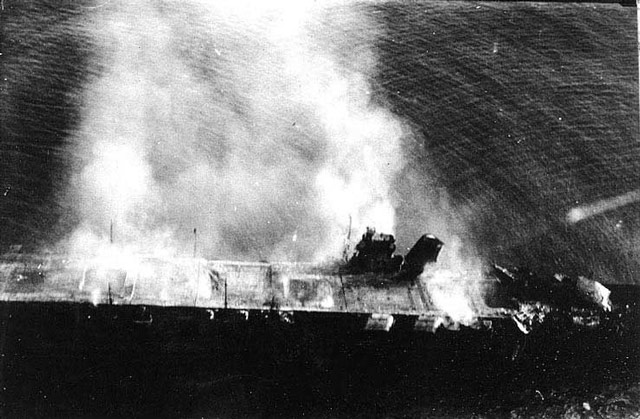
Hiryu sinking 5 June 1942 worldwartwo.filminspector.com
"Japanese aircraft carrier Hiryu ("Flying Dragon") burning shortly after sunrise on 5 June 1942, a few hours before she sank. Photographed by a plane from the carrier Hosho. Note collapsed flight deck at right. Part of the forward elevator is standing upright just in front of the island, where it had been thrown by an explosion in the hangar." It is Admiral Yamaguchi's funeral pyre. (US Naval History and Heritage Command NH 73064).

Battle of the Pacific: Admiral Chester Nimitz takes the unusual step of announcing the results of the Battle of Midway to the press on 5 June 1942 even as the battle continues. It is clear to everyone that this has been a complete debacle for the Japanese. It can only get worse for them now that the U.S. Navy has an overwhelming advantage due to the sinking of the four Japanese aircraft carriers.

Following the 4 June destruction of the four Japanese fleet carriers, Midway Island's defenders receive a vague report at 04:15 from the submarine USS Tambor (Cdr John Murphy), first sent to Hawaii, that the remaining Japanese fleet is approaching. Murphy later makes a half-hearted attack run on the ships, but misses. Upon receiving the report from Pearl, the island's defenders quickly launch eight B-17 bombers from Eastern Island, but the crews cannot spot anything in the early morning haze.

At 06:30, another report comes in from a Midway-based PBY Catalina that it has sighted "2 battleships" heading away from the island. A follow-up message says "Ships damaged, streaming oil." Marine Aircraft Group 22 then sends up two flights VMSB-24, six Dauntlesses (Capt. Marshall A. Tyler) and six Vought SB2U Vindicators (Captain Richard E. Fleming). The "battleships" turn out to be heavy cruisers Mikuma and Mogami. They are streaming oil because they collided during the night. The planes spot the oil slick, which allows them to zero in on the cruisers.

Admiral Yamaguchi's last moments 5 June 1942 worldwartwo.filminspector.com
"Last moments of Admiral Yamaguchi," war art painting by Kita Renzo. "Rear Admiral Tamon Yamaguchi, commander of the Japanese Carrier Striking Force's Carrier Division Two, elected to remain aboard his flagship Hiryu when she was abandoned during the early morning of 5 June 1942. He is depicted here in the middle of the scene as he bids farewell to his staff." Naval History and Heritage Command SC 301067


Tyler and his men attack Mogami but only score some near misses. Fleming then dives on Mikuma from out of the sun. Fleming does not survive - there is contradictory evidence whether his plane crashes into the Mikuma or the water nearby. The attack starts a fire that kills the men in Mikuma's engine room.

With the Mikuma crippled, eight B-17s (Lt. Col. Brooke Allen) then attack Mogami, but only score some near misses. Mikuma and Mogami ten head westward to escape, with Mikuma eventually sinking on the 6 June. Late in the day, Admiral Yamamoto orders all ships in the vicinity of Midway to retire. Japanese destroyers scuttle blazing carriers Hiryu and Akagi early in the day. The leader of the carrier force, Rear Admiral Tamon Yamaguchi, having lost his entire command, refuses to leave Hiryu and goes down with the ship.

For his heroism in leading the successful attack on Mikuma, U.S. Marine Richard Eugene Fleming will be posthumously awarded the Medal of Honor, the highest U.S. military decoration. President Franklin D. Roosevelt gives it to his mother on 24 November 1942.

To the northeast of Midway, Admiral Raymond Spruance, in charge of the combined task force 16 that includes aircraft carriers USS Enterprise and Hornet, seeks out but cannot find the Japanese surface fleet. Late in the day, he sends out scout planes, but they narrowly miss spotting Admiral Nagumo's main fleet. They do spot a destroyer and attack it, but miss. The planes return after dark, and the carrier crews must turn on their lights for the planes to land.

Spruance is extremely put out at the unacceptably vague report from submarine Tambor early in the day because it is vague and unhelpful. He also is upset at Commander Murphy for a lack of aggressiveness in not attacking the ships he spotted. He will have Murphy relieved of his command when Tambor returns to Pearl Harbor.
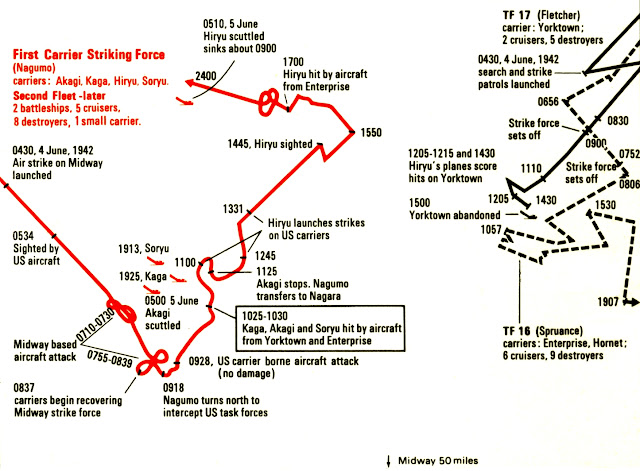
Map of Battle of Midway 5 June 1942 worldwartwo.filminspector.com
Map of the Battle of Midway 4-5 June 1942 (Onwar.com).

Rear Adm. Robert A. Theobald, in command of Task Force 8, which has been stationed uneventfully about 400 miles south of Kodiak Island in the Aleutians, receives a report of enemy warships in the Bering Sea. The report states that they are heading south toward Unalaska Island. Theobald sends his task force, which has no aircraft carriers, to investigate.

Intended U.S. air attacks using land-based bombers fail due to weather conditions. While six B-17 Flying Fortresses do report bombing enemy shipping, it turns out that in the hazy conditions they actually bomb some uninhabited islands (Pribilof Islands). While all these failed air attacks are going on, the Japanese order 1200 men of the Adak-Attu Occupation Force under Rear Admiral Omori Sentaro to proceed toward Attu for a landing on the 6th.

In reality, the Japanese force near the Aleutian Islands under the command of Vice Adm. Boshiro Hosogaya is moving south, but only to join Admiral Yamamoto's remaining fleet in the general vicinity of Midway Island. They are to join Yamamoto's forces in a desperate effort to lure the U.S. Navy carriers into surface combat. However, late in the day, Yamamoto decides that this plan will not work and sends Hosogaya back north to complete the landings in the western Aleutians. The Japanese high command in Tokyo dispatches two aircraft carriers from Japan to reinforce Hosogaya. Their hope is that the U.S. carriers might try to intervene in the Aleutian Island landings and be destroyed.

USS Yorktown remains afloat, though listing badly. At great hazard, a salvage party of 29 officers and 141 enlisted men board the sinking ship to see if anything can be done to save it. After the damage it has taken from multiple strikes, it is amazing that Yorktown still floats.

U.S. Navy submarine Pompano torpedoes and damages Japanese 131-ton guard ship Sumiyoshi Maru No. 8 off Truk Island. The entire crew survives by transferring to nearby ship Shoko Maru.

The Fifth Air Force sends B-17s to bomb a coal jetty, wharves, and a warehouse at Rabaul.
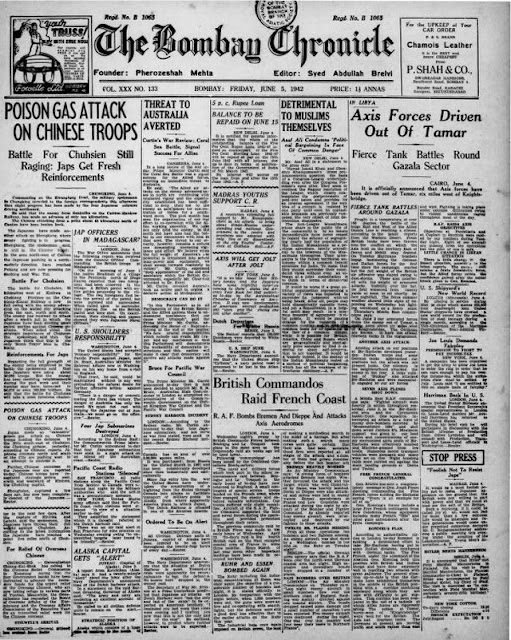
Bombay Chronicle 5 June 1942 worldwartwo.filminspector.com
The 5 June 1942 Bombay Chronicle headlines "Poison Gas Attack on Chinese Troops."

Battle of the Indian Ocean: There is a lot of Japanese naval activity off the west African coast today. The Japanese high command has sent a large force of submarines and other vessels to the vicinity of Madagascar in an attempt to decimate the British Far Eastern Fleet, and today that concentration of power pays off for them.

Japanese armed merchant cruisers Hokoku Maru and Aikoku Maru, operating 350 nautical miles (650 km) northeast of Durban, shell and sink 6757-ton British freighter Elysia. There are 22 dead. Elysia takes four days to sink. Hokoku Maru and Aikoku are there primarily to resupply the large number of Japanese submarines in the area.

Off the coast of Mozambique in the Mozambique Channel, Japanese submarine I-10 gets two successes. It sinks 2639-ton Panamanian freighter Atlantic Gulf (2 dead), and also 4999-ton US armed freighter Melvin H. Baker. British freighter Twickenham rescues the crew of Melvin H. Baker.

Japanese submarine I-20 torpedoes and sinks 5086-ton Panamanian freighter Johnstown off Mozambique. There are two deaths.
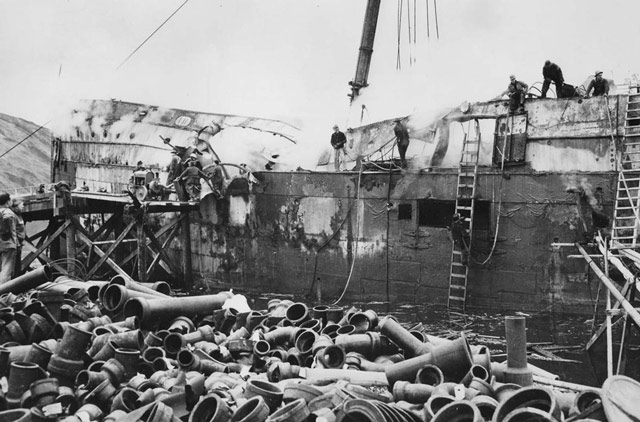
Dutch Harbor 5 June 1942 worldwartwo.filminspector.com
A damaged U.S. ship at Dutch Harbor following Japanese air attacks, Alaska, on 5 June 1942.

Eastern Front: In the Crimean Peninsula, General Erich von Manstein prepares to launch his long-awaited attack on the Soviet holdouts at Sevastopol. His 11th Army has LIV Corps to the north, 30th Corps (General Maximilian Fretter-Pico) to the south, and Romanian Mountain Corps 3 (General de divizie Gheorghe Avramescu) to the east. 

The Luftwaffe (Generaloberst Wolfram Freiherr von Richthofen) attacks throughout the day, as do 700 large German artillery pieces. Manstein's 203,800 men, including 65 Sturmgeschütz III self-propelled assault guns, oppose 118,000 Red Army troops holding the port. Today, the German bombardment, which has been rotating each day, shifts to the northern Red Army defensive line facing LIV Corps.

Fw. Anton "Toni" Hafner of 8./JG 51 claims 7 Soviet planes today to bring his score to 43 victories.

European Air Operations: It is a very hot day with some ground haze. The RAF engages in mostly convoy patrols with a few going along the French to Dutch coasts. RAF No. 141 Squadron pilot Warrant Officer Hamar shoots down a Dornier Do 217 E 20 km west of Leiden.
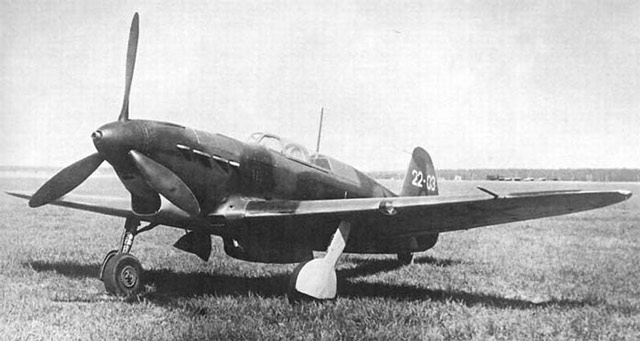
Yak-7B prototype 5 June 1942 worldwartwo.filminspector.com
Yakovlev Yak-7B prototype no.22-03 during trials in June 1942. It will become a useful close support fighter that serves first with the 42nd Fighter Aviation Regiment (IAP) at the North-Western front and then at Stalingrad and in the Caucasus.

Battle of the Atlantic: U-68 (KrvKpt. Karl-Friedrich Merten), on its fourth patrol out of Lorient, torpedoes and sinks 6693-ton U.S. tanker L.J. Drake in the Caribbean southeast of Santo Domingo. Merten uses three torpedoes, all of which hit and create a huge fireball. All 41 men aboard perish.

U-172 (Kptlt. Carl Emmermann), on its second patrol out of Lorient, torpedoes and sinks 3480-ton US freighter Delfina 130 miles northwest of San Juan, Puerto Rico. Emmerman has to follow the freighter for seven hours, during which he misses the ship with three torpedoes (due to malfunctions, not poor aim). The ship sinks within 20 minutes. There are four dead and 27 survivors, some of whom make landfall at Montecristi, Dominican Republic, and others are quickly picked up by US patrol boat USS YP-67.

U-94 (Oblt. Otto Ites), on its ninth patrol out of St. Nazaire, uses its deck gun and sinks 320-ton Portugues three-masted sailing ship Maria da Glória in codfish fishing grounds off Greenland. Ites does not see any markings so assumes it is an enemy vessel. Once the ship raises the Portuguese flag, Ites stops shooting, but it is too late for the ship. Once the crew abandons the ship, Ites resumes firing and sinks it. There are 36 dead and 8 survivors.

U-159 (Kptlt. Helmut Friedrich Witte), on its second patrol out of Lorient, uses its deck gun against 265-ton Brazilian sailing ship Paracury southeast of Santo Domingo in roughly the same area as where U-68 sinks L.J. Drake. The seas are rough, so the U-boat uses its 20mm anti-aircraft gun to punch holes in the waterline, causing it to capsize. Casualties are unknown. The ship remains afloat long enough for someone to find it, salvage it, and return it to service.
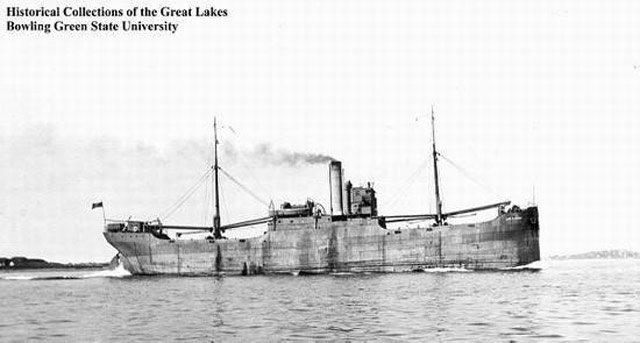
US freighter Velma Lykes, sunk 5 June 1942 worldwartwo.filminspector.com
U.S. freighter Velma Lykes, sunk on 5 June 1942 by U-158 in the Caribbean (Bowling Green State University).

U-158 (Kptlt. Erwin Rostin), on its second patrol out of Lorient, torpedoes and sinks 2572-ton U.S. freighter Velma Lykes off Puerto Juarrez, Yucatan Peninsula, Mexico. The ship sinks within one minute. There are 15 dead and 17 survivors, who cling to rafts and are picked up on the 6th by freighter Ardenvorhr after being spotted by a Catalina. The men of the Velma Lykes have further troubles when U-68 torpedoes and sinks their rescue ship, but they all survive that sinking, too.

British 1798-ton freighter Sonja Maersk runs aground and sinks off Ketch Harbor, Nova Scotia, due to heavy fog. There are no casualties.
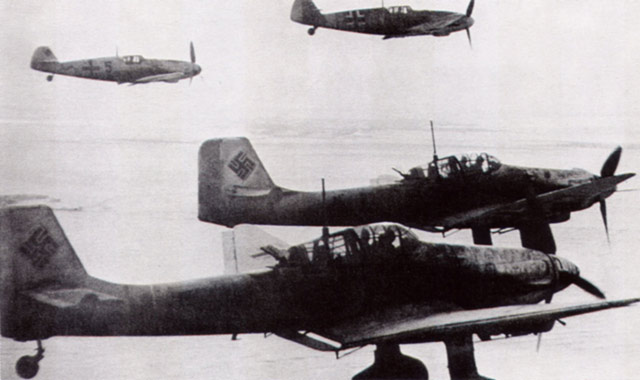
Stukas and Bf 109s June 1942 worldwartwo.filminspector.cmo
Messerschmitt Bf 109F4 JG5 Black 1 and 5 escorting Ju 87 Stukas of SG5.1 in Russia, June 1942

Battle of the Mediterranean: The land battle in Libya has been deadlocked for a week, and today the British Eighth Army decides to do something about it. General Neil Ritchie's forces launch Operation Aberdeen, an attempt to encircle German General Erwin Rommel's forces in "the Cauldron." Rommel's forces, meanwhile, still encircle the Free French outpost at Bir Hakeim.

The Axis forces in the Cauldron, however, have had time to prepare killing zones with their tanks and anti-tank gun positions. The British make no progress with their early-morning attacks from the north and only slight progress by the 7th Armoured and 5th Indian divisions from the east. The British 32nd Army Tank Brigade in the north loses 50-70 tanks.

Rommel, fortified by the morning success against the British tanks, reacts quickly. In the afternoon, he splits his forces, counterattacking east toward Bir el Hatmat with Ariete and 21st Panzer divisions and to the north with elements of the 15th Panzer Division. The attack to the east has great success, forcing the headquarters of two British divisions, two brigades, and others to flee in a panic. This effectively decapitates the British response. The 15th Panzer attack to the north also has success, forcing the 22nd Armoured Brigade back with a loss of 60 of its 156 tanks. This turns into a wild retreat in which the British abandon three Indian infantry battalions, a reconnaissance regiment, and four artillery regiments to be captured. The front then settles down for the night.

At Bir Hakeim, the surrounded  Free French remain safe within their fortifications but are running out of supplies such as food and water. The Desert Air Force flies cover overhead to disperse Luftwaffe attacks, but Axis artillery continues to batter away at the fort. The German 90th Light Division prepares to attack the fort on 6 June using pioneers to clear the minefields around it.

Convoy WS-19Z, which carries Force X, sails from the Clyde for Gibraltar. This is the prelude to Operation Harpoon, or the Battle of Pantelleria, when an eastbound convoy sailing from Gibraltar will pass a westbound convoy out of Alexandria (Operation Vigorous) in mid-June. Unknown to the Allies, who have been reading German codes with Operation Ultra, the Italian military intelligence service (Servizio Informazioni Militare) has broken the U.S. code being used in the Mediterranean. The Axis thus has an early warning of these two joint operations due to communications made by the U.S. Military Attaché in Egypt, Colonel Bonner Fellers.
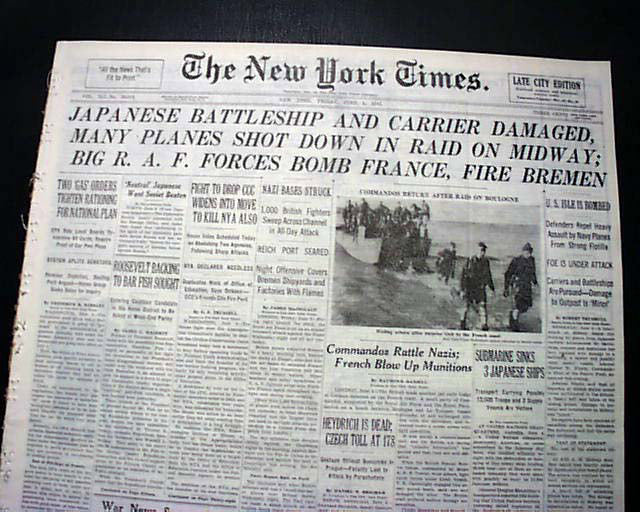
NY Times headlines June 1942 worldwartwo.filminspector.cmo
For once, the U.S. media actually downplays the real war news. The 5 June 1942 NY Times headlines that "Japanese Battleship and Carrier Damaged" when, in fact, the Japanese have lost four carriers. However, the truth comes out today as Admiral Nimitz lists the real successes at the Battle of Midway.

US/Axis Relations: The United States declares war on Bulgaria, Hungary, and Romania. Relations also now are strained with Finland due to its hosting Adolf Hitler to celebrate Marshal Mannerheim's 75th birthday on 4 June.

US Military: General Brehon B. Somervell, commander of the Army Service Forces, completes an inspection of US forces in Northern Island.

Two Douglas A-24 Dauntless dive bombers collide at Charters Towers, Queensland, Australia at 1000-1500 feet during a training flight. Three of the four men survive by parachuting out, but pilot 2nd Lt. Norman J. Davidson, whose plane was hit by the other plane's propeller from underneath, perishes.
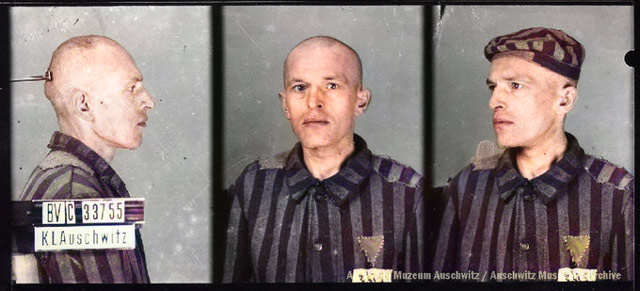
Auschwitz victim June 1942 worldwartwo.filminspector.cmo
Sloveč cabman Vaclav Novotny perishes in Auschwitz on 5 June 1942. Auschwitz Memorial (colorized).

Holocaust: Train Convoy No. 2 deporting people from France departs today for the East. The edict authorizing this train specifies that it should "deport Communists, Jews and anti-social elements to the East, in retaliation." Helmut Knochen (March 14, 1910 – April 4, 2003), the senior commander of the Sicherheitspolizei (Security Police) and Sicherheitsdienst in Paris, oversees the operation. SS Captain (Hauptsturmführer) Theodor Dannecker, leader of the Judenreferat at the SD office in Paris, has composed the list of deportees. 

This batch is composed of about 1000 mostly Jewish men aged 18 to 54, primarily Poles who fled the occupation there. They were arrested at Drancy, Beaune-la-Rolande, and Pithiviers and then taken to Compiègne between 14 May and 20 August 1941. Many of these men have been found unfit for work. Of these men, roughly 800 are taken to Auschwitz and are dead within ten weeks.
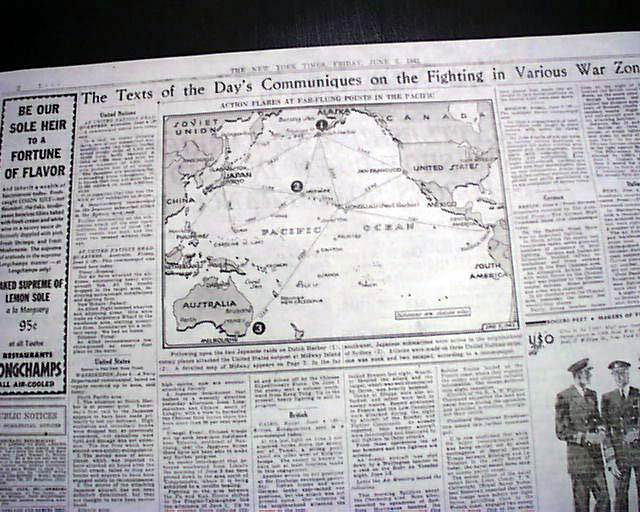
Map of Pacific battles in NY Times 5 June 1942 worldwartwo.filminspector.cmo
A war map in the 5 June 1942 NY Times helpfully shows American readers where the sites of three recent battles in the Pacific, at Midway, Sydney, and the Aleutians, are.

British Homefront: King George VI publishes his 1942 Birthday Honours. This involves various awards, rewards, appointments, and bestowing of honors. Among many other announcements, the economist John Maynard Keynes is made a Baron, filmmaker Alexander Korda is made a Knight Bachelor, and RAF Air Chief Marshal Charles Portal is awarded the Knight Grand Cross of the Order of the Bath (GCB).

American Homefront: Former child actress Virginia Lee Corbin, known at the start of her career as Baby Virginia Corbin, passes away at the age of 31 in Chicago, Illinois from tuberculosis. She is one of many silent film actors unable to transition to the talkies and retired shortly before her death. 
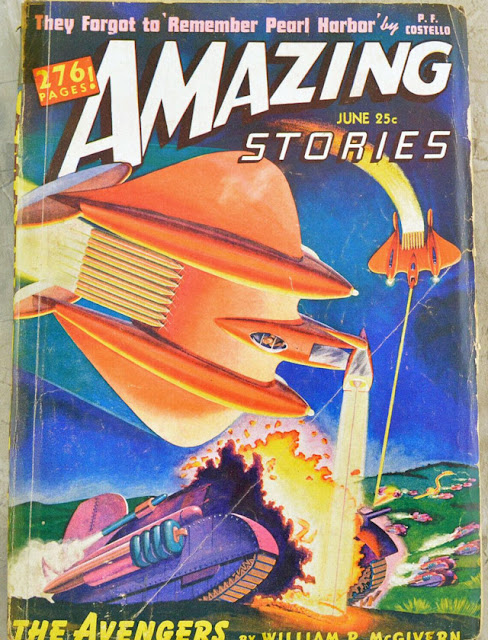
Amazing Stories June 1942 worldwartwo.filminspector.cmo
This June 1942 edition of Amazing Stories features the short story "The Avengers" by William P. McGivern. Hey, whatever happened to them? Actually, these Avengers are different than the Stan Lee ones, which debuted in Avengers #1 issued September 1963.


2021

Tuesday, October 5, 2021

June 4, 1942: Japanese Lose Four Carriers to One U.S. Carrier

Thursday 4 June 1942

USS Yorktown sinknig 4 June 1942 worldwartwo.filminspector.com
"The U.S. Navy aircraft carrier USS Yorktown (CV-5) lists heavily after she was abandoned during the afternoon of 4 June 1942. Note that two Grumman F4F-4 Wildcat fighters of Fighting Squadron 3 (VF-3) are still parked on her flight deck, aft of the island." Naval History and Heritage Command 80-G-21666.

Battle of the Pacific: Japan loses three aircraft carriers on 4 June 1942 during one of the pivotal days of World War II.

The day begins with the Japanese Fleet approaching Midway Island and three U.S. Navy aircraft carriers, unknown to the Japanese, waiting for them to the northeast of the island. Reveille on Midway sounds a 03:00, with battle stations ordered. At 04:00, six F4F Wildcats of VMF-221 (Major Floyd B. “Red” Parks) take off, followed by 11 PBY Catalinas of VP-44. In addition, 16 B-17 bombers get in the air, ready to bomb the Japanese.

Initial Japanese Carrier and Midway Island Aircraft Attacks

On the Japanese side, Vice Admiral Chuichi Nagumo’s First Striking Force, composed of fleet carriers Akagi, Kaga, Hiryu, and Soryu, begin launching their aircraft at 04:30. By 04:45, 36 Nakajima B5N2 Kate torpedo bombers, 36 Aichi D3A1 Val dive bombers, and 36 Mitsubishi A6M2Zero fighters were on their way to Midway.

A U.S. pilot, Lieutenant Howard P. Ady, spots the approaching Japanese planes at 05:30 and gets off a detailed radio report. Radar on Midway picks up the Japanese planes at 05:53. This alerts the defenders, who rush to man their positions. Twenty-one Buffalo fighters, six Wildcats, six TBFs, and four B-26 bombers follow suit, along with all available dive bombers. Every one of the 66 planes based at Midway is in the air by 06:16.

The Buffaloes and Wildcats intercept the approaching Japanese bombers. The Japanese Zeros make quick work of the first six Buffaloes, destroying all but one that barely limps back to Midway. The Zeroes then begin picking off the remaining Buffaloes, opening a path for their bombers, losing three Kate bombers in the process.
Midway Island fires, 4 June 1942 worldwartwo.filminspector.com
Oil tanks burning on Midway Atoll after the Japanese attack, 4 June 1942. Note the birds in the foreground. (US National Archives).

At 06:31, the Japanese are over Midway Island and the anti-aircraft guns on the island open fire. The Kate bombers destroy three oil tanks and set fire to a seaplane hanger while losing two of their number. Val dive bombers attack the airfield, killing four mechanics and setting off eight 100-lb bombs and some .50-caliber ammunition. The island's electricity goes out when a Val bombs Eastern Island's powerhouse. This causes a real interruption of the island's water supplies, as opposed to the fake problem radioed by Midway Island in May that enabled U.S. Navy cryptographers to pinpoint Midway as the Japanese objective.

The attack is over by 06:48, and the all-clear sounds at 07:15. Only six Buffalo fighters make it back to the island and only 20 of the original force of U.S. fighter planes. They are almost all badly damaged, with one Buffalo and one Wildcat still serviceable. Casualties on the ground are 11 dead and 18 wounded.

Meanwhile, Midway's own bombers find the Japanese carriers and launch their own attack at 07:10. Six TBFs attempt a torpedo run but five are shot down by defending Zero fighters. Only one TBF launches its torpedo at a cruiser and then barely makes it back to the island.

Four B-26 Marauder bombers then attack. Two get within 850 yards and 450 yards, respectively, of carrier Akagi and launch their torpedoes.  Only two of the Marauders survive the defending fighters. The torpedo attacks have done one thing extremely well, however, in that they have drawn the defending fighter cover down to sea level.

At 07:48,  sixteen Dauntless and Vindicator dive bombers of VMSB-241 (Major Lofton Henderson) arrive at the scene and begin their attacks. The fighters quickly get up to 4000 feet and begin shooting down the arriving planes, but there is enough cloud cover for the U.S. planes to evade most of the attacks. The Zeros shoot down Henderson's Dauntless, but ten get through to drop their bombs at low altitude. The planes then return to Midway, losing eight SBDs in total and with only six making it back to base.

Next, 15 B-17 Flying Fortress bombers led by Lt. Col. Walter C. Sweeney arrive at 08:10, just as the Dauntlesses are completing their attacks. These bombers have no success, finishing their attack by 08:20 and returning to Midway.

Just as the B-17s are completing their bomb runs, 11 Vindicators (Major Benjamin Norris) arrive and are immediately swarmed by Zero fighters. They attack battleship Haruna, losing two planes to anti-aircraft fire and three others on the way back to Midway. These attacks also completely fail.
A damaged Douglas SBD, 4 June 1942 worldwartwo.filminspector.com
A battle-damaged SBD from carrier USS Enterprise on the flight deck of carrier USS Yorktown after having to land there due to fuel exhaustion, 4 June 1942 (US Naval History and Heritage Command).

At this point, in mid-morning, the U.S. attacks have achieved no hits on the Japanese ships despite a wave of attacks. They have lost 19 planes, and only six Dauntlesses, seven Vindicators, one Buffalo, and a single Wildcat remain usable on Midway. The Japanese essentially have beaten the defenders of Midway Island and it is ripe for invasion.

However, the presence of three U.S. Navy aircraft carriers (USS Yorktown, Enterprise, and Hornet) remains unknown both to the island's defenders and to the Japanese. Admiral Nagumo is convinced that he has defeated the Americans, so he throws caution to the winds and has his reserve force armed with contact bombs for use against land targets to soften the island's defenders up for his invasion.

However, midway through this process, at 07:40, a scout plane from cruiser Tone reports that it has sighted a U.S. fleet to the east. Critically, the pilot does not mention that there are any aircraft carriers, and the report does not reach Nagumo until 08:00. He immediately orders the bombs changed to general-purpose bombs. 
 
Massive confusion now overcomes the Japanese commanders. Nagumo knows he has must recover his planes from the morning strike against Midway Island before launching any attacks on the U.S. ships, which he thinks are almost all non-carriers (the Tone pilot eventually reports seeing only one carrier). Bringing up his reserve planes from the hangar to the flight deck and launching them would take 30-40 minutes, and the strikes still would go off in a ragged fashion. Torn between sending an immediate strike or recovering his planes from the Midway raid, Nagumo ultimately decides on the latter. This also would give his crew time to arm the reserve planes with torpedoes.
An SBD ditches, 4 June 1942 worldwartwo.filminspector.com
"U.S. Navy LCdr Maxwell F. Leslie, commanding officer of Bombing Squadron 3 (VB-3), ditches his Douglas SBD-3 Dauntless next to the heavy cruiser USS Astoria (CA-34) after successfully attacking the Japanese carrier Soryu during the Battle of Midway, 13:48 hrs, 4 June 1942." Naval History and Heritage Command 80-G-32307.

U.S. Navy Carrier Attacks

Meanwhile, on the U.S. Navy side, there is no indecision at all. Admiral Frank Fletcher launches his planes beginning at 07:00 and completes this by 07:55 for Enterprise and Hornet and by 09:08 for Yorktown. The planes are well on their way toward the Japanese ships while Nagumo is making up his mind.

The U.S. carriers are roughly 155 nautical miles (287 km, 178 miles) from the Japanese carriers at launch. The planes from Enterprise and Hornet do not form up, but instead, fly piecemeal toward the targets. Some of the planes follow an incorrect heading and miss the carriers, having to ditch, but one formation of TBD Devastator torpedo bombers (Torpedo Squadron 8, or VT-8 (Lt Cdr John C. Waldron) heads on the correct heading.

Waldron's planes arrive over the Japanese carriers at 09:20 and immediately attack. Unfortunately, they have no fighter escort and the defending Japanese Zeros shoot down all 15 Devastators before they can make any hits (one ensign survives after launching a torpedo that misses carrier Sōryū).

At 09:40, VT-6 from Enterprise, composed of 14 Devastators, arrives and attacks. It fares only a little better, losing nine planes without any hits. At 10:10, another wave of Devastators (VT-3 from Yorktown) arrives and 10 of these 12 planes also are shot down. So far, the defending Japanese combat air patrol is having a field day and the Japanese fleet remains unscathed despite all the attacks. Zero fighters clearly outclass the obsolete U.S. Navy torpedo bombers. Another problem for the attackers is that their torpedoes seem surprisingly ineffective given how close some of the planes get to the carriers.

However, everything is not as it seems. As in the earlier attacks, the torpedo attacks have drawn the defending Zeros down to sea level. The carriers, meanwhile, have had to execute extreme maneuvers to evade the torpedo attacks and are out of position. Furthermore, the defending fighters are low on fuel and ammunition.
A Wildcat takes off from USS Yorktown, 4 June 1942 worldwartwo.filminspector.com
Lt. (jg) William Leonard’s F4F-4 Wildcat taking off from carrier USS Yorktown during Battle of Midway, 4 June 1942 (US National Archives).

The stage is now set for one of the epic attacks in naval history.

Air Group Commander C. Wade McClusky, Jr. from Yorktown commands three dive-bomber squadrons from U.S. carriers (VB-6, VS-6, and VB-3). McClusky knows his SBD dive bombers are running low on fuel due to heading on the incorrect course. However, he does not give up looking and by chance spots a lone Japanese destroyer sailing toward the Japanese fleet and pointing at it like an arrow. The planes are so low on fuel that some have to ditch before they make it to the Japanese carriers.

However, fortune smiles on McClusky. He splits his planes up to attack carriers Kaga and Akagi. Despite some confusion and miscommunication, the dive bombers attack both carriers within minutes of each other. Basically, Kaga is attacked by two squadrons of dive bombers while Akagi is attacked by one.

It is at this point that the Japanese luck runs out. Their defensive aircraft are out of position, the carriers are full of planes being fueled and armed, and the carriers themselves are poorly protected by their accompanying ships because of the evasive maneuvers they have been forced to make to evade torpedo attacks.

Three to five 500-lb bombs hit their mark on Kaga, starting fires and hitting the bridge, killing Captain Jisaku Okada and most of Kaga's senior officers. This leaves the ship leaderless and out of control. The carrier deck tears and bends into the air, exposing the hangar deck and its fueling aircraft to more bombs.
The End of Akagi, 4 June 1942 worldwartwo.filminspector.com
"The End of Akagi." Painting by John Hamilton (1919-1993), original is displayed in The Pentagon, Washington, D.C.

Due to miscommunication, only three dive-bombers led by Lieutenant Richard H. Best, who has decided not to attack Kaga because it is blowing up, attack Akagi. The bombers have unbelievable luck, as there is almost no defensive fire. One of the bombs hits the edge of the mid-ship elevator and penetrates to the hangar deck, where it explodes. The armed and fueled aircraft there detonate in a fireball, creating an explosion that rips the interior of the carrier apart. The crew has no hope of bringing the raging inferno under control.

VB-3 (Max Leslie) sees Kaga and Akagi blowing up and, still armed, now turns its attention toward a third carrier, Sōryū. They achieve at least three hits, igniting the gasoline being used to fuel the planes and detonating ammunition as with the other two carriers. VT-3 attacks the fourth carrier, Hiryū, but has no luck.

The fires on Akagi, Sōryū, and Kaga seal their fates. The fires expand and cause more bombs and fuel to explode and burn. Admiral Nagumo leaves Akagi and transfers his flag to light cruiser Nagara. The Japanese give up on all three carriers and scuttle them.
USS Yorktown sinking, 4 June 1942 worldwartwo.filminspector.com
USS Yorktown listing and about to sink, 4 June 1942 (US Navy).

Japanese Counterattack

With three of his four carriers gone, Nagumo orders Hiryū to launch its own immediate attack on the U.S. carriers with whatever is available. It sends 18 D3A Vals and six fighter escorts, a relatively small attack considering the forces battling earlier but the most the Japanese fleet can now muster. The planes follow the retreating U.S. planes back to their carriers and immediately attack when within range. The dive bombers sight Yorktown first and attack it, hitting it with three bombs. The Japanese lose 13 dive bombers and three fighters in this attack.

The damage does not seem too bad at first, with all but one boiler put out of operation and a hole in the flight deck. However, it is bad enough for Fletcher to transfer his own flag to heavy cruiser Astoria.

Yorktown's crew works quickly. They patch the flight deck and get several boilers back in operation within an hour. Soon, Yorktown is steaming at 19 knots (22 mph, 35 km/h) and everything seems under control. It resumes air operations and Captain Buckmaster gets a little cocky, hoisting a huge American flag from the foremast and returning operations to normal.

An hour later, the second wave of Hiryū planes arrives. This is composed of ten Nakajima B5N torpedo bombers and six escorting Zeros. Again, this is not much of an attacking force, but the U.S. defense are strained from the earlier attacks and they hit Yorktown with two torpedoes. The Japanese lose five more bombers and two Zeroes in this attack. Yorktown is left afloat but in very poor condition.

The few Japanese planes that make it back to Hiryū report having sunk two U.S. carriers. They mistakenly believe that the first and second waves attacked different carriers, when, in fact, both hit Yorktown. Nagumo believes that if he can launch one more coordinated attack, he can sink the third and last U.S. carrier, leaving him with the sole remaining carrier near Midway and able to complete the invasion of the island.
Map of Battle of Midway. 4 June 1942 worldwartwo.filminspector.com
The general outline of the Battle of Midway. Source: United States Military Academy, Department of History.

The Final U.S. Counterattack

Fletcher and Admiral Spruance, in tactical command of Enterprise and Hornet, are ready to launch their own attack on Hiryū, but first they have to know where it is. Fortuitously, a Yorktown scout plane sights it late in the afternoon and the Enterprise immediately gets a strike force in the air. It is composed of 24 dive bombers (six SBDs from VS-6, four from VB-6, and 14 of VB-3 recovered from Yorktown.

The 24 dive bombers finish the day's work by blowing through the defending 12 Zero fighters and hitting Hiryū with four or five bombs. The same pattern as earlier repeats, with the bombs setting the Japanese carrier ablaze and the fires quickly getting out of control. The damage is so obviously bad that a later raid by Hornet's aircraft decides to skip Hiryū and attack other ships, though with no success.

All four Japanese carriers are now flaming wrecks and must be scuttled (Akagi, Kaga, Soryu) or sink unaided (Hiryū). On the U.S. side, the only carrier that has been hit is Yorktown, but, following the two torpedo strikes, it now is a total loss. The crew abandons ship and it, too sinks. That leaves the score at one U.S. Navy carrier lost to all four Japanese carriers sunk. The U.S. still has two carriers completely undamaged and incorporating planes recovered from Yorktown in addition to their own.

As night falls, the Japanese ships attempt to find the U.S. ships and bring them to battle. Spruance, now in command of operations because Fletcher cannot command from a cruiser, decides the better part of valor is a hasty retreat to the east. The day ends with Yamamoto's heavy ships chasing the U.S. carriers to the east but never spotting them.
USS Enterprise operating at flank speed. 4 June 1942 worldwartwo.filminspector.com
"The U.S. Navy aircraft carrier USS Enterprise (CV-6) steaming at high speed at about 0725 hrs, 4 June 1942, seen from USS Pensacola (CA-24). The carrier had launched Scouting Squadron Six (VS-6) and Bombing Squadron Six (VB-6) and was striking unlaunched SBD aircraft below in preparation for respotting the flight deck with torpedo planes and escorting fighters. USS Northampton (CA-26) is in the right distance, with SBDs orbiting overhead, awaiting the launch of the rest of the attack group." Naval History and Heritage Command 80-G-32225.

Aleutians Campaign

Things go much better for the Japanese further north.

Following a successful raid on Dutch Harbor in the Aleutian Islands on 3 June, Japanese Vice Adm. Boshiro Hosogaya sends off a second raid from his carriers Junyō and Ryūjō. The attacking planes get through again, destroying oil storage tanks and damaging a hospital and a beached barracks ship. U.S. Navy Task Force 8, under the command of Rear-Admiral Robert A. Theobald, is nearby but does not intervene. Only late in the day do U.S. forces locate the two light Japanese carriers, but their attempts to sink them fail due to poor weather. The weather does help the Americans, though, because it causes the Japanese to cancel plans to invade Adak Island. Instead, they now plan only to land troops at Attu and Kiska. U.S. 3094-ton passenger/barracks ship Northwestern, bombed and damaged during the 3 June raid, is declared a total loss.

U.S. 15-ton halibut schooner King Fisher sinks from unknown causes five nautical miles (9.3 km, 5.8 miles) off Lazaroff Island and Pilot Point, Alaska. There are one survivor and three dead, the survivor rescued by a U.S. Navy patrol boat.

I-27 torpedoes and sinks 3353-ton Australian iron-ore carrier Iron Crown in the Bass Strait. There are 37 deaths. This sinking, combined with one on 3 June by I-24, convinces the Australian authorities to restrict shipping north of Melbourne until they can institute a convoy system on the east coast.

Battle of the Indian Ocean: HMS Trusty (Lt. Cdr. E. F Balston) torpedoes and sinks the 7031-ton Japanese merchant cargo ship Toyohashi Maru in the Strait of Malacca. Casualties are not recorded.

The Tenth Air Force sends two heavy bombers to attack Rangoon, Burma. The ten defending Japanese fighters shoot down one of the bombers and badly damage the other. This is the last raid on Rangoon for some time, as the monsoon rains ground the heavy bombers on their dirt runways.

The 11th Bombardment Squadron (Heavy), 7th Bombardment Group (Heavy) is established with B-25 bombers at Kunming, China.
Mannerheim, Hitler, and Ryti. 4 June 1942 worldwartwo.filminspector.com
Field Marshal Carl Mannerheim, Adolf Hitler, and Finnish President Ryti walk to Mannerheim's command train parked in a forest, 4 June 1942 (Finnish Military Museum SA-Kuva).

Eastern Front: At Sevastopol, the Wehrmacht bombardment continues unabated. The rolling barrage shifts today to the line facing the Romanian troops in the east. the Luftwaffe remains very active, flying hundreds of sorties.

Overall, it is a quiet day on the Eastern Front. With Hitler away and nothing going on, General Franz Halder doesn't even bother listing a daily summary in his war diary, simply noting that he is flying to Berlin. When the Fuhrer's away, the mice will play.

Of much greater importance is what Adolf Hitler is doing. While seemingly an informal visit to a friend, it actually is a calculated attempt to shore up the Reich's fraying "co-belligerency" with Finland. The Finns are fighting the same enemy, the Soviet Union, but increasingly are refusing to engage in battles desired by the German high command. Hitler decides a little personal diplomacy is in order.
Hitler and Keitel walk to Mannerheim's command train. 4 June 1942 worldwartwo.filminspector.com
Adolf Hitler, followed by Field Marshal Keitel, "walks the plank" to Finnish Field Marshal Carl Mannerheim's command train. Mannerheim can be seen smirking in the background (SA-Kuva).

Hitler, seemingly on a whim and with only one day's notice, flies to Finland to wish Field Marshal Carl Mannerheim a happy birthday on 4 June 1942. It is Mannerheim's 75th birthday. The visit is a very rare journey outside the Reich for Hitler, who almost never leaves areas of German control. While Hitler does eventually establish a headquarters in the occupied Soviet Union and visited Vichy France in 1940, German troops are always nearby. Finland is a co-belligerent but by no stretch of the imagination is under German control except in isolated areas such as the far north.

Hitler is greeted warmly by Mannerheim and treated properly, but the visit causes the Finns a great deal of anxiety. For one thing, it complicates Finland's diplomatic relations with the United States, with whom Finland is not at war. Mannerheim purposefully does not greet Hitler at his headquarters, but rather says that he is "in the field" and that Hitler should visit him where his command train is parked, at Imatra in Southern Finland.

Hitler's Focke-Wulf Fw 200 Kondor flies across the Gulf of Finland in great secrecy. When it lands at the small Immola Airfield (about 9 kilometers (6 mi) northeast of Imatrankoski), hard use of the brakes causes an issue with the left landing gear. A fire breaks out, apparently caused by brake fluid spraying over the hot brakes. The Kondor is known to have poorly designed brake hubs, causing the brakes to lock sometimes. Fortunately for Hitler, the fire is quickly extinguished with a fire extinguisher, the damage is slight, and the aircraft is quickly repaired (new bolts are quickly manufactured and installed). Hitler completely ignores the incident and may, in fact, not even know about it.
Hitler, Keitel, Mannerheim, and Ryti. 4 June 1942 worldwartwo.filminspector.com
June 4, 1942. Dining in the train wagon: Adolf Hitler (left), Finnish Prime Minister Jukka Rangell, President Risto Ryti (back toward the camera), Finnish military commander, Marshal Carl Gustav Mannerheim (right). Source: Finnish Military Museum SA-Kuva.

There are some odd moments during the visit, which lasts much of the day. For one thing, Mannerheim has Hitler and Field Marshal Wilhelm Keitel walk a plank from a hillside to his command train. Both men navigate it without incident, but this could have ended in an embarrassing disaster. Another peculiar moment is when an SS officer bursts into the carriage where Hitler and Mannerheim (along with Finnish State President Risto Ryti and Keitel) are discussing strategy to inform them that Finnish intelligence has been taping their conversation with a hidden microphone. The microphone is located and disabled.

Fortunately for posterity, the 11-minute recording (on a phonograph record) survives the war despite Finnish assurances that it will be destroyed or remain sealed. It is rediscovered (mislabeled) and later released to the public. It is a rare recording of Hitler using his normal speaking voice, as opposed to the louder and more strident voice he uses during speeches. While there is some question whether the recording is genuine, an official investigation verified it.

During the conversation, Hitler confides why he invaded the Soviet Union. He says that he had nightmares of the Romanian oil fields, the source of most of the Reich's oil, "burning from end to end" due to Soviet attacks. To Hitler, Operation Barbarossa is a defensive operation to protect essential assets from a Soviet attack. He admits to being surprised by the Soviet ability to produce so many tanks.

Hitler leaves the meeting and flies back to Germany late in the day, blissfully unaware of the fateful events occurring in the Pacific.
Hitler arrives in Finland. 4 June 1942 worldwartwo.filminspector.com
Adolf Hitler arrives in Finland and is greeted by President Ryti on 4 June 1942. Hitler's Focke Wulf Fw-200 Kondor is in the background.

European Air Operations: The Luftwaffe engages in scattered bombing and mine-laying around Durham County, Yorkshire, and in general the northeast of England. The bombers show poor accuracy and drop bombs in fields west of Ryhope and at Tunstall Poultry Farm and the Turnstall Burdon District in Durham. Other bombs fall on a golf course and along the foreshore at Seaton Carew and Seaton Snooks. Many of these bombs are delayed-action bombs that must be handled by bomb experts and safely exploded. Other bombs fall in the riverside area near Sunderland. There are two men wounded and minimal damage, though an unexploded bomb does delay the loading of two coaling ships.

Both sides lose a plane over the Waddenzee today. The RAF shoots down a Junker Ju 88 over the Waddenzee 1 km south from Ameland Island. All four men aboard perish. Meanwhile, night-fighter pilot Oblt. Zur Lippe Weissenfeld of II/NJG 1 shoots down a British Wellington III from Marham on a raid to Bremen. All five crewmen perish.

Luftwaffe bombers attack and sink 555-ton British patrol boat HMY Sona (FY 027) off Poole Quay, Dorset, England. The ship poses a hazard to navigation, so it later is raised and sunk at Handfast Point.
USS Yorktown hit during the Battle of Midway. 4 June 1942 worldwartwo.filminspector.com
USS Yorktown (CV-5) immediately after an aerial torpedo hit, 4 June 1942. The sky is full of planes and anti-aircraft bursts (U.S. Navy).

Battle of the Atlantic: German raider Stier, operating 200 miles east of St. Paul's Rocks off the coast of Brazil, spots 4986-ton British freighter Gemstone. It fires a warning shot across the bow, but Gemstone does not stop. Instead, it heads directly away from Stier and tries to make a run for it. However, Stier does not give up and continues firing. Eventually, the Gemstone's crew abandons the ship, which is carrying iron ore. The Stier makes the crew prisoners of war and sinks Gemstone with a torpedo.

U-158 (Kptlt. Erwin Rostin), on its second patrol out of Lorient, torpedoes and sinks 2647-ton Norwegian freighter Nidarnes in the Yucatan Strait (southwest of Cuba). Nidarnes is carrying military stores to Brazil and sinks within a minute, with the 11 survivors (13 dead) having to literally jump for their lives as the ship goes under. Someone manages to launch a raft, which the survivors reach a few hours later. They are picked up later in the day by U.S. freighter Curaca.

German 7978-ton freighter Katharina Dorothea Fritzen hits a mine and sinks near Borkum. Casualties are not recorded.
Japanese carrier Hiryu dodges bombs. 4 June 1942 worldwartwo.filminspector.com
Japanese carrier Hiryu successfully evading bombs dropped by B-17 bombers early on 4 June 1942. The war in the Pacific proves the futility of using level bombers against agile ships. 4 June 1942 (U.S. Navy).

Battle of the Mediterranean: The two opposing field commanders in Libya, German General Erwin Rommel and British General Neil Ritchie, spend the day resupplying and preparing offensive operations. RAF Desert Air Force (DAF) fighters and fighter-bombers have a mixed day, scoring some success against Luftwaffe Junkers Ju-87 dive bombers and destroying some Axis vehicles, but losing seven planes.

The Free French troops under General Kœnig continue to hold out at Bir Hakeim, disrupting Rommel's plans to sweep east toward Tobruk. He is grateful for the support of the DAF, which is destroying Axis vehicles surrounding his fortress, so he sends Air Vice-Marshal Arthur Coningham the message, "Bravo! Merci pour la R.A.F" Coningham responds in kind, "Merci pour le sport." However, all is not rosy on the Allied side, as Kœnig's men are surrounded and running low on water and other supplies.

German submarine S-57 torpedoes and sinks 305-ton Royal Navy anti-submarine ship HMS Cocker off Tobruk, Libya. There are 15 dead and 16 survivors.

RAF aircraft torpedo and badly damage 6837-ton Italian freighter Reginaldo Giuliani 120 miles northeast of Benghazi. An Italian destroyer, Partenope, later scuttles it. Casualties are not recorded. 
Badly damaged aircraft at Midway Island. 4 June 1942 worldwartwo.filminspector.com
 The badly damaged aircraft of Lt(jg) Albert Earnest, the sole survivor of VT-8 during a morning attack on the Japanese Fleet, after landing at Midway (U.S. Navy).

Special Operations: Eight days after being wounded during an assassination attempt, Reinhard Heydrich dies in a Prague hospital. Heydrich for a time appeared to be improving, but lapsed into a coma on 3 June and never regained consciousness. The cause of death is variously attributed to sepsis and an embolism. The Germans plan a massive funeral for 7 June.

Heydrich's death makes the British/Czech Operation Anthropoid a resounding success. The two Special Operations Executive agents who staged the attack on him, Jan Kubiš and Jozef Gabčík, remain at large but are the subject of an intense manhunt. The two men are hiding out in Czech safe houses, but the Germans have offered both inducements and threats for his capture. At least one Czech resistance member knows their whereabouts and is planning to reveal it to the Germans.

U.S. Military: Brigadier General Lucian K. Truscott, Jr. (Chief of the American  Section attached to the Combined Operations Headquarters) completes an inspection of Northern Ireland. He submits a report on plans to activate the 1st Ranger Battalion at Carrickfergus. Lieutenant General Breton Somervell, Commanding General of the Army Service Forces, also carries out an inspection in Northern Ireland.

American Homefront: Metro-Goldwyn-Mayer releases "Mrs. Miniver," starring Greer Garson, Walter Pidgeon, and Teresa Wright. It is the highest-grossing film of 1942 and earns six Academy Awards, including Best Picture, Best Director (William Wyler), and Best Actress (Garson). Teresa Wright, who was nominated for a Best Supporting Actress Oscar for her debut film "The Little Foxes" and also as Best Actress for 'Pride of the Yankees" for work in 1941, this time earns the Best Supporting Actress Oscar. It is one of the most dazzling debuts by any actor or actress in history, but her success quickly peters out after this and "Mrs. Miniver" is her last nomination.
Japanese carrier Hiryu dodges bombs from B-17 bombers on 4 June 1942 worldwartwo.filminspector.com
Japanese aircraft carrier Soryu circles while under high-level bombing attack by USAAF B-17 bombers from the Midway base, shortly after 8AM, 4 June 1942. This attack produced near misses, but no hits. U.S. Air Force Photograph.


2021

Thursday, September 30, 2021

June 2, 1942: German Artillery Barrage on Sevastopol

Tuesday June 2 1942

British capture supply truck in Libya, 2 June 1942 worldwartwo.filminspector.com
"An infantryman takes the surrender of the crew of an enemy supply truck in the Western Desert, 2 June 1942." © IWM E 12810.

Battle of the Pacific: About 350 miles (648 km) northeast of Midway Island, US Navy Task Force 16 (carriers USS Enterprise (CV-6) and Hornet (CV-8)) joins with Task Force 17 (Yorktown (CV-5)) on 2 June 1942. Rear Admiral Frank Jack Fletcher aboard Yorktown assumes tactical command of the entire force, with Rear Admiral Raymond A. Spruance in charge of TF16. 

Altogether, the three US carriers carry 234 aircraft. There also are 110 fighters, bombers (including B-17s, though six of the sixteen there are sent back to Hawaii today), and patrol planes on Midway itself, giving the US a slight numerical advantage in planes over the approaching Japanese fleet. In the waters nearby are 25 US Navy submarines. Only a few key officers on Midway know of the presence of the US carriers. The Navy pilots stationed on Midway are told not to "expect any help from the U.S. carriers; they’re off defending Hawaii."

The 11th Air Force in Alaska has been moving assets toward the Aleutian Islands in preparation for an expected Japanese invasion. Today, two PBY-5A Catalinas of the USN's Patrol Squadron Forty One (VP-41) flying out of Dutch Harbor spot the incoming invasion force. They report Japanese aircraft carriers HIJMS Ryujo and Junyo about 210 miles (644 km) away from Dutch Harbor. The Japanese on the carriers also spot the PBYs, and Zeros quickly shoot them down. One crewman is taken prisoner while the rest on the two planes perish.

Admiral Kakuta in command of the two Japanese light carriers is preparing to raid Dutch Harbor, which is now alerted. However, this is only a feint, as the invasion force is heading for islands further west in the Aleutians.

Fifth Air Force raids the Japanese base at Rabaul.

Japanese 5822-ton freighter Kofuku Maru hits a mine and sinks off Rangoon, Burma.

USS Long Island, 2 June 1942 worldwartwo.filminspector.com
The U.S. Navy escort carrier USS Long Island (AVG-1) moored at Naval Air Station North Island, California (USA), on 2 June 1942, shortly before she sortied with Task Force 1 (TF-1) under Vice Admiral William S. Pye. Aircraft on deck include six Grumman F4F-4 Wildcat and three Curtiss SOC-3A Seagull of Auxiliary Scouting Squadron 1 (VGS-1). Naval History and Heritage Command 80-G-31839.

Battle of the Indian Ocean: The two Japanese survivors of the attack on Sydney Harbour on 30 May 1942, Lt Akieda Saburo and PO1C Takemoto Masami, have traveled 48 miles on foot when they are intercepted and killed in a gunfight with Royal Marines Commando No. 5 at Amponkarana Bay. One Marine also is killed and four more wounded by a sword wielded by one of the Japanese. The two fleeing men were betrayed by a local in a village where they stopped to get food. I-20, submerged off Amber Bay, will wait for another 36 hours before giving up hope of picking up any of the men.

Eastern Front: Harko (Hoeheres Artillerie Kommando) 306, Eleventh Army's artillery command, gives the order today to open fire on the Red Army's Sevastopol defense with everything. And by everything, they mean everything

This includes 17-inch (420mm) GAMMA, known to the world as "Big Bertha" during World War I, and 21-inch KARL. The biggest gun of all, though, is DORA, a 31.5-inch (800mm) artillery weapon that fires a 7-ton shell and can penetrate 90 inches of steel. It has taken a month, a crane, and thousands of soldiers to get DORA ready. These artillery weapons are massive and extremely vulnerable to air attack, but they can be deployed because the Luftwaffe has complete control of the skies over Crimea. It is a one-off situation where there is no fear of retaliation and the biggest weapons ever made can just fire as many rounds as they are able (which isn't that many per day due to technical issues).


DORA at Sevastopol worldwartwo.filminspector.com
DORA finally ready to fire.

The firing of 600 large artillery pieces (1300 total) controlled by Harko 306 is joined by air attacks by VIII Air Corps, concentrating on Soviet forts to the north of the port. Luftwaffe General von Richtofen awakens at 03:30 and at daybreak flies over the cloudless combat zone in his personal Fieseler Storch observation plane. He is aloft when the artillery opens fire.

VIII Air Corps has been greatly reinforced by stripping South Air Corps based in Kerch. Its planes fly from airfields at Saki, Sarabus, and Simferopol, all within 70 km of the port. The planes arrive for their first sortie of the day between 06:00 and 06:30. The area of bombardment is scheduled to shift from one area to another each day to soften up the entire Red Army line. Today's area of attack is against barracks northeast of the city and mobilization points in the villages of Schabykina and Balossowa to the southeast. At 07:00, a full attack using everything in the arsenal begins and lasts for twelve hours. All told, the Luftwaffe flies 723 sorties today and drops 525 tons of high explosives while shooting down six enemy planes. The Red Army pilots are completely outmatched, and four of their planes are shot down while they are trying to flee from Crimea to airfields in the Caucasus. The Germans only lose one Junkers Ju 87 Stuka.

DORA does not have to make many direct hits to achieve results, because every single one that does hit the target completely destroys the pillbox or fort. At Fuhrer Headquarters, General Franz Halder simply notes in his war diary, "Artillery assault of Sevastopol has started... On the whole, a day without important events or changes on the front."

While it is a quiet day at Fuhrer headquarters, Halder does have several meetings today. One of them is with Major Count Stauffenberg. They discuss issues with the troops that just won the victory southeast of Kharkov near Izyum, which includes a disturbing shortage of horses in a place where the great summer offensive is to be launched within a few weeks.
RAF Beaulieu Airfield, 2 June 1942 worldwartwo.filminspector.com
"Aerial photograph of Beaulieu airfield, looking north 2 June 1942. Photograph taken by No. 1 Photographic Reconnaissance Unit, sortie number RAF/HLA/567. English Heritage (RAF Photography)." American Air Museum in Britain.

European Air Operations: It is a fairly quiet day on the Channel Front at first as both sides recuperate from their recent bombing missions (RAF Bomber Command to Cologne and Essen, the Luftwaffe to Canterbury). At first light, there are RAF patrols along the French coast between Gravelines and Dunkirk at 20-25,000 feet without incident. A second sweep at 09:30, however, turns into a massive dogfight over Le Touquet, where the Luftwaffe has an airbase. RAF No. 403 Squadron finds itself facing 40-50 enemy Focke Wulf 190s. The Allies (Canadians) lose six out of twelve pilots. The Luftwaffe also loses planes but seems to have gotten the better of the encounter. In a sign of the resiliency of the RAF, the six lost planes are replaced by nine new Spitfires by dinner time.

Battle of the Atlantic: In one of the more unusual events of the Battle of the Atlantic, U-213 (Oblt. Amelung von Varendorff), on its second patrol out of Lorient, spots 6826-ton Norwegian freighter Berganger southeast of Cape Cod at 03:32. Varendorff has bad luck, however, and all five torpedoes that he fires miss. However, the freighter also has very bad luck, as during the evening U-578 (KrvKpt. Ernst-August Rehwinkel), on its fourth patrol out of St. Nazaire, also spots the freighter and pumps a torpedo into the ship at 20:27. Rehwinkel then pumps a coup de grâce into the freighter, whose gunners have begun firing at his submarine. After the ship sinks Rehwinkel surfaces, questions the survivors, and takes pictures of them. There are 4 dead and 43 survivors, who occupy three lifeboats and are rescued by several different ships on 4 June.

U-156 (Kptlt. Werner Hartenstein), on its third patrol out of Lorient, torpedoes 5970-ton Brazilian freighter Alegrete between St. Lucia and St. Vincent. All 64 aboard the ship survive. This sinking is sometimes listed as happening on 1 June because it happens right around midnight on 1 June, so I mention it on both dates.

U-158 (Kptlt. Erwin Rostin), on its second patrol out of Lorient, torpedoes and sinks 5686-ton US freighter Knoxville City 50 miles southeast of Cape Corrientes, Cuba. There are two dead and 53 survivors. This sinking also is sometimes listed as occurring on 1 June 1942.

U-159 (Kptlt. Helmut Friedrich Witte), on its second patrol out of Lorient, sports 5403-ton U.S. transport Illinois 400 miles northwest of Puerto Rico. Witte hits the freighter with two torpedoes that cause the ship to capsize and sink within 40 seconds. The time is too short for a distress call or for the crew to launch any lifeboats. There are only six survivors and 32 dead. The survivors find a capsized lifeboat and manage to right it, then sail to the southwest until picked up on 8 June by US tanker Esso Montpelier.
Admiral Aboyneau, 2 June 1942 worldwartwo.filminspector.com
Free French Navy Admiral Aboyneau's barge coming alongside the Free French ship Amiens at Porsmouth for an inspection, 2 June 1942. © IWM A 8804.

U-553 (Kptlt. Karl Thurmann), on its seventh patrol out of St. Nazaire, torpedoes and sinks 6019-ton British freighter Mattawin 190 miles southeast of Nantucket. The U-boat chased the freighter for three and a half hours and missed with two torpedoes before finally having success with one (of two) at 07:18. All 71 men aboard the freighter survive, including a sailor blown off the forecastle and into the water when the torpedo hit. Thurmann fires a coup de grâce at 07.30 that sinks the ship in five minutes. The rescue of the survivors is a bit unusual in that the crews in three lifeboats turn down offers of rescue from Norwegian freighter Torvanger because it is heading to Capetown. However, the master of the vessel then discusses the matter with his own crew, who claim they are fearful of traveling independently with U-boats around. The master agrees to take the survivors to Halifax. Incidentally, the crew of the Torvanger is right to be fearful, as U-84 (Horst Uphoff) later sinks Torvanger west of the Azores while it is on its way to Capetown.

U-558 (Kptlt. Günther Krech), on its seventh patrol out of Brest, uses its deck gun because it is out of torpedoes and sinks 2078-ton Dutch freighter Triton 470 miles southeast of Bermuda. The first shot destroys the ship's stern gun and the German radio operator jams the ship's distress signals. There are 6 dead and 30 survivors, who are picked up after three days by US freighter Mormacport.

Italian submarine Da Vinci (Capt Luigi Longanesi-Cattani) uses its deck gun and torpedoes to sink 1087-ton Panamanian four-masted freighter Reine Marie Stewart 40 miles southwest of Freetown, Sierra Leone. All 11 crewmen survive after being picked up by the British freighter Afghanistan.

A Luftwaffe bomber finds 903-ton Irish freighter City of Bremen en route from Lisbon to Holyhead, Wales, and bombs it. While the City of Bremen does not sink immediately, the blast causes enough damage for the crew to abandon the ship at 23:30. Nobody sees the ship sink. Everybody survives.

Dutch 197-ton freighter Antares hits a mine and sinks. There is one death.

German 341-ton flak ship V 1510 Unitas 6 hits a sunken wreck and sinks near Dieppe in the English Channel.
British 25-pounder firing, 2 June 1942 worldwartwo.filminspector.com
"British 25 pounder guns fire at Erwin Rommel's Afrika Korps on the night of 2 June 1942 during the battle of Gazala, Libya." © IWM E 12789.

Battle of the Mediterranean: The Axis forces resume their blockade of the French fortress at Bir Hakeim after the Free French there briefly broke it to receive badly needed supplies. The Afrika Korps begins shelling the fortress at 10:00, accompanied by attacks from Axis planes. This includes twenty attacks by Junkers Ju 87 Stuka dive bombers. The Italian Ariete division then launches an attack on the fort, which the French repel.

The British Desert Air Force also is active. It bombs the easily observed Axis forces surrounding the fortress in the desert, blowing up a lot of vehicles and leaving them burning wrecks. The Allies launch small-scale raids by the 7th Motor Brigade and the 29th Indian Infantry Brigade that cause more destruction but can't end the blockade. The military draw at the fort, however, is bad news for the Free French, who are rapidly running low on essential supplies such as water.

U-652 (Oblt. Georg-Werner Fraatz), on its ninth patrol out of Pola, sustains heavy damage in the Gulf of Sollum from depth charges dropped by British Fairey Swordfish torpedo bombers of RAF No. 815 Naval Air Squadron. The submarine is able to surface and the entire crew survives, but it is a total loss. U-81 (Kptlt. Friedrich Guggenberger ) happens to be nearby and torpedoes it to ensure the Allies don't come into possession of the hulk. U-652 ends its career with a total of 34,907 of Allied tonnage to its credit. After this, U-81 breaks off its own patrol and takes the survivors to Salamis.

Battle of the Black Sea: Soviet submarine SHCH-214 continues its string of successes against neutral Turkish vessels, sinking 100-ton sailing ship Kaynarea. It does this by ramming the sailing ship east of Rezovo, Bulgaria. Why the Soviet sub destroys so many Turkish vessels is a mystery, but there are many suspicions that Turkish war profiteers are transporting cargo in violation of neutrality.

Luftwaffe aircraft bomb and sink 836-ton Soviet transport Mikhail Gromov near Yalta while it is en route from Tuapse to Sevastopol to supply the trapped Red Army soldiers there.

German Military: Reichsfuhrer-SS Heinrich Himmler visits Reinhard Heydrich in the hospital at Prague. Heydrich appears to be recovering satisfactorily but is not out of the woods yet. He tells Himmler that he is ready for whatever happens, saying, "The world is just a barrel-organ which the Lord God turns Himself. We all have to dance to the tune which is already on the drum."
Asahi Shimbun, 2 June 1942 worldwartwo.filminspector.com
An article in the Asahi Shimbun on 2 June 1942 describes "a gift from the front." Soldiers in southeast Asia have sent home this leopard for Ueno Zoological Garden, a Tokyo zoo. Captain Shigetaka Yoshimura is shown petting the leopard.

Australian Government: Apparently stung by the recent attack on Sydney Harbour, Prime Minister John Curtin defiantly says, "I defy the enemy to land large forces in Australia."

British Government: Prime Minister Winston Churchill gives a speech in the House of Commons primarily about the ongoing German attack in Libya. "From captured documents, it is clear that Rommel's object was to defeat our armored forces and capture Tobruk," he says. He gives an estimate that 260 enemy tanks have been destroyed or captured, and mentions that "we have retained control of the battlefield." Churchill also states that General Claude Auchinleck, in charge of North Africa, has complimented "the excellent performance of the American Grant tanks."

Churchill also gives a brief update on the air war, noting that "no fewer than 1,130 British-manned aircraft" attacked Cologne on the night of 30/31 May, and "1036 machines of the Royal Air Force" attacked Essen on the following night. "[T]hese two great night-bombing raids mark the introduction of a new phase in the British air offensive against Germany."

While it is all well and good for Churchill to crow about British successes, this speech also makes it quite awkward later in June when it turns out that the British in fact have not "retained control of the battlefield" and Rommel's forces capture Tobruk in a lightning assault. His government almost falls due to the heightened expectations and depressing results. To save face, Churchill has to fire Auchinleck. This shows the danger of being too overconfident and self-congratulatory. But that is looking ahead and I try not to do that too often.

American Homefront: There are 89 known US war dead today, a "quiet" day in the war.

The Western Defense Command warns citizens on the west coast to be on the alert for Japanese infiltrators wearing U.S. Army uniforms.

Veronica Lake on the cover of Look Magazine, 2 June 1942 worldwartwo.filminspector.com
Actress Veronica Lake on the cover of Look Magazine, 2 June 1942. 


2021