Showing posts with label Nimitz. Show all posts

Thursday, November 18, 2021

June 9, 1942: Nimitz Changes Strategy

Tuesday 9 June 1942

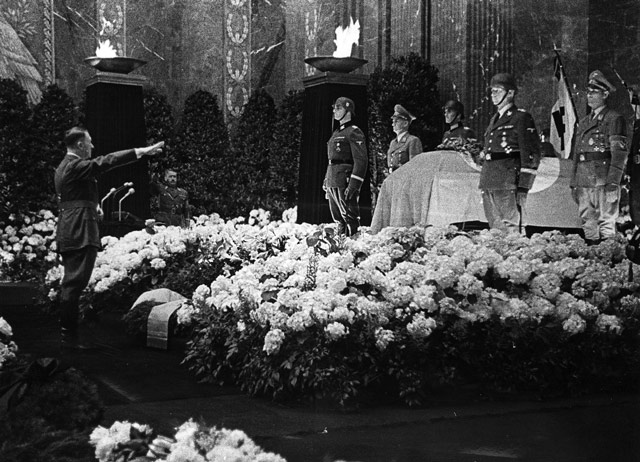
Hitler at Reinhard Heydrich's funeral, 9 June 1942 worldwartwo.filminspector.com
Adolf Hitler at Reinhard Heydrich's funeral (Narodowe Archiwum Cyfrowe, sygn. 2-13241).

Battle of the Pacific: Learning of the Japanese capture of Kiska on 9 June 1942, Admiral Chester Nimitz cancels his orders to Admiral Jack Fletcher to take his three aircraft carriers (USS Enterprise, Hornet, and Saratoga) north to the Aleutians. Nimitz now does not want them exposed to Japanese land bombers operating from Kiska and Attu. This unknowingly frustrates a Japanese plan to ambush them with the reinforced fleet of Admiral Boshirō Hosogaya.

Nimitz now is thinking offensively (as is General Douglas MacArthur in Melbourne, who submitted his own proposal for an advance led by the Army on 8 June 1942). He wants to keep his carrier force intact for a thrust due west across the central Pacific. This Nimitz and his team in Hawaii see as the main Allied strategy from now on. This is contrary to MacArthur's proposal to advance north from Australia, setting up a classic "turf war" between the US Army and Navy.

The Japanese high command, despite the minor successes in the Aleutians, is reeling from the early June results at Midway. The solution is denial and a coverup. The Imperial Japanese Navy prepares a vague and unrealistic summary of the battle to the military liaison conference. Admiral Chūichi Nagumo takes his time preparing an accurate summary of Japanese losses. He remains completely unaware that the Americans knew his complete battle plan in May and thinks his force was only discovered on the 5th. The Japanese public is kept completely in the dark, with media focusing entirely on the Aleutians.
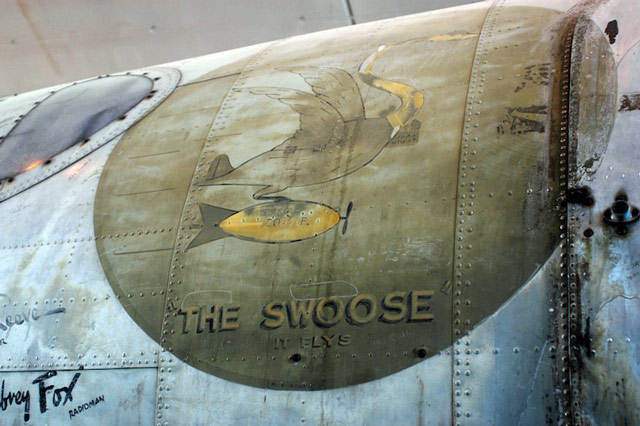
The Swoose ferried LBJ to Port Moresby on 9 June 1942 worldwartwo.filminspector.com
Artwork depicting "The Swoose" on the B-17D aircraft that carried Lyndon Baines Johnson to Port Moresby on 8 June 1942. The aircraft is currently being restored in Dayton, Ohio (U.S. Air Force photo courtesy of the National Museum of the United States Air Force).

Navy Reserve Lieutenant Lyndon B. Johnson, the future President, makes an aerial inspection tour from his location in Townsville, Australia. Johnson already has had an interesting time Down Under, having helped to quell a mutiny by African-African troops on 22 May 1942. The B-26 Marauder flying the mission has engine trouble after departing from Port Moresby and has to return to base, but the USAAF 19th Bombardment Squadron of the 22nd Bomber Group completes its mission (flying from Townsville to Port Moresby for refueling) to bomb Lae, New Guinea. The Port Moresby stage of the mission has to be delayed for an hour to accommodate LBJ, who arrives from Townsville in General Brett's VIP B-17D "The Swoose." 

The mission is hazardous even though Johnson misses out on the actual bombing run. LBJ narrowly escapes death because he switches bombers at the last minute due to a pilot change, and the plane he leaves crashes into the sea off Salamaua, killing everyone on board. LBJ then also escapes potential harm when the B-17 on the flight back to Townsville gets lost and almost runs out of fuel. It has to make an emergency landing at remote Carisbrooke Station near Winton. This B-17D, incidentally, survives and is the property of the National Air and Space Museum in Washington, D.C. The strange sequence of events results in General MacArthur awarding Johnson a Silver Star, the Army's third-highest decoration. Johnson soon after heads back to D.C. in accordance with FDR's requirement that all members of Congress return to their legislative duties. He remains in the US Naval Reserve until January 1964.

The Japanese complete their occupation of the Philippines and declare it secure.

US 24-ton freighter Husky founders two miles off Cape Constantine in Nushagak Bay, Aleutian Islands. Everyone survives.

US submarine USS Trout (SS-202) picks up two survivors of the sunken Japanese heavy cruiser Mikuma.

There is fierce fighting near the town of Chuhsien, China. Both sides take heavy casualties.
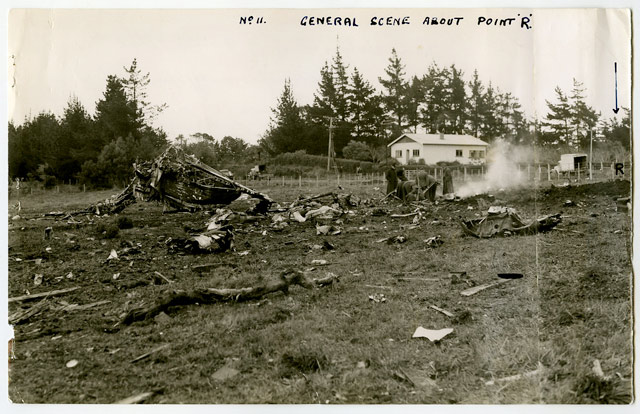
B-17 crash site in New Zealand, 9 June 1942 worldwartwo.filminspector.com
Crash site of a B-17 near Whenuapai Aerodrome, Auckland, New Zealand, 9 June 1942. All 11 men on board are killed (Archives New Zealand Reference: ADQA 17211 AIR1 572 25/2/588).

Battle of the Indian Ocean: The Japanese Divine Dragon Operation No. 2 submarine force, in which the Japanese high command placed high hopes, remains operational in the Mozambique Channel. However,  it is now clear to the local commanders that the operation now has turned into a standard submarine patrol and that initial plans to target the British Far Eastern Fleet are obsolete. Accordingly, Lieutenant Commander Otani Kiyonori of I-18 has his men destroy and jettison mini-submarine M-18b, effectively ending the operation.

Around this time, British divers discover the remains of M-20b, which carried out the most successful attack at Diego Suarez. It is sitting upright on a reef in heavy surf (remnants remain there to this day). They salvage the propellers, now on display at the gravesite of its occupants, Lieutenant (j.g.) Akieda Saburo and POIC Takemoto Masami. They were killed on 2 June 1942 by a British patrol on the mainland while attempting to rendezvous with I-20.

The Japanese have not given up on the Indian Ocean by any means. On 5 June 1942, auxiliary cruisers Aikoku Maru and Hokoko Maru caught 6757-ton British passenger ship Elysia 350 miles northeast of Durban. They torpedoed it, and today it sinks, causing 22 deaths. 

Battleship HMS Ramillies, previously damaged by a Japanese mini-submarine in late May 1942, arrives in Durban for repairs accompanied by light cruiser Emerald and three destroyers. The damage ultimately will require a return to the UK at Portsmouth on 8 September that will last until the summer of 1943.
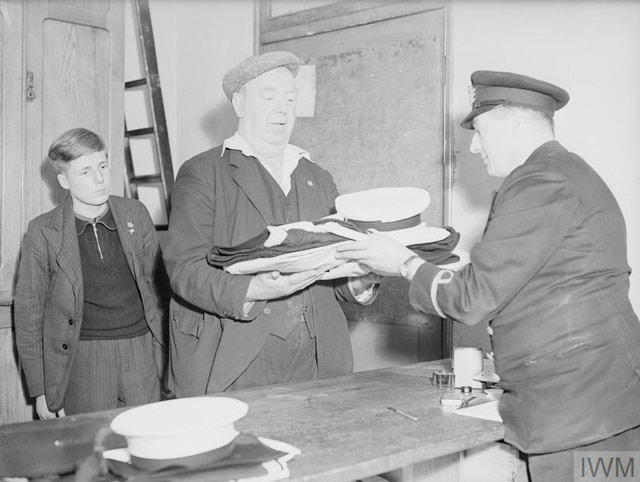
A new recruit for the Royal Navy, age 62, 9 June 1942 worldwartwo.filminspector.com
A new recruit, age 62, joins the Royal Navy, 9 June 1942. ""Owd Bob" drawing his petty officer's rig on board the Armed Merchant Cruiser Depot ship HMS MERSEY. Behind him is Tommy Harding, age 18, another new entry who volunteered for this special naval service." © IWM A 8807.

Eastern Front: German General Erich von Manstein's assault on Sevastopol has shown signs of turning into a battle of attrition, exactly what he didn't want. The priority is to take Sevastopol before the Case Blue offensive on the main front begins, and that now is looking doubtful. Luftwaffe General Wolfram von Richtofen begins changing attack priorities from assisting the front-line troops to attacking Soviet supply lines, a bad sign that the plan is faltering. The Luftwaffe is fully committed, flying 1044 sorties and dropping 954 tons of bombs, putting a strain on men, equipment, and logistics.

However, the German offensive is not dead, not by any means. General Franz Halder, remaining in East Prussia while the Fuhrer attends the Reinhard Heydrich funeral (see below), comments:
At Sevastopol, good progress despite strong enemy counter-attacks. Otherwise, all quiet. Army Group Center reports breakout of Cavalry Corps Belov to the south.
Halder does have his own grips about the Storfang operation. Writing about a meeting during the day with General Buhle, he comments acidly, "Report on Sevastopol. My suspicion that the Artillery Command is not of the best is confirmed."

The Red Navy is doing what it can to help its comrades ashore. Early in the morning, Soviet destroyers spot Axis mini-submarines operating from Yalta on their radar screens and unsuccessfully attack them. This new development induces Vice-Admiral Oktyabrskii to order his naval captains to concentrate less on offshore gunfire support of the army and more on keeping the sea lanes to Sevastopol clear. He also tells them to switch to area fire rather than targeted fire and cuts back on the number of surface vessel supply missions. This forces an increase in submarine supply missions. While they don't know it, the Axis mini-submariners thus achieve a tactical victory without sinking a single ship.

LIV Corps continues to make slow progress in the north, assisted greatly by an intense artillery bombardment laid down by the biggest guns ever used in combat. The 132nd Infantry clears a key obstacle, the Haccius Ridge, and the 22nd Infantry Division destroys the elite Soviet 79th Naval Infantry Brigade.

General Paulus' Sixth Army counterattacks against Red Army forces in the Kharkov sector. Paulus has plenty of troops because Sixth Army is fated to lead the Case Blue offensive toward Stalingrad. During this attack, Uffz. Wilhelm Crinius of 3./JG 53 shoots down two Soviet Il-2 Shturmovik ground-attack planes for his first two victories.

European Air Operations: Weather is poor on the Channel Front, with 10/10ths cloud cover down to 1500 feet and getting worse as the day proceeds.

A Polish squadron raids Essen. British Wellington IV R1725 crashes into the North Sea, 20 km west of Texel, Netherlands, while en route to bomb Essen. All six crewmen perish. Another Wellington targeting Essen, IV Z1412, is shot down by the nightfighter pilot Oblt. L.Fellerer of II/NJG 2. it crashlands on the beach 2 km west of St. Maartensvlotbrug. The five crewmen survive. A Wellington manages to make it back for a crashlanding after being attacked three times by Me-110 night fighters from below and astern, and the odds of survival are so iffy that the copilot bails out 20 miles west of Essen after the bombing run.
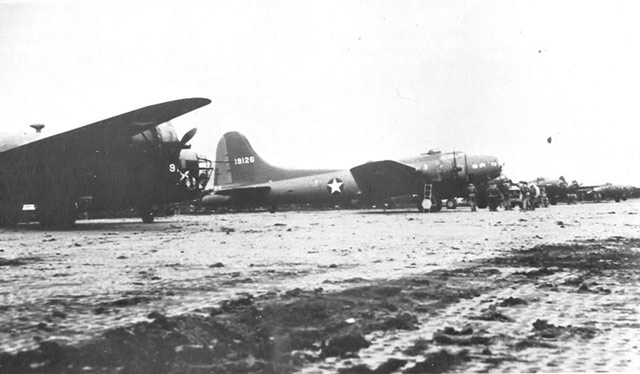
USAAF bombers in Alaska, June 1942 worldwartwo.filminspector.com
"36th Bombardment Squadron LB-30 Liberator and a Boeing B-17E Fortress (41-9126) at Fort Glenn Army Air Base, Alaska, June 1942. 9126 was lost Aug 28, 1942." USAAF photo via Chloe, John Hale, (1984), Top Cover for America. the Air Force in Alaska. 1920–1983, Pictorial Histories Publishing Company, ISBN 0-933126-47-6.

Battle of the Atlantic: U-124 (Kptlt. Johann Mohr), on its ninth patrol out of Lorient, torpedoes and sinks 940-ton French corvette FFL Mimosa (K11, Captain Roger R.L. Birot) 600 miles southeast of Cape Farewell in the British Isles. The Mimosa is an escort for Convoy ONS-100 and sinks within three minutes because the depth charges falling off the ship explode. The other escorts don't even notice the ship is missing until dawn breaks. There are 65-67 deaths and only four surviving French sailors, who are picked up by HMCS Assiniboine.

U-502 (Kptlt. Jürgen von Rosenstiel), on its fourth patrol out of Lorient, torpedoes 6589-ton US tanker Franklin K. Lane 35-40 miles (65 km) northeast of La Guiara and Cape Blanco, Venezuela. It is scuttled by the British destroyer HMS Churchill. The ship, a member of Convoy TO-5, is carrying 73,000 barrels of crude oil to Aruba for processing. There are four deaths and 37 survivors.

U-502 also gets another victim from the same convoy today, 5085-ton Belgian freighter Bruxelles. The ship manages to evade two torpedoes, but a third one blows a seven-meter (yard) hole in the side and the ship sinks within four minutes. The crew acts quickly and manages to launch lifeboats. Destroyer Churchill picks them up quickly. There are 53 survivors and one death.

U-432 (Kptlt. Heinz-Otto Schultze), on its fifth patrol out of La Pallice, torpedoes and damages 7073-ton Norwegian freighter Kronprinsen of Convoy BX-23A south of Cape Sable. The ship is taken in tow and beached at West Pubnico, Nova Scotia. Ultimately, the ship is repaired and returned to service.

U-432 also damages 8593-ton British freighter Malayan Prince with a torpedo that misses the Kronprinsen. The ship manages to remain with the convoy and is later repaired and returned to service in July 1942.
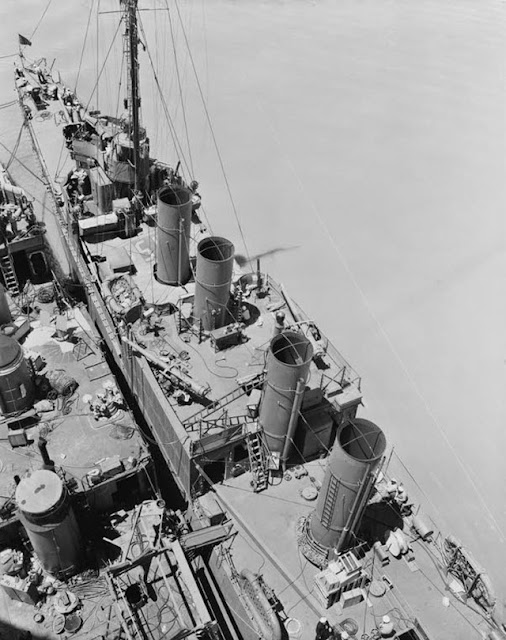
USS Southard at Mare Island, 9 June 1942 worldwartwo.filminspector.com
Four-stack destroyer USS Southard (DMS-10), Mare Island, 9 June 1942. She has just been converted into a minesweeper (Rickard, J (15 September 2018), USS Southard (DMS-10), Mare Island, 9 June 1942).

Battle of the Mediterranean: Early in the morning, the Luftwaffe sends 20 Junkers Ju 88 and 40 Ju 87 Stukas escorted by 50 Bf 109 and Me 110 fighters against the Free French in Bir Hakeim. However, thick smoke and dust force them to turn back. A second attack around noontime by 124 Stukas and 76 Ju 88s, escorted by 168 Bf 109s, has more luck. During this attack, Oblt. Hans-Joachim Marseilles of 3./JG 27 downs four RAF planes.

German artillery also opens up on the fortifications in the morning as General Erwin Rommel readies a final assault. After the planes and big guns have softened up the defenses, units of the 15th and 21st Panzer Divisions, the 90th Light Division, and Italian infantry launch a two-pronged attack.

Rommel's objective is the "high ground" near the fortress, a small rise called Point 186. The Italian Trieste Division makes good progress, overrunning a reinforced French force that is hampered by supply issues. The German advance gains steam in the afternoon when the 15th Panzer breaches the French line in the center, forcing a desperate counterattack with Bren Carriers that succeeds. Oberstleutnant Ernst-Günther Baade leads the Rifle Regiment 115 to within 200 meters (yards) of the fortress by dusk.

Overhead, the Luftwaffe establishes dominance due to previous losses in the RAF Desert Air Force despite frantic pleas for cover from French General Kœnig. The French are low on supplies and everyone can see the writing on the wall. British Major-General Frank Messervy, commander of the 7th Armoured Division, reports that a breakout should be attempted, and at 23:00 Kœnig signals for permission to evacuate the fortress. Lieutenant-General Neil Ritchie, commander of the 8th Army, replies that he'll prepare a thrust from the south but the fortress will have to hold out for another day or two. 

With water and ammunition running out and casualties mounting, Kœnig orders a breakout anyway. The French formation quickly loses coherence in the darkness and the Axis forces react quickly. The retreat turns into desperate hand-to-hand combat but does make progress into the early morning hours of the 10th.

Italian Caproni bombers catch 1584-ton Swedish freighter Stureborg in the eastern Mediterranean and sink it with torpedoes and bombs. There are 20 deaths and only one survivor, whose raft reaches land near Gaza. Ten men in total started out on the raft but nine perished because it drifted for 19 days and they had no food or water.

U-83 (Kptlt. Hans-Werner Kraus), on its eighth patrol out of Salamis, shells and sinks 175-ton Palestinian sailing ship Typhoon four miles southeast of Sidon, Lebanon. Everyone survives.

RAF Catalinas of No. 240 Squadron sinks Italian submarine Zaffiro in the western Mediterranean southeast of Palma de Mallorca, Balearic Islands. There are no survivors.
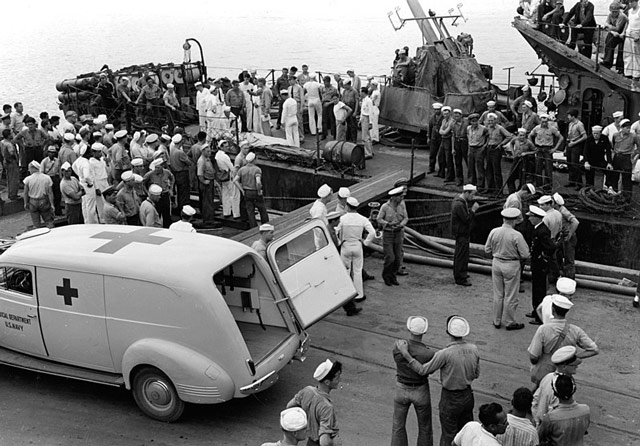
USS Hammann survivors arrive at Pearl Harbor, 9 June 1942 worldwartwo.filminspector.com
Survivors of the destroyer USS Hammann (DD-412), torpedoed and sunk on 6 June 1942 at the Battle of Midway, are brought ashore at Pearl Harbor, 9 June 1942 (Naval History and Heritage Command 80-G-312064).

Joint Allied Planning: The United States and British governments form the Combined Production and Resources Board. The purpose is to plan and coordinate production in each country to best serve war needs. It operates independently and competes with the Combined Munitions Assignment Board, which is under the jurisdiction of the Combined Chiefs of Staff. President Roosevelt's crony Harry Hopkins is the American leader behind the scenes, though Donald Nelson is the chair. 

While sometimes criticized as ineffective, the Board changes the military procurement process based on statistical analysis and perceived priorities. It provides some order to the former chaotic ordering system directly to industry used by the militaries of the respective countries. British representatives tend to feel the Board favors the US and prefer to exert their influence through the Munitions Board because they feel the Combined Chiefs give them more of an equal say. Canada feels left out and eventually is admitted to the Board as an equal partner. 

The real weakness of the Board is that its leaders don't really have much of an idea themselves of what the war effort needs or where the war is going until it is really too far along to matter. As the military strategy and objectives change - sometimes at the last minute - the Board must follow along and thus always is a step behind actual needs. Its findings also have to be implemented by the respective governments which may not necessarily agree completely with its decisions and thus may not treat them with a sense of urgency.

US Military: The Navy establishes a naval operating base at Kodiak, Alaska.
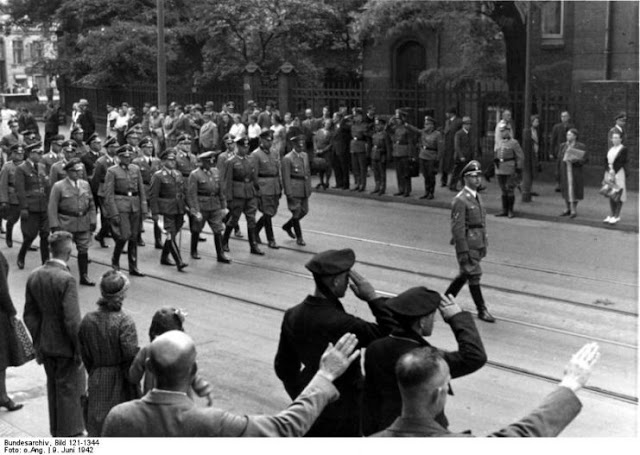
Heinrich Himmler leads the parade at the Reinhard Heydrich funeral, Berlin, 9 June 1942 worldwartwo.filminspector.com
Reichsfuhrer-SS Heinrich Himmler leads the procession at Reinhard Heydrich's Berlin funeral on 9 June 1942. Visible in the front row from left are Robert Ley, Karl-Hermann Frank, Erhard Milch, Sepp Dietrich, Sergeant Heinz Heydrich (Reinhard's younger brother), police chief Kurt Daluege (Heydrich's successor in Bohemia and Moravia), and Wilhelm Frick (Federal Archive Picture 121-1344).

German Homefront: The government holds the second funeral for Reinhard Heydrich, who was shot by British agents on 27 May 1942. This second funeral is in Berlin (the first, on 7 June, was in Prague). All of the top Reich officials attend, including Adolf Hitler and Hermann Goering. Hitler awards Heydrich the German Order, the highest honor in the Third Reich, posthumously. After the ceremony, Heinrich Himmler tells his subordinates to ramp up the Holocaust.

Heydrich is interred in a plot at the Invalidenfriedhof in Berlin. The location, once well known, since the war has become secret to prevent fascist gatherings.

Privately, Hitler blames Heydrich's own lax security precautions on his demise. He tells his cronies that a man as important to the war effort as Heydrich never should have been driving in an unguarded open-air car through streets filled with people. Hitler, of course, is (rightly) paranoid about his own personal security and routinely changes his routes and timing to frustrate would-be assassins. This already has saved his life at least once, when he evaded a bomb planted at the Munich Brown House (Braunes Haus) on 8 November 1939.

Due to the Gestapo's mistaken belief that the Heydrich assassins operated from the town of Lidice, the local German authorities begin to obliterate it today. Today and tomorrow, they kill 199 men and deport 195 women to the Ravensbrück concentration camp. There are 95 children in the town, 81 of whom later perish at the Chelmno camp. Eight are adopted by German families. The German security forces also prepare to destroy the town of Ležáky.

The two agents who assassinated Heydrich, Jozef Gabčík and Jan Kubiš, remain at large despite a massive German manhunt. The local authorities make it clear to the Czech people that if they are not turned over, more blood will be spilled. They also promise a bounty of a million Reichsmarks. Since everyone knows the German threats are not just empty words and Lidice is the proof, this reaches some receptive ears.
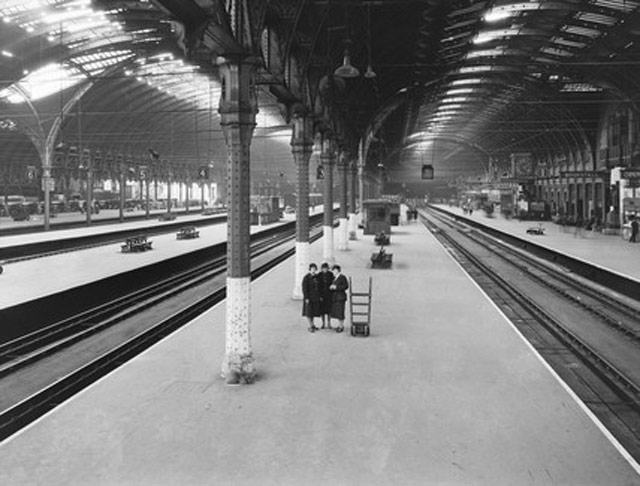
Paddington Station, London, UK, 9 June 1942 worldwartwo.filminspector.com
Platforms 2 and 3 of Paddington Station, London, UK, 9 June 1942 (Science & Society 10442395).

American Homefront: Lord Louis Mountbatten, Chief of the British Commandos, arrived in Washington for tactical conversations with US officers. Also returning from London are Generals Dwight D. Eisenhower, Henry "Hap" Arnold, and Mark Clark.

Ronald Reagan, who enlisted in the USAAF on 15 May 1942 as a private, receives a transfer to become the public relations officer for the First Motion Picture Unit in Burbank, California, under director John Ford. In this role, Reagan will be instrumental in "discovering" a young aviation worker in Burbank who will turn into film star Marilyn Monroe. He ends the war with the rank of Captain.

Future History: Heydrich's death leads to a series of prolonged court cases in the 1950s by his widow, Lina. She successfully argues to the West German government that she is entitled to a full pension as she widow of a German general. She writes a 1976 memoir, Leben mit einem Kriegsverbrecher (Living With a War Criminal), remarries, and passes away in 1985. Three of their four children survive the war.

Raymond "Ossie" Clark is born in Warrington, Lancashire, England. He becomes a top fashion designer during the "Carnaby Street" height of British fashion in the Swinging Sixties. He passes away on 6 August 1996 after being stabbed by a former lover.

Adolf Hitler speaks at the Reinhard Heydrich funeral, 9 June 1942 worldwartwo.filminspector.com
Adolf Hitler gives a memorial address at the funeral of Reinhard Heydrich in the New Reich Chancellery, 9 June 1942 (Federal Archive Image 146-1969-052-69).

2021

Friday, November 12, 2021

June 8, 1942: Japanese Submarines Shell Australia

Monday 8 June 1942

Italian submarine beached in Spain, 8 June 1942 worldwartwo.filminspector.com
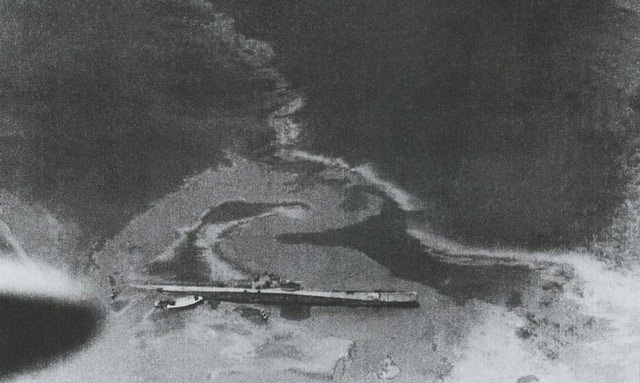
Italian submarine Luigi Torelli lying beached near Santander, Spain, on 8 June 1942. The submarine commander beached it after suffering damage from Allied aircraft on 6 June 1942 using Leigh Lights. It is ultimately repaired and restored to service.

Battle of the Pacific: In a coordinated attack in the early morning hours of 8 June 1942, two Japanese submarines fire their 140 mm deck guns at Sydney and Newcastle, Australia. The purpose is more symbolic than militarily effective, but it certainly catches the attention of a lot of people.

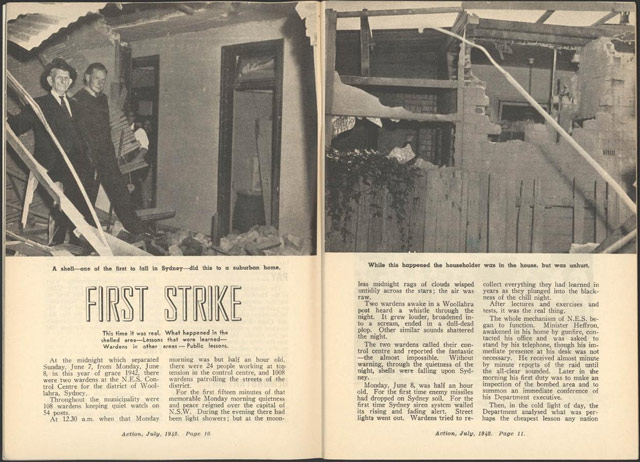
I-24 opens the attack by firing ten shells targeting the Sydney Harbour Bridge. They land in the suburbs of Bellevue Hill, Rose Bay, and Woollahra, with one shell landing in the harbor. One person is injured by falling masonry and debris even though only one of the ten shells explodes. There is no response from shore batteries due to the brevity of the attack.

Two hours later, Japanese submarine I-21 (Cdr Matsumura Kanji) shells the Australian city of Newcastle, New South Wales, on 8 June 1942 from a distance of 9 km (5.6 miles) northeast of Stockton Beach. The target this time is the BHP steelworks. It fires 34 shells, including 8 illumination rounds, but once again only one shell detonates. The attack does no significant damage, aside from destroying a house on Parnell Place. Fort On the alert due to the previous Sydney attack, Scratchley gunners respond with four shells but have little chance of scoring a hit on the submarine in the dark.

The only fatality from these attacks is a US Army Air Force pilot, Lieutenant Georg Cantello, who disobeys orders and takes off from Bankstown airport in a P-39 Aircobra to attack the submarines. He perishes when his plane crashes due to mechanical issues in Hammondville paddock. There is a memorial park, Lt. Cantello Reserve, in the City of Liverpool with a monument in his honor.

Japanese bombardment of Sydney, 8 June 1942 worldwartwo.filminspector.com
Australian "Action" magazine, the Official Journal of the National Emergency Services, has photos and a description of the 8 June 1942 shelling of Sydney in its July issue.

In response to the Japanese offensive in Australian waters that began with the attack on Sydney Harbour on 31 May 1942, the Australian government begins convoy operations on the east coast. Today, the first one, Convoy CO 1, departs from Newcastle bound for Whyalla.

The crew of a US Navy PBY-5A Catalina based at Dutch Harbor, Unalaska Island, spots two destroyers and four transport ships in Kiska Harbor. The crew then fly on to Attu and spot the Japanese presence there, too. This is the first news that the Japanese have invaded Alaska. An LB-30 of 11th Air Force also spots the Japanese.

In Hawaii, Admiral Chester Nimitz has ordered USS Enterprise and Hornet, now free due to the victory at Midway, to sail north to the Aleutian Islands in response to the attacks on Dutch Harbor. However, he quickly countermands this order when informed of the invasions at Attu and Kiska, fearing attacks on his carriers by land-based aircraft. The Japanese, meanwhile, are digging in on the islands and building airfields. Admiral Frank Fletcher, now aboard the aircraft carrier USS Saratoga, resumes command of the three-carrier task force northwest of Hawaii from Raymond Spruance. His carriers and the 11th Air Force in Alaska search for the remaining Japanese fleet but the planes spot only open water.

General Douglas MacArthur, Supreme Commander of Allied Forces in the Southwest Pacific Area (SWPA) in Melbourne, submits his first proposal for an Allied counteroffensive in the Pacific. He lists New Guinea, New Ireland, and New Britain as the initial objectives. It receives immediate opposition from Admiral Ernest King, Commander in Chief, United States Fleet (COMINCH), and Chief of Naval Operations (CNO), who, among other objections, does not like the idea of an Army general commanding an amphibious force. Negotiations over a compromise plan begin shortly. Another issue is that the Japanese remain on the offensive despite their recent defeat at Midway and that will affect operational choices.

The Boston Daily Globe, 8 June 1942 worldwartwo.filminspector.com
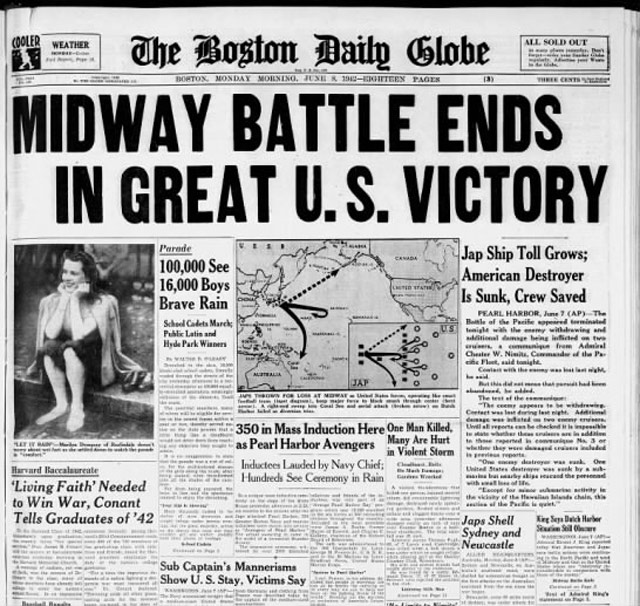
The Boston Daily Globe of 8 June 1942 is full of cheery news about the US victory at the Battle of Midway. The very careful wartime manipulation of war news is evident in the header "American Destroyer Is Sunk, Crew Saved." That is absolutely true, but there is no mention of the far more consequential sinking of the USS Yorktown. 

Battle of the Indian Ocean: Japanese submarine I-16 uses its deck gun to sink 4847-ton Greek freighter Aghios Georgios IV between Aden and Table Bay in the Mozambique Channel. There are seven deaths.

I-20 torpeoes and sinks 5209-ton Greek freighter Christos Markettos off Mombassa. There are two deaths.

I-10 (Cdr Otani) torpedoes and sinks 5224-ton British freighter King Lud in the Mozambique Channel 350 miles east of Beira. All 39 people on board perish. This is I-10's third victory in the vicinity.

I-10 also uses its deck gun to sink 2158-ton Norwegian freighter Wilford in the Mozambique Channel in the same general vicinity east of Beira. There are nine deaths. Some sources place this sinking on 7 June 1942.

Norwegian freighter Wilton, sunk on 8 June 1942 worldwartwo.filminspector.com
Norwegian freighter Wilford, sunk by I-10 in the Mozambique Channel on 8 June 1942.

Eastern Front: German General Erich von Manstein's 11th Army continues its attack on Sevastopol in Crimea but makes little progress. Soviet counterattacks also fail, leading to a virtual stalemate. The German LIV Corps, aided by strong artillery fire and furious Luftwaffe attacks, do make some progress in the northern sector where the largest artillery batteries are located. Already the corps has lost 1700 casualties in exchange for a shallow bulge into the Red Army lines that is 3 km deep and 5 km wide. German 30 Corps in the south has suffered 496 casualties for minor penetrations into the out Soviet defensive line.

There are fierce dogfights over Sevastopol, with both sides represented by veteran ace fighter pilots. The Luftwaffe gets the better of the encounters. Lt. Ludwig-Wilhelm Burckhardt of 6./JG 77 downs 2 Soviet fighters and Oblt. Anton Hackl of 5./JG 77 destroys three Russian planes to bring his score to 57 victories. Hptm. Kurt Ubben of Stab III./JG 77 brings his score to 70 victories after he downs a Russian fighter.

There is growing frustration in Manstein's headquarters with the pace of the offensive. Luftwaffe General Wolfram von Richtofen observes that his planes fly 1200 sorties during the day without achieving much and lamely explains, "We hope gradually to beat down the enemy by mass bombing."  He complains that flying so many missions is 'extremely strenuous." Conditions are made worse on both men and equipment by sweltering  105° Fahrenheit (40° Celsius) heat.

At Fuhrer Headquarters in East Prussia, General Halder is okay with the progress, but there is a hint of concern in his diary entry:
Assault of Sevastopol makes satisfactory progress on the first day against stiff opposition; high ammunition expenditures and severe losses. All other fronts quiet. Successful counterattacks at Kirishi.  
Kirishi, meanwhile is a town 115 kilometers (71 mi) southeast of St. Petersburg on the Volkhov River that defends Lyuban. The front has stayed stagnant there since the fall of 1941, a sign of the stalled German offensive into the USSR.

European Air Operations: The weather remains unsettled throughout the day, getting worse as time goes by. During RAF air patrols along the continent coast, they sink 7003-ton German patrol boat Sperrbrecher 15 Taronga off Scharhörn. The ship makes port but is a complete loss and written off.
Auschwitz victim executed on 8 June 1942 worldwartwo.filminspector.com
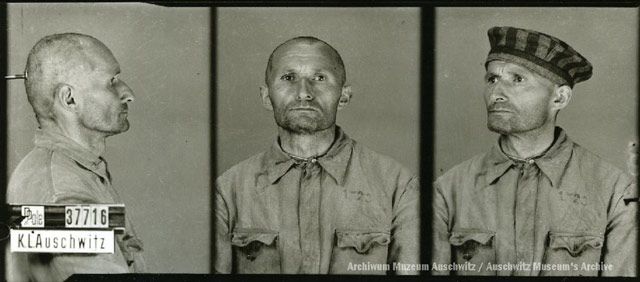
Polish teacher Władysław Dobija, executed at Auschwitz on 8 June 1942 (Auschwitz Memorial). 

Battle of the Atlantic: U-135 (Kptlt. Friedrich-Hermann Praetorius), on its third patrol out of Brest, torpedoes and sinks 4549-ton Norwegian freighter Pleasantville 200 miles northwest of Bermuda. There are two dead and 45 survivors, 10 of whom who are picked up about 24 hours later by freighter Chickasaw City while the remaining 35 are picked up by freighter Paderewski on 11 June.

U-504 (KrvKpt. Hans-Georg Friedrich Poske), on its third patrol out of Lorient, uses its deck gun to sink 3901-ton Honduran freighter Tela in the Gulf of Mexico near Rio Bravo. The ship sinks by the stern within five minutes There are 11 dead and 43 survivors, who abandon ship in two lifeboats and two rafts and are picked up twelve hours later by freighter Port of Montreal. Their adventure is not over, as U-68 sinks Port of Montreal in turn on 10 June 1942, during which two of the Tela survivors perish.

U-504 also uses its deck gun to sink 1512-ton British freighter Rosenborg in the same general area east of the Yucatan Peninsula. This is after Poske misses with two torpedoes. He must use 60 shots to sink the ship. There are four dead and 23 survivors, who are picked up by Norwegian freighter Geisha.

U-172 (Kptlt. Carl Emmermann), on its second patrol out of Lorient, torpedoes and sinks 1654-ton US freighter Sicilien 10 miles south of Cape Beata, Dominican Republic. There are 46 dead and 31 survivors, who get in rafts and make it to Barahona, Dominican Republic.

U-128 (Kptlt. Ulrich Heyse), on its third patrol out of Lorient, torpedoes and sinks 9234-ton Norwegian tanker South Africa 400 miles east of Trinidad. The ship breaks in two and sinks within two minutes. Survival is made difficult due to the tanker's full load of 9614 tons of lube distillate and 4146 tons of diesel oil. Heyse surfaces and points out a man in the water that the lifeboats then pick up, gives the men some cans of bread and two bottles of rum, and directs them toward land. There are six dead and 36 survivors in two lifeboats. The subsequent sequence of events almost defies belief. One lifeboat (14 men) is spotted by freighter Plaudit, but the men refuse rescue after getting some supplies because it is heading to Pernambuco on 12 June and sail on toward Trinidad. They then decline another rescue offer from sailing vessel Minnie M. Mosher before making landfall at Galara Light (Toko Bay) on 16 June. The other lifeboat (25 men) is spotted by tanker Acastra on 12 June, but the men also refuse rescue after taking on supplies because it is heading for Freetown. They also decline an offer on the 13th from Argentinian tanker 13 de Diciembre after taking on supplies. They are picked up by an American seaplane tender on 14 June 45 miles east of Trinidad.

U-107 torpedoes and sinks 3249-ton US freighter Suwied 140 miles southeast of Cozumel Island. the ship sinks within three minutes, preventing a distress call. There are six dead and 33 survivors, who are picked up by USCGC Nemesis (WPC 111) after 19 hours. Some sources place this sinking on 7 June 1942, where I also discuss this sinking.

British patrol boat HMT Catherine founders off Scapa Flow. Casualties are unknown.
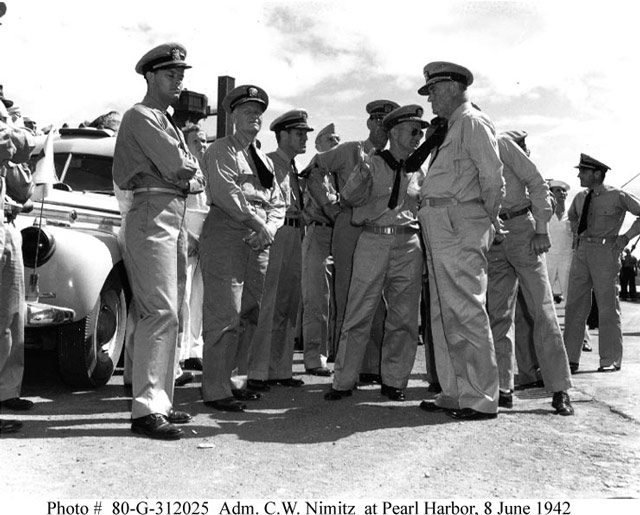
Admiral Chester Nimitz and his staff on 8 June 1942 worldwartwo.filminspector.com
Admiral Chester Nimitz (second from left) and his party await the arrival of survivors of USS Yorktown aboard Fulton (As-11), 8 June 1942. Also visible are Rear Admiral William L. Calhoun in the right front and Rear Admiral Lloyd J. Wiltse, of Nimitz' staff, in the center background (Naval History and Heritage Command 80-G-312025).

Battle of the Mediterranean: The situation in Libya remains unchanged today. The Germans continue their attack on the fortress of Bir Hakeim but make no progress, while the British 7th Motor Brigade and 29th Indian Infantry Brigade attempt raids on the Axis supply lines.

Time is on General Erwin Rommel's side because the Free French at Bir Hakeim cannot be resupplied and they are running low on everything. Today, Rommel personally leads an attack on the fortress from the north beginning at 10:00, supported by a massive Luftwaffe assault by 45 Ju 87 Stukas, 3 Junkers Ju 88 medium bombers, and ten Messerschmidt Me-110 fighter-bombers escorted by 54 Bf-109 fighters (3 losses two German and one Italian).

While the attack continues throughout the afternoon supported by another attack by 60 Stukas, the defenses hold. The British Desert Air Force (DAF) flies 478 sorties (8 fighter losses) during the day and drops supplies to the garrison after dark. The Italian Macchi C 202 fighters are particularly effective, shooting down three RAF planes.

In a friendly fire incident, the Italian submarine Alagi (Cdr Serio Puccini) spots a convoy 20 nautical miles north of Cape Bon, Tunisia. Captain Puccini assumes it is an Allied one, but it is a typical Axis convoy from Naples to Tripoli. Puccini fires three torpedoes and sinks 5085-ton Italian destroyer Antoniotto Usodimare. There are 141 killed and 165 survivors. This sinking is sometimes listed as occurring on 8 August 1942.

U-83 (Kptlt. Hans-Werner Kraus), on its eighth patrol out of Salamis, gets two victories today. First, it uses its deck gun to sink 100-ton Palestinian sailing ship Esther six miles northwest of Sidon, Lebanon. There are no survivors.

U-83 then uses its deck gun to sink 231-ton Egyptian freighter Said 15 miles southwest of Jaffa. This is after U-83 missed with two torpedoes, and it takes 50 rounds to sink the ship. There are five dead and nine survivors.
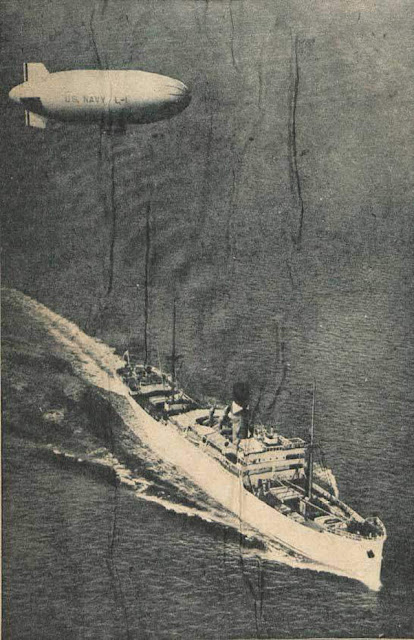
A US Naval blimp of the type involved in a fatal crash on 8 June 1942 worldwartwo.filminspector.com
US Navy blimp L-1. This is of the same class as L-2, which crashed in a fatal accident on 8 June 1942. It is shown above Panamanian freighter Musa.

US/Soviet Relations:  Soviet Ambassador to the United States Maxim M. Litvinov informs Harry Hopkins that the Soviet Union is agreeable to the establishment of a Lend-Lease air corridor between Alaska and Siberia. Since Japan is not at war with the USSR, it could not interfere with such flights without instigating a conflict with the Soviets.

US Military: The European Theater of Operations, United States Army (ETOUSA) is formed by the Department of War, though it doesn't begin operation officially until 4 July 1942. Its organizational divisions are Army Ground Forces (AGF), United States Army Air Forces (USAAF), and Army Service Forces (ASF) operations north of Italy and the Mediterranean coast. It replaces United States Army Forces in the British Isles (USAFBI) and its first commander for a brief period of time is Maj. Gen. James E. Chaney. The AGF currently has the 34th Infantry Division in Northern Island, which has released British troops from duties by patrolling the border between British Northern Ireland and the neutral Irish Free State.

Brigadier General Howard C Davidson, commander of VII Fighter Command, is promoted to Commanding General, 7th Air Force.

Canadian Military: Royal Canadian Air Force's No. 111 (Fighter) Squadron flies its Curtiss P-40 Kittyhawk fighters to Elmendorf Field, Alaska. This is part of the RCAF effort to reinforce Allied defenses on its western flank.

German Homefront: Following the elaborate funeral of Reinhard Heydrich on 7 June 1942, the Prague authorities embark on vicious reprisals. The Gestapo, with little to go on, receives a spurious report that the small town of Lidice is the hiding place of Heydrich's assassins and plans an operation to destroy it. This report is based on nothing but the town's reputation as the home of some Czech army officers who are now in hiding in Great Britain. A radio transmitter belonging to the Silver A team (a three-man Allied infiltration team that supported Operation Anthropoid, the assassination of Heydrich) is found in the village of Ležáky and so it, too, is targeted. Heydrich's two assassins, Jozef Gabčík and Jan Kubiš, remain at large shuttling between safe houses in Prague. A second Heydrich funeral is scheduled for Berlin on 9 June.
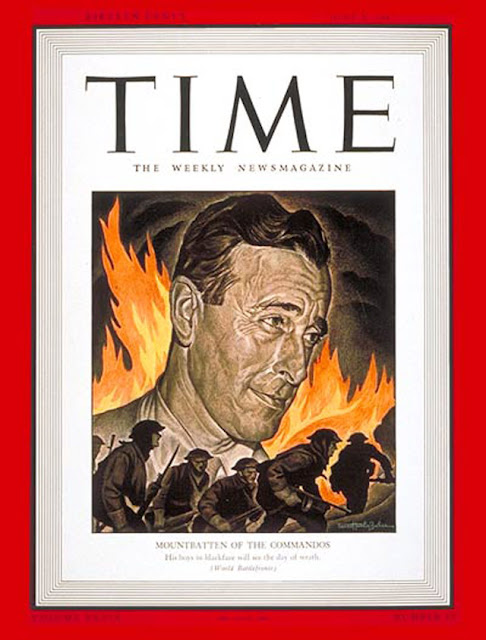
Time magazine 8 June 1942 worldwartwo.filminspector.com
"Mountbatten of the Commandos" is on the cover of the 8 June 1942 Time magazine (cover credit: Ernest Hamlin Baker).

British Homefront: The Guardian publishes an editorial today noting increasingly harsh living conditions in the Reich "since last winter." Its main theme is that "since last autumn’s clear failure to “annihilate” the Russians, the German civilian front has been increasingly tired and dispirited." This reflects the wishful thinking of RAF Bomber Command led by General Arthur"Bomber" Harris, who believes that his forces can crush the Reich from the air by destroying its people's will to fight. In this sole and strict sense, the Allied bombing campaign is proving to be a massive failure, as people in Germany may be down but the bombing is not making them demand surrender as they did in 1918.

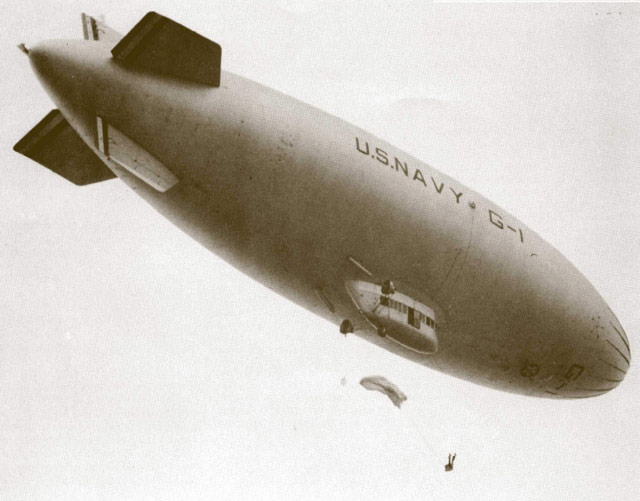
Naval airship G-1, involved in a fatal crash on 8 June 1942 worldwartwo.filminspector.com
US Navy Airship G-1, involved in a fatal crash on 8 June 1942. It is shown dropping a parachutist.

American Homefront: During the night, two U.S. Navy airships (G-1 and L-2) collide five miles north of Manasquan, New Jersey, while performing experimental visual and photographic reconnaissance at 400 feet. Twelve men, naval personnel and civilian technicians, perish. The blimps fall into the sea and only the co-pilot of L-2, Ensign Howard Fahey, survives. Only three bodies are recovered.

Due to the victory at the Battle of Midway, the US government cancels the invasion alert for the West Coast.

Bing Crosby makes a new recording of "Silent Night," which he first recorded on 21 February 1935, for his holiday compilation album "Merry Christmas." This is one of four recordings Bing makes of the "Silent Night." One of the reasons Crosby keeps returning to the song is that the recordings are so popular that the music label, Decca, complains that repeated stampings quickly wear out the master tapes.

Model Jane Greer models women's uniforms in the 8 June 1942 issue of Life magazine (see below), posing in a "Nurse's Aide" uniform on the cover. Movie producer and inventor Howard Hughes spots her and decides to make her an actress. He signs her to a personal services contract, which was somewhat customary for actresses at the time but gave him inordinate control over her career which he fully exploited. This begins Greer's decades-long Hollywood acting career and a very turbulent relationship with Hughes wherein he alternately helps and hurts her career and personal relationships. Greer is best known for film noirs, particularly with RKO, such as "Out of the Past" (1947), "The Big Steal" (1949), "Run for the Sun" (1956), and "Man of a Thousand Faces" (1957). Greer passes away on 24 August 2001.

Future History: Peter Grimwade is born in Ayr, Ayrshire, Scotland, UK. he becomes a noted television director, particularly on the Doctor Who series in the early 1980s. He passes away on 15 May 1990.

Life magazine, 8 June 1942 worldwartwo.filminspector.com
Life magazine, 8 June 1942, features a "Nurse's Aid" on the cover. It is actually model Jane Greer, who parleys this break into a memorable acting career.


2021

Saturday, May 1, 2021

May 16, 1942: Sobibor Begins Operation

Saturday 16 May 1942

Field Marshal Jan Smuts inspecting sailors, 16 May 1942 worldwartwo.filminspector.com
South African Field Marshal Jan Smuts inspecting the Royal Marine Guard of Honor on board cruiser HMS Cleopatra in Alexandria Harbor, 16 May 1942. © IWM A 9105.
Battle of the Pacific: Having accomplished Admiral Chester Nimitz's intent of allowing the Japanese to spot his Task Force 16, Admiral "Bull" Halsey on 16 May 1942 heads to Efate to refuel. Nimitz's devious strategy is to forestall the Japanese Operation RY to invade Nauru and Ocean Island by "showing his hand." This has worked, as the Japanese have been scared off by the appearance of Halsey's two carriers (USS Enterprise and Hornet) in the vicinity and canceled the operation. The Japanese invasion force now is headed back to Rabaul.

Nimitz now orders TF 16 to head back to Hawaii to prepare for future operations. Having viewed recent naval intelligence findings, Nimitz projects that the Japanese soon will make simultaneous attacks on Port Moresby, Dutch Harbor in the Aleutians, and Midway Island. His plan is to concentrate Task Force 16 and other available forces at Midway to repel that invasion while allowing the other invasions to be handled by local forces. However, naval intelligence continues to be split regarding Midway as a Japanese objective, so concentrating forces there remains a gamble based on disputed interpretations and conclusions of decrypted Japanese communications. Some intelligence officials, including Admiral Richmond K. Turner in Washington, believe Hawaii may be the target, but there is still time to discern Japanese intentions with more confidence.

USAAF Fifth Air Force sends B-26 and B-17 bombers to attack Lae, with B-25s flying two sorties against the airfield there. Poor weather causes some bombers to divert from Lae to attack shipping. In the morning, the bombers attack Lae at 800 feet, then return in the afternoon and bomb from 2400 feet. Other bombers attack the Japanese seaplane base at Deboyne, which the Japanese already have evacuated. The US loses no bombers, though one B-25C must force-land at Aiyary Airstrip in the eastern highlands of New Guinea (the airfield remains in service in 2021 as Aijura Airport).

US submarine USS Tautog (SS-199), on its second patrol, torpedoes and sinks Japanese fleet tanker Goyo Maru west of Royalist Bank, Truk. Tautog is one of the submarines on the assumed route of the Japanese aircraft carriers returning to Japan after the Battle of the Coral Sea. The sinking almost turns deadly for Tautog, too, as its first torpedo circles around and heads back toward it, forcing an immediate dive.
Saturday Evening Post, 16 May 1942 worldwartwo.filminspector.com
The Saturday Evening Post of 16 May 1942 urges people to "Keep 'em Flying."
Battle of the Indian Ocean: The 1st Burma Infantry Brigade, which has crossed the Chindwin River, reaches the frontier city of Tamu today. This continues a concentration of British military power along the Indian border while essentially abandoning Burma to the Japanese. More units are still on the road to Tamu but are expected to arrive shortly.

US power is growing in the theater, too. The 10th Air Force completes its move from the United States to New Delhi, India. A force of B-17s attacks the Japanese airfield at Myitkyina, Burma, today, destroying the runways.
The Arizona Daily Star, 16 May 1942 worldwartwo.filminspector.com
The Arizona Daily Star of 16 May 1942 optimistically headlines that "Reds Continue Kharkov Drive, Hold at Kerch." In fact, Kerch already is in German hands.
Eastern Front: Facing growing German resistance and counterattacks in the northern prong of their offensive around Kharkov, the Red Army renews its attacks with little success. German tanks blunt these assaults and recover some ground. The attack south of Kharkov continues to succeed, but both prongs must meet west of Kharkov for the Soviet strategy to succeed. Even in the south, the Luftwaffe increases its strikes and Wehrmacht reinforcements pour in from the rear areas. The southern Soviet advance through forests and small towns loses cohesion, spreading out in all directions without accomplishing any meaningful objectives.

General Franz Halder shows increasing confidence in his war diary. After noting that the northern attack "unfortunately has had a measure of success against the Hungarians" but "Disposal of the situation now is no more than a tactical matter," he writes:

East of Kharkov, our tank attack has captured Ternovaya. As a result, the fighting in this area, too, is now reduced to mere tactical scope.

Despite this sanguine attitude, the German high command remains torn. Field Marshal Fedor von Bock, commander of Army Group South, advocates the textbook approach of ringing the Soviet breakthrough with defensive troops to stop their progress. Hitler, however, brusquely rejects this approach. Instead, he coordinates a counterattack by General Ewald von Kleist's First Panzer Army at the base of the Soviet offensive, the breakthrough point. The plan is for 3rd Panzer Corps and 44th Army Corps to advance from north and south to cut the Soviet line of communications.
Baltimore News-Post 16 May 1942 worldwartwo.filminspector.com
The Baltimore News-Post of 16 May 1942 is full of optimism about the Red Army attack at Kharkov. Further down on the page is a headline about Earl Browder that reads "Communist Party Leader Serves 14 Months, Freed as Step Towards "Unity.""
Von Bock privately admits he favors Hitler's approach but is "compelled by orthodoxy" to reject it because it is a huge gamble:

Now the Fuehrer will order the big solution [the counterattack at the base of the breakthrough]. The laurels will go to the Supreme Command and we will have to be content with what is left.

Hitler, of course, does order the big solution. The counterattack, which is planned to begin on the 17th, is tenuous and Kleist himself is unsure if he has the strength to accomplish the encirclement. As the entire fate of the summer offensive on which Hitler places high hopes for ending the Soviet campaign successfully hangs in the balance, the counterattack will determine the future course of the campaign.

In Crimea, General von Manstein's Operation Trappenjagd has succeeded in its major objective by capturing Kerch. The battle now evolves into a mopping-up operation to subdue Soviet holdouts from Kerch all the way to the original line along the Parpach narrows. This will take a couple of days to complete, but the outcome in the Wehrmacht's favor is assured.

Despite the German successes, some sober facts keep crossing General Franz Halder's desk at Fuhrer Headquarters. In his war diary, Halder lists Wehrmacht casualties from the start of Operation Barbarossa through 10 May 1942 as reaching 1,182,735 men, or 36.96% of the starting total Eastern Army of 3.2 million. Of these, the killed number 9,450 officers and 241,572 others. Halder lists these numbers without comment.
Adolf Galland in North Africa, May 1942 worldwartwo.filminspector.com
Inspector of Fighters Adolf Galland visits JG 27 at Martuba Airfield, Libya, May 1942. Also visible are Lieutenant Colonel Woldenga and Major Neumann (Kanitz, Federal Archive Image 101I-442-1498-26A).
European Air Operations: Operations on both sides remain light today. Seven RAF Lancaster and seven Manchester bombers lay mines off Heligoland without loss.

Six Bf 109F fighters from 10/JG 2 attack Plymouth. They drop bombs near warships and strafe the dock area, killing one sailor on HMS Brocklesby. One airplane is shot down, killing the pilot, Hans-Joachim Schulz. The engine 

Battle of the Atlantic: U-751 (Kptlt. Gerhard Bigalk), on its sixth patrol out of St. Nazaire, torpedoes and sinks 1445-ton US freighter Nicarao north of the Bahama Islands. There are eight deaths and 31 survivors, who are rescued by US tanker Esso Augusta.

U-506 (Kptlt. Erich Würdemann), on its second patrol out of Lorient, torpedoes and shells US 7306-ton tanker William C. McTarnahan 35 nautical miles (65 km) east of the Ship Shoal Lighthouse in Louisiana. The crew abandons the ship with 18 dead and 27 survivors (rescued by local shrimpers). Tankers are famously difficult to sink due to their compartmentalized construction, and William C. McTarnahan follows this pattern. US Navy tugs Barranca and Tuckahoe take the ship in tow, and it is repaired and returned to service as St. James.

U-506 also torpedoes and damages 9002-ton US tanker Sun in the same vicinity just before the William C. McTarnahan. All 42 men on board survive. As with William C. McTarnahan, the crew abandons the ship, but when Sun does not sink, they reboard. The tanker still has power and makes its way to New Orleans.

U-103 (Kptlt. Werner Winter), on its seventh patrol out of Lorient, torpedoes and sinks 2637-ton US freighter Ruth Lykes off Cape Falso, Nicaragua. Torpedoed at 23:58, the freighter actually sinks at 00:44 on the 17th. The U-boat surfaces and uses its deck gun to finish off the ship, stopping to allow the crew to abandon the ship. There are five deaths and 27 survivors, rescued by Norwegian freighter Somerville. One crewman rescued later dies of wounds. The U-boat picks up one swimmer who has injuries, treats him, and then places him in a lifeboat.

Royal Navy 18-ton motor torpedo boat MTB 338 explodes and burns from unknown causes at Trinidad.

A Luftwaffe patrol shoots down a Catalina of RAF Squadron No. 210 200 miles west of Trondheim, Norway. All ten men aboard perish.
Freighter Ruth Lykes, torpedoed on 16 May 1942 worldwartwo.filminspector.com
US freighter Ruth Lykes, torpedoed by U-103 on 16 May 1942.
Battle of the Mediterranean: Fierce air battles continue over Malta. The Axis bombers focus on airfields. Several Spitfires are damaged but no planes or pilots are lost.

Partisans: With the Wehrmacht in possession of the port of Kerch in Crimea, many Red Army soldiers are trapped on the Kerch peninsula with a difficult escape route across the Strait of Kerch. In the town of Adzhimushkay, Colonel Pavel Yagunov forms a pocket several thousand strong to hold out indefinitely or until sufficient transportation can be arranged. Numbers are small at first, but they swell with time to about 13,000 as escape becomes impossible. Several different garrisons are formed.

Yagunov's force evolves from a holdout force into a guerilla operation based in the Great Adzhimushkay catacombs system. As with other large partisan operations, its fatal weakness is that its location becomes known to the Germans. Its priority is forced to shift from hit-and-run attacks to self-defense, and German reactions constantly whittle down its size. The operation survives until October 1942 with occasional successes against the occupying German forces but the eventual death or imprisonment of virtually everyone. 

This is known as the Adzhimushkay Defense. A museum is established in 1966 and a memorial complex in 1982.
Oveta Cullp Hobby becomes leader of the WAAC on 16 May 1942 worldwartwo.filminspector.com
Mrs. Oveta Culp Hobby, leader of the WAAC. Her name has been floated in the 2020s as a possible replacement for a military base.
US Military: Mrs. Oveta Culp Hobby is sworn in as director of US Women’s Army Auxiliary Corps.

Liner Queen Mary arrives in the Clyde, completing the first troop transport voyage carrying over 10,000 people (9880 troops, 875 crew). The voyage takes five days, three hours, and 45 minutes at an average speed of 25.58 knots.

The USAAF orders 25 lightweight wooded Bell XP-77 fighters.

German Military: Major Gordon "Mac" Gollob leaves JG 54 and becomes Geschwaderkommodore of JG 77, supporting General Manstein in Crimea. He gets off to a great start flying out of Kerch. During the day, he shoots down three Lavochkin-Gorbunov-Gudkov LaGG-3 fighter aircraft to raise his victory total to 89.

US Government: In a secret memorandum to US President Franklin Roosevelt, George C. Marshall recommends reducing the allocation of aircraft to the RAF substantially. These amounts were established by the Arnold-Porter (chiefs of the US and British air forces, respectively) Agreement of 13 January 1942. Marshall writes that the "situation... has greatly altered." Among those changed circumstances is new secret information about British aircraft production which shows that it is twice as large as the British claimed at the time. 

Among Marshall's suggestions are that 50% of all aircraft types except Martin 187 light bombers be immediately reallocated to the United States, with 100% of all aircraft reallocated to the US beginning in August 1942. Naval aircraft also should be reallocated to the US, Marshall argues. Basically, Marshall claims in diplomatic phrasing that the British have been misleading the US about the state of their aircraft production by undercounting it in order to get more free lend-lease planes from the US.
Ukrainian laborers waiting to go to Germany, May 1942 worldwartwo.filminspector.com
Ukrainian women, many in traditional garb, reporting for registration at an employment office at Artemovsk in order to be hired for work in Germany in May 1942. They are waiting at the train station. (Knodler, Karl, Federal Archives Image 183-B19878).
Holocaust: Sobibor concentration camp is located in a bucolic setting near the village of Sobibór. This is in the easternmost area of the General Government region of German-occupied Poland. Originally opened on 15 April 1942, the Sobibor camp becomes fully operational as an extermination camp on or about 16 May 1942.

After a crude start, Sobibor now begins operating with chilling efficiency. Trains from across Europe enter the camp station off a special rail spur, and the passengers ("evacuees") are immediately relieved of their personal possessions (the very few they were permitted to carry). Of course, the arrivals don't know why they are there, as the authorities have given them some concocted story about resettlement and jobs that will keep them from causing any trouble. The Germans actually give a lot of thought to this tactic and go to great lengths to disguise their true intentions. Everything appears innocent and routine right up until the end, though with increasing degrees of degradation.

Once out of the train, the passengers are separated by gender and sometimes other factors (such as the ability to work) and compelled to disrobe completely. Camp internees come and shave the hair off the incoming females, then everyone is separated into groups and led down a 100-meter (330 foot) long pathway euphemistically called the Himmelstrasse ("Road to Heaven"). The destination down the Himmelstrasse is an ordinary-looking bunker that the prisoners are told is a communal shower. In fact, it is a disguised gas chamber. The prisoners walk in, the door is barred behind them, and then engines (usually tank engines which give off a lot of exhaust) are started up. The exhaust is fed into the crowded chamber. The deed is done within about fifteen minutes.

After this process is completed, the gas is cleared, the door is opened, and the bodies are disposed of in various fashions. At first, the bodies are buried in mass burial pits, but as time goes on this becomes impractical. Bodies then are simply burned in the open air where they lie, but this, too, cannot keep up with the supply. Finally, the bodies are incinerated in ovens which are upgraded over time. Huge mounds of ash result.

The victims come from across the breadth of Occupied Europe, with heavy concentrations from Poland and the Balkans. Many of the earliest victims arrive from Slovakia and nearby regions. Much of the work at Sobibor, as at other camps, is done by auxiliaries ("Sonderkommando") who are internees themselves. Fearing for their own lives, they are only interested in getting the job done as fast and efficiently as possible to please their captors. These auxiliaries, of course, only want to stay out of the chambers themselves (few survive the war).
Sobibor opens for operation on 16 May 1942 worldwartwo.filminspector.com
Welcome to Sobibor.
Dr. August Becker, SS Untersturmführer, sends a letter to SS-Obersturmbannführer Rauff dated 6 May 1942 in which he gives details on gassing vans. Becker says in part:

The application of gas usually is not undertaken correctly. In order to come to an end as fast as possible, the driver presses the accelerator to the fullest extent. By doing that the persons to be executed suffer death from suffocation and not death by dozing off as was planned. My directions now have proved that by correct adjustment of the levers death comes faster and the prisoners fall asleep peacefully. Distorted faces and excretions, such as could be seen before, are no longer noticed.

Becker also notes that the vans have become "well-known" and that both local authorities and the civilian population call them "death vans."
Picture Post magazine, 16 May 1942 worldwartwo.filminspector.com
Picture Post magazine of 16 May 1942 shows a British soldier completing a climb up a 60-foot hill.
British Homefront: Prime Minister Winston Churchill visits Leeds. He says in part:

In the height of the second great war, it is a great pleasure to come to Leeds and bring to the citizens a word of thanks and encouragement in all the work they are doing to promote the common cause of many nations and in many lands. That cause appeals to the hearts of all those in the human race who are not already gripped by tyranny or who have not already been seduced to its insidious voice. That cause is shared by all the millions of our cousins across the Atlantic who are preparing night and day to have their will and rights respected. It appeals to the patient millions of China, who have suffered long from cruel aggression and still fight with faithful stubbornness. It appeals to the noble manhood of Russia, now at full grips with the murderous enemy, striking blow for blow.

His most quoted phrase is, "Now we see the ridge ahead." Churchill enters town standing in the back of an open limousine to crowds lined along the roadway. Huge crowds attend his speech. Afterward, Churchill tours the Leeds industrial districts.

American Homefront: An Assistant Solicitor General in the US Office of Legal Counsel, Oscar Cox, gives a legal opinion on the "Removal of Japanese Aliens and Citizens From Hawaii to the United States" (Hawaii in 1942 not yet being a State). The specific issue is whether such persons can be placed in internment camps on the mainland under martial law. Cox asserts:

Hawaii is still within the Pacific theatre of war and subject to attack again. Continuance of martial law in Hawaii is doubtless justified. If military necessity dictates it -- as it well may -- those Japanese who were interned in Hawaii or those whose presence is dangerous can be removed. To hold otherwise would be deciding upon the impractical.

Cox cautions, however, that:

The existing case law indicates some doubt on the power to remove and intern the Japanese citizens in the United States. But the conditions of modern warfare are different from those of prior wars. Because of this the courts might well follow a different course than that indicated by the earlier decisions.

Due to the legal uncertainty, Cox concludes that "the safest legal procedure would be to hold the Japanese who are American citizens in Hawaii." The next best course would be to intern them in Hawaii and give them the option of coming to the mainland voluntarily to become members of the work corps of the War Relocation Authority. The final option, evacuating them from Hawaii to mainland internment camps may be legal under President Roosevelt's Executive Order 9066 and Public Law 77-503 but would require factual proofs of military necessity that should be avoided if "feasible."

"Tangerine" by Jimmy Dorsey and His Orchestra with Bob Eberly and Helen O'Connell remains at No. 1 on the Billboard singles chart for the second week in a row.

Future History: Polish anthropologist Bronisław Malinowski passes away from natural causes in Mexico. While his work is important in the history of anthropology, Malinowski's personal diaries become his real legacy. Never intended to be published, the diaries are found after his death and published in 1967. These diaries give deep insight into the true impulses motivating academics, many of which are interpreted by readers to be venal and conflicted. Malinowski's self-critiques and reproaches call into question how "unbiased" observations of other cultures can be. While their usefulness is highly debated and controversial, the Malinowski diaries become a continuing point of contention and well known in the field of anthropology for decades.
Recruiting pig King Neptune, 16 May 1942 worldwartwo.filminspector.com
King Neptune (shown) is born on the Sherman Boner farm near West Franklin, Illinois, on 16 May 1942. A navy recruiter uses him to raise $19 million in war bonds for the construction of the Iowa-class battleship Illinois between 1942 and 1946. The recruiter, incidentally, saved King Neptune from his original fate of serving as the centerpiece at a fundraising pig roast. Upon his death in 1950, he is buried with military honors. A monument to King Neptune (with an incorrect birth year) later is placed at a northbound I-57 rest area. It still stands.

May 1942


2021