Showing posts with label Marshall. Show all posts

Monday, September 5, 2022

June 20, 1942: Rommel Breaks Through At Tobruk

Saturday 20 June 1942
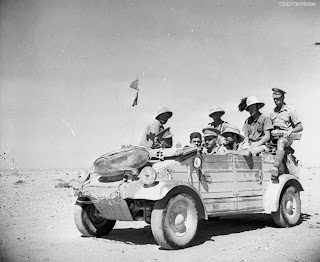
British troops in North Africa riding a captured German Kubelwagen, 20 June 1942 worldwartwo.filminspector.com
British troops drive a captured German Kubelwagen in North Africa, 20 June 1942.

Eastern Front: In Moscow on 20 June 1942, Joseph Stalin is in possession of the plans for the upcoming German Operation Blau, the planned offensive to capture the Soviet oil fields in the Caucasus. These papers were recovered from Major Joachim Reichel (now deceased) on 19 June 1942 after his plane was shot down by ground fire behind Soviet lines. While the plans are completely authentic and genuine, Stalin decides to disregard them because he believes they have been planted to deceive him.

In Crimea, both sides are experiencing supply shortages. Among other things, this compels a reduction in Luftwaffe flights by 40% and precise targeting of all bombs. The crews also are getting overworked, with some flying 25-30 missions per day. Fortunately for the Germans, Soviet resistance is crumbling and Luftwaffe war casualties are plummeting.

North of Severnaya Bay, the German 24th Infantry Division attacks the Lenin anti-aircraft and Northern Fort. While the Lenin position surrenders today, the Northern Fort holds out throughout the day despite the Germans using Goliath remote-controlled bombs and other techniques. In the south, the stalemate continues, with the Soviets retaining a firm grip on the critical Sapun Ridge and battering the nearby Wehrmacht forces with heavy artillery fire.

The Reichel Affair apparently has an immediate effect on German dispositions in Crimea. After many threats and indications that he would abandon the attempt to capture Sevastopol and turn it into a siege by transferring the essential Luftwaffe units to support Blau near Kharkov, Hitler suddenly tells Luftwaffe commander General von Richthofen that he can keep his air units in Crimea for the time being to finish the job. Richthofen joyfully writes in his diary, "Therefore, I feel reassured and can continue fighting in peace until we achieve final victory." This conclusion will turn out to be a bit premature but does reflect the upset and disequilibrium at Fuhrer Headquarters.

Luftwaffe attacks sink Royal Navy Landing Craft Tank HMS LCT-119 and LCT 150 off Tobruk.

Off Ak Mechet, Crimea, Romanian barge Danubius hits a mine laid by Soviet submarine L-6 and sinks.

Two women wearing the yellow Star of David badges in Paris, 20 June 1942 worldwartwo.filminspector.com
Women in Paris wearing the yellow Star of David badge, 20 June 1942 (Federal Archives Picture 183-B21356).

Battle of the Pacific: Japanese submarine I-26 (Yokota Minoru) shells the Estevan Point lighthouse on Vancouver Island in British Columbia. Accuracy is poor and nothing significant is hit. At the same time, I-26 first 25-30 5.5-inch (140 mm) rounds, then quickly escapes to the north and evades pursuit by five Royal Canadian Navy patrol vessels and a RCAF Supermarine Stranraer flying boat.

I-25 (Akiji Tagami) is also close to the North American coast and soon similarly will shell Fort Stevens, located at Columbia River, Oregon. During the early morning hours, it torpedoes Canadian freighter SS Fort Camosun off the coast of Washington. The freighter is badly damaged but survives to be towed into Puget Sound for repairs. It returns to service and the entire crew survives after abandoning the ship.

The U.S. Navy is still occupied with reorienting operations on an offensive footing following the dramatic success at Midway. So, local operations are the order of the day. Primarily, these are in the Aleutians, the one area of success for the Japanese.  USAAF 11th Air Force sends a bombing raid over Japanese-held Kiska Island that is hampered by poor weather conditions. Only three of nine bombers complete the mission, while three others abort and the final three divert to looking for a B-24 lost at sea on the 19th.

The crew of U.S. submarine USS S-27 (SS-132), which grounded and broke up on the 19th off Amchitka Island, makes it to a deserted village and awaits rescue. Much further south, B-17s of 5th Air Force bomb Lae Airfield on New Guinea. At Mubo, New Guinea, the 17th Australian Brigade repels a Japanese attack.

Janet Blair on the cover of Pix magazine, 20 June 1942 worldwartwo.filminspector.com
Singer/actress Janet Blair on the cover of Pix Magazine, 20 June 1942. Her most famous role was in "My Sister Eileen" (1942), for which undoubtedly this was some indirect publicity.

European Air Operations: During an RAF raid from Bourn to Emden, NF Oblt. G. Friedrich of III/NJG 1 shoots down British Wellington III bomber X3669 about 5 km southwest of Zandvoort. All four crew die.

Battle of the Atlantic: It is an oddly quiet day at sea in the Atlantic after many months of constant activity. There are no U-boat sinkings or major disasters at sea.

British 988-ton coaster Afon Dulais hits a mine and sinks near Beachy Head, East Sussex. There are no casualties.

German patrol boat V-1916 (Weser I) sinks from unknown causes somewhere in the Norwegian Sea.

Map of Tobruk battle, 20 June 1942 worldwartwo.filminspector.com
The battle of Tobruk, 20-21 June 1942.

Battle of the Mediterranean: General Erwin Rommel's Afrika Korps launches its assault on Tobruk only two days after reaching the port's perimeter. The Luftwaffe opens the attack at 05:20 by bombing the point of attack on Tobruk's southeastern defensive positions, with a theater-high 588 sorties. The Regia Aeronautica chips in with another 177 sorties. At 07:00, Gruppe Menny, positioned between the 15th and 21st Panzer Divisions, attacks in conjunction with a fierce artillery barrage. This achieves a breakthrough within 15 minutes, and the German 900th Engineer Battalion quickly enables a crossing of the port's anti-tank ditch. Panzers were rolling across by 08:30, and the infantry expands the breach.

The British defenders have not yet organized their defenses and are slow to respond to the unexpected onslaught. The defending 5th Mahratta Light Infantry immediately gives ground, and expected tank reinforcements never appear. The nearby Cameron Highlanders launch a counterattack, and then the 32nd Army Tank Brigade is ordered in, but it is too late. The British defensive effort is dispersed and overrun, aided by close German ground coordination with the Luftwaffe. By noon, the Germans have 113 tanks inside the perimeter, and by 13:30 they seize the critical Kings Cross road junction on Pilastrino Ridge. The British make a last stand by using 3.7-inch anti-aircraft guns as ground artillery, but this is ineffective. By 16:00, the port commander's headquarters, General Klopper, is under assault, and he has to escape hurriedly, losing contact with his command.

Having overcome the outer defenses, the panzers reach the port outskirts by 18:00. Realizing the developing catastrophe, British units begin blowing up port installations and ammunition dumps. By nightfall, the British defenses are in a chaotic state of disarray and the German 15th and 21st Panzer Divisions are poised to overcome all remaining defenses on the morrow.

USS Meade off NYC, 20 June 1942 worldwartwo.filminspector.com
U.S Navy destroyer USS Meade (DD-602) off New York City, 20 June 1942. This is during her delivery voyage from the Bethlehem Steel Company shipyard at Staten Island (Bureau of Ships Collection in the U.S. National Archives 19-N-30842).

Oddly, Fuhrer headquarters seems almost indifferent to Rommel's success. General Halder doesn't even mention it first in his list of the day's events, instead listing it fourth after "no change" on the Eastern Front, a mundane conference with the logistics chief, General Wagner, and a cursory description of the Reichel incident (which reflects poorly on OKH). When he finally does get to it, Halder writes:

Tobruk captured. Thus, the heavy battle in Cyrenaica has culminated on a victory that is of equally great value from the military and the political aspect.

This is one of the oddest entries in Halder's diary, completely distanced and remote from the actual state of affairs (Tobruk is not yet captured) and may reflect an underlying truth that seldom is brought out into the open. Halder and rest of OKH don't think highly of Rommel. He was not their first choice for command in Africa - General Paulus, now commander of Sixth Army, was. They view Rommel as a "loose cannon" whose victories are the result of insubordination and gambles. Rommel also has a reputation of not seeking approval for his operations. Finally, the OKH views the entire Mediterranean Theater as a sideshow that simply draws off forces that would be better employed on the theater of decision - the Eastern Front, which (not coincidentally) is completely under the control of the OKH and not the OKW (which controls western operations.

Thus, Rommel's successes are of far lesser import to the German High Command than to post-war Western accounts. Rommel only controls the equivalent of one corps, while OKH controls entire Army Groups. As long as Rommel stays out of trouble and doesn't require excess reinforcement, OKH really couldn't care less what he does. As to Hitler (who today, Halder notes, is back in East Prussia), he likely has a similar attitude but is simply happy that Rommel is keeping the Western Allies busy and giving him enough time to clear the table in the East.

Spy Stuff: The FBI picks up the German spies staying at a New York hotel following the surrender by leader George Dasch at FBI headquarters in Washington D.C. on the 19th. 

Allied Diplomacy: During discussions between Winston Churchill and President Roosevelt at the latter's Hyde Park, New York, estate, an agreement is reached to postpone an invasion of France (the Americans' preference) and instead invade North Africa (the British plan). This becomes Operation Torch and takes place in November 1942. 

US Military: Brigadier General Dwight D. Eisenhower is ordered to replace Major General James E. Chaney as Commanding General European Theater of Operations. This is a controversial choice, as Eisenhower thus leapfrogs over many more senior officers for such a prominent command. General George C. Marshall instructs Eisenhower to integrate all U.S. air units in the UK into the 8th Air Force and gives as the mission to attain "air supremacy over Western Continental Europe" in preparation for a future invasion of the Continent.

US Ninth Army under General Krueger establishes its headquarters at Milne Bay, New Guinea.
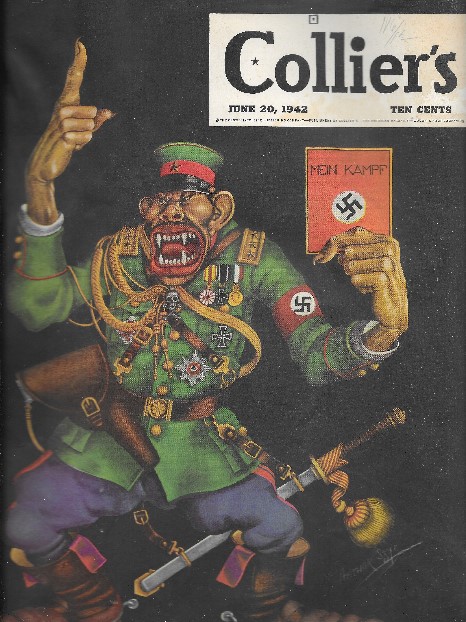
Collier's, 20 June 1942 worldwartwo.filminspector.com
Collier's, 20 June 1942 (Arthur Szyk).

Holocaust: Anne Frank discloses in her diary that she writes because she is lonely - there is nobody with whom she can share her secrets. She christens her diary "Kitty." Anne writes that she has a mother, father, and sister Margot, that they used to live in Frankfurt, Germany, and that they fled to Holland because of the persecution of people like them.

Four Polish prisoners at Auschwitz steal SS officer uniforms and drive a staff car out through the front gates. These are Eugeniusz Bendera, Stanisław Gustaw Jaster, Józef Lempart, and Kazimierz Piechowski. They are never recaptured and the last survivor, Piechowski, passes away on 15 December 2017 at the age of 98.

American Homefront: Comic book villain "Two-Face" is introduced in Detective Comics (the predecessor of DC Comics) issue #66 (the cover date is August 1942).

"Sleepy Lagoon" by Harry James and His Orchestra" becomes No. 1 on The Billboard National Best Selling Retail Records chart. It tops the chart for four weeks and becomes a standard.

Saturday Evening Post, 20 June 1942 worldwartwo.filminspector.com
"Women at Dude Ranch," Saturday Evening Post, 20 June 1942 (Fred Lukekens).

Future History: Brian Douglas Wilson is born in Inglewood, California. After moving to Hawthorne, California, Wilson begins to exhibit a special musical ability. He and his two younger brothers (Dennis, born 1944, and Carl, 1946) begin singing harmonies together while Brian plays the accordion or piano. At nine, Brian writes (or, more accurately, adapts) his first song, and writes his first independent song for a 4th-grade school project. He obsessively plays the piano and listens to the radio. After playing sports in high school, including being the quarterback of the Hawthorne football team, Brian attends El Camino Junior College, but drops out when he is disappointed at his teachers' attitudes toward pop music. In 1961, Brian and his brothers, cousin Mike Love, and friend Al Jardine form a musical group. With father Murry Wilson serving as manager, the group continues developing their skills. Brian's composition "Surfin," recorded by another act, becomes their first local LA hit. Their label, Candix Records, now changes the group's name to the "Beach Boys," but the label soon sells their contract to another label, but Murry decides to terminate it. They then attract the attention of Capitol Records, which begins releasing their tracks as singles, including "Surfin' Safari" and "409." When these become national hits, the future of the Beach Boys is assured and they become legendary performers, with their most famous album "Pet Sounds." Brian is recognized as a positive influence on The Beatles, whose Paul McCartney was born exactly two days before Brian on 18 June 1942. He thereafter battles mental health issues but largely overcomes them, with occasional relapses and continuing manageable stresses. As of writing, Brian Wilson continues touring and songwriting.  

The New Yorker, 20 June 1942 worldwartwo.filminspector.com
New Yorker, 20 June 1942 (Constantin Alajalov).

2022

Friday, March 26, 2021

April 24, 1942: When Will Help Arrive?

Friday 24 April 192

Manila being bombed, 24 April 1942 worldwartwo.filminspector.com
Axis bombs fall on Malta, 24 April 1942.
Battle of the Pacific: Japanese planes raid Port Moresby, New Guinea, on 24 April 1942. They destroy two B-26 bombers at 7-Mile Drome, some PBY Catalinas moored in the harbor, and three P-40E Kittyhawk fighters of RAF No. 75 Squadron.

The Japanese are bombing and shelling the sole remaining US Army outpost in the Philippines located in the caves on Corregidor Island without respite. Much of the world has forgotten about this lone holdout against the Japanese, mentally writing it off when General Douglas MacArthur escaped in mid-March. The troops there no longer seem to be at the top of his priority list, either. However, the troops and service personnel on Corregidor, some of whom are women, are suffering daily. A few trapped soldiers maintain diaries. One of them is Denny Williams.
US Army Nurse Denny Williams.
US Army Nurse Denny Williams, from Culpepper, Virginia, makes dispassionate but telling entries in her diary throughout the Corregidor ordeal. Williams watches some fortunate friends get flown out on seaplanes, but there is no happy ending for her and many others. She writes that "The large blowers in the ventilators have to be shut off when we get direct hits because the blowers circulate the dust caused from the bombs." The stress is inescapable, and to leave the tunnels just to hang some laundry is to risk your life. She records that everyone is making wisecracks to relieve the tension, but "My hands tremble when I’m giving anesthetics; evidently I’m more frightened than I realize." This is not unusual, as "I am not alone in this for even the hands of the calmest doctors tremble." Denny Williams concludes the day's entry with, "When will help arrive?"

US Navy submarine USS Trout (SS-202) torpedoes and sinks Japanese transport Tachibana Maru just south of Susami Kii, Japan (south of Osaka).
Manila Tribune, 24 April 1942 worldwartwo.filminspector.com
The Manila, Philippines, Tribune, 24 April 1942.
Battle of the Indian Ocean: The Battle of Hopong-Taunggyi in Burma ends after a fierce offensive by the motorized 200th Infantry Division of the Chinese National Revolutionary Army that captures Taunggyi. The Japanese, however, shrug off the loss and continue advancing toward Lashio.

Eastern Front: With the spring thaw ("Rasputitsa") in full swing on 24 April 1942, operations remain in a lull. General Franz Halder seems bored as he writes the day's diary entry:

Situation: Unchanged. Enemy continues relieving and regrouping movements opposite the southern part of the front. All quiet in Army Group North. 

The Germans remain worried about the possible Soviet use of poison gas, and Halder discusses preparedness for this and also "Rocket Projector troops" (Nebeltruppen, who man Nebelwerfer mortars and rockets) with General Wilhelm-Francis Ochsner.

The Nebelwerfer have been in use throughout the war and their use is being expanded by both sides on the Eastern Front. The Red Army has its own version, Katyusha rocket launchers. The advantage of these types of weapons is that they are light and inexpensive. These types of weapons also have the benefit of producing characteristic scary noises that cause G.I.s to nickname them "Screaming Mimis."
Bomb damage in Exeter, England, 24 April 1942 worldwartwo.filminspector.com
Luftwaffe bomb damage in the historic cathedral at Exeter, April 1942.
European Air Operations: The Luftwaffe conducts the first two so-called "Baedeker Raids" against Exeter on the nights of 23/24 and 24/25 April 1942. The first raid is a dud, causing little damage, but the second kills over 80 people. Luftflotte 3 conducts the raids using KG2 and KG106, led by pathfinders of I/KG100. The raids are moderate in size, comprised of 30-40 bombers, but the bombers fly two sorties each night. This leads to a terrifying, sleepless night. These raids cause more casualties than usual because the standard two sorties are separated by several hours that lull the residents into a false sense of security until the pattern becomes known.

During the day, the RAF sends a dozen Boston bombers to attack Flushing docks and half a dozen to attack the Abbeville airfields (these latter bombers are recalled). No planes are lost.

After dark, the RAF raids Rostock, Germany, for the second night in a row. It sends 125 bombers, with 91 targeting the town and 34 the Heinkel aircraft factory on its outskirts. Once again, the Heinkel factory emerges unscathed, but the town center sustains heavy damage. In subsidiary operations, 39 bombers attack Dunkirk, four Blenheim bombers independently raid the Low Countries (one is lost), and there are three leaflet flights.

Due to battle losses that cannot be replenished with Czechs, the Czechoslovak No. 311 Squadron is withdrawn from RAF Bomber Command and reassigned to Coastal Command. The Czech squadron finishes with over 1000 bombing sorties between 10 September 1940 and 24 April 1942.
Soviet submarine Shch-401 worldwartwo.filminspector.com
A pre-war photo of Soviet submarine Shch-401, sunk by Friendly Fire on or about 24 April 1942.
Battle of the Atlantic: U-136 (Kptlt. Heinrich Zimmermann), on its second patrol out of St. Nazaire, torpedoes and sinks 7244-ton British freighter Empire Drum just before midnight on the 24th about 280 nautical miles (520 km) southeast of New York City. The ship is carrying 1270 tons of explosives and sinks just after midnight on the 25th after Zimmermann pumps a coup de grâce into the ship. He then surfaces and questions the survivors, examines the wreckage, and departs. All 41 crewmen survive, picked up by USS Roper and Swedish freighter Venezia.

Soviet submarine Shch-401 (Capt 3rd Class Moiseev) is sunk in a case of "Friendly Fire" by torpedo-cutters "TKA N13" and "TKA N14." The cutters of the Northern Fleet use depth charges and torpedoes to sink the sub near Komagneset, Vardø, Finnmark Fylke, Norway. Different sources list this action as occurring on either 23 or 25 April 1942. This sinking occurs the day after Shch-401 attacked a German convoy and was damaged by German submarine chasers.

Danish 1359-ton ferry Kalundborg hits a mine and is badly damaged in Kalundborg Fjord. There are no deaths and some passengers are lightly injured. Tugs attempt to tow the ferry port but it sinks.
McComb Journal, 24 April 1942 worldwartwo.filminspector.com
The 24 April 1942 McComb, Mississippi, Journal headlines "Reds Hold Landed U.S. Bomber, Allies Keep Up Raids on Rabaul."
Battle of the Mediterranean: Axis air raids on Malta continue, focusing mainly on the RAF's airfields and the Grand Harbour area. There are many civilian and military casualties in Valletta and Floriana. The first raids are at 05:30 and they continue throughout the day and night. The RAF is down to four Spitfire fighters and about six Hurricane fighters, with some of these planes grounded at various times with damage. The RAF claims three enemy planes destroyed and loses two Wellington bombers, with others damaged, in retaliatory raids on Comiso Airfield in Sicily.

British Military: April 24, 1942, is the first flight of the Miles Master M.25 Martinet (LR 241), performed at Woodley Aerodrome by test pilot Flight Lieutenant Thomas Rose. This is a target tug aircraft used by the RAF and affiliated air forces throughout the remainder of World War II. The Martinet is necessary because front-line aircraft are being shot up too fast for enough to become "obsolete" and only suitable for target-towing duties. Some eventually are developed as radio-controlled target drones pursuant to secret Specification Q.10.43, something the United States also is working on. There are 1,724 Martinets produced in total and some remain in the RAF into the early 1950s.
US Naval base at Argentia, Newfoundland, 24 April 1942 worldwartwo.filminspector.com
U.S. Naval Air Station and Naval Operating Base, Argentia, Newfoundland, April 24, 1942 (U.S. Navy photo NH 113541).
US Military: New color specifications for naval aircraft go into effect. Service aircraft now are non-specular light gray except for non-specular blue-gray on surfaces visible from above. Advanced trainers are to be glossy aircraft gray with glossy orange-yellow on the wing and aileron surfaces, with primary trainers only having gray on their landing gear.

General George C. Marshall sends a thank-you note to General George Patton in appreciation for the gift of a goblet fashioned from a copper oil can. "Dear Patton," the letter begins, "Mrs. Marshall and I were much intrigued with the oil cup." General Patton at this time is commander of the Desert Training Center in the Mojave Desert to prepare for desert warfare. He also commands elements of the First Armored Corps and the Second and Third Armies.

The U.S. Navy announces that it will take over the Sanford (Florida) Municipal Airport (later known as the Orlando (Florida) Sanford International Airport). This is big news for the sleepy town and gets a banner headline in the 24 April 1942 "The Sanford Herald." This decision has a huge impact on the area, as the Navy is ready to spend millions of dollars upgrading the facilities.

The US Army issues Technical Manual "The Army Cook, April 24, 1942."
Finnish Army soldier, 24 April 1942 worldwartwo.filminspector.com
Finnish Army Company commander Cpt. Hakala is taking a morning wash. April 24, 1942, Voitatunturi (Voittotunturi). Colorized. [SA-Kuva].
Finnish Military: Kenraalimajuri (Major General) K. I. Viljanen, the commander of the 4th Infantry Division, and those accompanying him are killed when they get lost and wander into a Finnish minefield near Seesjürvi. Only one man from the group survives.

Holocaust: Continuing the gradual degradation of rights for Jewish citizens in the Reich, the government bans all Jews from using public transport. This is a great handicap, as private vehicles are increasingly rare due to production and fuel shortages.

German Homefront:  Plenipotentiary-General for Employment Gauleiter Fritz Sauckel issues a decree requiring women to work in manufacturing. This reflects a growing manpower shortage as casualties on the Eastern Front mount and production of munitions lags.

Canadian Homefront: Lucy Maud Montgomery, O.B.E, author of novels including "Anne of Green Gables," passes away at the age of 67.
Lieutenant Ramlo, 24 April 1942 worldwartwo.filminspector.com
"Official Portrait of US Marine Corps (USMC) Second Lieutenant (2LT) Orvin H. Ramlo, taken at San Diego, California (CA), April 24, 1942. 2LT Ramlo is an ace pilot and is credited with 5 kills." (National Archives 6608411). Ramlo wound up with seven kills and won the US Navy Cross on 10 November 1942. His son, Orvin Jr., became a Colonel and passed away in 2017.
American Homefront: Japanese residents of San Francisco, Alameda, and Contra Costa Counties are ordered to report for registration over the weekend prior to their evacuation. Authorities will take them to the new Tanforan assembly center. The plan is to resettle them in the Gila River Valley, 50 miles southeast of Phoenix, Arizona. Locals in that area see positives from the relocation, with a front-page article in the 24 April 1942 Casa Grande (Arizona) Dispatch titled, "Construction on Japanese Relocation Quarters Will Stimulate Local Business."

The San Francisco supervisor's committee on city planning requests a prohibition on liquor licenses in the areas being evacuated by Japanese residents (bounded by Ellis, Gough, California, and Fillmore Streets). It also proposes to ask Congress to impose a moratorium on all mortgages held by evacuating Japanese citizens.

A "Behind the News" commentary by Arthur Caylor in the San Francisco News warns "Uncle Heiny or Cousin Guiseppe" to discard "certain cameras, short-wave radios and other contraband" or face raids by "G-men."

Warner Bros. releases the comedy "Larceny, Inc." directed by Lloyd Bacon and starring Edward G. Robinson, Jane Wyman, Broderick Crawford, Jack Carson, and Anthony Quinn. Jackie Gleason makes an early appearance as a soda jerk. Robinson, who plays a gangster trying to go straight, takes the film to "soften his image" after a long run of tough gangster and policeman roles. Some reviewers have seen parallels between "Larceny, Inc." and Woody Allen's 2000 film "Small Time Crooks."

C.H. Laessig, who opened the very first gas station in the United States at 418 South Teresa in St. Louis, Missouri, passes away. He and his partner, Harry Grenner, later opened a chain of 40 gas stations across the city.
People displaced by the TVA 24 April 1942 worldwartwo.filminspector.com
One of a series of photos taken on 24 April 1942 of families displaced by the Tennessee Valley Authority's Fort Loudoun Dam (located 602 miles, or 969 km, upstream from the mouth of the Tennessee River). The dam opened on 2 August 1943. Some people view the displacement of these families as a sign of the indifference of government agencies to the needs of the common people (National Archives at Atlanta).
Future History: Barbara Joan "Barbra" Streisand is born in Brooklyn, New York. She takes after her mother, who occasionally sings professionally, and quickly gains a reputation in her neighborhood for singing in front of her apartment building. She makes her first demo tape at age 13, but her real passion becomes acting. A job as an usher at the Lunt-Fontanne Theater on Broadway in 1960 leads her to audition for the play ("The Sound of Music"), though she isn't hired. A talent show appearance at a Greenwich Village (gay) nightclub turns into a continuing gig, which leads to other gigs, and then some stage roles. Around this time she changes her stage name from "Barbara" to "Barbra." Further roles come along, then television appearances including "The Tonight Show" and "The Ed Sullivan Show." Her first album in 1963, "The Barbara Streisand Album," hits the top 10 on the Billboard charts and wins three Grammys. After that, her career is assured, and ultimately Barbra Streisand becomes a legendary singer and actress who is still active as of this writing in 2021.

Nurse Denny Williams survives the war after spending time in the Santo Tomas POW camp. She passes away in 1997 at the age of 89.
Evacuation orders for Japanese 24 April 1942 worldwartwo.filminspector.com
Posting of Japanese Exclusion Order (No. 17, dated April 24, 1942) in Seattle, Washington, 1942 Social Trends in Seattle Vol 14 (Seattle: University of Washington Press, 1944).

April 1942

April 1, 1942: Convoys Come to the USA 
April 2, 1942: Doolittle Raiders Leave Port
April 3, 1942: Japanese Attack in Bataan
April 4, 1942: Luftwaffe Attacks Kronstadt
April 5, 1942: Japanese Easter Sunday Raid on Ceylon
April 6, 1942: Japanese Devastation In Bay of Bengal
April 7, 1942: Valletta, Malta, Destroyed
April 8, 1942: US Bataan Defenses Collapse
April 9, 1942: US Defeat in Bataan
April 10, 1942: The Bataan Death March
April 11, 1942: The Sea War Heats Up
April 12, 1942: Essen Raids Conclude Dismally
April 13, 1942: Convoy QP-10 Destruction
April 14, 1942: Demyansk Breakout Attempt
April 15, 1942: Sobibor Extermination Camp Opens
April 16, 1942: Oil Field Ablaze in Burma
April 17, 1942: The Disastrous Augsburg Raid
April 18, 1942: The Doolittle Raid bombs Japan
April 19, 1942: British in Burma Escape
April 20, 1942: The Operation Calendar Disaster
April 21, 1942: Germans Relieve Demyansk

2021