Showing posts with label SBD Dauntless. Show all posts

Monday, October 18, 2021

June 6, 1942: Japanese Invade Aleutian Islands

Saturday 6 June 1942
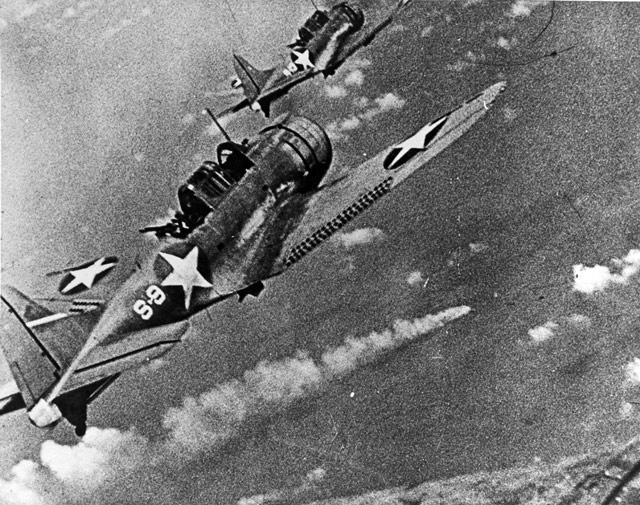
Battle of Midway 6 June 1942 worldwartwo.filminspector.com
"SBD Dauntless dive bombers from USS Hornet (CV-8) approaching the burning Japanese heavy cruiser Mikuma to make the third set of attacks on her, during the early afternoon of 6 June 1942. Mikuma had been hit earlier by strikes from Hornet and USS Enterprise (CV-6), leaving her dead in the water and fatally damaged." Naval History and Heritage Command 80-G-17054.

Battle of the Pacific: Despite having suffered staggering losses off Midway Island on 4 June, the Japanese follow through on their subsidiary campaign in the Aleutian Islands on 6 June 1942. The Japanese Northern Area Fleet, commanded by Vice-Admiral Boshiro Hosogaya, lands 500 troops of the elite Maizura 3rd Special Landing Force and 700 laborers on Kiska Island at 10:27. 

This is the first invasion of the continental United States since the War of 1812, though Alaska is not yet a state. The local Unangax (Aleuts) offer virtually no resistance and no U.S. military forces intervene at this time despite some fruitless bombers searching for the Japanese. There are U.S. soldiers of the U.S. Navy meteorological service on Kiska, but they disappear into the rugged interior. The Japanese rename the island Narukami.

Eight P-38s do spot and attack a ship, but it turns out to be a Soviet freighter. The Americans, though, are quite concerned about both a Japanese land invasion south toward Washington State through Canada and Japanese bombing raids from the Aleutians (neither of which the Japanese plan) and begin preparing a response.

Off Midway Island, things just keep getting worse for the Japanese. Having lost four irreplaceable aircraft carriers to the U.S. Navy's one, they now lose another important ship. Douglas SBD Dauntless dive bombers attack and sink cruiser Mikuma, already damaged in previous days' raids. Mikuma and fellow cruiser Mogami are heading for refuge at Wake Island when 31 SBDs from USS Enterprise and Hornet attack and hit Mikuma with five bombs and Mogami with six.
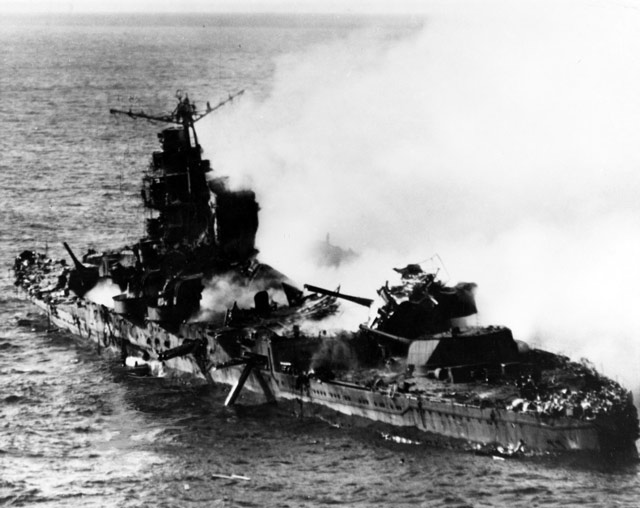
Japanese cruiser Mikuma under attack, 6 June 1942 worldwartwo.filminspector.com
"Japanese heavy cruiser Mikuma, photographed from a USS Enterprise (CV-6) SBD aircraft during the afternoon of 6 June 1942, after she had been bombed by planes from Enterprise and USS Hornet (CV-8). Note her shattered midships structure, torpedo dangling from the after port side tubes and wreckage atop her number four eight-inch gun turret." Naval History and Heritage Command 80-G-414422.

While the Mikuma may theoretically have survived that many bomb hits, one of them sets off the torpedoes it is carrying and they destroy the ship. There are 650 deaths and 240 survivors, who are picked up by destroyers Asashio and Arashio (both also hit by one bomb each. U.S. Navy submarine Trout investigates the scene on 9 June and picks up an additional two Japanese crewmen and makes them POWs.

An example of the "fog of war" almost causes a tragedy for the U.S. forces. A late-morning B-17 raid by 26 bombers based on Midway (led by Lt. Col. Brooke Allen) against the fleeing Japanese cruisers fails to find them. However, they do spot a target and six B-17s drop their loads on it thinking it is one of the cruisers. In fact, it is U.S. submarine Grayling. Fortunately for the Americans, level-bombing accuracy at sea lives down to its terrible reputation, no harm is done, and Grayling quickly dives before any bombs come close. 

The Japanese do "get one back" when submarine I-168, which previously shelled Midway Island, spots crippled USS Yorktown and attacks. In addition to pumping one more torpedo into the badly listing aircraft carrier, the submarine torpedoes and sinks the U.S. Navy destroyer USS Hammann (DD-412) around noon. Hammann has been providing auxiliary power to USS Yorktown as a damage control party desperately tries to keep it from sinking. Only one of four torpedoes hits the destroyer, but it is enough to break the ship in half. The destroyer sinks in just four minutes, and after it slips under, its armed depth charges explode, causing a violent underwater explosion and killing many men in the water. There are 80 deaths from the 192-man crew. I-168, despite being surrounded by U.S. Navy screening destroyers, escapes with minor damage.
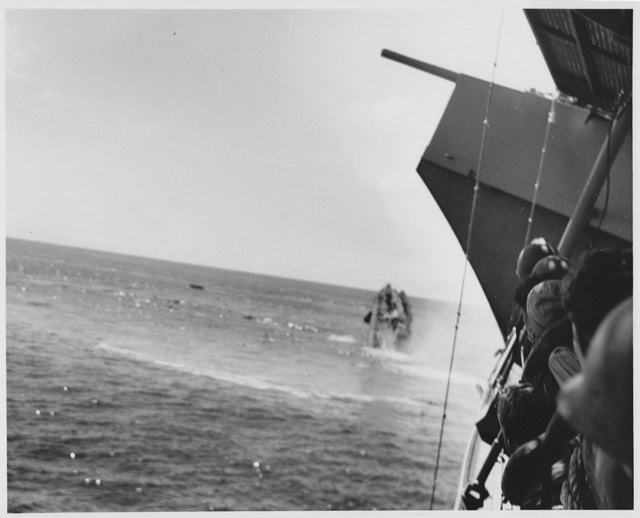
US destroyer Hammann sinking, 6 June 1942 worldwartwo.filminspector.com
"USS Hammann (DD-412) sinking with stern high, after being torpedoed by Japanese submarine I-168 in the afternoon of 6 June 1942. Photographed from the starboard forecastle deck of USS Yorktown (CV-5) by Photographer 2nd Class William G. Roy. Angular structure in right foreground is the front of Yorktown's forward starboard 5-inch gun gallery. Note knotted lines hanging down from the carrier's flight deck, remaining from her initial abandonment on 4 June." Naval History and Heritage Command 80-G-32320.

With ships on both sides still sinking (such as Yorktown) and already sunk, there are hundreds of men struggling to survive in the waters around Midway. The island's PT-boats and PBY Catalinas spend this and surrounding days picking up 27 men.

U.S. fleet carrier Saratoga, which missed the Battle of Midway due to repairs and upgrades being performed on the West Coast, arrives in Honolulu today. It quickly prepares to depart on the 7th to ferry replacement aircraft and crew to Enterprise and Hornet still stationed northeast of Midway. While most histories record 7 June 1942 as the final day of the Battle of Midway, today effectively marks the end of major hostilities.

The state-controlled Tokyo press quickly informs the public of the "great victory" in the Aleutian Islands. However, no mention is made of the catastrophic events for the Japanese Navy off of Midway Island until the war is over.
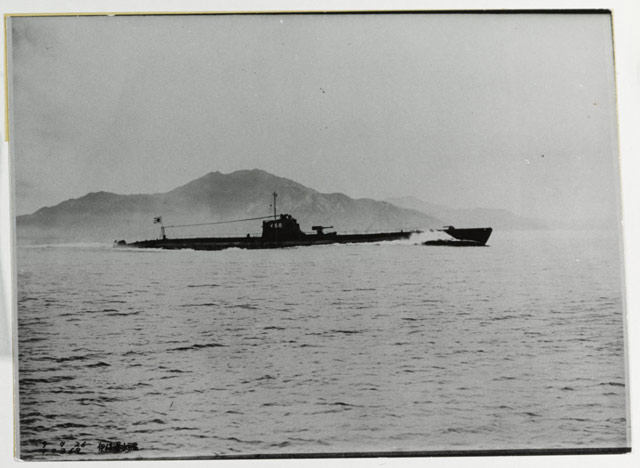
Japanese submarine U-168 which sank US destroyer Hammann on 6 June 1942 worldwartwo.filminspector.com
"I-168. (Japanese Submarine, 1933-1943) Underway in March 1934, probably during her trials. This submarine was renamed I-168 in May 1942. She torpedoed USS Yorktown (CV-5) on 6 June 1942, causing damage that led to the carrier's sinking the following morning." Naval History and Heritage Command NH 73054 I-68.

Battle of the Indian Ocean: Japanese submarine I-16 torpedoes, shells, and sinks 3839-ton Yugoslav freighter Susak in the Mozambique Channel. There are seven deaths.

I-10 torpedoes and sinks U.S. freighter Melvin H. Baker 45 miles off the mainland coast. All 48 men aboard survive and are picked up by British freighter Twickenham.

Eastern Front: German General Erich von Manstein makes his final preparations for Operation Stoerfang ("Sturgeon Catch"), the land assault against Sevastopol.  Meanwhile, the Luftwaffe continues an overpowering assault against the port, facing virtually no opposition from airports almost within sight of the defenders. Between 3 and 6 June, the Luftwaffe has flown 2355 sorties, dropping 1800 tons of high explosives 23,800 1.1kg incendiary bombs. In the two weeks from 24 May to 6 June, the Luftwaffe also has dropped 638,000 propaganda leaflets (50,000 per day) with instructions on how to surrender.

The massive artillery barrage that includes the biggest guns in military history, including the Karl and Gustav guns, shifts its targeting today to the defenses south of the city that face the German 30th Army Corps.

Rather than evacuating the port, the Soviets actually make every effort to reinforce it, slipping flotilla leader Tashkent, the destroyer Bezuprechnyi, and transport Abkhaziya through the blockade to deliver 2,785 more Red Army defenders.
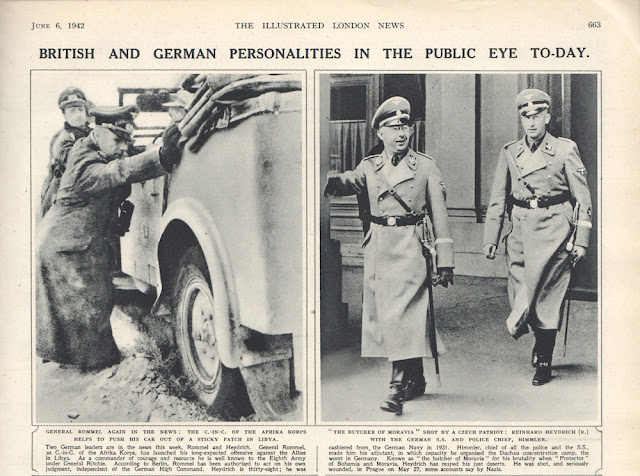
Illustrated London News, 6 June 1942 worldwartwo.filminspector.com
The Illustrated London News of 6 June 1942 features photos of German General Erwin Rommel, left, and recently deceased General Reinhard Heydrich, right (with Heinrich Himmler). Rommel is shown pushing his command car out of some trouble.

European Air Operations: The weather is warm, with plenty of ground haze below 1500 feet. The RAF focuses mainly on convoy protection.

R.A.A.F. Catalinas of RAF No. 10 Squadron, using Leigh Lights, bomb and damage Italian submarine Luigi Torelli in the Bay of Biscay. The submarine's crew manages to beach it at Santander, Spain, to prevent sinking. There is one death and one wounded crewman. The ship is temporarily repaired and sailed to France on 14 July for permanent repairs.

Hptm. Helmut Lent, Gruppenkommanduer of II./NJG 2, is awarded the Eichenlaub (No. Ninety-eight) after 34 night victories and 8 by day.
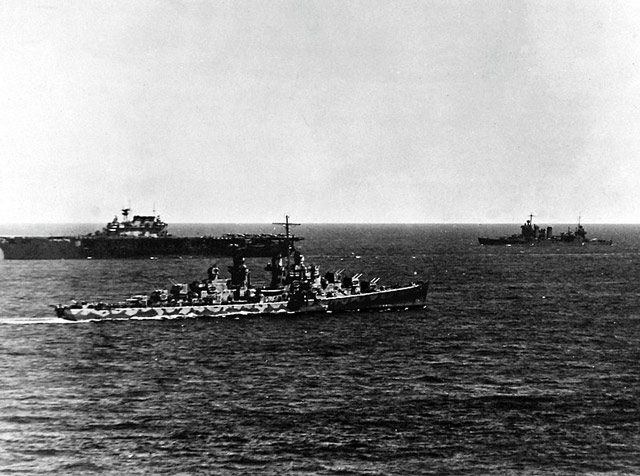
USS Atlanta with Hornet in the background, 6 June 1942 worldwartwo.filminspector.com
"A close-up of USS Atlanta (CL 51) with USS Hornet (CV 8) and USS Phelps (DD 360), all of Task Force 16, in background. Picture was made during the third day of the battle as Atlanta came up to offer assistance to the destroyer, which had broken down temporarily because of fuel shortage." 6 June 1942. Naval History and Heritage Command 80-G-88908

Battle of the Atlantic: It is a busy day for two German raiders operating in the South Atlantic east of Brazil. The 1940-41 glory days of the raiders are over and now they have to operate in remote areas to avoid detection. That doesn't mean they don't get the occasional moment of excitement. This happens during the Action of 6 June 1942.

In one incident, German raider Michel (Schiffe 28) spots disabled and drifting 7176-ton U.S. freighter George Clymer midway between Brazil and Africa. The Michel launches its motor torpedo boat Esan, which torpedoes and badly damages the freighter. One man perishes in the attack. The crew abandons the ship but reboards it on the 8th when it does not sink. however, the situation is hopeless and the crew is picked up by the British armed merchant cruiser HMS Alcantara. That is the last anyone sees of George Clymer, which remains stubbornly afloat. Exactly when and where the George Clymer sinks is unknown.

German raider Stier (Schiffe 23) has been quietly operating in the South Atlantic with limited success since leaving Royan, France in late May 1942. Today, Stier is cruising 500 miles (800 km) east of Pernambuco, Brazil, in overcast weather when it spots 10,170-ton U.S. tanker Stanvac Calcutta. Appearing suddenly out of a squall, Stier fires a warning shot and signals the tanker's crew to prepare to be boarded.

The Stanvac Calcutta, however, is heavily armed for a tanker. It has one 4-inch (102 mm)/50-caliber naval gun salvaged from World War I and a 5 inch (127 mm)/25-caliber anti-aircraft gun. Stier, meanwhile, has six 150-millimeter (6 in) guns, one 37 mm (1.5 in) gun, two 20 mm (0.79 in) cannons, and two torpedo tubes. So, there's a lot of firepower on both sides, though Stier outguns the tanker by a substantial margin.

The tanker's crew, led by Captain Gustav O. Karlsson, decides to not comply with the Stier's order to stop and opens fire. Led by Ensign Edward L. Anderson, the tanker's gunners get off several shots with both guns (the larger gun in the gun, smaller in the bow). Despite missing with most of their shots, the gunners do hit and disable one of Stier's 150mm guns. The Stier's crew then returns fire with 148 shells.

The battle lasts for 15 minutes, during which the Germans score a hit on the tanker's bridge, killing Captain Karlsson and several others. The Americans continue firing until their ammunition is exhausted. At this point, Stier Captain Horst Gerlach fires a torpedo that strikes Stanvac Calcutta on the port side. This kills several sailors and causes damage that leads to a sharp list and eventual sinking. The tanker's crew then abandons ship. Gerlach's men lower their own boats and rescue the Americans struggling in the water.

The Action of 6 June 1942 shows several hard truths about the Battle of the Atlantic. One is that merchant ships armed with a few guns stand little chance against raiders like Stier that are designed for combat even if they aren't true warships. Another is that these surface combats kill a lot of crewmen, as Stanvac Calcutta has 16 men killed in action, one dying later onboard Stier, fourteen men wounded, and 37 prisoners taken (the Stier only suffers two wounded men).

Actions like that of 6 June 1942 call into question the whole concept of arming merchant ships, which requires a lot of effort and dedicated gunners on hundreds of ships. However, later events involving Stier will redeem this idea somewhat. For their pains, the Stanvac Calcutta's crew later are awarded the Merchant Marine Gallant Ship Citation and Ensign Anderson is promoted (while a POW) to the rank of lieutenant commander. The tanker crew winds up in a Japanese POW camp.
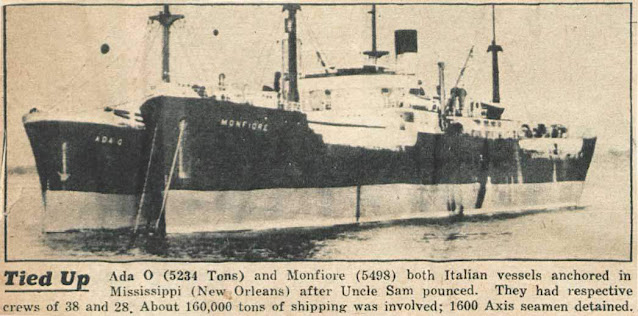
Freighter Hermis in the background, sunk on 6 June 1942 worldwartwo.filminspector.com
Coal-burning freighter Hermis is shown at left while still called "Ada O." Hermis was an Italian vessel anchored in New Orleans when seized in 1941 and pressed into U.S. service. Sunk on 6 June 1942.

There are also the usual U-boat sinkings, these days confined to the Caribbean.

U-68 (KrvKpt. Karl-Friedrich Merten), on its fourth patrol out of Lorient, torpedoes and sinks 13,006-ton Panamanian tanker C.O. Stillman 60 miles southwest of Puerto Rico. There are three deaths and 55 survivors,  most of whom are picked up by US Coast Guard patrol boat #83310 while 30 sail their lifeboats to Puerto Rico.

U-107 (Kptlt. Harald Gelhaus), on its sixth patrol out of Lorient, torpedoes and sinks 3910-ton Honduran freighter Castilla east of Cancun and south of western Cuba. One torpedo hits and causes the ship to sink quickly stern-first. The crew can't launch lifeboats and take to three rafts. There are 24 deaths (including one who dies on a raft) 35 survivors, who are picked up by USS Nike (WPC-112) after six days. Some sources place this sinking on 7 June 1942.

U-158 (Kptlt. Erwin Rostin), on its second patrol out of Lorient, torpedoes and sinks 5234-ton Panamanian freighter Hermis west of Havana and northeast of Cancun. Two torpedoes strike the ship on the port side but the engines continue running due to an inability to stop them due to damage. Rostin surfaces and uses his deck gun to finish off the freighter, setting it on fire. There is one death and 46 survivors, who are picked up by US Army transport Toloa. The ship does not sink for at least 12 hours and this sinking is sometimes listed as occurring on 7 June 1942.

Dutch 197-ton freighter Antares hits a mine and sinks off the Dutch coast.
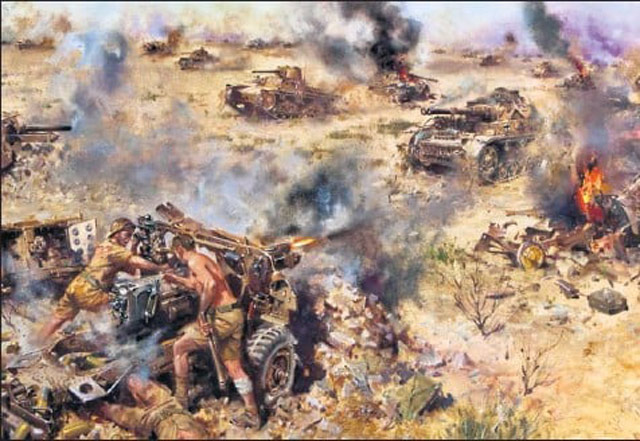
"Battle of Knightsbridge 6th June 1942" worldwartwo.filminspector.com
"The Battle of Knightsbridge, 6th June 1942," by Terence Cuneo (1907-1996). Shown are the 426th Battery of the 107th Regiment Royal Horse Artillery and the South Nottinghamshire Hussars, panzer of the Afrika Korps attacking. The 426th ultimately was forced to surrender.

Battle of the Mediterranean: After a wild day of attack and counter-attack between German and British troops on 5 June, the front settles down again today. However, German General Erwin Rommel retains command of the battlefield after his forces destroyed dozens of Allied tanks. He sends out armed reconnaissance to test the British lines and maintains pressure on the surrounded Free French garrison at Bir Hakeim. For their part, the British engage in harassing attacks against the German supply lines using the 7th Motor Brigade and 29th Indian Infantry Brigade.

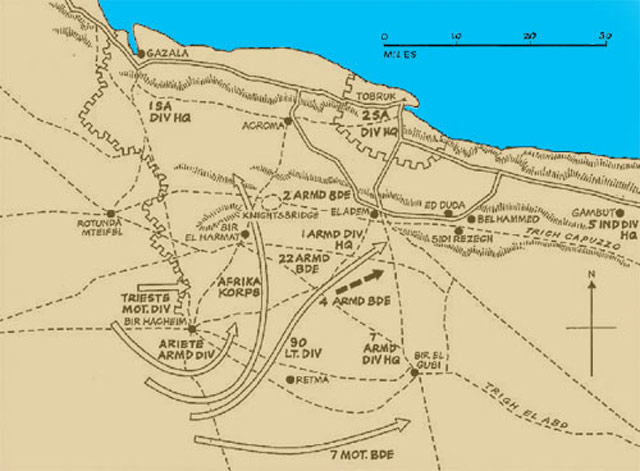
The main action of the day is an attack at 11:00 by the German 90th Light Division against Bir Hakeim. This involves a determined effort by troops and pioneers to clear a way through the minefields surrounding the fortress, which are divided into two perimeters. By nightfall, the Germans manage to get through the outer minefield and into the inner minefield to within 800 meters (900 yards) of the fortress. The advance, while threatening to the Free French, also leaves the German troops exposed to Desert Air Force attacks on the 7th.

The Battle of Knightsbridge proceeds as the 15th Panzer Division attacks northward. The British 22nd Armoured Brigade continues to give ground after having lost dozens of its tanks. The German objective is El Adem, but the 201st Guard Brigade is ferociously defending the approaches to Tobruk.

Operation Aberdeen, the Eighth Army's counterattack begun on 4/5 June against the German Afrika Korps panzers, ends today after having accomplished nothing but the loss of numerous British troops and tanks. British Eighth Army commander General Neil Ritchie and Middle East Commander-in-Chief Claude Auchinleck now face the prospect of not only losing the battle but also all of Libya and much of Egypt unless they can find some way to stop Rommel's attacks. Among the desperate options considered are withdrawing the Free French from Bir Hakeim to free up the 7th Motor Brigade. However, this is rejected as the French seem to be in a good defensive situation.

Oblt. Hans-Joachim Marseille of 3./JG 27, currently operating in North Africa, receives the Eichenlaub for achieving 75 victories. Marseille once was considered a disciplinary problem but now is revered by his colleagues as a legend.
Battle of the Gazala Line, 6 June 1942" worldwartwo.filminspector.com
A map showing the military situation in Libya ca. 6 June 1942. The 15th Panzer Division thrust through the British Knightsbridge defensive position is shown by the upward arrow in the center, with a separate thrust to the south of Tobruk at the upper right. The map makes clear the extreme jeopardy of the Allied position at Tobruk, though nobody on either side is thinking about it just yet.

American Homefront: At the Belmont Stakes, the third jewel of the Triple Crown, the chestnut stallion Shut Out is the winner. Having also won the Kentucky Derby, Shut Out just misses immortality by having lost the Preakness Stakes to Alsab. Shut Out continues racing until 1944, when it is retired and put out to stud until passing away in 1964.

Future History: Klaus Bednarz is born in  Falkensee, Province of Brandenburg, Germany. Bednarz becomes a popular West German correspondent, author, and television host, particularly of the TV show Monitor. Klaus Bednarz passes away on 14 April 2015.
L'Illustration, 6 June 1942" worldwartwo.filminspector.com
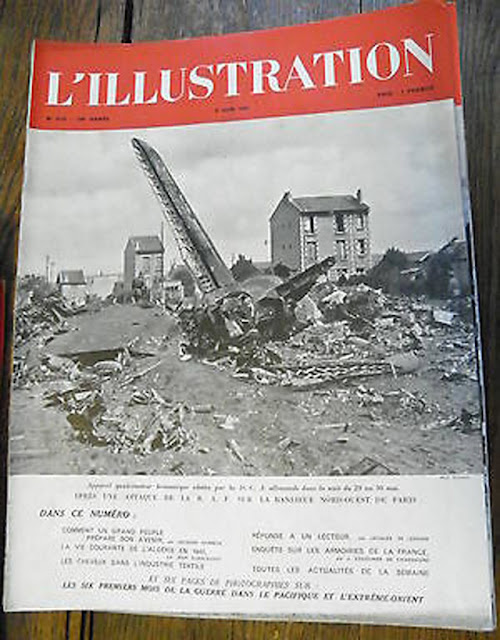
L'Illustration, 6 June 1942.

2021

Tuesday, October 5, 2021

June 4, 1942: Japanese Lose Four Carriers to One U.S. Carrier

Thursday 4 June 1942

USS Yorktown sinknig 4 June 1942 worldwartwo.filminspector.com
"The U.S. Navy aircraft carrier USS Yorktown (CV-5) lists heavily after she was abandoned during the afternoon of 4 June 1942. Note that two Grumman F4F-4 Wildcat fighters of Fighting Squadron 3 (VF-3) are still parked on her flight deck, aft of the island." Naval History and Heritage Command 80-G-21666.

Battle of the Pacific: Japan loses three aircraft carriers on 4 June 1942 during one of the pivotal days of World War II.

The day begins with the Japanese Fleet approaching Midway Island and three U.S. Navy aircraft carriers, unknown to the Japanese, waiting for them to the northeast of the island. Reveille on Midway sounds a 03:00, with battle stations ordered. At 04:00, six F4F Wildcats of VMF-221 (Major Floyd B. “Red” Parks) take off, followed by 11 PBY Catalinas of VP-44. In addition, 16 B-17 bombers get in the air, ready to bomb the Japanese.

Initial Japanese Carrier and Midway Island Aircraft Attacks

On the Japanese side, Vice Admiral Chuichi Nagumo’s First Striking Force, composed of fleet carriers Akagi, Kaga, Hiryu, and Soryu, begin launching their aircraft at 04:30. By 04:45, 36 Nakajima B5N2 Kate torpedo bombers, 36 Aichi D3A1 Val dive bombers, and 36 Mitsubishi A6M2Zero fighters were on their way to Midway.

A U.S. pilot, Lieutenant Howard P. Ady, spots the approaching Japanese planes at 05:30 and gets off a detailed radio report. Radar on Midway picks up the Japanese planes at 05:53. This alerts the defenders, who rush to man their positions. Twenty-one Buffalo fighters, six Wildcats, six TBFs, and four B-26 bombers follow suit, along with all available dive bombers. Every one of the 66 planes based at Midway is in the air by 06:16.

The Buffaloes and Wildcats intercept the approaching Japanese bombers. The Japanese Zeros make quick work of the first six Buffaloes, destroying all but one that barely limps back to Midway. The Zeroes then begin picking off the remaining Buffaloes, opening a path for their bombers, losing three Kate bombers in the process.
Midway Island fires, 4 June 1942 worldwartwo.filminspector.com
Oil tanks burning on Midway Atoll after the Japanese attack, 4 June 1942. Note the birds in the foreground. (US National Archives).

At 06:31, the Japanese are over Midway Island and the anti-aircraft guns on the island open fire. The Kate bombers destroy three oil tanks and set fire to a seaplane hanger while losing two of their number. Val dive bombers attack the airfield, killing four mechanics and setting off eight 100-lb bombs and some .50-caliber ammunition. The island's electricity goes out when a Val bombs Eastern Island's powerhouse. This causes a real interruption of the island's water supplies, as opposed to the fake problem radioed by Midway Island in May that enabled U.S. Navy cryptographers to pinpoint Midway as the Japanese objective.

The attack is over by 06:48, and the all-clear sounds at 07:15. Only six Buffalo fighters make it back to the island and only 20 of the original force of U.S. fighter planes. They are almost all badly damaged, with one Buffalo and one Wildcat still serviceable. Casualties on the ground are 11 dead and 18 wounded.

Meanwhile, Midway's own bombers find the Japanese carriers and launch their own attack at 07:10. Six TBFs attempt a torpedo run but five are shot down by defending Zero fighters. Only one TBF launches its torpedo at a cruiser and then barely makes it back to the island.

Four B-26 Marauder bombers then attack. Two get within 850 yards and 450 yards, respectively, of carrier Akagi and launch their torpedoes.  Only two of the Marauders survive the defending fighters. The torpedo attacks have done one thing extremely well, however, in that they have drawn the defending fighter cover down to sea level.

At 07:48,  sixteen Dauntless and Vindicator dive bombers of VMSB-241 (Major Lofton Henderson) arrive at the scene and begin their attacks. The fighters quickly get up to 4000 feet and begin shooting down the arriving planes, but there is enough cloud cover for the U.S. planes to evade most of the attacks. The Zeros shoot down Henderson's Dauntless, but ten get through to drop their bombs at low altitude. The planes then return to Midway, losing eight SBDs in total and with only six making it back to base.

Next, 15 B-17 Flying Fortress bombers led by Lt. Col. Walter C. Sweeney arrive at 08:10, just as the Dauntlesses are completing their attacks. These bombers have no success, finishing their attack by 08:20 and returning to Midway.

Just as the B-17s are completing their bomb runs, 11 Vindicators (Major Benjamin Norris) arrive and are immediately swarmed by Zero fighters. They attack battleship Haruna, losing two planes to anti-aircraft fire and three others on the way back to Midway. These attacks also completely fail.
A damaged Douglas SBD, 4 June 1942 worldwartwo.filminspector.com
A battle-damaged SBD from carrier USS Enterprise on the flight deck of carrier USS Yorktown after having to land there due to fuel exhaustion, 4 June 1942 (US Naval History and Heritage Command).

At this point, in mid-morning, the U.S. attacks have achieved no hits on the Japanese ships despite a wave of attacks. They have lost 19 planes, and only six Dauntlesses, seven Vindicators, one Buffalo, and a single Wildcat remain usable on Midway. The Japanese essentially have beaten the defenders of Midway Island and it is ripe for invasion.

However, the presence of three U.S. Navy aircraft carriers (USS Yorktown, Enterprise, and Hornet) remains unknown both to the island's defenders and to the Japanese. Admiral Nagumo is convinced that he has defeated the Americans, so he throws caution to the winds and has his reserve force armed with contact bombs for use against land targets to soften the island's defenders up for his invasion.

However, midway through this process, at 07:40, a scout plane from cruiser Tone reports that it has sighted a U.S. fleet to the east. Critically, the pilot does not mention that there are any aircraft carriers, and the report does not reach Nagumo until 08:00. He immediately orders the bombs changed to general-purpose bombs. 
 
Massive confusion now overcomes the Japanese commanders. Nagumo knows he has must recover his planes from the morning strike against Midway Island before launching any attacks on the U.S. ships, which he thinks are almost all non-carriers (the Tone pilot eventually reports seeing only one carrier). Bringing up his reserve planes from the hangar to the flight deck and launching them would take 30-40 minutes, and the strikes still would go off in a ragged fashion. Torn between sending an immediate strike or recovering his planes from the Midway raid, Nagumo ultimately decides on the latter. This also would give his crew time to arm the reserve planes with torpedoes.
An SBD ditches, 4 June 1942 worldwartwo.filminspector.com
"U.S. Navy LCdr Maxwell F. Leslie, commanding officer of Bombing Squadron 3 (VB-3), ditches his Douglas SBD-3 Dauntless next to the heavy cruiser USS Astoria (CA-34) after successfully attacking the Japanese carrier Soryu during the Battle of Midway, 13:48 hrs, 4 June 1942." Naval History and Heritage Command 80-G-32307.

U.S. Navy Carrier Attacks

Meanwhile, on the U.S. Navy side, there is no indecision at all. Admiral Frank Fletcher launches his planes beginning at 07:00 and completes this by 07:55 for Enterprise and Hornet and by 09:08 for Yorktown. The planes are well on their way toward the Japanese ships while Nagumo is making up his mind.

The U.S. carriers are roughly 155 nautical miles (287 km, 178 miles) from the Japanese carriers at launch. The planes from Enterprise and Hornet do not form up, but instead, fly piecemeal toward the targets. Some of the planes follow an incorrect heading and miss the carriers, having to ditch, but one formation of TBD Devastator torpedo bombers (Torpedo Squadron 8, or VT-8 (Lt Cdr John C. Waldron) heads on the correct heading.

Waldron's planes arrive over the Japanese carriers at 09:20 and immediately attack. Unfortunately, they have no fighter escort and the defending Japanese Zeros shoot down all 15 Devastators before they can make any hits (one ensign survives after launching a torpedo that misses carrier Sōryū).

At 09:40, VT-6 from Enterprise, composed of 14 Devastators, arrives and attacks. It fares only a little better, losing nine planes without any hits. At 10:10, another wave of Devastators (VT-3 from Yorktown) arrives and 10 of these 12 planes also are shot down. So far, the defending Japanese combat air patrol is having a field day and the Japanese fleet remains unscathed despite all the attacks. Zero fighters clearly outclass the obsolete U.S. Navy torpedo bombers. Another problem for the attackers is that their torpedoes seem surprisingly ineffective given how close some of the planes get to the carriers.

However, everything is not as it seems. As in the earlier attacks, the torpedo attacks have drawn the defending Zeros down to sea level. The carriers, meanwhile, have had to execute extreme maneuvers to evade the torpedo attacks and are out of position. Furthermore, the defending fighters are low on fuel and ammunition.
A Wildcat takes off from USS Yorktown, 4 June 1942 worldwartwo.filminspector.com
Lt. (jg) William Leonard’s F4F-4 Wildcat taking off from carrier USS Yorktown during Battle of Midway, 4 June 1942 (US National Archives).

The stage is now set for one of the epic attacks in naval history.

Air Group Commander C. Wade McClusky, Jr. from Yorktown commands three dive-bomber squadrons from U.S. carriers (VB-6, VS-6, and VB-3). McClusky knows his SBD dive bombers are running low on fuel due to heading on the incorrect course. However, he does not give up looking and by chance spots a lone Japanese destroyer sailing toward the Japanese fleet and pointing at it like an arrow. The planes are so low on fuel that some have to ditch before they make it to the Japanese carriers.

However, fortune smiles on McClusky. He splits his planes up to attack carriers Kaga and Akagi. Despite some confusion and miscommunication, the dive bombers attack both carriers within minutes of each other. Basically, Kaga is attacked by two squadrons of dive bombers while Akagi is attacked by one.

It is at this point that the Japanese luck runs out. Their defensive aircraft are out of position, the carriers are full of planes being fueled and armed, and the carriers themselves are poorly protected by their accompanying ships because of the evasive maneuvers they have been forced to make to evade torpedo attacks.

Three to five 500-lb bombs hit their mark on Kaga, starting fires and hitting the bridge, killing Captain Jisaku Okada and most of Kaga's senior officers. This leaves the ship leaderless and out of control. The carrier deck tears and bends into the air, exposing the hangar deck and its fueling aircraft to more bombs.
The End of Akagi, 4 June 1942 worldwartwo.filminspector.com
"The End of Akagi." Painting by John Hamilton (1919-1993), original is displayed in The Pentagon, Washington, D.C.

Due to miscommunication, only three dive-bombers led by Lieutenant Richard H. Best, who has decided not to attack Kaga because it is blowing up, attack Akagi. The bombers have unbelievable luck, as there is almost no defensive fire. One of the bombs hits the edge of the mid-ship elevator and penetrates to the hangar deck, where it explodes. The armed and fueled aircraft there detonate in a fireball, creating an explosion that rips the interior of the carrier apart. The crew has no hope of bringing the raging inferno under control.

VB-3 (Max Leslie) sees Kaga and Akagi blowing up and, still armed, now turns its attention toward a third carrier, Sōryū. They achieve at least three hits, igniting the gasoline being used to fuel the planes and detonating ammunition as with the other two carriers. VT-3 attacks the fourth carrier, Hiryū, but has no luck.

The fires on Akagi, Sōryū, and Kaga seal their fates. The fires expand and cause more bombs and fuel to explode and burn. Admiral Nagumo leaves Akagi and transfers his flag to light cruiser Nagara. The Japanese give up on all three carriers and scuttle them.
USS Yorktown sinking, 4 June 1942 worldwartwo.filminspector.com
USS Yorktown listing and about to sink, 4 June 1942 (US Navy).

Japanese Counterattack

With three of his four carriers gone, Nagumo orders Hiryū to launch its own immediate attack on the U.S. carriers with whatever is available. It sends 18 D3A Vals and six fighter escorts, a relatively small attack considering the forces battling earlier but the most the Japanese fleet can now muster. The planes follow the retreating U.S. planes back to their carriers and immediately attack when within range. The dive bombers sight Yorktown first and attack it, hitting it with three bombs. The Japanese lose 13 dive bombers and three fighters in this attack.

The damage does not seem too bad at first, with all but one boiler put out of operation and a hole in the flight deck. However, it is bad enough for Fletcher to transfer his own flag to heavy cruiser Astoria.

Yorktown's crew works quickly. They patch the flight deck and get several boilers back in operation within an hour. Soon, Yorktown is steaming at 19 knots (22 mph, 35 km/h) and everything seems under control. It resumes air operations and Captain Buckmaster gets a little cocky, hoisting a huge American flag from the foremast and returning operations to normal.

An hour later, the second wave of Hiryū planes arrives. This is composed of ten Nakajima B5N torpedo bombers and six escorting Zeros. Again, this is not much of an attacking force, but the U.S. defense are strained from the earlier attacks and they hit Yorktown with two torpedoes. The Japanese lose five more bombers and two Zeroes in this attack. Yorktown is left afloat but in very poor condition.

The few Japanese planes that make it back to Hiryū report having sunk two U.S. carriers. They mistakenly believe that the first and second waves attacked different carriers, when, in fact, both hit Yorktown. Nagumo believes that if he can launch one more coordinated attack, he can sink the third and last U.S. carrier, leaving him with the sole remaining carrier near Midway and able to complete the invasion of the island.
Map of Battle of Midway. 4 June 1942 worldwartwo.filminspector.com
The general outline of the Battle of Midway. Source: United States Military Academy, Department of History.

The Final U.S. Counterattack

Fletcher and Admiral Spruance, in tactical command of Enterprise and Hornet, are ready to launch their own attack on Hiryū, but first they have to know where it is. Fortuitously, a Yorktown scout plane sights it late in the afternoon and the Enterprise immediately gets a strike force in the air. It is composed of 24 dive bombers (six SBDs from VS-6, four from VB-6, and 14 of VB-3 recovered from Yorktown.

The 24 dive bombers finish the day's work by blowing through the defending 12 Zero fighters and hitting Hiryū with four or five bombs. The same pattern as earlier repeats, with the bombs setting the Japanese carrier ablaze and the fires quickly getting out of control. The damage is so obviously bad that a later raid by Hornet's aircraft decides to skip Hiryū and attack other ships, though with no success.

All four Japanese carriers are now flaming wrecks and must be scuttled (Akagi, Kaga, Soryu) or sink unaided (Hiryū). On the U.S. side, the only carrier that has been hit is Yorktown, but, following the two torpedo strikes, it now is a total loss. The crew abandons ship and it, too sinks. That leaves the score at one U.S. Navy carrier lost to all four Japanese carriers sunk. The U.S. still has two carriers completely undamaged and incorporating planes recovered from Yorktown in addition to their own.

As night falls, the Japanese ships attempt to find the U.S. ships and bring them to battle. Spruance, now in command of operations because Fletcher cannot command from a cruiser, decides the better part of valor is a hasty retreat to the east. The day ends with Yamamoto's heavy ships chasing the U.S. carriers to the east but never spotting them.
USS Enterprise operating at flank speed. 4 June 1942 worldwartwo.filminspector.com
"The U.S. Navy aircraft carrier USS Enterprise (CV-6) steaming at high speed at about 0725 hrs, 4 June 1942, seen from USS Pensacola (CA-24). The carrier had launched Scouting Squadron Six (VS-6) and Bombing Squadron Six (VB-6) and was striking unlaunched SBD aircraft below in preparation for respotting the flight deck with torpedo planes and escorting fighters. USS Northampton (CA-26) is in the right distance, with SBDs orbiting overhead, awaiting the launch of the rest of the attack group." Naval History and Heritage Command 80-G-32225.

Aleutians Campaign

Things go much better for the Japanese further north.

Following a successful raid on Dutch Harbor in the Aleutian Islands on 3 June, Japanese Vice Adm. Boshiro Hosogaya sends off a second raid from his carriers Junyō and Ryūjō. The attacking planes get through again, destroying oil storage tanks and damaging a hospital and a beached barracks ship. U.S. Navy Task Force 8, under the command of Rear-Admiral Robert A. Theobald, is nearby but does not intervene. Only late in the day do U.S. forces locate the two light Japanese carriers, but their attempts to sink them fail due to poor weather. The weather does help the Americans, though, because it causes the Japanese to cancel plans to invade Adak Island. Instead, they now plan only to land troops at Attu and Kiska. U.S. 3094-ton passenger/barracks ship Northwestern, bombed and damaged during the 3 June raid, is declared a total loss.

U.S. 15-ton halibut schooner King Fisher sinks from unknown causes five nautical miles (9.3 km, 5.8 miles) off Lazaroff Island and Pilot Point, Alaska. There are one survivor and three dead, the survivor rescued by a U.S. Navy patrol boat.

I-27 torpedoes and sinks 3353-ton Australian iron-ore carrier Iron Crown in the Bass Strait. There are 37 deaths. This sinking, combined with one on 3 June by I-24, convinces the Australian authorities to restrict shipping north of Melbourne until they can institute a convoy system on the east coast.

Battle of the Indian Ocean: HMS Trusty (Lt. Cdr. E. F Balston) torpedoes and sinks the 7031-ton Japanese merchant cargo ship Toyohashi Maru in the Strait of Malacca. Casualties are not recorded.

The Tenth Air Force sends two heavy bombers to attack Rangoon, Burma. The ten defending Japanese fighters shoot down one of the bombers and badly damage the other. This is the last raid on Rangoon for some time, as the monsoon rains ground the heavy bombers on their dirt runways.

The 11th Bombardment Squadron (Heavy), 7th Bombardment Group (Heavy) is established with B-25 bombers at Kunming, China.
Mannerheim, Hitler, and Ryti. 4 June 1942 worldwartwo.filminspector.com
Field Marshal Carl Mannerheim, Adolf Hitler, and Finnish President Ryti walk to Mannerheim's command train parked in a forest, 4 June 1942 (Finnish Military Museum SA-Kuva).

Eastern Front: At Sevastopol, the Wehrmacht bombardment continues unabated. The rolling barrage shifts today to the line facing the Romanian troops in the east. the Luftwaffe remains very active, flying hundreds of sorties.

Overall, it is a quiet day on the Eastern Front. With Hitler away and nothing going on, General Franz Halder doesn't even bother listing a daily summary in his war diary, simply noting that he is flying to Berlin. When the Fuhrer's away, the mice will play.

Of much greater importance is what Adolf Hitler is doing. While seemingly an informal visit to a friend, it actually is a calculated attempt to shore up the Reich's fraying "co-belligerency" with Finland. The Finns are fighting the same enemy, the Soviet Union, but increasingly are refusing to engage in battles desired by the German high command. Hitler decides a little personal diplomacy is in order.
Hitler and Keitel walk to Mannerheim's command train. 4 June 1942 worldwartwo.filminspector.com
Adolf Hitler, followed by Field Marshal Keitel, "walks the plank" to Finnish Field Marshal Carl Mannerheim's command train. Mannerheim can be seen smirking in the background (SA-Kuva).

Hitler, seemingly on a whim and with only one day's notice, flies to Finland to wish Field Marshal Carl Mannerheim a happy birthday on 4 June 1942. It is Mannerheim's 75th birthday. The visit is a very rare journey outside the Reich for Hitler, who almost never leaves areas of German control. While Hitler does eventually establish a headquarters in the occupied Soviet Union and visited Vichy France in 1940, German troops are always nearby. Finland is a co-belligerent but by no stretch of the imagination is under German control except in isolated areas such as the far north.

Hitler is greeted warmly by Mannerheim and treated properly, but the visit causes the Finns a great deal of anxiety. For one thing, it complicates Finland's diplomatic relations with the United States, with whom Finland is not at war. Mannerheim purposefully does not greet Hitler at his headquarters, but rather says that he is "in the field" and that Hitler should visit him where his command train is parked, at Imatra in Southern Finland.

Hitler's Focke-Wulf Fw 200 Kondor flies across the Gulf of Finland in great secrecy. When it lands at the small Immola Airfield (about 9 kilometers (6 mi) northeast of Imatrankoski), hard use of the brakes causes an issue with the left landing gear. A fire breaks out, apparently caused by brake fluid spraying over the hot brakes. The Kondor is known to have poorly designed brake hubs, causing the brakes to lock sometimes. Fortunately for Hitler, the fire is quickly extinguished with a fire extinguisher, the damage is slight, and the aircraft is quickly repaired (new bolts are quickly manufactured and installed). Hitler completely ignores the incident and may, in fact, not even know about it.
Hitler, Keitel, Mannerheim, and Ryti. 4 June 1942 worldwartwo.filminspector.com
June 4, 1942. Dining in the train wagon: Adolf Hitler (left), Finnish Prime Minister Jukka Rangell, President Risto Ryti (back toward the camera), Finnish military commander, Marshal Carl Gustav Mannerheim (right). Source: Finnish Military Museum SA-Kuva.

There are some odd moments during the visit, which lasts much of the day. For one thing, Mannerheim has Hitler and Field Marshal Wilhelm Keitel walk a plank from a hillside to his command train. Both men navigate it without incident, but this could have ended in an embarrassing disaster. Another peculiar moment is when an SS officer bursts into the carriage where Hitler and Mannerheim (along with Finnish State President Risto Ryti and Keitel) are discussing strategy to inform them that Finnish intelligence has been taping their conversation with a hidden microphone. The microphone is located and disabled.

Fortunately for posterity, the 11-minute recording (on a phonograph record) survives the war despite Finnish assurances that it will be destroyed or remain sealed. It is rediscovered (mislabeled) and later released to the public. It is a rare recording of Hitler using his normal speaking voice, as opposed to the louder and more strident voice he uses during speeches. While there is some question whether the recording is genuine, an official investigation verified it.

During the conversation, Hitler confides why he invaded the Soviet Union. He says that he had nightmares of the Romanian oil fields, the source of most of the Reich's oil, "burning from end to end" due to Soviet attacks. To Hitler, Operation Barbarossa is a defensive operation to protect essential assets from a Soviet attack. He admits to being surprised by the Soviet ability to produce so many tanks.

Hitler leaves the meeting and flies back to Germany late in the day, blissfully unaware of the fateful events occurring in the Pacific.
Hitler arrives in Finland. 4 June 1942 worldwartwo.filminspector.com
Adolf Hitler arrives in Finland and is greeted by President Ryti on 4 June 1942. Hitler's Focke Wulf Fw-200 Kondor is in the background.

European Air Operations: The Luftwaffe engages in scattered bombing and mine-laying around Durham County, Yorkshire, and in general the northeast of England. The bombers show poor accuracy and drop bombs in fields west of Ryhope and at Tunstall Poultry Farm and the Turnstall Burdon District in Durham. Other bombs fall on a golf course and along the foreshore at Seaton Carew and Seaton Snooks. Many of these bombs are delayed-action bombs that must be handled by bomb experts and safely exploded. Other bombs fall in the riverside area near Sunderland. There are two men wounded and minimal damage, though an unexploded bomb does delay the loading of two coaling ships.

Both sides lose a plane over the Waddenzee today. The RAF shoots down a Junker Ju 88 over the Waddenzee 1 km south from Ameland Island. All four men aboard perish. Meanwhile, night-fighter pilot Oblt. Zur Lippe Weissenfeld of II/NJG 1 shoots down a British Wellington III from Marham on a raid to Bremen. All five crewmen perish.

Luftwaffe bombers attack and sink 555-ton British patrol boat HMY Sona (FY 027) off Poole Quay, Dorset, England. The ship poses a hazard to navigation, so it later is raised and sunk at Handfast Point.
USS Yorktown hit during the Battle of Midway. 4 June 1942 worldwartwo.filminspector.com
USS Yorktown (CV-5) immediately after an aerial torpedo hit, 4 June 1942. The sky is full of planes and anti-aircraft bursts (U.S. Navy).

Battle of the Atlantic: German raider Stier, operating 200 miles east of St. Paul's Rocks off the coast of Brazil, spots 4986-ton British freighter Gemstone. It fires a warning shot across the bow, but Gemstone does not stop. Instead, it heads directly away from Stier and tries to make a run for it. However, Stier does not give up and continues firing. Eventually, the Gemstone's crew abandons the ship, which is carrying iron ore. The Stier makes the crew prisoners of war and sinks Gemstone with a torpedo.

U-158 (Kptlt. Erwin Rostin), on its second patrol out of Lorient, torpedoes and sinks 2647-ton Norwegian freighter Nidarnes in the Yucatan Strait (southwest of Cuba). Nidarnes is carrying military stores to Brazil and sinks within a minute, with the 11 survivors (13 dead) having to literally jump for their lives as the ship goes under. Someone manages to launch a raft, which the survivors reach a few hours later. They are picked up later in the day by U.S. freighter Curaca.

German 7978-ton freighter Katharina Dorothea Fritzen hits a mine and sinks near Borkum. Casualties are not recorded.
Japanese carrier Hiryu dodges bombs. 4 June 1942 worldwartwo.filminspector.com
Japanese carrier Hiryu successfully evading bombs dropped by B-17 bombers early on 4 June 1942. The war in the Pacific proves the futility of using level bombers against agile ships. 4 June 1942 (U.S. Navy).

Battle of the Mediterranean: The two opposing field commanders in Libya, German General Erwin Rommel and British General Neil Ritchie, spend the day resupplying and preparing offensive operations. RAF Desert Air Force (DAF) fighters and fighter-bombers have a mixed day, scoring some success against Luftwaffe Junkers Ju-87 dive bombers and destroying some Axis vehicles, but losing seven planes.

The Free French troops under General Kœnig continue to hold out at Bir Hakeim, disrupting Rommel's plans to sweep east toward Tobruk. He is grateful for the support of the DAF, which is destroying Axis vehicles surrounding his fortress, so he sends Air Vice-Marshal Arthur Coningham the message, "Bravo! Merci pour la R.A.F" Coningham responds in kind, "Merci pour le sport." However, all is not rosy on the Allied side, as Kœnig's men are surrounded and running low on water and other supplies.

German submarine S-57 torpedoes and sinks 305-ton Royal Navy anti-submarine ship HMS Cocker off Tobruk, Libya. There are 15 dead and 16 survivors.

RAF aircraft torpedo and badly damage 6837-ton Italian freighter Reginaldo Giuliani 120 miles northeast of Benghazi. An Italian destroyer, Partenope, later scuttles it. Casualties are not recorded. 
Badly damaged aircraft at Midway Island. 4 June 1942 worldwartwo.filminspector.com
 The badly damaged aircraft of Lt(jg) Albert Earnest, the sole survivor of VT-8 during a morning attack on the Japanese Fleet, after landing at Midway (U.S. Navy).

Special Operations: Eight days after being wounded during an assassination attempt, Reinhard Heydrich dies in a Prague hospital. Heydrich for a time appeared to be improving, but lapsed into a coma on 3 June and never regained consciousness. The cause of death is variously attributed to sepsis and an embolism. The Germans plan a massive funeral for 7 June.

Heydrich's death makes the British/Czech Operation Anthropoid a resounding success. The two Special Operations Executive agents who staged the attack on him, Jan Kubiš and Jozef Gabčík, remain at large but are the subject of an intense manhunt. The two men are hiding out in Czech safe houses, but the Germans have offered both inducements and threats for his capture. At least one Czech resistance member knows their whereabouts and is planning to reveal it to the Germans.

U.S. Military: Brigadier General Lucian K. Truscott, Jr. (Chief of the American  Section attached to the Combined Operations Headquarters) completes an inspection of Northern Ireland. He submits a report on plans to activate the 1st Ranger Battalion at Carrickfergus. Lieutenant General Breton Somervell, Commanding General of the Army Service Forces, also carries out an inspection in Northern Ireland.

American Homefront: Metro-Goldwyn-Mayer releases "Mrs. Miniver," starring Greer Garson, Walter Pidgeon, and Teresa Wright. It is the highest-grossing film of 1942 and earns six Academy Awards, including Best Picture, Best Director (William Wyler), and Best Actress (Garson). Teresa Wright, who was nominated for a Best Supporting Actress Oscar for her debut film "The Little Foxes" and also as Best Actress for 'Pride of the Yankees" for work in 1941, this time earns the Best Supporting Actress Oscar. It is one of the most dazzling debuts by any actor or actress in history, but her success quickly peters out after this and "Mrs. Miniver" is her last nomination.
Japanese carrier Hiryu dodges bombs from B-17 bombers on 4 June 1942 worldwartwo.filminspector.com
Japanese aircraft carrier Soryu circles while under high-level bombing attack by USAAF B-17 bombers from the Midway base, shortly after 8AM, 4 June 1942. This attack produced near misses, but no hits. U.S. Air Force Photograph.


2021

Tuesday, September 22, 2020

April 17, 1942: The Disastrous Augsburg Raid

Friday 17 April 1942

Douglas SBD "Dauntless" aboard the USS Enterprise (CV-6) April 17, 1942 worldwartwo.filminspector.com
Douglas SBD "Dauntless" aboard the USS Enterprise (CV-6) April 17, 1942 (US Navy).
Battle of the Indian Ocean: The British retreat in Burma accelerates on 17 April 1942 as the Japanese take Yenangyaung, the site of Britain's largest overseas oil fields. The British have skillfully destroyed the 6000-well oil field, which continues to blaze away. The Japanese 214th Regiment has blocked the British Burma Division's retreat route to the north, so the 1st Battalion The Royal Inniskilling Fusiliers in Yenangyaung is forced to retreat south - toward the main body of the Japanese force. Things do not look good for them as the Japanese have infiltrated through the jungle and all the roads are blocked.

Fortunately for the British, help is on the way in the form of part of the Chinese 38th Division. While he is under orders not to help the British, Chinese General Sun Li-jen disobeys and sends his 113th Regiment (1121 men) south toward the trapped British. British Lieutenant-General William Slim chips in the 7th Armored Brigade (Brigadier John Anstice) with two regiments of American M3 Stuart tanks and a battery of 25-pounder guns to help General Sun's infantry. This combined force battles its way south toward the trapped British infantry, making good progress in 114-degree Fahrenheit heat.
Ironwood Daily Globe, 17 April 1942 worldwartwo.filminspector.com
Ironwood (Michigan) Daily Globe, 17 Aprl 1942. The public knows there are a lot of prisoners in Bataan, but they do not know what is happening to them in the Bataan Death March. That is not disclosed until early 1944.
Battle of the Pacific: The Bataan Death March continues in the Philippines. Prisoners who have survived the roughly 65-mile (105 km) walk to Camp O'Donnell under brutal conditions find little relief there. Men collapse at the camp and many die of exposure. The roads to the south remain clogged with shuffling columns of underfed and dehydrated men hoping they won't fall behind the slow pace and be bayoneted by pitiless Japanese guards. The sides of the roads are littered with dead bodies. Of the 80,000 Allied POWs who began the march, only about 54,000 even make it to the camp.

About 1000 miles (1500 km) east of Japan, Admiral "Bull" Halsey's Task Force 16 continues preparing for the Doolittle Raid on Tokyo. The deck crew of USS Hornet pulls the 16 B-25 bombers to the rear of the flight deck, loads them with four 500-lb bombs apiece and ammunition, and fuels them. The bombers also are fitted with broomsticks painted black in their tails to look like machine guns. All plane systems are checked even though the operation is not scheduled to begin for a couple of days. 

Lieutenant Colonel James Doolittle and the Hornet's Captain Marc Mitscher hold a small ceremony on the Hornet's flight deck with the aircrew. They tie "friendship medals" given to the United States by Japan before the war - this apparently was President Roosevelt's idea, who wanted to return the medals in proper fashion. The fleet oilers refuel the ships and then withdraw with the destroyers to the east. The two aircraft carriers, Hornet and Enterprise, continue heading west at 20 knots (37 km/h; 23 mph) in radio silence.
Lieutenant Colonel Doolittle, 17 April 1942 worldwartwo.filminspector.com
Lieutenant Colonel James Doolittle pins a Japanese "Peace and Friendship" medal to a bomb destined to be dropped on Tokyo, 17 April 1942 (US Navy).
Eastern Front: General Franz Halder notes in his war diary that there are "confused movements and radio silence" opposite General Kleist's front along the Mius River from south of Kharkiv to Taganrog on the Sea of Azov. While Halder does not flesh this out, it is well known among German commanders that Soviet radio silence usually presages an attack.

Following Hitler's lead, Halder is becoming busy preparing for Operation Blau, the upcoming offensive in Kleist's area toward the Caucasus. Troops are being transferred from Army Group Center to the south (held in reserve for now) and they need support. Today, Halder meets with Reichsleiter Konstantin Hierl, head of the Reich Labour Service (Reichsarbeitsdienst; RAD), to arrange support services for Operation Blau. At some point, Halder notes in his diary, these Labour Service personnel face "incorporation into Army." Halder also meets with the Italian transportation chief, General de Raimondo, and discusses strategy for Blau with General von Sodenstern, the chief of staff for Army Group South.

The Luftwaffe continues building up its strength in the Black Sea region in order to support General Manstein's 11th Army, and this is producing results. KG 26 sinks 4125-ton transport Svanetiya as it is trying to bring reinforcements to Sevastopol, leading to the death of about 535 Soviet soldiers. Luftwaffe General Wolfram von Richthofen is bringing an entire air fleet - which usually supports an entire army group - into the area as units return from winter quarters in the Reich. While the ground contest is fairly even, there is no question that the Luftwaffe dominates the air over the Crimea.
Douglas F-3 "Havoc" aerial reconnaissance aircraft, April 17, 1942 worldwartwo.filminspector.com
Douglas F-3 "Havoc" aerial reconnaissance aircraft, April 17, 1942.
European Air Operations: During the day, Arthur "Bomber" Harris decides to try something new to address the poor accuracy of his bomber force. He sends a dozen Lancaster bombers to Augsburg while 30 Boston bombers stage a diversionary raid to northern France. The controversial Augsburg raid succeeds in one respect - the eight bombers that get through do make accurate bombing runs. However, the Luftwaffe has something to say about all this, and its pilots shoot down four of the Lancasters en route to the target and three others over Augsburg itself. An additional Boston is lost during the diversionary raid. Many of the bombers that do make it back are damaged. Squadron Leader J.D. Nettleton of RAF No. 44 Squadron, flying one of the five damaged planes that make it back from Augsburg, receives the Victoria Cross for his heroism during this raid.

After dark, RAF Bomber Command does a normal nighttime mission and sends 173 bombers (134 Wellingtons, 23 Stirlings, 11 Halifaxes, 5 Manchesters, and 7 Manchesters) over Hamburg. As is standard with these night raids, bombing accuracy is poor. The bombs start 75 fires, 33 large, in Hamburg, with 23 people killed and 66 injured. In minor operations, 22 Whitleys bomb St. Nazaire, four bomb Le Havre, six Blenheims attack targets in Holland, and nine bombers lay mines off Heligoland.

Overall, it is a bad day for the RAF. Out of 214 sorties, it loses 10 aircraft. This loss ratio of 4.7% is too high for sustainable operations. Thus, Harris decides to end his experimental daylight raids to focus exclusively on night attacks.
The crew of HMS UPRIGHT with their Jolly Roger Flag recording their successes, Holy Loch, 17 April 1942, www.filminspector.com
"The crew of HMS UPRIGHT with their Jolly Roger Flag recording their successes." Holy Loch, 17 April 1942. © IWM A 8426.
Battle of the Atlantic: U-123 (Kptlt. Reinhard Hardegen), on its eighth patrol out of Lorient, completes one of the war's best patrols by sinking 4834-ton US freighter Alcoa Guide about 300 miles east of Cape Hatteras. Out of torpedoes, Hardegen maneuvers close to the freighter and uses the last of his deck-gun ammunition to shell the ship from only 400 yards. The Alcoa Guide's master, Leroy Cobb, tries to ram the U-boat but fails, so the crew abandons the ship, which sinks at 05:23. There are six dead and 28 survivors. One survivor is at sea until 18 May when he is picked up by freighter Hororata.

During this patrol, U-123 has sunk 8 ships of 39,917 tons and damaged three more of 24,310 tons for a total of 64,227 tons. It is because of successes like this along the east coast of the United States that Admiral Doenitz extends his Operation Paukenschlag through the summer.
A fleet tanker refueling the ships of the Doolittle Raid, 17 April 1942 worldwartwo.filminspector.com
A fleet tanker refueling the ships of the Doolittle Raid, 17 April 1942 (US Navy).
U-66 (KrvKpt. Richard Zapp), on its fifth patrol out of Lorient, torpedoes and sinks 11,020-ton Panamanian tanker Heinrich von Riedemann between Grenada and Isla La Blanquilla. All 44 men on board survive in lifeboats, with 15 men landing at Blanquilla and 29 picked up by passing freighter Karmt the same day as the sinking.

Activity remains bustling along the Arctic convoy route even though no action takes place today. Soviet submarines K-21, S-1010, and ShCh-401 begin a patrol along the Arctic coast and two Soviet destroyers join Convoy PQ-14 to help it into port. U-376, meanwhile, is shadowing the convoy and fires torpedoes at Royal Navy cruiser HMS Edinburgh east of Bear Island, but misses. German U-boat commanders routinely complain about defective torpedoes during this stage of the war, with the problem ultimately traced to the magnetic detonators being triggered prematurely due to variations in the earth's magnetic field.
Mobile canteen in Benghazi, 17 April 1942 worldwartwo.filminspector.com
"One of a fleet of YMCA mobile canteens presented by the Women of India distributing free chocolate to troops in Benghazi." © IWM K 1930.
Battle of the Mediterranean: Luftwaffe General Albert Kesselring's air offensive against Malta, begun on 20 March 1942, is over for the time being. With the skies temporarily clear, the British issue orders today for troops from Army infantry brigades to help clear and restore airfields for operations.

POWs: French General Henri Giraud, held in Königstein Castle near Dresden, escapes by making a 150-foot (46 m) rope out of torn bedsheets, twine, and copper wire. Giraud has alerted his family back in France of his plans in letters using a simple code, so they have placed a British Special Operations Executive (SOE) contact at Schandau. Giraud makes it to Schandau and, supplied there with identity papers and clothes, continues on to the Swiss border.

Resistance: The Gestapo reports that there has been an increase in resistance activities in the Rhineland. These include anti-German graffiti and "V for Victory" signs.

US/Vichy French Relations: In the evening, President Roosevelt announces that he is recalling the US Ambassador to France, Admiral William Leahy (Retired), due to Marshal Pétain's appointment of arch-collaborator Pierre Laval as Vice-Premier (and effective head of the French government). Leahy will remain in France through the end of the month.
Pentagon site, 17 April 1942 worldwartwo.filminspector.com
This photo was taken on 17 April 1942. It shows the area being cleared for the Pentagon. "Army Blitz levels Arlington Area-Government operations rather than a bomb caused this shell of a house and other wreckage near the new War Department Building in Arlington, Va. Workmen yesterday fired several houses, mostly frame, to clear the way for the network of roads which will surround the Federal structure, shown in the background. Colored families have moved into trailers supplied by the Government." Washington Star, 18 April 1942.
US Military: The US Army Air Force 5th Air Force transfers the 8th Pursuit Squadron (Interceptor), 49th Pursuit Group (Interceptor), from Canberra to Darwin, Australia. 

Holocaust: It is "Bloody Friday" in the Jewish District of Warsaw. In the evening, German officers and non-commissioned officers from the police, SS, Gestapo, and Jewish employees of the Jewish Ghetto Police undertake a "hunt" under the direction of SS leader Karl Brandt. The President of the Warsaw Judenrat, Adam Czerniaków, writes in his diary:
There is panic in the district. The shops are being closed. The population is gathering in the street in front of the houses. I went out onto the street and walked through several streets to calm the people down.
Cars containing armed Germans each assisted by a Jew of the Jewish Ghetto Police round up individuals and families based on a list of obscure derivation. The victims are given a few minutes to round up a very few possessions (to allay their suspicions) and then driven to a central spot and executed. A total of 52 people (both women and men) are shot. By the standards of the Holocaust, this is not a lot, but the entire city's Jewish population is terrorized. "Bloody Friday" is considered a prelude to the worst extermination campaigns that begin soon after.

American Homefront: In an article by H. Dyson Carter in The Family Circle magazine, the question is raised of whether comics are bad for children. Carter's answer is a resounding 'No." She (presumably, given the first name is shown as an initial and this is a woman's magazine) writes about the popularity of comics with children:
Yes, you say, but is this healthy? And what you mean is: Isn’t it dangerous to put so much faith in fantasy?  Isn’t this escapism?  Doctors Baker and Lourie answer no to both questions.  Your child isn’t wrong.  It’s you who are wrong.  You’ve lost touch, as adults invariably do, with the essence of childhood-which is a magic compound of imagination and fantasy.  It isn’t so much his faith that a child puts into these comic book stories.  It’s his gathering emotions, his craving for self-expression, his desire to be a part of great adventures.  And great adventures, at his age, are limited only by the limits of his imagination.  And where his imagination leaves off, Superman begins.
This article is the first shot in a long war about this particular issue. In the 1950s, Senator Estes Kefauver and Fredric Wertham will lead a crusade against comic books, so there is hardly unanimity on this topic. It is worth pointing out that the "Batman" and "Superman" comic series are both relatively new in 1942, with a classic serial of "The Batman" running in theaters. In the long run, the view expressed in this 1942 article ultimately prevails.
Family Circle magazine, 17 April 1942 worldwartwo.filminspector.com
The Family Circle magazine, 17 April 1942, asks the eternal question: Are comics bad for kids.

April 1942

April 1, 1942: Convoys Come to the USA 
April 2, 1942: Doolittle Raiders Leave Port
April 3, 1942: Japanese Attack in Bataan
April 4, 1942: Luftwaffe Attacks Kronstadt
April 5, 1942: Japanese Easter Sunday Raid on Ceylon
April 6, 1942: Japanese Devastation In Bay of Bengal
April 7, 1942: Valletta, Malta, Destroyed
April 8, 1942: US Bataan Defenses Collapse
April 9, 1942: US Defeat in Bataan
April 10, 1942: The Bataan Death March
April 11, 1942: The Sea War Heats Up
April 12, 1942: Essen Raids Conclude Dismally
April 13, 1942: Convoy QP-10 Destruction
April 14, 1942: Demyansk Breakout Attempt
April 15, 1942: Sobibor Extermination Camp Opens
April 16, 1942: Oil Field Ablaze in Burma
April 17, 1942: The Disastrous Augsburg Raid
April 18, 1942: The Doolittle Raid bombs Japan
April 19, 1942: British in Burma Escape
April 20, 1942: The Operation Calendar Disaster
April 21, 1942: Germans Relieve Demyansk

2021