Showing posts with label Ritchie. Show all posts

Sunday, July 31, 2022

June 14, 1942: British Withdraw Toward Tobruk

Sunday 14 June 1942

Hitler and Eva Braun, Berghof, 14 June 1942 worldwartwo.filminspector.com
Adolf Hitler and Eva Braun relaxing with their dogs at the Berghof, Berchtesgaden, 114 June 1942. Hitler is taking a break from the war before the beginning of "Case Blue," the summer offensive in the Soviet Union that he thinks will end the war. (Federal Archive B 145 Bild-F051673-0059).

Eastern Front: General Erich von Manstein's 11th Army troops have scored a deep penetration into Soviet lines on the northern front of the Sevastopol perimeter on 14 June 1942. Manstein's forces have captured Fort Stalin, opening a wedge into the Soviet lines. The German 24th, 50th, and Romanian 4th Mountain Division advance through the central valley. The first objective is the Maxim Gorky fortress, defended by the greatly weakened Soviet 95th Rifle Division and 7th Naval Brigade.

The German also make some progress in the south, where the German 72nd and 170th Infantry Divisions advance along north the coast. The Romanian 18th Mountain Division attacks the Soviet 386th Rifle Division to keep pressure off their flank. The Luftwaffe is flying from fields just behind the front, averaging 780 sorties a day, many against Sevastopol itself.

At Fuhrer headquarters in East Prussia, General Franz Halder receives an updated casualty list for Operation Barbarossa through 10 June 1942. It shows total Heer (army) losses of 1,268,434 soldiers (39.58% of the army's establishment strength of 3.2 million). There have been 9,915 offices and 256,302 of other ranks killed, 27,282 officers and 915,575 of other ranks wounded, and 38,084 officers and 230,350 of other ranks missing. While things appear to be going well on the battlefield, the Wehrmacht in the USSR is shrinking fast.

Halder also has a conference with supply chief General Wagner. He writes: "On the whole quite satisfactory. Situation difficult in fuel and tank and AT [antitank] ammunition." Ammunition shortages plagued the Wehrmacht throughout Operation Barbarossa.

USS Wakefield arrives in New Zealand, 14 June 1942 worldwartwo.filminspector.com.
 USS Wakefield arrives at King's Wharf in Wellington, New Zealand, carrying U.S. troops of the 1st Marine Division, on 14 June 1942.

Battle of the Pacific: Following its devastating losses at the Battle of Midway, the remaining Japanese fleet arrives at Hashirajima. This completes the events directly related to the battle and this date is sometimes given as the end of the Battle of Midway.

Wounded sailors are immediately taken to naval hospitals, placed in isolation, and classified as "secret patients" so word of the disaster will not get out. The men on the ships are quickly transferred to other postings, many in remote locations in the South Pacific, without being able to see their families or give accounts of the battle. The flag officers retain their positions and are not disciplined, with Admiral Nabumo given command of the new carrier force, as his old one was completely sunk, and he begins implementing new policies such as refueling aircraft on the flight deck and not taking the extra time to bring them down to the hangar.

On the American side, of course, it is quite different. They cannot talk enough about the battle. Admiral Chester Nimitz begins drawing up an offensive campaign in the southern Solomon Islands to protect supply lines to Australia.

The Japanese public is kept completely in the dark about the epic loss. Emperor Hirohito is one of the few people outside of the military who receives accurate information.

In the Aleutians, the USAAF 11th Air Force sends four B-17s and three B-24 Liberators to attack Japanese shipping in Kiska Harbor. To B-17s are heavily damaged, and a scout seaplane is shot down - the attackers claim hits on Japanese cruisers that are not verified. A long USN PBY Catalina attacks shipping southwest of Kiska, but only scores a near-miss on light cruiser HIJMS Tama. Japanese bombers bomb Nazan Bay on Atka Island, and the Japanese send the light cruiser Abukuma accompanied by four destroyers to investigate Amchitka Island.

Battle of the Indian Ocean: German raider Thor shells and sinks 6307-ton Dutch tanker Olivia midway between Madagascar and Perth, Australia (far south of India). There are 41 deaths, with one crewman taken captive and four crewmen making landfall in Madagascar.

LA Times 14 June 1942 worldwartwo.filminspector.com
The Society Section of the 14 June 1942 LA Times is full of bathing beauties.

European Air Operations: It is a quiet day on the Channel Front with no major operations.

Battle of the Atlantic: U-172 (Kptlt. Carl Emmermann), on its second patrol out of Lorient, torpedoes and sinks 8289-ton U.S. bulk carrier Lebore 200 nautical miles (370 km) north of Cristóbal, Panama. There are one death and 93 survivors, rescued by USS Erie and Tattnall.

U-504 (KrvKpt. Hans-Georg Friedrich Poske), on its third patrol out of Lorient, torpedoes and sinks 3280-ton Latvian freighter Regent 200 nautical miles (370 km) southwest of the Cayman Islands. There are 11 deaths and 14 survivors.

Norwegian 1942-ton freighter Gunvor hits a mine and sinks 25 nautical miles (46 km) north of Key West Lighthouse, Florida. There are two deaths and 20 survivors.

While forming up for Convoy HX 194 at Halifax, Nova Scotia, Swedish 3386-ton freighter Kaaparen collides with Norwegian freighter Tungsha and sinks. All 36 crew survive.

Arizona Daily Star, 14 June 1942 worldwartwo.filminspector.com
The Arizona Daily Star of Tucson, Arizona, 14 June 1942. The Battle of Midway is still being celebrated. 

Battle of the Mediterranean: German General Erwin Rommel continues his breakout from "the Cauldron," sending his panzers north to the Libyan coast. The British command reacts quickly, with Auchinleck authorizing General Ritchie, 8th Army commander, to withdraw his forces from the Gazala line west of the German advance. The retreat is not easy, as the remnants of the 50th (Northumbrian) Division must break through Italian forces (27th "Brescia" and 17th "Pavia" Divisions) to the south to make their escape. Auchinleck, under pressure from London, orders Ritchie to hold a new line. The defensive position is to run to the west of Tobruk, running southeast from Acroma through El Adem to Bir El Gubi. 

It is a day of heavy and continuous Axis air and naval attacks against British convoys that are quite successful. Italian Savoia-Marchetti SM.79 bombers attack Operation Harpoon, heading east from Gibraltar (part of Operation Julius, a Malta resupply effort from both ends of the Mediterranean simultaneously). They torpedo the Royal Navy cruiser HMS Liverpool, which is part of Force W escorting convoy WS.19. The torpedo hits the starboard side at the engine room, reducing her speed to 4 knots. The Italian attacks then focus on Liverpool, and while it survives, it is further damaged by near-misses. There are 15 dead and 22 wounded

Liverpool must be towed to Gibraltar, then on to Rosyth, Scotland, for repairs and is out of service until October 945. This is despite the actual battle damage being repaired by July 1943 - there just are not enough crew available to staff her. Liverpool has had several instances of heavy battle damage, including a torpedoing on 14 October 1940 that also was done by an SM.79 and numerous bombings.

Also sunk during the SM.79 attacks is the 8169-ton Dutch freighter Tanimbar, which is part of the Gibraltar convoy, sunk south of Sardinia. In a separate action, A German motor torpedo boat (S-55) torpedoes the Royal Navy destroyer HMS Hasty off Sirte and damages her so badly that the ship must be scuttled on 15 June. Also destroyed by Luftwaffe air attacks is 6811-ton Dutch freighter Aagtekirk, which is hit after it develops engine trouble, runs aground, and burns out, with several freighters badly damaged. British 6104-ton freighter Bhutan also is sunk by the Luftwaffe. Near Malta, air attacks sink HM MTB 259 as it is being towed to Alexandria. The Italians only lose about five bombers.

The Axis attacks could have been worse, but the Luftwaffe in North Africa is grounded for most of the day by dust storms. In an illustration of the wide scope of operations, British land forces are hampered when the RAF must divert its Hawker Hurricanes and Kittyhawks to protect the convoys.

After dark, Admiral Harwood, after receiving an update from Admiral Vian sailing with the convoy, orders Operation Vigorous to be abandoned. The ships head back toward Alexandria but are harassed along the way by both Italian aircraft and the Italian surface fleet, with the battleship Littorio receiving a minor torpedo hit. Operation Harpoon, the convoy heading east from Gibraltar, continues on toward Malta, but the covering force retires to Gibraltar today, leaving the freighters on their own.

FDR and representatives of Mexico and The Philippines sign the United Nations Declaration, 14 June 1942
President Roosevelt, Manuel Quezon, and the Mexican Ambassador sign the United Nations Declaration. FDR Library Photograph Collection. NPx 48-22:3868(473).

Spy Stuff: German spy George John Dasch calls the New York Office of the FBI and gives details of his sabotage mission - how he and several others landed on a Long Island beach a couple of days ago and are saboteurs. He identifies himself as "Pastorius" (After the codename for his mission) and states that he will travel down to FBI headquarters in Washington, D.C., to turn himself in.

Allied Diplomacy: Mexico and the Philippines government in exile sign the "Declaration by United Nations," begun during the Arcadia Conference in January 1942. This binds them to employ all resources against the Axis powers and forbids a separate peace. President Quezon is particularly pleased because he interprets this as the U.S. recognizing the Philippines as a separate nation and no longer a U.S. colony.

U.S. Miltary: General Electric Corporation in Bridgeport, Connecticut, finalizes the development of the M1 bazooka anti-tank rocket launcher. This is the equivalent of the Wehrmacht Panzerschreck (but not the more famous Panzerfaust), which is apparently based on a captured bazooka in North Africa in November 1942.

The U.S. 1st Marine Division begins arriving at Wellington, New Zealand.

M1A1 Bazooka replica worldwartwo.filminspector.com.
An M1A1 Bazooka replica at the Evergreen Aviation & Space Museum in McMinnville, Oregon. 

Holocaust: In Amsterdam, Anne Frank makes her first entry in the diary she received for her 13th birthday on 12 June.

Italian Homefront: Roma beats Modena 2-0 to become Scudetto champions of Italy (Serie A). Roma will not repeat the feat until 1983.

Japanese Homeland: There is a magnitude 7.0 earthquake at a depth of 15.0 km 231 km (144 miles) east southeast of Saipan. There are no reports of anyone noticing it.

American Homefront: Today is Flag Day, and President Roosevelt gives a national radio address to commemorate the occasion. He says that "The four freedoms of common humanity are as much elements of man's needs as air and sunlight, bread and salt. Deprive him of all these freedoms and he dies—deprive him of a part of them and a part of him withers."

Kenosha, Wisconsin, Block Bros Store, 14 June 1942 worldwartwo.filminspector.com
Block Brothers Store in Kenosha, Wisconsin, southeast corner of Sixth Avenue and 58th Street, Sunday morning, 14 June 1942 (UW-Madison Libraries).


2022

Tuesday, October 12, 2021

June 5, 1942: Last Moments of Admiral Yamaguchi

Friday 5 June 1942

Hiryu sinking 5 June 1942 worldwartwo.filminspector.com
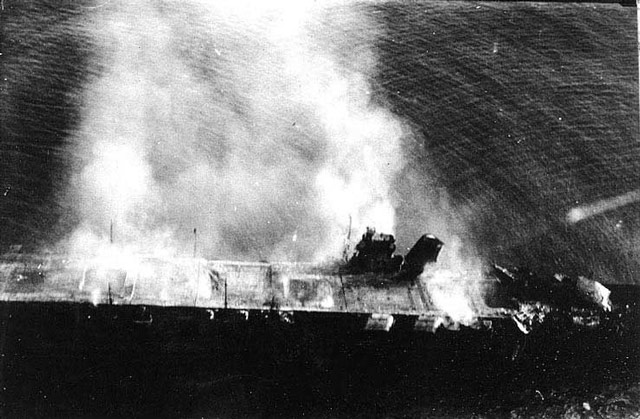
"Japanese aircraft carrier Hiryu ("Flying Dragon") burning shortly after sunrise on 5 June 1942, a few hours before she sank. Photographed by a plane from the carrier Hosho. Note collapsed flight deck at right. Part of the forward elevator is standing upright just in front of the island, where it had been thrown by an explosion in the hangar." It is Admiral Yamaguchi's funeral pyre. (US Naval History and Heritage Command NH 73064).

Battle of the Pacific: Admiral Chester Nimitz takes the unusual step of announcing the results of the Battle of Midway to the press on 5 June 1942 even as the battle continues. It is clear to everyone that this has been a complete debacle for the Japanese. It can only get worse for them now that the U.S. Navy has an overwhelming advantage due to the sinking of the four Japanese aircraft carriers.

Following the 4 June destruction of the four Japanese fleet carriers, Midway Island's defenders receive a vague report at 04:15 from the submarine USS Tambor (Cdr John Murphy), first sent to Hawaii, that the remaining Japanese fleet is approaching. Murphy later makes a half-hearted attack run on the ships, but misses. Upon receiving the report from Pearl, the island's defenders quickly launch eight B-17 bombers from Eastern Island, but the crews cannot spot anything in the early morning haze.

At 06:30, another report comes in from a Midway-based PBY Catalina that it has sighted "2 battleships" heading away from the island. A follow-up message says "Ships damaged, streaming oil." Marine Aircraft Group 22 then sends up two flights VMSB-24, six Dauntlesses (Capt. Marshall A. Tyler) and six Vought SB2U Vindicators (Captain Richard E. Fleming). The "battleships" turn out to be heavy cruisers Mikuma and Mogami. They are streaming oil because they collided during the night. The planes spot the oil slick, which allows them to zero in on the cruisers.

Admiral Yamaguchi's last moments 5 June 1942 worldwartwo.filminspector.com
"Last moments of Admiral Yamaguchi," war art painting by Kita Renzo. "Rear Admiral Tamon Yamaguchi, commander of the Japanese Carrier Striking Force's Carrier Division Two, elected to remain aboard his flagship Hiryu when she was abandoned during the early morning of 5 June 1942. He is depicted here in the middle of the scene as he bids farewell to his staff." Naval History and Heritage Command SC 301067


Tyler and his men attack Mogami but only score some near misses. Fleming then dives on Mikuma from out of the sun. Fleming does not survive - there is contradictory evidence whether his plane crashes into the Mikuma or the water nearby. The attack starts a fire that kills the men in Mikuma's engine room.

With the Mikuma crippled, eight B-17s (Lt. Col. Brooke Allen) then attack Mogami, but only score some near misses. Mikuma and Mogami ten head westward to escape, with Mikuma eventually sinking on the 6 June. Late in the day, Admiral Yamamoto orders all ships in the vicinity of Midway to retire. Japanese destroyers scuttle blazing carriers Hiryu and Akagi early in the day. The leader of the carrier force, Rear Admiral Tamon Yamaguchi, having lost his entire command, refuses to leave Hiryu and goes down with the ship.

For his heroism in leading the successful attack on Mikuma, U.S. Marine Richard Eugene Fleming will be posthumously awarded the Medal of Honor, the highest U.S. military decoration. President Franklin D. Roosevelt gives it to his mother on 24 November 1942.

To the northeast of Midway, Admiral Raymond Spruance, in charge of the combined task force 16 that includes aircraft carriers USS Enterprise and Hornet, seeks out but cannot find the Japanese surface fleet. Late in the day, he sends out scout planes, but they narrowly miss spotting Admiral Nagumo's main fleet. They do spot a destroyer and attack it, but miss. The planes return after dark, and the carrier crews must turn on their lights for the planes to land.

Spruance is extremely put out at the unacceptably vague report from submarine Tambor early in the day because it is vague and unhelpful. He also is upset at Commander Murphy for a lack of aggressiveness in not attacking the ships he spotted. He will have Murphy relieved of his command when Tambor returns to Pearl Harbor.
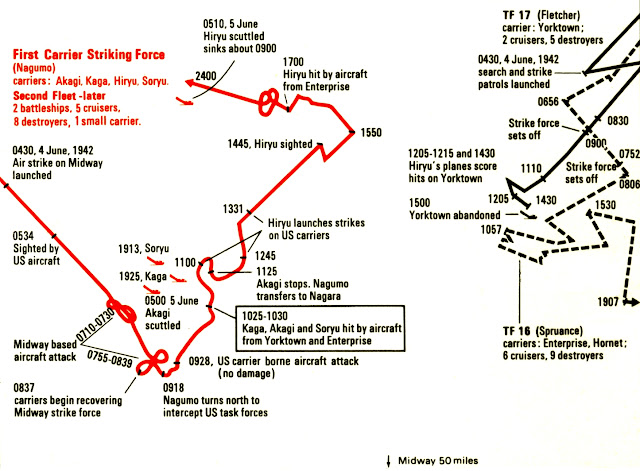
Map of Battle of Midway 5 June 1942 worldwartwo.filminspector.com
Map of the Battle of Midway 4-5 June 1942 (Onwar.com).

Rear Adm. Robert A. Theobald, in command of Task Force 8, which has been stationed uneventfully about 400 miles south of Kodiak Island in the Aleutians, receives a report of enemy warships in the Bering Sea. The report states that they are heading south toward Unalaska Island. Theobald sends his task force, which has no aircraft carriers, to investigate.

Intended U.S. air attacks using land-based bombers fail due to weather conditions. While six B-17 Flying Fortresses do report bombing enemy shipping, it turns out that in the hazy conditions they actually bomb some uninhabited islands (Pribilof Islands). While all these failed air attacks are going on, the Japanese order 1200 men of the Adak-Attu Occupation Force under Rear Admiral Omori Sentaro to proceed toward Attu for a landing on the 6th.

In reality, the Japanese force near the Aleutian Islands under the command of Vice Adm. Boshiro Hosogaya is moving south, but only to join Admiral Yamamoto's remaining fleet in the general vicinity of Midway Island. They are to join Yamamoto's forces in a desperate effort to lure the U.S. Navy carriers into surface combat. However, late in the day, Yamamoto decides that this plan will not work and sends Hosogaya back north to complete the landings in the western Aleutians. The Japanese high command in Tokyo dispatches two aircraft carriers from Japan to reinforce Hosogaya. Their hope is that the U.S. carriers might try to intervene in the Aleutian Island landings and be destroyed.

USS Yorktown remains afloat, though listing badly. At great hazard, a salvage party of 29 officers and 141 enlisted men board the sinking ship to see if anything can be done to save it. After the damage it has taken from multiple strikes, it is amazing that Yorktown still floats.

U.S. Navy submarine Pompano torpedoes and damages Japanese 131-ton guard ship Sumiyoshi Maru No. 8 off Truk Island. The entire crew survives by transferring to nearby ship Shoko Maru.

The Fifth Air Force sends B-17s to bomb a coal jetty, wharves, and a warehouse at Rabaul.
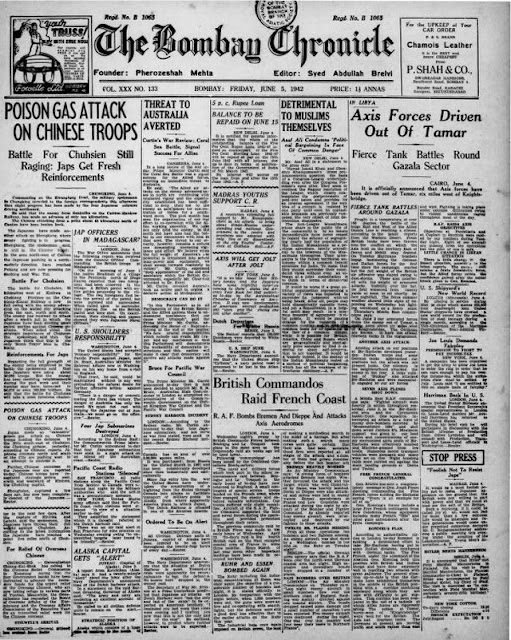
Bombay Chronicle 5 June 1942 worldwartwo.filminspector.com
The 5 June 1942 Bombay Chronicle headlines "Poison Gas Attack on Chinese Troops."

Battle of the Indian Ocean: There is a lot of Japanese naval activity off the west African coast today. The Japanese high command has sent a large force of submarines and other vessels to the vicinity of Madagascar in an attempt to decimate the British Far Eastern Fleet, and today that concentration of power pays off for them.

Japanese armed merchant cruisers Hokoku Maru and Aikoku Maru, operating 350 nautical miles (650 km) northeast of Durban, shell and sink 6757-ton British freighter Elysia. There are 22 dead. Elysia takes four days to sink. Hokoku Maru and Aikoku are there primarily to resupply the large number of Japanese submarines in the area.

Off the coast of Mozambique in the Mozambique Channel, Japanese submarine I-10 gets two successes. It sinks 2639-ton Panamanian freighter Atlantic Gulf (2 dead), and also 4999-ton US armed freighter Melvin H. Baker. British freighter Twickenham rescues the crew of Melvin H. Baker.

Japanese submarine I-20 torpedoes and sinks 5086-ton Panamanian freighter Johnstown off Mozambique. There are two deaths.
Dutch Harbor 5 June 1942 worldwartwo.filminspector.com
A damaged U.S. ship at Dutch Harbor following Japanese air attacks, Alaska, on 5 June 1942.

Eastern Front: In the Crimean Peninsula, General Erich von Manstein prepares to launch his long-awaited attack on the Soviet holdouts at Sevastopol. His 11th Army has LIV Corps to the north, 30th Corps (General Maximilian Fretter-Pico) to the south, and Romanian Mountain Corps 3 (General de divizie Gheorghe Avramescu) to the east. 

The Luftwaffe (Generaloberst Wolfram Freiherr von Richthofen) attacks throughout the day, as do 700 large German artillery pieces. Manstein's 203,800 men, including 65 Sturmgeschütz III self-propelled assault guns, oppose 118,000 Red Army troops holding the port. Today, the German bombardment, which has been rotating each day, shifts to the northern Red Army defensive line facing LIV Corps.

Fw. Anton "Toni" Hafner of 8./JG 51 claims 7 Soviet planes today to bring his score to 43 victories.

European Air Operations: It is a very hot day with some ground haze. The RAF engages in mostly convoy patrols with a few going along the French to Dutch coasts. RAF No. 141 Squadron pilot Warrant Officer Hamar shoots down a Dornier Do 217 E 20 km west of Leiden.
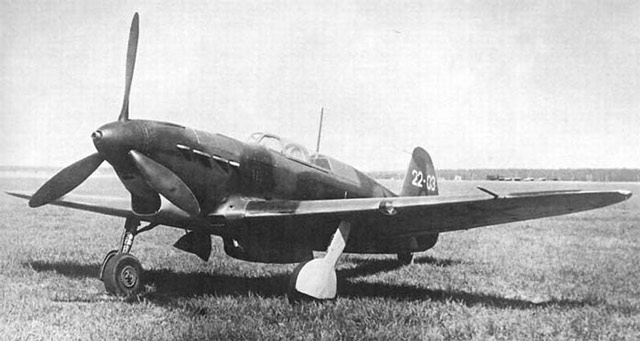
Yak-7B prototype 5 June 1942 worldwartwo.filminspector.com
Yakovlev Yak-7B prototype no.22-03 during trials in June 1942. It will become a useful close support fighter that serves first with the 42nd Fighter Aviation Regiment (IAP) at the North-Western front and then at Stalingrad and in the Caucasus.

Battle of the Atlantic: U-68 (KrvKpt. Karl-Friedrich Merten), on its fourth patrol out of Lorient, torpedoes and sinks 6693-ton U.S. tanker L.J. Drake in the Caribbean southeast of Santo Domingo. Merten uses three torpedoes, all of which hit and create a huge fireball. All 41 men aboard perish.

U-172 (Kptlt. Carl Emmermann), on its second patrol out of Lorient, torpedoes and sinks 3480-ton US freighter Delfina 130 miles northwest of San Juan, Puerto Rico. Emmerman has to follow the freighter for seven hours, during which he misses the ship with three torpedoes (due to malfunctions, not poor aim). The ship sinks within 20 minutes. There are four dead and 27 survivors, some of whom make landfall at Montecristi, Dominican Republic, and others are quickly picked up by US patrol boat USS YP-67.

U-94 (Oblt. Otto Ites), on its ninth patrol out of St. Nazaire, uses its deck gun and sinks 320-ton Portugues three-masted sailing ship Maria da Glória in codfish fishing grounds off Greenland. Ites does not see any markings so assumes it is an enemy vessel. Once the ship raises the Portuguese flag, Ites stops shooting, but it is too late for the ship. Once the crew abandons the ship, Ites resumes firing and sinks it. There are 36 dead and 8 survivors.

U-159 (Kptlt. Helmut Friedrich Witte), on its second patrol out of Lorient, uses its deck gun against 265-ton Brazilian sailing ship Paracury southeast of Santo Domingo in roughly the same area as where U-68 sinks L.J. Drake. The seas are rough, so the U-boat uses its 20mm anti-aircraft gun to punch holes in the waterline, causing it to capsize. Casualties are unknown. The ship remains afloat long enough for someone to find it, salvage it, and return it to service.
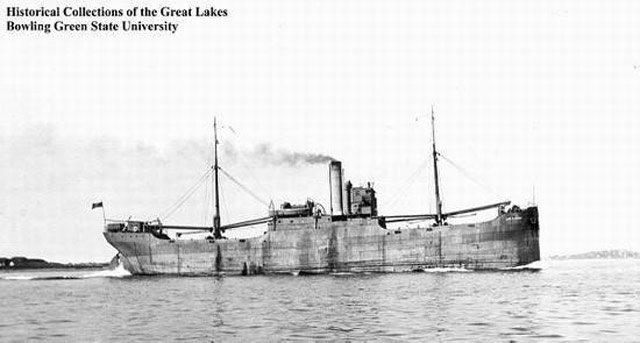
US freighter Velma Lykes, sunk 5 June 1942 worldwartwo.filminspector.com
U.S. freighter Velma Lykes, sunk on 5 June 1942 by U-158 in the Caribbean (Bowling Green State University).

U-158 (Kptlt. Erwin Rostin), on its second patrol out of Lorient, torpedoes and sinks 2572-ton U.S. freighter Velma Lykes off Puerto Juarrez, Yucatan Peninsula, Mexico. The ship sinks within one minute. There are 15 dead and 17 survivors, who cling to rafts and are picked up on the 6th by freighter Ardenvorhr after being spotted by a Catalina. The men of the Velma Lykes have further troubles when U-68 torpedoes and sinks their rescue ship, but they all survive that sinking, too.

British 1798-ton freighter Sonja Maersk runs aground and sinks off Ketch Harbor, Nova Scotia, due to heavy fog. There are no casualties.
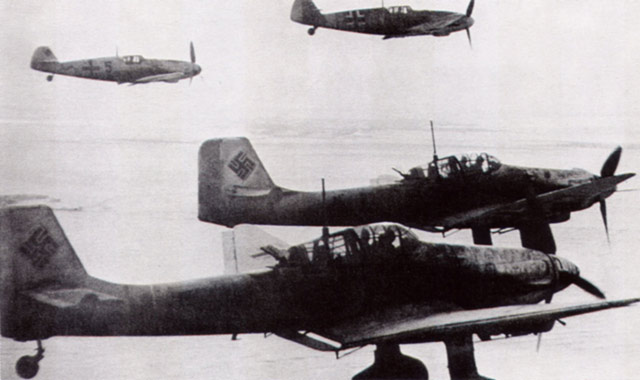
Stukas and Bf 109s June 1942 worldwartwo.filminspector.cmo
Messerschmitt Bf 109F4 JG5 Black 1 and 5 escorting Ju 87 Stukas of SG5.1 in Russia, June 1942

Battle of the Mediterranean: The land battle in Libya has been deadlocked for a week, and today the British Eighth Army decides to do something about it. General Neil Ritchie's forces launch Operation Aberdeen, an attempt to encircle German General Erwin Rommel's forces in "the Cauldron." Rommel's forces, meanwhile, still encircle the Free French outpost at Bir Hakeim.

The Axis forces in the Cauldron, however, have had time to prepare killing zones with their tanks and anti-tank gun positions. The British make no progress with their early-morning attacks from the north and only slight progress by the 7th Armoured and 5th Indian divisions from the east. The British 32nd Army Tank Brigade in the north loses 50-70 tanks.

Rommel, fortified by the morning success against the British tanks, reacts quickly. In the afternoon, he splits his forces, counterattacking east toward Bir el Hatmat with Ariete and 21st Panzer divisions and to the north with elements of the 15th Panzer Division. The attack to the east has great success, forcing the headquarters of two British divisions, two brigades, and others to flee in a panic. This effectively decapitates the British response. The 15th Panzer attack to the north also has success, forcing the 22nd Armoured Brigade back with a loss of 60 of its 156 tanks. This turns into a wild retreat in which the British abandon three Indian infantry battalions, a reconnaissance regiment, and four artillery regiments to be captured. The front then settles down for the night.

At Bir Hakeim, the surrounded  Free French remain safe within their fortifications but are running out of supplies such as food and water. The Desert Air Force flies cover overhead to disperse Luftwaffe attacks, but Axis artillery continues to batter away at the fort. The German 90th Light Division prepares to attack the fort on 6 June using pioneers to clear the minefields around it.

Convoy WS-19Z, which carries Force X, sails from the Clyde for Gibraltar. This is the prelude to Operation Harpoon, or the Battle of Pantelleria, when an eastbound convoy sailing from Gibraltar will pass a westbound convoy out of Alexandria (Operation Vigorous) in mid-June. Unknown to the Allies, who have been reading German codes with Operation Ultra, the Italian military intelligence service (Servizio Informazioni Militare) has broken the U.S. code being used in the Mediterranean. The Axis thus has an early warning of these two joint operations due to communications made by the U.S. Military Attaché in Egypt, Colonel Bonner Fellers.
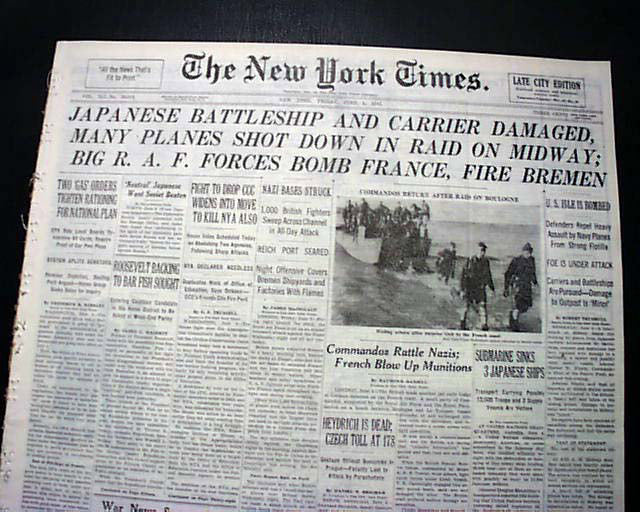
NY Times headlines June 1942 worldwartwo.filminspector.cmo
For once, the U.S. media actually downplays the real war news. The 5 June 1942 NY Times headlines that "Japanese Battleship and Carrier Damaged" when, in fact, the Japanese have lost four carriers. However, the truth comes out today as Admiral Nimitz lists the real successes at the Battle of Midway.

US/Axis Relations: The United States declares war on Bulgaria, Hungary, and Romania. Relations also now are strained with Finland due to its hosting Adolf Hitler to celebrate Marshal Mannerheim's 75th birthday on 4 June.

US Military: General Brehon B. Somervell, commander of the Army Service Forces, completes an inspection of US forces in Northern Island.

Two Douglas A-24 Dauntless dive bombers collide at Charters Towers, Queensland, Australia at 1000-1500 feet during a training flight. Three of the four men survive by parachuting out, but pilot 2nd Lt. Norman J. Davidson, whose plane was hit by the other plane's propeller from underneath, perishes.
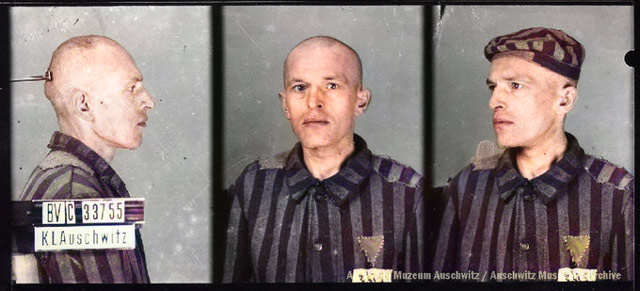
Auschwitz victim June 1942 worldwartwo.filminspector.cmo
Sloveč cabman Vaclav Novotny perishes in Auschwitz on 5 June 1942. Auschwitz Memorial (colorized).

Holocaust: Train Convoy No. 2 deporting people from France departs today for the East. The edict authorizing this train specifies that it should "deport Communists, Jews and anti-social elements to the East, in retaliation." Helmut Knochen (March 14, 1910 – April 4, 2003), the senior commander of the Sicherheitspolizei (Security Police) and Sicherheitsdienst in Paris, oversees the operation. SS Captain (Hauptsturmführer) Theodor Dannecker, leader of the Judenreferat at the SD office in Paris, has composed the list of deportees. 

This batch is composed of about 1000 mostly Jewish men aged 18 to 54, primarily Poles who fled the occupation there. They were arrested at Drancy, Beaune-la-Rolande, and Pithiviers and then taken to Compiègne between 14 May and 20 August 1941. Many of these men have been found unfit for work. Of these men, roughly 800 are taken to Auschwitz and are dead within ten weeks.
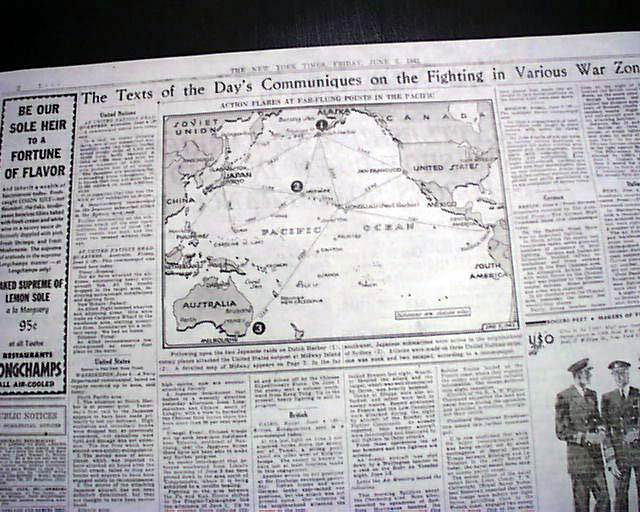
Map of Pacific battles in NY Times 5 June 1942 worldwartwo.filminspector.cmo
A war map in the 5 June 1942 NY Times helpfully shows American readers where the sites of three recent battles in the Pacific, at Midway, Sydney, and the Aleutians, are.

British Homefront: King George VI publishes his 1942 Birthday Honours. This involves various awards, rewards, appointments, and bestowing of honors. Among many other announcements, the economist John Maynard Keynes is made a Baron, filmmaker Alexander Korda is made a Knight Bachelor, and RAF Air Chief Marshal Charles Portal is awarded the Knight Grand Cross of the Order of the Bath (GCB).

American Homefront: Former child actress Virginia Lee Corbin, known at the start of her career as Baby Virginia Corbin, passes away at the age of 31 in Chicago, Illinois from tuberculosis. She is one of many silent film actors unable to transition to the talkies and retired shortly before her death. 
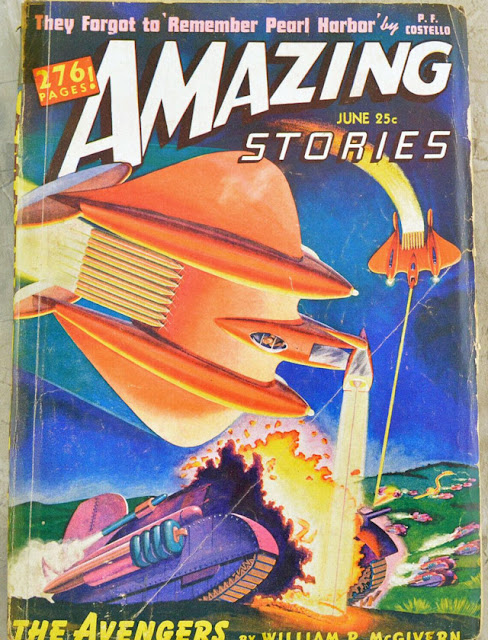
Amazing Stories June 1942 worldwartwo.filminspector.cmo
This June 1942 edition of Amazing Stories features the short story "The Avengers" by William P. McGivern. Hey, whatever happened to them? Actually, these Avengers are different than the Stan Lee ones, which debuted in Avengers #1 issued September 1963.


2021