Showing posts with label Gollob. Show all posts

Wednesday, August 11, 2021

May 23, 1942: German Forces Surround Soviet Armies at Kharkov

Saturday 23 May 1942

Jewish deportees in Stropkov, Slovakia, 23 May 1942 worldwartwo.filminspector.com
Jewish residents of Stropkov, Slovakia, being deported to concentration camps (Majdanek and Auschwitz) on 23 May 1942. Yad Vashem Photo Archives 3132/1.

Battle of the Pacific: Following US Naval Intelligence descriptions of Japanese communications, both sides on 23 May 1942 know that a major confrontation soon will occur at Midway Island. The key difference is that the Japanese don't know that the Allies know about their invasion plans. In fact, the Japanese believe that they sunk two US Navy carriers, USS Lexington and Yorktown, at the Battle of the Coral Sea and that the Midway operation will be fairly routine. In fact, only the Lexington sank and the Yorktown has joined up with USS Enterprise to return to Pearl Harbor at high speed in preparation for the battle.

There is still some Allied resistance in the occupied Philippines, though it is gradually dying out. During one of these incidents, Lt. Comdr. Ryland Dillard Tisdale, 47 (who had retired in the 1930s but returned to service in July 1940 due to the contingency of war) perishes at Tamparan. He dies in an action against the Moros, who are collaborating with the Japanese. He receives the Silver Star posthumously. The citation notes that Tisdale was offered passage out of Corregidor on the last plane out but offered up his seat to another. Tisdale escaped from the island along with a few others shortly before the surrender. Tisdale falls today in a "last stand" near Dansalan (Marawi, Lanao del Sur, Philippines, since 1956) along with a small group of officers and enlisted men, including civilians, that includes Lieutenant Colonel Vesy of the Philippine Army.

Five B-25 bombers of the 3rd Bomber Group attack Lae, New Guinea. They damage the airfield and buildings there. Two bombers fail to return.

US Navy patrol boat USS YP-277 hits a mine and sinks at the French Frigate Shoals in the Northwestern Hawaiian Islands. The US Navy is keeping a close eye on this area due to Japanese attempts to use them to bomb Hawaii.

Japanese submarine I-29 launches its Yokosuka "Glen" seaplane for an uneventful reconnaissance mission over Sydney, Australia. This is one of a continuing series of Japanese reconnaissance flights over Allied areas in the southwest Pacific that are rarely noticed.

P-40 of the Flying Tigers in Kunming, China, 23 May 1942 worldwartwo.filmisnpector.com
Curtiss Hawk P-40 Tomahawk with pilot Robert T. Smith at the controls in Kunming, China, 23 May 1942. Photo: akg-images / Robert T. Smith.

Battle of the Indian Ocean: Japanese and Chinese troops clash in inconclusive fighting along the Hsipaw-Mogok road in northern Burma. The Japanese have no intention of invading China from this direction, though the Chinese do not know this. The Japanese in Burma already have achieved their main objectives of closing the Burma Road and establishing a defensive front along the Indian border.

Eastern Front: A carefully laid German trap south of Kharkov springs shut as the Soviet 6th and 57th Armies desperately try to avoid being surrounded near Izyum. Early in the morning, the 16th Panzer Division (Hube) and the 23rd Panzer Division meet ten miles west of Balakleya. This forms a ten-mile wide German corridor from north to south to the east of the Soviet offensive forces. This is generally considered to be the activity that surrounds the Soviets and traps them, though technically the 14th Panzer Division already has formed a thin line to the east.

Soviet Marshal Timoshenko has staked everything on a breakout attempt by these two armies today south of Kharkov, but it fails. At Fuhrer Headquarters, General Franz Halder writes confidently in his diary that "The Izyum pocket is firmly closed." However, things are still a bit more tentative than that.

The Soviets outnumber the Wehrmacht troops at the key points, but the Red Army breakout effort is dissipated today in multiple counterattacks to relieve surrounded formations to consolidate their overall defensive position. In addition, the German forces may be relatively small, but they include elite panzer units hemming the Soviets in on a narrow corridor to the east. The Soviets have by no means given up and are preparing more breakout attempts during the coming days. Halder notes that "Pressure from within [the Izyum] pocket seems to be preparing and will be felt from 24 May onwards." 

German soldiers on the scene remain puzzled that the Red Army forces to the east haven't tried a strong relief effort. Stalin does not like to retreat, especially from such a massive offensive operation. Plus, he tacitly is putting the onus on Timoshenko to prove his worth and regain the initiative - or suffer the consequences personally.

Meanwhile, the other prong of the Soviet offensive north of Kharkov has ground to a complete halt. Halder notes that "the enemy has withdrawn his tanks behind the Donets, but is still holding the western bank with its strong forces." The Soviets are only mounting local thrusts in this area that the Wehrmacht easily parries. Halder concludes this diary entry with a rare dash of emotion, writing, "The bulges shrink!" 

The overriding Wehrmacht concern remains the preparation for the upcoming "decisive" summer offensive on the southern third of the front, Operation Blau. Halder confers with Luftwaffe Colonel Meister about air preparations for this today and with others (including Colonel Balck, a top field commander) about training and personnel issues. All is calm and serene in East Prussia.

Soviet flak on the southern front downs three Henschel Hs 129B-1 ground attack planes belonging to II./SchG 1. The Hs 129B-1 have only arrived in Crimea within the past two weeks and each is equipped with a 30 mm (1.2 inch) MK 101 cannon.

Following a dramatic run of victories during the Crimea campaign, Major Gordon "Mac" Gollob, Geschwaderkommodore of JG 77, receives his reward. He is awarded the Knights Cross (no. 17). Gollob continues to shoot down Red Army planes seemingly at will from his base near Kerch and now has 107 victories.

European Air Operations: Luftwaffe experimental unit Erg.u.Lehr. Kdo 17 (formerly Erg.u.Lehr. Kdo 100) mounts an afternoon daylight raid on the Avonmouth docks using 7 He 111s. The weather is poor, providing some cover, and the real purpose of the missions is to test out planes guided by both X- and Y-Verfahren direction-finding equipment. The raid is not very successful, as one plane is lost and the bombers drop their loads six miles from the target at Severn Tunnel Junction. From the British perspective, the Luftwaffe raid is very meaningful. For the first time, RAF technicians detect the Luftwaffe's X-signals. The RAF immediately begins developing countermeasures.

Saturday Evening Post 23 May 1942 worldwartwo.filminspector.com
The Saturday Evening Post for 23 May 1942 features the beginning of a new serial featuring Perry Mason by Erle Stanley Gardner.

Battle of the Atlantic: U-588 (Kptlt. Victor Vogel), on its third patrol out of St. Nazaire, torpedoes and sinks 4545-ton British freighter Margot southeast of Philadelphia, Pennsylvania. There are one death and 44 survivors. Swedish freighter Sagoland picks up the survivors. After this sinking, U-588 returns to port after a successful cruise during which it has sunk or damaged 27,106 tons of Allied shipping. As things turn out, this is U-588's final victory because it is sunk early on its next patrol.

U-558 (Kptlt. Günther Krech), on its seventh patrol out of Brest, torpedoes and damages 7061-ton US tanker William Boyce Thompson (en route from New York to Curaçao in ballast) at 00:53 about 120 miles south of Kington, Jamaica. While the torpedo opens a hole of 20 feet on the starboard side, tankers are famous for survivability due to their compartmentalized construction. The fact that the tanker is carrying no cargo further helps it. The tanker escapes northward zigzagging at full speed with a smokescreen. There are no injuries, and the tanker makes it to Guantanamo Bay, Cuba.

U-432 (Kptlt. Heinz-Otto Schultze), on its fifth patrol out of La Pallice, torpedoes and sinks 4455-ton British freighter Zurichmoor 400 nautical miles (740 km) east of Philadelphia, Pennsylvania. All 45 men on board perish.

U-155 (Kptlt. Adolf Cornelius Piening), on its second patrol out of Lorient, torpedoes and sinks 2220-ton Panamanian Design 1049 freighter Watsonville in Saint Vincent Passage (in the Caribbean between Saint Lucia and Saint Vincent). Everyone survives.

U-103 (Kptlt. Werner Winter) torpedoes and badly damages 6625-ton US tanker Samuel Q. Brown about 100 nautical miles (190 km) south of Cape Corrientes, Cuba (extreme western tip of Cuba). There are two deaths when the torpedoes hit and 53 survivors. The crew gathers in two lifeboats and the U-boat surfaces to question them. A US Navy seaplane based at Upham, Canal Zone, locates the damaged ship and quickly and lands to pick up five injured crew. The rest have to wait a couple of days to be rescued by USS Goff, which scuttles the flaming tanker.

German 4626-ton freighter Asuncion hits a mine and sinks off the coast in the extreme north of Norway in the general vicinity of Sandland.

German 254-ton trawler/Vorpostenboot V 1808 Dortmund hits a mine and sinks in the southern North Sea. It sinks in an area south of the Dogger Bank off the coast of The Netherlands known as the "Broad Fourteens" due to its consistent 14-fathom (84 feet, 26 m) depth.

Midland Michigan Theater 23 May 1942 worldwartwo.filminspector.cmo
A new movie palace, The Midland Theater, opens on 23 May 1942 in Midland, Michigan. The first film is "Captain of the Clouds" starring James Cagney.

Battle of the Mediterranean: Activity is stirring along the North African front as the temperature rises. Gruppenkommandure of  I./JG 27 Oblt. Gustav Rodel downs two planes to bring his total to 41 kills. His unit downs a total of a dozen RAF Tomahawks and Kittyhawks.

Oberlieutenant Hans-Joachim Marseille also downs two bombers today southeast of Tobruk. This brings his own victory total to 64 planes. His victims are a pair of No. 223 Sqdn Martin "Baltimore" bombers on their first flights with their unit. While unit commands in the Luftwaffe generally go to the most successful pilots, Marseille is considered "trouble" by his superiors despite his obvious talent. Thus, Marseille remains an ordinary pilot who simply continues racking up victories without having to worry about administrative duties.

On Malta, things have quieted down considerably since the arrival of numerous defensive RAF Spitfires recently. There is a raid at 07:16 by five Cant 1007 Italian bombers with a large escort of Italian RE2001s, Macchi 200s, and Luftwaffe Bf 109s. The planes come in from the north and are met by a dozen Spitfires of Nos. 126 and 601 Squadrons based at Luqa. The RAF planes down two Re 2001s, two Bf 109s, one Cant bomber (probable). Two other Cant 1007s are damaged along with a Re 2001 and a Bf 109. The only RAF damage is to a Spitfire that returns safely to base. The Italian bombers do get through, however. They drop ten 100kg bombs apiece on Ta Qali airfield, causing craters.

Liberty magazine 23 May 1942 worldwartwo.filminspector.com
Abbott and Costello grace the cover of Liberty magazine, 23 May 1942. This apparently is to promote their film "Rio Rita," released on 11 March 1942, about wartime spies on the Mexican border.

Battle of the Black Sea: Soviet submarine ShCh-205 torpedoes and sinks Turkish 330-ton freighter Safak off Burgas, Bulgaria. This obviously is a military mistake, as the USSR is not at war with Turkey and has no wish to antagonize it at this time. Then again, there are historical enmities between the two powers that date back centuries and continue after this war.

US Military: The 7th Air Force transfers the 31 Bombardment Squadron's B-17s and B-18s from Hickam Field to Kipapa.

German Government: Adolf Hitler gives a speech to the Reichsleiters and Gauleiters in Berlin in which he justifies the concentration camps. According to Hitler, these are necessary to prevent an uprising. This is part of a very gradual and almost indiscernible trend in Hitler's 1942 speeches toward a defensive, paranoid, and almost fearful tone. British Intelligence has a pioneer social scientist, Mark Abrams, watching Hitler's speeches closely and he notes this tendency in a report marked "Secret." The aim is ""to reconstruct, if possible, what was in Hitler's mind when he composed and delivered the speech."

Abrams asks a fellow academic, Joseph McCurdy, to write up a report on these findings. McCurdy concludes that Hitler's speeches now have a "dull flatness of the delivery" and show "a man who is seriously contemplating the possibility of utter defeat." Hitler also is developing a "Jew phobia" and increasingly sees them as a "universal diabolical agency" versus himself, who represents "the incarnation of the spirit of good."

US Government: Grand Duchess Charlotte of Luxembourg meets with President Roosevelt in Washington, D.C. before returning to her wartime home in Montreal.
The New Yorker 23 May 1942 worldwartwo.filminspector.com
The New Yorker, 23 May 1942. Painting by Ilonka Karasz.

American Homefront: Japanese are not the only enemy aliens being imprisoned at internment camps in the United States. Today, Lt. Colonel Horace Rogers writes a letter to the Provost Marshal General in Washington, D.C., confirming the arrival of 13 new internees, mostly German, at Camp McCoy, Wisconsin. The internees will be at Camp McCoy for the duration of the war.

"Grand Central Murder" opens today, starring Van Heflin and Virginia Grey.

Future History: Peter Frederick Wedlock is born in Bristol, England. He gets some singing experience in the church choir at St. Mary Redcliffe. After becoming a teacher, Fred Wedlock becomes a regular performer on the folk circuit. This leads him to record albums beginning with "The Folker" (1971), "Frollicks" (1973), and, most notably, "The Oldest Swinger in Town" (1981) (the title track becomes a hit single). Fred Wedlock passes away on 4 March 2010 in Bath, Somerset, with his funeral held at St. Mary Redcliffe where he had begun singing.

Colliers 23 May 1942 worldwartwo.filminspector.com
Collier's magazine, 23 May 1942.

May 1942


2021

Wednesday, May 19, 2021

May 20, 1942: Churchill and Molotov Negotiate

Wednesday 20 May 1942

Churchill and Molotov, 20 May 1942 worldwartwo.filminspector.com
Prime Minister Winston Churchill greets Soviet Foreign Minister Molotov in the back garden of No. 10 Downing Street, 20 May 1942. Also seen in the photo are  Deputy Prime Minister Clement Attlee, British Foreign Secretary Anthony Eden, and others (The Daily Telegraph).
Battle of the Pacific: Admiral Nimitz approves a secret operation on 20 May 1942 to ascertain Japanese plans. One of the codebreakers in the Honolulu station, Jasper Holmes, has come up with a way to ascertain the location of "AF," known from decrypts to be the target for an upcoming Japanese invasion. Using an undersea cable that is known to be secure, Nimitz today sends a message to the Midway Island base commander telling him to send out a radio message that there is a "water shortage" at the island. "At the present time, we have only enough water for two weeks. Please supply us immediately."

Just to make certain the intended Japanese recipients get the radio message, the island commander also is instructed to send the request for help both in a code the Japanese are known to have broken and "in the clear" (without coding). The US naval intelligence offices in three locations - Melbourne, Honolulu, and Washington - then sit back to see what develops.

The Japanese indeed are preparing an offensive operation against Midway. Today, Admiral Yamamoto sends out Operational Order 14. This details a complex plan to coordinate invasions of the Aleutian Islands and Midway with troops from Saipan.

A Yeoman in the US Navy Fleet Radio Unit in Melbourne, Australia (FRUMEL), Bill Tremblay, is working late. At 23:30, he identifies Yamamoto's message as important even though it is badly garbled. After Tremblay discusses it with his superiors, the message is put on a fast track for decryption. That, however, will take several days. The Honolulu station also intercepts a copy of the message which also is garbled, but largely in different places. Between the two interceptions, a large portion of the lengthy message can be decrypted.

B-17s based in Australia bomb the airfield at Koepang, Timor, continuing a series of missions against the base. These missions are effective at silencing antiaircraft guns at the airfield.
Baltimore News-Post 20 May 1942 worldwartwo.filminspector.com
Due to the meeting of Brigadier General Jimmy Doolittle and President Franklin Roosevelt in the White House on 19 May, the newspapers on 20 May are full of hints of new raids on Japan. Here, the Baltimore News-Post gives these rumors a banner headline. In fact, no such raids are planned.
Battle of the Indian Ocean: Today is generally viewed as the completion of the Japanese conquest of Burma. The British formally dissolve Burma Corps, transferring all soldiers formerly under General William Slim to the British IV Corps. Slim is reassigned to Indian XV Corps.

Meanwhile, India is receiving a steady flow of reinforcements from the United States. Another unit of the 10th Air Force in the China-Burma-India Theater arrives at Karachi, India, from the US today. It is the 11th Bombardment Squadron, 7th Bomber Group (Heavy), and flies B-17s. The 11th will become active and fly its first mission on 3 June 1942
Marshal Timoshenko worldwartwo.filminspector.com
The troops of Soviet Marshal Timoshenko, shown, are in big trouble around Kharkov on 20 May 1942.
Eastern Front: The Wehrmacht commits more units to its attempt to encircle the Red Army troops wheeling about in confusion south of Kharkov. The Luftwaffe is particularly effective at sealing the pocket, sending Junkers Ju 87 Stukas from StG 77 to destroy five of the Soviet bridges across the Donets River and damage four others. Kampfgeschwader 3 (KG 3), meanwhile, focuses on the roads in the developing pocket that are crowded with Soviet columns that have belatedly been turned 180 degrees to face the growing threat to their communications. Such a maneuver is difficult even in normal times, as the roads east are crowded with service troops, equipment, and other obstacles. The going is slow, and the Soviets are running out of time.

Turning an army around is one of the most difficult maneuvers in warfare. The entire orientation is inverted, with the cutting edge of tanks, infantry, and artillery having to reverse course in a perfectly coordinated ballet that is difficult in peacetime, let alone under fire. The army's "tail," or supply establishment, likewise has to change position to be just the right distance from the front line - which is moving who knows where. Ammunition dumps wind up in the wrong places, headquarters have to move and are out of touch, unit commanders don't even know where their soldiers are. Add to that blocked roads through rough terrain caused by air and artillery attacks and it's easy for chaos to erupt. This is exactly what happens to the Red Army south of Kharkov in May 1942.

Fulfilling a direct order from Field Marshal Fedor von Bock, the 14th Panzer Division advances further north from Petrovskoye and takes Protopopovka. This eliminates another key Soviet Donets river crossing and narrows the mouth of the breakthrough from there to Balakleya down to a dozen miles.

The Germans, though, are running a big risk. They are drawing only a thin line between the huge Red Army forces to the east and west. It is eight miles long and, in most places, only two miles wide. This easily could be pierced by fierce Red Army attacks. The German III Panzer Corps heads west to try and expand the width of this cordon. However, the Germans have to rely on Romanian troops that are less than enthusiastic to stick their heads into this potential noose (at Fuhrer headquarters, General Franz Halder notes that "the Romanians have gained only a little ground").
Von Kleist worldwartwo.filminspector.com
Von Kleist.
Determined to seal his victory, General Ewald von Kleist risks it all and sends the 16th Panzer Division (General Hube), the 60th Motorized Division, and the 1st Mountain Division to support the exposed 14th Panzer Division. These are the best troops in the First Panzer Army, the cream of the Wehrmacht. It is a huge gamble because Soviet counterattacks from either or both sides easily could cut off all of these divisions in the exposed salient. This would turn German victory into defeat. Bock convinces Sixth Army commander Friedrich Paulus (direct orders don't always work in these situations even in the Wehrmacht), whose troops are north of the bulge, to support this ambitious move by releasing the 3rd and 23rd Panzer Divisions. They will advance south from Balakleya and meet Kleist's advancing panzers. Even if they meet, however, it is unclear if they can hold their positions against furious counterattacks. It is an audacious gambit.

Someone is going to have a massive victory that may decide the entire summer campaign. It's just not perfectly clear yet who that will be. How hard the Red Army on opposite sides of the German advance will resist this encircling move is the big imponderable.

Bock knows the decisive moment of the entire campaign, perhaps the entire war has arrived. He writes in his war diary, confidently but perhaps more hopefully:

[T]tonight I have given orders aimed at completely sealing off the Izyum bulge. Now everything will turn out well after all.

Only one thing stands in Bock's path to victory: the Red Army. However, something strange is going on. The Germans are astonished to see no signs of either a determined breakout or a relief attack from the East. The thin German lines are holding and consolidating even though they are outgunned and outmanned by enemy troops just out of sight. It's a mystery that only deepens.
Arizona Daily Star 20 May 1942 worldwartwo.filminspector.com
The Arizona Daily Star of 20 May 1942 features news from the Eastern Front battle of Kharkov that suggests the Red Army is doing well there. "Russian Planes blast at German Tanks Along Highway."
General Manstein's 11th Army eliminates the final above-ground pocket of Soviet resistance south of Kerch today (there are still Red Army soldiers operating out of catacombs in the region). The German success in the Kerch peninsula means many Luftwaffe resources can be transferred to the Kharkov battle, but there is still unfinished business in Crimea to the west. Luftwaffe ace Gordon "Mac" Gollob completes one of the longest sustained victory streaks of the war by shooting down two enemy aircraft, a DB-3 and a LaGG-3. This gives him 101 victories, a major milestone, and 14 victories over the past five days since taking command of JG 77. Gollob is the tenth Luftwaffe pilot to reach the century mark. After these victories, JG 77 is transferred west to help with the conquest of Sevastopol.

The German victory in the Kerch peninsula now is complete. It was an overwhelming triumph. While Fliegerkorps VIII has lost 37 aircraft, the Soviets lose 417. While between 37,000 and 116,045 Red Army soldiers make it back to the mainland, an estimated 162,282 do not. The Germans take about 150,000 soldiers and others (many are civilians) prisoner. The 11th Army loses only 7588 men in total, about ten tanks, and a dozen artillery pieces. The Soviets effectively lose three armies and nine divisions, with nine other divisions requiring major rebuilding.

European Air Operations: There are no major raids by either side today, perhaps due to the weather. The RAF's 197-plane raid on Mannheim on the night of 19/20 May accomplishes very little and causes only two fatalities in the city.

During an intruder operation to Soesterberg Airfield, German Flak of the 2./leichte Flak-Abteilung 764 downs an RCAF Douglas DB-7B Boston Mk III. All three crewmen perish.
MV Norland sinking on 20 May 1942 worldwartwo.filminspector.com
MV Norland on fire and sinking after being torpedoed by U-108 on 20 May 1942.
Battle of the Atlantic: German raider Michel shells and sinks 4245-ton Norwegian freighter Kattegat in the South Atlantic. Michel's crew takes the entire 32-man crew of Kattegat as prisoners.

U-108 (KrvKpt. Klaus Scholtz), on its seventh patrol out of Lorient, torpedoes, shells, and sinks 8134-ton Norwegian tanker Norland in the mid-Atlantic. Norland is part of Convoy ON 93. The entire 48-man crew survives and is rescued by Dutch freighter Polyphemus and USS PT-453.

U-753 (KrvKpt. Alfred Manhardt von Mannstein), on its fourth patrol out of La Pallice, gets its first victory of the wary. It torpedoes and sinks 7191-ton US Liberty ship George Calvert in the Caribbean near the Yucatan Channel. There are three deaths and 48 survivors.

U-155 (Kptlt. Adolf Cornelius Piening), on its second patrol out of Lorient, torpedoes and badly damages 7797-ton Panamanian tanker Sylvan Arrow in the Caribbean southwest of Grenada. There are one death and 43 survivors, who are picked up by the destroyer USS Barney. Sylvan Arrow sinks while under tow on 28 May.
Wreck of SS Halo, sunk on 20 May 1942 worldwartwo.filminspector.com
Wreck of SS Halo, sunk on 20 May 1942 by U-506, lying on the seafloor.
U-506 (Kptlt. Erich Würdemann), on its second patrol out of Lorient, torpedoes and sinks 6986-ton US tanker Halo 50 miles south of Louisiana. There are 39 deaths and three survivors, who are rescued by Mexican freighter Oaxaca and British freighter Otina. This is the ninth victory of the patrol for U-506 and it isn't over yet. The wreck of the Halo, which was carrying 64,103 barrels of crude oil, is found during a pipeline survey in July 2000 lying in 470 feet (78 fathoms, 143 m) of water.

U-158 (Kptlt. Erwin Rostin), on its second patrol out of Lorient, torpedoes and sinks 8,113-ton British tanker Darina 500 nautical miles (930 km) southeast of Bermuda. There are six deaths and 50 survivors, who are rescued by British freighter British Ardour, Norwegian freighter Dagrun, and US freighter Exanthia. This is the first victory of what will be an eventful patrol for U-158.

US Navy yard patrol craft USS YP-387 sinks after colliding with collier Jason off Delaware. There are six deaths and 15 survivors who are rescued by Jason.
Map of Doolittle raid, 20 May 1942 Chicago Daily Tribune worldwartwo.filminspector.com
The 20 May 1942 Chicago Daily Tribune contains a map and account of the 18 April Doolittle Raid on Japan.
Battle of the Mediterranean: U-431 (Kptlt. Wilhelm Dommes), on its sixth patrol out of La Spezia, torpedoes and sinks 4216-ton British tanker Eocene off Sollum, Egypt. The tanker is part of convoy AT-46. All 43 crewmen survive, rescued by Royal Navy HMT Cocker.

Due to a large number of RAF Supermarine Spitfires now on Malta, the Axis bombing raids now are usually composed of hit-and-run attacks by Luftwaffe fighter-bombers. The main objectives are still the airfields, and Luqa Airfield is attacked several times today after dark. Compared to the situation of a month ago, however, the attacks are minor and cause little damage.

Battle of the Baltic: Norwegian (Axis) freighter Vestra hits a mine and sinks in the Skagerrak near the Falsterbo Lighthouse, Sweden. The ship sinks in shallow water and is refloated, repaired, and returned to service.

Anglo/Soviet Relations: Soviet Foreign Minister Vyacheslav Molotov arrives in London to hold talks on opening a second front. Churchill does not take to Molotov, later saying about him, "I have never seen a human being who more perfectly represented the modern conception of a robot." (WSC, WWII, Vol. I p. 288-9). Molotov, as usual, is all business, just as he was with Hitler in November 1940. He emphasizes Soviet claims on territory in Poland and the Baltic States, matters that Churchill views as premature. Despite their issues, the two men immediately begin work toward preparing a twenty-year treaty of friendship. The final agreement is signed on 26 May 1942.
WCCA headquarters in Woodland, California, 20 May 1942 worldwartwo.filminspector.com
Woodland, California, 20 May 1942. Entrance to American Legion Hall, being used by the Wartime Civil Control Administration (W.C.C.A.) to assist persons of Japanese ancestry in settling their affairs before they depart for internment camps (Dorothea Lange, National Archives at College Park NARA record 1372774).
US Military: The US Navy Department issues a press release on 20 May 1942, "Recruiting of [African Americans] to Begin June 1." It also releases a separate press release, "Marines Announce Plans for Recruiting [African Americans]."

The new Navy recruits are to receive the normal eight weeks of training at the established Great Lakes facilities. This will qualify them for a sixteen-week vocational school at the Hampton Institute in Virginia. They will be trained there as electricians, carpenters, ship fitters, machinists, metalsmiths, firemen, and cooks. Heretofore, African Americans in the Navy have been confined to the stewards' branch. Fearful of crew shortages in this area, the Navy refuses to allow transfers out of the stewards' branch to the general service until May 1945.

The black Marine Corps recruits have a somewhat different experience. The Marine Corps does not have a training center prepared, so the recruits must be placed on inactive duty status while one is set up. Eventually, a facility is constructed at Montford Point, near New River, North Carolina, and Camp Lejeune. Prospective Marine Corps recruits face often insurmountable obstacles such as tight quotas for black marines and other restrictions.

Admiral John S. McCain arrives at Noumea, New Caledonia, in seaplane tender USS Tangier. He assumes command as the new Commander Aircraft South Pacific Forces (COMAIRSOPAC). McCain now is responsible for tender and shore-based aviation in the South Pacific Area (SOPAC) under admiral Nimitz. This area is to the east of the Southwest Pacific Area and south of the Central Pacific Area. SOPAC encompasses the Ellice, Phoenix, Marquesas, Tuamotu, Samoa, Fiji, and New Hebrides island groups plus New Caledonia and New Zealand. However, it does not yet include Guadalcanal or Tulagi and thus does not include areas of likely conflict. It includes, though, the main route from the United States to Australia and is of immense strategic importance.

Submarine USS Kingfish (SS-234) is commissioned.
MLB schedule, 20 May 1942 worldwartwo.filminspector.com
The Major League Baseball schedule for 20 May 1942, sponsored by Carstairs White Seal Blended Whiskey.
British Government: A two-day debate on the war situation concludes in Parliament. PM Leslie Hore-Belisha, the Secretary of State for War under former Prime Minister Neville Chamberlain, is particularly critical of the Churchill government's handling of the war situation. He notes that there is not yet a "method of continuous cooperate" with the United States and that the different Allies are speaking with "disunited voices." Hore-Belisha proposes government reforms that will maintain "a clear-cut distinction" between "impartial, undiluted military opinion and what is a political decision." This is an obvious attack on Churchill, who is suspected by some of managing the war for his own personal political benefit.

American Homefront: Henry Ford begins the construction of a memorial to inventor George Washington Carver in Greenfield Village adjacent to the Logan County Courthouse. This project has been Ford's dream since meeting Carver, who is still alive to watch the building go up and be completed, in 1937.

Future History: Carlos Norman Hathcock is born in Little Rock, Arkansas. He joins the US military during the Vietnam War and becomes a Marine Corps Gunnery Sergeant. He earns the nickname "White Feather Sniper" due to his habit of wearing a bush hat with a feather in it. Hathcock becomes a legendary sniper, and the Viet Cong place a $30,000 bounty on him. In his most famous encounter, he is sent specifically to eliminate an elite Viet Cong sniper known as "The Cobra." He accomplishes the task with a bullet that travels up Cobra's scope and into his eye. Carlos Norman Hathcock survives the war and passes away on 23 February 1999.
Internees leaving Woodland, California, 20 May 1942 worldwartwo.filminspector.com
West Coast internees bound for a camp. (Dorothea Lange, Woodland, California, May 20, 1942. Courtesy National Archives and Records Administration).

May 1942


2021

Sunday, May 16, 2021

May 19, 1942: Soviet Panic at Kharkov

Tuesday 19 May 1942

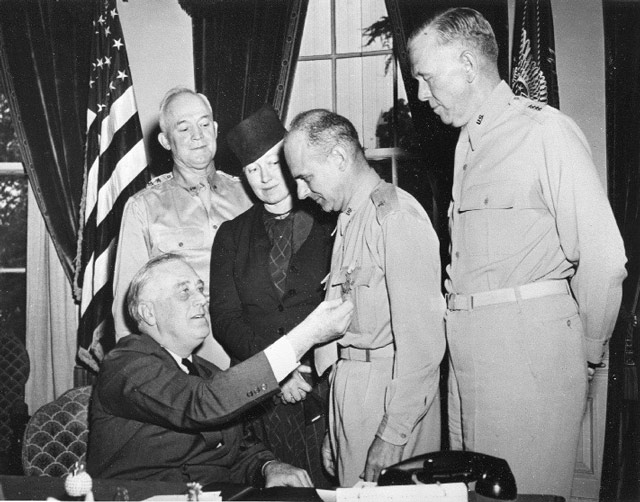
Roosevelts gives Doolittle Medal of Honor 19 May 1942 worldwartwo.filminspector.com
President Franklin D. Roosevelt presents the Medal of Honor to Brigadier General James Harold Doolittle in a ceremony at The White House, 19 May 1942. The President is seated at the left. Standing, left to right, are Lieutenant General Henry H. Arnold, Chief of the Army Air Forces; Mrs. Doolittle; Brigadier General Doolittle; and General George Catlett Marshall, Jr., Chief of Staff, United States Army. (Franklin D. Roosevelt Library and Museum, Photographic Collection, NPx. 65-696).
Battle of the Pacific: US Admirals "Bull" Halsey and Frank Fletcher are bringing their Task Forces 16 and 17 east toward Hawaii on 19 May 1942 in anticipation of a major Japanese attack. Nobody is completely sure where the attack will occur, but the consensus is that Midway Island will be the target. Light cruiser USS Nashville (CL-43) sails through the expected area of the attack from Midway to the western Aleutians today but does not see any enemy ships.

Japanese submarine I-21 launches a seaplane to reconnoiter Suva Bay, Fiji.

Battle of the Indian Ocean: The Japanese have sent a detachment of submarines, "Detachment A," to the Indian Ocean to scout for opportunities. Today, submarine I-30 launches a seaplane to reconnoiter Zanzibar and Dar-es-Salaam.
Crashed B-25B, 19 May 1942 worldwartwo.filminspector.com
A B-25B of the 39th Bomb Squadron forced to crashland at Westover Field, Massachusetts, on 19 May 1942 due to issues with the landing gear. Everyone survived. The pilot, Lt. John Henebry, ultimately becomes a major general and writes a book about his wartime experiences, "The Grim Reapers: At Work in the Pacific Theater" (2002).
Eastern Front: Commander of Army Group South Field Marshal Fedor von Bock presses his advantage against a disbelieving Red Army south of Kharkov. Having coordinated plans with First Panzer Army commander General Ewald on Kleist on the 18th, he orders Sixth Army commander General Friedrich Paulus to begin an attack from Merefa southwest of Kharkov. The objective is to occupy and distract the Soviet forces far to the west of where Kleist's panzers are attempting to surround them.

Kleist's III Panzer Corps, meanwhile, is brushing aside opposition as it continues eating into the Soviet supply corridor. The 14th Panzer Division crosses the Bereka River to take Petrovskoye while other divisions head west to block an expected Red Army breakout attempt. This narrows the mouth of the bulge to fifteen miles and deprives the Red Army forces to the west of a critical Donets river crossing.

Soviet Southwest Front, led by Marshal Semyon Timoshenko, finally begins to react to the growing Wehrmacht threat. After continuing to attack German VIII Corps south of Kharkov in the morning, it quickly breaks off the attacks and begins sending units to block Kleist's panzers to the southeast. The Luftwaffe controls the skies and sees and attacks the red Army columns on the roads. The German pilots, enjoying complete aerial dominance, claim to destroy 29 tanks during the day.

The Sixth Army war diary summarizes the situation at the end of the day: "The enemy's offensive strength has cracked. The breakthrough to Kharkov is therewith prevented."
Panzer 38(t) in Crimea, 19 May 1942 worldwartwo.filminspector.com
A German Panzer 38(t) leaves a landing craft on a beach near Yalta, May 1942 (Federal Archive B 145 Fig. F016214-0021A).
It is unclear where the Soviet orders to break off the attack in the morning came from. Post-war Soviet histories claim they came from Timoshenko on his own authority. If so, it is a dramatic turnaround by Timoshenko, who has been telling Stalin all along that the German counterattacks are not a threat. The Stavka finally reverses course at the end of the day and orders the advanced Sixth Army and Bobkin Group to terminate the offensive toward Kharkov and head southeast to confront Kleist's panzers.  
 
At his midnight conference, Hitler calls von Bock and tells him to hurry up and finish the encirclement. Kleist is to send 14th Panzer Division the final fifteen miles to reach Balakleya, where German troops of Paulus' Sixth Army await. Bock immediately calls Kleist's chief of staff and tells him to take the next town, Protopopovka, "under all circumstances and as soon as in any way possible." The fate of 600,000 Soviet soldiers to the west hangs in the balance. At Fuhrer Headquarters, General Franz Halder notes briefly in his diary that "The situation east of Kharkov is no longer dangerous."

In Crimea, General Manstein's 11th Army continues mopping up resistance in the Kerch region. Some histories record the 19th as the day of German victory in Crimea, and General Franz Halder records in his war diary that "The Kerch offensive can be regarded as closed." However, there remain Red Army holdouts (including at the port of Sevastopol), including thousands congregating in catacombs south of Kerch. In the air, Luftwaffe ace Gordon "Mac" Gollob continues a torrid victory streak, shooting down three more Soviet R-5 reconnaissance planes to raise his victory total to 99.
Japanese-American internees, 19 May 1942 worldwartwo.filminspector.com
Internees await relocation in Centerville, California. May 19, 1942. Dorothea Lange, photographer. Gelatin silver print. Collection of Oakland Museum of California. Gift of Paul S. Taylor.
European Air Operations: The weather clears sufficiently for both sides to resume their bombing operations. This is only a brief interruption of activity in what otherwise is a very quiet month along the Channel Front.

The Luftwaffe ends its lull by attacking Hull in another "Baedeker Raid." There are 50 deaths, 58 seriously injured, and extensive damage, especially in the Alexandria dock area. The bombing accuracy is quite good, especially relative to recent RAF attempts, with hits on the Blackburn aircraft factory at Brough (west of Hull). Extensive fires erupt along Scarborough Lane and Westbourne Avenue. The attack is notable for the use of an 1,800kg bomb and a 1,000kg bomb. Other areas hit include Hedon (east of Hull), Hornsea, and Withernsea. The Luftwaffe loses two Junkers Ju 88 bombers and a Dornier Do-217.

RAF Bomber Command mounts its first major raid in eleven days. The target is Mannheim. A total of 197 bombers (11 lost) embark, with 105 bomber crews claiming to hit the city. However, accuracy is very poor, and very few bombs actually hit the city. Local authorities estimate that bombs from only about ten bombers actually hit the city. However, the bombs that do hit cause an appreciable amount of damage to some small businesses in the harbor areas. There are only two deaths in the city.

In minor raids, 65 RAF bombers (one lost) attack St. Nazaire but cause little damage. Another 9 bombers lay mines off Lorient and near Heligoland, while 13 bombers drop leaflets over France.
Survivors of SS Heredia, 19 May 1942 worldwartwo.filminspector.com
The Downs family, survivors of the sinking of freighter SS Heredia on 19 May 1942 by U-506.
Battle of the Atlantic: U-506 (Kptlt. Erich Würdemann), on its second patrol out of Lorient, torpedoes and sinks 4732-ton US refrigerated freighter Heredia at 02:00 two nautical miles (3.7 km) southeast of the Ship Shoal Buoy off Louisiana. The ship sinks very quickly, giving no time to launch the boats. There are 36 deaths and 26 survivors, who are rescued by local shrimpers Conquest, J. Edwin Treakle, Papa Joe, and Shellwater, with three of the survivors picked up by a seaplane.

U-103 (Kptlt. Werner Winter), on its seventh patrol out of Lorient, torpedoes and sinks 5037-ton US freighter Ogontz 70 nautical miles (130 km) southeast of Cozumel, Mexico. There are 19 deaths and 22 survivors, who are rescued by US tanker Esso Dover.

U-751 (Kptlt. Gerhard Bigalk), on its sixth patrol out of St. Nazaire, torpedoes, shells, and sinks 3110-ton US freighter Isabela 35 nautical miles (65 km) south of Navassa Island Lighthouse. There are three deaths and 34 survivors, who make it to Cape Briton, Haiti, in lifeboats. This is the final victory for U-751.

An Italian submarine torpedoes and sinks Swedish 5747-ton steel cargo freighter Tisnaren somewhere in the Atlantic between Brazil and Senegal. Italian submarines Comandante Cappellini and Barbarigo are operating in this area but it is not definite which is the attacker.

At Hvalfjordur, Iceland, some merchant marine sailors aboard US freighter SS Ironclad notice that there is a shipment of liquor (it is en route to the US Ambassador to Moscow, Admiral William H. Standley, USN (Ret.)). They decide to help themselves and discipline breaks down, with fighting breaking out. At the behest of an armed guard officer on board, troops from the battleship USS Washington are sent over to restore order. Ironclad is removed from convoy PQ 16.
Tugboat Iriquois in Puget Sound, 19 May 1942 worldwartwo.filminspector.com
Tugboat Iriquois at sea, 19 May 1942 (Puget Sound Maritime Historical Society).
Battle of the Mediterranean: Royal Navy submarine HMS Thrasher torpedoes and sinks 1160-ton Italian freighter Penelope a few miles northwest of Monopoli, Italy.

Malta has been heavily reinforced with Spitfire fighters recently and the results are plain in the daytime sky. While Luftwaffe fighter sweeps over the island continue, the new defenders lead to a much-reduced bomber threat. In fact, they enable RAF bombers to go back on the offensive. Today, RAF bombers attack an Italian convoy northbound from Tripoli, though no ships are sunk.

Manhattan Project: Having just taken over the atom bomb research program, Robert Oppenheimer sends a letter to Ernest O. Lawrence updating him on progress. He writes that the atomic bomb design is solved "in principle" and projects that "six good physicists" should be able to work out the details within six months.

Joint Allied Command: The 30th and final in a series of Post-Arcadia meetings of the Combined Chiefs of Staff takes place in Washington, D.C. Among the topics discussed is an expected German advance toward the Persian Gulf from Syrian bases, the selection of targets for the nascent USAAF Eighth Air Force, and German development of a "new odorless gas, suitable for a surprise attack by inclusion in bombardments from the ground or from the air."
Crash site in Quebec, 19 May 1942 worldwartwo.filminspector.com
The crash site at No. 9 Bombing and Gunner School, Quebec.
Canadian Military: A Battle Mk. I crashes at No. 9 Bombing and Gunnery School, Mt.-Joli, Quebec, killing the four crewmen. This school is part of the British Commonwealth Air Training Plan, so the passengers include airmen from Canada, New Zealand, and Australia.

US Military: Brigadier General Ira C. Eaker, commander of Eighth Air Force, assumes command of all US air units in the United Kingdom.

Pursuant to a recent agreement between the United States and Panama, the 31st Fighter Squadron, 37th Fighter Group, 6th Air Force transfers its P-39 and P-40 fighters from Chorrera, Panama, to Albrook Field, Canal Zone.

Australian Military: A Tugan LJW7 Gannet aircraft flying from Batchelor Field (northern Australia) to Groote Eylandt makes a forced crash landing in a swamp in remote Arnhem Bay. The crew survives and scavengers the ruined airplane to make a raft. They survive an epic 33-day journey to the Milingimbi mission. Survivor George Booth later writes a book, "33 Days," describing how local natives helped the crew survive. This real-life story has echoes in the motion picture "Flight of the Phoenix" (1965) starring Jimmy Stewart.
General Jimmy Doolittle, 1942 worldwartwo.filminspector.com
Brigadier General James Harold Doolittle, U.S. Army Air Forces, 1942. (U.S. Air Force).
President Roosevelt presents the Medal of Honor to Lt. Colonel James Doolittle, who is also promoted to brigadier general, for the 18 April 1942 Doolittle raid. The citation reads:

For conspicuous leadership above and beyond the call of duty, involving personal valor and intrepidity at an extreme hazard to life. With the apparent certainty of being forced to land in enemy territory or to perish at sea, Lt. Col. Doolittle personally led a squadron of Army bombers, manned by volunteer crews, in a highly destructive raid on the Japanese mainland.

While, in fact, not a particularly damaging air raid as the citation reads, the Doolittle Raid was a major morale booster after the series of defeats at Singapore, Bataan, and elsewhere. It also influences Japanese strategy to its detriment, making it more defensive and paranoid.

American Homefront: The Western Defense Command issues Civilian Restrictive Order No. 1. This forces all Japanese-Americans in California, Oregon, Washington State, and southern Arizona to move into relocation camps. These camps are located in numerous states between eastern California and the Mississippi River. The total number of persons ultimately sent to camps is approximately 122,000.

Paul Waner of the Braves becomes the third National Leaguer to get 3000 hits (following Honus Wagner and Cap Anson).

Future History: Frederick "Curly" Neal is born in Greensboro, North Carolina. Curly Neal becomes a celebrity as the Harlem Globetrotters' featured ballhandler from 1963-1985. He also is featured in the animated Hanna-Barbera cartoon "Harlem Globetrotters." The Globetrotters retire Neal's No. 22 on 15 February 2008. Frederick Neal passes away in Houston on 26 March 2020.
Look magazine 19 May 1942 worldwartwo.filminspector.com
Look magazine of 19 May 1942 features a Marine Corps Sergeant Otto Nuske on the cover.

May 1942


2021

Saturday, May 1, 2021

May 16, 1942: Sobibor Begins Operation

Saturday 16 May 1942

Field Marshal Jan Smuts inspecting sailors, 16 May 1942 worldwartwo.filminspector.com
South African Field Marshal Jan Smuts inspecting the Royal Marine Guard of Honor on board cruiser HMS Cleopatra in Alexandria Harbor, 16 May 1942. © IWM A 9105.
Battle of the Pacific: Having accomplished Admiral Chester Nimitz's intent of allowing the Japanese to spot his Task Force 16, Admiral "Bull" Halsey on 16 May 1942 heads to Efate to refuel. Nimitz's devious strategy is to forestall the Japanese Operation RY to invade Nauru and Ocean Island by "showing his hand." This has worked, as the Japanese have been scared off by the appearance of Halsey's two carriers (USS Enterprise and Hornet) in the vicinity and canceled the operation. The Japanese invasion force now is headed back to Rabaul.

Nimitz now orders TF 16 to head back to Hawaii to prepare for future operations. Having viewed recent naval intelligence findings, Nimitz projects that the Japanese soon will make simultaneous attacks on Port Moresby, Dutch Harbor in the Aleutians, and Midway Island. His plan is to concentrate Task Force 16 and other available forces at Midway to repel that invasion while allowing the other invasions to be handled by local forces. However, naval intelligence continues to be split regarding Midway as a Japanese objective, so concentrating forces there remains a gamble based on disputed interpretations and conclusions of decrypted Japanese communications. Some intelligence officials, including Admiral Richmond K. Turner in Washington, believe Hawaii may be the target, but there is still time to discern Japanese intentions with more confidence.

USAAF Fifth Air Force sends B-26 and B-17 bombers to attack Lae, with B-25s flying two sorties against the airfield there. Poor weather causes some bombers to divert from Lae to attack shipping. In the morning, the bombers attack Lae at 800 feet, then return in the afternoon and bomb from 2400 feet. Other bombers attack the Japanese seaplane base at Deboyne, which the Japanese already have evacuated. The US loses no bombers, though one B-25C must force-land at Aiyary Airstrip in the eastern highlands of New Guinea (the airfield remains in service in 2021 as Aijura Airport).

US submarine USS Tautog (SS-199), on its second patrol, torpedoes and sinks Japanese fleet tanker Goyo Maru west of Royalist Bank, Truk. Tautog is one of the submarines on the assumed route of the Japanese aircraft carriers returning to Japan after the Battle of the Coral Sea. The sinking almost turns deadly for Tautog, too, as its first torpedo circles around and heads back toward it, forcing an immediate dive.
Saturday Evening Post, 16 May 1942 worldwartwo.filminspector.com
The Saturday Evening Post of 16 May 1942 urges people to "Keep 'em Flying."
Battle of the Indian Ocean: The 1st Burma Infantry Brigade, which has crossed the Chindwin River, reaches the frontier city of Tamu today. This continues a concentration of British military power along the Indian border while essentially abandoning Burma to the Japanese. More units are still on the road to Tamu but are expected to arrive shortly.

US power is growing in the theater, too. The 10th Air Force completes its move from the United States to New Delhi, India. A force of B-17s attacks the Japanese airfield at Myitkyina, Burma, today, destroying the runways.
The Arizona Daily Star, 16 May 1942 worldwartwo.filminspector.com
The Arizona Daily Star of 16 May 1942 optimistically headlines that "Reds Continue Kharkov Drive, Hold at Kerch." In fact, Kerch already is in German hands.
Eastern Front: Facing growing German resistance and counterattacks in the northern prong of their offensive around Kharkov, the Red Army renews its attacks with little success. German tanks blunt these assaults and recover some ground. The attack south of Kharkov continues to succeed, but both prongs must meet west of Kharkov for the Soviet strategy to succeed. Even in the south, the Luftwaffe increases its strikes and Wehrmacht reinforcements pour in from the rear areas. The southern Soviet advance through forests and small towns loses cohesion, spreading out in all directions without accomplishing any meaningful objectives.

General Franz Halder shows increasing confidence in his war diary. After noting that the northern attack "unfortunately has had a measure of success against the Hungarians" but "Disposal of the situation now is no more than a tactical matter," he writes:

East of Kharkov, our tank attack has captured Ternovaya. As a result, the fighting in this area, too, is now reduced to mere tactical scope.

Despite this sanguine attitude, the German high command remains torn. Field Marshal Fedor von Bock, commander of Army Group South, advocates the textbook approach of ringing the Soviet breakthrough with defensive troops to stop their progress. Hitler, however, brusquely rejects this approach. Instead, he coordinates a counterattack by General Ewald von Kleist's First Panzer Army at the base of the Soviet offensive, the breakthrough point. The plan is for 3rd Panzer Corps and 44th Army Corps to advance from north and south to cut the Soviet line of communications.
Baltimore News-Post 16 May 1942 worldwartwo.filminspector.com
The Baltimore News-Post of 16 May 1942 is full of optimism about the Red Army attack at Kharkov. Further down on the page is a headline about Earl Browder that reads "Communist Party Leader Serves 14 Months, Freed as Step Towards "Unity.""
Von Bock privately admits he favors Hitler's approach but is "compelled by orthodoxy" to reject it because it is a huge gamble:

Now the Fuehrer will order the big solution [the counterattack at the base of the breakthrough]. The laurels will go to the Supreme Command and we will have to be content with what is left.

Hitler, of course, does order the big solution. The counterattack, which is planned to begin on the 17th, is tenuous and Kleist himself is unsure if he has the strength to accomplish the encirclement. As the entire fate of the summer offensive on which Hitler places high hopes for ending the Soviet campaign successfully hangs in the balance, the counterattack will determine the future course of the campaign.

In Crimea, General von Manstein's Operation Trappenjagd has succeeded in its major objective by capturing Kerch. The battle now evolves into a mopping-up operation to subdue Soviet holdouts from Kerch all the way to the original line along the Parpach narrows. This will take a couple of days to complete, but the outcome in the Wehrmacht's favor is assured.

Despite the German successes, some sober facts keep crossing General Franz Halder's desk at Fuhrer Headquarters. In his war diary, Halder lists Wehrmacht casualties from the start of Operation Barbarossa through 10 May 1942 as reaching 1,182,735 men, or 36.96% of the starting total Eastern Army of 3.2 million. Of these, the killed number 9,450 officers and 241,572 others. Halder lists these numbers without comment.
Adolf Galland in North Africa, May 1942 worldwartwo.filminspector.com
Inspector of Fighters Adolf Galland visits JG 27 at Martuba Airfield, Libya, May 1942. Also visible are Lieutenant Colonel Woldenga and Major Neumann (Kanitz, Federal Archive Image 101I-442-1498-26A).
European Air Operations: Operations on both sides remain light today. Seven RAF Lancaster and seven Manchester bombers lay mines off Heligoland without loss.

Six Bf 109F fighters from 10/JG 2 attack Plymouth. They drop bombs near warships and strafe the dock area, killing one sailor on HMS Brocklesby. One airplane is shot down, killing the pilot, Hans-Joachim Schulz. The engine 

Battle of the Atlantic: U-751 (Kptlt. Gerhard Bigalk), on its sixth patrol out of St. Nazaire, torpedoes and sinks 1445-ton US freighter Nicarao north of the Bahama Islands. There are eight deaths and 31 survivors, who are rescued by US tanker Esso Augusta.

U-506 (Kptlt. Erich Würdemann), on its second patrol out of Lorient, torpedoes and shells US 7306-ton tanker William C. McTarnahan 35 nautical miles (65 km) east of the Ship Shoal Lighthouse in Louisiana. The crew abandons the ship with 18 dead and 27 survivors (rescued by local shrimpers). Tankers are famously difficult to sink due to their compartmentalized construction, and William C. McTarnahan follows this pattern. US Navy tugs Barranca and Tuckahoe take the ship in tow, and it is repaired and returned to service as St. James.

U-506 also torpedoes and damages 9002-ton US tanker Sun in the same vicinity just before the William C. McTarnahan. All 42 men on board survive. As with William C. McTarnahan, the crew abandons the ship, but when Sun does not sink, they reboard. The tanker still has power and makes its way to New Orleans.

U-103 (Kptlt. Werner Winter), on its seventh patrol out of Lorient, torpedoes and sinks 2637-ton US freighter Ruth Lykes off Cape Falso, Nicaragua. Torpedoed at 23:58, the freighter actually sinks at 00:44 on the 17th. The U-boat surfaces and uses its deck gun to finish off the ship, stopping to allow the crew to abandon the ship. There are five deaths and 27 survivors, rescued by Norwegian freighter Somerville. One crewman rescued later dies of wounds. The U-boat picks up one swimmer who has injuries, treats him, and then places him in a lifeboat.

Royal Navy 18-ton motor torpedo boat MTB 338 explodes and burns from unknown causes at Trinidad.

A Luftwaffe patrol shoots down a Catalina of RAF Squadron No. 210 200 miles west of Trondheim, Norway. All ten men aboard perish.
Freighter Ruth Lykes, torpedoed on 16 May 1942 worldwartwo.filminspector.com
US freighter Ruth Lykes, torpedoed by U-103 on 16 May 1942.
Battle of the Mediterranean: Fierce air battles continue over Malta. The Axis bombers focus on airfields. Several Spitfires are damaged but no planes or pilots are lost.

Partisans: With the Wehrmacht in possession of the port of Kerch in Crimea, many Red Army soldiers are trapped on the Kerch peninsula with a difficult escape route across the Strait of Kerch. In the town of Adzhimushkay, Colonel Pavel Yagunov forms a pocket several thousand strong to hold out indefinitely or until sufficient transportation can be arranged. Numbers are small at first, but they swell with time to about 13,000 as escape becomes impossible. Several different garrisons are formed.

Yagunov's force evolves from a holdout force into a guerilla operation based in the Great Adzhimushkay catacombs system. As with other large partisan operations, its fatal weakness is that its location becomes known to the Germans. Its priority is forced to shift from hit-and-run attacks to self-defense, and German reactions constantly whittle down its size. The operation survives until October 1942 with occasional successes against the occupying German forces but the eventual death or imprisonment of virtually everyone. 

This is known as the Adzhimushkay Defense. A museum is established in 1966 and a memorial complex in 1982.
Oveta Cullp Hobby becomes leader of the WAAC on 16 May 1942 worldwartwo.filminspector.com
Mrs. Oveta Culp Hobby, leader of the WAAC. Her name has been floated in the 2020s as a possible replacement for a military base.
US Military: Mrs. Oveta Culp Hobby is sworn in as director of US Women’s Army Auxiliary Corps.

Liner Queen Mary arrives in the Clyde, completing the first troop transport voyage carrying over 10,000 people (9880 troops, 875 crew). The voyage takes five days, three hours, and 45 minutes at an average speed of 25.58 knots.

The USAAF orders 25 lightweight wooded Bell XP-77 fighters.

German Military: Major Gordon "Mac" Gollob leaves JG 54 and becomes Geschwaderkommodore of JG 77, supporting General Manstein in Crimea. He gets off to a great start flying out of Kerch. During the day, he shoots down three Lavochkin-Gorbunov-Gudkov LaGG-3 fighter aircraft to raise his victory total to 89.

US Government: In a secret memorandum to US President Franklin Roosevelt, George C. Marshall recommends reducing the allocation of aircraft to the RAF substantially. These amounts were established by the Arnold-Porter (chiefs of the US and British air forces, respectively) Agreement of 13 January 1942. Marshall writes that the "situation... has greatly altered." Among those changed circumstances is new secret information about British aircraft production which shows that it is twice as large as the British claimed at the time. 

Among Marshall's suggestions are that 50% of all aircraft types except Martin 187 light bombers be immediately reallocated to the United States, with 100% of all aircraft reallocated to the US beginning in August 1942. Naval aircraft also should be reallocated to the US, Marshall argues. Basically, Marshall claims in diplomatic phrasing that the British have been misleading the US about the state of their aircraft production by undercounting it in order to get more free lend-lease planes from the US.
Ukrainian laborers waiting to go to Germany, May 1942 worldwartwo.filminspector.com
Ukrainian women, many in traditional garb, reporting for registration at an employment office at Artemovsk in order to be hired for work in Germany in May 1942. They are waiting at the train station. (Knodler, Karl, Federal Archives Image 183-B19878).
Holocaust: Sobibor concentration camp is located in a bucolic setting near the village of Sobibór. This is in the easternmost area of the General Government region of German-occupied Poland. Originally opened on 15 April 1942, the Sobibor camp becomes fully operational as an extermination camp on or about 16 May 1942.

After a crude start, Sobibor now begins operating with chilling efficiency. Trains from across Europe enter the camp station off a special rail spur, and the passengers ("evacuees") are immediately relieved of their personal possessions (the very few they were permitted to carry). Of course, the arrivals don't know why they are there, as the authorities have given them some concocted story about resettlement and jobs that will keep them from causing any trouble. The Germans actually give a lot of thought to this tactic and go to great lengths to disguise their true intentions. Everything appears innocent and routine right up until the end, though with increasing degrees of degradation.

Once out of the train, the passengers are separated by gender and sometimes other factors (such as the ability to work) and compelled to disrobe completely. Camp internees come and shave the hair off the incoming females, then everyone is separated into groups and led down a 100-meter (330 foot) long pathway euphemistically called the Himmelstrasse ("Road to Heaven"). The destination down the Himmelstrasse is an ordinary-looking bunker that the prisoners are told is a communal shower. In fact, it is a disguised gas chamber. The prisoners walk in, the door is barred behind them, and then engines (usually tank engines which give off a lot of exhaust) are started up. The exhaust is fed into the crowded chamber. The deed is done within about fifteen minutes.

After this process is completed, the gas is cleared, the door is opened, and the bodies are disposed of in various fashions. At first, the bodies are buried in mass burial pits, but as time goes on this becomes impractical. Bodies then are simply burned in the open air where they lie, but this, too, cannot keep up with the supply. Finally, the bodies are incinerated in ovens which are upgraded over time. Huge mounds of ash result.

The victims come from across the breadth of Occupied Europe, with heavy concentrations from Poland and the Balkans. Many of the earliest victims arrive from Slovakia and nearby regions. Much of the work at Sobibor, as at other camps, is done by auxiliaries ("Sonderkommando") who are internees themselves. Fearing for their own lives, they are only interested in getting the job done as fast and efficiently as possible to please their captors. These auxiliaries, of course, only want to stay out of the chambers themselves (few survive the war).
Sobibor opens for operation on 16 May 1942 worldwartwo.filminspector.com
Welcome to Sobibor.
Dr. August Becker, SS Untersturmführer, sends a letter to SS-Obersturmbannführer Rauff dated 6 May 1942 in which he gives details on gassing vans. Becker says in part:

The application of gas usually is not undertaken correctly. In order to come to an end as fast as possible, the driver presses the accelerator to the fullest extent. By doing that the persons to be executed suffer death from suffocation and not death by dozing off as was planned. My directions now have proved that by correct adjustment of the levers death comes faster and the prisoners fall asleep peacefully. Distorted faces and excretions, such as could be seen before, are no longer noticed.

Becker also notes that the vans have become "well-known" and that both local authorities and the civilian population call them "death vans."
Picture Post magazine, 16 May 1942 worldwartwo.filminspector.com
Picture Post magazine of 16 May 1942 shows a British soldier completing a climb up a 60-foot hill.
British Homefront: Prime Minister Winston Churchill visits Leeds. He says in part:

In the height of the second great war, it is a great pleasure to come to Leeds and bring to the citizens a word of thanks and encouragement in all the work they are doing to promote the common cause of many nations and in many lands. That cause appeals to the hearts of all those in the human race who are not already gripped by tyranny or who have not already been seduced to its insidious voice. That cause is shared by all the millions of our cousins across the Atlantic who are preparing night and day to have their will and rights respected. It appeals to the patient millions of China, who have suffered long from cruel aggression and still fight with faithful stubbornness. It appeals to the noble manhood of Russia, now at full grips with the murderous enemy, striking blow for blow.

His most quoted phrase is, "Now we see the ridge ahead." Churchill enters town standing in the back of an open limousine to crowds lined along the roadway. Huge crowds attend his speech. Afterward, Churchill tours the Leeds industrial districts.

American Homefront: An Assistant Solicitor General in the US Office of Legal Counsel, Oscar Cox, gives a legal opinion on the "Removal of Japanese Aliens and Citizens From Hawaii to the United States" (Hawaii in 1942 not yet being a State). The specific issue is whether such persons can be placed in internment camps on the mainland under martial law. Cox asserts:

Hawaii is still within the Pacific theatre of war and subject to attack again. Continuance of martial law in Hawaii is doubtless justified. If military necessity dictates it -- as it well may -- those Japanese who were interned in Hawaii or those whose presence is dangerous can be removed. To hold otherwise would be deciding upon the impractical.

Cox cautions, however, that:

The existing case law indicates some doubt on the power to remove and intern the Japanese citizens in the United States. But the conditions of modern warfare are different from those of prior wars. Because of this the courts might well follow a different course than that indicated by the earlier decisions.

Due to the legal uncertainty, Cox concludes that "the safest legal procedure would be to hold the Japanese who are American citizens in Hawaii." The next best course would be to intern them in Hawaii and give them the option of coming to the mainland voluntarily to become members of the work corps of the War Relocation Authority. The final option, evacuating them from Hawaii to mainland internment camps may be legal under President Roosevelt's Executive Order 9066 and Public Law 77-503 but would require factual proofs of military necessity that should be avoided if "feasible."

"Tangerine" by Jimmy Dorsey and His Orchestra with Bob Eberly and Helen O'Connell remains at No. 1 on the Billboard singles chart for the second week in a row.

Future History: Polish anthropologist Bronisław Malinowski passes away from natural causes in Mexico. While his work is important in the history of anthropology, Malinowski's personal diaries become his real legacy. Never intended to be published, the diaries are found after his death and published in 1967. These diaries give deep insight into the true impulses motivating academics, many of which are interpreted by readers to be venal and conflicted. Malinowski's self-critiques and reproaches call into question how "unbiased" observations of other cultures can be. While their usefulness is highly debated and controversial, the Malinowski diaries become a continuing point of contention and well known in the field of anthropology for decades.
Recruiting pig King Neptune, 16 May 1942 worldwartwo.filminspector.com
King Neptune (shown) is born on the Sherman Boner farm near West Franklin, Illinois, on 16 May 1942. A navy recruiter uses him to raise $19 million in war bonds for the construction of the Iowa-class battleship Illinois between 1942 and 1946. The recruiter, incidentally, saved King Neptune from his original fate of serving as the centerpiece at a fundraising pig roast. Upon his death in 1950, he is buried with military honors. A monument to King Neptune (with an incorrect birth year) later is placed at a northbound I-57 rest area. It still stands.

May 1942


2021