Showing posts with label Rommel. Show all posts

Saturday, October 8, 2022

June 22, 1942: Rommel Promoted to Field Marshal

Monday 22 June 1942

Fleet Air Arm, 22 June 1942 worldwartwo.filminspector.com
"Fleet Air Arm planes starting out on an exercise carrying torpedoes." © IWM A 10683.

Eastern Front: June 22, 1942, is the start of the second year in the Soviet Union, as General Halder notes in his war diary. Things look good for the Germans despite the failure to accomplish the end objectives of 1941. The grand offensive, Case Blau, that Adolf Hitlers sees as "clearing the table" in the East is ready and the Wehrmacht is reporting successes far and wide. Word of the Japanese defeat at Midway has not yet filtered through, and in any event, the Germans feel they can win the war on their own.

In Crimea, German troops continue cleaning out dwindling Soviet resistance on the north side of Severnaya Bay. On the southern and eastern fronts, the German 30th Corps remains stymied by fierce Soviet resistance backed by effective artillery fire on Sapun Ridge. Romanian 18th Infantry, 1st, and 4th Mountain Divisions continue slowly advancing along the Chernaya River toward Severnaya Bay. The Luftwaffe remains a dominant force, flying about 800 sorties and dropping about 700 tons of bombs every day.

General von Manstein, in command in Crimea, suddenly comes up with an innovative way to end the Sevastopol siege quickly. He asks General Halder for permission to parachute the captive Allied commander at Tobruk into Sevastopol to serve as a kind of object lesson on the futility of holding out. He predicts "a strong demoralizing effect." Halder does not even bother mentioning the crazy idea - which ignores practicality and the Geneva Convention - in his diary entry. 

Luftwaffe General von Richthofen is ordered north to his new post helping out with Blau and given three days to get there. He wanted to remain for the ultimate victory, which now seems as far off as ever, and complains in his diary that he had originally been promised a full week to fly out. "It is a pity," he writes, "that one can never finish what one starts here in the east. After a while, it takes away all the pleasure."

Von Richthofen likes to dabble in ground operation strategy - all Luftwaffe generals are former army officers - and complains in his diary about Manstein's conservative approach (emphasis in original):

"I wish that everyone would just push a little more energetically. The view that advancing cautiously avoids losses is simply not correct, because small losses each day soon mount up the longer it takes."

Richthofen is a crony of Hitler and feels free to critique his peers freely in his diary. His assessments generally (but not always) appear quite reasonable.

Hitler finally returns to Fuhrer Headquarters in East Prussia after having been informed of the Reichel Affair on the 21st, and it is as though a dark raincloud has descended on the trapped generals. He summons Field Marshal von Bock, leader of Army Group South, to report on the situation. Halder reports "a great agitation conducted against the General Staff" about the loss of the plans for Blau to the Soviets. Nobody is quite sure what is going to happen to Blau, which today goes on four-days standby (so, projected to begin on 26 June). Halder notes that the pre-positioning of forces for Blau will take place today after dark.

Stalin on Newsweek cover, 22 June 1942 worldwartwo.filminspector.com
Soviet Premier Joseph Stalin on the cover of Newsweek, 22 June 1942.

On the Soviet side, Stalin has dismissed the Reichel Blau plans as disinformation, but not all of the Soviet generals are so sure. Colonel General Golikov, commanding the Bryansk Front, begins reinforcing his southern (left) flank. General Timoshenko further south, however, agrees with Stalin and believes that the papers were "fed to us deliberately in order to throw a veil over the true intentions of the German command." Golikov is taken aback by Timoshenko's head-in-the-sand approach and asks Stalin for a special commander to take over the sector in front of Voronezh. Stalin, however, still believes the German main effort will be toward Moscow to finish up the unfinished business of 1941 and turns him down flat. Since the Reichel papers indicated that the offensive would start on 22 June, at least so far the generals taking the papers seriously are starting to look foolish.

Operation Fridericus II, the remaining preliminary operation for Blau, jumps off in the morning. As with the recently concluded Operation Wilhelm, III Panzer Corps of Sixth Army carries the main load. It departs from the vicinity of Chuguyev heading toward Kupyansk, where it intends to turn south along the Oskol River. Further south, XXXXIV Corps of General Kleist's First Panzer Army crosses the Donets between Izyum and the mouth of the Oskol and heads north to close the pincer. It is still raining, as it has been for several days, and III Corps' panzers only make it halfway to Kupyansk. Halder notes that the operation:

made substantial initial ground gains, but later encountered stubborn resistance west of Kupyansk. Crossing of the Donets from the south has been executed without major difficulties. 

An unexpected trend for the Germans is becoming apparent from these preliminary operations: the Soviets are not resisting. Rather than make defensive stands to stop or slow the German advances, the Red Army is simply giving ground. Nobody is quite sure what to make of this, and it is not entirely beneficial because the advancing troops are taking distressingly few prisoners. 

Further north, things also are going well. Soviet Second Shock Army remains trapped west of the Volkhov River, though Halder notes that "Enemy tanks have penetrated into our 'bridge,' but... it is believed this will prevent the enemy from getting his forces out of the sac." He adds approvingly that "Starvation among the penned-up enemy is beginning to take its toll."

Battle of the Baltic: Soviet submarine Shch-317 torpedoes and sinks 2399-ton Swedish iron ore freighter Ada Gorthon west of Gotland (off Bläsinge, Öland). The ship sinks in less than a minute, and there are 14 deaths and 8 survivors.

Danish 81-ton freighter Ruth hits a mine and sinks in the Småland Sea off Sweden. The crew survives and they are later picked up by another freighter.

USS Meredith near Fiji, 22 June 1942 worldwartwo.filminspector.com
USS Meredith (DD-434) at sea off the Fiji Islands, 22 June 1942. Note the camouflage painting (Naval History and Heritage Command 80-G-13134).

Battle of the Pacific: Port Moresby is now top of the agenda for both sides and can be considered the unofficial start of the battle for Port Moresby (which was the target of the failed Japanese invasion deterred by the Battle of the Coral Sea in May). Japanese forces of the Japanese 17th Army under Lieutenant General Harukichi Hyakutake in Papua, New Guinea begin the long 60-mile (100 km) trek over the mountains south toward Port Moresby. The terrain is rough and there are dense jungles along the way. Japanese forces use the Kokoda foot Track, which soars to 2190 meters (7,185 feet) at the peak of Mount Bellamy.

The Allies, in Operation Boston, send a garrison force from Port Moresby today to Milne Bay to develop an airfield. They also authorize another strip at Merauke, on the south coast of Dutch New Guinea, to protect the less-exposed western approaches. General Douglas MacArthur is the theater commander, while General Sir Thomas Blamey is the commander of Allied land forces for protection against Japanese overland attacks. Blamey is now in the process of deploying forces north to Kokoda.

Blamey's Allied Land Headquarters today orders Brigadier Basil Morris, commander of the 8th Military District of Australia, to deploy "Australian Infantry" to Kokoda (midway along the Trail) to block the Japanese advance (this takes a couple of days for Morris to undertake). The Allies also are in the process of building a vehicle track north toward Owers' Corner (38 miles, 61 km from Port Moresby), which generally is considered the southern terminus of the Kokoda Trail (completed late September).

USS Saratoga begins ferrying 18 Marine Dauntlesses of VMSB-231 and 25 Army Air Corps Curtiss P-40 Warhawks to Midway Island to replace aircraft lost during the Battle of Midway in early June. Admiral Fitch, the temporary commander of Task Force 11, is in command of the operation.

There is poor weather in the Aleutians, so some missions are canceled. A B-17 does manage a weather reconnaissance flight over the Japanese-held Kiska Island.

U.S. 44-foot tug Laura catches fire and sinks at Wood Island in Alaska.

European Air Operations: The Luftwaffe raids Southampton and neighboring Eastleigh during the early morning hours. Several homes are bombed and over a dozen people killed in the hardest raid in months.

Japanese landings on Borneo, 22 June 1942 worldwartwo.filminspector.com
Japanese troops land on Natuna Island, northwest Borneo, 22 June 1942.

Battle of the Atlantic: Luftwaffe Junkers Ju 87 Stuka dive bombers attack shipping in the Kola Inlet. They sink minesweeper HMS Gossamer within eight minutes. There are 23 casualties. The Germans are preparing for a major effort to disrupt the Arctic convoys during the long summer days. The Soviets also lose two Sh-4 motor torpedo boats, No. 73 and No. 83.

U-159 (Kptlt. Helmut Friedrich Witte), on its second patrol out of Lorient, uses its deck gun to sink 9639-ton U.S. tanker E.J. Sadler southeast of Santo Domingo (west of Dominica). All 36 crew are rescued by destroyer USS Biddle.

U-202 (Kptlt. Hans-Heinz Linder), on its sixth patrol out of Brest, torpedoes and sinks 5864-ton Argentinian tanker Rio Tercero 120 nautical miles (220 km) southeast of NYC. There are five deaths and 37 survivors.

German patrol boat Sperrbrecher 14 Brockenheim hits a mine off Royan in the Bay of Biscay and is severely damaged, though it is towed back to port. Eventually, it is written off and scuttled as a block ship on 25 August.

British 242-ton fishing trawler (now ferry) Bromelia is being watched by a U-boat off Grimsby, North East Lincolnshire, Lincolnshire, England, when it suddenly hits a mine and explodes. There are 13 deaths.

Time magazine ad, 22 June 1942 worldwartwo.filminspector.com
Magazine ads are taking on a decidedly patriotic slant, such as this one from 22 June 1942 Time magazine p. 14.

Battle of the Mediterranean: General Rommel's promotion has some immediate consequences. While nominally under the command of Italian generals at Commando Supremo, Rommel now feels even less bound by their decisions. During the day, a senior Italian staff officer shows up at his headquarters with General Bastico's orders to halt and consolidate gain, but Rommel disagrees. He already is planning a quick sweep east to disrupt the British before they can build strong defenses at Mersa Matruh.

Rommel has good reason to act quickly. German intelligence services inform him from intercepted communications that a U.S. military attaché in Cairo, Bonner Fellers, has told his superiors that, "If Rommel intends to take the Delta, now is the time." One of the reasons the Italians had such difficulties against the British before the arrival of the Afrika Korps was their conservative approach. So, the idea of stopping at Tobruk is anathema to Rommel.

He thus resorts to an appeal directly to Mussolini. Bypassing the chain of command normally would be prohibited, but the complicated international nature of the situation gives Rommel some flexibility. He writes a letter to Mussolini that is hand-delivered by the German attaché in Rome, Enno von Rintelen, in which he requests permission to continue advancing.  He further requests that the projected invasion of Malta, Operation Herkules, be postponed so that he can keep his vital Luftwaffe support (which Field Marshal Kesselring already has begun withdrawing to Italy for the operation). He sums it up: "the goddess of success passes generals only once."

It is a clever decision, and it works. Mussolini already is arranging for a suitable white charger on which he can make his triumphal entry into Cairo. He immediately forwards the letter to Hitler.  

The Germans no longer consider the British a factor in their plans (a similar tendency develops in Russia). Eighth Army is fleeing to Egypt, and General Ritchie has already abandoned any thought of making a stand at the border. Mersa Matruh, a fortified base to the northeast, seems much more defendable. Shattered British troops make the long, hot drive that they sardonically call the "Mersa Matruh Stakes."

Soviet Yak-7B prototype, June 1942 worldwartwo.filminspector.com
Yakovlev Yak-7B prototype no.22-03 during trials in June 1942.

Partisans: About 600 Italian police ("carabinieri") surround a home where three Albanian student communists (Branko Kadia, Perlat Rexhepi, and Jordan Misja) are holding out. They burn the building to the ground and execute the partisans. This becomes known as the Three Heroes of Shkodër (Shkrodra) and proclaimed as People's Heroes of Albania, with a patriotic song written about them.

A German anti-partisan operation, Operation Zenica-Zavidovići, concludes in the puppet state of Croatia. Fighting occurred mainly around Vlasenica to the east of Zenica. Most of the partisans have escaped to the southwest.

German Military: As a reward for victory at the Battle of Gazala and the capture of Tobruk, Hitler promotes Erwin Rommel to Generalfeldmarschall. This is not met with unanimous acclaim, as the Italian generals feel slighted after the very real contributions of Italian forces in the victory. Even Rommel is a bit indifferent, later confiding to his wife that he would have preferred being sent another division (throughout the campaign, he commands only three German divisions). Other German generals feel that the entire North African campaign is nothing but a sideshow and that Rommel is a reckless gambler - in their opinion, he should just hunker down and preserve his forces while the real work is done in Russia.

Rommel becomes famous in part for being Germany's youngest Field Marshal at the age of 50, though this is only partly true. Note that younger officers in the Luftwaffe, Generals Erhard Milch promoted on 19 July 1940 at age 48, and Wolfram von Richthofen on 16 February 1943 at age 47, become field marshals at younger ages. As a younger branch of the military, the Luftwaffe is well-known for having more room for advancement by younger men. This is also with the exception of Hermann Goering, chief of the Luftwaffe, promoted to field marshal at age 45 on 4 February1938 not for military feats but solely due to his position within the state hierarchy. Erwin Rommel, unlike the others, is famous for his overall generalship and ground victories rather than due to a position within the administrative apparatus.

Time magazine map of Eastern front, 22 June 1942 worldwartwo.filminspector.com
Time magazine, 22 June 1942 p.25, contains a prescient map of what will soon become Case Blau, the German offensive toward Stalingrad. Tellingly, it foresees quite modest goals for the Wehrmacht, with Stalingrad still far in the distance. It is actually a quite good prediction that the Germans will strike in the south and not, as Stalin and many others feel, again toward Moscow. 

US Military: Rear echelon troops of the First Marine Division set out from San Francisco aboard M/S John Erickson. They pass the time playing cards.

Holocaust: Adolf Eichmann sends an express letter to the Ministry of Foreign Affairs confirming a telephone call on the 20th in which he directed that Jewish resident of France, Belgium, and the Netherlands are to be sent to Auschwitz camp beginning "mid-July/the beginning of August." There are to be 40k from France, a similar number from the Netherlands, and 10k from Belgium. These are to be people "who are fit for labor, if they are not intermarried or hold the nationality of the British Empire, the USA, Mexico, enemy countries in Central or South America, or neutral or Allied countries." The "special trains" are to leave "every day."

In Plonsk, a Jewish Community in Warsaw Province, Poland, a 30-member communist group in the ghetto joins the Polish Workers' Party, or PPR. A party committee is established in the ghetto. 

French Homefront: Prime Minister of France (aka Vice Premier) Pierre Laval, who is effectively running the French government as an ally of the Germans, makes a radio broadcast to the nation. He says in part:

I wish for a German victory, because, without it, Bolshevism tomorrow would settle everywhere.

Laval owes his return to the government in April to the German authorities, who view Premier Philippe Pétain as insufficiently supportive of the Axis. The way Laval frames his questionable reasoning as being more a stand against communism rather than simply blind support for the Reich becomes a common Axis theme and echoes common pre-war French political battles. 

There is no question that Laval collaborates with the Reich, sometimes phrased more stringently as his being an "arch-collaborator."| However, Laval does now and then make a few small stands on behalf of France around this time that go unnoticed but make an impact on some people. For instance, in June 1942 he refuses a German demand for the forced deportation of 300,000 French workers as virtual slave labor in German war factories. Instead, he makes a counterproposal that one French POW be repatriated to France in exchange for every three French workers arriving in Germany. While a minimal gesture, it at least is something. Hitler accepts this, a rare concession to retain what support he has within the Vichy French government.

This is obviously not a major "victory for France" and does not excuse Laval's overall support of Germany during the war, but apparently does (or at least intends to) accomplish something positive for a very small sliver of Frenchmen that otherwise would not have happened. Laval's involvement in the Holocaust is murky, but he seems to go along with abhorrent German policies for the most part, though there are disputes about his participation and support.

American Homefront: Congress, in a Joint Resolution, formally adopts the words of the Pledge of Allegiance in the U.S. Flag Code. It was composed to celebrate the 400th anniversary of Christopher Columbus' arrival in the Americas. The author is Francis Bellamy, and it was originally published on 8 September 1892 in the children's magazine "The Youth's Companion." Reciting the Pledge in classrooms began spontaneously thereafter, and a surge of patriotism following the Pearl Harbor attack has made the Pledge popular among adults, too.

Life magazine, War Stamp Brides, 22 June 1942 worldwartwo.filminspector.com
Life magazine, 22 June 1942, "War Stamp Bride."

2022

Sunday, September 11, 2022

June 21, 1942: Rommel Takes Tobruk, Allies Stunned

 Sunday 21 June 1942

Rommel and Bayerlein in Tobruk, 21 June 1942 worldwartwo.filminspector.com
German generals Erwin Rommel and Fritz Bayerlein, Afrika Corps Chief of Staff, in Tobruk ca. 21 June 1942 (Moosmuller, Federal Archive Picture 101I-785-0299-08A).

Battle of the Mediterranean: South African Major General Hendrik Klopper, commander of all Allied forces at Tobruk, spends the early hours of 21 June 1942 trying to figure out a strategy following the German breakthrough at the port perimeter. Klopper sends a message to Eighth Army Headquarters, "Am holding out but I do not know for how long." Army headquarters responds by suggesting a breakout on the night of the 21st/22nd. Eighth Army commander General Ritchie orders his 7th Armored Division to attempt a relief mission from the south. At 02:00, Klopper signals that he agrees with the breakout but somewhat cryptically adds that the garrison would "fight to the last man and the last round."

At dawn, though, Klopper reviews the situation and changes his mind. After Klopper informs HQ of this, Ritchie replies, "I cannot tell tactical situation and therefore leave you to act on your own judgment regarding capitulation. With this clearance, Klopper quickly invites some German staff officers to his headquarters in Tobruk to discuss terms. Klopper then orders a surrender which some units do not honor, and scattered fighting by holdouts continues in various places into the 22nd, but the surrender effectively ends the battle for the port. The Germans claim 25,000-33,000 (19,000 British) prisoners (sources differ) of the British 30,000-troop garrison. The Germans only suffer 3360 casualties.

It is a brilliant lightning attack, as the Axis forces only surrounded Tobruk on the 18th. Most German generals would have settled in and built up forces over a long period of time for a set-piece attack against such a formidable target, as Erich von Manstein has done in Crimea regarding Sevastopol. However, Rommel proves here that speed of attack and strategy is sometimes more important than weight of numbers.

Italian medium tank of Ariete Division at Tobruk, 21 June 1942 worldwartwo.filminspector.com
Italian medium tank of the Ariete Division advancing on Tobruk, ca. 2 June 1942.

In the United States, British Prime Minister Winston Churchill is meeting with President Franklin Roosevelt when an aide come in with a message for the President. FDR then passes the note to Churchill, who has his own military aide confirm the news from London. Churchill later writes that this is the greatest shock he receives during the entire war. He says to FDR, "Give us as many Sherman tanks as you can spare and ship them to the Middle East as quickly as possible." These tanks will prove important - perhaps decisive - at El Alamein in October and November.

On the German side, there is tempered joy., as noted below with General Halder's official reaction. Theater Commander Field Marshal Albert Kesselring visits Rommel's headquarters in the afternoon and reminds him of a previous understanding that an invasion of Malta would follow. To that end, Kesselring informs Rommel that he is withdrawing Luftwaffe units from North Africa to Italy.

British POWs marched out of Tobruk, 21 June 1942 worldwartwo.filminspector.com
British POWs marched out of Tobruk ca. 21 June 1942.

German E-boats are operating off Tobruk to forestall an evacuation by sea and they claim 250-ton South African Navy auxiliary minesweeper HMSAS Parktown. There is one death.

RAF bombers attack and sink 7744-ton German freighter Reichenfels, which is bringing supplies for Rommel's panzers, north of Tripoli. 

British submarine Turbulent torpedoes and destroys Italian destroyer Strale. The Italian ship had run aground due to attacks by Royal Navy Fairey Swordfish) at Ras el Amar on 21 March 1942. There are one dead and 221 survivors. There are alternate dates for all of these events at various places online (this sinking is sometimes fixed on 6 August), but the basic facts are confirmed.

Soviet Cossack commander near Kharkov, 21 June 1942 worldwartwo.filminspector.com
 A Soviet commander of a Cossack unit in the Kharkov sector of the Eastern Front, 21 June 1942 (AP Photo).

Eastern Front: The German 24th Infantry Division continues clearing the north side of Severnaya Bay at Sevastopol. At 11:20, the Soviet North Fort falls and about 182 Soviet prisoners surrender. The Soviet holdouts at the Maxim Gorki fort also have surrendered. There remains scattered Soviet resistance in the area that takes a couple of days to overcome. Holdouts that attempt to escape across the 1000-meter wide bay in small boats become target practice for German artillery.

To the south and east of Sevastopol, the Axis forces remain stuck. The Romanian 18th Infantry, 1st, and 4th Mountain Divisions are advancing slowly up the Chernaya River toward Severnaya Bay, with LIV Corps on its left providing flank protection. Soviet artillery on Sapun Ridge provides good counter-battery fire that destroys Axis artillery pieces.

The Germans are preparing Operation Fridericus II, a shallow envelopment by Sixth Army and First Panzer Army near Kupyansk, to begin on the 22nd. It is one of a series of small preliminary operations to Operation Blau. Heavy rains in this portion of the front have delayed German operations.

At Fuhrer Headquarters in East Prussia, General Franz Halder barely mentions the fall of Tobruk, or indeed North Africa at all. There is only a succinct "Tobruk taken" at the bottom of his summary. This is more evidence that the General Staff doesn't think much of the North African campaign or, for that matter, of Rommel. They view him as a loose cannon  who "rushes around frittering away his forces." Rommel was not their first choice for command there and he is viewed as a prima donna. That Rommel has succeeded is thus not a cause for joy there. However, Hitler does like Rommel, and the general is considered somewhat of a Fuhrer favorite - another cause for resentment by the other staff officers.

Halder does provide a brief update on the Major Reichel incident:

Major Reichel's plane has been found. He probably is dead. The documents, filled with vital information, must by now be in enemy hands.

Halder is absolutely correct: Stalin has the Blau plans sitting on his desk. However, the Soviet premier believes the plans are faked by the Germans to lead him in the wrong direction and thus completely disregards them.

Italian medium tank of Ariete Division at Tobruk, 21 June 1942 worldwartwo.filminspector.com
Italian medium tank M13/40 of the Italian 132nd Panzer Division "Ariete" at Tobruk Harbor ca.  21 June 1942.

The German generals, though, naturally don't know about Stalin's reaction. Halder and his staff's attention is completely preoccupied with the upcoming Operation Blau. Field Marshal Fedor von Bock, whose troops will carry out Blau, fears the worst and urges Halder to tell the Fuhrer - who apparently is still on holiday at the Berghof - about the Reichel incident (about which apparently Hitler does not yet know).  Hitler predictably is shocked and arranges to fly back to East Prussia immediately.

Halder does have a lot to say about Sevastopol, though, which arguably is a lot less important to the overall war effort than North Africa:

At Sevastopol, the Battery Headland peninsula is in our hands and consequently we are now controlling almost the entire north shore (LIV Corps). Good progress by 30 Corps. The enemy appears to be abandoning the front opposite the Romanians in order to concentrate his forces against 30 Corps. On the Volkhov, heavy attacks supported by tanks, which were repelled with difficulty. Otherwise, no change.
The war at sea off Sevastopol remains hot as well. Luftwaffe attacks sink two Soviet patrol boats, CKA-125 and CKA-155, off Musketeer's Bay near Sevastopol.  

Shell crater at Fort Stevens, 21 June 1942 worldwartwo.filminspector.com
Shell crater at Fort Stevens from I-25 shelling, 21 June 1942 (National Archives 299678).

Battle of the Pacific: For the second day in a row, a Japanese submarine bombards North America. Yesterday, it was HIJMS I-26 shelling Estevan Point, Vancouver Island, British Columbia. Today, it is I-25 (Meiji Tagami), which follows some fishing vessels coming home after a day's work through minefields to the mouth of the Columbia River, Oregon. It then fires 17 14 cm shells from its deck gun at Battery Russell, an artillery installation within Fort Stevens, Washington.

The failure to return fire or take any other action causes a scandal. The commander, Colonel Doney, forbids any counterfire despite numerous requests from the batteries. The reason why is a bit of a mystery, but Doney - who is only in temporary command of the post while the real commander is away - may be trying to assert his authority and "show who is boss" to his troops.

No counter-fire is attempted because the defenders are unable to spot the submarine in the dark. The shells only create craters and destroy power/telephone lines and a baseball field, but this marks the first time during the war that an enemy shells a military installation in the United States.

US Navy submarine USS S-44 torpedoes and sinks 2626-ton Japanese auxiliary gunboat Keijo Maru south of Guadalcanal (a dozen miles west of Gavutu) in the Solomon Islands. There are 63 deaths and 62 survivors, rescued by the Japanese minesweeper W-20.

Two men from Torpedo Squadron Six off of USS Enterprise who have been adrift in a liferaft since 4 June are rescued by a USN PBY-5A 360 miles north of Midway. They had ditched their TBD Devastator during the battle.

German soldiers inspected downed Stirling bomber, 21 June 1942 worldwartwo.filminspector.com
German sentries inspecting the Stirling bomber downed on 21 June 1942 near Hoorn, The Netherlands (COR KOOMEN).

European Air Operations: A Stirling bomber flying out of Norfolk on a raid to Emden is downed over the Netherlands by a night fighter in the early morning hours, killing three of the eight crewmen. Flight Lt. Alan Green is briefly hidden by Dutch farmers before being captured and sent to Stalag Luft 3. The three dead crewmen are buried near Hoorn.

NF Oblt. R. Sigmund of II/NJG 2 shoots down another Stirling I bomber, No. W7472, in the North Sea about 3 km west of Bergen aan Zee. All 8 crewmen perish.

Battle of the Atlantic: U-128 (Kptlt. Ulrich Heyse) torpedoes and sinks 5681-ton U.S. freighter West Ira southeast of Barbados.  The ship sinks in 15 minutes after the U-boat stalks it for about six hours. There are one death and 48 survivors. Some survivors are picked up by the Dutch freighter Macuba, others reach shore in their lifeboats.

Royal Navy submarine HMS P.514 - formerly U.S. submarine R-19 that had been transferred under Lend-lease - is sailing on the surface off St. Johns, Newfoundland, when it is mistaken for a U-boat and rammed by a Royal Canadian Navy minesweeper, HMCS Georgian. P.514 sinks with all hands.

Yugoslavian (Croatian) 2317-ton freighter S.S. Lina Matkovic hits a mine and sinks about 1000 yards north of the Cristobal East Breakwater Light near the Panama Canal. The craneship U.S. Atlas salvages the valuable parts of the cargo. This sinking is sometimes listed on the 20th.

Swedish 1847-ton ore freighter SS Eknö hits a mine and sinks in the Weser River.

U.S. 4823-ton freighter Alcoa Cadet hits a mine and sinks in the Kola Inlet near Murmansk. Everyone survives.

Rommel and Bayerlein in Tobruk, 21 June 1942 worldwartwo.filminspector.com
Generals Rommel and Bayerlein survey the port of Tobruk ca. 21 June 1942. That appears to be a Type 40 medium off-road passenger car with an inside spare. (Moosmuller, Federal Archive Picture 101I-785-0299-22A).

Partisan Stuff: Following the German victory against the Belov partisans south of Vyazma on the 20th, Germany Fourth Army commander General Kluge ends the ongoing Hannover II anti-partisan operation. Meanwhile, German Second Army winds up Operation Vogelsang, which began on 6 June, near Kirov. It does not discontinue its operations, though, and will begin Vogelsang II on the 22nd. An upcoming anti-partisan operation will be Ninth Army's Operation Seydlitz that begins on 2 July near Rzhev. These anti-partisan operations usually produce little and occupy a lot of troops throughout the summer.

US Military: The War Department elevates the Alaskan Provisional Service Command to XI Air Force Services Command. It will maintain and supply all of 11th Air Force's bases. 

Israel Homefront: Israel records its highest temperature to date at Tirat Avi, 129.2 degrees Fahrenheit (54 Celsius).

American Homefront: President Roosevelt and Winston Churchill travel to Washington, D.C., from FDR's Hyde Park, New York residence. There, they continue their talks during the Second Washington Conference. King Peter II of Yugoslavia also is visiting the United States.

German Panzer I at Tobruk, 21 June 1942 worldwartwo.filminspector.com
German light tank Pz. Kpfw. I Ausf. A enters Tobruk ca. 21 June 1942.
2022

Monday, September 5, 2022

June 20, 1942: Rommel Breaks Through At Tobruk

Saturday 20 June 1942

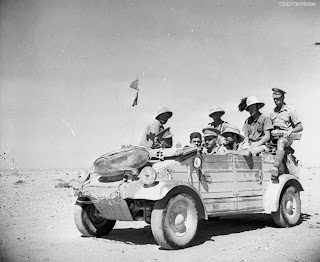
British troops in North Africa riding a captured German Kubelwagen, 20 June 1942 worldwartwo.filminspector.com
British troops drive a captured German Kubelwagen in North Africa, 20 June 1942.

Eastern Front: In Moscow on 20 June 1942, Joseph Stalin is in possession of the plans for the upcoming German Operation Blau, the planned offensive to capture the Soviet oil fields in the Caucasus. These papers were recovered from Major Joachim Reichel (now deceased) on 19 June 1942 after his plane was shot down by ground fire behind Soviet lines. While the plans are completely authentic and genuine, Stalin decides to disregard them because he believes they have been planted to deceive him.

In Crimea, both sides are experiencing supply shortages. Among other things, this compels a reduction in Luftwaffe flights by 40% and precise targeting of all bombs. The crews also are getting overworked, with some flying 25-30 missions per day. Fortunately for the Germans, Soviet resistance is crumbling and Luftwaffe war casualties are plummeting.

North of Severnaya Bay, the German 24th Infantry Division attacks the Lenin anti-aircraft and Northern Fort. While the Lenin position surrenders today, the Northern Fort holds out throughout the day despite the Germans using Goliath remote-controlled bombs and other techniques. In the south, the stalemate continues, with the Soviets retaining a firm grip on the critical Sapun Ridge and battering the nearby Wehrmacht forces with heavy artillery fire.

The Reichel Affair apparently has an immediate effect on German dispositions in Crimea. After many threats and indications that he would abandon the attempt to capture Sevastopol and turn it into a siege by transferring the essential Luftwaffe units to support Blau near Kharkov, Hitler suddenly tells Luftwaffe commander General von Richthofen that he can keep his air units in Crimea for the time being to finish the job. Richthofen joyfully writes in his diary, "Therefore, I feel reassured and can continue fighting in peace until we achieve final victory." This conclusion will turn out to be a bit premature but does reflect the upset and disequilibrium at Fuhrer Headquarters.

Luftwaffe attacks sink Royal Navy Landing Craft Tank HMS LCT-119 and LCT 150 off Tobruk.

Off Ak Mechet, Crimea, Romanian barge Danubius hits a mine laid by Soviet submarine L-6 and sinks.

Two women wearing the yellow Star of David badges in Paris, 20 June 1942 worldwartwo.filminspector.com
Women in Paris wearing the yellow Star of David badge, 20 June 1942 (Federal Archives Picture 183-B21356).

Battle of the Pacific: Japanese submarine I-26 (Yokota Minoru) shells the Estevan Point lighthouse on Vancouver Island in British Columbia. Accuracy is poor and nothing significant is hit. At the same time, I-26 first 25-30 5.5-inch (140 mm) rounds, then quickly escapes to the north and evades pursuit by five Royal Canadian Navy patrol vessels and a RCAF Supermarine Stranraer flying boat.

I-25 (Akiji Tagami) is also close to the North American coast and soon similarly will shell Fort Stevens, located at Columbia River, Oregon. During the early morning hours, it torpedoes Canadian freighter SS Fort Camosun off the coast of Washington. The freighter is badly damaged but survives to be towed into Puget Sound for repairs. It returns to service and the entire crew survives after abandoning the ship.

The U.S. Navy is still occupied with reorienting operations on an offensive footing following the dramatic success at Midway. So, local operations are the order of the day. Primarily, these are in the Aleutians, the one area of success for the Japanese.  USAAF 11th Air Force sends a bombing raid over Japanese-held Kiska Island that is hampered by poor weather conditions. Only three of nine bombers complete the mission, while three others abort and the final three divert to looking for a B-24 lost at sea on the 19th.

The crew of U.S. submarine USS S-27 (SS-132), which grounded and broke up on the 19th off Amchitka Island, makes it to a deserted village and awaits rescue. Much further south, B-17s of 5th Air Force bomb Lae Airfield on New Guinea. At Mubo, New Guinea, the 17th Australian Brigade repels a Japanese attack.

Janet Blair on the cover of Pix magazine, 20 June 1942 worldwartwo.filminspector.com
Singer/actress Janet Blair on the cover of Pix Magazine, 20 June 1942. Her most famous role was in "My Sister Eileen" (1942), for which undoubtedly this was some indirect publicity.

European Air Operations: During an RAF raid from Bourn to Emden, NF Oblt. G. Friedrich of III/NJG 1 shoots down British Wellington III bomber X3669 about 5 km southwest of Zandvoort. All four crew die.

Battle of the Atlantic: It is an oddly quiet day at sea in the Atlantic after many months of constant activity. There are no U-boat sinkings or major disasters at sea.

British 988-ton coaster Afon Dulais hits a mine and sinks near Beachy Head, East Sussex. There are no casualties.

German patrol boat V-1916 (Weser I) sinks from unknown causes somewhere in the Norwegian Sea.

Map of Tobruk battle, 20 June 1942 worldwartwo.filminspector.com
The battle of Tobruk, 20-21 June 1942.

Battle of the Mediterranean: General Erwin Rommel's Afrika Korps launches its assault on Tobruk only two days after reaching the port's perimeter. The Luftwaffe opens the attack at 05:20 by bombing the point of attack on Tobruk's southeastern defensive positions, with a theater-high 588 sorties. The Regia Aeronautica chips in with another 177 sorties. At 07:00, Gruppe Menny, positioned between the 15th and 21st Panzer Divisions, attacks in conjunction with a fierce artillery barrage. This achieves a breakthrough within 15 minutes, and the German 900th Engineer Battalion quickly enables a crossing of the port's anti-tank ditch. Panzers were rolling across by 08:30, and the infantry expands the breach.

The British defenders have not yet organized their defenses and are slow to respond to the unexpected onslaught. The defending 5th Mahratta Light Infantry immediately gives ground, and expected tank reinforcements never appear. The nearby Cameron Highlanders launch a counterattack, and then the 32nd Army Tank Brigade is ordered in, but it is too late. The British defensive effort is dispersed and overrun, aided by close German ground coordination with the Luftwaffe. By noon, the Germans have 113 tanks inside the perimeter, and by 13:30 they seize the critical Kings Cross road junction on Pilastrino Ridge. The British make a last stand by using 3.7-inch anti-aircraft guns as ground artillery, but this is ineffective. By 16:00, the port commander's headquarters, General Klopper, is under assault, and he has to escape hurriedly, losing contact with his command.

Having overcome the outer defenses, the panzers reach the port outskirts by 18:00. Realizing the developing catastrophe, British units begin blowing up port installations and ammunition dumps. By nightfall, the British defenses are in a chaotic state of disarray and the German 15th and 21st Panzer Divisions are poised to overcome all remaining defenses on the morrow.

USS Meade off NYC, 20 June 1942 worldwartwo.filminspector.com
U.S Navy destroyer USS Meade (DD-602) off New York City, 20 June 1942. This is during her delivery voyage from the Bethlehem Steel Company shipyard at Staten Island (Bureau of Ships Collection in the U.S. National Archives 19-N-30842).

Oddly, Fuhrer headquarters seems almost indifferent to Rommel's success. General Halder doesn't even mention it first in his list of the day's events, instead listing it fourth after "no change" on the Eastern Front, a mundane conference with the logistics chief, General Wagner, and a cursory description of the Reichel incident (which reflects poorly on OKH). When he finally does get to it, Halder writes:

Tobruk captured. Thus, the heavy battle in Cyrenaica has culminated on a victory that is of equally great value from the military and the political aspect.

This is one of the oddest entries in Halder's diary, completely distanced and remote from the actual state of affairs (Tobruk is not yet captured) and may reflect an underlying truth that seldom is brought out into the open. Halder and rest of OKH don't think highly of Rommel. He was not their first choice for command in Africa - General Paulus, now commander of Sixth Army, was. They view Rommel as a "loose cannon" whose victories are the result of insubordination and gambles. Rommel also has a reputation of not seeking approval for his operations. Finally, the OKH views the entire Mediterranean Theater as a sideshow that simply draws off forces that would be better employed on the theater of decision - the Eastern Front, which (not coincidentally) is completely under the control of the OKH and not the OKW (which controls western operations.

Thus, Rommel's successes are of far lesser import to the German High Command than to post-war Western accounts. Rommel only controls the equivalent of one corps, while OKH controls entire Army Groups. As long as Rommel stays out of trouble and doesn't require excess reinforcement, OKH really couldn't care less what he does. As to Hitler (who today, Halder notes, is back in East Prussia), he likely has a similar attitude but is simply happy that Rommel is keeping the Western Allies busy and giving him enough time to clear the table in the East.

Spy Stuff: The FBI picks up the German spies staying at a New York hotel following the surrender by leader George Dasch at FBI headquarters in Washington D.C. on the 19th. 

Allied Diplomacy: During discussions between Winston Churchill and President Roosevelt at the latter's Hyde Park, New York, estate, an agreement is reached to postpone an invasion of France (the Americans' preference) and instead invade North Africa (the British plan). This becomes Operation Torch and takes place in November 1942. 

US Military: Brigadier General Dwight D. Eisenhower is ordered to replace Major General James E. Chaney as Commanding General European Theater of Operations. This is a controversial choice, as Eisenhower thus leapfrogs over many more senior officers for such a prominent command. General George C. Marshall instructs Eisenhower to integrate all U.S. air units in the UK into the 8th Air Force and gives as the mission to attain "air supremacy over Western Continental Europe" in preparation for a future invasion of the Continent.

US Ninth Army under General Krueger establishes its headquarters at Milne Bay, New Guinea.

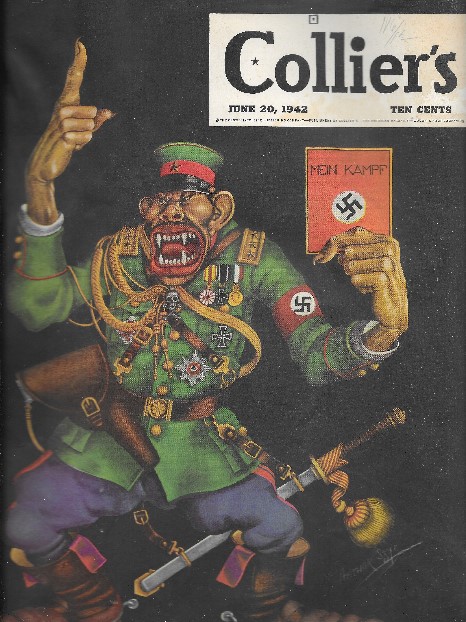
Collier's, 20 June 1942 worldwartwo.filminspector.com
Collier's, 20 June 1942 (Arthur Szyk).

Holocaust: Anne Frank discloses in her diary that she writes because she is lonely - there is nobody with whom she can share her secrets. She christens her diary "Kitty." Anne writes that she has a mother, father, and sister Margot, that they used to live in Frankfurt, Germany, and that they fled to Holland because of the persecution of people like them.

Four Polish prisoners at Auschwitz steal SS officer uniforms and drive a staff car out through the front gates. These are Eugeniusz Bendera, Stanisław Gustaw Jaster, Józef Lempart, and Kazimierz Piechowski. They are never recaptured and the last survivor, Piechowski, passes away on 15 December 2017 at the age of 98.

American Homefront: Comic book villain "Two-Face" is introduced in Detective Comics (the predecessor of DC Comics) issue #66 (the cover date is August 1942).

"Sleepy Lagoon" by Harry James and His Orchestra" becomes No. 1 on The Billboard National Best Selling Retail Records chart. It tops the chart for four weeks and becomes a standard.

Saturday Evening Post, 20 June 1942 worldwartwo.filminspector.com
"Women at Dude Ranch," Saturday Evening Post, 20 June 1942 (Fred Lukekens).

Future History: Brian Douglas Wilson is born in Inglewood, California. After moving to Hawthorne, California, Wilson begins to exhibit a special musical ability. He and his two younger brothers (Dennis, born 1944, and Carl, 1946) begin singing harmonies together while Brian plays the accordion or piano. At nine, Brian writes (or, more accurately, adapts) his first song, and writes his first independent song for a 4th-grade school project. He obsessively plays the piano and listens to the radio. After playing sports in high school, including being the quarterback of the Hawthorne football team, Brian attends El Camino Junior College, but drops out when he is disappointed at his teachers' attitudes toward pop music. In 1961, Brian and his brothers, cousin Mike Love, and friend Al Jardine form a musical group. With father Murry Wilson serving as manager, the group continues developing their skills. Brian's composition "Surfin," recorded by another act, becomes their first local LA hit. Their label, Candix Records, now changes the group's name to the "Beach Boys," but the label soon sells their contract to another label, but Murry decides to terminate it. They then attract the attention of Capitol Records, which begins releasing their tracks as singles, including "Surfin' Safari" and "409." When these become national hits, the future of the Beach Boys is assured and they become legendary performers, with their most famous album "Pet Sounds." Brian is recognized as a positive influence on The Beatles, whose Paul McCartney was born exactly two days before Brian on 18 June 1942. He thereafter battles mental health issues but largely overcomes them, with occasional relapses and continuing manageable stresses. As of writing, Brian Wilson continues touring and songwriting.  

The New Yorker, 20 June 1942 worldwartwo.filminspector.com
New Yorker, 20 June 1942 (Constantin Alajalov).

2022

Sunday, August 28, 2022

June 18, 1942: Rommel Reaches Tobruk

Thursday 18 June 1942

General Erwin Rommel, North Africa, 18 June 1942 worldwartwo.filminspector.com
Erwin Rommel in North Africa, 18 June 1942 (Gemini, Ernst A., Federal Archives Image 146-2002-010-05A).

Eastern Front: The German advance toward Sevastopol, Crimea, gains a second wind on 18 June 1942 following the fall of key Soviet fortress Maxim Gorki north of Severnaya Bay. Luftwaffe operations over the port become much less hazardous as bombers of KG 51 destroy an effective Soviet anti-aircraft platform in the bay.

The Germans continue their mopping up of Soviet resistance north of the bay. The 132nd Infantry Division accepts the surrender of the Soviet 95th Rifle Division and Coastal Battery 12 at 09:00, while the 24th Infantry Division captures Bartenyevka at the mouth of the bay and the 22nd ID catches up with them. The Soviet defenders counterattack with the 138th Naval Brigade, which has no artillery or air support and is wiped out. In the south, the Wehrmacht attack remains stalled before Sapun Ridge, though Romanian troops are moving up the Chernaya River toward Sevastopol.

At Fuhrer Headquarters, Hitler has returned from his vacation. General Franz Halder briefly notes in his war diary the success at Sevastopol, but lavished much more ink on the partisan situation farther north:

In [Army Group] Center, [Soviet] Corps Belov ... has been split into several groups. We must reckon with the ability of some elements to fight their way through the forests toward Kirov, and that the enemy at Kirov will support these breakout attempts by launching an attack of his own.

He also notes in passing that the Soviet troops trapped on the Volkhov "are running short of food."

Battle of the Black Sea: German Kriegsmarine motor torpedo boat S 102 torpedoes and sinks 2048-ton Soviet freighter Belostok near Balaklava, Crimea. There are 388 deaths.

An Italian mini-submarine scores another success when it sinks another Soviet submarine sailing on the surface near Cape Sarych, Crimea. This is the second such sinking in four nights.

British POWs in North Africa, 18 June 1942 worldwartwo.filminspector.com
British POWs under guard behind barbed wire, near Bir Hacheim, North Africa, 18 June 1942 (Bockelmann, Werner, Federal Archives Picture 101I-443-1583-11).

Battle of the Pacific: Three 11th Air Force USAAF B-17s, an LB-30, and four B-24 bombers attack Japanese shipping at Kiska in the Aleutian Islands and sink 6537-ton Japanese oiler Nissan Maru. There is one death. One B-24 is lost with casualties, the Japanese possibly lose two scout planes.

Japanese aircraft raiding Port Moresby bomb and badly damage 4561-ton Australian passenger ship MV Macdhui. There are 10 deaths. The ship's remains are still visible on the reef south of Tatana Island.

Japanese  2206-ton freighter Tairyu Maru runs aground and is wrecked off Gyoji Island, Korea. Casualties are unknown.

Luftwaffe Bf 109 over North Africa, 18 June 1942 worldwartwo.filminspector.com
A Bf 109 fighter of JG 53 escorting a reconnaissance plane in North Africa (Bockelmann, Werner, Federal Archive Picture 101I-443-1588-09).

Battle of the Atlantic: U-159 (Kptlt. Helmut Friedrich Witte), on its second patrol out of Lorient, uses its deck gun to sink 1417-ton Dutch freighter Flora north of Manaure, Colombia. Conserving torpedoes is important on these missions far from home port, so U-boat captains like to use their gun instead of torpedoes even though it is somewhat riskier and less certain. There are one death and 36 survivors, who are briefly questioned by the U-boat crew and then land on the Colombian coast on 19 June. The ship is only in this location because it picked up some survivors from two other recently sunk ships, Surrey and Ardenvohr, and dropped them off at Cristobal.

U-172 (Kptlt. Carl Emmermann), also on its second patrol out of Lorient, similarly uses its deck gun to sink a ship in the Caribbean, this one 1958-ton British tanker Motorex northwest of Colón, Panama. There are one death and 20 survivors. This is a continuation of a quite successful patrol for U-172, which now has sunk seven ships and is running low on torpedoes.

U-124 (Kptlt. Johann Mohr), on its ninth patrol out of Lorient, torpedoes and badly damages U.S. tanker Seattle Spirit south of Greenland/ east of Newfoundland and Labrador. Seattle Spirit is sailing with Convoy ONS-102 in rough seas. The ship is armed, but the sinking takes place too quickly to use the guns. One of four torpedoes hits in the engine room and the ship quickly floods, but the crew and seven Canadian passengers manage to get off in three lifeboats. There are four deaths and 51 survivors, who are picked up by HMCS Agassiz. The Canadian corvette then scuttles Seattle Spirit. After this, Mohr heads back to base having sunk seven ships of 32,429 tons on this patrol.

Royal Navy destroyer HMS Albrighton, accompanied by steam gun boats HM SGB 6, 7, and 8, sinks German minesweeper R 41 during a sweep of the Seine Bay. The British lose SGB 7 during the raid. 

During the same action, German 810-ton freighter Turquoise is running from the gunboats when it runs aground six nautical miles (11 km) from Port-en-Bessin-Huppain, Lower Normandy, France. The ship is a total loss.

Luftwaffe Me 110 in North Africa, 18 June 1942 worldwartwo.filminspector.com
A Luftwaffe Lieutenant on the field telephone in front of an Me 110 fighter plane in North Africa near Bir Hacheim, 18 June 1942 (Bockelmann, Werner, Federal Archives Picture 101I-443-1588-11). 

Battle of the Mediterranean: German General Erwin Rommel's panzers advance rapidly against fading British resistance, reaching Gambut (Kambut), Libya. This is the site of a major RAF base, and the airfield is perfectly positioned for the Luftwaffe to bomb Tobruk.

Now on the outskirts of the port, Rommel's troops advance with their 2 German and one Italian armored divisions for a frontal assault after clearing out any pockets of resistance. Rommel's plan is to attack the southeastern perimeter, held by the 2/7th Gurka Rifles at the coast and the 2/5th Mahrattas and 2nd Cameron Highlands further inland, in a couple of days. He will use his two German panzer divisions, 15 and 21 Panzer, near the coast and the Italian Trieste and Ariete Divisions further inland.

British tug SS Vsion sinks at Mersa Matruh, Egypt, of unknown causes. No casualties.

An unusual German rescue concludes when U-83 makes port in Messina, Italy. The U-boat rescued the crew of a downed DO-24T-2 of Seenofstaffel 7 based at Suda (Souda), Crete. The Dornier had rescued a downed Bf-109 pilot, Lt. Heinrich Hesse of 7./JG 53, but then lost its tail while trying to take off and been left floating aimlessly in the Mediterranean. U-83 then was vectored to the Dornier by a passing Heinkel He 111.

New York Times, 18 June 1942 worldwartwo.filminspector.com
The 18 June 1942 NY Times manages to get every key fact in its headlines wrong in a jingoistic sort of way.

Spy Stuff: There are now two German spy rings in the United States operating as Operation Pastorius. One ring is in a Manhattan hotel, while the other is traveling north by train from their landing at Ponte Vedra, Florida. The leader of the New York group, George John Dasch, already has begun the process of turning himself and his confederates over to the FBI, but for now, both groups remain unrestrained and with full freedom of action.

POWs: The first of two wartime prisoner exchanges between the Allies and Japan begins today. The U.S. government has chartered the Swedish cruise ship M.S. Gripsholm for such exchanges, and today it leaves with a load of Japanese civilians for Rio de Janeiro and then Mozambique, where the exchange is to be made. Spain represents Japan and Switzerland represents the Allies in these negotiations. The Gripsholm's passengers are mainly Japanese diplomats or businessmen who happened to be in the U.S. when war broke out. The Japanese have brought1554 Allied prisoners there to be picked up by the Gripsholm. The Japanese prisoners are picked up in Mozambique and taken to Japan aboard the Asamu Maru and Conte Verde. The Gripsholm will arrive back in New York on 25 August with its exchanged Allied prisoners. The next exchange will be in August 1943.

German Military: Luftwaffe squadron 7./JG 54 moves to Kotly near Leningrad and begins sweeps to protect German minesweepers in the Gulf of Finland.

Having been placed on leave for getting his 100th victory, Luftwaffe ace Oblt. Hans-Joachim Marseille of 3./JG 27 is informed that he has been awarded the Schwerter (swords) to his Ritterkreuz (Iron Cross). Marseille departs from North Africa for Fuhrer Headquarters on a Junker Ju 52/3m.

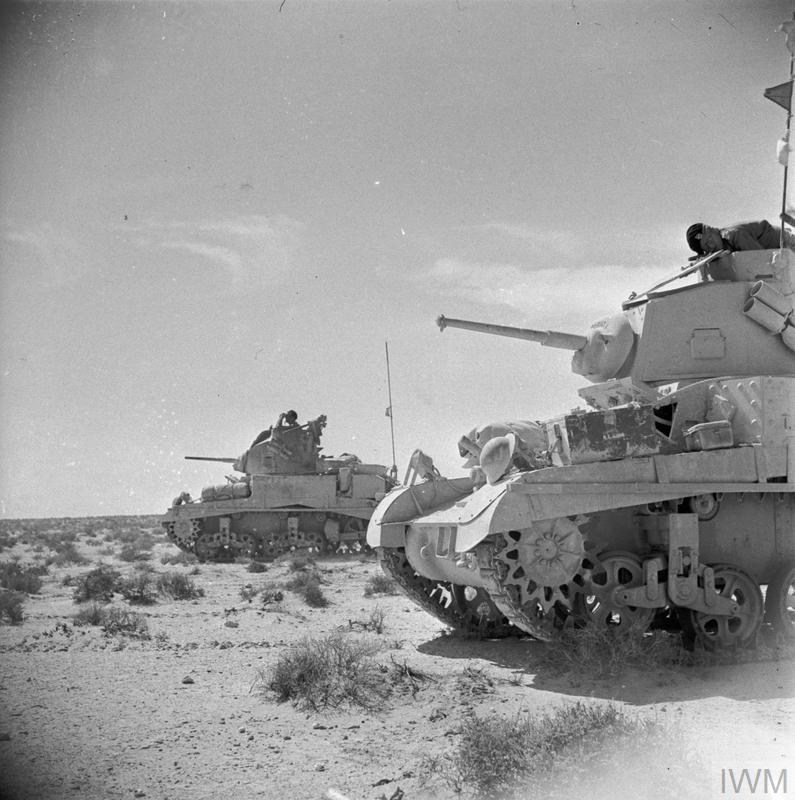
British Army Stuart tanks in North Africa, 18 June 1942 worldwartwo.filminspector.com
Two Stuart tanks advancing in the Western Desert, 18 June 1942 © IWM E 13534.

US Military: Bernard Whitfield Robinson becomes the first black U.S. Navy commissioned officer.

The air echelon of the 69th Bombardment Squadron, 38th BG (Medium) flies from Hickam Field in Hawaii with its B-26s to New Caledonia. It will fly reconnaissance missions for the rest of the year.

Major General Carl Spaatz arrives in London to formally take command of Eighth Air Force.

The U.S military begins developing the first medical air evacuation service. This will begin operation later in the year during the construction of the Alcan Highway and in Burma, New Guinea, and Guadalcanal.

German Homefront: Following a lengthy investigation when a partisan provides information in exchange for cash, German troops find and gun down the two assassins of Reichsprotektor of Bohemia and Moravia Reinhard Heydrich. The two men, Jan Kubiš and Jozef Gabčík, are found in Cyril and Methodius Cathedral in Prague. After a ferocious six-hour gun battle, German security troops overcome the opposition at a cost of 14 of their own number. This follows a brutal two-week period during which 13,000 Czechs are arrested and tortured. The two men, flown into the Reich as part of British/Czech Operation Anthropoid, receive many posthumous honors.

British Homefront: Free French leader Charles de Gaulle gives a "unity" speech at the Royal Albert Hall in London.

American Homefront: British Prime Minister Winston Churchill arrives in Washington, D.C. The Americans want to invade France, but Churchill convinces them that invading French North Africa makes more sense. The two sides also discuss atomic research and agree to share information. This is not the best time for Churchill to be visiting, with his troops struggling in North Africa, but everything seemed fine when he left London.

Future History: James Paul McCartney is born in Liverpool, England to a volunteer firefighter, James, and a licensed nurse. Both parents are of Irish descent. An excellent student, McCartney tests into the Liverpool Institute grammar school in 1953, and around this time his father encourages him to embrace music. One day on the bus to the Institute, he meets younger student George Harrison. McCartney's mother passes away on 31 October 1956, and on 6 July 1957 he meets older John Lennon at a church festival. Lennon leads a band, the Quarrymen, and McCartney soon joins, followed a year later by Harrison. The band has some local success and in 1960 gets a gig in Hamburg, Germany. After several personnel changes, the band renames itself The Beatles and goes on to international success, with McCartney and Lennon writing the vast majority of their oeuvre. As of this writing, McCartney remains a performer, songwriter, and influencer in the music scene while leading his own band.

Roger Joseph Ebert is born in Urbana, Illinois. He becomes a celebrity film critic for the Chicago Sun-Times until his death on 4 April 2013, hosting television review shows along with Chicago Tribune critic Gene Siskel. 

Nicholas John Tate is born in Sydney, New South Wales, Australia. He becomes a character actor best known for roles in "Space: 1999" in the 1970s and the Australian soap opera "Sons and Daughters." He remains active as an actor as of this writing.

Thabo Mvuyelwa Mbeki is born in Mbewuleni, Eastern Cape, South Africa. He becomes the second president of South Africa, following Nelson Mandela, from 14 June 1999 to 24 September 2008. He remains active in South African politics as of this writing.

A Japanese decoy airfield on Kiska in the Aleutians, 18 June 1942 worldwartwo.filminspector.com
Japanese decoy "aircraft" on Kiska Island in the Aleutians, 18 June 1942 (U.S. Navy).


2022

Friday, December 24, 2021

June 11, 1942: U.S-Soviet Lend-Lease Agreement

Thursday 11 June 1942

Rommel in North Africa worldwartwo.filminspector.com
German General Erwin Rommel in his command vehicle in North Africa, 11 June 1942 (Zwilling, Ernst A., Federal Archive Image 101I-443-1589-08).

Eastern Front: General Erich von Manstein's 11th Army continues battering away at Red Army defenses outside Sevastopol, Crimea, on 11 June 1942. His troops of the LIV Corps are having the most success north of the port, where the heaviest German artillery is located. The Soviet 345th Division counterattacks on the borderline between the Wehrmacht 132nd and 50th Divisions, but quick Luftwaffe intervention (1070 sorties while dropping 1000 tons of bombs today) prevents a rupture. The Red Army and LIV Corps, however, continue taking heavy casualties.

While progress is still being made at Sevastopol, the local commanders are getting concerned at the high cost of the small local gains. Luftwaffe General Wolfram von Richthofen, in command at Fliegerkorps VIII, comments sourly in his war diary that his forces have "only enough left for 1.5 more days of bombing." His mood is black, and he adds that "the specter of failure now seriously looms." On the spur of the moment, Richthofen decides that his bombers are dispersing their efforts too widely. He thus changes bombing procedures to conserve resources. The new tactic of "column bombing" involves bomber attacks on only specifically designated targets while the aircraft fly one after another in narrow air corridors.

The Red Air Force also is proving to be a nuisance, though not to the Luftwaffe. Instead, the Soviets are making nightly raids on German positions in the "rear" to the east at places like Simferopol, Theodosiya, Eupatoria, and Yalta. The Luftwaffe can see the attacks coming on their radar but do not have any night fighters to intercept them. Fortunately for the Germans, the Red Air Force bombing runs are very inaccurate, so the raids for the most part are ineffective.

Off the Crimean coast, a mini-war at sea also is brewing. The Soviets are running fast convoys to Sevastopol every night, and early in the morning, the Kriegsmarine decides to do something about it. For the first time, Axis small craft (MTBs and motorboats) manned by Italians attack a Soviet convoy near Cape Khersones. It is believed, but not absolutely certain, that they sink a Soviet ship.  

Back at Fuhrer Headquarters in East Prussia, General Halder also is getting impatient with Manstein's progress. He notes that the Soviet artillery at Sevastapol "is quite troublesome." However, further north, "The Voshansk attack is making very satisfactory progress." Meanwhile, the situation at Ninth Army is "unclear," with the Soviets "unaccountably" abandoning territory. This new Red Army tactic of not fighting for every inch of ground but instead trading space for time and tactical regrouping will befuddle and mislead the German High Command throughout the summer.

Battle of the Black Sea: Soviet submarine A-5 torpedoes and sinks 5695-ton Romanian freighter Ardeal off Odessa. Ardeal's captain beaches the ship to avoid sinking but is later repaired and returned to service.

British POWs in North Africa worldwartwo.filminspector.com
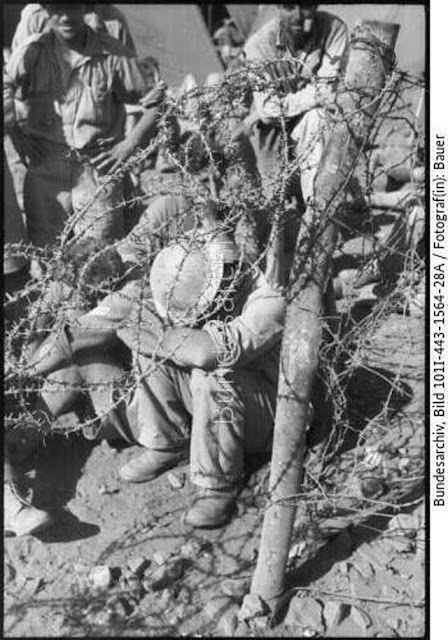
British POWs in North Africa, 11 June 1942 (Farmer, Federal Archive Image 101I-443-1564-28A).

Battle of the Pacific: USS Saratoga rendezvouses with fellow carriers Enterprise and Hornet. It transfers 19 SBD Dauntless, five TBD Devastator of VT-5, and 10 VT-8 Avenger planes to the two other carriers to replace their losses at the Battle of Midway. The ships then turn head to Pearl Harbor in foul weather.

Reinforcements for the Pacific Fleet are on the way. USS Wasp and battleship North Carolina, along with escorting destroyers, pass through the Panama Canal. Battleships just barely fit through the channel with mere feet (sometimes only inches) to spare on each side. The Japanese know the importance of the Canal and have plans to block it throughout the war.

The U.S. 11th Air Force make their first attack on the Japanese on Kiska Island in the Aleutian chain. The attack is made by five B-24 and five B-17 bombers flying from Cold Bay and loading their bomb racks at Umnak Island. PBY Catalinas also participate in the attack. on Kiska Harbor. The attack only scores some near misses on the Japanese ships while losing a B-24 (Captain Jack F. Todd) to anti-aircraft fire. This begins a 48-hour period during which the Catalinas make repeated attacks without much success.

British POWs in North Africa worldwartwo.filminspector.com
British and South African POWs in North Africa, 11 June 1942 (Zwilling, Ernst A., Image 101I-443-1589-34A).

Battle of the Indian Ocean: German raider Michel (HSK-9) uses its guns to sink 5186-ton British freighter Lylepark southeast of Cocos Islands (northwest of Perth, Australia). Michel is on her way from Japan for a hunting raid off the coast of South America.

Japanese submarine I-20 torpedoes and sinks 7926-ton British freighter Mahronda in the Mozambique Channel. There are two deaths and 40 survivors. The survivors are rescued by the Royal Indian Navy ship HMIS Orissa. This is an unusual situation where a German ship sinks a ship further west than a Japanese submarine in the Indian Ocean on the same day.

Australian corvette HMAS Wallaroo (J 222) sinks after colliding with a ship it is escorting, U.S. Liberty Ship Henry Gilbert Costin. The sinking ironically occurs because the ships are sailing without navigation lights in overcast weather to avoid detection by the enemy. Wallaroo sinks while trying to return to Fremantle, while the other ship makes it back. There are three deaths.

European Air Operations: The foul weather that has characterized the spring of 1942 continues today. It is 10/10ths clouds during the morning, but visibility clears a bit by noon. RAF fighters attack Koksijde and the Furnes Canal, sinking and damaging barges. The attacks are broken off after encountering heavy anti-aircraft fire at Nieuport. These attacks in low visibility are quite hazardous, and several planes narrowly avoid collisions or hitting ground obstructions.

Battle of the Baltic: German support ship MRS-11 Osnabruck hits a mine and sinks off Tallinn, Estonia. There are 84 deaths. The ship is later salvaged.

German cruiser Lutzow spotted by Allied air reconnaissance 11 June 1942 worldwartwo.filminspector.com
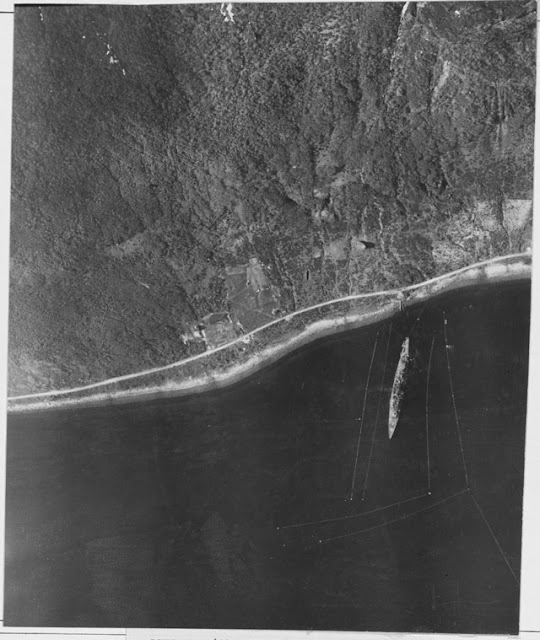
German heavy cruiser Lutzow photographed by Allied air reconnaissance, 11 June 1942 (Naval History and Heritage Command NH 110843).

Battle of the Atlantic: Italian submarine Leonardo da Vinci uses torpedoes and gunfire to sink 5483-ton Dutch freighter Alioth in the Atlantic Ocean near Freetown, Sierra Leone. Everyone survives.

U-504 (Kptlt. Hans-Georg Friedrich Poske), on its third patrol out of Lorient, torpedoes and sinks 4282-ton Dutch freighter Crijnssen 85 miles southwest of the Cayman Islands. There are one death and 93 survivors, who abandon the ship in four lifeboats and a gig. The sinking is especially traumatic for some on board because there are a dozen survivors of Sylvan Arrow (sunk by U-155 on 20 May 1942) and one from U.S. tanker T.C. McCobb (sunk by Italian submarine Pietro Calvi on 31 March 1942). The survivors in one lifeboat and the gig from Crijnssen are picked up by the U.S. freighter Lebore, which itself is sunk by U-172 a few days later. The other lifeboats make landfall in Mexico aside from four crewmembers on a raft who are picked up by the Panamanian tanker J.A. Mowinckel.

Freighter American sunk on 11 June 1942 worldwartwo.filminspector.com
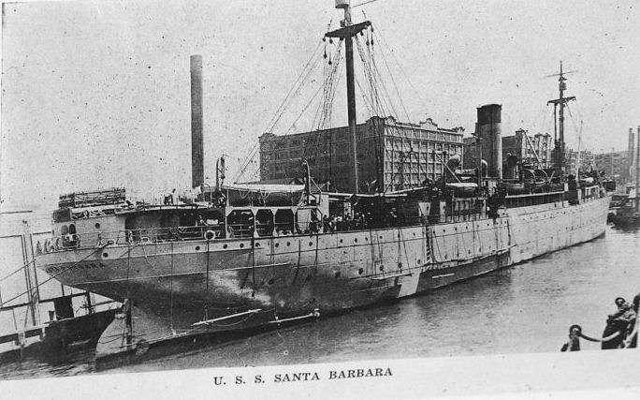
SS American, originally the Santa Barbara, was sunk by U-504 on 11 June 1942. 

Much later in the day, U-504 also torpedoes and sinks 4846-ton U.S. freighter American off Honduras. The ship is hit by two torpedoes and sinks within 25 minutes. There are four deaths and 34 survivors, who are picked up by British freighter Kent. One survivor perishes after being picked up.

U-159 (Kptlt. Helmut Friedrich Witte), on its second patrol out of Lorient, torpedoes and sinks 7130-ton British freighter Fort Good Hope northwest of Colon, Panama. Two torpedoes hit and sink the freighter (carrying wheat, timber, lead, and zinc) within half an hour. There are two deaths and 45 survivors, who are picked up by U.S. gunboat USS Erie (PG 50).

U-455 (Kptlt. Hans-Heinrich Giessler), on its third patrol out of St. Nazaire, torpedoes and sinks 6914-ton British tanker Geo H. Jones northeast of the Azores. The tanker is a straggler from Convoy SL-111 heading from Aruba to Freetown. There are two dead and 40 survivors, who are picked up by HMIS Orissa (J 200).

U-157 (KrvKpt. Wolf Henne), on its second patrol out of Lorient, torpedoes and sinks 6401-ton U.S. tanker Hagan five miles off the north coast of Cuba. Hagan is simply steaming a straight course independently and thus is an ideal target. Two torpedoes hit the engine room and fuel bunkers, sinking the ship, which is carrying 2,676 barrels of blackstrap molasses, fairly quickly. There are six dead and 38 survivors, who make landfall in Cuba in two lifeboats. This is the only victory for U-157 in its career, which ends a couple of days later when it is sunk.

U-94 (Oblt. Otto Ites), on its ninth patrol out of St. Nazaire, torpedoes and sinks 4458pton British freighter Pontypridd northeast of St. John's, Newfoundland. Pontypridd is a straggler from Convoy ONS-100. There are two dead and 46 survivors, who are picked up by HMCS Chambly (K 116).

U-158 (Kptlt. Erwin Rostin), on its second patrol out of Lorient, torpedoes and sinks 13,467-ton Panamanian tanker/transport Sheherazade 20 miles west of Ship Shoal Buoy, Louisiana. Sheherazade is a French ship turned over to the U.S. War Shipping Administration (WSA). There are one dead and 58 survivors, who are rescued by shrimp boat Midshipman and fishing vessel 40 Fathoms. The rescue happens quickly enough that nine men are found swimming after having jumped overboard.

Norwegian 6049-ton freighter Haugarland hits a mine and sinks off Terschelling, Netherlands. It appears that everyone survives.

U.S. 9310-ton tanker F.W. Abrams hits a U.S.  defensive mine and sinks east of Morehead City, North Carolina (near Cape Hatteras). The 36 men on board make it to shore near Morehead City. A tug ("Relief") attempts salvage of the floating wreck without success.

U-87 mines the waters off Boston, Massachusetts, while U-373 mines the area near Delaware Bay.

Rommel in North Africa worldwartwo.filminspector.com
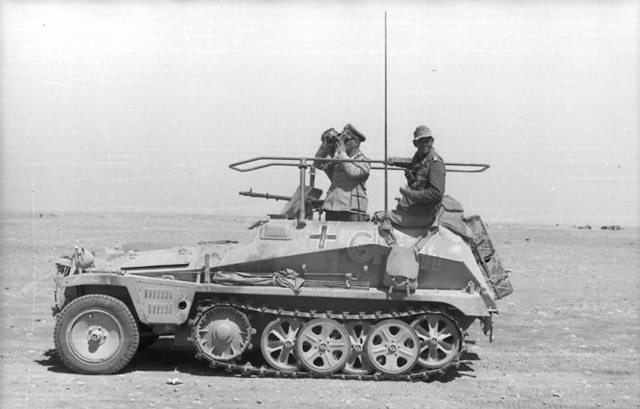
General Rommel in his Sd.Kfz. 250 command truck, 11 June 1942 (Zwilling, Ernst A., Federal Archive Image 101I-443-1589-09).

Battle of the Mediterranean: German General Erwin Rommel's Afrika Korps occupies the fortress of Bir Hakeim, which has been a roadblock in his advance toward Tobruk. The Free French defenders have almost all escaped to British lines to the south save for a small rear guard left to delay the attackers. The French and British pull back from their advanced position outside the fortress to Gasr-el-Arid early in the morning, completing the breakout by 2700 men and women (there are some female nurses).

After finally clearing this obstacle, about which he later comments "seldom in Africa was I given such a hard-fought struggle," Rommel quickly resumes his offensive, sending the 15th Panzer and 90th Light Divisions toward El Adem. The British 201st Guard Brigade in the Knightbridge Box, which blocks the way to Tobruk to the east, comes under severe pressure. While the Allied defense of Bir Hakeim has seriously disrupted Rommel's overly ambitious timetable, his advance now regains momentum.

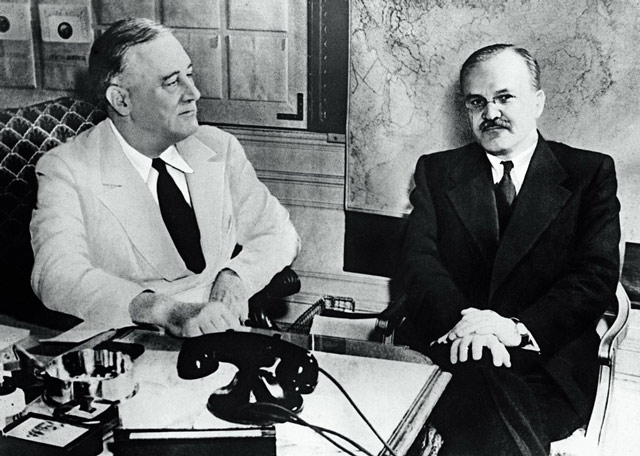
Molotov and FDR in Washington on 11 June 1942 worldwartwo.filminspector.com
Soviet Foreign Minister Vyacheslav Molotov and U.S. President Franklin D. Roosevelt meet in Washington, D.C., to finalize the lend-lease agreement, 11 June 1942 (Alliance.rusarchives.ru).

US/Soviet Relations: The United States and Soviet Union sign a lend-lease agreement. The agreement contemplates "mutually advantageous economic relations" between the two powers, with the agreement to continue in force "until a date to be agreed upon by the two governments." U.S. Secretary of State Cordell Hull and Soviet Ambassador Maxim Litvinov sign for their respective governments.

Article 1 sets out the main purpose of the agreement:
The Government of the United States of America will continue to supply the Government of the Union of Soviet Socialist Republics with such defense articles, defense services, and defense information as the President of the United States of America shall authorize to be transferred or provided.
This agreement, however, is not specific on certain key points. These become a lingering bone of contention during the post-war era. Significantly, the title to the equipment supplied by the U.S. is not transferred to the Soviet Union. The U.S. believes it still "owns" the items and retains rights to them, while the USSR believes it now owns them because they were freely given.

Technically, under the U.S. interpretation of the agreement, the Soviet Union is obligated to return any intact equipment or compensate the United States for it after the war. The USSR, perhaps understandably, has a vastly different interpretation. This leads to awkward exchanges between the two governments in the late 1940s in which the United States demands either the return of the intact equipment or payment for them, including limitations on the equipment's transfer to other countries. Ultimately, the United States simply demands payment for the "civilian-type articles remaining in existence."

Of course, the United States already has abandoned military equipment of its own at bases around the world because it is obsolete and considered too expensive to return to the homeland. Thus, there seem to be deeper reasons underlying the disagreement. It is entertaining to ponder the reactions of the Soviets when they receive these petty and abrasive demands for payment for goods they always assumed were given for free to win the war at the cost of Soviet blood. These pointless and unproductive "negotiations" help to poison the relations between the two nations and contribute to the growth of the Cold War, a hostile relationship that more or less continues to the present day.

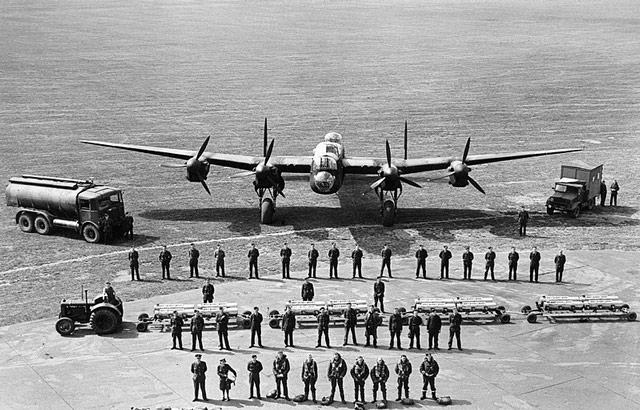
An Avro Lancaster and its crew on 11 June 1942 worldwartwo.filminspector.com
An Avro Lancaster and the personnel and equipment needed to keep it flying. This photograph was taken at Scampton, Lincolnshire, on 11 June 1942.  © IWM CH 15362.

German Military: Adolf Hitler issues Führer Directive 32. It sets out operations to be undertaken after the defeat of the Soviet Union, including the capture of Gibraltar with or without Spain's cooperation and resumption of the "siege of England." It is a curious mixture of far-sighted planning and mundane objectives such as the capture of Tobruk. It presupposes the quick defeat of the USSR in the coming Case Blue summer offensive and, like many of Hitler's grand strategies, assumes launch conditions that do not yet exist.

U.S. Military: With the threat to the U.S. west coast vastly reduced due to the Japanese defeat at Midway, the 97th Bombardment Group deployed for emergency purposes on the coast is transferred back to New England for eventual movement to join the Eighth Air Force in Great Britain.

Holocaust: Adolf Eichmann holds a meeting for his underlings controlling Jewish Affairs in France, Belgium, and Holland. This meeting sparks a systemic deportation scheme for Jewish residents of those areas to the extermination camps in the East that affects tens of thousands of people.

German Homefront: Michael Kitzelmann, 26, is executed at Orel Prison after being court-martialed and convicted of crimes against the state. Kitzelmann, a Wehrmacht lieutenant, was denounced by a sergeant for saying things that "undermined the military." He was in a hospital being treated for wounds when the allegations against him were made, but apparently, he made them previously while serving on the Eastern Front. The statements apparently concerned certain atrocities that Kitzelmann witnessed against the Russian population. While Kitzelmann became outspoken, he also had earned the Iron Cross Second Class and the Wound Badge in Gold.

TheGerman Bundestag rehabilitated Kitzelmann on 8 September 2009. A plaque in his memory is at the Johann-Michael-Sailer-school in Dillingen an der Donau.

American Homefront: The New England Journal of Medicine reports a case of "internal anthrax," which is considered quite novel because the vast majority of cases are of the cutaneous type. The patient died after showing progressively worse symptoms and a full autopsy was performed. Penicillin, still in its experimental phase, will become the accepted treatment for anthrax in 1944. 

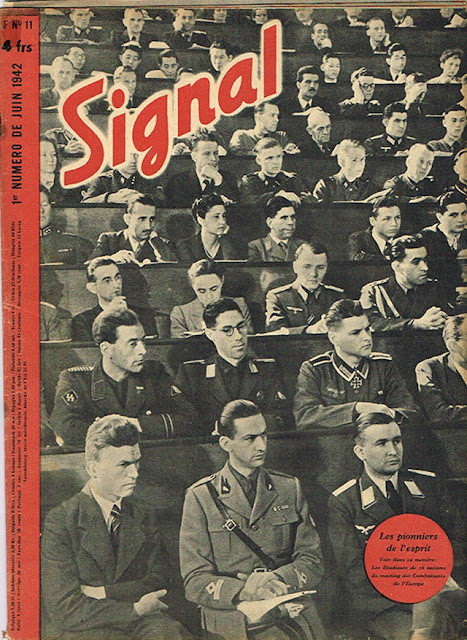
German Signal magazine from June 1942 worldwartwo.filminspector.com
Signal magazine, June 1942.

2021