Showing posts with label Chaney. Show all posts

Monday, September 5, 2022

June 20, 1942: Rommel Breaks Through At Tobruk

Saturday 20 June 1942
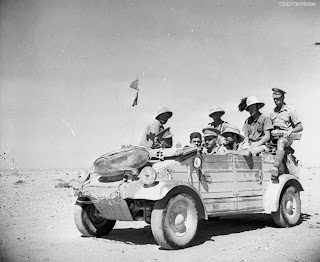
British troops in North Africa riding a captured German Kubelwagen, 20 June 1942 worldwartwo.filminspector.com
British troops drive a captured German Kubelwagen in North Africa, 20 June 1942.

Eastern Front: In Moscow on 20 June 1942, Joseph Stalin is in possession of the plans for the upcoming German Operation Blau, the planned offensive to capture the Soviet oil fields in the Caucasus. These papers were recovered from Major Joachim Reichel (now deceased) on 19 June 1942 after his plane was shot down by ground fire behind Soviet lines. While the plans are completely authentic and genuine, Stalin decides to disregard them because he believes they have been planted to deceive him.

In Crimea, both sides are experiencing supply shortages. Among other things, this compels a reduction in Luftwaffe flights by 40% and precise targeting of all bombs. The crews also are getting overworked, with some flying 25-30 missions per day. Fortunately for the Germans, Soviet resistance is crumbling and Luftwaffe war casualties are plummeting.

North of Severnaya Bay, the German 24th Infantry Division attacks the Lenin anti-aircraft and Northern Fort. While the Lenin position surrenders today, the Northern Fort holds out throughout the day despite the Germans using Goliath remote-controlled bombs and other techniques. In the south, the stalemate continues, with the Soviets retaining a firm grip on the critical Sapun Ridge and battering the nearby Wehrmacht forces with heavy artillery fire.

The Reichel Affair apparently has an immediate effect on German dispositions in Crimea. After many threats and indications that he would abandon the attempt to capture Sevastopol and turn it into a siege by transferring the essential Luftwaffe units to support Blau near Kharkov, Hitler suddenly tells Luftwaffe commander General von Richthofen that he can keep his air units in Crimea for the time being to finish the job. Richthofen joyfully writes in his diary, "Therefore, I feel reassured and can continue fighting in peace until we achieve final victory." This conclusion will turn out to be a bit premature but does reflect the upset and disequilibrium at Fuhrer Headquarters.

Luftwaffe attacks sink Royal Navy Landing Craft Tank HMS LCT-119 and LCT 150 off Tobruk.

Off Ak Mechet, Crimea, Romanian barge Danubius hits a mine laid by Soviet submarine L-6 and sinks.

Two women wearing the yellow Star of David badges in Paris, 20 June 1942 worldwartwo.filminspector.com
Women in Paris wearing the yellow Star of David badge, 20 June 1942 (Federal Archives Picture 183-B21356).

Battle of the Pacific: Japanese submarine I-26 (Yokota Minoru) shells the Estevan Point lighthouse on Vancouver Island in British Columbia. Accuracy is poor and nothing significant is hit. At the same time, I-26 first 25-30 5.5-inch (140 mm) rounds, then quickly escapes to the north and evades pursuit by five Royal Canadian Navy patrol vessels and a RCAF Supermarine Stranraer flying boat.

I-25 (Akiji Tagami) is also close to the North American coast and soon similarly will shell Fort Stevens, located at Columbia River, Oregon. During the early morning hours, it torpedoes Canadian freighter SS Fort Camosun off the coast of Washington. The freighter is badly damaged but survives to be towed into Puget Sound for repairs. It returns to service and the entire crew survives after abandoning the ship.

The U.S. Navy is still occupied with reorienting operations on an offensive footing following the dramatic success at Midway. So, local operations are the order of the day. Primarily, these are in the Aleutians, the one area of success for the Japanese.  USAAF 11th Air Force sends a bombing raid over Japanese-held Kiska Island that is hampered by poor weather conditions. Only three of nine bombers complete the mission, while three others abort and the final three divert to looking for a B-24 lost at sea on the 19th.

The crew of U.S. submarine USS S-27 (SS-132), which grounded and broke up on the 19th off Amchitka Island, makes it to a deserted village and awaits rescue. Much further south, B-17s of 5th Air Force bomb Lae Airfield on New Guinea. At Mubo, New Guinea, the 17th Australian Brigade repels a Japanese attack.

Janet Blair on the cover of Pix magazine, 20 June 1942 worldwartwo.filminspector.com
Singer/actress Janet Blair on the cover of Pix Magazine, 20 June 1942. Her most famous role was in "My Sister Eileen" (1942), for which undoubtedly this was some indirect publicity.

European Air Operations: During an RAF raid from Bourn to Emden, NF Oblt. G. Friedrich of III/NJG 1 shoots down British Wellington III bomber X3669 about 5 km southwest of Zandvoort. All four crew die.

Battle of the Atlantic: It is an oddly quiet day at sea in the Atlantic after many months of constant activity. There are no U-boat sinkings or major disasters at sea.

British 988-ton coaster Afon Dulais hits a mine and sinks near Beachy Head, East Sussex. There are no casualties.

German patrol boat V-1916 (Weser I) sinks from unknown causes somewhere in the Norwegian Sea.

Map of Tobruk battle, 20 June 1942 worldwartwo.filminspector.com
The battle of Tobruk, 20-21 June 1942.

Battle of the Mediterranean: General Erwin Rommel's Afrika Korps launches its assault on Tobruk only two days after reaching the port's perimeter. The Luftwaffe opens the attack at 05:20 by bombing the point of attack on Tobruk's southeastern defensive positions, with a theater-high 588 sorties. The Regia Aeronautica chips in with another 177 sorties. At 07:00, Gruppe Menny, positioned between the 15th and 21st Panzer Divisions, attacks in conjunction with a fierce artillery barrage. This achieves a breakthrough within 15 minutes, and the German 900th Engineer Battalion quickly enables a crossing of the port's anti-tank ditch. Panzers were rolling across by 08:30, and the infantry expands the breach.

The British defenders have not yet organized their defenses and are slow to respond to the unexpected onslaught. The defending 5th Mahratta Light Infantry immediately gives ground, and expected tank reinforcements never appear. The nearby Cameron Highlanders launch a counterattack, and then the 32nd Army Tank Brigade is ordered in, but it is too late. The British defensive effort is dispersed and overrun, aided by close German ground coordination with the Luftwaffe. By noon, the Germans have 113 tanks inside the perimeter, and by 13:30 they seize the critical Kings Cross road junction on Pilastrino Ridge. The British make a last stand by using 3.7-inch anti-aircraft guns as ground artillery, but this is ineffective. By 16:00, the port commander's headquarters, General Klopper, is under assault, and he has to escape hurriedly, losing contact with his command.

Having overcome the outer defenses, the panzers reach the port outskirts by 18:00. Realizing the developing catastrophe, British units begin blowing up port installations and ammunition dumps. By nightfall, the British defenses are in a chaotic state of disarray and the German 15th and 21st Panzer Divisions are poised to overcome all remaining defenses on the morrow.

USS Meade off NYC, 20 June 1942 worldwartwo.filminspector.com
U.S Navy destroyer USS Meade (DD-602) off New York City, 20 June 1942. This is during her delivery voyage from the Bethlehem Steel Company shipyard at Staten Island (Bureau of Ships Collection in the U.S. National Archives 19-N-30842).

Oddly, Fuhrer headquarters seems almost indifferent to Rommel's success. General Halder doesn't even mention it first in his list of the day's events, instead listing it fourth after "no change" on the Eastern Front, a mundane conference with the logistics chief, General Wagner, and a cursory description of the Reichel incident (which reflects poorly on OKH). When he finally does get to it, Halder writes:

Tobruk captured. Thus, the heavy battle in Cyrenaica has culminated on a victory that is of equally great value from the military and the political aspect.

This is one of the oddest entries in Halder's diary, completely distanced and remote from the actual state of affairs (Tobruk is not yet captured) and may reflect an underlying truth that seldom is brought out into the open. Halder and rest of OKH don't think highly of Rommel. He was not their first choice for command in Africa - General Paulus, now commander of Sixth Army, was. They view Rommel as a "loose cannon" whose victories are the result of insubordination and gambles. Rommel also has a reputation of not seeking approval for his operations. Finally, the OKH views the entire Mediterranean Theater as a sideshow that simply draws off forces that would be better employed on the theater of decision - the Eastern Front, which (not coincidentally) is completely under the control of the OKH and not the OKW (which controls western operations.

Thus, Rommel's successes are of far lesser import to the German High Command than to post-war Western accounts. Rommel only controls the equivalent of one corps, while OKH controls entire Army Groups. As long as Rommel stays out of trouble and doesn't require excess reinforcement, OKH really couldn't care less what he does. As to Hitler (who today, Halder notes, is back in East Prussia), he likely has a similar attitude but is simply happy that Rommel is keeping the Western Allies busy and giving him enough time to clear the table in the East.

Spy Stuff: The FBI picks up the German spies staying at a New York hotel following the surrender by leader George Dasch at FBI headquarters in Washington D.C. on the 19th. 

Allied Diplomacy: During discussions between Winston Churchill and President Roosevelt at the latter's Hyde Park, New York, estate, an agreement is reached to postpone an invasion of France (the Americans' preference) and instead invade North Africa (the British plan). This becomes Operation Torch and takes place in November 1942. 

US Military: Brigadier General Dwight D. Eisenhower is ordered to replace Major General James E. Chaney as Commanding General European Theater of Operations. This is a controversial choice, as Eisenhower thus leapfrogs over many more senior officers for such a prominent command. General George C. Marshall instructs Eisenhower to integrate all U.S. air units in the UK into the 8th Air Force and gives as the mission to attain "air supremacy over Western Continental Europe" in preparation for a future invasion of the Continent.

US Ninth Army under General Krueger establishes its headquarters at Milne Bay, New Guinea.
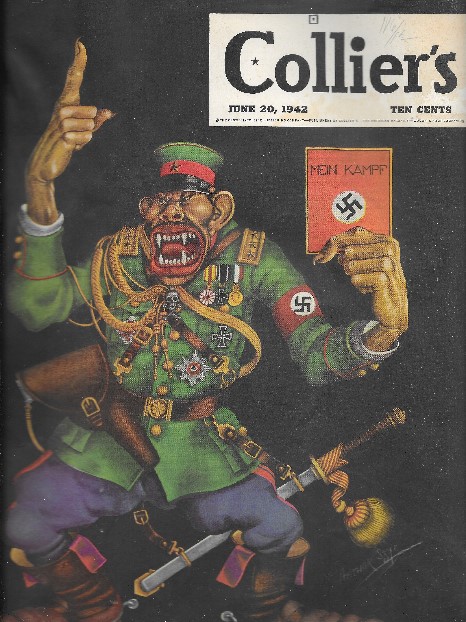
Collier's, 20 June 1942 worldwartwo.filminspector.com
Collier's, 20 June 1942 (Arthur Szyk).

Holocaust: Anne Frank discloses in her diary that she writes because she is lonely - there is nobody with whom she can share her secrets. She christens her diary "Kitty." Anne writes that she has a mother, father, and sister Margot, that they used to live in Frankfurt, Germany, and that they fled to Holland because of the persecution of people like them.

Four Polish prisoners at Auschwitz steal SS officer uniforms and drive a staff car out through the front gates. These are Eugeniusz Bendera, Stanisław Gustaw Jaster, Józef Lempart, and Kazimierz Piechowski. They are never recaptured and the last survivor, Piechowski, passes away on 15 December 2017 at the age of 98.

American Homefront: Comic book villain "Two-Face" is introduced in Detective Comics (the predecessor of DC Comics) issue #66 (the cover date is August 1942).

"Sleepy Lagoon" by Harry James and His Orchestra" becomes No. 1 on The Billboard National Best Selling Retail Records chart. It tops the chart for four weeks and becomes a standard.

Saturday Evening Post, 20 June 1942 worldwartwo.filminspector.com
"Women at Dude Ranch," Saturday Evening Post, 20 June 1942 (Fred Lukekens).

Future History: Brian Douglas Wilson is born in Inglewood, California. After moving to Hawthorne, California, Wilson begins to exhibit a special musical ability. He and his two younger brothers (Dennis, born 1944, and Carl, 1946) begin singing harmonies together while Brian plays the accordion or piano. At nine, Brian writes (or, more accurately, adapts) his first song, and writes his first independent song for a 4th-grade school project. He obsessively plays the piano and listens to the radio. After playing sports in high school, including being the quarterback of the Hawthorne football team, Brian attends El Camino Junior College, but drops out when he is disappointed at his teachers' attitudes toward pop music. In 1961, Brian and his brothers, cousin Mike Love, and friend Al Jardine form a musical group. With father Murry Wilson serving as manager, the group continues developing their skills. Brian's composition "Surfin," recorded by another act, becomes their first local LA hit. Their label, Candix Records, now changes the group's name to the "Beach Boys," but the label soon sells their contract to another label, but Murry decides to terminate it. They then attract the attention of Capitol Records, which begins releasing their tracks as singles, including "Surfin' Safari" and "409." When these become national hits, the future of the Beach Boys is assured and they become legendary performers, with their most famous album "Pet Sounds." Brian is recognized as a positive influence on The Beatles, whose Paul McCartney was born exactly two days before Brian on 18 June 1942. He thereafter battles mental health issues but largely overcomes them, with occasional relapses and continuing manageable stresses. As of writing, Brian Wilson continues touring and songwriting.  

The New Yorker, 20 June 1942 worldwartwo.filminspector.com
New Yorker, 20 June 1942 (Constantin Alajalov).

2022

Friday, November 12, 2021

June 8, 1942: Japanese Submarines Shell Australia

Monday 8 June 1942

Italian submarine beached in Spain, 8 June 1942 worldwartwo.filminspector.com
Italian submarine Luigi Torelli lying beached near Santander, Spain, on 8 June 1942. The submarine commander beached it after suffering damage from Allied aircraft on 6 June 1942 using Leigh Lights. It is ultimately repaired and restored to service.

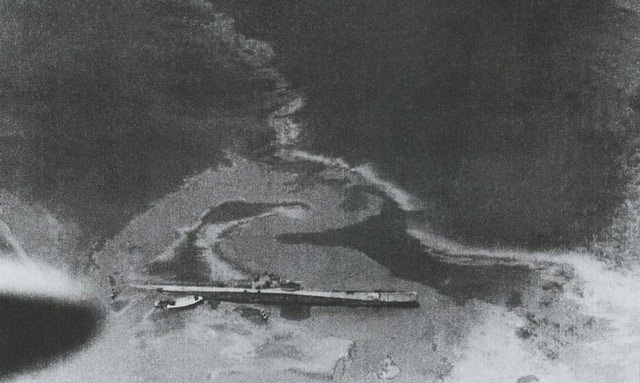
Battle of the Pacific: In a coordinated attack in the early morning hours of 8 June 1942, two Japanese submarines fire their 140 mm deck guns at Sydney and Newcastle, Australia. The purpose is more symbolic than militarily effective, but it certainly catches the attention of a lot of people.

I-24 opens the attack by firing ten shells targeting the Sydney Harbour Bridge. They land in the suburbs of Bellevue Hill, Rose Bay, and Woollahra, with one shell landing in the harbor. One person is injured by falling masonry and debris even though only one of the ten shells explodes. There is no response from shore batteries due to the brevity of the attack.

Two hours later, Japanese submarine I-21 (Cdr Matsumura Kanji) shells the Australian city of Newcastle, New South Wales, on 8 June 1942 from a distance of 9 km (5.6 miles) northeast of Stockton Beach. The target this time is the BHP steelworks. It fires 34 shells, including 8 illumination rounds, but once again only one shell detonates. The attack does no significant damage, aside from destroying a house on Parnell Place. Fort On the alert due to the previous Sydney attack, Scratchley gunners respond with four shells but have little chance of scoring a hit on the submarine in the dark.

The only fatality from these attacks is a US Army Air Force pilot, Lieutenant Georg Cantello, who disobeys orders and takes off from Bankstown airport in a P-39 Aircobra to attack the submarines. He perishes when his plane crashes due to mechanical issues in Hammondville paddock. There is a memorial park, Lt. Cantello Reserve, in the City of Liverpool with a monument in his honor.

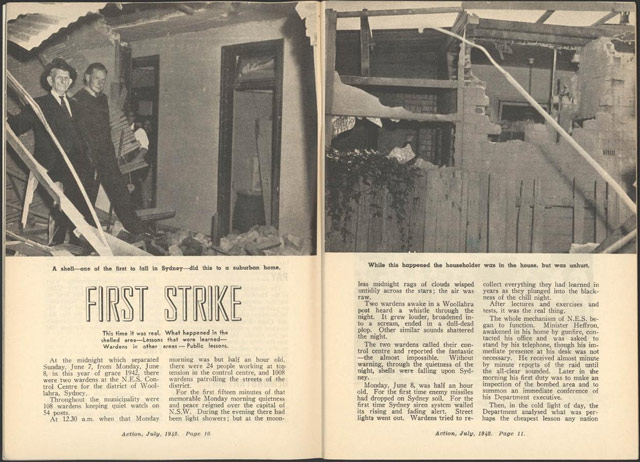
Japanese bombardment of Sydney, 8 June 1942 worldwartwo.filminspector.com
Australian "Action" magazine, the Official Journal of the National Emergency Services, has photos and a description of the 8 June 1942 shelling of Sydney in its July issue.

In response to the Japanese offensive in Australian waters that began with the attack on Sydney Harbour on 31 May 1942, the Australian government begins convoy operations on the east coast. Today, the first one, Convoy CO 1, departs from Newcastle bound for Whyalla.

The crew of a US Navy PBY-5A Catalina based at Dutch Harbor, Unalaska Island, spots two destroyers and four transport ships in Kiska Harbor. The crew then fly on to Attu and spot the Japanese presence there, too. This is the first news that the Japanese have invaded Alaska. An LB-30 of 11th Air Force also spots the Japanese.

In Hawaii, Admiral Chester Nimitz has ordered USS Enterprise and Hornet, now free due to the victory at Midway, to sail north to the Aleutian Islands in response to the attacks on Dutch Harbor. However, he quickly countermands this order when informed of the invasions at Attu and Kiska, fearing attacks on his carriers by land-based aircraft. The Japanese, meanwhile, are digging in on the islands and building airfields. Admiral Frank Fletcher, now aboard the aircraft carrier USS Saratoga, resumes command of the three-carrier task force northwest of Hawaii from Raymond Spruance. His carriers and the 11th Air Force in Alaska search for the remaining Japanese fleet but the planes spot only open water.

General Douglas MacArthur, Supreme Commander of Allied Forces in the Southwest Pacific Area (SWPA) in Melbourne, submits his first proposal for an Allied counteroffensive in the Pacific. He lists New Guinea, New Ireland, and New Britain as the initial objectives. It receives immediate opposition from Admiral Ernest King, Commander in Chief, United States Fleet (COMINCH), and Chief of Naval Operations (CNO), who, among other objections, does not like the idea of an Army general commanding an amphibious force. Negotiations over a compromise plan begin shortly. Another issue is that the Japanese remain on the offensive despite their recent defeat at Midway and that will affect operational choices.

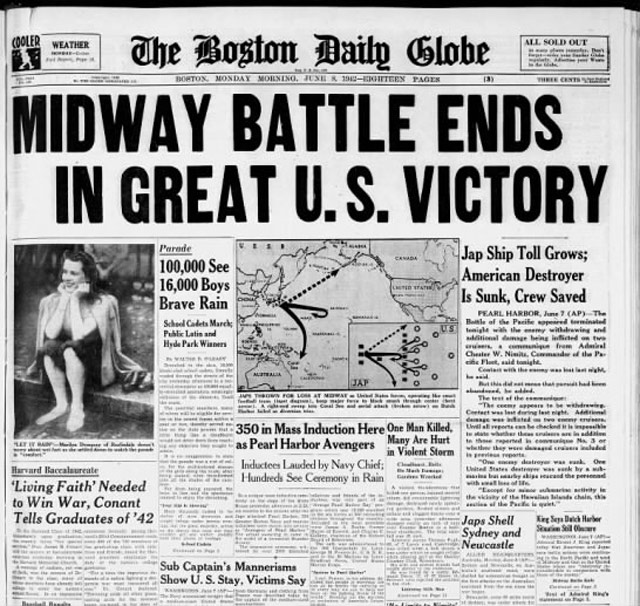
The Boston Daily Globe, 8 June 1942 worldwartwo.filminspector.com
The Boston Daily Globe of 8 June 1942 is full of cheery news about the US victory at the Battle of Midway. The very careful wartime manipulation of war news is evident in the header "American Destroyer Is Sunk, Crew Saved." That is absolutely true, but there is no mention of the far more consequential sinking of the USS Yorktown. 

Battle of the Indian Ocean: Japanese submarine I-16 uses its deck gun to sink 4847-ton Greek freighter Aghios Georgios IV between Aden and Table Bay in the Mozambique Channel. There are seven deaths.

I-20 torpeoes and sinks 5209-ton Greek freighter Christos Markettos off Mombassa. There are two deaths.

I-10 (Cdr Otani) torpedoes and sinks 5224-ton British freighter King Lud in the Mozambique Channel 350 miles east of Beira. All 39 people on board perish. This is I-10's third victory in the vicinity.

I-10 also uses its deck gun to sink 2158-ton Norwegian freighter Wilford in the Mozambique Channel in the same general vicinity east of Beira. There are nine deaths. Some sources place this sinking on 7 June 1942.

Norwegian freighter Wilton, sunk on 8 June 1942 worldwartwo.filminspector.com
Norwegian freighter Wilford, sunk by I-10 in the Mozambique Channel on 8 June 1942.

Eastern Front: German General Erich von Manstein's 11th Army continues its attack on Sevastopol in Crimea but makes little progress. Soviet counterattacks also fail, leading to a virtual stalemate. The German LIV Corps, aided by strong artillery fire and furious Luftwaffe attacks, do make some progress in the northern sector where the largest artillery batteries are located. Already the corps has lost 1700 casualties in exchange for a shallow bulge into the Red Army lines that is 3 km deep and 5 km wide. German 30 Corps in the south has suffered 496 casualties for minor penetrations into the out Soviet defensive line.

There are fierce dogfights over Sevastopol, with both sides represented by veteran ace fighter pilots. The Luftwaffe gets the better of the encounters. Lt. Ludwig-Wilhelm Burckhardt of 6./JG 77 downs 2 Soviet fighters and Oblt. Anton Hackl of 5./JG 77 destroys three Russian planes to bring his score to 57 victories. Hptm. Kurt Ubben of Stab III./JG 77 brings his score to 70 victories after he downs a Russian fighter.

There is growing frustration in Manstein's headquarters with the pace of the offensive. Luftwaffe General Wolfram von Richtofen observes that his planes fly 1200 sorties during the day without achieving much and lamely explains, "We hope gradually to beat down the enemy by mass bombing."  He complains that flying so many missions is 'extremely strenuous." Conditions are made worse on both men and equipment by sweltering  105° Fahrenheit (40° Celsius) heat.

At Fuhrer Headquarters in East Prussia, General Halder is okay with the progress, but there is a hint of concern in his diary entry:
Assault of Sevastopol makes satisfactory progress on the first day against stiff opposition; high ammunition expenditures and severe losses. All other fronts quiet. Successful counterattacks at Kirishi.  
Kirishi, meanwhile is a town 115 kilometers (71 mi) southeast of St. Petersburg on the Volkhov River that defends Lyuban. The front has stayed stagnant there since the fall of 1941, a sign of the stalled German offensive into the USSR.

European Air Operations: The weather remains unsettled throughout the day, getting worse as time goes by. During RAF air patrols along the continent coast, they sink 7003-ton German patrol boat Sperrbrecher 15 Taronga off Scharhörn. The ship makes port but is a complete loss and written off.
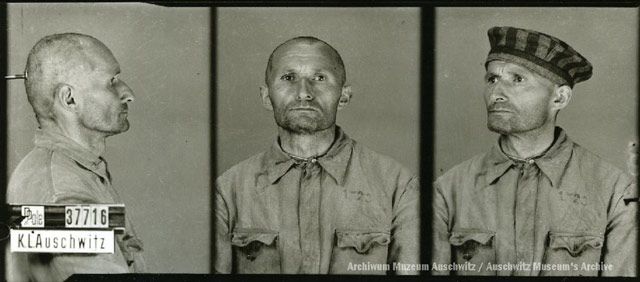
Auschwitz victim executed on 8 June 1942 worldwartwo.filminspector.com
Polish teacher Władysław Dobija, executed at Auschwitz on 8 June 1942 (Auschwitz Memorial). 

Battle of the Atlantic: U-135 (Kptlt. Friedrich-Hermann Praetorius), on its third patrol out of Brest, torpedoes and sinks 4549-ton Norwegian freighter Pleasantville 200 miles northwest of Bermuda. There are two dead and 45 survivors, 10 of whom who are picked up about 24 hours later by freighter Chickasaw City while the remaining 35 are picked up by freighter Paderewski on 11 June.

U-504 (KrvKpt. Hans-Georg Friedrich Poske), on its third patrol out of Lorient, uses its deck gun to sink 3901-ton Honduran freighter Tela in the Gulf of Mexico near Rio Bravo. The ship sinks by the stern within five minutes There are 11 dead and 43 survivors, who abandon ship in two lifeboats and two rafts and are picked up twelve hours later by freighter Port of Montreal. Their adventure is not over, as U-68 sinks Port of Montreal in turn on 10 June 1942, during which two of the Tela survivors perish.

U-504 also uses its deck gun to sink 1512-ton British freighter Rosenborg in the same general area east of the Yucatan Peninsula. This is after Poske misses with two torpedoes. He must use 60 shots to sink the ship. There are four dead and 23 survivors, who are picked up by Norwegian freighter Geisha.

U-172 (Kptlt. Carl Emmermann), on its second patrol out of Lorient, torpedoes and sinks 1654-ton US freighter Sicilien 10 miles south of Cape Beata, Dominican Republic. There are 46 dead and 31 survivors, who get in rafts and make it to Barahona, Dominican Republic.

U-128 (Kptlt. Ulrich Heyse), on its third patrol out of Lorient, torpedoes and sinks 9234-ton Norwegian tanker South Africa 400 miles east of Trinidad. The ship breaks in two and sinks within two minutes. Survival is made difficult due to the tanker's full load of 9614 tons of lube distillate and 4146 tons of diesel oil. Heyse surfaces and points out a man in the water that the lifeboats then pick up, gives the men some cans of bread and two bottles of rum, and directs them toward land. There are six dead and 36 survivors in two lifeboats. The subsequent sequence of events almost defies belief. One lifeboat (14 men) is spotted by freighter Plaudit, but the men refuse rescue after getting some supplies because it is heading to Pernambuco on 12 June and sail on toward Trinidad. They then decline another rescue offer from sailing vessel Minnie M. Mosher before making landfall at Galara Light (Toko Bay) on 16 June. The other lifeboat (25 men) is spotted by tanker Acastra on 12 June, but the men also refuse rescue after taking on supplies because it is heading for Freetown. They also decline an offer on the 13th from Argentinian tanker 13 de Diciembre after taking on supplies. They are picked up by an American seaplane tender on 14 June 45 miles east of Trinidad.

U-107 torpedoes and sinks 3249-ton US freighter Suwied 140 miles southeast of Cozumel Island. the ship sinks within three minutes, preventing a distress call. There are six dead and 33 survivors, who are picked up by USCGC Nemesis (WPC 111) after 19 hours. Some sources place this sinking on 7 June 1942, where I also discuss this sinking.

British patrol boat HMT Catherine founders off Scapa Flow. Casualties are unknown.
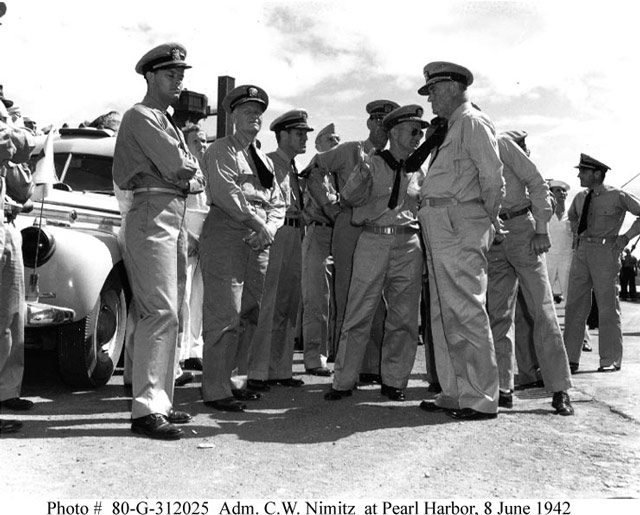
Admiral Chester Nimitz and his staff on 8 June 1942 worldwartwo.filminspector.com
Admiral Chester Nimitz (second from left) and his party await the arrival of survivors of USS Yorktown aboard Fulton (As-11), 8 June 1942. Also visible are Rear Admiral William L. Calhoun in the right front and Rear Admiral Lloyd J. Wiltse, of Nimitz' staff, in the center background (Naval History and Heritage Command 80-G-312025).

Battle of the Mediterranean: The situation in Libya remains unchanged today. The Germans continue their attack on the fortress of Bir Hakeim but make no progress, while the British 7th Motor Brigade and 29th Indian Infantry Brigade attempt raids on the Axis supply lines.

Time is on General Erwin Rommel's side because the Free French at Bir Hakeim cannot be resupplied and they are running low on everything. Today, Rommel personally leads an attack on the fortress from the north beginning at 10:00, supported by a massive Luftwaffe assault by 45 Ju 87 Stukas, 3 Junkers Ju 88 medium bombers, and ten Messerschmidt Me-110 fighter-bombers escorted by 54 Bf-109 fighters (3 losses two German and one Italian).

While the attack continues throughout the afternoon supported by another attack by 60 Stukas, the defenses hold. The British Desert Air Force (DAF) flies 478 sorties (8 fighter losses) during the day and drops supplies to the garrison after dark. The Italian Macchi C 202 fighters are particularly effective, shooting down three RAF planes.

In a friendly fire incident, the Italian submarine Alagi (Cdr Serio Puccini) spots a convoy 20 nautical miles north of Cape Bon, Tunisia. Captain Puccini assumes it is an Allied one, but it is a typical Axis convoy from Naples to Tripoli. Puccini fires three torpedoes and sinks 5085-ton Italian destroyer Antoniotto Usodimare. There are 141 killed and 165 survivors. This sinking is sometimes listed as occurring on 8 August 1942.

U-83 (Kptlt. Hans-Werner Kraus), on its eighth patrol out of Salamis, gets two victories today. First, it uses its deck gun to sink 100-ton Palestinian sailing ship Esther six miles northwest of Sidon, Lebanon. There are no survivors.

U-83 then uses its deck gun to sink 231-ton Egyptian freighter Said 15 miles southwest of Jaffa. This is after U-83 missed with two torpedoes, and it takes 50 rounds to sink the ship. There are five dead and nine survivors.
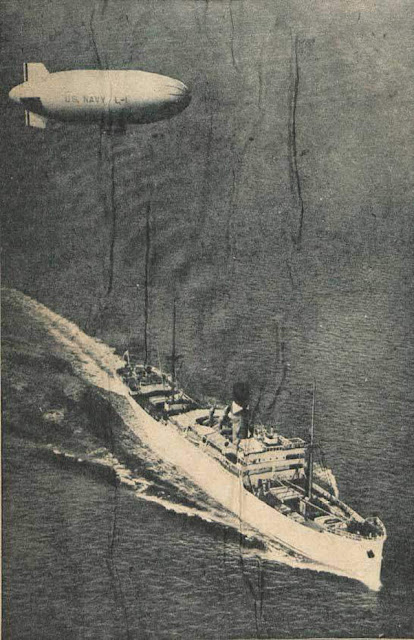
A US Naval blimp of the type involved in a fatal crash on 8 June 1942 worldwartwo.filminspector.com
US Navy blimp L-1. This is of the same class as L-2, which crashed in a fatal accident on 8 June 1942. It is shown above Panamanian freighter Musa.

US/Soviet Relations:  Soviet Ambassador to the United States Maxim M. Litvinov informs Harry Hopkins that the Soviet Union is agreeable to the establishment of a Lend-Lease air corridor between Alaska and Siberia. Since Japan is not at war with the USSR, it could not interfere with such flights without instigating a conflict with the Soviets.

US Military: The European Theater of Operations, United States Army (ETOUSA) is formed by the Department of War, though it doesn't begin operation officially until 4 July 1942. Its organizational divisions are Army Ground Forces (AGF), United States Army Air Forces (USAAF), and Army Service Forces (ASF) operations north of Italy and the Mediterranean coast. It replaces United States Army Forces in the British Isles (USAFBI) and its first commander for a brief period of time is Maj. Gen. James E. Chaney. The AGF currently has the 34th Infantry Division in Northern Island, which has released British troops from duties by patrolling the border between British Northern Ireland and the neutral Irish Free State.

Brigadier General Howard C Davidson, commander of VII Fighter Command, is promoted to Commanding General, 7th Air Force.

Canadian Military: Royal Canadian Air Force's No. 111 (Fighter) Squadron flies its Curtiss P-40 Kittyhawk fighters to Elmendorf Field, Alaska. This is part of the RCAF effort to reinforce Allied defenses on its western flank.

German Homefront: Following the elaborate funeral of Reinhard Heydrich on 7 June 1942, the Prague authorities embark on vicious reprisals. The Gestapo, with little to go on, receives a spurious report that the small town of Lidice is the hiding place of Heydrich's assassins and plans an operation to destroy it. This report is based on nothing but the town's reputation as the home of some Czech army officers who are now in hiding in Great Britain. A radio transmitter belonging to the Silver A team (a three-man Allied infiltration team that supported Operation Anthropoid, the assassination of Heydrich) is found in the village of Ležáky and so it, too, is targeted. Heydrich's two assassins, Jozef Gabčík and Jan Kubiš, remain at large shuttling between safe houses in Prague. A second Heydrich funeral is scheduled for Berlin on 9 June.
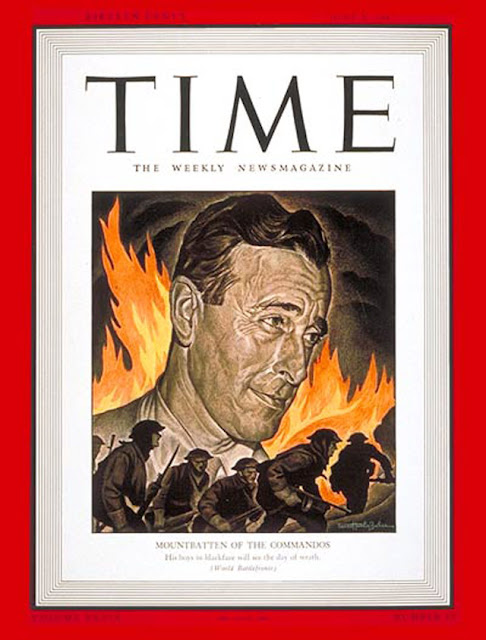
Time magazine 8 June 1942 worldwartwo.filminspector.com
"Mountbatten of the Commandos" is on the cover of the 8 June 1942 Time magazine (cover credit: Ernest Hamlin Baker).

British Homefront: The Guardian publishes an editorial today noting increasingly harsh living conditions in the Reich "since last winter." Its main theme is that "since last autumn’s clear failure to “annihilate” the Russians, the German civilian front has been increasingly tired and dispirited." This reflects the wishful thinking of RAF Bomber Command led by General Arthur"Bomber" Harris, who believes that his forces can crush the Reich from the air by destroying its people's will to fight. In this sole and strict sense, the Allied bombing campaign is proving to be a massive failure, as people in Germany may be down but the bombing is not making them demand surrender as they did in 1918.

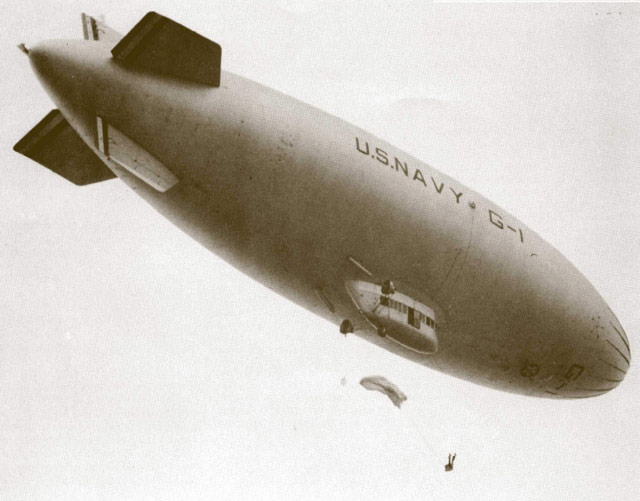
Naval airship G-1, involved in a fatal crash on 8 June 1942 worldwartwo.filminspector.com
US Navy Airship G-1, involved in a fatal crash on 8 June 1942. It is shown dropping a parachutist.

American Homefront: During the night, two U.S. Navy airships (G-1 and L-2) collide five miles north of Manasquan, New Jersey, while performing experimental visual and photographic reconnaissance at 400 feet. Twelve men, naval personnel and civilian technicians, perish. The blimps fall into the sea and only the co-pilot of L-2, Ensign Howard Fahey, survives. Only three bodies are recovered.

Due to the victory at the Battle of Midway, the US government cancels the invasion alert for the West Coast.

Bing Crosby makes a new recording of "Silent Night," which he first recorded on 21 February 1935, for his holiday compilation album "Merry Christmas." This is one of four recordings Bing makes of the "Silent Night." One of the reasons Crosby keeps returning to the song is that the recordings are so popular that the music label, Decca, complains that repeated stampings quickly wear out the master tapes.

Model Jane Greer models women's uniforms in the 8 June 1942 issue of Life magazine (see below), posing in a "Nurse's Aide" uniform on the cover. Movie producer and inventor Howard Hughes spots her and decides to make her an actress. He signs her to a personal services contract, which was somewhat customary for actresses at the time but gave him inordinate control over her career which he fully exploited. This begins Greer's decades-long Hollywood acting career and a very turbulent relationship with Hughes wherein he alternately helps and hurts her career and personal relationships. Greer is best known for film noirs, particularly with RKO, such as "Out of the Past" (1947), "The Big Steal" (1949), "Run for the Sun" (1956), and "Man of a Thousand Faces" (1957). Greer passes away on 24 August 2001.

Future History: Peter Grimwade is born in Ayr, Ayrshire, Scotland, UK. he becomes a noted television director, particularly on the Doctor Who series in the early 1980s. He passes away on 15 May 1990.

Life magazine, 8 June 1942 worldwartwo.filminspector.com
Life magazine, 8 June 1942, features a "Nurse's Aid" on the cover. It is actually model Jane Greer, who parleys this break into a memorable acting career.


2021