Showing posts with label USS Trout. Show all posts

Thursday, November 18, 2021

June 9, 1942: Nimitz Changes Strategy

Tuesday 9 June 1942

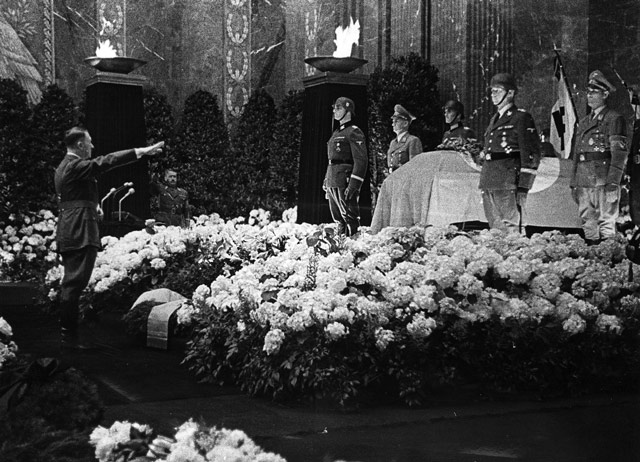
Hitler at Reinhard Heydrich's funeral, 9 June 1942 worldwartwo.filminspector.com
Adolf Hitler at Reinhard Heydrich's funeral (Narodowe Archiwum Cyfrowe, sygn. 2-13241).

Battle of the Pacific: Learning of the Japanese capture of Kiska on 9 June 1942, Admiral Chester Nimitz cancels his orders to Admiral Jack Fletcher to take his three aircraft carriers (USS Enterprise, Hornet, and Saratoga) north to the Aleutians. Nimitz now does not want them exposed to Japanese land bombers operating from Kiska and Attu. This unknowingly frustrates a Japanese plan to ambush them with the reinforced fleet of Admiral Boshirō Hosogaya.

Nimitz now is thinking offensively (as is General Douglas MacArthur in Melbourne, who submitted his own proposal for an advance led by the Army on 8 June 1942). He wants to keep his carrier force intact for a thrust due west across the central Pacific. This Nimitz and his team in Hawaii see as the main Allied strategy from now on. This is contrary to MacArthur's proposal to advance north from Australia, setting up a classic "turf war" between the US Army and Navy.

The Japanese high command, despite the minor successes in the Aleutians, is reeling from the early June results at Midway. The solution is denial and a coverup. The Imperial Japanese Navy prepares a vague and unrealistic summary of the battle to the military liaison conference. Admiral Chūichi Nagumo takes his time preparing an accurate summary of Japanese losses. He remains completely unaware that the Americans knew his complete battle plan in May and thinks his force was only discovered on the 5th. The Japanese public is kept completely in the dark, with media focusing entirely on the Aleutians.
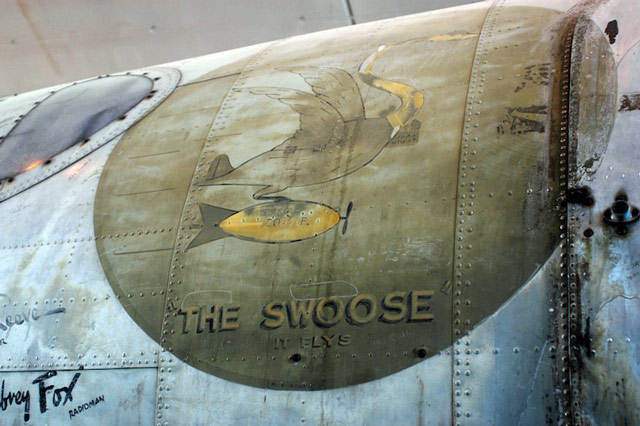
The Swoose ferried LBJ to Port Moresby on 9 June 1942 worldwartwo.filminspector.com
Artwork depicting "The Swoose" on the B-17D aircraft that carried Lyndon Baines Johnson to Port Moresby on 8 June 1942. The aircraft is currently being restored in Dayton, Ohio (U.S. Air Force photo courtesy of the National Museum of the United States Air Force).

Navy Reserve Lieutenant Lyndon B. Johnson, the future President, makes an aerial inspection tour from his location in Townsville, Australia. Johnson already has had an interesting time Down Under, having helped to quell a mutiny by African-African troops on 22 May 1942. The B-26 Marauder flying the mission has engine trouble after departing from Port Moresby and has to return to base, but the USAAF 19th Bombardment Squadron of the 22nd Bomber Group completes its mission (flying from Townsville to Port Moresby for refueling) to bomb Lae, New Guinea. The Port Moresby stage of the mission has to be delayed for an hour to accommodate LBJ, who arrives from Townsville in General Brett's VIP B-17D "The Swoose." 

The mission is hazardous even though Johnson misses out on the actual bombing run. LBJ narrowly escapes death because he switches bombers at the last minute due to a pilot change, and the plane he leaves crashes into the sea off Salamaua, killing everyone on board. LBJ then also escapes potential harm when the B-17 on the flight back to Townsville gets lost and almost runs out of fuel. It has to make an emergency landing at remote Carisbrooke Station near Winton. This B-17D, incidentally, survives and is the property of the National Air and Space Museum in Washington, D.C. The strange sequence of events results in General MacArthur awarding Johnson a Silver Star, the Army's third-highest decoration. Johnson soon after heads back to D.C. in accordance with FDR's requirement that all members of Congress return to their legislative duties. He remains in the US Naval Reserve until January 1964.

The Japanese complete their occupation of the Philippines and declare it secure.

US 24-ton freighter Husky founders two miles off Cape Constantine in Nushagak Bay, Aleutian Islands. Everyone survives.

US submarine USS Trout (SS-202) picks up two survivors of the sunken Japanese heavy cruiser Mikuma.

There is fierce fighting near the town of Chuhsien, China. Both sides take heavy casualties.
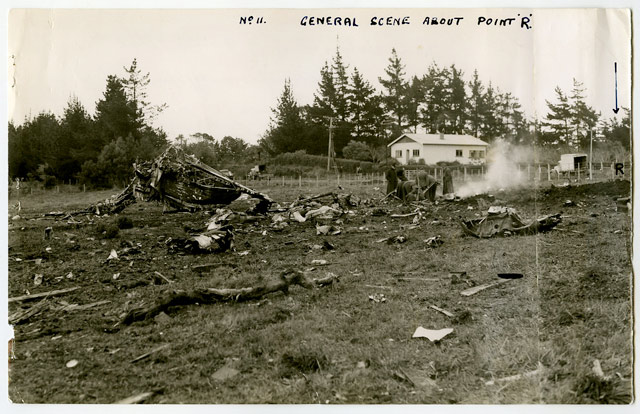
B-17 crash site in New Zealand, 9 June 1942 worldwartwo.filminspector.com
Crash site of a B-17 near Whenuapai Aerodrome, Auckland, New Zealand, 9 June 1942. All 11 men on board are killed (Archives New Zealand Reference: ADQA 17211 AIR1 572 25/2/588).

Battle of the Indian Ocean: The Japanese Divine Dragon Operation No. 2 submarine force, in which the Japanese high command placed high hopes, remains operational in the Mozambique Channel. However,  it is now clear to the local commanders that the operation now has turned into a standard submarine patrol and that initial plans to target the British Far Eastern Fleet are obsolete. Accordingly, Lieutenant Commander Otani Kiyonori of I-18 has his men destroy and jettison mini-submarine M-18b, effectively ending the operation.

Around this time, British divers discover the remains of M-20b, which carried out the most successful attack at Diego Suarez. It is sitting upright on a reef in heavy surf (remnants remain there to this day). They salvage the propellers, now on display at the gravesite of its occupants, Lieutenant (j.g.) Akieda Saburo and POIC Takemoto Masami. They were killed on 2 June 1942 by a British patrol on the mainland while attempting to rendezvous with I-20.

The Japanese have not given up on the Indian Ocean by any means. On 5 June 1942, auxiliary cruisers Aikoku Maru and Hokoko Maru caught 6757-ton British passenger ship Elysia 350 miles northeast of Durban. They torpedoed it, and today it sinks, causing 22 deaths. 

Battleship HMS Ramillies, previously damaged by a Japanese mini-submarine in late May 1942, arrives in Durban for repairs accompanied by light cruiser Emerald and three destroyers. The damage ultimately will require a return to the UK at Portsmouth on 8 September that will last until the summer of 1943.
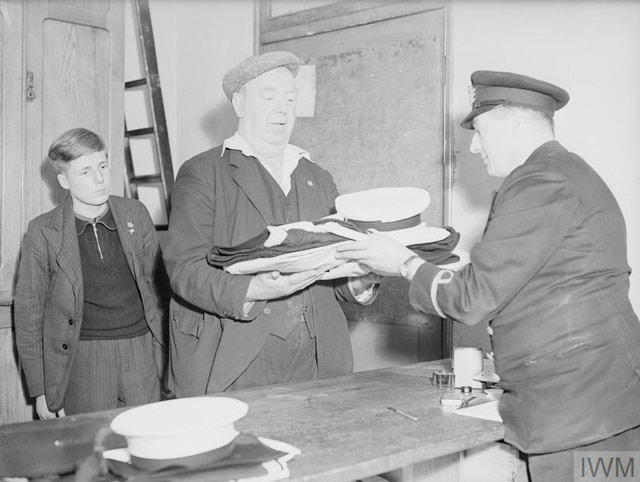
A new recruit for the Royal Navy, age 62, 9 June 1942 worldwartwo.filminspector.com
A new recruit, age 62, joins the Royal Navy, 9 June 1942. ""Owd Bob" drawing his petty officer's rig on board the Armed Merchant Cruiser Depot ship HMS MERSEY. Behind him is Tommy Harding, age 18, another new entry who volunteered for this special naval service." © IWM A 8807.

Eastern Front: German General Erich von Manstein's assault on Sevastopol has shown signs of turning into a battle of attrition, exactly what he didn't want. The priority is to take Sevastopol before the Case Blue offensive on the main front begins, and that now is looking doubtful. Luftwaffe General Wolfram von Richtofen begins changing attack priorities from assisting the front-line troops to attacking Soviet supply lines, a bad sign that the plan is faltering. The Luftwaffe is fully committed, flying 1044 sorties and dropping 954 tons of bombs, putting a strain on men, equipment, and logistics.

However, the German offensive is not dead, not by any means. General Franz Halder, remaining in East Prussia while the Fuhrer attends the Reinhard Heydrich funeral (see below), comments:
At Sevastopol, good progress despite strong enemy counter-attacks. Otherwise, all quiet. Army Group Center reports breakout of Cavalry Corps Belov to the south.
Halder does have his own grips about the Storfang operation. Writing about a meeting during the day with General Buhle, he comments acidly, "Report on Sevastopol. My suspicion that the Artillery Command is not of the best is confirmed."

The Red Navy is doing what it can to help its comrades ashore. Early in the morning, Soviet destroyers spot Axis mini-submarines operating from Yalta on their radar screens and unsuccessfully attack them. This new development induces Vice-Admiral Oktyabrskii to order his naval captains to concentrate less on offshore gunfire support of the army and more on keeping the sea lanes to Sevastopol clear. He also tells them to switch to area fire rather than targeted fire and cuts back on the number of surface vessel supply missions. This forces an increase in submarine supply missions. While they don't know it, the Axis mini-submariners thus achieve a tactical victory without sinking a single ship.

LIV Corps continues to make slow progress in the north, assisted greatly by an intense artillery bombardment laid down by the biggest guns ever used in combat. The 132nd Infantry clears a key obstacle, the Haccius Ridge, and the 22nd Infantry Division destroys the elite Soviet 79th Naval Infantry Brigade.

General Paulus' Sixth Army counterattacks against Red Army forces in the Kharkov sector. Paulus has plenty of troops because Sixth Army is fated to lead the Case Blue offensive toward Stalingrad. During this attack, Uffz. Wilhelm Crinius of 3./JG 53 shoots down two Soviet Il-2 Shturmovik ground-attack planes for his first two victories.

European Air Operations: Weather is poor on the Channel Front, with 10/10ths cloud cover down to 1500 feet and getting worse as the day proceeds.

A Polish squadron raids Essen. British Wellington IV R1725 crashes into the North Sea, 20 km west of Texel, Netherlands, while en route to bomb Essen. All six crewmen perish. Another Wellington targeting Essen, IV Z1412, is shot down by the nightfighter pilot Oblt. L.Fellerer of II/NJG 2. it crashlands on the beach 2 km west of St. Maartensvlotbrug. The five crewmen survive. A Wellington manages to make it back for a crashlanding after being attacked three times by Me-110 night fighters from below and astern, and the odds of survival are so iffy that the copilot bails out 20 miles west of Essen after the bombing run.
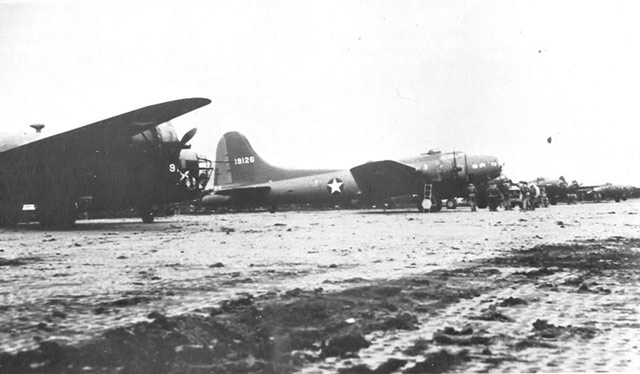
USAAF bombers in Alaska, June 1942 worldwartwo.filminspector.com
"36th Bombardment Squadron LB-30 Liberator and a Boeing B-17E Fortress (41-9126) at Fort Glenn Army Air Base, Alaska, June 1942. 9126 was lost Aug 28, 1942." USAAF photo via Chloe, John Hale, (1984), Top Cover for America. the Air Force in Alaska. 1920–1983, Pictorial Histories Publishing Company, ISBN 0-933126-47-6.

Battle of the Atlantic: U-124 (Kptlt. Johann Mohr), on its ninth patrol out of Lorient, torpedoes and sinks 940-ton French corvette FFL Mimosa (K11, Captain Roger R.L. Birot) 600 miles southeast of Cape Farewell in the British Isles. The Mimosa is an escort for Convoy ONS-100 and sinks within three minutes because the depth charges falling off the ship explode. The other escorts don't even notice the ship is missing until dawn breaks. There are 65-67 deaths and only four surviving French sailors, who are picked up by HMCS Assiniboine.

U-502 (Kptlt. Jürgen von Rosenstiel), on its fourth patrol out of Lorient, torpedoes 6589-ton US tanker Franklin K. Lane 35-40 miles (65 km) northeast of La Guiara and Cape Blanco, Venezuela. It is scuttled by the British destroyer HMS Churchill. The ship, a member of Convoy TO-5, is carrying 73,000 barrels of crude oil to Aruba for processing. There are four deaths and 37 survivors.

U-502 also gets another victim from the same convoy today, 5085-ton Belgian freighter Bruxelles. The ship manages to evade two torpedoes, but a third one blows a seven-meter (yard) hole in the side and the ship sinks within four minutes. The crew acts quickly and manages to launch lifeboats. Destroyer Churchill picks them up quickly. There are 53 survivors and one death.

U-432 (Kptlt. Heinz-Otto Schultze), on its fifth patrol out of La Pallice, torpedoes and damages 7073-ton Norwegian freighter Kronprinsen of Convoy BX-23A south of Cape Sable. The ship is taken in tow and beached at West Pubnico, Nova Scotia. Ultimately, the ship is repaired and returned to service.

U-432 also damages 8593-ton British freighter Malayan Prince with a torpedo that misses the Kronprinsen. The ship manages to remain with the convoy and is later repaired and returned to service in July 1942.
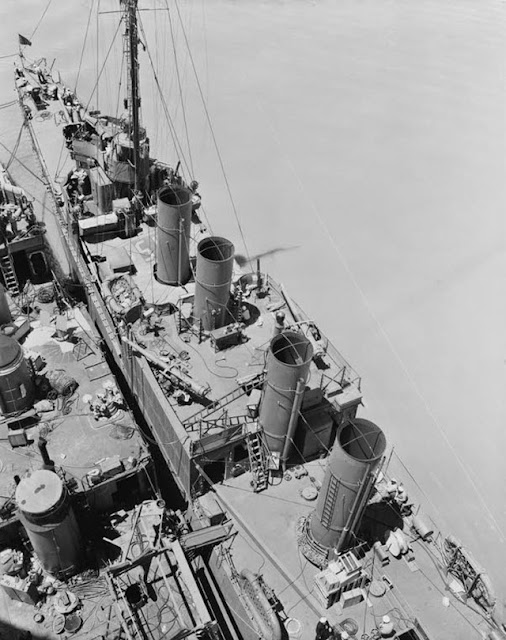
USS Southard at Mare Island, 9 June 1942 worldwartwo.filminspector.com
Four-stack destroyer USS Southard (DMS-10), Mare Island, 9 June 1942. She has just been converted into a minesweeper (Rickard, J (15 September 2018), USS Southard (DMS-10), Mare Island, 9 June 1942).

Battle of the Mediterranean: Early in the morning, the Luftwaffe sends 20 Junkers Ju 88 and 40 Ju 87 Stukas escorted by 50 Bf 109 and Me 110 fighters against the Free French in Bir Hakeim. However, thick smoke and dust force them to turn back. A second attack around noontime by 124 Stukas and 76 Ju 88s, escorted by 168 Bf 109s, has more luck. During this attack, Oblt. Hans-Joachim Marseilles of 3./JG 27 downs four RAF planes.

German artillery also opens up on the fortifications in the morning as General Erwin Rommel readies a final assault. After the planes and big guns have softened up the defenses, units of the 15th and 21st Panzer Divisions, the 90th Light Division, and Italian infantry launch a two-pronged attack.

Rommel's objective is the "high ground" near the fortress, a small rise called Point 186. The Italian Trieste Division makes good progress, overrunning a reinforced French force that is hampered by supply issues. The German advance gains steam in the afternoon when the 15th Panzer breaches the French line in the center, forcing a desperate counterattack with Bren Carriers that succeeds. Oberstleutnant Ernst-Günther Baade leads the Rifle Regiment 115 to within 200 meters (yards) of the fortress by dusk.

Overhead, the Luftwaffe establishes dominance due to previous losses in the RAF Desert Air Force despite frantic pleas for cover from French General Kœnig. The French are low on supplies and everyone can see the writing on the wall. British Major-General Frank Messervy, commander of the 7th Armoured Division, reports that a breakout should be attempted, and at 23:00 Kœnig signals for permission to evacuate the fortress. Lieutenant-General Neil Ritchie, commander of the 8th Army, replies that he'll prepare a thrust from the south but the fortress will have to hold out for another day or two. 

With water and ammunition running out and casualties mounting, Kœnig orders a breakout anyway. The French formation quickly loses coherence in the darkness and the Axis forces react quickly. The retreat turns into desperate hand-to-hand combat but does make progress into the early morning hours of the 10th.

Italian Caproni bombers catch 1584-ton Swedish freighter Stureborg in the eastern Mediterranean and sink it with torpedoes and bombs. There are 20 deaths and only one survivor, whose raft reaches land near Gaza. Ten men in total started out on the raft but nine perished because it drifted for 19 days and they had no food or water.

U-83 (Kptlt. Hans-Werner Kraus), on its eighth patrol out of Salamis, shells and sinks 175-ton Palestinian sailing ship Typhoon four miles southeast of Sidon, Lebanon. Everyone survives.

RAF Catalinas of No. 240 Squadron sinks Italian submarine Zaffiro in the western Mediterranean southeast of Palma de Mallorca, Balearic Islands. There are no survivors.
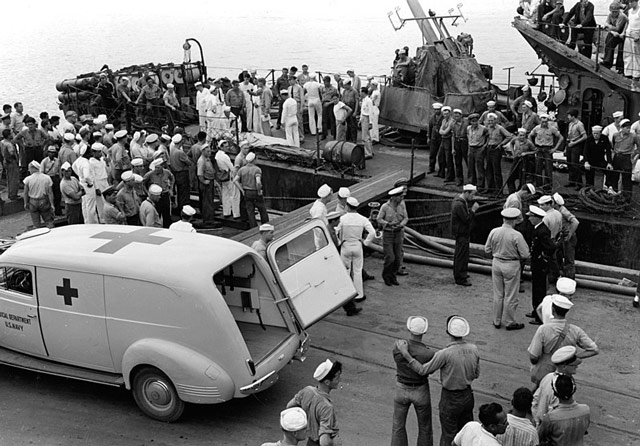
USS Hammann survivors arrive at Pearl Harbor, 9 June 1942 worldwartwo.filminspector.com
Survivors of the destroyer USS Hammann (DD-412), torpedoed and sunk on 6 June 1942 at the Battle of Midway, are brought ashore at Pearl Harbor, 9 June 1942 (Naval History and Heritage Command 80-G-312064).

Joint Allied Planning: The United States and British governments form the Combined Production and Resources Board. The purpose is to plan and coordinate production in each country to best serve war needs. It operates independently and competes with the Combined Munitions Assignment Board, which is under the jurisdiction of the Combined Chiefs of Staff. President Roosevelt's crony Harry Hopkins is the American leader behind the scenes, though Donald Nelson is the chair. 

While sometimes criticized as ineffective, the Board changes the military procurement process based on statistical analysis and perceived priorities. It provides some order to the former chaotic ordering system directly to industry used by the militaries of the respective countries. British representatives tend to feel the Board favors the US and prefer to exert their influence through the Munitions Board because they feel the Combined Chiefs give them more of an equal say. Canada feels left out and eventually is admitted to the Board as an equal partner. 

The real weakness of the Board is that its leaders don't really have much of an idea themselves of what the war effort needs or where the war is going until it is really too far along to matter. As the military strategy and objectives change - sometimes at the last minute - the Board must follow along and thus always is a step behind actual needs. Its findings also have to be implemented by the respective governments which may not necessarily agree completely with its decisions and thus may not treat them with a sense of urgency.

US Military: The Navy establishes a naval operating base at Kodiak, Alaska.
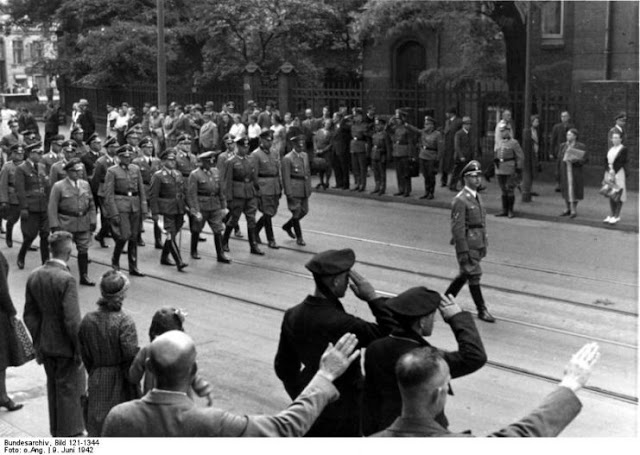
Heinrich Himmler leads the parade at the Reinhard Heydrich funeral, Berlin, 9 June 1942 worldwartwo.filminspector.com
Reichsfuhrer-SS Heinrich Himmler leads the procession at Reinhard Heydrich's Berlin funeral on 9 June 1942. Visible in the front row from left are Robert Ley, Karl-Hermann Frank, Erhard Milch, Sepp Dietrich, Sergeant Heinz Heydrich (Reinhard's younger brother), police chief Kurt Daluege (Heydrich's successor in Bohemia and Moravia), and Wilhelm Frick (Federal Archive Picture 121-1344).

German Homefront: The government holds the second funeral for Reinhard Heydrich, who was shot by British agents on 27 May 1942. This second funeral is in Berlin (the first, on 7 June, was in Prague). All of the top Reich officials attend, including Adolf Hitler and Hermann Goering. Hitler awards Heydrich the German Order, the highest honor in the Third Reich, posthumously. After the ceremony, Heinrich Himmler tells his subordinates to ramp up the Holocaust.

Heydrich is interred in a plot at the Invalidenfriedhof in Berlin. The location, once well known, since the war has become secret to prevent fascist gatherings.

Privately, Hitler blames Heydrich's own lax security precautions on his demise. He tells his cronies that a man as important to the war effort as Heydrich never should have been driving in an unguarded open-air car through streets filled with people. Hitler, of course, is (rightly) paranoid about his own personal security and routinely changes his routes and timing to frustrate would-be assassins. This already has saved his life at least once, when he evaded a bomb planted at the Munich Brown House (Braunes Haus) on 8 November 1939.

Due to the Gestapo's mistaken belief that the Heydrich assassins operated from the town of Lidice, the local German authorities begin to obliterate it today. Today and tomorrow, they kill 199 men and deport 195 women to the Ravensbrück concentration camp. There are 95 children in the town, 81 of whom later perish at the Chelmno camp. Eight are adopted by German families. The German security forces also prepare to destroy the town of Ležáky.

The two agents who assassinated Heydrich, Jozef Gabčík and Jan Kubiš, remain at large despite a massive German manhunt. The local authorities make it clear to the Czech people that if they are not turned over, more blood will be spilled. They also promise a bounty of a million Reichsmarks. Since everyone knows the German threats are not just empty words and Lidice is the proof, this reaches some receptive ears.
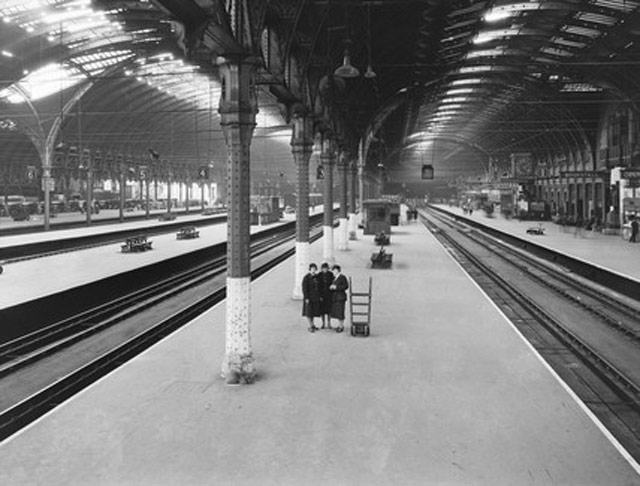
Paddington Station, London, UK, 9 June 1942 worldwartwo.filminspector.com
Platforms 2 and 3 of Paddington Station, London, UK, 9 June 1942 (Science & Society 10442395).

American Homefront: Lord Louis Mountbatten, Chief of the British Commandos, arrived in Washington for tactical conversations with US officers. Also returning from London are Generals Dwight D. Eisenhower, Henry "Hap" Arnold, and Mark Clark.

Ronald Reagan, who enlisted in the USAAF on 15 May 1942 as a private, receives a transfer to become the public relations officer for the First Motion Picture Unit in Burbank, California, under director John Ford. In this role, Reagan will be instrumental in "discovering" a young aviation worker in Burbank who will turn into film star Marilyn Monroe. He ends the war with the rank of Captain.

Future History: Heydrich's death leads to a series of prolonged court cases in the 1950s by his widow, Lina. She successfully argues to the West German government that she is entitled to a full pension as she widow of a German general. She writes a 1976 memoir, Leben mit einem Kriegsverbrecher (Living With a War Criminal), remarries, and passes away in 1985. Three of their four children survive the war.

Raymond "Ossie" Clark is born in Warrington, Lancashire, England. He becomes a top fashion designer during the "Carnaby Street" height of British fashion in the Swinging Sixties. He passes away on 6 August 1996 after being stabbed by a former lover.

Adolf Hitler speaks at the Reinhard Heydrich funeral, 9 June 1942 worldwartwo.filminspector.com
Adolf Hitler gives a memorial address at the funeral of Reinhard Heydrich in the New Reich Chancellery, 9 June 1942 (Federal Archive Image 146-1969-052-69).

2021

Monday, April 12, 2021

May 4, 1942: Fletcher Attacks at Tulagi

Monday 4 May 1942

Battle of Tulagi 4 May 1942 worldwartwo.filminspector.com
 Japanese Destroyer Kikzuki. Beached in Purvis Bay, Florida Island, Solomon Islands, in 1944. She had been sunk on 4 May 1942, when USS Yorktown (CV-5) planes raided the Tulagi area. Salvaged by the U.S. Navy in 1943 (Original color photograph, Naval History and Heritage Command 80-G-K-6103).
Battle of the Pacific: US Vice Admiral Frank Jack Fletcher, in command of Task Force 17 (led by the aircraft carrier USS Yorktown) and Task Force 11 (USS Lexington), finally is ready to attack on 4 May 1942. Having moved the Yorktown to within about 86 nautical miles (160 km, 99 miles) of Tulagi, he launches his first strike of the campaign at 07:01. It consists of 12 TBD Devastator torpedo bombers and 28 SBD Dauntless dive bombers heading to Tulagi Island, which the Japanese captured on 3 May 1942. The objective is the large fleet of ships anchored near the island under the command of  Rear Admiral Kiyohide Shima. This is considered the beginning of the Battle of the Coral Sea.

The Japanese intended to have air cover over the invasion ships, but Admiral Takeo Takagi's aircraft carriers have been trying to ferry fighters to Rabaul but have been prevented from doing so by poor weather. It is unclear if Takagi ever actually completed that minor ferrying job, but he pointlessly has spent two days trying to do it and now his carriers are out of position exactly when they are needed most. Due to the delay, carriers Shokaku and Suikaku are 340 miles north of Tulagi, much too far away to intervene. Takagi has made a huge blunder, of course, but the real fault lies with the overly intricate Japanese operational plan that requires perfect timing of all of its parts without any allowances for outside interference by things that can disrupt that timetable - like the weather.

The US aircraft, facing no real air opposition, begin dropping their bombs on the ships at Tulagi at 08:50. They take the Japanese, who are still unloading troops and have most of their ships at anchor, completely by surprise. They hit two ships, Okinoshima (minor damage) and 1315-ton destroyer Kikuzuki (major damage, 12 deaths and 142 survivors). The Japanese manage to beach the latter ship on nearby Gavutu Island. The attackers also down a Mitsubishi F1M2 "Pete" floatplane that attempts to take off during the raid.

Fletcher is not done yet. After the planes return to Yorktown, he orders them to undertake a second strike. They arrive at 12:10 and sink two 215-ton minesweepers (Wa-1 and Wa-2) and damage another, Tama Maru (four dead, seven wounded). The US pilots also shoot down another seaplane. Four F4F-3/3A Wildcat fighters from Yorktown then arrive and shoot down two more "Pete" floatplanes over Florida island. The Wildcats then strafe destroyer Yūzuki, killing ten crewmen including the captain, and damage several other floatplanes near Gavutu. While attempting to return to Yorktown, two of the Wildcats run out of fuel and crashland on the southern coast of Guadalcanal (rescued by destroyer USS Hammann).
SBD Dauntless raiding Tulagi, 4 May 1942 worldwartwo.filminspector.com
Douglas SBD Dauntless dive bombers returning to USS Yorktown after an attack on Tulagi, Solomon Islands, 4 May 1942 (US National Archives US Navy photo #80-G-20515)
Pleased with the results of the day's first two strikes and pleasantly surprised at the absence of Japanese fighter cover, Fletcher sends in a third strike. Many of the Japanese ships have departed the scene, but the planes damage transport Azumasan Maru and the minelayer/transport Okinoshima. One of the TBDs in this strike runs out of fuel, has to ditch in the ocean, and the crew is not found. After this, Fletcher retires to the south. Takagi attempts to find Fletcher's ships, but his planes search east of the Solomons and find nothing.

While Fletcher's planes have scattered the Japanese ships and scored numerous successes, they have not interfered with the Japanese construction of the seaplane base at Tulagi. The air attacks at Tulagi have been a brilliant demonstration of US naval air power, but they have no strategic effect. The Japanese seaplane base is operational on 6 May.

Meanwhile, the Japanese put the main thrust of Operation Mo into motion today. The invasion force of five thousand troops of the South Seas Force and five hundred of the 3rd Kure Special Naval Landing Force bound for Port Moresby leaves Rabaul. Escorted by one light cruiser and six destroyers, they proceed southward toward Jomard Passage. The plan is to sail around the southern tip of Papua New Guinea around midnight on 6-7 May and then head west to Port Moresby.
Raid on Tulagi, 4 May 1942 worldwartwo.filminspector.com
The Japanese cargo ship Koei Maru is straddled by bombs dropped from aircraft the USS Yorktown (CV-5) in Tulagi harbor on 4 May 1942. The cargo ship escaped without serious damage (U.S. Navy photo 80-G-20532).
The Japanese continue pounding the isolated US island fortress of Corregidor in the Philippines. Today, a dive bomber sinks the 950-ton submarine rescue ship USS Pigeon and shore artillery sinks the 950-ton minesweeper Tanager (AM-5). Commanding officer General Wainwright sends a radio message to Douglas MacArthur in Melbourne, Australia warning that, "In my opinion, the enemy is capable of making an assault on Corregidor at any time. Wainwright knows he only has a four-day supply of potable water remaining.

Shortly thereafter, the first Japanese troops, 600 men, land on Corregidor. The 1300 men of the First Marine Battalion begin a defensive struggle that quickly moves to the entrance of Malinta Tunnel. President Roosevelt sends Wainwright a message, "You and your devoted followers have become the symbols of our war aims and the guarantee of our victory."

US Navy submarine USS Greenling (SS-213) torpedoes and sinks 3252-ton Japanese armed merchant cruiser Kinjosan Maru near Truk (Chuuk).

US Navy submarine USS Trout (SS-202) torpedoes and sinks 2119-ton Japanese auxiliary gunboat Kongosan Maru east of Honshū, Japan.
General Brereton on cover of Time, 4 May 1942 worldwartwo.filminspector.com
Major General Lewis H. Brereton is on the cover of the 4 May 1942 Time magazine. He is the commander of the Tenth Air Force with its headquarters in New Delhi, India.
Battle of the Indian Ocean: Having finally gotten across the Shweli River on the road from Lashio after several days of effort, Japanese troops drive into the regional center of Bhamo. Their next objective is Myitkyina. There is little to stand in their way on the road from Bhamo to Myitkyina except disorganized remnants of lost battles. Chinese troops also give ground on the Burma River.

The British evacuate the island of Akyab (Sittwe), which is prized due to its airfield and deepwater port. This is in part due to a surge in malaria cases that has affected morale. The Japanese advance is now getting uncomfortably close to India.

After dark, four B-17s of 10th Air Force raid Mingaladon Airfield, Rangoon. They damage a hangar and parked aircraft.

At Diego Suarez in Vichy Madagascar, a German crew partially scuttles 6181-ton freighter Wartenfels in its dry dock. The British and Australians will find the ship there when they invade later in 1942. They will repair it and return it to service as Empire Tugela.
Life, 4 May 1942 worldwartwo.filminspector.com
The 4 May 1942 Life magazine features a Chinese air cadet on the cover.
Eastern Front: While Demyansk has been relieved, the nearby and much smaller garrison at Kholm remains surrounded. General Franz Halder notes in his war diary, "Attack to free Kholm has opened with good results." Halder notes that unlike the past week or two, the Soviets have launched some attacks that "were repelled; more attacks must be expected."

Halder also hints at growing tensions within the high command. He writes that at the daily Fuhrer Conference, there were "At times very lively exchange of views." This generally means that Hitler reacted to something with a screaming fit. Halder continues that "von Kuechler's suggestion to abandon the offensive in South in order to maintain the operation in North, is sharply disapproved." In other words, the Army Group North Commander, General Georg von Kuechler, asks to concentrate power at Leningrad and take it rather than dispersing inadequate effort all along the front. This is a roundabout way of saying that the Wehrmacht is overstretched in Russia, which it is, though nobody can say that to the Fuhrer. Hitler remains determined to make a decisive grab for the oil fields in the South and let the siege at Leningrad continue. Von Kuechler does not fall out of favor over this, as Hitler later promotes him to Field Marshal.
Cowes after the Luftwaffe raid of 4 May 1942 worldwartwo.filminspector.com
Damage on Arctic Road in West Cowes due to the 4 May 1942 Luftwaffe raid.
European Air Operations: The Luftwaffe continues its Baedeker Raids with an attack on Cowes and East Cowes, Isle of Wight. This has the large J. Samuel White Shipyard. Bombers drop 200 tons of bombs, beginning with incendiaries followed by high explosives. There are 70 deaths and many damaged buildings in a 100,000 square-foot  (10,000 square meters) area of destruction. Polish destroyer Blyskawica, being refitted at the shipyard, puts up a strong anti-aircraft defense (Blyskawica later is preserved and becomes the oldest preserved destroyer in the UK).

During the day, RAF Bomber Command sends six Boston bombers to attack the Le Havre power station. No hits are made on the target and no bombers are lost.

After dark, the RAF's target is Stuttgart. It sends 121 aircraft (69 Wellingtons, 19 Hampdens, 14 Lancasters, 12 Stirlings, 7 Halifaxes) in the first major raid on Stuttgart. One Stirling fails to return. The night is very cloudy and bombing accuracy is poor. The Robert Bosch factory, which makes dynamos, injection pumps, and magnetos, is the primary target, but no hits are made on it. There are 13 deaths and 37 injured and only scattered damage to Stuttgart. A German decoy site at Lauffen 15 miles north of Stuttgart, though, receives a lot of damage. It is lit up by 35 searchlights and has 50 flak guns in action. The decoy site (Nachtscheinanlage) deceives the bomber crews on this and many other missions into thinking it is a major city when in fact it was empty countryside. The British also have used this tactic successfully ("Starfish sites," code-named "Q" sites).

There are minor operations of 9 bombers to Nantes, 6 Stirling bombers to Pilsen, 8 bombers on minelaying missions off Heligoland, and 6 bombers on leaflet flights. One bomber sent to Pilsen fails to return.
Cowes after the Luftwaffe raid of 4 May 1942 worldwartwo.filminspector.com
Houses at Sun Hill, Cowes, after the 4 May 1942 Luftwaffe raid (Friends of the O.R.P. Blyskawica Society).
May 4, 1942, is notable for the first combat mission of the North American Mustang Mk. 1, though only over England. These are Mustangs built to British requirements and are designated NA-73s, not P-51s as they will be in the US Army Air Force. The British Mustangs fly with RAF No. 26 Squadron on a patrol from Gatwick, Surrey. The RAF is unimpressed with the fighter's high-altitude performance - which is considered necessary for an air superiority fighter - and relegates the fighters to Army Co-operation Command rather than Fighter Command. It equips its Mustangs with cameras to fly low-level reconnaissance.
Newsweek, 4 May 1942 worldwartwo.filminspector.com
The cover story of Newsweek magazine, 4 May 1942, is about "Battles in Burma: The Chinese Fight for Their Lifeline."
Battle of the Atlantic: After two days of losses by both sides in the Barents Sea, the weather takes a turn for the worse and decides matters. It degenerates from Arctic gales into a full-blown snowstorm and hostilities must cease. Both PQ 15 and QP 11 escape further damage, with the former having lost three freighters and a destroyer (the Punjabi, with HMS King George V damaged after colliding with it) and the latter one freighter, a submarine, and escorting cruiser HMS Edinburgh. PQ 15 arrives in Murmansk on 5 May and QP 11 arrives in Iceland on 7 May.

The Allies consider both convoys to have been a success despite the losses, particularly since PQ 15 is the largest Arctic Convoy (22 ships make port at Murmansk) so far. The Germans, too, are delighted, as they have created havoc on the Arctic convoy route at the expense of only three Heinkel torpedo bombers and one destroyer lost. The stage now is set for even larger convoy battles in the future.

U-162 (FrgKpt. Jürgen Wattenberg), on its second patrol out of Lorient, torpedoes and sinks 3785-ton US freighter Eastern Sword 12 nautical miles (22 km) off the Georgetown Lighthouse, British Guiana (Guyana). There are 16 deaths and 13 survivors, who make landfall in their lifeboat aside from one man picked up by local fishing boat Ocean Star.

U-162 also surfaces and shells 119-ton British three-masted schooner Florence M. Douglas off the coast of Guyana. Everyone survives.
Detroit during a blackout, 4 May 1942 worldwartwo.filminspector.com
Detroit, Michigan, conducts a blackout drill on 4 May 1942. Detroit is the location of critical industries necessary for the war effort.
U-564 (Kptlt. Reinhard Suhren), on its fifth patrol out of Brest, torpedoes and sinks 9767-ton British tanker Eclipse, a member of Convoy ON-87, near Fort Lauderdale, Florida. There are two deaths and 45 survivors. The ship sinks in very shallow water and is later salvaged, repaired, and returned to service in December 1942.

U-507 (KrvKpt. Harro Schacht), on its second patrol out of Lorient, torpedoes and sinks 2686-ton US Design 1074 tanker Norlindo 80 nautical miles (150 km) northwest of Dry Tortugas Island. There are five deaths and 28 survivors, rescued by Panamanian freighter San Blas.

U-507 later torpedoes and then surfaces to shell and sink 5104-ton tanker Munger T. Ball. The ship erupts in flames due to the 65,000 barrels of gasoline on board. There are 30 deaths and only four survivors, rescued by Norwegian freighter Katy. This sinking is sometimes listed as occurring on 5 May.

U-507 finds a third US tanker, 6950-ton Joseph M. Cudahy, and torpedoes and sinks it about 74 miles northwest of the Dry Tortugas. There are 27 deaths and 10 survivors. This sinking is sometimes listed as occurring on 5 May.
HMS Rodney, 4 May 1942 worldwartwo.filminspector.com
HMS Rodney at Liverpool, 4 May 1942 (© IWM A 9608).
U-125 (Kptlt. Ulrich Folkers), on its fourth mission out of Lorient, torpedoes and sinks 5687-ton US freighter Tuscaloosa City 200 miles west of Negrit, Jamaica. All 34 men on board survive, picked up by US freighter Falcon. The U-boat captain surfaces after the attack, questions the crew, gives them directions to shore and wishes them well.

British 7037-ton freighter Empire Story runs aground in foul weather at Briar Island, Nova Scotia. The crew abandons the ship, but it later works itself off the island itself and is found and taken in tow by Canadian tug Foundation Franklin. On the way to Digby, Empire Story capsizes and sinks.

RAF bombers of Coastal Command sink 2936-ton German freighter Klaus Fritzen at Måløy, near Bergen, Norway.

RAF bombers of Coastal Command also sink 4647-ton German freighter Sizilien off Borkum, Germany. During these Coastal Command raids, a flak ship 20 km southwest of Egmond aan Zee shoots down an RAF Hudson V AM530. All five crewmen perish.

German 773-ton freighter Herrenwyk (formerly Finnish Martti-Ragnar, captured at Bergen) hits a mine and sinks in the Bay of Kiel, Germany.

A 9-ton British fishing boat, FV Little Express, hits a mine in the Thames Estuary and is destroyed. All three men aboard perish.
Planes lined up on USS Enterprise, 4 May 1942 worldwartwo.filminspector.com
An SBD Dauntless scout-bomber and five TBD-1 Devastator torpedo planes prepare to take off from the USS Enterprise during operations in the south Pacific area, 4 May 1942 (US Navy).
Battle of the Mediterranean: At Malta, a Luftwaffe fighter downs the Spitfire of Flight Lieutenant Norman MacQueen. MacQueen had just been announced as a winner of the Distinguished Flying Cross in the London Gazette on 1 May 1942. Malta Command also activates a new Infantry Brigade today, the Western Infantry Brigade, bringing the total to four. Luftwaffe raids begin at 10:25 and continue throughout the day.

Battle of the Black Sea: Luftwaffe aircraft sink 836-ton Russian transport Potemkin en route from Kamysh, Crimea - Burun, Turkey. There are 30 deaths and 25 wounded. This sinking is sometimes listed as occurring on 5 May.

Special Operations: The British Special Operations Executive (SOE) team Norwegian Independent Company 1 performs a successful sabotage operation against the electric railway Thamshavn Line in Orkdal, Norway. The objective is to prevent the Third Reich from transporting the pyrites that are being extracted at the mine at Løkken Verk. This is the first in a series of raids to accomplish this objective which, due to concerns of local residents, is done by targeted sabotage rather than RAF bombing.

Three men from Company Linge, having sailed from the UK via fishing boat, alight at Bjørnør on Fosen and travel overland to Namdalseid. A German lorry helpfully gives them a lift for part of the way. At Orkdal, they target the transformer station for the railway at Bårdshaug. The explosion at 05:00 wrecks the station and brings all traffic on the electric railway to a standstill. The three saboteurs escape to Sweden via Trondheim.
German internees at Camp Kenedy, 1942 worldwartwo.filminspector.com
German internees at Camp Kenedy, Texas, 1942 (German American Internee Coalition).
Hungarian/Uruguayan Relations: Hungary severs relations with Uruguay. This apparently is retaliation for Uruguay breaking diplomatic relations with Germany, Italy, and Japan on 25 January 1942. Uruguay is not at war with any of the Axis powers, however (not until 21 February 1945, when it declares war on Germany and Japan). Uruguay has a large ethnic German population and is important for the Battle of the Atlantic because of the port of Montevideo, the last stop for Kriegsmarine heavy cruiser Admiral Graf Spee. Latin America is under heavy diplomatic pressure from Washington to favor the Allies, of course.

US Military: The Commander in Chief U.S. Fleet, Admiral Ernest J. King, directs the Coast Guard Auxiliary to organize civilian small craft as coastal picket ships.

Danish Homefront: Vilhelm Buhl becomes the 11th Prime Minister of Denmark, replacing the recently deceased Thorvald Stauning. He leads the unity government created by Stauning. The Third Reich at this time is allowing Denmark a very small degree of political independence, though that is entirely subject to Adolf Hitler's whims and is more of an illusion than a reality.

American Homefront: Albert Greutert, Acting Swiss Consul and representing Italian and German interests, and F. van den Arend, Special Division, Department of State, submit separate reports on conditions at detention camps Camp Kenedy and the Doud Field Alien Internment Camp at Fort Sam Houston in San Antonio, Texas. Greutert's report notes that Camp Kenedy, "made up of pre-fabricated barracks," is "not fully organized yet" and "was hardly prepared for the influx of about 500 German internees." There also are about 160 Japanese internees there. The report continues, "I found the conditions [at Fort Sam Houston] in every regard so much better than those prevailing at the Kenedy camp, with everything nice and running smoothly." Greutert notes that the Camp Kenedy inmates have broken up into "several very different groups, especially with regard to their former countries of residence."

The US Office of Price Administration issues Ration Book Number One to every American to use when purchasing rationed items, including sugar, coffee, and meat.
German internees at Camp Kenedy, 1942 worldwartwo.filminspector.com
Camp Kenedy Internment Camp, 1942, a former Civilian Conservation Corps (CCC) camp near the town of Kenedy, Texas (German American Internee Coalition).

May 1942


2021

Saturday, April 10, 2021

May 2, 1942: Cruiser Edinburgh Sunk

Saturday 2 May 1942

U-boats at Hel naval base May 1942 worldwartwo.filminspector.com
U-boats at the Hel submarine training base in Poland on the Baltic Sea, May 1942. The two U-boats closest to the camera are Type VIIC.
Battle of the Pacific: The Japanese are on the move in the South West Pacific Area (SWPA) on 2 May 1942. Their Operation Mo has as its first objective the occupation of Tulagi, where the Japanese intend to establish a seaplane base. Coastwatcher Jack Read on Bougainville Island spots large Japanese ships departing the Buka Island area near northern Bougainville, and later coastwatcher D.G. Kennedy on New Georgia (further south on the way to Tulagi) spots the same. Alerted of these sightings on Tulagi, Australian commando commander Captain A. L. Goode and Royal Australian Air Force commander Flight Officer R.B. Peagam order the immediate destruction of their facilities and evacuation of personnel. Flyable PBY-5 Catalina flying boats already have left. The evacuation will be completed by the early hours of 3 May.

The Japanese also have their Carrier Strike Force, led by aircraft carriers Shōkaku and Zuikaku, on the way from Truk. Its commander, Vice Admiral Takeo Takagi, attempts today to deliver eighteen Mitsubishi A6M Zero fighter planes to Rabaul, but poor weather interferes. Ultimately, Takagi is able to deliver the fighters (this is unclear and disputed in the sources), but he must keep trying until the 3rd. The bad weather also prevents Takagi's force from refueling until the 4th. These delays seriously disrupt the entire Japanese timetable for Operation Mo and prevent the Carrier Strike Force from arriving at Tulagi on time to have any effect.
MacArthur on cover of Women's Weekly 2 May 1942 worldwartwo.filminspector.com
A portrait of General MacArthur on the Australians Women Weekly, 2 May 1942
A separate Japanese force out of New Ireland establishes a seaplane base at Thousand Ships Bay, Santa Isabel Island, to support the projected landings at Tulagi, while the Japanese 3rd Kure Special Landing Force occupies the Florida Islands (Nggela Islands) north of Guadalcanal.

The US Navy has a good idea of the Japanese plans because of radio intercepts. Vice Admiral Frank Jack Fletcher, commander of Task Force 17, has stationed fleet carriers USS Yorktown (TF 17) and Lexington (TF 11) about 300 nautical miles (350 miles, 560 km) northwest of New Caledonia. TF 17 completes its refueling today, but TF 11 takes longer and signals it will not be ready until the 4th. Yorktown aircraft (SBDs (VS 5) and TBDs (VT 5)) spot Japanese submarine I-21 near Nouméa and attack but score no hits. Reporting by radio to Tokyo, the Japanese commander does not indicate that the attacking aircraft are carrier-based, so the nearby US Navy carriers remain undetected.
Corregidor Island worldwartwo.filminspector.com
Corregidor.
On Corregidor Island, Philippine Islands, the embattled US garrison (many of the 4th Marine Division) continues to hold out against a vicious around-the-clock pounding from Japanese shore artillery and bombers. Malinta Tunnel is overcrowded - to step outside is to invite death. Potable water is running out, now down to a six-day supply. The US Navy scuttles the river gunboat USS Mindanao off South Harbor. The US Navy is sending submarine USS Starfish to pick up a couple of dozen more lucky people, it is scheduled to arrive on the 3rd.

US Navy submarine USS Trout torpedoes and sinks 5015-ton Japanese freighter Uzan Maru off Shikoku, Japan.

Japanese 10,930-ton seaplane carrier Mizuho, torpedoed off Omaezaki, Japan, by USS Drum on 1 May 1942, sinks about 40 nautical miles (74 km) offshore. There are 472 survivors (31 wounded) and 101 deaths.
USS Sunfish is launched on 2 May 1942 worldwartwo.filminspector.com
USS Sunfish (Cdr R.W. Peterson) is launched on 2 May 1942 at Mare Island Naval Shipyard, Vallejo, California (US Navy).
Battle of the Indian Ocean: The Japanese tighten their grip on Mandalay, Burma, on 2 May 1942. Their advance units range far to the west of the former capital. Their occupation of the city and rapid move westward blocks the escape route for part of the 1st Burma Division. It attacks the Japanese 33rd Infantry Division at Monywa, west of Mandalay, in an attempt to rejoin the main British forces north of Mandalay, but fails to make progress.

North of Lashio, the Northern Shan States Battalion, Burma Frontier Force, along with elements of a detachment of the Chin Hills Battalion, continue to block the Japanese advance north toward the regional center at Bhamo. The Allied troops are holding a key bridge across the Shweli River. The bridge has been rigged for detonation, but nobody knows how to set off the charges. The battle for the bridge rages throughout the day while the Japanese troops await reinforcements.

Eastern Front: General Franz Halder, fresh off a week-long leave in Berlin, returns to, as he puts it in his war diary, a "Quiet day along the entire front, except on the Volkhov, where local fighting continues." The Germans have cut off a large Red Army force to the west of the Volkhov River, which now is fighting for its life. Operations along the rest of the front are at a standstill due to the spring thaw ("Rasputitsa") which always peaks around this time of year.

European Air Operations: A pause in major operations by both sides continues today, likely due in part to the weather (the RCAF in England reports "Weather visibility 2000 yards, improving by midday"). The RAF sends 96 bombers of Nos. 3 and 5 Groups on minelaying all along the coast from the German North Sea coast on south to Brittany, France. Two bombers are lost. Another 11 bombers drop leaflet over France.
Picture Post 2 May 1942 worldwartwo.filminspector.com
Picture Post magazine, 2 May 1942.
Battle of the Atlantic: The battle in the Barents Sea explodes when German destroyers Z7 "Hermann Schoemann," Z24, and Z25, which attacked convoy QP 11 on 1 May 1942 and sank a freighter, find badly damaged Royal Navy cruiser HMS Edinburgh (Captain H W Faulkner). The German destroyers spot the cruiser at 06:17 about 250 miles east of QP 11. It is moving at only two knots and is escorted by seven ships: destroyers Foresight and Forester, four British minesweepers, and Soviet guard ship Rubin. Despite these poor odds, the German commander Kapitän zur See Alfred Schulze-Hinrichs, flush off his victory against the convoy, decides to attack.

Hinrichs has a problem, however. A snow shower separates his destroyer, Z7, from the two other Kriegsmarine Narvik-class destroyers. Despite this, Hinrichs attacks alone. Edinburgh can only steam in circles, but its guns remain fully operational. It scores a devastating hit on Hinrich's ship that causes it to sink later in the day.
HMS Edinburgh sinking 2 May 1942 worldwartwo.filminspector.com
Light cruiser HMS Edinburgh, with its stern blown off, unloads its crew to another ship before sinking in the Barents Sea, 2 May 1942.
During the afternoon, the other two German destroyers arrive on the scene. Z25 scores hits on both Forester and Foresight, disabling the former and badly damaging the latter. At 18:52, a German torpedo hits Edinburgh directly opposite its previous damage done to it by U-456. The blows Edinburgh's stern clean off. The German destroyers then withdraw and rescue the crew of Z7, which is still afloat, before scuttling it (other survivors from Z7 are picked up later by U-88). Edinburgh, now in very bad shape, is sunk with a torpedo from Foresight. The action of 2 May 1942 unquestionably is a German naval victory, though the convoys that are the main prize still have suffered minimal losses.

Polish submarine ORP Jastrząb (LtCdr  Bolesław Romanowski) is serving with the Royal Navy, but it is hard to distinguish friendly submarines from unfriendly ones under the gray, overcast skies of the Barents Sea. It is in the vicinity of Convoy PQ 15, perhaps loosely escorting it but more likely just on the lookout for German surface ships, when destroyer HNoMS St. Albans and minesweeper Seagull spot it. There are divergent accounts after this point, but the particulars are immutable. The two ships force the submarine to the surface and strafe the deck (killing five men including a British liaison officer and wounding six more). They damage the submarine so badly that it must be scuttled. ORP Jastrząb, incidentally, was former US Navy submarine USS S-25 that was given to the British, and thence the Polish Navy, in November 1941.
Anne Frank May 1942 worldwartwo.filminspector.com
A portrait of Anne Frank in May 1942, shortly before she and her family went into hiding in Amsterdam.
U-402 (Kptlt. Siegfried Freiherr von Forstner), on its third patrol out of St. Nazaire, torpedoes and sinks 602-ton US Navy patrol yacht USS Cythera (PY-26). This is a former civilian yacht owned by William L. Harkness that served in both World War I and II. There are 69 deaths. The U-boat picks up the only two survivors of the sinking and makes them prisoners of war.

U-66 (KrvKpt. Richard Zapp), on its fifth patrol out of Lorient, torpedoes and sinks 7624-ton Norwegian tanker Sandar southwest of Grenada in the Caribbean. There are three deaths and 37 survivors, who are picked up by US freighter Alcoa Pilot.
Halifax Harbor 2 May 1942 worldwartwo.filminspector.com
A view of Halifax on 2 May 1942, showing Royal Navy aircraft carrier HMS Illustrious and various US Navy transports (Nova Scotia Archives H.B. Jefferson Nova Scotia Archives 1992-304 / 43.1.4 64).
Battle of the Mediterranean: U-573, badly damaged on 29 April 1942 by depth charges dropped by an RAF Lockheed Hudson, limps into port at Cartagena, Spain. Since Spain is a neutral country, it can only offer a limited time period before under international law it must intern the submarine. For instance, when German heavy cruiser Admiral Graf Spee docked at Montevideo in December 1939, it was given only 72 hours for repairs.

The Spanish are much more accommodating to the Germans than the Uruguayans had been. They allow three months rather than just three days for repairs to be made before they will take action. Naturally, the British embassy in Madrid protests, but both sides must treat Spain with great sensitivity because it controls access to the Mediterranean - where a major campaign is underway. 

Kapitänleutnant Heinrich Heinsohn, however, knows that even three months is insufficient to repair the submarine in Spain. Ultimately, the crew returns to the Reich for further service and the German government sells U-573 to Spain on 2 August 1942 for 1.5 million Reichsmarks. U-573 continues in service there until 1970. U-573 ends her career with on sinking of 5289 tons (Norwegian freighter Hellen on 21 December 1941) and no casualties among her crew - a rarity in the U-boat service.
U-573 worldwartwo.filminspector.com
U-573 while still in the Kriegsmarine.
While U-573 gets away, another U-boat does not. Royal Navy destroyers HMS Wishart and Wrestler use depth charges to sink U-74 (Oblt. Karl Friederich), on its eighth patrol out of La Spezia, off Cartagena, Spain. The U-74 is a victim of bad luck, as a Catalina flying boat spots U-573 nearby, and it vectors in the Royal Navy ships that find U-74 instead. U-74 ends its career having sunk 37,144 tons of shipping.

Royal Navy submarine HMS Proteus torpedoes 3682-ton German freighter Otto Leonhardt off Sfax, Tunisia. The ship's captain manages to beach the vessel, but it is a complete write-off.

In Malta, invasion fears are at a peak as heavy bombing raids continue. Delayed-action bombs dropped near Zejtun Church and on houses south of Zejtun-Tarxien road explode, killing 21 civilians and wounding another 30. 
Bomb damage to HMS Wallace 2 May 1942 worldwartwo.filminspector.com
Bomb damage to HMS Wallace, 2 May 1942 © IWM A 9895
US Military: Admiral Chester W. Nimitz arrives on Midway Island for an inspection and to present decorations. He departs on the 3rd.

American Homefront: Chestnut stallion Shut Out wins the Kentucky Derby with jockey Wayne D. Wright.

There is a hybrid eclipse of the sun.

Future History: Jacques Rogge is born in Ghent, Belgium. He becomes an orthopedic surgeon and later goes on to become the 8th President of the International Olympic Committee (IOC) from 2001 to 2013. As of this writing, Rogge serves as the Honorary President of the IOC.
Pix magazine 2 May 1942 worldwartwo.filminspector.com
Pix magazine of 2 May 1942 features an article on "The Japanese Attitude to Women," a subject that will occupy researchers and diplomats well into the 21st Century due to the military's use of "Comfort Women."

May 1942


2021