Showing posts with label Kiska. Show all posts

Sunday, July 31, 2022

June 14, 1942: British Withdraw Toward Tobruk

Sunday 14 June 1942

Hitler and Eva Braun, Berghof, 14 June 1942 worldwartwo.filminspector.com
Adolf Hitler and Eva Braun relaxing with their dogs at the Berghof, Berchtesgaden, 114 June 1942. Hitler is taking a break from the war before the beginning of "Case Blue," the summer offensive in the Soviet Union that he thinks will end the war. (Federal Archive B 145 Bild-F051673-0059).

Eastern Front: General Erich von Manstein's 11th Army troops have scored a deep penetration into Soviet lines on the northern front of the Sevastopol perimeter on 14 June 1942. Manstein's forces have captured Fort Stalin, opening a wedge into the Soviet lines. The German 24th, 50th, and Romanian 4th Mountain Division advance through the central valley. The first objective is the Maxim Gorky fortress, defended by the greatly weakened Soviet 95th Rifle Division and 7th Naval Brigade.

The German also make some progress in the south, where the German 72nd and 170th Infantry Divisions advance along north the coast. The Romanian 18th Mountain Division attacks the Soviet 386th Rifle Division to keep pressure off their flank. The Luftwaffe is flying from fields just behind the front, averaging 780 sorties a day, many against Sevastopol itself.

At Fuhrer headquarters in East Prussia, General Franz Halder receives an updated casualty list for Operation Barbarossa through 10 June 1942. It shows total Heer (army) losses of 1,268,434 soldiers (39.58% of the army's establishment strength of 3.2 million). There have been 9,915 offices and 256,302 of other ranks killed, 27,282 officers and 915,575 of other ranks wounded, and 38,084 officers and 230,350 of other ranks missing. While things appear to be going well on the battlefield, the Wehrmacht in the USSR is shrinking fast.

Halder also has a conference with supply chief General Wagner. He writes: "On the whole quite satisfactory. Situation difficult in fuel and tank and AT [antitank] ammunition." Ammunition shortages plagued the Wehrmacht throughout Operation Barbarossa.

USS Wakefield arrives in New Zealand, 14 June 1942 worldwartwo.filminspector.com.
 USS Wakefield arrives at King's Wharf in Wellington, New Zealand, carrying U.S. troops of the 1st Marine Division, on 14 June 1942.

Battle of the Pacific: Following its devastating losses at the Battle of Midway, the remaining Japanese fleet arrives at Hashirajima. This completes the events directly related to the battle and this date is sometimes given as the end of the Battle of Midway.

Wounded sailors are immediately taken to naval hospitals, placed in isolation, and classified as "secret patients" so word of the disaster will not get out. The men on the ships are quickly transferred to other postings, many in remote locations in the South Pacific, without being able to see their families or give accounts of the battle. The flag officers retain their positions and are not disciplined, with Admiral Nabumo given command of the new carrier force, as his old one was completely sunk, and he begins implementing new policies such as refueling aircraft on the flight deck and not taking the extra time to bring them down to the hangar.

On the American side, of course, it is quite different. They cannot talk enough about the battle. Admiral Chester Nimitz begins drawing up an offensive campaign in the southern Solomon Islands to protect supply lines to Australia.

The Japanese public is kept completely in the dark about the epic loss. Emperor Hirohito is one of the few people outside of the military who receives accurate information.

In the Aleutians, the USAAF 11th Air Force sends four B-17s and three B-24 Liberators to attack Japanese shipping in Kiska Harbor. To B-17s are heavily damaged, and a scout seaplane is shot down - the attackers claim hits on Japanese cruisers that are not verified. A long USN PBY Catalina attacks shipping southwest of Kiska, but only scores a near-miss on light cruiser HIJMS Tama. Japanese bombers bomb Nazan Bay on Atka Island, and the Japanese send the light cruiser Abukuma accompanied by four destroyers to investigate Amchitka Island.

Battle of the Indian Ocean: German raider Thor shells and sinks 6307-ton Dutch tanker Olivia midway between Madagascar and Perth, Australia (far south of India). There are 41 deaths, with one crewman taken captive and four crewmen making landfall in Madagascar.

LA Times 14 June 1942 worldwartwo.filminspector.com
The Society Section of the 14 June 1942 LA Times is full of bathing beauties.

European Air Operations: It is a quiet day on the Channel Front with no major operations.

Battle of the Atlantic: U-172 (Kptlt. Carl Emmermann), on its second patrol out of Lorient, torpedoes and sinks 8289-ton U.S. bulk carrier Lebore 200 nautical miles (370 km) north of Cristóbal, Panama. There are one death and 93 survivors, rescued by USS Erie and Tattnall.

U-504 (KrvKpt. Hans-Georg Friedrich Poske), on its third patrol out of Lorient, torpedoes and sinks 3280-ton Latvian freighter Regent 200 nautical miles (370 km) southwest of the Cayman Islands. There are 11 deaths and 14 survivors.

Norwegian 1942-ton freighter Gunvor hits a mine and sinks 25 nautical miles (46 km) north of Key West Lighthouse, Florida. There are two deaths and 20 survivors.

While forming up for Convoy HX 194 at Halifax, Nova Scotia, Swedish 3386-ton freighter Kaaparen collides with Norwegian freighter Tungsha and sinks. All 36 crew survive.

Arizona Daily Star, 14 June 1942 worldwartwo.filminspector.com
The Arizona Daily Star of Tucson, Arizona, 14 June 1942. The Battle of Midway is still being celebrated. 

Battle of the Mediterranean: German General Erwin Rommel continues his breakout from "the Cauldron," sending his panzers north to the Libyan coast. The British command reacts quickly, with Auchinleck authorizing General Ritchie, 8th Army commander, to withdraw his forces from the Gazala line west of the German advance. The retreat is not easy, as the remnants of the 50th (Northumbrian) Division must break through Italian forces (27th "Brescia" and 17th "Pavia" Divisions) to the south to make their escape. Auchinleck, under pressure from London, orders Ritchie to hold a new line. The defensive position is to run to the west of Tobruk, running southeast from Acroma through El Adem to Bir El Gubi. 

It is a day of heavy and continuous Axis air and naval attacks against British convoys that are quite successful. Italian Savoia-Marchetti SM.79 bombers attack Operation Harpoon, heading east from Gibraltar (part of Operation Julius, a Malta resupply effort from both ends of the Mediterranean simultaneously). They torpedo the Royal Navy cruiser HMS Liverpool, which is part of Force W escorting convoy WS.19. The torpedo hits the starboard side at the engine room, reducing her speed to 4 knots. The Italian attacks then focus on Liverpool, and while it survives, it is further damaged by near-misses. There are 15 dead and 22 wounded

Liverpool must be towed to Gibraltar, then on to Rosyth, Scotland, for repairs and is out of service until October 945. This is despite the actual battle damage being repaired by July 1943 - there just are not enough crew available to staff her. Liverpool has had several instances of heavy battle damage, including a torpedoing on 14 October 1940 that also was done by an SM.79 and numerous bombings.

Also sunk during the SM.79 attacks is the 8169-ton Dutch freighter Tanimbar, which is part of the Gibraltar convoy, sunk south of Sardinia. In a separate action, A German motor torpedo boat (S-55) torpedoes the Royal Navy destroyer HMS Hasty off Sirte and damages her so badly that the ship must be scuttled on 15 June. Also destroyed by Luftwaffe air attacks is 6811-ton Dutch freighter Aagtekirk, which is hit after it develops engine trouble, runs aground, and burns out, with several freighters badly damaged. British 6104-ton freighter Bhutan also is sunk by the Luftwaffe. Near Malta, air attacks sink HM MTB 259 as it is being towed to Alexandria. The Italians only lose about five bombers.

The Axis attacks could have been worse, but the Luftwaffe in North Africa is grounded for most of the day by dust storms. In an illustration of the wide scope of operations, British land forces are hampered when the RAF must divert its Hawker Hurricanes and Kittyhawks to protect the convoys.

After dark, Admiral Harwood, after receiving an update from Admiral Vian sailing with the convoy, orders Operation Vigorous to be abandoned. The ships head back toward Alexandria but are harassed along the way by both Italian aircraft and the Italian surface fleet, with the battleship Littorio receiving a minor torpedo hit. Operation Harpoon, the convoy heading east from Gibraltar, continues on toward Malta, but the covering force retires to Gibraltar today, leaving the freighters on their own.

FDR and representatives of Mexico and The Philippines sign the United Nations Declaration, 14 June 1942
President Roosevelt, Manuel Quezon, and the Mexican Ambassador sign the United Nations Declaration. FDR Library Photograph Collection. NPx 48-22:3868(473).

Spy Stuff: German spy George John Dasch calls the New York Office of the FBI and gives details of his sabotage mission - how he and several others landed on a Long Island beach a couple of days ago and are saboteurs. He identifies himself as "Pastorius" (After the codename for his mission) and states that he will travel down to FBI headquarters in Washington, D.C., to turn himself in.

Allied Diplomacy: Mexico and the Philippines government in exile sign the "Declaration by United Nations," begun during the Arcadia Conference in January 1942. This binds them to employ all resources against the Axis powers and forbids a separate peace. President Quezon is particularly pleased because he interprets this as the U.S. recognizing the Philippines as a separate nation and no longer a U.S. colony.

U.S. Miltary: General Electric Corporation in Bridgeport, Connecticut, finalizes the development of the M1 bazooka anti-tank rocket launcher. This is the equivalent of the Wehrmacht Panzerschreck (but not the more famous Panzerfaust), which is apparently based on a captured bazooka in North Africa in November 1942.

The U.S. 1st Marine Division begins arriving at Wellington, New Zealand.

M1A1 Bazooka replica worldwartwo.filminspector.com.
An M1A1 Bazooka replica at the Evergreen Aviation & Space Museum in McMinnville, Oregon. 

Holocaust: In Amsterdam, Anne Frank makes her first entry in the diary she received for her 13th birthday on 12 June.

Italian Homefront: Roma beats Modena 2-0 to become Scudetto champions of Italy (Serie A). Roma will not repeat the feat until 1983.

Japanese Homeland: There is a magnitude 7.0 earthquake at a depth of 15.0 km 231 km (144 miles) east southeast of Saipan. There are no reports of anyone noticing it.

American Homefront: Today is Flag Day, and President Roosevelt gives a national radio address to commemorate the occasion. He says that "The four freedoms of common humanity are as much elements of man's needs as air and sunlight, bread and salt. Deprive him of all these freedoms and he dies—deprive him of a part of them and a part of him withers."

Kenosha, Wisconsin, Block Bros Store, 14 June 1942 worldwartwo.filminspector.com
Block Brothers Store in Kenosha, Wisconsin, southeast corner of Sixth Avenue and 58th Street, Sunday morning, 14 June 1942 (UW-Madison Libraries).


2022

Friday, December 24, 2021

June 11, 1942: U.S-Soviet Lend-Lease Agreement

Thursday 11 June 1942

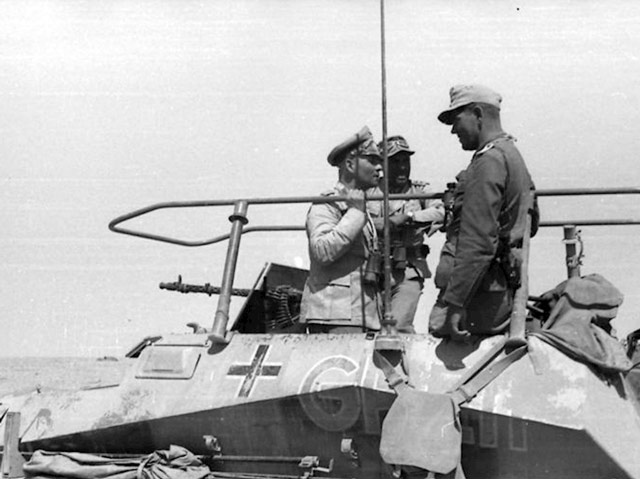
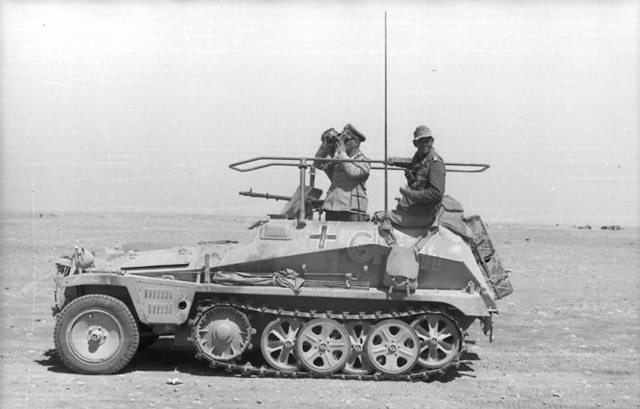
Rommel in North Africa worldwartwo.filminspector.com
German General Erwin Rommel in his command vehicle in North Africa, 11 June 1942 (Zwilling, Ernst A., Federal Archive Image 101I-443-1589-08).

Eastern Front: General Erich von Manstein's 11th Army continues battering away at Red Army defenses outside Sevastopol, Crimea, on 11 June 1942. His troops of the LIV Corps are having the most success north of the port, where the heaviest German artillery is located. The Soviet 345th Division counterattacks on the borderline between the Wehrmacht 132nd and 50th Divisions, but quick Luftwaffe intervention (1070 sorties while dropping 1000 tons of bombs today) prevents a rupture. The Red Army and LIV Corps, however, continue taking heavy casualties.

While progress is still being made at Sevastopol, the local commanders are getting concerned at the high cost of the small local gains. Luftwaffe General Wolfram von Richthofen, in command at Fliegerkorps VIII, comments sourly in his war diary that his forces have "only enough left for 1.5 more days of bombing." His mood is black, and he adds that "the specter of failure now seriously looms." On the spur of the moment, Richthofen decides that his bombers are dispersing their efforts too widely. He thus changes bombing procedures to conserve resources. The new tactic of "column bombing" involves bomber attacks on only specifically designated targets while the aircraft fly one after another in narrow air corridors.

The Red Air Force also is proving to be a nuisance, though not to the Luftwaffe. Instead, the Soviets are making nightly raids on German positions in the "rear" to the east at places like Simferopol, Theodosiya, Eupatoria, and Yalta. The Luftwaffe can see the attacks coming on their radar but do not have any night fighters to intercept them. Fortunately for the Germans, the Red Air Force bombing runs are very inaccurate, so the raids for the most part are ineffective.

Off the Crimean coast, a mini-war at sea also is brewing. The Soviets are running fast convoys to Sevastopol every night, and early in the morning, the Kriegsmarine decides to do something about it. For the first time, Axis small craft (MTBs and motorboats) manned by Italians attack a Soviet convoy near Cape Khersones. It is believed, but not absolutely certain, that they sink a Soviet ship.  

Back at Fuhrer Headquarters in East Prussia, General Halder also is getting impatient with Manstein's progress. He notes that the Soviet artillery at Sevastapol "is quite troublesome." However, further north, "The Voshansk attack is making very satisfactory progress." Meanwhile, the situation at Ninth Army is "unclear," with the Soviets "unaccountably" abandoning territory. This new Red Army tactic of not fighting for every inch of ground but instead trading space for time and tactical regrouping will befuddle and mislead the German High Command throughout the summer.

Battle of the Black Sea: Soviet submarine A-5 torpedoes and sinks 5695-ton Romanian freighter Ardeal off Odessa. Ardeal's captain beaches the ship to avoid sinking but is later repaired and returned to service.

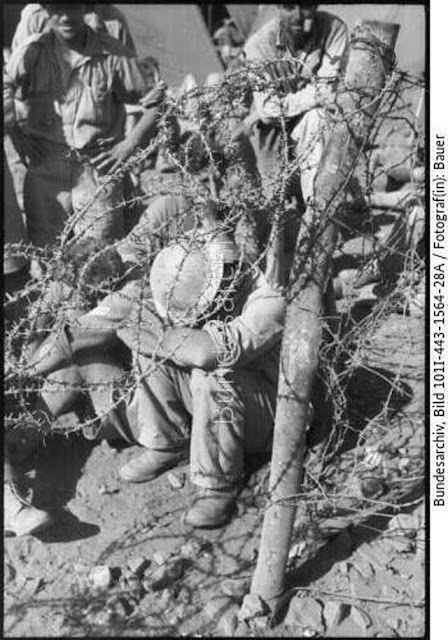
British POWs in North Africa worldwartwo.filminspector.com
British POWs in North Africa, 11 June 1942 (Farmer, Federal Archive Image 101I-443-1564-28A).

Battle of the Pacific: USS Saratoga rendezvouses with fellow carriers Enterprise and Hornet. It transfers 19 SBD Dauntless, five TBD Devastator of VT-5, and 10 VT-8 Avenger planes to the two other carriers to replace their losses at the Battle of Midway. The ships then turn head to Pearl Harbor in foul weather.

Reinforcements for the Pacific Fleet are on the way. USS Wasp and battleship North Carolina, along with escorting destroyers, pass through the Panama Canal. Battleships just barely fit through the channel with mere feet (sometimes only inches) to spare on each side. The Japanese know the importance of the Canal and have plans to block it throughout the war.

The U.S. 11th Air Force make their first attack on the Japanese on Kiska Island in the Aleutian chain. The attack is made by five B-24 and five B-17 bombers flying from Cold Bay and loading their bomb racks at Umnak Island. PBY Catalinas also participate in the attack. on Kiska Harbor. The attack only scores some near misses on the Japanese ships while losing a B-24 (Captain Jack F. Todd) to anti-aircraft fire. This begins a 48-hour period during which the Catalinas make repeated attacks without much success.

British POWs in North Africa worldwartwo.filminspector.com
British and South African POWs in North Africa, 11 June 1942 (Zwilling, Ernst A., Image 101I-443-1589-34A).

Battle of the Indian Ocean: German raider Michel (HSK-9) uses its guns to sink 5186-ton British freighter Lylepark southeast of Cocos Islands (northwest of Perth, Australia). Michel is on her way from Japan for a hunting raid off the coast of South America.

Japanese submarine I-20 torpedoes and sinks 7926-ton British freighter Mahronda in the Mozambique Channel. There are two deaths and 40 survivors. The survivors are rescued by the Royal Indian Navy ship HMIS Orissa. This is an unusual situation where a German ship sinks a ship further west than a Japanese submarine in the Indian Ocean on the same day.

Australian corvette HMAS Wallaroo (J 222) sinks after colliding with a ship it is escorting, U.S. Liberty Ship Henry Gilbert Costin. The sinking ironically occurs because the ships are sailing without navigation lights in overcast weather to avoid detection by the enemy. Wallaroo sinks while trying to return to Fremantle, while the other ship makes it back. There are three deaths.

European Air Operations: The foul weather that has characterized the spring of 1942 continues today. It is 10/10ths clouds during the morning, but visibility clears a bit by noon. RAF fighters attack Koksijde and the Furnes Canal, sinking and damaging barges. The attacks are broken off after encountering heavy anti-aircraft fire at Nieuport. These attacks in low visibility are quite hazardous, and several planes narrowly avoid collisions or hitting ground obstructions.

Battle of the Baltic: German support ship MRS-11 Osnabruck hits a mine and sinks off Tallinn, Estonia. There are 84 deaths. The ship is later salvaged.

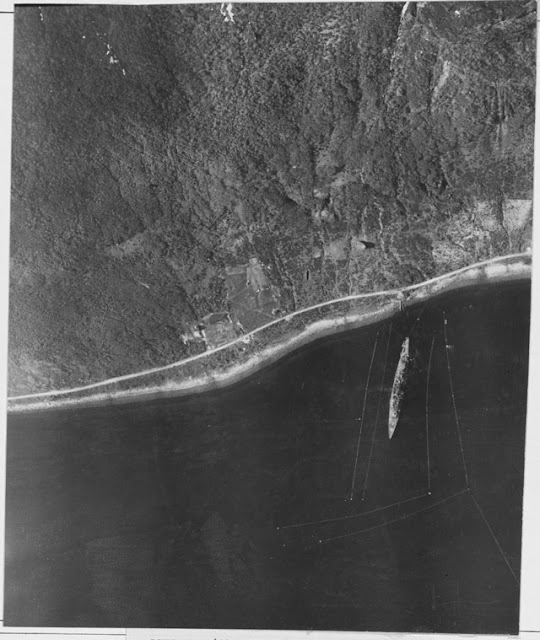
German cruiser Lutzow spotted by Allied air reconnaissance 11 June 1942 worldwartwo.filminspector.com
German heavy cruiser Lutzow photographed by Allied air reconnaissance, 11 June 1942 (Naval History and Heritage Command NH 110843).

Battle of the Atlantic: Italian submarine Leonardo da Vinci uses torpedoes and gunfire to sink 5483-ton Dutch freighter Alioth in the Atlantic Ocean near Freetown, Sierra Leone. Everyone survives.

U-504 (Kptlt. Hans-Georg Friedrich Poske), on its third patrol out of Lorient, torpedoes and sinks 4282-ton Dutch freighter Crijnssen 85 miles southwest of the Cayman Islands. There are one death and 93 survivors, who abandon the ship in four lifeboats and a gig. The sinking is especially traumatic for some on board because there are a dozen survivors of Sylvan Arrow (sunk by U-155 on 20 May 1942) and one from U.S. tanker T.C. McCobb (sunk by Italian submarine Pietro Calvi on 31 March 1942). The survivors in one lifeboat and the gig from Crijnssen are picked up by the U.S. freighter Lebore, which itself is sunk by U-172 a few days later. The other lifeboats make landfall in Mexico aside from four crewmembers on a raft who are picked up by the Panamanian tanker J.A. Mowinckel.

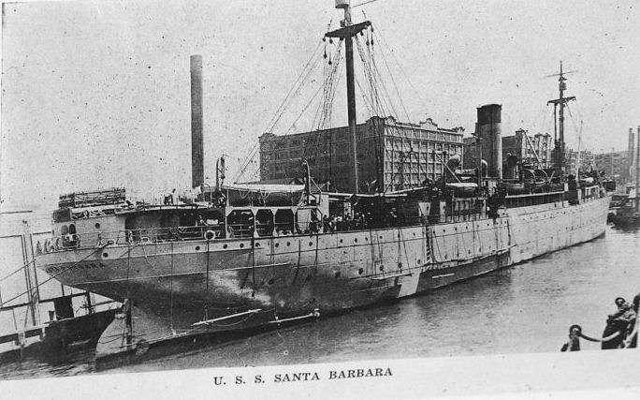
Freighter American sunk on 11 June 1942 worldwartwo.filminspector.com
SS American, originally the Santa Barbara, was sunk by U-504 on 11 June 1942. 

Much later in the day, U-504 also torpedoes and sinks 4846-ton U.S. freighter American off Honduras. The ship is hit by two torpedoes and sinks within 25 minutes. There are four deaths and 34 survivors, who are picked up by British freighter Kent. One survivor perishes after being picked up.

U-159 (Kptlt. Helmut Friedrich Witte), on its second patrol out of Lorient, torpedoes and sinks 7130-ton British freighter Fort Good Hope northwest of Colon, Panama. Two torpedoes hit and sink the freighter (carrying wheat, timber, lead, and zinc) within half an hour. There are two deaths and 45 survivors, who are picked up by U.S. gunboat USS Erie (PG 50).

U-455 (Kptlt. Hans-Heinrich Giessler), on its third patrol out of St. Nazaire, torpedoes and sinks 6914-ton British tanker Geo H. Jones northeast of the Azores. The tanker is a straggler from Convoy SL-111 heading from Aruba to Freetown. There are two dead and 40 survivors, who are picked up by HMIS Orissa (J 200).

U-157 (KrvKpt. Wolf Henne), on its second patrol out of Lorient, torpedoes and sinks 6401-ton U.S. tanker Hagan five miles off the north coast of Cuba. Hagan is simply steaming a straight course independently and thus is an ideal target. Two torpedoes hit the engine room and fuel bunkers, sinking the ship, which is carrying 2,676 barrels of blackstrap molasses, fairly quickly. There are six dead and 38 survivors, who make landfall in Cuba in two lifeboats. This is the only victory for U-157 in its career, which ends a couple of days later when it is sunk.

U-94 (Oblt. Otto Ites), on its ninth patrol out of St. Nazaire, torpedoes and sinks 4458pton British freighter Pontypridd northeast of St. John's, Newfoundland. Pontypridd is a straggler from Convoy ONS-100. There are two dead and 46 survivors, who are picked up by HMCS Chambly (K 116).

U-158 (Kptlt. Erwin Rostin), on its second patrol out of Lorient, torpedoes and sinks 13,467-ton Panamanian tanker/transport Sheherazade 20 miles west of Ship Shoal Buoy, Louisiana. Sheherazade is a French ship turned over to the U.S. War Shipping Administration (WSA). There are one dead and 58 survivors, who are rescued by shrimp boat Midshipman and fishing vessel 40 Fathoms. The rescue happens quickly enough that nine men are found swimming after having jumped overboard.

Norwegian 6049-ton freighter Haugarland hits a mine and sinks off Terschelling, Netherlands. It appears that everyone survives.

U.S. 9310-ton tanker F.W. Abrams hits a U.S.  defensive mine and sinks east of Morehead City, North Carolina (near Cape Hatteras). The 36 men on board make it to shore near Morehead City. A tug ("Relief") attempts salvage of the floating wreck without success.

U-87 mines the waters off Boston, Massachusetts, while U-373 mines the area near Delaware Bay.

Rommel in North Africa worldwartwo.filminspector.com
General Rommel in his Sd.Kfz. 250 command truck, 11 June 1942 (Zwilling, Ernst A., Federal Archive Image 101I-443-1589-09).

Battle of the Mediterranean: German General Erwin Rommel's Afrika Korps occupies the fortress of Bir Hakeim, which has been a roadblock in his advance toward Tobruk. The Free French defenders have almost all escaped to British lines to the south save for a small rear guard left to delay the attackers. The French and British pull back from their advanced position outside the fortress to Gasr-el-Arid early in the morning, completing the breakout by 2700 men and women (there are some female nurses).

After finally clearing this obstacle, about which he later comments "seldom in Africa was I given such a hard-fought struggle," Rommel quickly resumes his offensive, sending the 15th Panzer and 90th Light Divisions toward El Adem. The British 201st Guard Brigade in the Knightbridge Box, which blocks the way to Tobruk to the east, comes under severe pressure. While the Allied defense of Bir Hakeim has seriously disrupted Rommel's overly ambitious timetable, his advance now regains momentum.

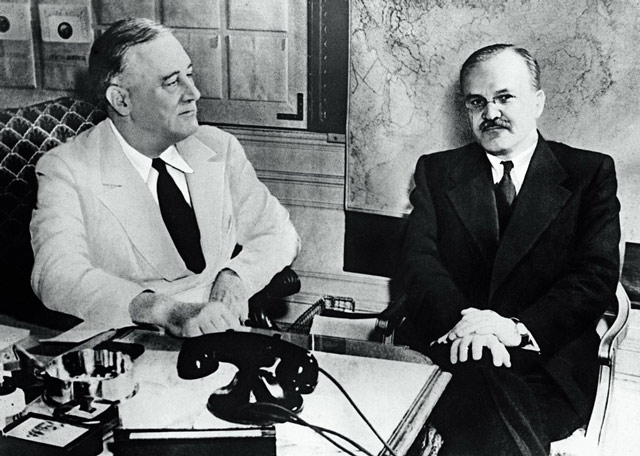
Molotov and FDR in Washington on 11 June 1942 worldwartwo.filminspector.com
Soviet Foreign Minister Vyacheslav Molotov and U.S. President Franklin D. Roosevelt meet in Washington, D.C., to finalize the lend-lease agreement, 11 June 1942 (Alliance.rusarchives.ru).

US/Soviet Relations: The United States and Soviet Union sign a lend-lease agreement. The agreement contemplates "mutually advantageous economic relations" between the two powers, with the agreement to continue in force "until a date to be agreed upon by the two governments." U.S. Secretary of State Cordell Hull and Soviet Ambassador Maxim Litvinov sign for their respective governments.

Article 1 sets out the main purpose of the agreement:
The Government of the United States of America will continue to supply the Government of the Union of Soviet Socialist Republics with such defense articles, defense services, and defense information as the President of the United States of America shall authorize to be transferred or provided.
This agreement, however, is not specific on certain key points. These become a lingering bone of contention during the post-war era. Significantly, the title to the equipment supplied by the U.S. is not transferred to the Soviet Union. The U.S. believes it still "owns" the items and retains rights to them, while the USSR believes it now owns them because they were freely given.

Technically, under the U.S. interpretation of the agreement, the Soviet Union is obligated to return any intact equipment or compensate the United States for it after the war. The USSR, perhaps understandably, has a vastly different interpretation. This leads to awkward exchanges between the two governments in the late 1940s in which the United States demands either the return of the intact equipment or payment for them, including limitations on the equipment's transfer to other countries. Ultimately, the United States simply demands payment for the "civilian-type articles remaining in existence."

Of course, the United States already has abandoned military equipment of its own at bases around the world because it is obsolete and considered too expensive to return to the homeland. Thus, there seem to be deeper reasons underlying the disagreement. It is entertaining to ponder the reactions of the Soviets when they receive these petty and abrasive demands for payment for goods they always assumed were given for free to win the war at the cost of Soviet blood. These pointless and unproductive "negotiations" help to poison the relations between the two nations and contribute to the growth of the Cold War, a hostile relationship that more or less continues to the present day.

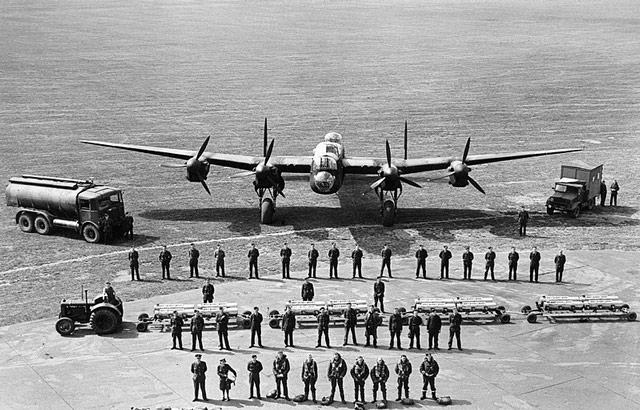
An Avro Lancaster and its crew on 11 June 1942 worldwartwo.filminspector.com
An Avro Lancaster and the personnel and equipment needed to keep it flying. This photograph was taken at Scampton, Lincolnshire, on 11 June 1942.  © IWM CH 15362.

German Military: Adolf Hitler issues Führer Directive 32. It sets out operations to be undertaken after the defeat of the Soviet Union, including the capture of Gibraltar with or without Spain's cooperation and resumption of the "siege of England." It is a curious mixture of far-sighted planning and mundane objectives such as the capture of Tobruk. It presupposes the quick defeat of the USSR in the coming Case Blue summer offensive and, like many of Hitler's grand strategies, assumes launch conditions that do not yet exist.

U.S. Military: With the threat to the U.S. west coast vastly reduced due to the Japanese defeat at Midway, the 97th Bombardment Group deployed for emergency purposes on the coast is transferred back to New England for eventual movement to join the Eighth Air Force in Great Britain.

Holocaust: Adolf Eichmann holds a meeting for his underlings controlling Jewish Affairs in France, Belgium, and Holland. This meeting sparks a systemic deportation scheme for Jewish residents of those areas to the extermination camps in the East that affects tens of thousands of people.

German Homefront: Michael Kitzelmann, 26, is executed at Orel Prison after being court-martialed and convicted of crimes against the state. Kitzelmann, a Wehrmacht lieutenant, was denounced by a sergeant for saying things that "undermined the military." He was in a hospital being treated for wounds when the allegations against him were made, but apparently, he made them previously while serving on the Eastern Front. The statements apparently concerned certain atrocities that Kitzelmann witnessed against the Russian population. While Kitzelmann became outspoken, he also had earned the Iron Cross Second Class and the Wound Badge in Gold.

TheGerman Bundestag rehabilitated Kitzelmann on 8 September 2009. A plaque in his memory is at the Johann-Michael-Sailer-school in Dillingen an der Donau.

American Homefront: The New England Journal of Medicine reports a case of "internal anthrax," which is considered quite novel because the vast majority of cases are of the cutaneous type. The patient died after showing progressively worse symptoms and a full autopsy was performed. Penicillin, still in its experimental phase, will become the accepted treatment for anthrax in 1944. 

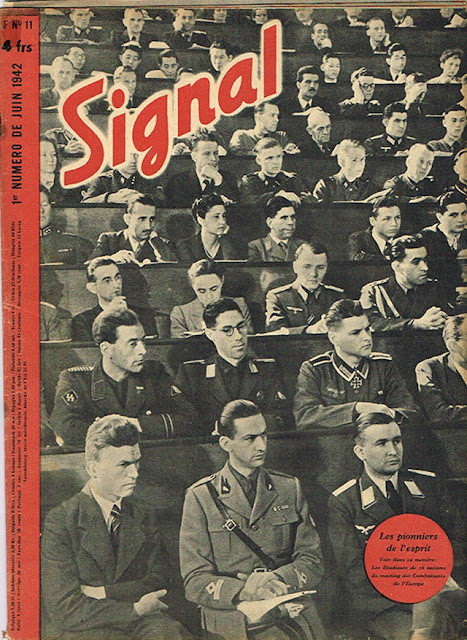
German Signal magazine from June 1942 worldwartwo.filminspector.com
Signal magazine, June 1942.

2021

Monday, November 8, 2021

June 7, 1942: Manstein Attacks Sevastopol in Crimea

Sunday 7 June 1942

Transfer of Yorktown survivors at sea, 7 June 1942 worldwartwo.filminspector.com
"USS Portland (CA-33), at right, transfers USS Yorktown survivors to USS Fulton (AS-11) on 7 June 1942, following the battle of Midway. Fulton transported the men to Pearl Harbor." Naval History and Heritage Command 80-G-312028.

Battle of the Pacific: US aircraft carrier USS Yorktown (CV-5) sinks just after dawn on 7 June 1942, marking the definitive end of the Battle of Midway. Yorktown capsizes due to the combined effects of previous Japanese naval air strikes and torpedoes from I-168. The Battle of Midway has been a decisive American victory, with the Japanese losing four fleet aircraft carriers and a cruiser.

Continuing with their grand operational plan whose main component already has been thwarted at Midway, the Japanese occupy Attu Island in the Aleutians. There is no opposition to the 1143 men of the North Sea Detachment, and it is unclear if the US even knows about this latest invasion for a day or two. There are only 44 US civilians and 42 Aleut natives on Attu. One US civilian, Charles Jones, dies during the Attu invasion of unknown causes. The Japanese send everyone to camps in Japan, with only 25 of the 86 inhabitants surviving the war. The Japanese also capture nine of ten US Navy sailors manning a weather station on Kiska, with the tenth man (wearing a summer uniform) evading capture in the interior for 45 days.

The Japanese now occupy two islands at the extreme end of the Aleutian Island chain (Attu and Kiska). The Japanese high command anticipates that the US Navy will intervene and sends two light carriers to the vicinity in order to stage an ambush. In fact, Admiral Chester Nimitz does intend to send USS Enterprise and Hornet to the Aleutians, but he has not yet issued the necessary orders.

While Admiral Raymond A. Spruance has chosen not to pursue the retreating Japanese fleet - a decision for which he receives criticism - the US Army Air Force decides otherwise. Major General Clarence L. Tinker, Commander, 7th Air Force, personally leads a bomber strike from Hawaii. He perishes when his plane crashes near Midway.
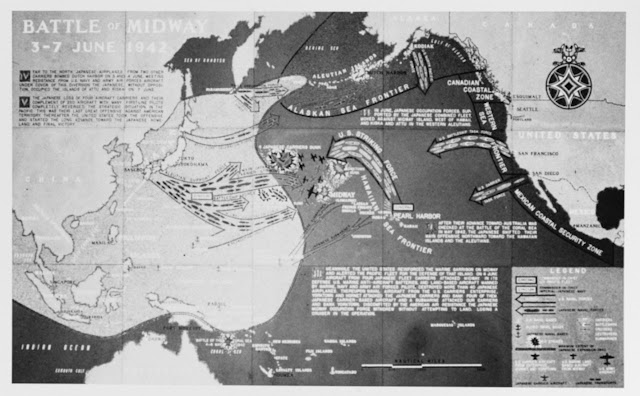
Map of Battle of Midway June 1942 worldwartwo.filminspector.com
"Located in the southeast room of the visitors building of Manila American Cemetery and Memorial. Map was designed by Margaret Bruton and fabricated by P. Grassi American Terrazzo Company of South Francisco." Naval History and Heritage Command NH 114452.

Admiral Frank Fletcher, who ceded command of US Task Force 18 around Midway Island due to the loss of his ship, the Yorktown, transfers his flag to aircraft carrier Saratoga, which has recently arrived from the US west coast. Saratoga departs Pearl Harbor today carrying replacement aircraft for the two remaining carriers involved in the battle. Fletcher thus is able to resume command of the task force on 8 June. He learns that Spruance has withdrawn to the east in order to refuel his ships and quickly orders search missions for the Japanese, who are heading back to Japan. However, the opportunity to continue the battle and "finish off the Japanese" has been lost.

While he has presided over the dramatic victory off Midway, Spruance manages to destroy much of the reputation he could have gained. This is due to his perceived lack of aggressiveness following the heat of the battle. Spruance's "discretion is the better part of valor" approach is controversial - then and now - and contrasts poorly with the aggressive tactics of Admiral "Bull" Halsey, who was unable to command the fleet at Midway due to health concerns. Now that Fletcher is back in command, Spruance is quickly reassigned from his field command to serve as Admiral Nimitz's chief of staff, though he does recover to have some important commands in 1943-1945.

Japanese submarine I-26 (Cdr Yokota) torpedoes and sinks 3545-ton US refrigerated freighter Coast Trader thirty miles off the Strait of Juan de Fuca on the US west coast. The ship is carrying refrigerated ammonia, which leaks due to the explosion and incapacitates some of the crew. There is one death. The remaining 56 men make it to a lifeboat, which local fishing vessel Virginia I tows to Neah Bay, and two rafts that Canadian corvette Edmunston (K-106) finds.

US submarine Grouper (SS-214) is mistakenly bombed by USAAF B-17 bombers looking for the Japanese fleet. It escapes undamaged, reflecting typical poor aim by level bombers against shipping in the Pacific.
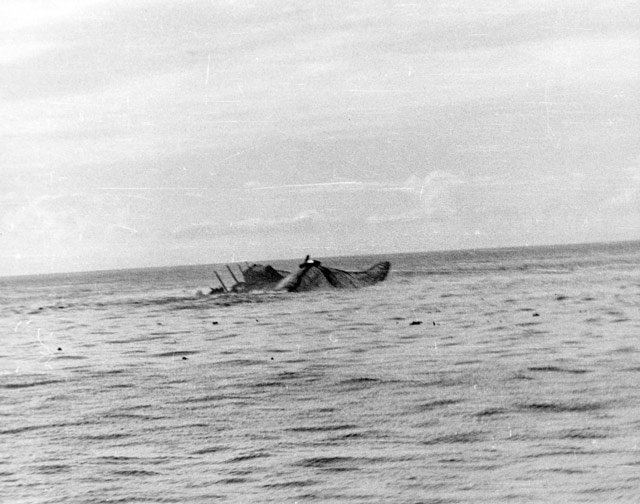
USS Yorktown sinks at Battle of Midway 7 June 1942 worldwartwo.filminspector.com
"USS Yorktown (CV-5) sinking, just after dawn on 7 June 1942, as seen from an accompanying destroyer." Naval History and Heritage Command NH 106000.

Battle of the Indian Ocean: Japanese submarine I-18 shells and sinks 2158-ton Norwegian freighter Wilford in the Indian Ocean off the Mozambique Coast. There are nine deaths and 34 survivors. All but two of the survivors, who are picked up by a Marinha Portuguesa gunboat, reach land in their lifeboats.

Eastern Front: In Crimea, German General Erich von Manstein begins Unternehmen Störfang (Operation Sturgeon Catch), the assault on Sevastopol. The port is well-defended, surrounded by rugged forests and bunkers that include 11 batteries and strong points north of Severnaya Bay.

The German 11th Army is weak, with many divisions seriously understrength. This is because Adolf Hitler is husbanding his fresh troops for the grand offensive, Case Blue, that he plans to launch in a few weeks. There are many fresh divisions and thousands of idle troops just north of the Crimea. It is an artificial manpower shortage, as opposed to the real one that are to come. Thus, Manstein must rely heavily on his artillery and airpower to make up for a weak thrust on land. Assisting the Germans are units of the Romanian Army, including the 1st Mountain Division and 18th Division, which are strong but lack their own artillery and air support.
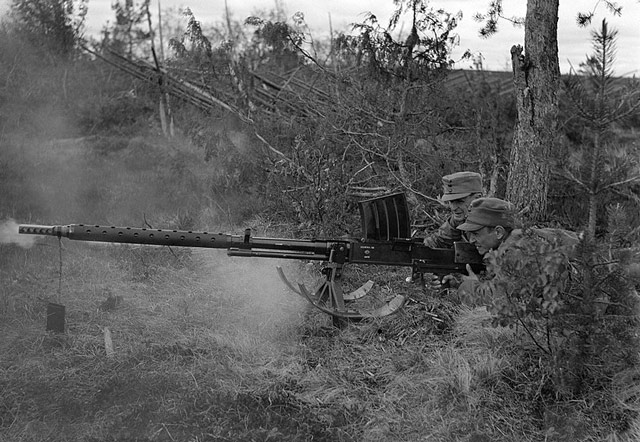
Finnish Lahti L-39 antitank gun in use, 7 June 1942 worldwartwo.filminspector.com
Lahti L-39 anti-tank gun in use, 7 June 1942 (Martin Persson, SA-kuva).

Aiding the assault are the Germans' heavy artillery that includes an 800 mm gun (Schwere Gustav), three 600 mm guns (Karl-Gerät self-propelled mortars), two 280 mm railway guns, two 420 mm guns, two 355 mm howitzers, and four 305 mm mortars. These massive artillery pieces have been firing at the Soviet defenses for days and have destroyed some key Soviet bunkers. The Luftwaffe's 8th Air Corps already has flown 3,069 sorties against the port, dropping 2,264 tons of high explosives and 23,800 incendiary bombs.

Following the massive preparatory bombardment, German 30 Corps attacks in the south while LIV Corps does so in the north. The southern attack stalls, but the LIV Corps makes good progress (this is the sector where the heaviest artillery has is located). The 132nd Infantry Division heads down the river while the 22nd Infantry Division attacks further east. The Soviets have planted numerous minefields that slow the Axis troops down. 

For Manstein, it is a mixed picture, with some advances in the north, few gains in the south, and failed attacks by the German 24th and 50th Infantry Divisions. In LIV Corps' four divisions alone there are 2,357 casualties, including 340 men killed. In addition, some of the units are running low on ammunition. However, the Germans take the key Red Army defensive position at Belbek, and Red Army casualties also have been severe. With his attempt at a quick victory a failure, Manstein now is looking at a depressing battle of attrition against the numerous enemy forces unless he can get the attack moving in the coming days.
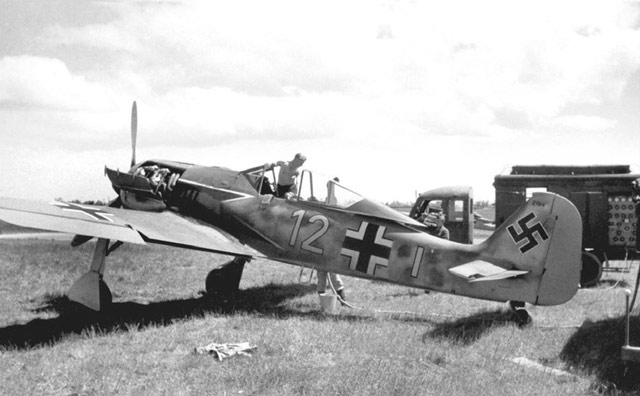
Fw-190 in France, June 1942 worldwartwo.filminspector.com
Focke-Wulf Fw-190A-2, 7./JG2, Theville, France, June 1942. The plane is still a bit of a mystery to Allied forces at this time.

European Air Operations: The weather is poor (10/10), with clouds down to 2000 feet. There are few operations during the day, typical during a relatively quiet spring 1942 on the Channel Front.

After dark, RAF Bomber Command attacks the German port of Emden. On the way back to base at 00:47, Luftwaffe pilot Oblt. Ludwig Becker of 6./NJG 2 in a Bf 110 shoots down a Wellington III (X3279) into the Waddenzee. All six crewmen perish.

Hptm. Johannes Seifert of I./JG 26 (KIA 25 November 1943) is awarded the Ritterkreuz (Knight's Cross of the Iron Cross) for 36 victories.
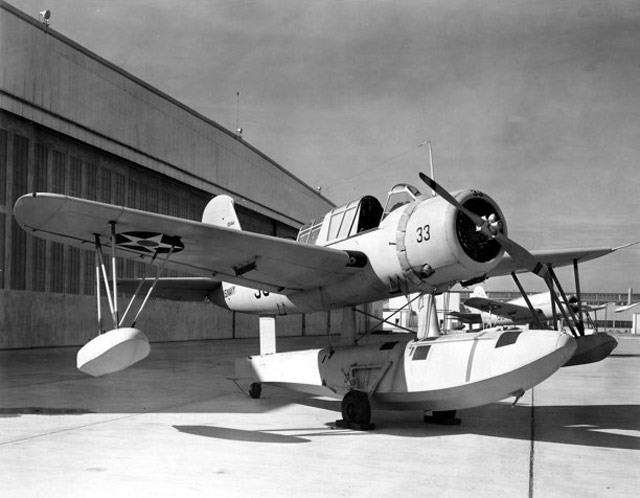
Kingfisher seaplane in Jacksonville, Florida, 7 June 1942 worldwartwo.filminspector.com
A US Navy Vought OS2U Kingfisher seaplane on the ramp at Naval Air Station Jacksonville, Florida, 7 June 1942 (US Navy). 

Battle of the Atlantic: U-653 (Kptlt. Gerhard Feiler), on its third patrol out of Brest, torpedoes and sinks seaplane tender USS Gannet (AVP-8) northwest of Bermuda. The ship sinks within four minutes. PBM Mariner seaplanes of VP-74 rescue 22 men, while USS Hamilton picks up 40 more. There are 16 deaths. 

U-159 (Kptlt. Helmut Friedrich Witte), on its second patrol out of Lorient, torpedoes and sinks 3382-ton US freighter Edith 200 miles southeast of Kingston, Jamaica. The ship sinks within twelve minutes. Witte surfaces after the attack to question the survivors and give them direction. He also, in an unusual move, scavenges various supplies that are bobbing in the water such as food, clothing, and even toys. The ship's survivors make it to Black River, Jamaica, in a week.

Italian submarine Leonardo da Vinci torpedoes and sinks 6956-ton British freighter Chile 350 miles southwest of Monrovia, Liberia. There are five deaths and 39 survivors.

U-107 (Kptlt. Harald Gelhaus), on its sixth patrol out of Lorient, torpedoes and sinks 3910-ton Honduran freighter Castilla near Jamaica. The ship sinks within minutes and no lifeboats can be launched. There are 24 dead and 35 survivors, who are picked up by USS Nike (WPC 112).

U-107 also torpedoes and sinks 3249-ton US freighter Sterling Steel Bridge (formerly Suwied) near Cozumel, Mexico. The ship sinks within three minutes, preventing any distress calls. There are six dead and 27 survivors. The survivors are picked up after 19 hours by USCGC Nemesis (WPC 111). This sinking, which occurs around midnight, is sometimes cited as occurring on 8 June.

U-158 (Kptlt. Erwin Rostin), on its second patrol out of Lorient, torpedoes and sinks 5234-ton Panamanian freighter Hermis due west of Havana, Cuba and due north of the extreme western tip of Cuba. Despite being hit by two torpedoes, the ship remains afloat and steaming in a circle, so Rostin surfaces and shells the freighter, setting it on fire, but it remains afloat for 12 more hours. There are one death and 46 survivors, who are picked up by US Army transport Toloa and taken to Kingston, Jamaica.

German 2967-ton freighter Joao Pessoa strikes rocks and sinks two miles from San Sebastian, Spain. Casualties are unknown.
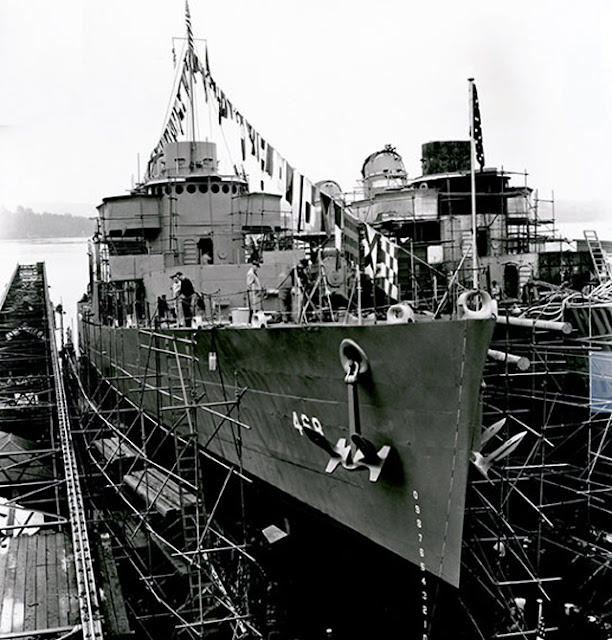
USS Taylor being launched in Maine, 7 June 1942 worldwartwo.filminspector.com
Launch of USS Taylor (DD-468) at the Bath Iron Works in Bath, Maine, on 7 June 1942. The ship is named after  Rear Admiral William Rogers Taylor (US Taylor Reunion Association).

Battle of the Mediterranean: The Axis forces around Bir Hakeim continue small-scale attacks. The 90th Light Division has managed to send pioneers through one minefield and into an interior minefield within about 800 meters (900 yards) of the fortress. The Free French garrison, while low on supplies, continues to hold out. During the day, the British Desert Air Force (DAF) launches several attacks against the exposed pioneers, while Luftwaffe Stukas pound the fort.

Much of the fighting at this stage of the battle revolves around supply lines, which are of vital concern in the desert. The British launch minor attacks by the 7th Motor Brigade and 29th Indian Infantry Brigade against Axis supply lines without much success. One last convoy manages to get through to Bir Hakeim in heavy fog after dark. Meanwhile, German General Erwin Rommel use the fog to reposition his forces for a determined assault on Bir Hakeim from the north on the 8th.

Besieged within Bir Hakeim, Brigadier General Marie-Pierre Koenig requests permission to withdraw due to his supply problems. Lieutenant-General Neil Ritchie, commanding the British Eighth Army, denies the request. Ritchie has his reasons - he anticipates the loss of Libya and needs to buy time while he builds a last-ditch defensive position at the little Egyptian town of El Alamein. Koenig, knowing that he can't hold out much longer, begins contemplating a breakout.

Italian submarine Sebastiano Veniero (Cdr Elio Zappetti) is lost due to two Catalina attacks of RAF No. 240 Squadron between the Balearic Islands and Sardinia around noontime. All 57-58 men on board perish.
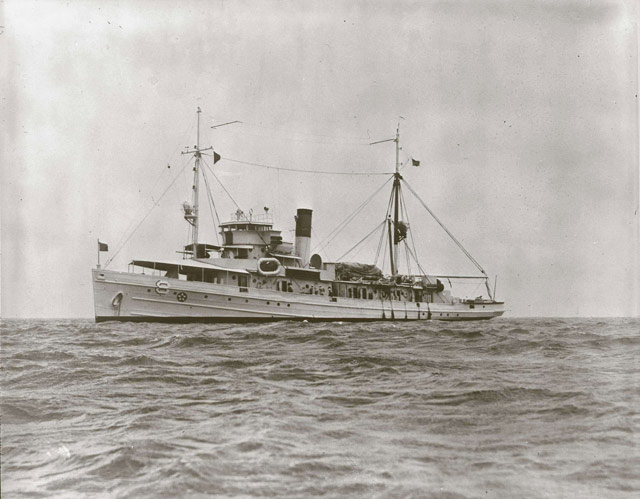
USS Gannet, sunk on 7 June 1942 worldwartwo.filminspector.com
USS Gannet, sunk by U-653 on 7 June 1942.

Special Operations: British Commandos execute Operation Albumen, another in a long sequence of overnight operations against Axis coastal targets. This one is on the Greek island of Crete, where Luftwaffe forces have been supporting the currently successful campaign of German General Erwin Rommel in Libya. Operation Albumen has several different coordinated sabotage operations.

Led by Captain G.I.A. Duncan of the Black Watch and assisted by local partisans, the Commandos destroy five aircraft and damage 29 others, along with several vehicles and stores, at Kastelli. At Heraklion, George Jellico leads members of the Free French Forces and Hellenic Army to plant Lewes bombs, destroying about 20 Junkers Ju 88 medium bombers. Similar attacks at Tympaki and Maleme do not accomplish anything because there were no aircraft at the former location and the latter was too well guarded. The Germans lose a dozen soldiers.

Aside from the damage caused directly by Operation Albumen, there are some lasting consequences. While the Commandos escape, the German authorities take and execute 50 local hostages. German Crete commander General Alexander Andrae ultimately is replaced by General Bruno Bräuer in November 1942 partly as a consequence of this raid.
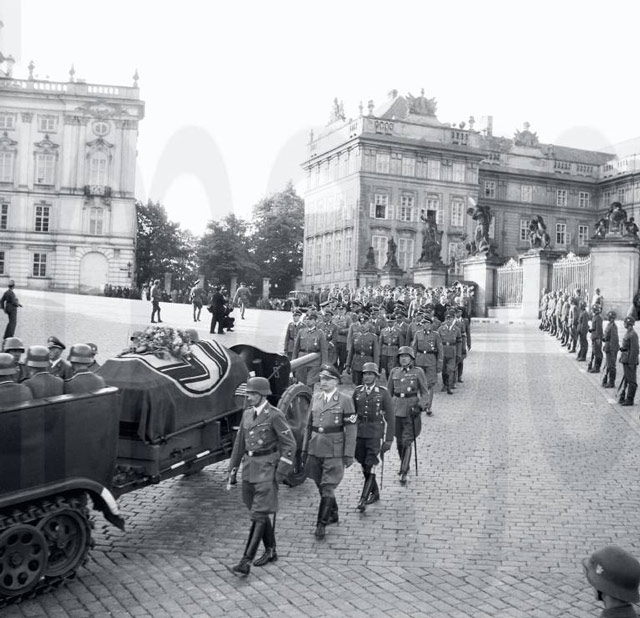
Funeral in Prague of Reinhard Heydrich, 7 June 1942 worldwartwo.filminspector.com
Funeral procession of Reinhard Heydrich in Prague, 7 June 1942. Note his flag-draped coffin on a caisson on the left.

German Homefront: The German authorities in Prague hold a massive, ostentatious funeral for assassinated Reichsprotektor Reinhard Heydrich. Afterward, the coffin is sent by train to Berlin for a second funeral to be held on 9 June. The second funeral is planned to be even more elaborate and ostentatious and is to be attended by the entire Reich leadership including Adolf Hitler. The Prague authorities continue to search for the assassins, who remain in the city moving between safe houses. Severe reprisals are in progress, with many more planned.

British Homefront: Scientist Alan Blumlein, the inventor of stereo sound recording among many other things, dies when a Halifax bomber in which he is testing H2S airborne radar crashes in Herefordshire. The crash apparently is due to improper aircraft maintenance. Due to Blumlein's importance to the war effect, the British government does not announce Blumlein's death until 1945. This delay leads to various conspiracy theories about the true cause of Blumlein's death. In 2017, the US Recording Academy posthumously awards Alan Blumlein a Technical Grammy for his contributions to the recording field.
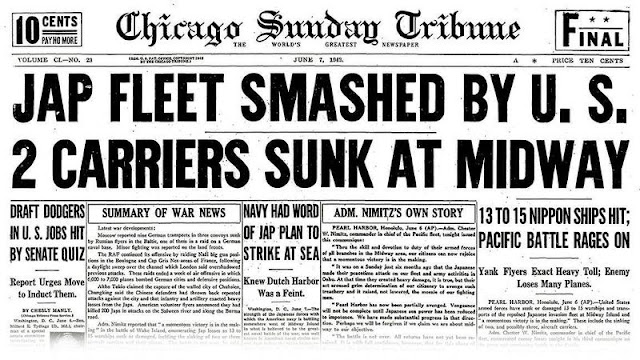
Chicago Sunday Tribune, 7 June 1942 worldwartwo.filminspector.com
The 7 June 1942 Chicago Sunday Tribune, featuring the article in the center "Navy Had Word of Japanese Plan to Strike at Sea" which almost got the reporter and newspaper in big trouble.

American Homefront: In a remarkable journalistic coup, the Chicago Tribune breaks the news of the codebreaking that contributed heavily to the US Navy victory in the Battle of Midway. Under the headline "Navy Had Word of Japanese Plan to Strike at Sea," the article describes how Naval Intelligence allowed Admiral Nimitz to pre-position his forces to ambush the Japanese fleet. While this article displays a clear breach of critical military security that might aid the Japanese, nothing comes of it. The Japanese military shows no signs of becoming aware that the Americans have broken their codes.

In Great Britain, Winston Churchill is known for having a short fuse with regard to sensitive press leaks like this. His government engages in many displays of censorship and attempted censorship. However, the US government ultimately lets the matter pass because events show that the disclosures do not interfere with the war effort.

Future History: Muammar Muhammad Abu Minyar al-Gaddafi is born in Qasr Abu Hadi, Sirte, Italian Libya. From a poor tribal family, he joins the Libyan military in 1963. In 1964, Muammar Gaddafi forms the "Central Committee of the Free Officers Movement," a revolutionary group styled after the teachings of a former Egyptian leader. In mid-1969, while Libyan King Idris is on vacation in Turkey and Greece, Gaddafi leads a bloodless coup and established the Libyan Arab Republic. Self-styled as the "Brotherly Leader and Guide of the Revolution of Libya," Muammar Gaddafi thereafter rules Libya as a dictator. He develops a cult of personality and remains in power until 20 October 2011, when Muammar Gaddafi perishes while trying to flee from an insurrection.
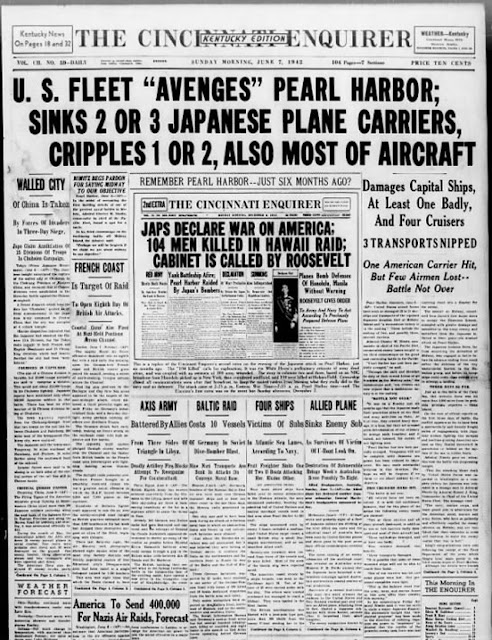
Cincinnati Enquirer, 7 June 1942 worldwartwo.filminspector.com
The 7 June 1942 Cincinnati Enquirer headlines the Battle of Midway as "Avenging" Pearl Harbor. It even reprints its front page from the Pearl Harbor report on this front page to hammer home that point. Unusually for this stage of the war, the report actually underplays the American victory, claiming only "2 or 3" Japanese carriers sunk when actually four were sunk. Still, this is very accurate reporting this close to the actual battle.

2021

Monday, October 18, 2021

June 6, 1942: Japanese Invade Aleutian Islands

Saturday 6 June 1942

Battle of Midway 6 June 1942 worldwartwo.filminspector.com
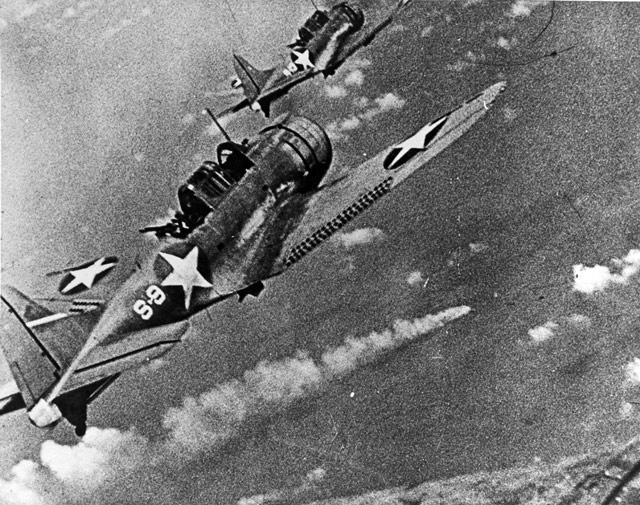
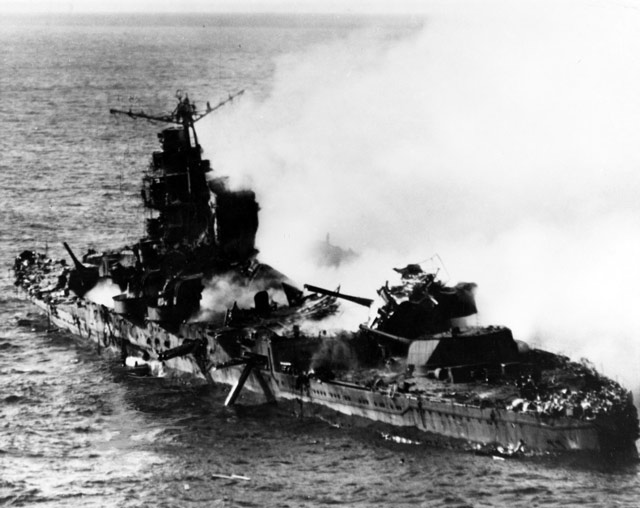
"SBD Dauntless dive bombers from USS Hornet (CV-8) approaching the burning Japanese heavy cruiser Mikuma to make the third set of attacks on her, during the early afternoon of 6 June 1942. Mikuma had been hit earlier by strikes from Hornet and USS Enterprise (CV-6), leaving her dead in the water and fatally damaged." Naval History and Heritage Command 80-G-17054.

Battle of the Pacific: Despite having suffered staggering losses off Midway Island on 4 June, the Japanese follow through on their subsidiary campaign in the Aleutian Islands on 6 June 1942. The Japanese Northern Area Fleet, commanded by Vice-Admiral Boshiro Hosogaya, lands 500 troops of the elite Maizura 3rd Special Landing Force and 700 laborers on Kiska Island at 10:27. 

This is the first invasion of the continental United States since the War of 1812, though Alaska is not yet a state. The local Unangax (Aleuts) offer virtually no resistance and no U.S. military forces intervene at this time despite some fruitless bombers searching for the Japanese. There are U.S. soldiers of the U.S. Navy meteorological service on Kiska, but they disappear into the rugged interior. The Japanese rename the island Narukami.

Eight P-38s do spot and attack a ship, but it turns out to be a Soviet freighter. The Americans, though, are quite concerned about both a Japanese land invasion south toward Washington State through Canada and Japanese bombing raids from the Aleutians (neither of which the Japanese plan) and begin preparing a response.

Off Midway Island, things just keep getting worse for the Japanese. Having lost four irreplaceable aircraft carriers to the U.S. Navy's one, they now lose another important ship. Douglas SBD Dauntless dive bombers attack and sink cruiser Mikuma, already damaged in previous days' raids. Mikuma and fellow cruiser Mogami are heading for refuge at Wake Island when 31 SBDs from USS Enterprise and Hornet attack and hit Mikuma with five bombs and Mogami with six.
Japanese cruiser Mikuma under attack, 6 June 1942 worldwartwo.filminspector.com
"Japanese heavy cruiser Mikuma, photographed from a USS Enterprise (CV-6) SBD aircraft during the afternoon of 6 June 1942, after she had been bombed by planes from Enterprise and USS Hornet (CV-8). Note her shattered midships structure, torpedo dangling from the after port side tubes and wreckage atop her number four eight-inch gun turret." Naval History and Heritage Command 80-G-414422.

While the Mikuma may theoretically have survived that many bomb hits, one of them sets off the torpedoes it is carrying and they destroy the ship. There are 650 deaths and 240 survivors, who are picked up by destroyers Asashio and Arashio (both also hit by one bomb each. U.S. Navy submarine Trout investigates the scene on 9 June and picks up an additional two Japanese crewmen and makes them POWs.

An example of the "fog of war" almost causes a tragedy for the U.S. forces. A late-morning B-17 raid by 26 bombers based on Midway (led by Lt. Col. Brooke Allen) against the fleeing Japanese cruisers fails to find them. However, they do spot a target and six B-17s drop their loads on it thinking it is one of the cruisers. In fact, it is U.S. submarine Grayling. Fortunately for the Americans, level-bombing accuracy at sea lives down to its terrible reputation, no harm is done, and Grayling quickly dives before any bombs come close. 

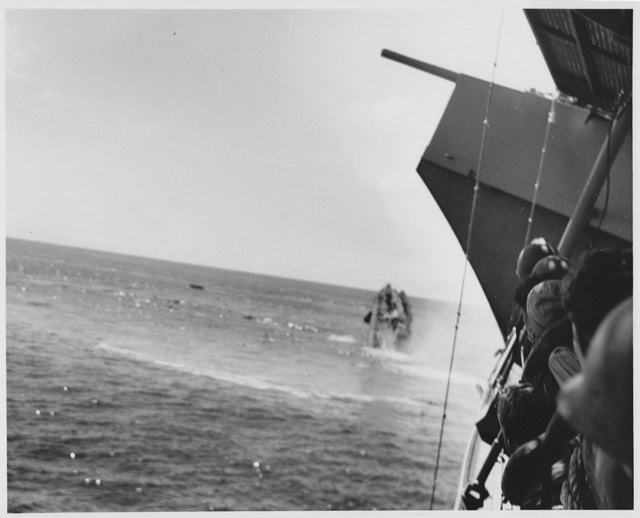
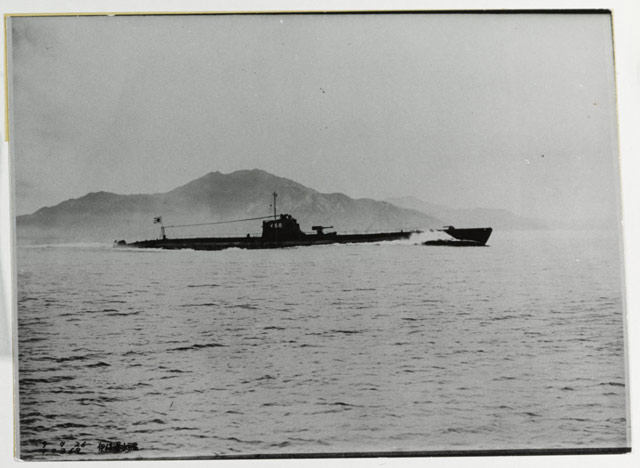
The Japanese do "get one back" when submarine I-168, which previously shelled Midway Island, spots crippled USS Yorktown and attacks. In addition to pumping one more torpedo into the badly listing aircraft carrier, the submarine torpedoes and sinks the U.S. Navy destroyer USS Hammann (DD-412) around noon. Hammann has been providing auxiliary power to USS Yorktown as a damage control party desperately tries to keep it from sinking. Only one of four torpedoes hits the destroyer, but it is enough to break the ship in half. The destroyer sinks in just four minutes, and after it slips under, its armed depth charges explode, causing a violent underwater explosion and killing many men in the water. There are 80 deaths from the 192-man crew. I-168, despite being surrounded by U.S. Navy screening destroyers, escapes with minor damage.
US destroyer Hammann sinking, 6 June 1942 worldwartwo.filminspector.com
"USS Hammann (DD-412) sinking with stern high, after being torpedoed by Japanese submarine I-168 in the afternoon of 6 June 1942. Photographed from the starboard forecastle deck of USS Yorktown (CV-5) by Photographer 2nd Class William G. Roy. Angular structure in right foreground is the front of Yorktown's forward starboard 5-inch gun gallery. Note knotted lines hanging down from the carrier's flight deck, remaining from her initial abandonment on 4 June." Naval History and Heritage Command 80-G-32320.

With ships on both sides still sinking (such as Yorktown) and already sunk, there are hundreds of men struggling to survive in the waters around Midway. The island's PT-boats and PBY Catalinas spend this and surrounding days picking up 27 men.

U.S. fleet carrier Saratoga, which missed the Battle of Midway due to repairs and upgrades being performed on the West Coast, arrives in Honolulu today. It quickly prepares to depart on the 7th to ferry replacement aircraft and crew to Enterprise and Hornet still stationed northeast of Midway. While most histories record 7 June 1942 as the final day of the Battle of Midway, today effectively marks the end of major hostilities.

The state-controlled Tokyo press quickly informs the public of the "great victory" in the Aleutian Islands. However, no mention is made of the catastrophic events for the Japanese Navy off of Midway Island until the war is over.
Japanese submarine U-168 which sank US destroyer Hammann on 6 June 1942 worldwartwo.filminspector.com
"I-168. (Japanese Submarine, 1933-1943) Underway in March 1934, probably during her trials. This submarine was renamed I-168 in May 1942. She torpedoed USS Yorktown (CV-5) on 6 June 1942, causing damage that led to the carrier's sinking the following morning." Naval History and Heritage Command NH 73054 I-68.

Battle of the Indian Ocean: Japanese submarine I-16 torpedoes, shells, and sinks 3839-ton Yugoslav freighter Susak in the Mozambique Channel. There are seven deaths.

I-10 torpedoes and sinks U.S. freighter Melvin H. Baker 45 miles off the mainland coast. All 48 men aboard survive and are picked up by British freighter Twickenham.

Eastern Front: German General Erich von Manstein makes his final preparations for Operation Stoerfang ("Sturgeon Catch"), the land assault against Sevastopol.  Meanwhile, the Luftwaffe continues an overpowering assault against the port, facing virtually no opposition from airports almost within sight of the defenders. Between 3 and 6 June, the Luftwaffe has flown 2355 sorties, dropping 1800 tons of high explosives 23,800 1.1kg incendiary bombs. In the two weeks from 24 May to 6 June, the Luftwaffe also has dropped 638,000 propaganda leaflets (50,000 per day) with instructions on how to surrender.

The massive artillery barrage that includes the biggest guns in military history, including the Karl and Gustav guns, shifts its targeting today to the defenses south of the city that face the German 30th Army Corps.

Rather than evacuating the port, the Soviets actually make every effort to reinforce it, slipping flotilla leader Tashkent, the destroyer Bezuprechnyi, and transport Abkhaziya through the blockade to deliver 2,785 more Red Army defenders.
Illustrated London News, 6 June 1942 worldwartwo.filminspector.com
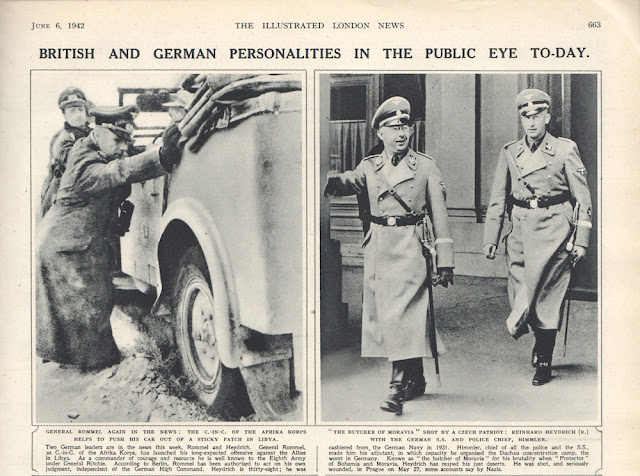
The Illustrated London News of 6 June 1942 features photos of German General Erwin Rommel, left, and recently deceased General Reinhard Heydrich, right (with Heinrich Himmler). Rommel is shown pushing his command car out of some trouble.

European Air Operations: The weather is warm, with plenty of ground haze below 1500 feet. The RAF focuses mainly on convoy protection.

R.A.A.F. Catalinas of RAF No. 10 Squadron, using Leigh Lights, bomb and damage Italian submarine Luigi Torelli in the Bay of Biscay. The submarine's crew manages to beach it at Santander, Spain, to prevent sinking. There is one death and one wounded crewman. The ship is temporarily repaired and sailed to France on 14 July for permanent repairs.

Hptm. Helmut Lent, Gruppenkommanduer of II./NJG 2, is awarded the Eichenlaub (No. Ninety-eight) after 34 night victories and 8 by day.
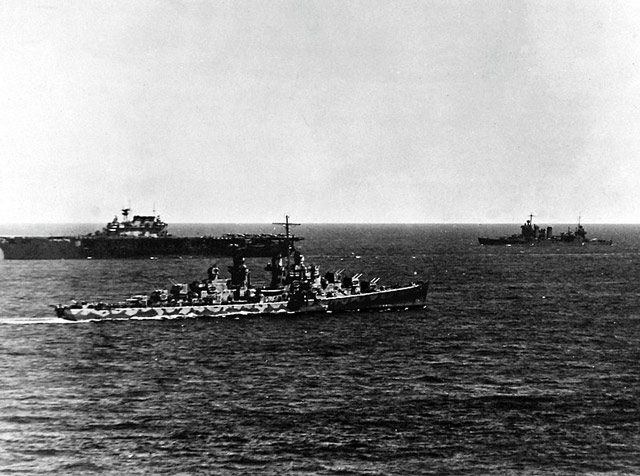
USS Atlanta with Hornet in the background, 6 June 1942 worldwartwo.filminspector.com
"A close-up of USS Atlanta (CL 51) with USS Hornet (CV 8) and USS Phelps (DD 360), all of Task Force 16, in background. Picture was made during the third day of the battle as Atlanta came up to offer assistance to the destroyer, which had broken down temporarily because of fuel shortage." 6 June 1942. Naval History and Heritage Command 80-G-88908

Battle of the Atlantic: It is a busy day for two German raiders operating in the South Atlantic east of Brazil. The 1940-41 glory days of the raiders are over and now they have to operate in remote areas to avoid detection. That doesn't mean they don't get the occasional moment of excitement. This happens during the Action of 6 June 1942.

In one incident, German raider Michel (Schiffe 28) spots disabled and drifting 7176-ton U.S. freighter George Clymer midway between Brazil and Africa. The Michel launches its motor torpedo boat Esan, which torpedoes and badly damages the freighter. One man perishes in the attack. The crew abandons the ship but reboards it on the 8th when it does not sink. however, the situation is hopeless and the crew is picked up by the British armed merchant cruiser HMS Alcantara. That is the last anyone sees of George Clymer, which remains stubbornly afloat. Exactly when and where the George Clymer sinks is unknown.

German raider Stier (Schiffe 23) has been quietly operating in the South Atlantic with limited success since leaving Royan, France in late May 1942. Today, Stier is cruising 500 miles (800 km) east of Pernambuco, Brazil, in overcast weather when it spots 10,170-ton U.S. tanker Stanvac Calcutta. Appearing suddenly out of a squall, Stier fires a warning shot and signals the tanker's crew to prepare to be boarded.

The Stanvac Calcutta, however, is heavily armed for a tanker. It has one 4-inch (102 mm)/50-caliber naval gun salvaged from World War I and a 5 inch (127 mm)/25-caliber anti-aircraft gun. Stier, meanwhile, has six 150-millimeter (6 in) guns, one 37 mm (1.5 in) gun, two 20 mm (0.79 in) cannons, and two torpedo tubes. So, there's a lot of firepower on both sides, though Stier outguns the tanker by a substantial margin.

The tanker's crew, led by Captain Gustav O. Karlsson, decides to not comply with the Stier's order to stop and opens fire. Led by Ensign Edward L. Anderson, the tanker's gunners get off several shots with both guns (the larger gun in the gun, smaller in the bow). Despite missing with most of their shots, the gunners do hit and disable one of Stier's 150mm guns. The Stier's crew then returns fire with 148 shells.

The battle lasts for 15 minutes, during which the Germans score a hit on the tanker's bridge, killing Captain Karlsson and several others. The Americans continue firing until their ammunition is exhausted. At this point, Stier Captain Horst Gerlach fires a torpedo that strikes Stanvac Calcutta on the port side. This kills several sailors and causes damage that leads to a sharp list and eventual sinking. The tanker's crew then abandons ship. Gerlach's men lower their own boats and rescue the Americans struggling in the water.

The Action of 6 June 1942 shows several hard truths about the Battle of the Atlantic. One is that merchant ships armed with a few guns stand little chance against raiders like Stier that are designed for combat even if they aren't true warships. Another is that these surface combats kill a lot of crewmen, as Stanvac Calcutta has 16 men killed in action, one dying later onboard Stier, fourteen men wounded, and 37 prisoners taken (the Stier only suffers two wounded men).

Actions like that of 6 June 1942 call into question the whole concept of arming merchant ships, which requires a lot of effort and dedicated gunners on hundreds of ships. However, later events involving Stier will redeem this idea somewhat. For their pains, the Stanvac Calcutta's crew later are awarded the Merchant Marine Gallant Ship Citation and Ensign Anderson is promoted (while a POW) to the rank of lieutenant commander. The tanker crew winds up in a Japanese POW camp.
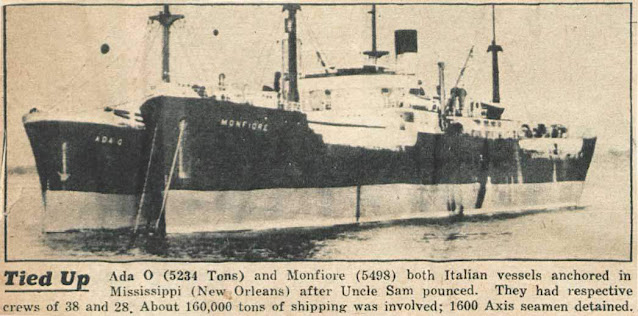
Freighter Hermis in the background, sunk on 6 June 1942 worldwartwo.filminspector.com
Coal-burning freighter Hermis is shown at left while still called "Ada O." Hermis was an Italian vessel anchored in New Orleans when seized in 1941 and pressed into U.S. service. Sunk on 6 June 1942.

There are also the usual U-boat sinkings, these days confined to the Caribbean.

U-68 (KrvKpt. Karl-Friedrich Merten), on its fourth patrol out of Lorient, torpedoes and sinks 13,006-ton Panamanian tanker C.O. Stillman 60 miles southwest of Puerto Rico. There are three deaths and 55 survivors,  most of whom are picked up by US Coast Guard patrol boat #83310 while 30 sail their lifeboats to Puerto Rico.

U-107 (Kptlt. Harald Gelhaus), on its sixth patrol out of Lorient, torpedoes and sinks 3910-ton Honduran freighter Castilla east of Cancun and south of western Cuba. One torpedo hits and causes the ship to sink quickly stern-first. The crew can't launch lifeboats and take to three rafts. There are 24 deaths (including one who dies on a raft) 35 survivors, who are picked up by USS Nike (WPC-112) after six days. Some sources place this sinking on 7 June 1942.

U-158 (Kptlt. Erwin Rostin), on its second patrol out of Lorient, torpedoes and sinks 5234-ton Panamanian freighter Hermis west of Havana and northeast of Cancun. Two torpedoes strike the ship on the port side but the engines continue running due to an inability to stop them due to damage. Rostin surfaces and uses his deck gun to finish off the freighter, setting it on fire. There is one death and 46 survivors, who are picked up by US Army transport Toloa. The ship does not sink for at least 12 hours and this sinking is sometimes listed as occurring on 7 June 1942.

Dutch 197-ton freighter Antares hits a mine and sinks off the Dutch coast.
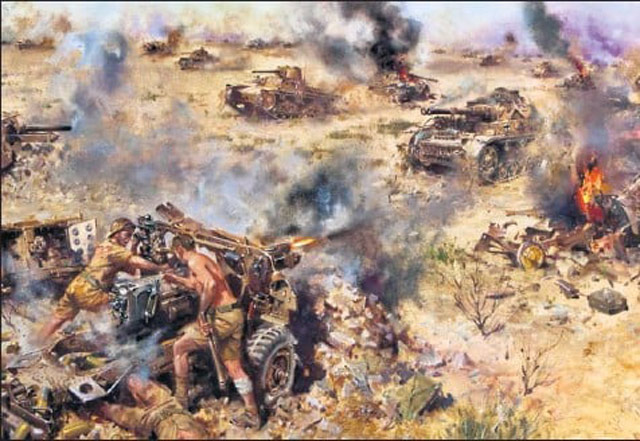
"Battle of Knightsbridge 6th June 1942" worldwartwo.filminspector.com
"The Battle of Knightsbridge, 6th June 1942," by Terence Cuneo (1907-1996). Shown are the 426th Battery of the 107th Regiment Royal Horse Artillery and the South Nottinghamshire Hussars, panzer of the Afrika Korps attacking. The 426th ultimately was forced to surrender.

Battle of the Mediterranean: After a wild day of attack and counter-attack between German and British troops on 5 June, the front settles down again today. However, German General Erwin Rommel retains command of the battlefield after his forces destroyed dozens of Allied tanks. He sends out armed reconnaissance to test the British lines and maintains pressure on the surrounded Free French garrison at Bir Hakeim. For their part, the British engage in harassing attacks against the German supply lines using the 7th Motor Brigade and 29th Indian Infantry Brigade.

The main action of the day is an attack at 11:00 by the German 90th Light Division against Bir Hakeim. This involves a determined effort by troops and pioneers to clear a way through the minefields surrounding the fortress, which are divided into two perimeters. By nightfall, the Germans manage to get through the outer minefield and into the inner minefield to within 800 meters (900 yards) of the fortress. The advance, while threatening to the Free French, also leaves the German troops exposed to Desert Air Force attacks on the 7th.

The Battle of Knightsbridge proceeds as the 15th Panzer Division attacks northward. The British 22nd Armoured Brigade continues to give ground after having lost dozens of its tanks. The German objective is El Adem, but the 201st Guard Brigade is ferociously defending the approaches to Tobruk.

Operation Aberdeen, the Eighth Army's counterattack begun on 4/5 June against the German Afrika Korps panzers, ends today after having accomplished nothing but the loss of numerous British troops and tanks. British Eighth Army commander General Neil Ritchie and Middle East Commander-in-Chief Claude Auchinleck now face the prospect of not only losing the battle but also all of Libya and much of Egypt unless they can find some way to stop Rommel's attacks. Among the desperate options considered are withdrawing the Free French from Bir Hakeim to free up the 7th Motor Brigade. However, this is rejected as the French seem to be in a good defensive situation.

Oblt. Hans-Joachim Marseille of 3./JG 27, currently operating in North Africa, receives the Eichenlaub for achieving 75 victories. Marseille once was considered a disciplinary problem but now is revered by his colleagues as a legend.
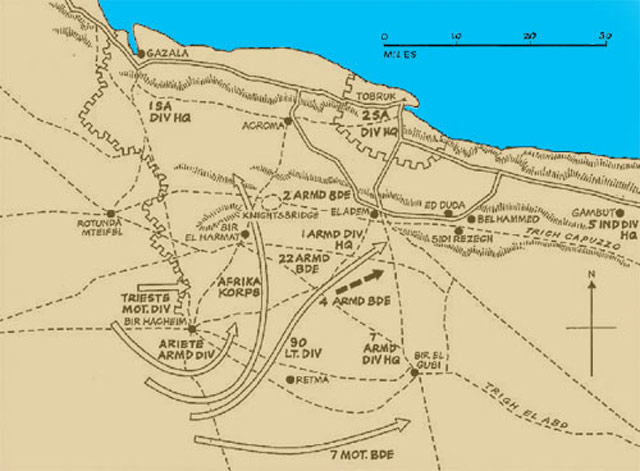
Battle of the Gazala Line, 6 June 1942" worldwartwo.filminspector.com
A map showing the military situation in Libya ca. 6 June 1942. The 15th Panzer Division thrust through the British Knightsbridge defensive position is shown by the upward arrow in the center, with a separate thrust to the south of Tobruk at the upper right. The map makes clear the extreme jeopardy of the Allied position at Tobruk, though nobody on either side is thinking about it just yet.

American Homefront: At the Belmont Stakes, the third jewel of the Triple Crown, the chestnut stallion Shut Out is the winner. Having also won the Kentucky Derby, Shut Out just misses immortality by having lost the Preakness Stakes to Alsab. Shut Out continues racing until 1944, when it is retired and put out to stud until passing away in 1964.

Future History: Klaus Bednarz is born in  Falkensee, Province of Brandenburg, Germany. Bednarz becomes a popular West German correspondent, author, and television host, particularly of the TV show Monitor. Klaus Bednarz passes away on 14 April 2015.
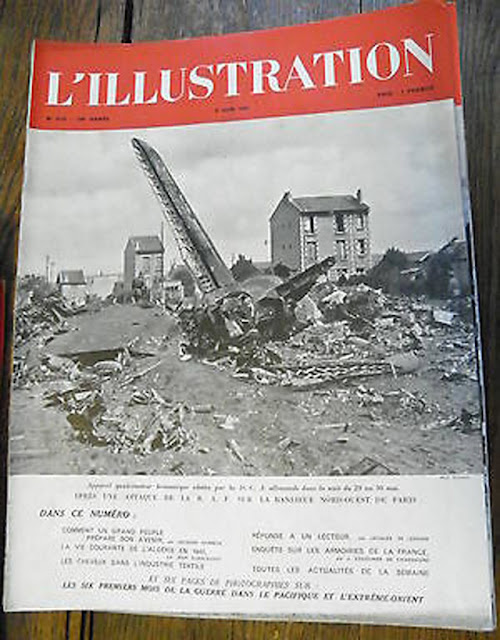
L'Illustration, 6 June 1942" worldwartwo.filminspector.com
L'Illustration, 6 June 1942.

2021