Showing posts with label HMS Thrasher. Show all posts

Sunday, May 16, 2021

May 19, 1942: Soviet Panic at Kharkov

Tuesday 19 May 1942

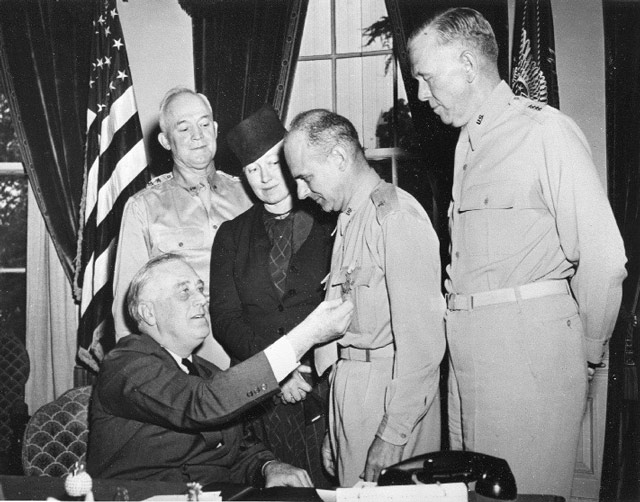
Roosevelts gives Doolittle Medal of Honor 19 May 1942 worldwartwo.filminspector.com
President Franklin D. Roosevelt presents the Medal of Honor to Brigadier General James Harold Doolittle in a ceremony at The White House, 19 May 1942. The President is seated at the left. Standing, left to right, are Lieutenant General Henry H. Arnold, Chief of the Army Air Forces; Mrs. Doolittle; Brigadier General Doolittle; and General George Catlett Marshall, Jr., Chief of Staff, United States Army. (Franklin D. Roosevelt Library and Museum, Photographic Collection, NPx. 65-696).
Battle of the Pacific: US Admirals "Bull" Halsey and Frank Fletcher are bringing their Task Forces 16 and 17 east toward Hawaii on 19 May 1942 in anticipation of a major Japanese attack. Nobody is completely sure where the attack will occur, but the consensus is that Midway Island will be the target. Light cruiser USS Nashville (CL-43) sails through the expected area of the attack from Midway to the western Aleutians today but does not see any enemy ships.

Japanese submarine I-21 launches a seaplane to reconnoiter Suva Bay, Fiji.

Battle of the Indian Ocean: The Japanese have sent a detachment of submarines, "Detachment A," to the Indian Ocean to scout for opportunities. Today, submarine I-30 launches a seaplane to reconnoiter Zanzibar and Dar-es-Salaam.
Crashed B-25B, 19 May 1942 worldwartwo.filminspector.com
A B-25B of the 39th Bomb Squadron forced to crashland at Westover Field, Massachusetts, on 19 May 1942 due to issues with the landing gear. Everyone survived. The pilot, Lt. John Henebry, ultimately becomes a major general and writes a book about his wartime experiences, "The Grim Reapers: At Work in the Pacific Theater" (2002).
Eastern Front: Commander of Army Group South Field Marshal Fedor von Bock presses his advantage against a disbelieving Red Army south of Kharkov. Having coordinated plans with First Panzer Army commander General Ewald on Kleist on the 18th, he orders Sixth Army commander General Friedrich Paulus to begin an attack from Merefa southwest of Kharkov. The objective is to occupy and distract the Soviet forces far to the west of where Kleist's panzers are attempting to surround them.

Kleist's III Panzer Corps, meanwhile, is brushing aside opposition as it continues eating into the Soviet supply corridor. The 14th Panzer Division crosses the Bereka River to take Petrovskoye while other divisions head west to block an expected Red Army breakout attempt. This narrows the mouth of the bulge to fifteen miles and deprives the Red Army forces to the west of a critical Donets river crossing.

Soviet Southwest Front, led by Marshal Semyon Timoshenko, finally begins to react to the growing Wehrmacht threat. After continuing to attack German VIII Corps south of Kharkov in the morning, it quickly breaks off the attacks and begins sending units to block Kleist's panzers to the southeast. The Luftwaffe controls the skies and sees and attacks the red Army columns on the roads. The German pilots, enjoying complete aerial dominance, claim to destroy 29 tanks during the day.

The Sixth Army war diary summarizes the situation at the end of the day: "The enemy's offensive strength has cracked. The breakthrough to Kharkov is therewith prevented."
Panzer 38(t) in Crimea, 19 May 1942 worldwartwo.filminspector.com
A German Panzer 38(t) leaves a landing craft on a beach near Yalta, May 1942 (Federal Archive B 145 Fig. F016214-0021A).
It is unclear where the Soviet orders to break off the attack in the morning came from. Post-war Soviet histories claim they came from Timoshenko on his own authority. If so, it is a dramatic turnaround by Timoshenko, who has been telling Stalin all along that the German counterattacks are not a threat. The Stavka finally reverses course at the end of the day and orders the advanced Sixth Army and Bobkin Group to terminate the offensive toward Kharkov and head southeast to confront Kleist's panzers.  
 
At his midnight conference, Hitler calls von Bock and tells him to hurry up and finish the encirclement. Kleist is to send 14th Panzer Division the final fifteen miles to reach Balakleya, where German troops of Paulus' Sixth Army await. Bock immediately calls Kleist's chief of staff and tells him to take the next town, Protopopovka, "under all circumstances and as soon as in any way possible." The fate of 600,000 Soviet soldiers to the west hangs in the balance. At Fuhrer Headquarters, General Franz Halder notes briefly in his diary that "The situation east of Kharkov is no longer dangerous."

In Crimea, General Manstein's 11th Army continues mopping up resistance in the Kerch region. Some histories record the 19th as the day of German victory in Crimea, and General Franz Halder records in his war diary that "The Kerch offensive can be regarded as closed." However, there remain Red Army holdouts (including at the port of Sevastopol), including thousands congregating in catacombs south of Kerch. In the air, Luftwaffe ace Gordon "Mac" Gollob continues a torrid victory streak, shooting down three more Soviet R-5 reconnaissance planes to raise his victory total to 99.
Japanese-American internees, 19 May 1942 worldwartwo.filminspector.com
Internees await relocation in Centerville, California. May 19, 1942. Dorothea Lange, photographer. Gelatin silver print. Collection of Oakland Museum of California. Gift of Paul S. Taylor.
European Air Operations: The weather clears sufficiently for both sides to resume their bombing operations. This is only a brief interruption of activity in what otherwise is a very quiet month along the Channel Front.

The Luftwaffe ends its lull by attacking Hull in another "Baedeker Raid." There are 50 deaths, 58 seriously injured, and extensive damage, especially in the Alexandria dock area. The bombing accuracy is quite good, especially relative to recent RAF attempts, with hits on the Blackburn aircraft factory at Brough (west of Hull). Extensive fires erupt along Scarborough Lane and Westbourne Avenue. The attack is notable for the use of an 1,800kg bomb and a 1,000kg bomb. Other areas hit include Hedon (east of Hull), Hornsea, and Withernsea. The Luftwaffe loses two Junkers Ju 88 bombers and a Dornier Do-217.

RAF Bomber Command mounts its first major raid in eleven days. The target is Mannheim. A total of 197 bombers (11 lost) embark, with 105 bomber crews claiming to hit the city. However, accuracy is very poor, and very few bombs actually hit the city. Local authorities estimate that bombs from only about ten bombers actually hit the city. However, the bombs that do hit cause an appreciable amount of damage to some small businesses in the harbor areas. There are only two deaths in the city.

In minor raids, 65 RAF bombers (one lost) attack St. Nazaire but cause little damage. Another 9 bombers lay mines off Lorient and near Heligoland, while 13 bombers drop leaflets over France.
Survivors of SS Heredia, 19 May 1942 worldwartwo.filminspector.com
The Downs family, survivors of the sinking of freighter SS Heredia on 19 May 1942 by U-506.
Battle of the Atlantic: U-506 (Kptlt. Erich Würdemann), on its second patrol out of Lorient, torpedoes and sinks 4732-ton US refrigerated freighter Heredia at 02:00 two nautical miles (3.7 km) southeast of the Ship Shoal Buoy off Louisiana. The ship sinks very quickly, giving no time to launch the boats. There are 36 deaths and 26 survivors, who are rescued by local shrimpers Conquest, J. Edwin Treakle, Papa Joe, and Shellwater, with three of the survivors picked up by a seaplane.

U-103 (Kptlt. Werner Winter), on its seventh patrol out of Lorient, torpedoes and sinks 5037-ton US freighter Ogontz 70 nautical miles (130 km) southeast of Cozumel, Mexico. There are 19 deaths and 22 survivors, who are rescued by US tanker Esso Dover.

U-751 (Kptlt. Gerhard Bigalk), on its sixth patrol out of St. Nazaire, torpedoes, shells, and sinks 3110-ton US freighter Isabela 35 nautical miles (65 km) south of Navassa Island Lighthouse. There are three deaths and 34 survivors, who make it to Cape Briton, Haiti, in lifeboats. This is the final victory for U-751.

An Italian submarine torpedoes and sinks Swedish 5747-ton steel cargo freighter Tisnaren somewhere in the Atlantic between Brazil and Senegal. Italian submarines Comandante Cappellini and Barbarigo are operating in this area but it is not definite which is the attacker.

At Hvalfjordur, Iceland, some merchant marine sailors aboard US freighter SS Ironclad notice that there is a shipment of liquor (it is en route to the US Ambassador to Moscow, Admiral William H. Standley, USN (Ret.)). They decide to help themselves and discipline breaks down, with fighting breaking out. At the behest of an armed guard officer on board, troops from the battleship USS Washington are sent over to restore order. Ironclad is removed from convoy PQ 16.
Tugboat Iriquois in Puget Sound, 19 May 1942 worldwartwo.filminspector.com
Tugboat Iriquois at sea, 19 May 1942 (Puget Sound Maritime Historical Society).
Battle of the Mediterranean: Royal Navy submarine HMS Thrasher torpedoes and sinks 1160-ton Italian freighter Penelope a few miles northwest of Monopoli, Italy.

Malta has been heavily reinforced with Spitfire fighters recently and the results are plain in the daytime sky. While Luftwaffe fighter sweeps over the island continue, the new defenders lead to a much-reduced bomber threat. In fact, they enable RAF bombers to go back on the offensive. Today, RAF bombers attack an Italian convoy northbound from Tripoli, though no ships are sunk.

Manhattan Project: Having just taken over the atom bomb research program, Robert Oppenheimer sends a letter to Ernest O. Lawrence updating him on progress. He writes that the atomic bomb design is solved "in principle" and projects that "six good physicists" should be able to work out the details within six months.

Joint Allied Command: The 30th and final in a series of Post-Arcadia meetings of the Combined Chiefs of Staff takes place in Washington, D.C. Among the topics discussed is an expected German advance toward the Persian Gulf from Syrian bases, the selection of targets for the nascent USAAF Eighth Air Force, and German development of a "new odorless gas, suitable for a surprise attack by inclusion in bombardments from the ground or from the air."
Crash site in Quebec, 19 May 1942 worldwartwo.filminspector.com
The crash site at No. 9 Bombing and Gunner School, Quebec.
Canadian Military: A Battle Mk. I crashes at No. 9 Bombing and Gunnery School, Mt.-Joli, Quebec, killing the four crewmen. This school is part of the British Commonwealth Air Training Plan, so the passengers include airmen from Canada, New Zealand, and Australia.

US Military: Brigadier General Ira C. Eaker, commander of Eighth Air Force, assumes command of all US air units in the United Kingdom.

Pursuant to a recent agreement between the United States and Panama, the 31st Fighter Squadron, 37th Fighter Group, 6th Air Force transfers its P-39 and P-40 fighters from Chorrera, Panama, to Albrook Field, Canal Zone.

Australian Military: A Tugan LJW7 Gannet aircraft flying from Batchelor Field (northern Australia) to Groote Eylandt makes a forced crash landing in a swamp in remote Arnhem Bay. The crew survives and scavengers the ruined airplane to make a raft. They survive an epic 33-day journey to the Milingimbi mission. Survivor George Booth later writes a book, "33 Days," describing how local natives helped the crew survive. This real-life story has echoes in the motion picture "Flight of the Phoenix" (1965) starring Jimmy Stewart.
General Jimmy Doolittle, 1942 worldwartwo.filminspector.com
Brigadier General James Harold Doolittle, U.S. Army Air Forces, 1942. (U.S. Air Force).
President Roosevelt presents the Medal of Honor to Lt. Colonel James Doolittle, who is also promoted to brigadier general, for the 18 April 1942 Doolittle raid. The citation reads:

For conspicuous leadership above and beyond the call of duty, involving personal valor and intrepidity at an extreme hazard to life. With the apparent certainty of being forced to land in enemy territory or to perish at sea, Lt. Col. Doolittle personally led a squadron of Army bombers, manned by volunteer crews, in a highly destructive raid on the Japanese mainland.

While, in fact, not a particularly damaging air raid as the citation reads, the Doolittle Raid was a major morale booster after the series of defeats at Singapore, Bataan, and elsewhere. It also influences Japanese strategy to its detriment, making it more defensive and paranoid.

American Homefront: The Western Defense Command issues Civilian Restrictive Order No. 1. This forces all Japanese-Americans in California, Oregon, Washington State, and southern Arizona to move into relocation camps. These camps are located in numerous states between eastern California and the Mississippi River. The total number of persons ultimately sent to camps is approximately 122,000.

Paul Waner of the Braves becomes the third National Leaguer to get 3000 hits (following Honus Wagner and Cap Anson).

Future History: Frederick "Curly" Neal is born in Greensboro, North Carolina. Curly Neal becomes a celebrity as the Harlem Globetrotters' featured ballhandler from 1963-1985. He also is featured in the animated Hanna-Barbera cartoon "Harlem Globetrotters." The Globetrotters retire Neal's No. 22 on 15 February 2008. Frederick Neal passes away in Houston on 26 March 2020.
Look magazine 19 May 1942 worldwartwo.filminspector.com
Look magazine of 19 May 1942 features a Marine Corps Sergeant Otto Nuske on the cover.

May 1942


2021

Friday, September 25, 2020

April 18, 1942: The Doolittle Raiders Bomb Japan

Saturday 18 April 1942

USS Hornet launching Doolittle raiders, 18 April 1942 worldwartwo.filminspector.com
"A B 25 bomber of the US Army Air Force, piloted by Lieutenant Colonel James H Doolittle, takes off from USS HORNET, bound for a raid on Tokyo and other Japanese military centers on 18 April 1942." © IWM NY 7343.
Battle of the Pacific: Lieutenant-Colonel James H. Doolittle launches his Doolittle Raid on Tokyo on 18 April 1942. While successful in many respects, it does not go exactly as planned. The day is rainy and overcast, with thirty-foot swells and repeated rain squalls.
At 03:00, the USS Enterprise radar operators spot two Japanese picket ships about 11 miles ahead. Admiral "Bull" Halsey sounds general quarters and takes evasive action, which avoids contact for the moment. At 05:58, an Enterprise scout plane spots another patrol boat about 40 miles ahead and flies back to drop this sighting on the Enterprise's deck in a canvas bag in order to maintain radio silence. Halsey again changes course, and again this avoids contact.

At 07:48, a Japanese picket boat (Patrol Boat No. 25, the Nitto Maru) suddenly appears off within sight of aircraft carrier Hornet about ten miles away. US Navy cruiser Nashville opens fire with six-inch guns and Enterprise dive-bombers quickly join in. They sink the Nitto Maru at 08:23, but the Japanese crew has alerted the Fifth Fleet that it has spotted "three enemy carriers." Radio operators on the Enterprise pick up these transmissions and know they have lost the element of surprise. SBD Dauntless and F4F Wildcat planes from the Enterprise also sink patrol boats Iwata Maru No. 1, Nagato Maru, and Nanshin Maru No. 26, with some of their crew rescued by I-74.
Doolittle raiders, 18 April 1942 worldwartwo.filminspector.com
A B-25B bomber taking off from USS Hornet on its way to Japan, 18 April 1942.
Even though the ships are still about 700 miles east of Japan, Admiral Halsey sends the "go" signal to Doolittle on the Hornet:
launch planes x to colonel doolittle and gallant command x good luck and god bless you.
The pilots know they are too far away from Japan to make it to Chinese bases, as the plan was to close to within 400 miles. At 08:15, Doolittle takes off with the first B-25, barely clearing the waves by yards. The 15 other bombers soon follow, and Halsey quickly orders the task force to reverse course back to Hawaii.

At 09:45, a Japanese patrol plane spots the bombers and alerts Tokyo. However, Japanese naval intelligence believes it is impossible for twin-engined bombers to be operating that far out to sea and takes no action. Doolittle continues leading his force west in a very loose formation stretching over two hundred miles, fighting 20-mile-per-hour headwinds.
Doolittle raiders, 18 April 1942 worldwartwo.filminspector.com
Smoke rises from bomb strikes on the Japanese mainland on 18 April 1942.
Colonel Doolittle, in the lead, crosses the Japanese coast around noon about 80 miles northeast of Tokyo. At 12:15, he releases four incendiary clusters on the city. Facing heavy antiaircraft fire, Doolittle descends to a treetop level and turns south, heading for China. The following bombers arrive soon after from all directions but skip Tokyo and instead bomb Yokohama, Kobe, Osaka, and Nagoya, confusing the Japanese defenses. After dropping their 500-pound bombs, they, too, scoot off to the west toward China.

The raid demolishes 112 buildings and damages 53 more, killing 87 men, women, and children. There are 151 civilians seriously injured, one being a woman shot through the face and thigh while gathering shellfish near Nagoya. Another 311 Japanese suffer minor injuries. For a single raid by only 16 bombers, the raid causes an outsized amount of damage compared to similar European missions, likely because the Japanese are taken completely by surprise and have not organized any air defenses.

The Doolittle raiders now are in the clear, but they have one problem: they don't have enough fuel to make it to the planned five landing strips at Chuchow. The US has kept the raid so secret, however, that the Chinese haven't been properly informed of the bombers' arrival, so they fail to send out pre-arranged homing signals. In any event, the bombers run out of fuel, and most of the crews bail wherever they happen to be - and many crews can't even tell if they are over land or water due to clouds and fog. Of the sixteen planes, only one makes a safe landing at an airfield at Vladivostok, where, much to their surprise, they are taken imprisoned as internees (they eventually escape to Iran). 

Doolittle's plane makes it to a Chinese airfield after dark, but the local authorities mistake his plane for a Japanese bomber and turn off the field lights. Unable to see the field to land, Doolittle and his crew bail as the bomber runs out of fuel. They are aided by local Chinese citizens and eventually make it back to the United States.
Doolittle raiders, 18 April 1942 worldwartwo.filminspector.com
Four unidentified Doolittle Raiders being escorted in a Japanese village, 18 April 1942.
Doolittle himself parachutes into a rice paddy behind Japanese lines and quickly makes contact with Chinese guerillas. Only three of 72 crewmen of the Doolittle Raiders perish before reaching the ground. Eight men are taken as prisoners and, after a war crimes trial, three are executed by a Japanese firing squad. One of the other men dies in captivity. The planes averaged about 2,250 nautical miles (4170 km), the longest mission ever by B-25 Mitchell bombers. The last surviving crewman, Lt. Robert L. Hite, passes away on 29 March 2015.

The Doolittle Raid isn't the only US Army Air Force raid today. The US 5th Air Force sends Martin B-26 bombers over the Japanese overseas base at Rabaul and hits Japanese Navy aircraft transport Komaki Maru. The ship sinks so close to shore that the Japanese fill the hulk with sand and make it a pier.
Doolittle raiders, 18 April 1942 worldwartwo.filminspector.com
The Minneapolis Morning Tribune of 18 April 1942 trumpets the Doolittle Raid on Tokyo.
Battle of the Indian Ocean: British troops of the Burma Division are in trouble south of Penangyaung, as Japanese troops have blocked their best escape route to the north. The 13th Indian Brigade launches a breakout attempt at 06:00 that is intended to open a path to advancing Chinese relief forces of General Sun Li-jen's 38th Division.

The ground is rough and well-forested and the Allied attack bogs down without taking its key objective, a hill overlooking a road they can use to escape. The fighting in the dense forest becomes confused and desperate. A small Japanese force feigns being Chinese and lulls troops of the 1st Battalion The Royal Inniskilling Fusiliers into letting down their guard, then suddenly attacks and bayonets the surprised British troops, killing several men. Throughout the day, the Japanese infantry is supported by effective air support.

At 17:00, the Allied troops consolidate and form a defensive perimeter after a hard day of close fighting. Unknown to the British troops, the Chinese relief force makes good progress and crosses the Pin Chaung Ford, brightening the prospects of effective relief. The British plan another breakout attempt on the 19th.

Elsewhere in Burma, the Japanese 55th Division encircles the Chinese 55th Division in the Toungoo area. The Chinese have few prospects for relief. The Japanese 56th Division is battering the Chinese 6th Corps in the Karen Hills area of Bawlake, Bato, Taunggyi, and Loikaw and slowly forcing the Chinese back.
Doolittle raiders, 18 April 1942 worldwartwo.filminspector.com
A U.S. postage stamp commemorating the Doolittle Raid of 18 April 1942.
Eastern Front: The spring thaw ("Rasputitsa") is in full swing in central Russia, and General Franz Halder notes in his diary, "Unaccountable quiet along the entire front." However, the relief attempt at Demyansk continues with the breakout from the pocket making good progress as well as General Seydlitz's men coming up along the Lovat River. 

European Air Operations: It is a quiet day on the Channel Front as weather conditions are poor.

Battle of the Atlantic: U-boats have achieved devastating success during Operation Paukenschlag off the east coast of the United States, to the consternation of US authorities. Convoys are planned but have not yet made any difference. In desperation, the US Navy now orders a blackout all along the east coast to prevent U-boats from using city lights to spot the silhouettes of passing ships.

German 2978-ton freighter Seefahrer hits a mine and sinks near Borkum, Germany.
Doolittle raiders, 18 April 1942 worldwartwo.filminspector.com
The New York Times of 18 April 1942 features the Doolittle Raid as its main headline, along with Admiral Leahy being recalled as Ambassador to France.
Battle of the Mediterranean: Air raids on Malta resume today after a multi-day lull. A bomber hits and sinks Royal Navy tug HMS Andromeda while the tug is leaving Grand Harbour.

Royal Navy submarine HMS Thrasher torpedoes and sinks 1297-ton German freighter Bellona near Tobruk.

Partisans: On the Nanos Plateau in the Slovene Littoral, about 800 Italian soldiers surround 54 Slovene partisans. In this Battle of Nanos, the Italians kill 10 partisans and capture 11, with the rest escaping in the forest.
Hitler Youth marching on 18 April 1942 worldwartwo.filminspector.com
Hitler Youth marching on 18 April 1942 (Federal Archive Image 183-J01182).
Propaganda: General Halder meets with General Dittmar, the army radio spokesman, to discuss how the army "wants news presented."

Finnish/German Relations: General Halder receives the Finnish Cross of Liberation 1st Class from General Talvela.

French Government: Pierre Laval officially returns to power. Not only is he head of the executive, with Petain now a figurehead, he also is Minister of the Interior, of Information and of Foreign Affairs. He pledges to maintain "Une place de choix" (a special place) for France beside Germany in the fight against Communism.

American Homefront: The Toronto Maple Leafs complete one of the greatest comebacks in sports history when they defeat the Detroit Red Wings 3-1 in Game 7 of the Stanley Cup Finals. The Maple Leafs were down 3 games to none but now have won the last four games to win the title. This is Toronto's fourth Stanley Cup.

Gertrude Vanderbilt Whitney passes away in New York City at age 67. She is the founder of the Whitney Museum of American Art. She also is the designer of the Titanic Memorial in Washington, D.C.

Future History: The last surviving Doolittle raider, Lt. Col. Richard Cole, dies on 9 April 2019. Mission commander Jimmy Doolittle’s co-pilot, Cole parachuted out of his B-25 as it was running out of gas and spent the night in a tree before some locals reunited him with Doolittle.


April 1942

April 1, 1942: Convoys Come to the USA 
April 2, 1942: Doolittle Raiders Leave Port
April 3, 1942: Japanese Attack in Bataan
April 4, 1942: Luftwaffe Attacks Kronstadt
April 5, 1942: Japanese Easter Sunday Raid on Ceylon
April 6, 1942: Japanese Devastation In Bay of Bengal
April 7, 1942: Valletta, Malta, Destroyed
April 8, 1942: US Bataan Defenses Collapse
April 9, 1942: US Defeat in Bataan
April 10, 1942: The Bataan Death March
April 11, 1942: The Sea War Heats Up
April 12, 1942: Essen Raids Conclude Dismally
April 13, 1942: Convoy QP-10 Destruction
April 14, 1942: Demyansk Breakout Attempt
April 15, 1942: Sobibor Extermination Camp Opens
April 16, 1942: Oil Field Ablaze in Burma
April 17, 1942: The Disastrous Augsburg Raid
April 18, 1942: The Doolittle Raid bombs Japan
April 19, 1942: British in Burma Escape
April 20, 1942: The Operation Calendar Disaster
April 21, 1942: Germans Relieve Demyansk

2021

Friday, September 11, 2020

April 13, 1942: Convoy QP-10 Destruction

Monday 13 April 1942

Harry S. Truman in Michigan, 13 April 1942 worldwartwo.filminspector.com
Senator Harry S. Truman at the New York Central RR Depot in Ann Arbor, Michigan, on April 13,1942. Truman's Commission is in Michigan to review affairs at the Ford Motor Company, which is producing bombers for the government (Photo credit Harry S. Truman Library & Museum).
Battle of the Pacific: The Bataan Death March that began on 10 April continues in the Philippines on 13 April 1942. It is a six-day march to the San Fernando railhead and more groups of men are starting out every day. The roads north from Mariveles and Bagac are full of shuffling men, routinely mistreated, given minimal food and water, and executed if they fail to keep pace. The first groups that began the march from Mariveles on 10 April and Bagac the following day now are beginning to converge at Pilar, where they march together toward the train. 

While Bataan and Cebu have fallen, the Allies still maintain a presence in the Philippines. Australian-based B-25s stage through Del Monte Airfield on Mindanao to bomb shipping off Cebu and Davao port installations. They make a second attack on Davao during the day. The US Army Air Force loses one B-17E during this mission. The bombers evacuate personnel on their way back to Australia. Separately, the 5th Air Force sends seven A-24 bombers to attack Lae, New Guinea. The escort of 8 P-40E Kittyhawks of No. 75 Squadron loses one plane.

US Navy submarine USS Grayling, operating off the southwest tip of Shikoku, Japan, torpedoes and sinks Japanese freighter Ryujin Maru.
Liberty ships under construction in Portland, 13 April 1942 worldwartwo.filminspector.com
Five Liberty Ships under construction at South Portland Shipyard, 13 April 1942.
After steaming west out of Pearl Harbor for five days at a steady twenty knots through rain, fog, and rough seas, Admiral "Bull" Halsey's Task Force 16 catches up with the task force led by USS Hornet that is heading toward Japan. Hornet carries the Doolittle raiders whose mission is to bomb Tokyo. The combined task force now comprises two aircraft carriers (USS Hornet and Enterprise), three heavy cruisers (Salt Lake City, Northampton, and Vincennes), one light cruiser (Nashville), eight destroyers, and two fleet oilers.

From this point forward, the combined task forces (Halsey is in overall command) will continue toward Japan with USS Enterprise providing scouting and air cover. Unknown to the Americans, Japanese Naval Intelligence already has detected their radio transmissions (at this point Halsey imposed radio silence) and knows that something is up. However, the Japanese await word from their naval picket line ships stationed about 600 miles east of Japan before taking any action.

Battle of the Indian Ocean: Japanese attacks in the Irrawaddy River valley toward the Yenangyaung oil fields are forcing the British back to the northwest. The British still hope to hold the oil fields, but it is not looking good. They now are using the Burma Frontier Force, not real troops but an internal security unit, as infantry.
Time magazine 13 April 1942 worldwartwo.filminspector.com
Time magazine for 13 April 1942 features Sir Stafford Cripps on the cover. His mission to India to arrange a deal with Indian nationalists recently failed.
Eastern Front: In the Crimea, Soviet General Kozlov gradually is bringing his forces back to their starting points after his failed fourth offensive on the Parpach Narrows. His Crimean Front has taken massive casualties in these offensives, but Stalin is contemplating launching a fifth offensive against the advice of his generals. The Luftwaffe, which is building up its power in the area to that of an Air Fleet that usually supports an entire Army Group, is working to isolate Crimean Front. The constant air attacks are causing Kozlov's men to run down their supplies.

General Seydlitz's Operation Brückenschlag relief attack toward Demyansk continues making slow progress north along the Lovat River toward Ramushevo. Simply advancing, however, is no guarantee of success. His forces already have taken 10,000 casualties and reinforcements are not available in abundance. The original OKH plan was for Seydlitz to take Ramushevo before authorizing a breakout from the Demyansk and Kholm pockets, but conditions in the Demyansk and Kholm pockets are deteriorating and now there is no certainty that Seydlitz' men can take Ramushevo before the spring thaw ("Rasputitsa") stops things completely. As General Franz Halder notes cryptically today in his war diary, "Difficult situation at Kholm."
Kewanee fire of 13 April 1942 worldwartwo.filminspector.com
A fire devastates Kewanee, Illinois, in the early morning hours of 13 April 1942 (The Kewanee Historical Society).
Realizing the danger, Hitler authorizes a breakout by Generalmajor H. Zorn's II Corps that maintains the integrity of the Demyansk pocket - a difficult feat - to begin on 14 April. This is Operation Fallreep. It will be led by the Totenkopf SS Division.

At Fuhrer Headquarters, General Franz Halder is keeping close track of troop losses. The original plan was for casualties to diminish during the winter and spring months, but that has not happened. Instead, casualties have remained high. Halder notes the following casualty figures:
  • First ten days of March: 3478 (58 officers)
  • Second ten days of March: 3139 (67 officers)
  • Third ten days of March: 5947 (37 officers)
These are not extraordinary figures by the standards of World War II, but the show that a period that was supposed to provide a respite has done nothing of the sort.
MP in Columbus, Ohio, 13 April 1942 worldwartwo.filminspector.cmo
An Army MP on duty in Columbus, Ohio, 13 April 1942.
European Air Operations: The Luftwaffe raids Hull at 00:05 on 13 April. There is some property damage, four killed, and five seriously wounded. The bombs drop in the Willerby Road/Woodlands Road/Springhead Ave. area.

RAF Bomber Command schedules a light day of activity after the heavy attack on Essen on the night of 12/13 April. It sends 47 aircraft on minelaying operations in the Frisian Islands and off the German coast, four Wellington bombers over Boulogne, and three bombers on leaflet flights. It loses a Stirling bomber during the minelaying operation.

Battle of the Atlantic: As 16-freighter QP-10 continues heading from Murmansk to Iceland with a heavy escort, Axis attacks increase in intensity. While the PQ convoys heading to Murmansk are better known, the return convoys turn into deadly gauntlets north of Norway. Today, German destroyers Z24 and Z25 search for the convoy but turn back due to rough weather, but the Germans have multiple ways to attack Arctic convoys and use all of them today. U-435 attacks Royal Navy destroyer HMS Punjabi, but misses, and U-209 also attempts an attack but fails. These actions, however, are only a prelude to the action.

U-436 (Kptlt. Günther Seibicke), on its fifth patrol out of Kirkenes, begins the attacks on QP-10 at 01:00 when it torpedoes and sinks 5823-ton Russian freighter Kiev. The ship sinks within seven minutes and there are six dead, including one woman passenger.
MacArthur and Sutherland on Corregidor worldwartwo.filminspector.com
In this photograph published in Life magazine on 13 April 1942, General MacArthur and General Sutherland are shown walking outside the east entrance to Malinta Tunnel on Corregidor. By this time, these two officers have been in Australia for almost a month. However, Corregidor remains under US Army control under General Wainwright. 
U-435 (Kptlt. Siegfried Strelow), on its third patrol out of Kirkenes, follows up U-436's success at 03:30 when Strelow torpedoes and sinks 6008-ton Panamanian ore freighter El Occidente. As with many ore freighters hit by torpedoes, El Occidente sinks quickly and there is no time to launch the lifeboats. There are 20 dead and 21 survivors.

Junkers Ju 88 medium bombers appear over QP-10 at 05:00 and shadow it for an hour. When they attack around dawn, they hit 5486-ton British ore freighter Harpalion. With its rudder and steering gear inoperative, the crew abandons ship after repairs fail. A destroyer escort, HMS Fury, then shells the ship to keep it from falling into enemy hands but fails. U-435 reports later finding the hulk and sinks it with a spread of three torpedoes at 15:50.

Thousands of miles to the southwest, U-154 (KrvKpt. Walther Kölle), on its second patrol out of Lorient, gets another victory in a successful patrol in the Caribbean. Kölle, after a grueling 16-hour chase, torpedoes and sinks 8032-ton British tanker Empire Amethyst at 05:52 about 150 miles northeast of Aruba. The tanker erupts into a fireball and breaks in two, with the stern sinking within five minutes. There are no survivors of the 47-man crew.

U-402 (Kptlt. Siegfried Freiherr von Forstner), on its third patrol out of St. Nazaire, torpedoes 5249-ton British freighter Empire Progress south of Cape Race at 23:26. It takes four torpedoes, one of them a dud, but Empire Progress finally sinks at 00:17 on the 14th. The ship was a member of Convoy ON-80 that had been dispersed. there are 12 dead and 38 survivors.
Fisherman's Club Banquet held on 13 April 1942 at Biola University worldwartwo.filminspector.com
Fishermen's Club Banquet, Biola University, 13 April 1942 (Biola University Digital Archive alumni1-012).
U-123 (Kptlt. Reinhard Hardegen), on its eighth patrol out of Lorient, continues a highly successful patrol off the east coast of the United States with two sinkings in rapid succession. Using his last torpedo, Hardegen torpedoes and sinks 2609-ton US sugar freighter Leslie about three miles southeast of the Hetzel Shoals Gas Buoy at 05:11. There are four dead and 28 survivors.

Hardegen follows this up by sinking 2647-ton Swedish freighter Korsholm. at 07:45. Hardegen, now out of torpedoes after already sinking or damaging nine ships on this patrol, uses his deck gun to dispose of Korsholm about 70 miles off Cape Canaveral. There are nine dead and 17 survivors. With this sinking, Hardegen provest that he is a master of the economy of force and efficient use of his resources. He also demonstrates the usefulness of deck guns. And, not to give anything away - but he's not through yet on this patrol.

Off Falmouth, naval trawler HMT Lord Snowden collides with another ship and sinks.

German landing craft PiLB 210 is lost today for uncertain reasons.
Newsweek magazine, 13 April 1942 worldwartwo.filminspector.com
Newsweek magazine, 13 April 1942 features a cover story about the "ship shortage."
Battle of the Mediterranean: The Luftwaffe bombing offensive against Malta continues and today sinks Royal Navy trawler HMT Coral.

Royal Navy submarine HMS Thrasher sinks 2297-ton German freighter Atlas near Benghazi.

Battle of the Black Sea: Soviet freighter Partizan Zheleznay hits a mine and sinks in the Kerch Gulf. There are six deaths. This is part of the Luftwaffe's interdiction of supplies to General Kozlov's Crimean Front.

Propaganda: German radio announces that mass graves of murdered Polish officers have been found in Katyn, Poland. It is implied that these men were murdered by Soviet occupation forces prior to Operation Barbarossa. The Germans begin an investigation.

Iranian/Japanese Relations: Iran breaks diplomatic relations with the Empire of Japan. This is likely provoked by the recent Japanese Indian Ocean Raid.
Life magazine, 13 April 1942 worldwartwo.filminspector.com
Life magazine for 13 April 1942 features Army Supply Chief General Somervell.
US Military: Upon Admiral Chester Nimitz's recommendation, Vice Admiral Robert L Ghormley is appointed Commander-in-Chief South Pacific (COMSOPAC). Ghormley is "connected" and a good friend of President Roosevelt somewhat along the lines of Harry Hopkins. Nimitz's first choice was Admiral Pye, who temporarily held Nimitz's own position for a brief period after Pearl Harbor, but Pye remains "in the doghouse" because he recalled the Wake Island relief attempt in December 1941 (Wake fell immediately thereafter, though that was hardly Pye's fault). Ghormley is a staff officer without recent active commands and no aircraft carrier experience, and carriers recently have become the focus of the war in the Pacific, so he is operating at somewhat of a disadvantage. The assignment seems rushed and sudden, but Ghormley does have a long resume of experience both in the United States and abroad at the highest level of naval affairs.

German Military: Count Claus von Stauffenberg, currently serving in the organizational department of the OKH, makes a rare appearance in General Franz Halder's war diary today. He reports that "OKW (overall military command organization) shows a desire to activate troops of its own." This, of course, would diminish the power of OKH, which controls the army and considers the Eastern Front its own preserve. The growing tension between the influence of OKW and OKH over army operations is a recurrent feature of the middle war years.

British Military: The military announces that Rear-Admiral Lord Mountbatten has been appointed Chief of Combined Operations. He now is a member of the British Chiefs of Staff Committee. Appointment effective 18 March 1942.
Anton Schmidt worldwartwo.filminspector.com
Anton Schmid, executed by his superiors on 13 April 1942.
Holocaust: Anton Schmid (January 9, 1900 – April 13, 1942),  a German sergeant (Feldwebel), is executed in Vilnius, Lithuania. Arrested in late January and condemned to death on 25 February 1942, Schmid is shot by his superiors for helping about 250 Jewish men, women, and children escape from extermination by the Nazi SS during the European Jewish Holocaust. Yad Vashem will recognize Schmid as Righteous Among the Nations.

British Homefront: A horrible friendly-fire accident takes place at Imber, Wiltshire, UK. In the "Imber Incident," a crowd of spectators is watching a firepower demonstration when pilot error and poor weather lead to a tragedy. Six Hawker Hurricanes and six Supermarine Spitfires fly in formation and fire their guns at a target (stationary vehicles). Everything goes well until one of the Hurricane pilots mistakenly fires at the crowd of spectators instead of the target. There are 25 military casualties (16 officers) and 71 wounded. The pilot is later found guilty of error in mistaking the spectators as target dummies but remains in the service.

Wild rumors spread after the incident about the number of deaths, the identity of the pilot as American (Sergeant William McLachlan is actually British, KIA 29 June 1942), and other matters. A similar live-fire demonstration on 16 April 1942 for Winston Churchill and US General George Marshall proceeds without incident.

American Homefront: Golfer Byron Nelson wins the Masters golf tournament in a playoff against Ben Hogan. This is the last Masters tournament until 1946.

The Federal Communications Commission reduces the minimum weekly programming time for television stations from 15 hours to 4 hours. This minimum will not be raised again until 1946. The US War Production Board already, on 1 April 1942, has halted the production of television and radio sets for domestic use. Television programs on the air at this time include CBS Television Quiz, The Face of War, CBS Television News, Boxing from Jamaica Arena, Stars of Tomorrow, The Adam Hats Sports Parade: Wrestling at Ridgewood Grove, and Sports with Bob Edge. Many of these and other programs (12 in total) will end in May or June 1942 due to these relaxed FCC requirements.

Future History: Isaac Brown is born in Memphis, Tennessee. He becomes a utility player for the Detroit Tigers from 1969 through 1974. "Ike" Brown singled in the winning runs in Game 3 of the 1972 ALCS. He becomes a popular figure in Detroit, beginning each day saying "It's a beautiful day" regardless of the weather. Isaac Brown passes away on 17 May 2001.
Harry Truman Commission, 13 April 1942 worldwartwo.filminspector.com
Senator Harry S. Truman, center, leads his commission to investigate possible corruption at the Ford Motor Company in Michigan, 13 April 1942. Incidentally, the Truman Commission traveled by train despite the fact they are posing in front of a bomber (Photo credit Harry S. Truman Library & Museum).

April 1942

April 1, 1942: Convoys Come to the USA 
April 2, 1942: Doolittle Raiders Leave Port
April 3, 1942: Japanese Attack in Bataan
April 4, 1942: Luftwaffe Attacks Kronstadt
April 5, 1942: Japanese Easter Sunday Raid on Ceylon
April 6, 1942: Japanese Devastation In Bay of Bengal
April 7, 1942: Valletta, Malta, Destroyed
April 8, 1942: US Bataan Defenses Collapse
April 9, 1942: US Defeat in Bataan
April 10, 1942: The Bataan Death March
April 11, 1942: The Sea War Heats Up
April 12, 1942: Essen Raids Conclude Dismally
April 13, 1942: Convoy QP-10 Destruction
April 14, 1942: Demyansk Breakout Attempt
April 15, 1942: Sobibor Extermination Camp Opens
April 16, 1942: Oil Field Ablaze in Burma
April 17, 1942: The Disastrous Augsburg Raid
April 18, 1942: The Doolittle Raid bombs Japan
April 19, 1942: British in Burma Escape
April 20, 1942: The Operation Calendar Disaster
April 21, 1942: Germans Relieve Demyansk

2021