Showing posts with label Panzer 38(t). Show all posts

Sunday, May 16, 2021

May 19, 1942: Soviet Panic at Kharkov

Tuesday 19 May 1942

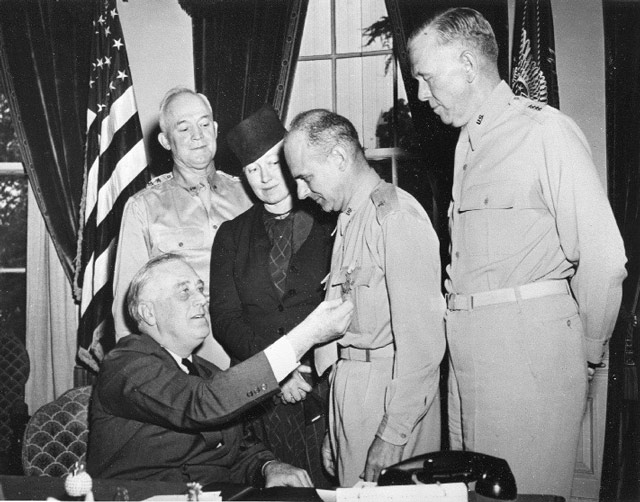
Roosevelts gives Doolittle Medal of Honor 19 May 1942 worldwartwo.filminspector.com
President Franklin D. Roosevelt presents the Medal of Honor to Brigadier General James Harold Doolittle in a ceremony at The White House, 19 May 1942. The President is seated at the left. Standing, left to right, are Lieutenant General Henry H. Arnold, Chief of the Army Air Forces; Mrs. Doolittle; Brigadier General Doolittle; and General George Catlett Marshall, Jr., Chief of Staff, United States Army. (Franklin D. Roosevelt Library and Museum, Photographic Collection, NPx. 65-696).
Battle of the Pacific: US Admirals "Bull" Halsey and Frank Fletcher are bringing their Task Forces 16 and 17 east toward Hawaii on 19 May 1942 in anticipation of a major Japanese attack. Nobody is completely sure where the attack will occur, but the consensus is that Midway Island will be the target. Light cruiser USS Nashville (CL-43) sails through the expected area of the attack from Midway to the western Aleutians today but does not see any enemy ships.

Japanese submarine I-21 launches a seaplane to reconnoiter Suva Bay, Fiji.

Battle of the Indian Ocean: The Japanese have sent a detachment of submarines, "Detachment A," to the Indian Ocean to scout for opportunities. Today, submarine I-30 launches a seaplane to reconnoiter Zanzibar and Dar-es-Salaam.
Crashed B-25B, 19 May 1942 worldwartwo.filminspector.com
A B-25B of the 39th Bomb Squadron forced to crashland at Westover Field, Massachusetts, on 19 May 1942 due to issues with the landing gear. Everyone survived. The pilot, Lt. John Henebry, ultimately becomes a major general and writes a book about his wartime experiences, "The Grim Reapers: At Work in the Pacific Theater" (2002).
Eastern Front: Commander of Army Group South Field Marshal Fedor von Bock presses his advantage against a disbelieving Red Army south of Kharkov. Having coordinated plans with First Panzer Army commander General Ewald on Kleist on the 18th, he orders Sixth Army commander General Friedrich Paulus to begin an attack from Merefa southwest of Kharkov. The objective is to occupy and distract the Soviet forces far to the west of where Kleist's panzers are attempting to surround them.

Kleist's III Panzer Corps, meanwhile, is brushing aside opposition as it continues eating into the Soviet supply corridor. The 14th Panzer Division crosses the Bereka River to take Petrovskoye while other divisions head west to block an expected Red Army breakout attempt. This narrows the mouth of the bulge to fifteen miles and deprives the Red Army forces to the west of a critical Donets river crossing.

Soviet Southwest Front, led by Marshal Semyon Timoshenko, finally begins to react to the growing Wehrmacht threat. After continuing to attack German VIII Corps south of Kharkov in the morning, it quickly breaks off the attacks and begins sending units to block Kleist's panzers to the southeast. The Luftwaffe controls the skies and sees and attacks the red Army columns on the roads. The German pilots, enjoying complete aerial dominance, claim to destroy 29 tanks during the day.

The Sixth Army war diary summarizes the situation at the end of the day: "The enemy's offensive strength has cracked. The breakthrough to Kharkov is therewith prevented."
Panzer 38(t) in Crimea, 19 May 1942 worldwartwo.filminspector.com
A German Panzer 38(t) leaves a landing craft on a beach near Yalta, May 1942 (Federal Archive B 145 Fig. F016214-0021A).
It is unclear where the Soviet orders to break off the attack in the morning came from. Post-war Soviet histories claim they came from Timoshenko on his own authority. If so, it is a dramatic turnaround by Timoshenko, who has been telling Stalin all along that the German counterattacks are not a threat. The Stavka finally reverses course at the end of the day and orders the advanced Sixth Army and Bobkin Group to terminate the offensive toward Kharkov and head southeast to confront Kleist's panzers.  
 
At his midnight conference, Hitler calls von Bock and tells him to hurry up and finish the encirclement. Kleist is to send 14th Panzer Division the final fifteen miles to reach Balakleya, where German troops of Paulus' Sixth Army await. Bock immediately calls Kleist's chief of staff and tells him to take the next town, Protopopovka, "under all circumstances and as soon as in any way possible." The fate of 600,000 Soviet soldiers to the west hangs in the balance. At Fuhrer Headquarters, General Franz Halder notes briefly in his diary that "The situation east of Kharkov is no longer dangerous."

In Crimea, General Manstein's 11th Army continues mopping up resistance in the Kerch region. Some histories record the 19th as the day of German victory in Crimea, and General Franz Halder records in his war diary that "The Kerch offensive can be regarded as closed." However, there remain Red Army holdouts (including at the port of Sevastopol), including thousands congregating in catacombs south of Kerch. In the air, Luftwaffe ace Gordon "Mac" Gollob continues a torrid victory streak, shooting down three more Soviet R-5 reconnaissance planes to raise his victory total to 99.
Japanese-American internees, 19 May 1942 worldwartwo.filminspector.com
Internees await relocation in Centerville, California. May 19, 1942. Dorothea Lange, photographer. Gelatin silver print. Collection of Oakland Museum of California. Gift of Paul S. Taylor.
European Air Operations: The weather clears sufficiently for both sides to resume their bombing operations. This is only a brief interruption of activity in what otherwise is a very quiet month along the Channel Front.

The Luftwaffe ends its lull by attacking Hull in another "Baedeker Raid." There are 50 deaths, 58 seriously injured, and extensive damage, especially in the Alexandria dock area. The bombing accuracy is quite good, especially relative to recent RAF attempts, with hits on the Blackburn aircraft factory at Brough (west of Hull). Extensive fires erupt along Scarborough Lane and Westbourne Avenue. The attack is notable for the use of an 1,800kg bomb and a 1,000kg bomb. Other areas hit include Hedon (east of Hull), Hornsea, and Withernsea. The Luftwaffe loses two Junkers Ju 88 bombers and a Dornier Do-217.

RAF Bomber Command mounts its first major raid in eleven days. The target is Mannheim. A total of 197 bombers (11 lost) embark, with 105 bomber crews claiming to hit the city. However, accuracy is very poor, and very few bombs actually hit the city. Local authorities estimate that bombs from only about ten bombers actually hit the city. However, the bombs that do hit cause an appreciable amount of damage to some small businesses in the harbor areas. There are only two deaths in the city.

In minor raids, 65 RAF bombers (one lost) attack St. Nazaire but cause little damage. Another 9 bombers lay mines off Lorient and near Heligoland, while 13 bombers drop leaflets over France.
Survivors of SS Heredia, 19 May 1942 worldwartwo.filminspector.com
The Downs family, survivors of the sinking of freighter SS Heredia on 19 May 1942 by U-506.
Battle of the Atlantic: U-506 (Kptlt. Erich Würdemann), on its second patrol out of Lorient, torpedoes and sinks 4732-ton US refrigerated freighter Heredia at 02:00 two nautical miles (3.7 km) southeast of the Ship Shoal Buoy off Louisiana. The ship sinks very quickly, giving no time to launch the boats. There are 36 deaths and 26 survivors, who are rescued by local shrimpers Conquest, J. Edwin Treakle, Papa Joe, and Shellwater, with three of the survivors picked up by a seaplane.

U-103 (Kptlt. Werner Winter), on its seventh patrol out of Lorient, torpedoes and sinks 5037-ton US freighter Ogontz 70 nautical miles (130 km) southeast of Cozumel, Mexico. There are 19 deaths and 22 survivors, who are rescued by US tanker Esso Dover.

U-751 (Kptlt. Gerhard Bigalk), on its sixth patrol out of St. Nazaire, torpedoes, shells, and sinks 3110-ton US freighter Isabela 35 nautical miles (65 km) south of Navassa Island Lighthouse. There are three deaths and 34 survivors, who make it to Cape Briton, Haiti, in lifeboats. This is the final victory for U-751.

An Italian submarine torpedoes and sinks Swedish 5747-ton steel cargo freighter Tisnaren somewhere in the Atlantic between Brazil and Senegal. Italian submarines Comandante Cappellini and Barbarigo are operating in this area but it is not definite which is the attacker.

At Hvalfjordur, Iceland, some merchant marine sailors aboard US freighter SS Ironclad notice that there is a shipment of liquor (it is en route to the US Ambassador to Moscow, Admiral William H. Standley, USN (Ret.)). They decide to help themselves and discipline breaks down, with fighting breaking out. At the behest of an armed guard officer on board, troops from the battleship USS Washington are sent over to restore order. Ironclad is removed from convoy PQ 16.
Tugboat Iriquois in Puget Sound, 19 May 1942 worldwartwo.filminspector.com
Tugboat Iriquois at sea, 19 May 1942 (Puget Sound Maritime Historical Society).
Battle of the Mediterranean: Royal Navy submarine HMS Thrasher torpedoes and sinks 1160-ton Italian freighter Penelope a few miles northwest of Monopoli, Italy.

Malta has been heavily reinforced with Spitfire fighters recently and the results are plain in the daytime sky. While Luftwaffe fighter sweeps over the island continue, the new defenders lead to a much-reduced bomber threat. In fact, they enable RAF bombers to go back on the offensive. Today, RAF bombers attack an Italian convoy northbound from Tripoli, though no ships are sunk.

Manhattan Project: Having just taken over the atom bomb research program, Robert Oppenheimer sends a letter to Ernest O. Lawrence updating him on progress. He writes that the atomic bomb design is solved "in principle" and projects that "six good physicists" should be able to work out the details within six months.

Joint Allied Command: The 30th and final in a series of Post-Arcadia meetings of the Combined Chiefs of Staff takes place in Washington, D.C. Among the topics discussed is an expected German advance toward the Persian Gulf from Syrian bases, the selection of targets for the nascent USAAF Eighth Air Force, and German development of a "new odorless gas, suitable for a surprise attack by inclusion in bombardments from the ground or from the air."
Crash site in Quebec, 19 May 1942 worldwartwo.filminspector.com
The crash site at No. 9 Bombing and Gunner School, Quebec.
Canadian Military: A Battle Mk. I crashes at No. 9 Bombing and Gunnery School, Mt.-Joli, Quebec, killing the four crewmen. This school is part of the British Commonwealth Air Training Plan, so the passengers include airmen from Canada, New Zealand, and Australia.

US Military: Brigadier General Ira C. Eaker, commander of Eighth Air Force, assumes command of all US air units in the United Kingdom.

Pursuant to a recent agreement between the United States and Panama, the 31st Fighter Squadron, 37th Fighter Group, 6th Air Force transfers its P-39 and P-40 fighters from Chorrera, Panama, to Albrook Field, Canal Zone.

Australian Military: A Tugan LJW7 Gannet aircraft flying from Batchelor Field (northern Australia) to Groote Eylandt makes a forced crash landing in a swamp in remote Arnhem Bay. The crew survives and scavengers the ruined airplane to make a raft. They survive an epic 33-day journey to the Milingimbi mission. Survivor George Booth later writes a book, "33 Days," describing how local natives helped the crew survive. This real-life story has echoes in the motion picture "Flight of the Phoenix" (1965) starring Jimmy Stewart.
General Jimmy Doolittle, 1942 worldwartwo.filminspector.com
Brigadier General James Harold Doolittle, U.S. Army Air Forces, 1942. (U.S. Air Force).
President Roosevelt presents the Medal of Honor to Lt. Colonel James Doolittle, who is also promoted to brigadier general, for the 18 April 1942 Doolittle raid. The citation reads:

For conspicuous leadership above and beyond the call of duty, involving personal valor and intrepidity at an extreme hazard to life. With the apparent certainty of being forced to land in enemy territory or to perish at sea, Lt. Col. Doolittle personally led a squadron of Army bombers, manned by volunteer crews, in a highly destructive raid on the Japanese mainland.

While, in fact, not a particularly damaging air raid as the citation reads, the Doolittle Raid was a major morale booster after the series of defeats at Singapore, Bataan, and elsewhere. It also influences Japanese strategy to its detriment, making it more defensive and paranoid.

American Homefront: The Western Defense Command issues Civilian Restrictive Order No. 1. This forces all Japanese-Americans in California, Oregon, Washington State, and southern Arizona to move into relocation camps. These camps are located in numerous states between eastern California and the Mississippi River. The total number of persons ultimately sent to camps is approximately 122,000.

Paul Waner of the Braves becomes the third National Leaguer to get 3000 hits (following Honus Wagner and Cap Anson).

Future History: Frederick "Curly" Neal is born in Greensboro, North Carolina. Curly Neal becomes a celebrity as the Harlem Globetrotters' featured ballhandler from 1963-1985. He also is featured in the animated Hanna-Barbera cartoon "Harlem Globetrotters." The Globetrotters retire Neal's No. 22 on 15 February 2008. Frederick Neal passes away in Houston on 26 March 2020.
Look magazine 19 May 1942 worldwartwo.filminspector.com
Look magazine of 19 May 1942 features a Marine Corps Sergeant Otto Nuske on the cover.

May 1942


2021

Wednesday, April 21, 2021

May 11, 1942: First Japanese Retreat at Deboyne

Monday 11 May 1942

Soviet soldier surrendering in Crimea, May 1942 worldwartwo.filminspector.com
A Soviet soldier surrendering in Crimea during Operation Trappenjagd, May 1942. In the background is a Panzer 38(t), turret number 711 (Federal Archive B 145 Fig. F016237-0025A).
Battle of the Pacific: The Japanese are forced to evacuate their Deboyne Islands seaplane base east of New Guinea on 11 May 1942 due to three consecutive days of Allied air attacks. The base was only recently established as part of Operation Mo in order to cover the invasion of Port Moresby. However, that invasion now is very unlikely due to the recent damage to the Japanese carrier forces. This withdrawal (the Japanese never return) cements the Allies' strategic victory in the Battle of the Coral Sea. Giving up on the invasion at this point is somewhat ironic because the path has become clear due to the withdrawal of Admiral Frank Jack Fletcher's Task Force 17 to the east. However, the Japanese don't know that and they choose not to risk an invasion without first knowing the US fleet can't intervene.

Australian Rear Admiral John Crace completes the withdrawal of Task Force 44 (three cruisers and three destroyers) from the Coral Sea, arriving at Cid Harbor, Australia. This leaves no large Allied naval units in the Coral Sea. Admiral Fletcher, refueling at Tongatabu, detaches cruisers USS Astoria, Minneapolis, and New Orleans under the command of Rear Admiral Thomas Kinkaid to join Admiral "Bull" Halsey's Task Force 16 (USS Enterprise) near Efate, Vanuatu (northeast of New Caledonia). The Japanese, unable to find TF 17 since it has left the area, cancel their pursuit today when Admiral Shigeyoshi Inoue issues orders for all forces to leave the area entirely.
Tanker Sabine approaching Enterprise, 11 May 1942 worldwartwo.filminspector.com
"The U.S. Navy fleet oiler USS Sabine (AO-25) approaches the aircraft carrier USS Enterprise (CV-6) for refueling on 11 May 1942. On deck are Douglas SBD-2/-3 Dauntless from Scouting Squadron 6 (VS-6) and Bombing Squadron 6 (VB-6). A Grumman F4F-4 Wildcat from Fighting Squadron 6 (VF-6) in the foreground bears the old red-centered star markings." U.S. Naval History and Heritage Command 80-G-14115.
Operation Ry commences when a Japanese invasion force leaves the fleet base at Rabaul under the command of Rear Admiral Shima Kiyohide. The force has no aircraft carriers (Shōkaku and Zuikaku have both been sent back to Japan for repairs and replenishment and Shōhō was sunk on 7 May). Vice Admiral Takeo Takagi, who commanded at the Battle of the Coral Sea, now commands the 5th Cruiser Division consisting of two heavy cruisers and four destroyers. Two transport ships, Kinryū Maru and Takahata Maru, carry troops from the 6th Special Naval Landing Force (SNLF) and Kashima SNLF.
Japanese-Canadian internees, 11 May 1942 worldwartwo.filminspector.com
Japanese-Canadian internees at the medical building at Hastings Park, Vancouver, 11 May 1942 (Vancouver Public Library 14911).
The Operation Ry invasion force leaves in the middle of the night and runs into trouble immediately. US Navy submarine S-42 (Commander Oliver G. Kirk) torpedoes the Japanese flagship, minelayer Okinoshima, west of Buka Island at 04:52. The convoy's escorts mount a depth charge attack, damaging S-42 and forcing it to withdraw to Moreton Bay, Brisbane. Shima transfers his flag to the destroyer Yūzuki and continues with the invasion. Okinoshima, taken under tow, capsizes at 06:40 in St. George's Channel.

During the afternoon, a US Navy PBY out of Nouméa spots the powerless and drifting tanker Neosho that the Japanese attacked on 7 May while patrolling over the Coral Sea. US destroyer Henley is dispatched to the tanker. Upon reaching the ship, Henley's crew finds and rescues 109 Neosho survivors and 14 survivors of destroyer Sims, which was accompanying Neosho and sank on the 7th. Henley then scuttles the tanker with gunfire.

The US submarine force gets another victory when S-44 torpedoes and sinks repair ship Shoei Maru, en route to assist Okinoshima, off Cape St. George, New Ireland. 

US Navy submarine USS Greenling torpedoes and sinks Japanese freighter Kinjosan Maru off Truk (Chuuk), South Pacific Mandate.

Japanese freighter Oridono hits a Japanese-laid mine near Surabaya, Java, and sinks.
A USAAF B-26 in the Aleutians, 11 May 1942 worldwartwo.filminspector.com
"U.S. Army Air Forces Martin B-26 Marauder Medium Bomber (USAAF Serial # 40-1447) On the airfield at Cold Bay, Alaska, with a Mark XIII aerial torpedo hung below its bomb bay, 11 May 1942" (Naval History and Heritage Command 80-G-246587).
Battle of the Indian Ocean: British troops in Burma continue their withdrawal to the frontier areas and India. The 2nd Burma Infantry Brigade marches northward toward the border town of Tamu, while the 1st Burma Infantry Brigade continues marching eastward toward Tamu via Yuwa and the Yu River. The 17th Indian Infantry Division also is heading for Tamu via the Kabaw Valley. In this way, the British are concentrating their forces along the Indian border, virtually conceding all of Burma to the Japanese. The Japanese, meanwhile, are happy to consolidate their possession of Burma and make no moves toward India at the present time.

The Chinese also are getting out of Burma. The 6th Division heads toward the Salwen River on the way to Kengtung (Kyaingtong).
Soviet soldier surrendering in Crimea, May 1942 worldwartwo.filminspector.com
A Soviet soldier surrendering during Operation Trappenjagd, May 1942 (Federal Archive B 145 Fig. F016237-0024A).
Eastern Front: At Fuhrer Headquarters in East Prussia, General Franz Halder finally shows a little enthusiasm for Operation Trappenjagd, the 11th Army offensive against Red Army forces in Crimea. He writes that there are "Heartening advances at Kerch; probably one-half of the enemy forces may be regarded as encircled. Otherwise, nothing new."

In Crimea, the Germans under General Erich von Manstein solidify their growing advantage over the Red Army in the Kerch peninsula. The 22nd Panzer Division reaches the coast of Azov in the north, effectively encircling the 51st Army along with the 50th Infantry Division and 28th Light Division. The 30th Corps, meanwhile, continues east toward Kerch with two divisions and the Grodeck Brigade. All of the Wehrmacht forces make further dramatic progress during the day, with the Germans practically eliminating the 51st Army pocket, 22nd Panzer turning east toward Kerch, and 132nd and 170th Infantry Divisions approaching the remaining Soviet line (the "Sultanovka" line).

General Fretter-Pico's scratch Grodeck Brigade that already has broken through the Sultanovka line, meanwhile, is low on ammunition. It forms a "cauldron" and fights off furious Red Army counterattacks with ammunition and supplies air-dropped to it. This is another benefit of the Luftwaffe's absolute dominance over the battlefield. While the Grodeck Brigade is no longer advancing, it poses a serious thorn in the Red Army's side and saps its response to the threats elsewhere.
Manstein and Richthofen in Crimea, May 1942 worldwartwo.filminspector.com
Colonel General Erich von Manstein and Luftwaffe Colonel General Wolfram von Richthofen confer on the Crimea Battlefield during Operation Trappenjagd, May 1942 (Federal Archive Image 183-B18917).
The Second Battle of Kharkiv, in a strategic sense far more significant than the sideshow in Crimea, is nearing as Red Army troops begin final preparations for an offensive on the southern portion of the Eastern Front. The Front Military Council issues its combat orders, and these are distributed to all unit commanders late in the evening at Komsomol and part meetings. Enthusiasm is high within the ranks as leadership characterizes this as a "decisive offensive."

German troops also are preparing for an offensive, Operation Fridericus, but they are not as close to attacking as are the Soviets. Soviet 21st Tank Corps and 23rd Tanks Corps get into position with the 21st, 28th, 38th, and 6th armies today on the Southwestern Front, while the Southern Front has the 24th Tank Corps and the 57th and 9th armies. The ground is still muddy from the spring thaw ("rasputitsa"), complicating preparations and giving the Wehrmacht a better chance of observing the troop movements.

European Air Operations: The Channel Front is quiet today, perhaps due to poor weather. There are no missions logged by either side.
HMT Bedfordshire, sunk on 11 May 1942 worldwartwo.filminspector.com
HMT Bedfordshire, sunk by U-558 on 11 May 1942.
Battle of the Atlantic: U-558 (Kptlt. Günther Krech), on its seventh patrol out of Brest, torpedoes and sinks armed naval trawler HMT Bedfordshire off the coast of Ocracoke Island in the Outer Banks, North Carolina. Bedfordshire is assisting the US Navy with anti-submarine patrols and is crewed by Canadian and British sailors. All 37 men on board perish. A 38th sailor, Sam Nutt, was in jail in Morehead City and missed the sailing, saving his life. Due to the absence of survivors, the ship's fate is somewhat of a mystery until U-558 is sunk in 1943 and Kapitänleutnant Krech and his ship's log are captured.

U-502 (Kptlt. Jürgen von Rosenstiel), on its fourth patrol out of Lorient, torpedoes and sinks 4963-ton British freighter Cape of Good Hope northeast of the Virgin Islands. When the ship does not sink quickly, the U-boat surfaces and shells it. All 37 crewmen survive.
HMS Kipling, sunk on 11 May 1942 worldwartwo.filminspector.com
HMS Kipling, one of three British destroyers sunk in the Mediterranean on 11 May 1942.
Battle of the Mediterranean: Lord Gort makes his first report as the commander of Malta. He writes that the dozens of newly arrived Spitfire fighters have enabled the RAF to gain "local air superiority." Due to this shift in the balance of power, Lord Gort lifts restrictions on the use of anti-aircraft ammunition. Recently departed commander General Dobbie, of course, would have loved to have had these kinds of forces under his control to produce better results, but those types of shifts often are timed to accompany changes in command in order to give the new commander prestige.

Just when the situation at Malta appears to be improving due to the arrival of a large Spitfire fighter force, disaster strikes for the British. The Admiralty gets a little over-confident and the men in the ships pay for it as three waves of German bombers wreak havoc.

While stalking an Italian convoy to North Africa, British destroyers Jackal, Jervis, Kipling, and Lively are sighted by Luftwaffe reconnaissance north of Mersa Matruh/Sidi Barrani, Egypt. During the afternoon, the destroyers decide to turn back, but it is too late. Eight Junkers Ju 88s of I/Lehrgeschwader 1 (I/LG 1) based at Heraklion on Crete attack at 16:31. They score three direct hits on Lively, sinking it. But this is just the beginning.
HMT Queen Mary worldwartwo.filminspector.com
On 11 May 1942, HMT Queen Mary (shown) leaves New York en route to the Clyde and becomes the first ship to carry over 10,000 (9880 are troops, 875 are crew). The trip takes 5 days, 3 hours, and 48 minutes, averaging 25.58 knots. This cruise is just a warmup, though, the ship can carry many more people than that. Queen Mary does not travel in convoy, relying on its speed and zigzag course to evade U-boats.
At around 18:15, the second round of bombers, nine Ju 88s and four Heinkel He 111s of II/LG 1 from Eleusis, Greece, arrives overhead. They cause no damage.

At 20:00, the third wave of bombers, ten Ju 88s from I/LG 1, arrives. This is the worst attack at all. The Germans quickly sink Kipling and score a direct hit on Jackal, along with three near misses that cause underwater damage. Jervis, the only intact destroyer, takes Jackal in tow, but its fires and flooding get out of control and ultimately it must be abandoned and scuttled. It is a great day of success for the Luftwaffe and one of the worst days of the campaign for the Royal Navy.

All told, 77 Royal Navy sailors perish in the three destroyers while 630 men are rescued. They eventually reach Alexandria.

The Luftwaffe bombs and sinks 154-ton Royal Navy tug C.308 at Malta. There are ten deaths.
Li'l Abner, 11 May 1942 worldwartwo.filminspector.com
Li'l Abner comic strip from 11 May 1942 (Al Capp).
Battle of the Black Sea: The Luftwaffe bombs and sinks 422-ton Soviet barge Anakriya off Kerch. The ship is evacuating wounded from Crimea (Stalin has not authorized any withdrawals for able-bodied soldiers).

The Luftwaffe also bombs and sinks the 840-ton Soviet gunboat Rion, which also is evacuating wounded soldiers from Kerch.
Time Magazine, 11 May 1942 worldwartwo.filminspector.com
The 11 May 1942 Time magazine features Soviet diplomat Maxim Litvinoff on the cover (cover credit: Boris Artzybasheff).
German Military: Hptm. Heinz "Pritzi" Baer (Bär) of IV./JG 51 on the Moscow front is transferred to become the Gruppenkommandeur of I./JG 77. JG 77 currently is fighting in Crimea in support of Manstein's offensive with great success. Bär is a free spirit and anti-authoritarian (much like the war's top tank ace, Kurt Knispel) who clashes with hardcore National Socialists in the Luftwaffe (of which there are many). This might ordinarily be considered a liability for a leadership position in the Wehrmacht, but Bär also is an outstanding fighter pilot. The German military tends to put these kinds of philosophical differences aside as long as a soldier is producing, and Bär produces. He quickly begins racking up victories in Crimea at a rapid pace (he ends the war as one of the top Luftwaffe aces).

Australian Navy: Destroyer HMAS Nepal is commissioned. It is destined to be used by Two Cities Films to represent fictional destroyer HMAS Torrin in the British war film "In Which We Serve," starring Noel Coward.
Queen Elizabeth inspects WRNS, 11 May 1942 worldwartwo.filminspector.com
Queen Elizabeth visits Didsworth Manor, Windsor, on 11 May 1942. "Her Majesty inspecting the WRNS during her visit." © IWM A 8477.
Holocaust: SS-Untersturmführer Dr. Rascher reports to Reichsführer-SS Heinrich  Himmler on the results of high-altitude medical experiments being conducted on prisoners at concentration camps. He writes in part:

The question of the formation of embolism was investigated in 10 cases. Some of the experimental subjects died during a continued high-altitude experiment; for instance, after one-half hour at the height of 12 Km.

Rascher also comments that "some experimental subjects were kept underwater until they died."

A Zionist Conference is held at the Biltmore Hotel in New York City. The participants adopt Declaration that states in part:

The Conference calls for the fulfillment of the original purpose of the Balfour Declaration and the Mandate which recognizing the historical connection of the Jewish people with Palestine' was to afford them the opportunity, as stated by President Wilson, to found there a Jewish Commonwealth.

The Declaration concludes that there cannot be "peace, justice and equality" until "the problem of Jewish homelessness is finally solved." The Declaration also "offers a message of hope and encouragement" to those in the "Ghettos and concentration camps of Hitler-dominated Europe."
Nuremberg Police Chief Martin at the SS Barracks, 11 May 1942 worldwartwo.filminspector.com
Inner courtyard of the SS barracks in Nuremberg, showing a visit by Gestapo Chief and Chief of Police Benno Martin during an exercise on 11 May 1942.
American Homefront: Eleanor Roosevelt publishes an article in the "New Republic" titled "Race, Religion and Prejudice." She writes:

We have had a definite policy toward the Chinese and Japanese who wished to enter our country for many years, and I doubt very much if after this war is over we can differentiate between the peoples of Europe, the Near East, and the Far East. Perhaps the simplest way of facing the problem in the future is to say that we are fighting for freedom, and one of the freedoms we must establish is freedom from discrimination among the peoples of the world, either because of race, or of color, or of religion.

She counsels patience to those wishing quick progress on race relations as "you must not expect miracles overnight."

Labor activist Susan Green writes "Of Special Interest to Women" in "Labor Action." She complains that there are too many exceptions to recently announced price controls and urges housewives to "organize themselves into neighborhood housewives' groups" in order to combat "war profiteers." Green is an avowed communist, and her issues with the system actually go much deeper than mere profiteering. She concludes her article by complaining about "the profit system that Mr. Roosevelt has pledged himself to preserve." 
Life magazine featuring Joan Caulfield, 11 May 1942 worldwartwo.filminspector.com
The 11 May 1942 Life magazine features Harry Conover Agency model and future starlet Joan Caulfield on the cover.

May 1942


2021