Showing posts with label Michel. Show all posts

Wednesday, April 13, 2022

June 12, 1942: First US Air Raid On Occupied Europe

Friday 12 June 1942

Free French attack in North Africa, 12 June 1942 worldwartwo.filminspector.com
Free French on the attack near Bir Hackeim, 12 June 1942 © IWM E 13313.

Eastern Front: On vacation in Berchtesgaden, Adolf Hitler is full of hope and secret dread for the coming "decisive" summer offensive in the Soviet Union. The whole point of the attack, he muses, is to "clear the table" and win the war. "If I do not get the oil of Maikop and Grozny, then I must end this war," Hitler admits to his cronies.

The current attacks are not going well, let alone ones in the future. The assault on entrenched Russian defenses at the Crimean port of Sevastopol continues on 12 June 1942 without much progress by either side. The Soviets receive reinforcements when cruiser Molotov and destroyer Bditel'nyy evade the Axis blockade and deliver 2,314 soldiers, 190 tons of ammunition, and 28 artillery pieces to the besieged garrison.

German ground attacks continue without much success. In the critical northeast sector, LIV Corps continues its relentless attacks and loses 1957 men in the fighting of 11-12 June, but the Soviet defenders also are in bad shape. 

The Germans, though, are determined. Super-heavy artillery piece "Dora" and eleven 420 mm mortars open fire on Fort Stalin, which guards the approaches to Severnaya Bay but have little impact. Finally, a dive-bombing attack by Junkers  Ju-87 Stukas of StG 77 knocks out three of the fort's main 76.2 mm guns, and General Erich von Manstein's 11th Army assembles an attack force to take the fort for early on the morning of 13 June.

Resistance to superior orders is fairly common within the Wehrmacht, but everyone in uniform knows that it must be done "the right way." An example occurs today in Crimea. Luftwaffe General Wolfram von Richtofen has forbidden all air attacks in the Black Sea for fear of hitting Axis naval vessels. The local German naval commander, Vizeadmiral Gotting, vehemently disagrees, but von Richtofen's order is final and he will not listen to any complaints.

Accordingly, Gotting meets today in private with von Richtofen's naval liaison, Koneradmiral von Eyssen - who gives von Richtofen all of his naval information. Together they secretly agree that the order prohibiting Luftwaffe operations at sea is counterproductive and they jointly limit the order to a very small restricted zone directly off Crimea - without, of course, telling von Richtofen. Von Eyssen then coordinates this with Luftwaffe Oberst Wolfgang von Wild, who commands Lufftwaffe forces (Fliegerfuhrer Sud) operating over the Black Sea. Von Wild also agrees that von Richtofen's order is nonsense, and all three men subvert von Richtofen's direct order. This is the "right" way to disobey orders in the Third Reich and is done by different commanders throughout the war.

At Fuhrer Headquarters in East Prussia (Hitler is on vacation on the Obersalzberg), General Franz Halder has a disturbing conference with Vice Admiral Fricke and his aide. It is disturbing because, as Halder records in his diary, "Those people are dreaming in terms of continents." He writes that they "assume without another thought" massive German land victories that will obtain ports on the Persian Gulf and on the East African coast. "The problems of the Atlantic," Halder notes with incredulity, "are treated with off-hand superiority and those of the Black Sea with criminal unconcern."  Halder, of course, has first-hand information on just how precarious the Axis position in the USSR really is.

Battle of the Pacific: Both sides are heading for home following the decisive American victory at Midway Island. Admiral Frank Fletcher, in command aboard USS Saratoga, is one day's sail from Pearl Harbor, while Admiral Nagumo is still two days' sail from Hashirajima. the Americans are eagerly publicizing their victory, while the Japanese are keeping their losses a guarded secret known only to the Emperor and a small number of high-ranking naval personnel.

USS Swordfish (Lt. Cdr. Chester C. Smith SS-193), operating northwest of Poulo Wai in the Gulf of Siam (later Gulf of Thailand), torpedoes and sinks Japanese freighter Burma Maru. The wreck is discovered in February 2017.

Japanese submarine I-21, operating off the east coast of Australia, torpedoes and sinks 5527-ton Panamanian coke freighter Guatemala while on the surface. The freighter is traveling in an eight-ship convoy from Newcastle to Whyalla, such convoys having been organized only recently due to the recent submarine assault on Sydney Harbor. HMAS Doomba picks up the crew, all of whom survive.

In China, the American Volunteer Group (Flying Tigers) has a big day. At dawn, the 1st Squadron shoots down four Ki-27 Nate bombers and five other twin-engine plans over Kweilin (Guilin, on the west bank of the Li River).

B-17s of the 5th Air Force bomb Lakunai Airfield and Vunakanau at the Japanese main overseas base of Rabaul.

NY Times 12 June 1942 worldwartwo.filminspector.com
NY Times, 12 June 1942.

Battle of the Indian Ocean: Japanese submarine I-10 shells and sinks 2052-ton Panamania freighter Hellenic Trader in the northwestern Mozambique Channel near Bahla de Cruz. Later in the day, I-10 torpedoes and sinks 5064-ton British freighter Cliftonhall.

Japanese submarine I-16 torpedoes and sinks 3748-ton Yugoslav freighter Supetar in the Mozambique Channel near Cabo de Sao Sebastiao.

Japanese submarine I-20 shells and sinks 5063-ton British freighter Clifton Hall in the Mozambique Channel off Angoche, Mozambique.

European Air Operations: A small force of a dozen U.S. Army Air Force B-24 Liberators flying from northeast Egypt bomb the Ploesti, Romania, oil fields after taking off at 22:30 on 11 June. The bombing is extremely inaccurate due to poor weather and no appreciable damage is caused. The bombers encounter flak and a few enemy fighters. Altogether, the planes drop 24 tons of bombs, with a thirteenth bomber attacking the port of Constanta. The bombers then proceed on to Habbaniyah, Iraq, making this an early example of shuttle bombing. Four bombers make it to Habbaniyah, while the others land at other fields in Iraq and Syria. Four of the bombers land in Turkey and their crews are interned. 

This is the first offensive mission by U.S. planes over Europe during World War II. General Dwight D. Eisenhower comments drily that the failed attack "did something to dispel the illusion that big planes could win the war." The bombers are from the Halverson Project 63, or HALPRO and have flown across the Atlantic for the mission. This small force forms the genesis of the 1st Provisional Bombardment Group (PBG) and the 376th Heavy Bombardment Group, completing another 450 missions.

The poor weather of spring 1942 continues and gets worse throughout the day on the Channel Front, but it is mild enough in the morning and early afternoon for some operations.

Group Captain Ken Gatward and navigator Flight Sargeant George Fern conduct The Beaufighter Raid on Paris, or Operation Squabble. This has been delayed for a month due to poor weather. This is a daring propaganda strafing run on a German parade down the Champs-Élysées that includes dropping Tricolor flags on prominent monuments (the Arc de Triomphe and the French Naval Ministry, currently being used as Kriegsmarine headquarters).

The two men take off from RAF Thorney Island in rain and clouds, but the weather clears sufficiently to carry out the mission. Flying at an extremely low altitude, the Beaufighter circles the Eiffel Tower at 12:27 and then heads for the Champs-Élysées. It turns out there is no German military parade (it hasn't begun yet), but the men drop the flags as intended. After strafing the Ministry building, the men return to RAF Northolt at 13:53. During the strafing run, the plane suffers a birdstrike, and the French crow is found in the starboard radiator. Gatward receives the DFC and Fern the DFM for their efforts.

RAF aircraft of Coastal Command engage in routine convoy patrols. They bomb and sink 1497-ton Swedish freighter Senta 30 nautical miles Cuxhaven, Germany (near the Weser River). There are no casualties.

RAF Beaufighter, 12 June 1942 worldwartwo.filminspector.com
Beaufighter Mk IC T4800 code ND-C of No. 236 Squadron RAF on the ground at Wattisham Suffolk 12 June 1942.

Battle of the Baltic: Swedish 1046-ton Bojan hits a mine and sinks off Saßnitz, Germany.

Battle of the Atlantic: German cruiser Michel, operating off the coast of Brazil, on 6 June had spotted the disabled 7176-ton U.S. freighter George Clymer and launched its MTB Esan. The MTB torpedoed the freighter and the crew abandoned ship. However, the ship remained afloat, and the crew re-embarked. British armed merchant cruiser HMS Alcantara has remained in the vicinity of the badly damaged ship since arriving on the scene on 8 June, but today departs, leaving the freighter still afloat. It is assumed that George Clymer eventually sinks.

U-158 (Kptlt. Erwin Rostin), on its second patrol out of Lorient, torpedoes and sinks US 8192-ton tanker Cities Service of Toledo 20 miles east of the Trinity Shoal Buoy in the Gulf of Mexico. There are 15 deaths.

U-124 (Kptlt. Johann Mohr), on its ninth patrol out of Lorient, torpedoes and sinks 4093-ton British freighter Dartford south of Cape Race. There are 17 survivors and 30 deaths.

U-129 (Kptlt. Hans-Ludwig Witt), on its fifth patrol out of Lorient, torpedoes and sinks 9005-ton refrigerated cargo freighter Hardwicke Grange 120 nautical miles (220 km) north of Puerto Rico. There are three deaths and 78 survivors. The survivors are in four lifeboats for two weeks, and each lifeboat lands in a different country: Cuba, the Dominican Republic, Jamaica, and Haiti.

German 125-ton minesweeper M-4212 (formerly Belgian trawler Marie-Frans) hits a mine and sinks south of Vieux-Boucau-les-Bains, France. The mine was laid previously by French submarine Rubis.

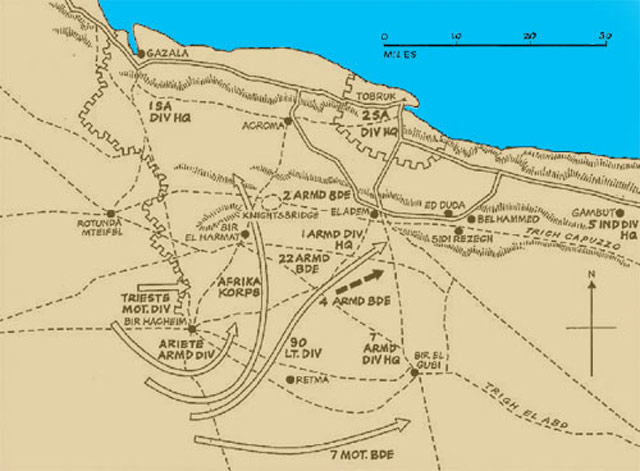
Map of North African campaign, 12 June 1942 worldwartwo.filminspector.com
Map of North African campaign, 12 June 1942.

Battle of the Mediterranean: The British in the El Adem "box" are under intense pressure by General Erwin Rommel's 15th Panzer Division and give ground as the Germans attempt to break out of  "the Cauldron." The 2nd and 4th Armoured Brigades retreat 6 km (3.7 miles) in disarray, leaving only the 29th Indian Infantry Brigade holding its ground. Rommel orders the 21st  Panzer Division to join the attack on the 13th. A breakthrough here would open a pathway to Tobruk.

The Allies are only in as good a situation as they are due to the previous stout Free French defense at Bir Hakeim. Now that the fortress has fallen, the Germans can bring much greater pressure to bear on the British. Today, General Auchinleck praises the French, saying, "The United Nations need to be filled with admiration and gratitude in respect of these French troops and their brave General Kœnig."

While the intense Luftwaffe air campaign against Malta has eased in recent weeks, it remains in a precarious position due to supply shortages. Today, the Royal Navy begins Operations Harpoon and Vigorous, typical convoy missions to the embattled island. Harpoon sets out from Haifa, Palestine, while Vigorous begins at Gibraltar.

Convoy MW4 leaves Gibraltar heading east with six merchantmen (the British Troilus, Burdwan and Orari, the Dutch Tanimbar, the American Chant, and the tanker Kentucky) carrying 43,000 short tons (39,000 t) of cargo and oil. It is protected by Force X, which includes distant cover by battleship HMS Malaya and aircraft carriers Argus and Eagle.

The westward operation is a little more complicated. Convoy MW-11a embarks from Haifa with five merchantmen (British Ajax, City of Edinburgh, City of Pretoria, City of Lincoln, and Elizabeth Bakke) heading west. It is escorted by the 7th destroyer flotilla. This convoy has trouble immediately when Elizabeth Bakke is ordered back to port because it cannot maintain station due to overloading and its poor condition. Convoy MW11b departs from Alexandria, Egypt, with a tanker (Bulkoil), a merchantman (Potaro), and a decommissioned battleship (Centurion) being used as a freighter. It is escorted by five destroyers, four corvettes, and two rescue ships (Antwerp and Malines). There also is a third convoy from this direction that departs from Port Said, MW-11C, composed of freighters Aagtekirk, Bhutan, City of Calcutta, and Rembrandt.

The objective is to confuse and disperse the Axis defenses with all of these simultaneous convoys. In theory, this should enable maximum resupply of the island despite inevitable losses.

Unknown to the British, the Axis knows all about these operations already due to a major security breach by the US Military Attaché in Egypt, Colonel Bonner Fellers. Italian military intelligence (Servizio Informazioni Militare) has broken the American code and thus has deciphered Fellers' detailed reports to Washington. While not strictly Fellers' fault, better precautions could have avoided this. In any event, this incident proves that codebreaking during World War II was not just a one-way street that benefited only the Allies.

With the Axis ready and waiting, the attacks begin almost immediately. In the evening, 15 Junkers Ju 88 bombers of I Kampfgeschwader 54 based in Crete attack MW-11c. They score a near-miss on City of Calcutta, which slows it and forces the freighter to divert to Tobruk along with its towed MBT, escorted by two escorts. During the night, MW-11c slows to arrange a rendezvous with the other two convoys off Mersa Matruh.

Separately, U-77 (Kptlt. Heinrich Schonder), on its sixth patrol out of La Spezia, torpedoes and sinks the Royal Navy destroyer HMS Grove (L77) off Sollum, Egypt. The ship sinks in 14 minutes with 110 deaths and 79 survivors. Escort destroyer HMS Tetcott picks up the survivors.

SS Hardwicke Grange, sunk on 12 June 1942 worldwartwo.filminspector.com
British refrigerated freighter Hardwicke Grange, sunk by U-129 on 12 June 1942.

Spy Stuff: U-202 (Kptlt. Hans-Heinz Linder), on its sixth patrol out of Brest, arrives off the south coast of Long Island, New York, in early-morning darkness and disembarks four German spies/saboteurs. The four men land at Amagansett. This is Operation Pastorius, one of a series of such operations planned to disrupt the economy of the United States. They are wearing German Navy uniforms to avoid being shot as spies if captured during the landing. However, upon landing and finding themselves alone on the beach, they quickly change into civilian clothes and bury their uniforms and other equipment.

A problem quickly develops when Coast Guardsman John C. Cullen spots the men posing as fishermen on a raft. Cullen also notices the submarine and sees that the men are armed. He approaches them, and the spies give Cullen $200 to keep quiet. Cullen takes the money but alerts his superiors later in the day, by which time the four spies have taken the LIRR into Manhattan.

Anne Frank's diary, begun on 12 June 1942 worldwartwo.filminspector.com
The first page of Anne Frank's diary, written on 12 June 1942.

Holocaust: In Amsterdam, Anne Frank is gifted a red-and-white plaid diary on her thirteenth birthday. The Franks, German Jewish refugees, have not yet gone into hiding. Her first entry begins, "On Friday, June 12th, I woke up at six o’clock and no wonder; it was my birthday." Later in the entry, she says, "I hope I will be able to confide everything to you, as I have never been able to confide in anyone, and I hope you will be a great source of comfort and support."

US Military: The US Army activates the 100th Infantry Battalion, composed of Japanese-Americans from Hawaii.

German Military: Oblt. Egon Albrecht becomes Staffelkapitaen of 1./ZG 1.

George Bush joins the US Navy, 12 June 1942 worldwartwo.filminspector.com
George Bush during World War II.

Russian Homefront: Russian revolutionary Anna Yakimova dies in Novosibirisk, aged 86. She was a prime early agitator against the Tsar around the turn of the 20th Century.

American Homefront: In the evening, a tornado hits the southwest section of Oklahoma City near Will Rogers Airfield. Local sources (the Ada Evening News) report 21 dead, 25 critically injured, and 250 made homeless.

Future President George Herbert Walker Bush graduates from high school and immediately enlists in the U.S. Navy despite already having been admitted to Yale University.

Future History: Bert Sakmann is born in Stuttgart, German Reich. He grows up to become a noted cell physiologist who wins the Nobel Prize in Physiology or Medicine with Erwin Neher in 1991. As of this writing, Sakmann leads an emeritus research group at the Max Planck Institute of Neurobiology in Heidelberg, Germany.

Memorial to the 100th Infantry Brigade, activate on 12 June 1942 worldwartwo.filminspector.com
Brothers in Valor Monument in Honolulu, Hawaii, commemorating the 100th Infantry Battalion and other Japanese-American units in World War II (Photo: Sarah Sundin).


2022

Friday, December 24, 2021

June 11, 1942: U.S-Soviet Lend-Lease Agreement

Thursday 11 June 1942

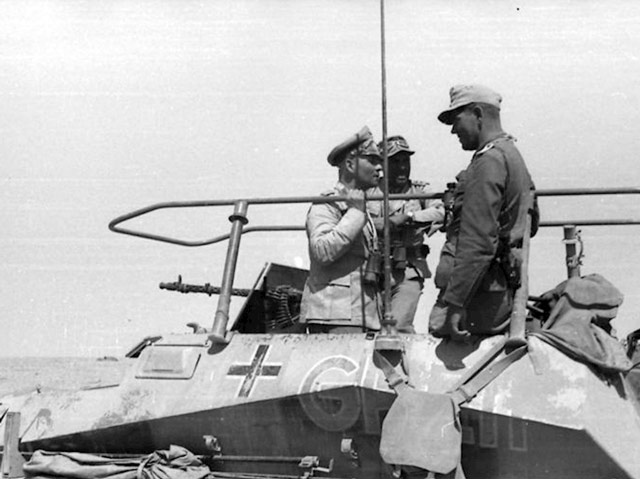
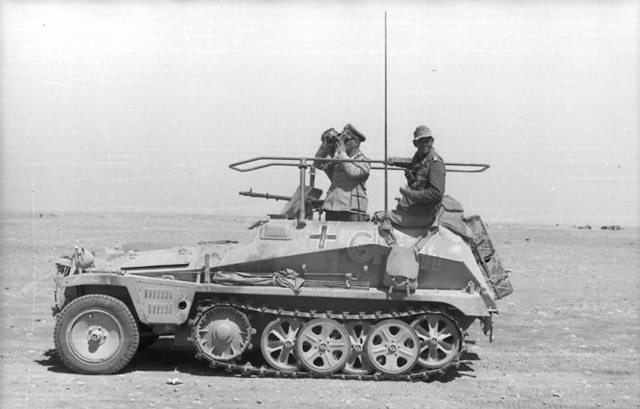
Rommel in North Africa worldwartwo.filminspector.com
German General Erwin Rommel in his command vehicle in North Africa, 11 June 1942 (Zwilling, Ernst A., Federal Archive Image 101I-443-1589-08).

Eastern Front: General Erich von Manstein's 11th Army continues battering away at Red Army defenses outside Sevastopol, Crimea, on 11 June 1942. His troops of the LIV Corps are having the most success north of the port, where the heaviest German artillery is located. The Soviet 345th Division counterattacks on the borderline between the Wehrmacht 132nd and 50th Divisions, but quick Luftwaffe intervention (1070 sorties while dropping 1000 tons of bombs today) prevents a rupture. The Red Army and LIV Corps, however, continue taking heavy casualties.

While progress is still being made at Sevastopol, the local commanders are getting concerned at the high cost of the small local gains. Luftwaffe General Wolfram von Richthofen, in command at Fliegerkorps VIII, comments sourly in his war diary that his forces have "only enough left for 1.5 more days of bombing." His mood is black, and he adds that "the specter of failure now seriously looms." On the spur of the moment, Richthofen decides that his bombers are dispersing their efforts too widely. He thus changes bombing procedures to conserve resources. The new tactic of "column bombing" involves bomber attacks on only specifically designated targets while the aircraft fly one after another in narrow air corridors.

The Red Air Force also is proving to be a nuisance, though not to the Luftwaffe. Instead, the Soviets are making nightly raids on German positions in the "rear" to the east at places like Simferopol, Theodosiya, Eupatoria, and Yalta. The Luftwaffe can see the attacks coming on their radar but do not have any night fighters to intercept them. Fortunately for the Germans, the Red Air Force bombing runs are very inaccurate, so the raids for the most part are ineffective.

Off the Crimean coast, a mini-war at sea also is brewing. The Soviets are running fast convoys to Sevastopol every night, and early in the morning, the Kriegsmarine decides to do something about it. For the first time, Axis small craft (MTBs and motorboats) manned by Italians attack a Soviet convoy near Cape Khersones. It is believed, but not absolutely certain, that they sink a Soviet ship.  

Back at Fuhrer Headquarters in East Prussia, General Halder also is getting impatient with Manstein's progress. He notes that the Soviet artillery at Sevastapol "is quite troublesome." However, further north, "The Voshansk attack is making very satisfactory progress." Meanwhile, the situation at Ninth Army is "unclear," with the Soviets "unaccountably" abandoning territory. This new Red Army tactic of not fighting for every inch of ground but instead trading space for time and tactical regrouping will befuddle and mislead the German High Command throughout the summer.

Battle of the Black Sea: Soviet submarine A-5 torpedoes and sinks 5695-ton Romanian freighter Ardeal off Odessa. Ardeal's captain beaches the ship to avoid sinking but is later repaired and returned to service.

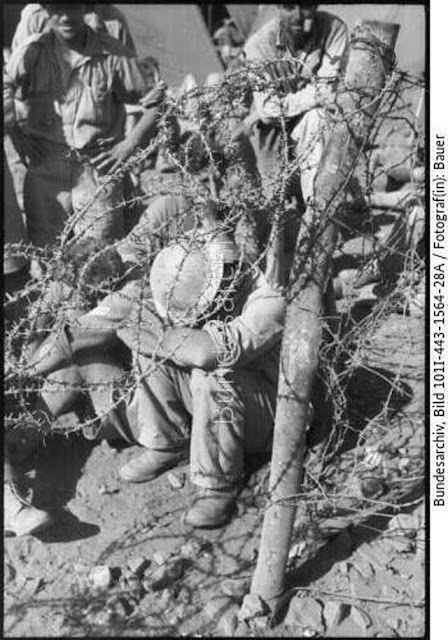
British POWs in North Africa worldwartwo.filminspector.com
British POWs in North Africa, 11 June 1942 (Farmer, Federal Archive Image 101I-443-1564-28A).

Battle of the Pacific: USS Saratoga rendezvouses with fellow carriers Enterprise and Hornet. It transfers 19 SBD Dauntless, five TBD Devastator of VT-5, and 10 VT-8 Avenger planes to the two other carriers to replace their losses at the Battle of Midway. The ships then turn head to Pearl Harbor in foul weather.

Reinforcements for the Pacific Fleet are on the way. USS Wasp and battleship North Carolina, along with escorting destroyers, pass through the Panama Canal. Battleships just barely fit through the channel with mere feet (sometimes only inches) to spare on each side. The Japanese know the importance of the Canal and have plans to block it throughout the war.

The U.S. 11th Air Force make their first attack on the Japanese on Kiska Island in the Aleutian chain. The attack is made by five B-24 and five B-17 bombers flying from Cold Bay and loading their bomb racks at Umnak Island. PBY Catalinas also participate in the attack. on Kiska Harbor. The attack only scores some near misses on the Japanese ships while losing a B-24 (Captain Jack F. Todd) to anti-aircraft fire. This begins a 48-hour period during which the Catalinas make repeated attacks without much success.

British POWs in North Africa worldwartwo.filminspector.com
British and South African POWs in North Africa, 11 June 1942 (Zwilling, Ernst A., Image 101I-443-1589-34A).

Battle of the Indian Ocean: German raider Michel (HSK-9) uses its guns to sink 5186-ton British freighter Lylepark southeast of Cocos Islands (northwest of Perth, Australia). Michel is on her way from Japan for a hunting raid off the coast of South America.

Japanese submarine I-20 torpedoes and sinks 7926-ton British freighter Mahronda in the Mozambique Channel. There are two deaths and 40 survivors. The survivors are rescued by the Royal Indian Navy ship HMIS Orissa. This is an unusual situation where a German ship sinks a ship further west than a Japanese submarine in the Indian Ocean on the same day.

Australian corvette HMAS Wallaroo (J 222) sinks after colliding with a ship it is escorting, U.S. Liberty Ship Henry Gilbert Costin. The sinking ironically occurs because the ships are sailing without navigation lights in overcast weather to avoid detection by the enemy. Wallaroo sinks while trying to return to Fremantle, while the other ship makes it back. There are three deaths.

European Air Operations: The foul weather that has characterized the spring of 1942 continues today. It is 10/10ths clouds during the morning, but visibility clears a bit by noon. RAF fighters attack Koksijde and the Furnes Canal, sinking and damaging barges. The attacks are broken off after encountering heavy anti-aircraft fire at Nieuport. These attacks in low visibility are quite hazardous, and several planes narrowly avoid collisions or hitting ground obstructions.

Battle of the Baltic: German support ship MRS-11 Osnabruck hits a mine and sinks off Tallinn, Estonia. There are 84 deaths. The ship is later salvaged.

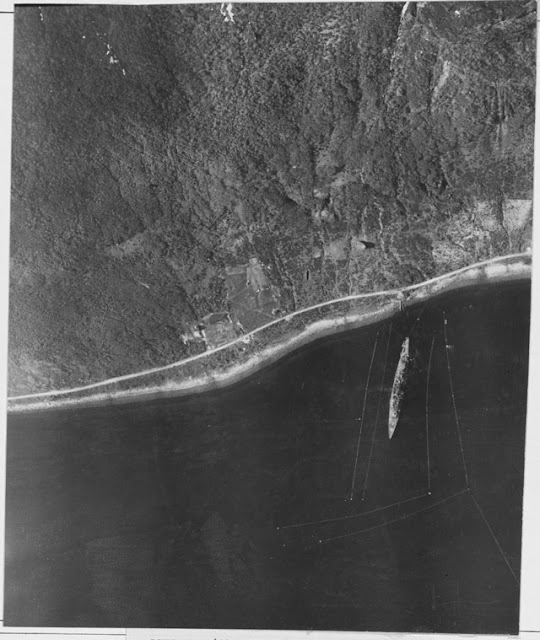
German cruiser Lutzow spotted by Allied air reconnaissance 11 June 1942 worldwartwo.filminspector.com
German heavy cruiser Lutzow photographed by Allied air reconnaissance, 11 June 1942 (Naval History and Heritage Command NH 110843).

Battle of the Atlantic: Italian submarine Leonardo da Vinci uses torpedoes and gunfire to sink 5483-ton Dutch freighter Alioth in the Atlantic Ocean near Freetown, Sierra Leone. Everyone survives.

U-504 (Kptlt. Hans-Georg Friedrich Poske), on its third patrol out of Lorient, torpedoes and sinks 4282-ton Dutch freighter Crijnssen 85 miles southwest of the Cayman Islands. There are one death and 93 survivors, who abandon the ship in four lifeboats and a gig. The sinking is especially traumatic for some on board because there are a dozen survivors of Sylvan Arrow (sunk by U-155 on 20 May 1942) and one from U.S. tanker T.C. McCobb (sunk by Italian submarine Pietro Calvi on 31 March 1942). The survivors in one lifeboat and the gig from Crijnssen are picked up by the U.S. freighter Lebore, which itself is sunk by U-172 a few days later. The other lifeboats make landfall in Mexico aside from four crewmembers on a raft who are picked up by the Panamanian tanker J.A. Mowinckel.

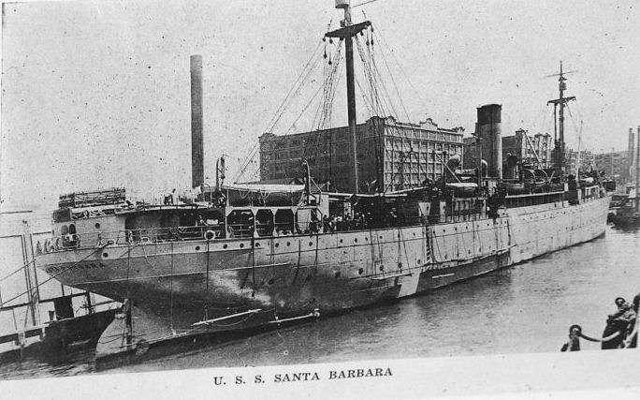
Freighter American sunk on 11 June 1942 worldwartwo.filminspector.com
SS American, originally the Santa Barbara, was sunk by U-504 on 11 June 1942. 

Much later in the day, U-504 also torpedoes and sinks 4846-ton U.S. freighter American off Honduras. The ship is hit by two torpedoes and sinks within 25 minutes. There are four deaths and 34 survivors, who are picked up by British freighter Kent. One survivor perishes after being picked up.

U-159 (Kptlt. Helmut Friedrich Witte), on its second patrol out of Lorient, torpedoes and sinks 7130-ton British freighter Fort Good Hope northwest of Colon, Panama. Two torpedoes hit and sink the freighter (carrying wheat, timber, lead, and zinc) within half an hour. There are two deaths and 45 survivors, who are picked up by U.S. gunboat USS Erie (PG 50).

U-455 (Kptlt. Hans-Heinrich Giessler), on its third patrol out of St. Nazaire, torpedoes and sinks 6914-ton British tanker Geo H. Jones northeast of the Azores. The tanker is a straggler from Convoy SL-111 heading from Aruba to Freetown. There are two dead and 40 survivors, who are picked up by HMIS Orissa (J 200).

U-157 (KrvKpt. Wolf Henne), on its second patrol out of Lorient, torpedoes and sinks 6401-ton U.S. tanker Hagan five miles off the north coast of Cuba. Hagan is simply steaming a straight course independently and thus is an ideal target. Two torpedoes hit the engine room and fuel bunkers, sinking the ship, which is carrying 2,676 barrels of blackstrap molasses, fairly quickly. There are six dead and 38 survivors, who make landfall in Cuba in two lifeboats. This is the only victory for U-157 in its career, which ends a couple of days later when it is sunk.

U-94 (Oblt. Otto Ites), on its ninth patrol out of St. Nazaire, torpedoes and sinks 4458pton British freighter Pontypridd northeast of St. John's, Newfoundland. Pontypridd is a straggler from Convoy ONS-100. There are two dead and 46 survivors, who are picked up by HMCS Chambly (K 116).

U-158 (Kptlt. Erwin Rostin), on its second patrol out of Lorient, torpedoes and sinks 13,467-ton Panamanian tanker/transport Sheherazade 20 miles west of Ship Shoal Buoy, Louisiana. Sheherazade is a French ship turned over to the U.S. War Shipping Administration (WSA). There are one dead and 58 survivors, who are rescued by shrimp boat Midshipman and fishing vessel 40 Fathoms. The rescue happens quickly enough that nine men are found swimming after having jumped overboard.

Norwegian 6049-ton freighter Haugarland hits a mine and sinks off Terschelling, Netherlands. It appears that everyone survives.

U.S. 9310-ton tanker F.W. Abrams hits a U.S.  defensive mine and sinks east of Morehead City, North Carolina (near Cape Hatteras). The 36 men on board make it to shore near Morehead City. A tug ("Relief") attempts salvage of the floating wreck without success.

U-87 mines the waters off Boston, Massachusetts, while U-373 mines the area near Delaware Bay.

Rommel in North Africa worldwartwo.filminspector.com
General Rommel in his Sd.Kfz. 250 command truck, 11 June 1942 (Zwilling, Ernst A., Federal Archive Image 101I-443-1589-09).

Battle of the Mediterranean: German General Erwin Rommel's Afrika Korps occupies the fortress of Bir Hakeim, which has been a roadblock in his advance toward Tobruk. The Free French defenders have almost all escaped to British lines to the south save for a small rear guard left to delay the attackers. The French and British pull back from their advanced position outside the fortress to Gasr-el-Arid early in the morning, completing the breakout by 2700 men and women (there are some female nurses).

After finally clearing this obstacle, about which he later comments "seldom in Africa was I given such a hard-fought struggle," Rommel quickly resumes his offensive, sending the 15th Panzer and 90th Light Divisions toward El Adem. The British 201st Guard Brigade in the Knightbridge Box, which blocks the way to Tobruk to the east, comes under severe pressure. While the Allied defense of Bir Hakeim has seriously disrupted Rommel's overly ambitious timetable, his advance now regains momentum.

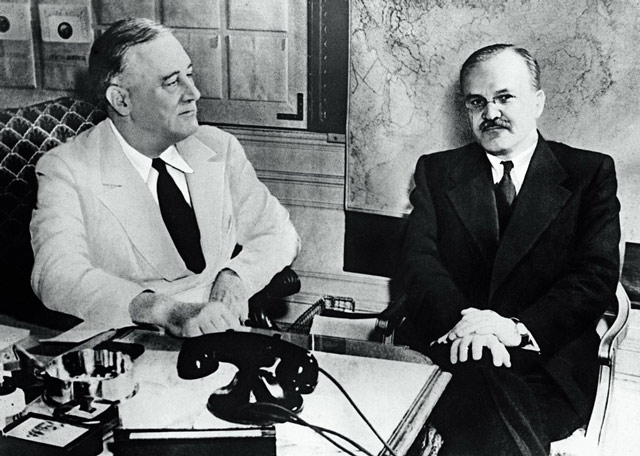
Molotov and FDR in Washington on 11 June 1942 worldwartwo.filminspector.com
Soviet Foreign Minister Vyacheslav Molotov and U.S. President Franklin D. Roosevelt meet in Washington, D.C., to finalize the lend-lease agreement, 11 June 1942 (Alliance.rusarchives.ru).

US/Soviet Relations: The United States and Soviet Union sign a lend-lease agreement. The agreement contemplates "mutually advantageous economic relations" between the two powers, with the agreement to continue in force "until a date to be agreed upon by the two governments." U.S. Secretary of State Cordell Hull and Soviet Ambassador Maxim Litvinov sign for their respective governments.

Article 1 sets out the main purpose of the agreement:
The Government of the United States of America will continue to supply the Government of the Union of Soviet Socialist Republics with such defense articles, defense services, and defense information as the President of the United States of America shall authorize to be transferred or provided.
This agreement, however, is not specific on certain key points. These become a lingering bone of contention during the post-war era. Significantly, the title to the equipment supplied by the U.S. is not transferred to the Soviet Union. The U.S. believes it still "owns" the items and retains rights to them, while the USSR believes it now owns them because they were freely given.

Technically, under the U.S. interpretation of the agreement, the Soviet Union is obligated to return any intact equipment or compensate the United States for it after the war. The USSR, perhaps understandably, has a vastly different interpretation. This leads to awkward exchanges between the two governments in the late 1940s in which the United States demands either the return of the intact equipment or payment for them, including limitations on the equipment's transfer to other countries. Ultimately, the United States simply demands payment for the "civilian-type articles remaining in existence."

Of course, the United States already has abandoned military equipment of its own at bases around the world because it is obsolete and considered too expensive to return to the homeland. Thus, there seem to be deeper reasons underlying the disagreement. It is entertaining to ponder the reactions of the Soviets when they receive these petty and abrasive demands for payment for goods they always assumed were given for free to win the war at the cost of Soviet blood. These pointless and unproductive "negotiations" help to poison the relations between the two nations and contribute to the growth of the Cold War, a hostile relationship that more or less continues to the present day.

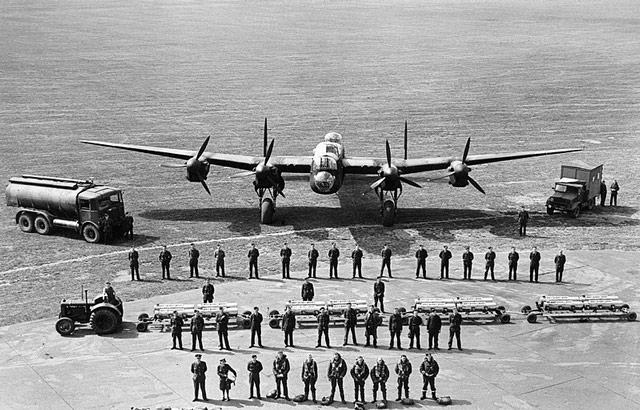
An Avro Lancaster and its crew on 11 June 1942 worldwartwo.filminspector.com
An Avro Lancaster and the personnel and equipment needed to keep it flying. This photograph was taken at Scampton, Lincolnshire, on 11 June 1942.  © IWM CH 15362.

German Military: Adolf Hitler issues Führer Directive 32. It sets out operations to be undertaken after the defeat of the Soviet Union, including the capture of Gibraltar with or without Spain's cooperation and resumption of the "siege of England." It is a curious mixture of far-sighted planning and mundane objectives such as the capture of Tobruk. It presupposes the quick defeat of the USSR in the coming Case Blue summer offensive and, like many of Hitler's grand strategies, assumes launch conditions that do not yet exist.

U.S. Military: With the threat to the U.S. west coast vastly reduced due to the Japanese defeat at Midway, the 97th Bombardment Group deployed for emergency purposes on the coast is transferred back to New England for eventual movement to join the Eighth Air Force in Great Britain.

Holocaust: Adolf Eichmann holds a meeting for his underlings controlling Jewish Affairs in France, Belgium, and Holland. This meeting sparks a systemic deportation scheme for Jewish residents of those areas to the extermination camps in the East that affects tens of thousands of people.

German Homefront: Michael Kitzelmann, 26, is executed at Orel Prison after being court-martialed and convicted of crimes against the state. Kitzelmann, a Wehrmacht lieutenant, was denounced by a sergeant for saying things that "undermined the military." He was in a hospital being treated for wounds when the allegations against him were made, but apparently, he made them previously while serving on the Eastern Front. The statements apparently concerned certain atrocities that Kitzelmann witnessed against the Russian population. While Kitzelmann became outspoken, he also had earned the Iron Cross Second Class and the Wound Badge in Gold.

TheGerman Bundestag rehabilitated Kitzelmann on 8 September 2009. A plaque in his memory is at the Johann-Michael-Sailer-school in Dillingen an der Donau.

American Homefront: The New England Journal of Medicine reports a case of "internal anthrax," which is considered quite novel because the vast majority of cases are of the cutaneous type. The patient died after showing progressively worse symptoms and a full autopsy was performed. Penicillin, still in its experimental phase, will become the accepted treatment for anthrax in 1944. 

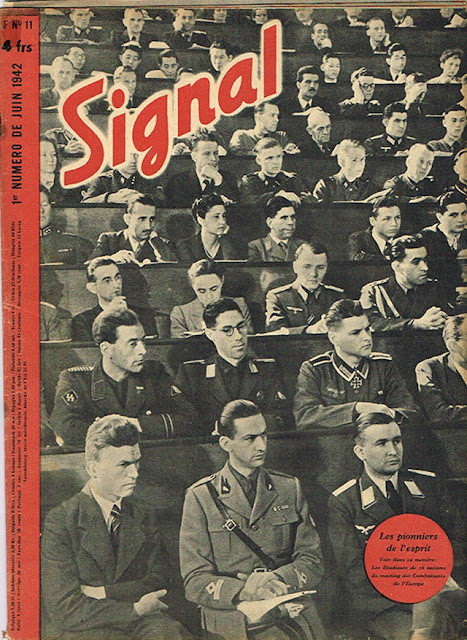
German Signal magazine from June 1942 worldwartwo.filminspector.com
Signal magazine, June 1942.

2021

Monday, October 18, 2021

June 6, 1942: Japanese Invade Aleutian Islands

Saturday 6 June 1942

Battle of Midway 6 June 1942 worldwartwo.filminspector.com
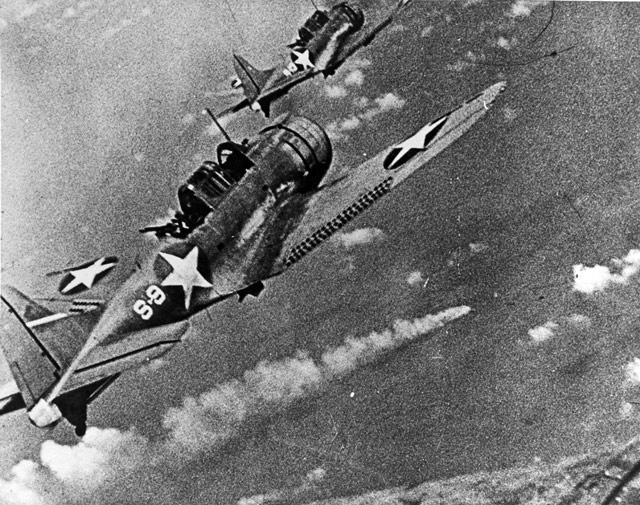
"SBD Dauntless dive bombers from USS Hornet (CV-8) approaching the burning Japanese heavy cruiser Mikuma to make the third set of attacks on her, during the early afternoon of 6 June 1942. Mikuma had been hit earlier by strikes from Hornet and USS Enterprise (CV-6), leaving her dead in the water and fatally damaged." Naval History and Heritage Command 80-G-17054.

Battle of the Pacific: Despite having suffered staggering losses off Midway Island on 4 June, the Japanese follow through on their subsidiary campaign in the Aleutian Islands on 6 June 1942. The Japanese Northern Area Fleet, commanded by Vice-Admiral Boshiro Hosogaya, lands 500 troops of the elite Maizura 3rd Special Landing Force and 700 laborers on Kiska Island at 10:27. 

This is the first invasion of the continental United States since the War of 1812, though Alaska is not yet a state. The local Unangax (Aleuts) offer virtually no resistance and no U.S. military forces intervene at this time despite some fruitless bombers searching for the Japanese. There are U.S. soldiers of the U.S. Navy meteorological service on Kiska, but they disappear into the rugged interior. The Japanese rename the island Narukami.

Eight P-38s do spot and attack a ship, but it turns out to be a Soviet freighter. The Americans, though, are quite concerned about both a Japanese land invasion south toward Washington State through Canada and Japanese bombing raids from the Aleutians (neither of which the Japanese plan) and begin preparing a response.

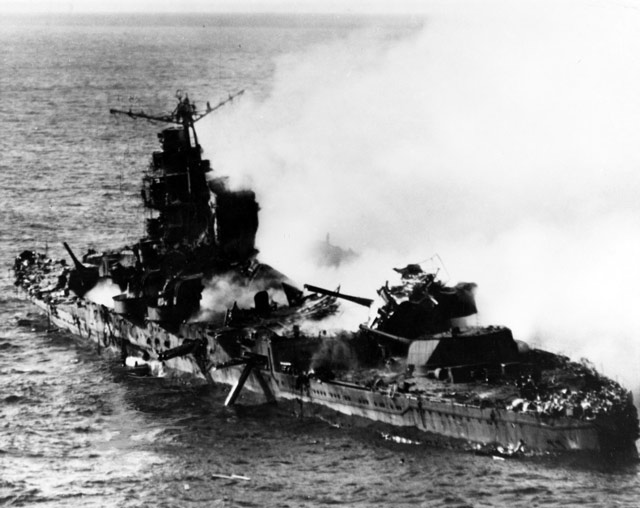
Off Midway Island, things just keep getting worse for the Japanese. Having lost four irreplaceable aircraft carriers to the U.S. Navy's one, they now lose another important ship. Douglas SBD Dauntless dive bombers attack and sink cruiser Mikuma, already damaged in previous days' raids. Mikuma and fellow cruiser Mogami are heading for refuge at Wake Island when 31 SBDs from USS Enterprise and Hornet attack and hit Mikuma with five bombs and Mogami with six.
Japanese cruiser Mikuma under attack, 6 June 1942 worldwartwo.filminspector.com
"Japanese heavy cruiser Mikuma, photographed from a USS Enterprise (CV-6) SBD aircraft during the afternoon of 6 June 1942, after she had been bombed by planes from Enterprise and USS Hornet (CV-8). Note her shattered midships structure, torpedo dangling from the after port side tubes and wreckage atop her number four eight-inch gun turret." Naval History and Heritage Command 80-G-414422.

While the Mikuma may theoretically have survived that many bomb hits, one of them sets off the torpedoes it is carrying and they destroy the ship. There are 650 deaths and 240 survivors, who are picked up by destroyers Asashio and Arashio (both also hit by one bomb each. U.S. Navy submarine Trout investigates the scene on 9 June and picks up an additional two Japanese crewmen and makes them POWs.

An example of the "fog of war" almost causes a tragedy for the U.S. forces. A late-morning B-17 raid by 26 bombers based on Midway (led by Lt. Col. Brooke Allen) against the fleeing Japanese cruisers fails to find them. However, they do spot a target and six B-17s drop their loads on it thinking it is one of the cruisers. In fact, it is U.S. submarine Grayling. Fortunately for the Americans, level-bombing accuracy at sea lives down to its terrible reputation, no harm is done, and Grayling quickly dives before any bombs come close. 

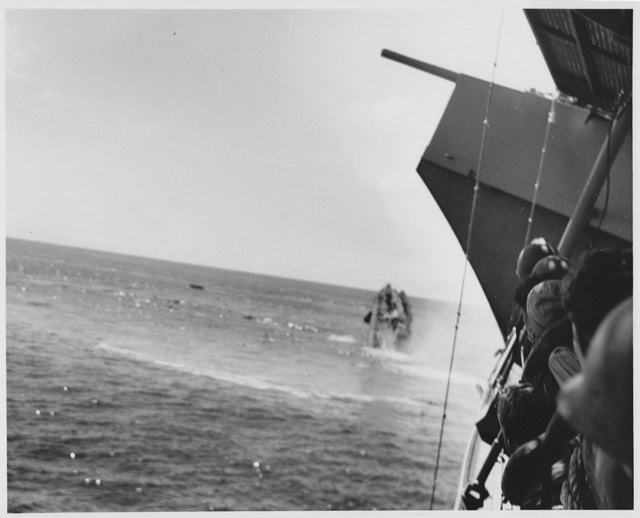
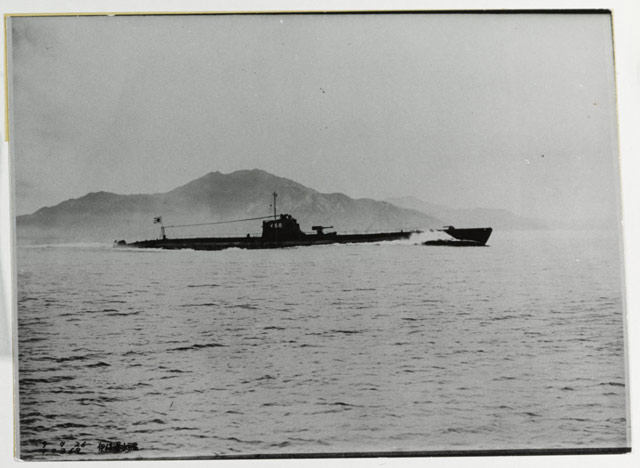
The Japanese do "get one back" when submarine I-168, which previously shelled Midway Island, spots crippled USS Yorktown and attacks. In addition to pumping one more torpedo into the badly listing aircraft carrier, the submarine torpedoes and sinks the U.S. Navy destroyer USS Hammann (DD-412) around noon. Hammann has been providing auxiliary power to USS Yorktown as a damage control party desperately tries to keep it from sinking. Only one of four torpedoes hits the destroyer, but it is enough to break the ship in half. The destroyer sinks in just four minutes, and after it slips under, its armed depth charges explode, causing a violent underwater explosion and killing many men in the water. There are 80 deaths from the 192-man crew. I-168, despite being surrounded by U.S. Navy screening destroyers, escapes with minor damage.
US destroyer Hammann sinking, 6 June 1942 worldwartwo.filminspector.com
"USS Hammann (DD-412) sinking with stern high, after being torpedoed by Japanese submarine I-168 in the afternoon of 6 June 1942. Photographed from the starboard forecastle deck of USS Yorktown (CV-5) by Photographer 2nd Class William G. Roy. Angular structure in right foreground is the front of Yorktown's forward starboard 5-inch gun gallery. Note knotted lines hanging down from the carrier's flight deck, remaining from her initial abandonment on 4 June." Naval History and Heritage Command 80-G-32320.

With ships on both sides still sinking (such as Yorktown) and already sunk, there are hundreds of men struggling to survive in the waters around Midway. The island's PT-boats and PBY Catalinas spend this and surrounding days picking up 27 men.

U.S. fleet carrier Saratoga, which missed the Battle of Midway due to repairs and upgrades being performed on the West Coast, arrives in Honolulu today. It quickly prepares to depart on the 7th to ferry replacement aircraft and crew to Enterprise and Hornet still stationed northeast of Midway. While most histories record 7 June 1942 as the final day of the Battle of Midway, today effectively marks the end of major hostilities.

The state-controlled Tokyo press quickly informs the public of the "great victory" in the Aleutian Islands. However, no mention is made of the catastrophic events for the Japanese Navy off of Midway Island until the war is over.
Japanese submarine U-168 which sank US destroyer Hammann on 6 June 1942 worldwartwo.filminspector.com
"I-168. (Japanese Submarine, 1933-1943) Underway in March 1934, probably during her trials. This submarine was renamed I-168 in May 1942. She torpedoed USS Yorktown (CV-5) on 6 June 1942, causing damage that led to the carrier's sinking the following morning." Naval History and Heritage Command NH 73054 I-68.

Battle of the Indian Ocean: Japanese submarine I-16 torpedoes, shells, and sinks 3839-ton Yugoslav freighter Susak in the Mozambique Channel. There are seven deaths.

I-10 torpedoes and sinks U.S. freighter Melvin H. Baker 45 miles off the mainland coast. All 48 men aboard survive and are picked up by British freighter Twickenham.

Eastern Front: German General Erich von Manstein makes his final preparations for Operation Stoerfang ("Sturgeon Catch"), the land assault against Sevastopol.  Meanwhile, the Luftwaffe continues an overpowering assault against the port, facing virtually no opposition from airports almost within sight of the defenders. Between 3 and 6 June, the Luftwaffe has flown 2355 sorties, dropping 1800 tons of high explosives 23,800 1.1kg incendiary bombs. In the two weeks from 24 May to 6 June, the Luftwaffe also has dropped 638,000 propaganda leaflets (50,000 per day) with instructions on how to surrender.

The massive artillery barrage that includes the biggest guns in military history, including the Karl and Gustav guns, shifts its targeting today to the defenses south of the city that face the German 30th Army Corps.

Rather than evacuating the port, the Soviets actually make every effort to reinforce it, slipping flotilla leader Tashkent, the destroyer Bezuprechnyi, and transport Abkhaziya through the blockade to deliver 2,785 more Red Army defenders.
Illustrated London News, 6 June 1942 worldwartwo.filminspector.com
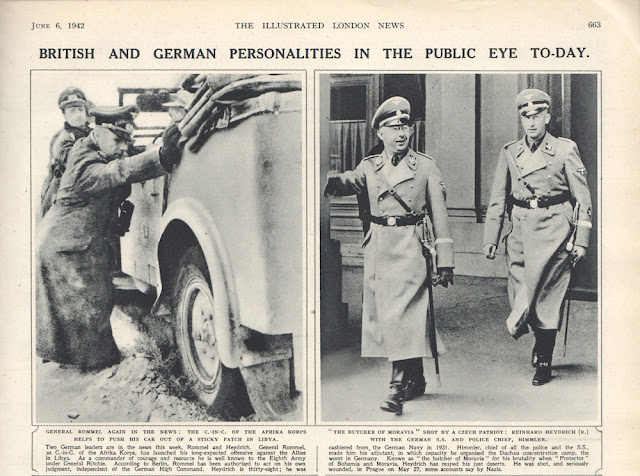
The Illustrated London News of 6 June 1942 features photos of German General Erwin Rommel, left, and recently deceased General Reinhard Heydrich, right (with Heinrich Himmler). Rommel is shown pushing his command car out of some trouble.

European Air Operations: The weather is warm, with plenty of ground haze below 1500 feet. The RAF focuses mainly on convoy protection.

R.A.A.F. Catalinas of RAF No. 10 Squadron, using Leigh Lights, bomb and damage Italian submarine Luigi Torelli in the Bay of Biscay. The submarine's crew manages to beach it at Santander, Spain, to prevent sinking. There is one death and one wounded crewman. The ship is temporarily repaired and sailed to France on 14 July for permanent repairs.

Hptm. Helmut Lent, Gruppenkommanduer of II./NJG 2, is awarded the Eichenlaub (No. Ninety-eight) after 34 night victories and 8 by day.
USS Atlanta with Hornet in the background, 6 June 1942 worldwartwo.filminspector.com
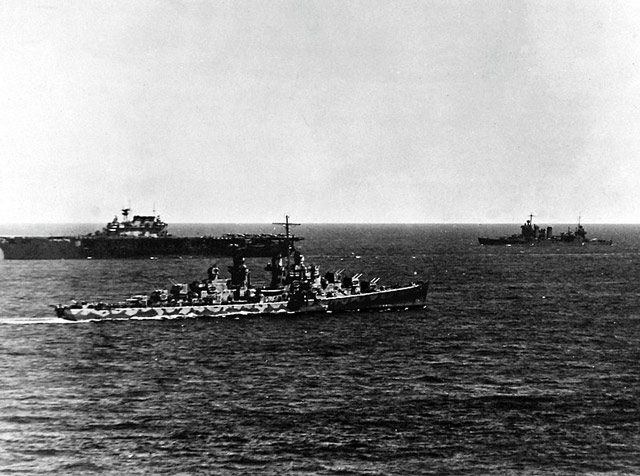
"A close-up of USS Atlanta (CL 51) with USS Hornet (CV 8) and USS Phelps (DD 360), all of Task Force 16, in background. Picture was made during the third day of the battle as Atlanta came up to offer assistance to the destroyer, which had broken down temporarily because of fuel shortage." 6 June 1942. Naval History and Heritage Command 80-G-88908

Battle of the Atlantic: It is a busy day for two German raiders operating in the South Atlantic east of Brazil. The 1940-41 glory days of the raiders are over and now they have to operate in remote areas to avoid detection. That doesn't mean they don't get the occasional moment of excitement. This happens during the Action of 6 June 1942.

In one incident, German raider Michel (Schiffe 28) spots disabled and drifting 7176-ton U.S. freighter George Clymer midway between Brazil and Africa. The Michel launches its motor torpedo boat Esan, which torpedoes and badly damages the freighter. One man perishes in the attack. The crew abandons the ship but reboards it on the 8th when it does not sink. however, the situation is hopeless and the crew is picked up by the British armed merchant cruiser HMS Alcantara. That is the last anyone sees of George Clymer, which remains stubbornly afloat. Exactly when and where the George Clymer sinks is unknown.

German raider Stier (Schiffe 23) has been quietly operating in the South Atlantic with limited success since leaving Royan, France in late May 1942. Today, Stier is cruising 500 miles (800 km) east of Pernambuco, Brazil, in overcast weather when it spots 10,170-ton U.S. tanker Stanvac Calcutta. Appearing suddenly out of a squall, Stier fires a warning shot and signals the tanker's crew to prepare to be boarded.

The Stanvac Calcutta, however, is heavily armed for a tanker. It has one 4-inch (102 mm)/50-caliber naval gun salvaged from World War I and a 5 inch (127 mm)/25-caliber anti-aircraft gun. Stier, meanwhile, has six 150-millimeter (6 in) guns, one 37 mm (1.5 in) gun, two 20 mm (0.79 in) cannons, and two torpedo tubes. So, there's a lot of firepower on both sides, though Stier outguns the tanker by a substantial margin.

The tanker's crew, led by Captain Gustav O. Karlsson, decides to not comply with the Stier's order to stop and opens fire. Led by Ensign Edward L. Anderson, the tanker's gunners get off several shots with both guns (the larger gun in the gun, smaller in the bow). Despite missing with most of their shots, the gunners do hit and disable one of Stier's 150mm guns. The Stier's crew then returns fire with 148 shells.

The battle lasts for 15 minutes, during which the Germans score a hit on the tanker's bridge, killing Captain Karlsson and several others. The Americans continue firing until their ammunition is exhausted. At this point, Stier Captain Horst Gerlach fires a torpedo that strikes Stanvac Calcutta on the port side. This kills several sailors and causes damage that leads to a sharp list and eventual sinking. The tanker's crew then abandons ship. Gerlach's men lower their own boats and rescue the Americans struggling in the water.

The Action of 6 June 1942 shows several hard truths about the Battle of the Atlantic. One is that merchant ships armed with a few guns stand little chance against raiders like Stier that are designed for combat even if they aren't true warships. Another is that these surface combats kill a lot of crewmen, as Stanvac Calcutta has 16 men killed in action, one dying later onboard Stier, fourteen men wounded, and 37 prisoners taken (the Stier only suffers two wounded men).

Actions like that of 6 June 1942 call into question the whole concept of arming merchant ships, which requires a lot of effort and dedicated gunners on hundreds of ships. However, later events involving Stier will redeem this idea somewhat. For their pains, the Stanvac Calcutta's crew later are awarded the Merchant Marine Gallant Ship Citation and Ensign Anderson is promoted (while a POW) to the rank of lieutenant commander. The tanker crew winds up in a Japanese POW camp.
Freighter Hermis in the background, sunk on 6 June 1942 worldwartwo.filminspector.com
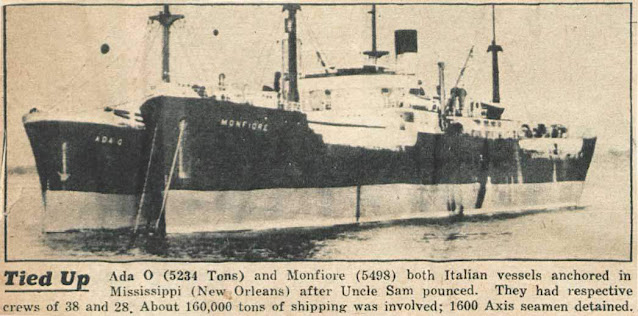
Coal-burning freighter Hermis is shown at left while still called "Ada O." Hermis was an Italian vessel anchored in New Orleans when seized in 1941 and pressed into U.S. service. Sunk on 6 June 1942.

There are also the usual U-boat sinkings, these days confined to the Caribbean.

U-68 (KrvKpt. Karl-Friedrich Merten), on its fourth patrol out of Lorient, torpedoes and sinks 13,006-ton Panamanian tanker C.O. Stillman 60 miles southwest of Puerto Rico. There are three deaths and 55 survivors,  most of whom are picked up by US Coast Guard patrol boat #83310 while 30 sail their lifeboats to Puerto Rico.

U-107 (Kptlt. Harald Gelhaus), on its sixth patrol out of Lorient, torpedoes and sinks 3910-ton Honduran freighter Castilla east of Cancun and south of western Cuba. One torpedo hits and causes the ship to sink quickly stern-first. The crew can't launch lifeboats and take to three rafts. There are 24 deaths (including one who dies on a raft) 35 survivors, who are picked up by USS Nike (WPC-112) after six days. Some sources place this sinking on 7 June 1942.

U-158 (Kptlt. Erwin Rostin), on its second patrol out of Lorient, torpedoes and sinks 5234-ton Panamanian freighter Hermis west of Havana and northeast of Cancun. Two torpedoes strike the ship on the port side but the engines continue running due to an inability to stop them due to damage. Rostin surfaces and uses his deck gun to finish off the freighter, setting it on fire. There is one death and 46 survivors, who are picked up by US Army transport Toloa. The ship does not sink for at least 12 hours and this sinking is sometimes listed as occurring on 7 June 1942.

Dutch 197-ton freighter Antares hits a mine and sinks off the Dutch coast.
"Battle of Knightsbridge 6th June 1942" worldwartwo.filminspector.com
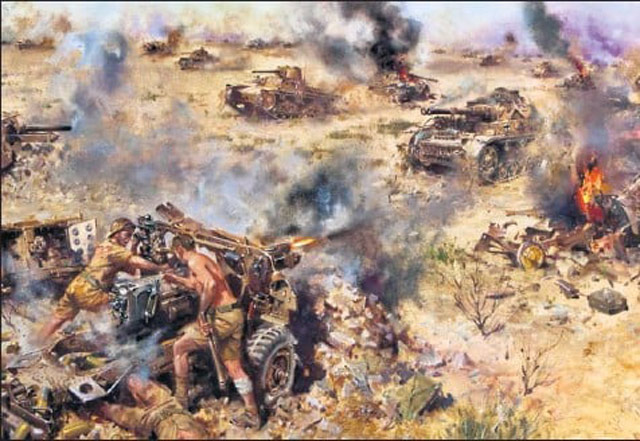
"The Battle of Knightsbridge, 6th June 1942," by Terence Cuneo (1907-1996). Shown are the 426th Battery of the 107th Regiment Royal Horse Artillery and the South Nottinghamshire Hussars, panzer of the Afrika Korps attacking. The 426th ultimately was forced to surrender.

Battle of the Mediterranean: After a wild day of attack and counter-attack between German and British troops on 5 June, the front settles down again today. However, German General Erwin Rommel retains command of the battlefield after his forces destroyed dozens of Allied tanks. He sends out armed reconnaissance to test the British lines and maintains pressure on the surrounded Free French garrison at Bir Hakeim. For their part, the British engage in harassing attacks against the German supply lines using the 7th Motor Brigade and 29th Indian Infantry Brigade.

The main action of the day is an attack at 11:00 by the German 90th Light Division against Bir Hakeim. This involves a determined effort by troops and pioneers to clear a way through the minefields surrounding the fortress, which are divided into two perimeters. By nightfall, the Germans manage to get through the outer minefield and into the inner minefield to within 800 meters (900 yards) of the fortress. The advance, while threatening to the Free French, also leaves the German troops exposed to Desert Air Force attacks on the 7th.

The Battle of Knightsbridge proceeds as the 15th Panzer Division attacks northward. The British 22nd Armoured Brigade continues to give ground after having lost dozens of its tanks. The German objective is El Adem, but the 201st Guard Brigade is ferociously defending the approaches to Tobruk.

Operation Aberdeen, the Eighth Army's counterattack begun on 4/5 June against the German Afrika Korps panzers, ends today after having accomplished nothing but the loss of numerous British troops and tanks. British Eighth Army commander General Neil Ritchie and Middle East Commander-in-Chief Claude Auchinleck now face the prospect of not only losing the battle but also all of Libya and much of Egypt unless they can find some way to stop Rommel's attacks. Among the desperate options considered are withdrawing the Free French from Bir Hakeim to free up the 7th Motor Brigade. However, this is rejected as the French seem to be in a good defensive situation.

Oblt. Hans-Joachim Marseille of 3./JG 27, currently operating in North Africa, receives the Eichenlaub for achieving 75 victories. Marseille once was considered a disciplinary problem but now is revered by his colleagues as a legend.
Battle of the Gazala Line, 6 June 1942" worldwartwo.filminspector.com
A map showing the military situation in Libya ca. 6 June 1942. The 15th Panzer Division thrust through the British Knightsbridge defensive position is shown by the upward arrow in the center, with a separate thrust to the south of Tobruk at the upper right. The map makes clear the extreme jeopardy of the Allied position at Tobruk, though nobody on either side is thinking about it just yet.

American Homefront: At the Belmont Stakes, the third jewel of the Triple Crown, the chestnut stallion Shut Out is the winner. Having also won the Kentucky Derby, Shut Out just misses immortality by having lost the Preakness Stakes to Alsab. Shut Out continues racing until 1944, when it is retired and put out to stud until passing away in 1964.

Future History: Klaus Bednarz is born in  Falkensee, Province of Brandenburg, Germany. Bednarz becomes a popular West German correspondent, author, and television host, particularly of the TV show Monitor. Klaus Bednarz passes away on 14 April 2015.
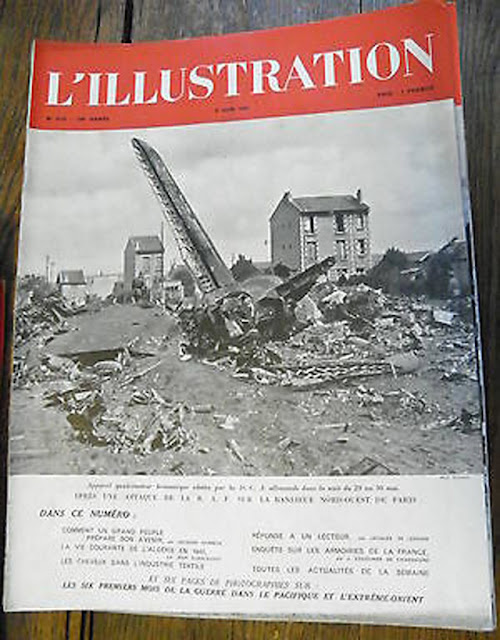
L'Illustration, 6 June 1942" worldwartwo.filminspector.com
L'Illustration, 6 June 1942.

2021

Sunday, September 26, 2021

May 30, 1942: First RAF Thousand-Plane Raid

Saturday 30 May 1942

Operation Millenium 30 May 1942 worldwartwo.filminspector.com
Cologne Cathedral illuminated during Operation Millenium, 30-31 May 1942.

Battle of the Pacific: Having spent 72 hours in drydock, during which its flight deck was patched and whole sections of internal frame were replaced, USS Yorktown (Task Force 17) departs Pearl Harbor on 30 May 1942 to join Enterprise and Hornet near Midway Island. Repairmen from repair ship Vestal, damaged on 7 December 1941, remain on the ship and continue to work as it sails. Yorktown's depleted air group is replenished with units from aircraft carrier Saratoga, which is under repair in San Diego. The carriers plan to rendezvous northeast of Midway.

Admiral Nimitz, meanwhile, has not forgotten about Saratoga. Today, he orders Captain Ramsey to sail from San Diego as soon as possible even if not 100% ready for action. The 7th Air Force dispatches six B-17 bombers from Hawaii to Midway to reinforce the 15 already there.

The Japanese invasion fleet bound for Midway already is at sea. Today, a task force of two light aircraft carriers and two troop transport ships departs from northern Honshu for the Aleutian Islands part of the plan.

The US 11th Air Force based in Alaska brings a new airfield at Umnak, Aleutian Islands, into operation with B-26 bombers of the 77th Bombardment Squadron (Medium).

Japanese patrol planes approach the French Frigate Shoals, but they spot two US Navy ships anchored there and are forced to turn back. Their mission was to rendezvous with a submarine there, refuel, and fly reconnaissance over Pearl Harbor. This is now impossible and the Japanese do not find out with certainty that the US Navy carriers have left. The US ships are stationed at the shoals because they know the Japanese have used them in the past as transit points for bombing missions against Hawaii.

US Navy submarine Pompano  (SS-181) torpedoes and sinks Japanese troop transport Atsuta Maru in the East China Sea east of Okinawa. There are 39 crew and 37 passengers killed. Pompano escapes a depth charge attack by the transport's destroyer escort.

Pix magazine 30 May 1942 worldwartwo.filminspector.com
Pix magazine, 30 May 1942.

Battle of the Indian Ocean: Two Japanese submarines (I-16 and I-20) stationed about ten miles off Diego Suarez, Madagascar, launch mini-subs to penetrate the harbor. Both subs make it into the harbor, which the British have left unguarded despite having spotted a Japanese floatplane on the 29th. At 17:10, the I-20 mini-sub M-20b (Lt. Akieda Saburo) launches a torpedo that hits Royal Navy battleship HMS Ramillies. The torpedo blows a 30x30 foot hole in the port bulge forward of "A" turret. This cuts off the entire ship's electrical system and floods the forward magazines and shell rooms.

Saburo is not done yet. He and the other sub remain in the harbor and, at 21:20, Saburo fires his second and last torpedo, which sinks 6,993-ton tanker British Loyalty in 65 feet of water (later raised and used as a hulk at Addu Atoll, Maldives). The subs remain in the harbor until the 31st.

B-17 bombers of the 10th Air Force again bomb the airfield at Myitkyina, Burma. This is the last attack against this target for the time being. 

Eastern Front: The final, weak Soviet attempts to break out of the encirclement southeast of Kharkov end today. Less than 10% of the trapped men have managed to escape. The Germans march the roughly 250,000 (the exact number is a matter of scholarly debate) Red Army prisoners in long columns through Kharkov and then on to prison camps. At Fuhrer Headquarters in East Prussia, General Franz Halder notes in his war diary "All fronts equally quiet. On the Volkhov, the access to the bulge has been narrowed down."

The loss of the Kharkov battle irreparably destroys Marshal Semyon Timoshenko's military reputation. Stalin will replace him as commander of the Stalingrad Front on 22 July 1942 with Vasily Gordov. Thereafter, Timoshenko will be given only one more command before being basically cashiered.

Boeing B17F 30 May 1942 worldwartwo.filminspector.com
The Boeing B-17F Flying Fortress makes its first flight at Boeing Field, Seattle, on 30 May 1942. This is a new series of B-17 bombers that incorporated 400 improvements learned from missions to date in the war. 

European Air Operations: After a lengthy period of preparation, RAF Bomber Command launches Operation Millenium at dusk. It sends over 1000 bombers to raid Cologne, the first 1000-plane raid of the war. The main targets are the city's chemical and machine-tool factories. The planes drop 1455 tons of bombs and incendiaries during a 90-minute attack. The firestorm kills 469 people and leaving 45,000 homeless.

Hermann Goering is having dinner at Veldenstein Castle when he gets a call from Josef Grohe, the Gauleiter of Cologne. During Grohe's explanation of the severity of the attack, Goering calls him a liar and hangs up. Soon after, another call comes in - this time from Adolf Hitler, who is in Berlin and has heard the same reports. Goering assures Hitler that at most 70 bombers attacked. When Goering learns later that air and flak defenses claim to have shot down 40 bombers, he claims it was a great defensive victory. Another 116 RAF bombers are damaged.

Winston Churchill, meanwhile, knows exactly how many bombers were sent - 1046 planes - and announces to the press that it was over 1000. Hitler, speaking to an aide, comments to an aide:
It is out of the question that only seventy or eighty bombers attacked. I never capitulate to an unpleasant truth. I must see clearly if I am to draw the proper conclusions.
Aside from the devastation to the city, the raid begins a rift between Hitler and Goering that only grows with time.

During an RAF Coastal Command patrol off Terschelling, the planes bomb and sink 2956-ton Swedish ore carrier Värmdö in the North Sea off Den Helder, North Holland. The ship was carrying ore to Rotterdam. There are seven deaths.

A German flak ship shoots down an RAF Hudson III (AM842) out of North Coates during a convoy attack in the Waddenzee, South of Schiermonnikoog. All four crewmen perish.

German flak ship that shot down an RAF bomber on 30 May 1942 worldwartwo.filminspector.com
The crew of a German flak ship showing off the wheel of an RAF Hudson III they shot down on 30 May 1942.

Battle of the Baltic: German 1354-ton freighter Orkan hits a mine laid by Soviet submarine Lembit and sinks near Greifswalder Oie, Swinemunde. Casualties are unknown.

Battle of the Atlantic: Having lost seven ships to air raids, Convoy PQ 16 makes port in Murmansk (eight ships continue on to Archangelsk and reach that port safely). The Luftwaffe sends Junkers Ju 88 bombers of  II./KG 30 against the Murmansk-bound ships, and during these attacks Hero of the Soviet Union Leonid Ivanovich Rodionov is shot down and killed after claiming two planes himself.

German auxiliary cruiser Michel (HSK-9), operating in the South Atlantic, spots 6800-ton US Liberty ship George Clymer. The Liberty ship is stopped with engine trouble and makes an easy target. The raider hits the ship with two torpedoes (actually, it launches a motor torpedo boat that scores the hits), but is then chased off by nearby Royal Navy AMC Alcantara (which doesn't see Michel and assumes it was torpedoed by a U-boat). The George Clymer is so badly damaged that the crew has to abandon it, and Alcantara later scuttles it on 6 July 1942. Everybody survives.

U-404 (Kptlt. Otto von Bülow), on its third patrol out of Brest, torpedoes and sinks 5491-ton US freighter Alcoa Shipper 500 miles east of Cape Charles, Virginia. The lookouts on the freighter spot the U-boat well before the attack, but evasive maneuvers do not prevent a torpedo strike. The ship, carrying 8340 tons of bauxite ore, sinks within five minutes. The U-boat surfaces after the sinking, questions the men in their lifeboat, and leaves them bottles of rum, cigarettes, and a pair of dungarees for a sailor who was undressed. There are seven dead and 25 survivors, who are picked up just over two days later by Norwegian freighter Margrethe Bakke.

An unidentified submarine torpedoes and sinks the 2161-ton Norwegian freighter Baghdad east of Martinique. The ship sinks within minutes. There are nine deaths and 21 survivors. U-155 (KrvKpt. Adolf Cornelius Piening), on its sixth patrol out of Lorient, is usually credited with this sinking, but some records indicate that it was still in port at Lorient on this date.

German 1592-ton minesweeper Sperrbrecher-166 Schirmeck sinks after a collision with training ship Obra. The ship apparently is refloated and returned to service.

French 288-ton trawler Edmond René is lost off Boulogne-sur-Mer, Pas-de-Calais, of unknown causes (perhaps a mine).

Sperrbrecher 166, sunk on 30 May 1942 worldwartwo.filminspector.com
Sperrbrecher 166, sunk on 30 May 1942 after a collision but refloated and repaired.

Battle of the Mediterranean: In Libya, the Axis offensive is struggling. German General Erwin Rommel, low on supplies and facing determined Free French resistance at the fortress of Bir Hakeim, pulls back the leading tanks of the Afrika Korps to the west. This forms a defensive perimeter, dubbed "The Cauldron," that is protected by British minefields on its western side.

Rommel sends some brave men through the minefield to make contact with Italian X Corps to the west and open a supply lane. These troops run into the British 150th Brigade at the "Sidi Muftah box" and destroy it early on the 31st to establish a connection with the Italian Corps. Meanwhile, fierce battles erupt near Bir Hakeim as the French attempt to close the supply lane there opened through the minefield on the 29th, while the Germans attempt to defend it.

The Germans previously captured 620 soldiers of the 3rd Indian Motor Brigade but, unable to watch over them, simply let them loose in the desert. These men make it to the Bir Hakeim fortress today. This only adds to the French supply issues, especially of water. 

British submarine HMS Proteus torpedoes and sinks 1571-ton Italian freighter Bravo in the Gulf of Sidra. Casualties are unknown.

British 72-ton utility tug HMS St. Angelo hits a mine off Grand Harbour, Malta, and blows up. There are at least four deaths.

Colonial League Day in Munich on 30 May 1942 worldwartwo.filminspector.com
Colonial Union day in Munich, at which Governor of Bavaria Franz Ritter von Epp gives a speech (Denzel, Federal Archive Image 146-2008-0172).

Partisans: Félix Otto Cadras, a leading French partisan and communist (participating in organizing the National Front partisan organization), is executed by a German firing squad at Fort Mont-Valérien, Paris, along with Arthur Dallidet, Louis Salomon, and Jacques Decour. These executions are in reprisal for an attempted assassination at Le Havre on 23 May 1942. Cadras will be made a Chevalier of the Legion of Honor by a decree of 17 January 1961, and a school and a street are named after him.

Allied Relations: RAF Air Chief Marshall Sir Charles F Portal and Lieutenant General Henry H "Hap" Arnold, Commanding General USAAF, meet to discuss the basing of US planes in Great Britain. Arnold's plan calls for 66 combat groups and additional observation squadrons by March 1943.

American Homefront: It is Memorial Day in the United States.

Attempting to evade being sent to an intern camp, Fred Korematsu has had plastic surgery on his eyelids. However, today he is arrested on a street corner in San Leandro, California. He will begin a court case, Korematsu vs. United States, 323 U.S. 214 (1944), that reaches the US Supreme Court. It upholds the exclusion of those of Japanese ancestry from the US West Coast. The conviction is overturned in a case filed in 1983 and disavowed by the Supreme Court in Trump vs. Hawaii (2018), though this latter opinion is not binding, being merely dictum.

USS Runner is launched, 30 May 1942 worldwartwo.filminspector.com
Launching of submarine Runner, Portsmouth Naval Shipyard, Kittery, Maine, United States, 30 May 1942 (US Navy).

May 1942


2021