Showing posts with label Operation Storfang. Show all posts

Monday, November 8, 2021

June 7, 1942: Manstein Attacks Sevastopol in Crimea

Sunday 7 June 1942

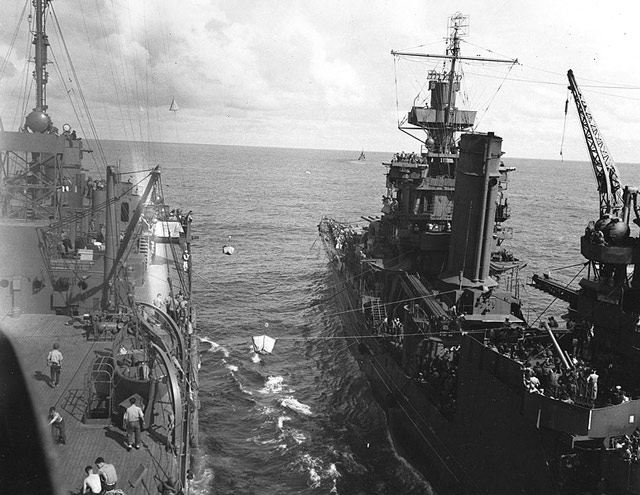
Transfer of Yorktown survivors at sea, 7 June 1942 worldwartwo.filminspector.com
"USS Portland (CA-33), at right, transfers USS Yorktown survivors to USS Fulton (AS-11) on 7 June 1942, following the battle of Midway. Fulton transported the men to Pearl Harbor." Naval History and Heritage Command 80-G-312028.

Battle of the Pacific: US aircraft carrier USS Yorktown (CV-5) sinks just after dawn on 7 June 1942, marking the definitive end of the Battle of Midway. Yorktown capsizes due to the combined effects of previous Japanese naval air strikes and torpedoes from I-168. The Battle of Midway has been a decisive American victory, with the Japanese losing four fleet aircraft carriers and a cruiser.

Continuing with their grand operational plan whose main component already has been thwarted at Midway, the Japanese occupy Attu Island in the Aleutians. There is no opposition to the 1143 men of the North Sea Detachment, and it is unclear if the US even knows about this latest invasion for a day or two. There are only 44 US civilians and 42 Aleut natives on Attu. One US civilian, Charles Jones, dies during the Attu invasion of unknown causes. The Japanese send everyone to camps in Japan, with only 25 of the 86 inhabitants surviving the war. The Japanese also capture nine of ten US Navy sailors manning a weather station on Kiska, with the tenth man (wearing a summer uniform) evading capture in the interior for 45 days.

The Japanese now occupy two islands at the extreme end of the Aleutian Island chain (Attu and Kiska). The Japanese high command anticipates that the US Navy will intervene and sends two light carriers to the vicinity in order to stage an ambush. In fact, Admiral Chester Nimitz does intend to send USS Enterprise and Hornet to the Aleutians, but he has not yet issued the necessary orders.

While Admiral Raymond A. Spruance has chosen not to pursue the retreating Japanese fleet - a decision for which he receives criticism - the US Army Air Force decides otherwise. Major General Clarence L. Tinker, Commander, 7th Air Force, personally leads a bomber strike from Hawaii. He perishes when his plane crashes near Midway.
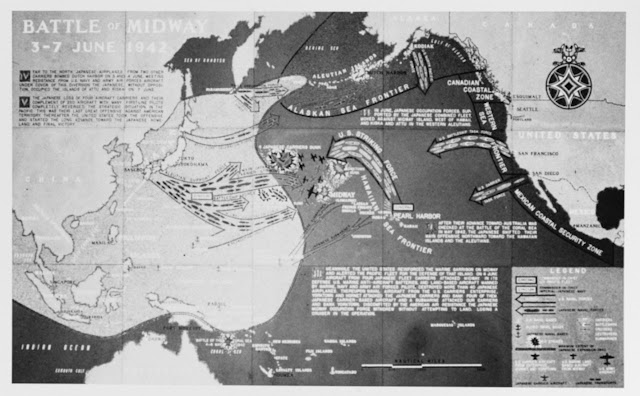
Map of Battle of Midway June 1942 worldwartwo.filminspector.com
"Located in the southeast room of the visitors building of Manila American Cemetery and Memorial. Map was designed by Margaret Bruton and fabricated by P. Grassi American Terrazzo Company of South Francisco." Naval History and Heritage Command NH 114452.

Admiral Frank Fletcher, who ceded command of US Task Force 18 around Midway Island due to the loss of his ship, the Yorktown, transfers his flag to aircraft carrier Saratoga, which has recently arrived from the US west coast. Saratoga departs Pearl Harbor today carrying replacement aircraft for the two remaining carriers involved in the battle. Fletcher thus is able to resume command of the task force on 8 June. He learns that Spruance has withdrawn to the east in order to refuel his ships and quickly orders search missions for the Japanese, who are heading back to Japan. However, the opportunity to continue the battle and "finish off the Japanese" has been lost.

While he has presided over the dramatic victory off Midway, Spruance manages to destroy much of the reputation he could have gained. This is due to his perceived lack of aggressiveness following the heat of the battle. Spruance's "discretion is the better part of valor" approach is controversial - then and now - and contrasts poorly with the aggressive tactics of Admiral "Bull" Halsey, who was unable to command the fleet at Midway due to health concerns. Now that Fletcher is back in command, Spruance is quickly reassigned from his field command to serve as Admiral Nimitz's chief of staff, though he does recover to have some important commands in 1943-1945.

Japanese submarine I-26 (Cdr Yokota) torpedoes and sinks 3545-ton US refrigerated freighter Coast Trader thirty miles off the Strait of Juan de Fuca on the US west coast. The ship is carrying refrigerated ammonia, which leaks due to the explosion and incapacitates some of the crew. There is one death. The remaining 56 men make it to a lifeboat, which local fishing vessel Virginia I tows to Neah Bay, and two rafts that Canadian corvette Edmunston (K-106) finds.

US submarine Grouper (SS-214) is mistakenly bombed by USAAF B-17 bombers looking for the Japanese fleet. It escapes undamaged, reflecting typical poor aim by level bombers against shipping in the Pacific.
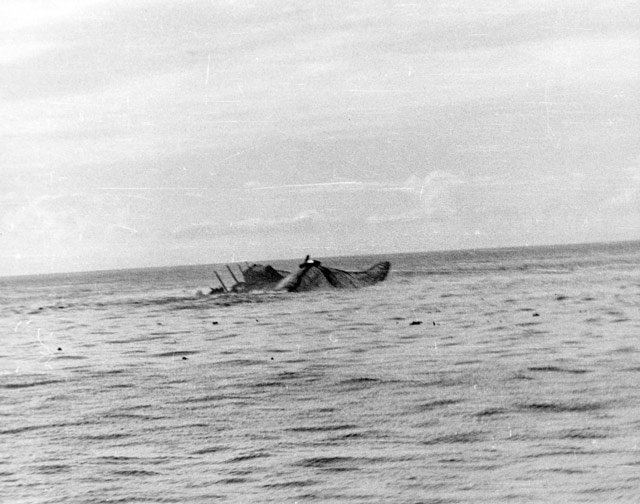
USS Yorktown sinks at Battle of Midway 7 June 1942 worldwartwo.filminspector.com
"USS Yorktown (CV-5) sinking, just after dawn on 7 June 1942, as seen from an accompanying destroyer." Naval History and Heritage Command NH 106000.

Battle of the Indian Ocean: Japanese submarine I-18 shells and sinks 2158-ton Norwegian freighter Wilford in the Indian Ocean off the Mozambique Coast. There are nine deaths and 34 survivors. All but two of the survivors, who are picked up by a Marinha Portuguesa gunboat, reach land in their lifeboats.

Eastern Front: In Crimea, German General Erich von Manstein begins Unternehmen Störfang (Operation Sturgeon Catch), the assault on Sevastopol. The port is well-defended, surrounded by rugged forests and bunkers that include 11 batteries and strong points north of Severnaya Bay.

The German 11th Army is weak, with many divisions seriously understrength. This is because Adolf Hitler is husbanding his fresh troops for the grand offensive, Case Blue, that he plans to launch in a few weeks. There are many fresh divisions and thousands of idle troops just north of the Crimea. It is an artificial manpower shortage, as opposed to the real one that are to come. Thus, Manstein must rely heavily on his artillery and airpower to make up for a weak thrust on land. Assisting the Germans are units of the Romanian Army, including the 1st Mountain Division and 18th Division, which are strong but lack their own artillery and air support.
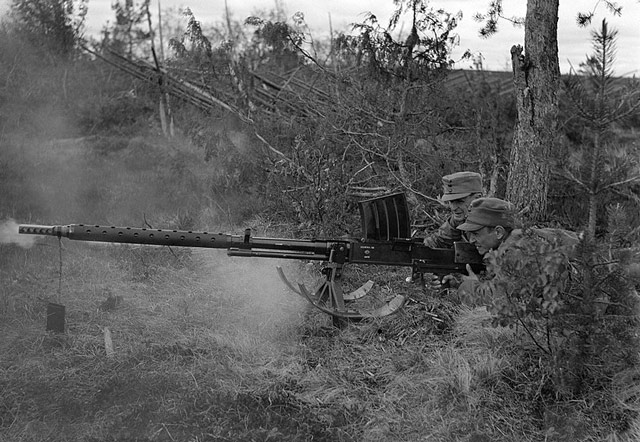
Finnish Lahti L-39 antitank gun in use, 7 June 1942 worldwartwo.filminspector.com
Lahti L-39 anti-tank gun in use, 7 June 1942 (Martin Persson, SA-kuva).

Aiding the assault are the Germans' heavy artillery that includes an 800 mm gun (Schwere Gustav), three 600 mm guns (Karl-Gerät self-propelled mortars), two 280 mm railway guns, two 420 mm guns, two 355 mm howitzers, and four 305 mm mortars. These massive artillery pieces have been firing at the Soviet defenses for days and have destroyed some key Soviet bunkers. The Luftwaffe's 8th Air Corps already has flown 3,069 sorties against the port, dropping 2,264 tons of high explosives and 23,800 incendiary bombs.

Following the massive preparatory bombardment, German 30 Corps attacks in the south while LIV Corps does so in the north. The southern attack stalls, but the LIV Corps makes good progress (this is the sector where the heaviest artillery has is located). The 132nd Infantry Division heads down the river while the 22nd Infantry Division attacks further east. The Soviets have planted numerous minefields that slow the Axis troops down. 

For Manstein, it is a mixed picture, with some advances in the north, few gains in the south, and failed attacks by the German 24th and 50th Infantry Divisions. In LIV Corps' four divisions alone there are 2,357 casualties, including 340 men killed. In addition, some of the units are running low on ammunition. However, the Germans take the key Red Army defensive position at Belbek, and Red Army casualties also have been severe. With his attempt at a quick victory a failure, Manstein now is looking at a depressing battle of attrition against the numerous enemy forces unless he can get the attack moving in the coming days.
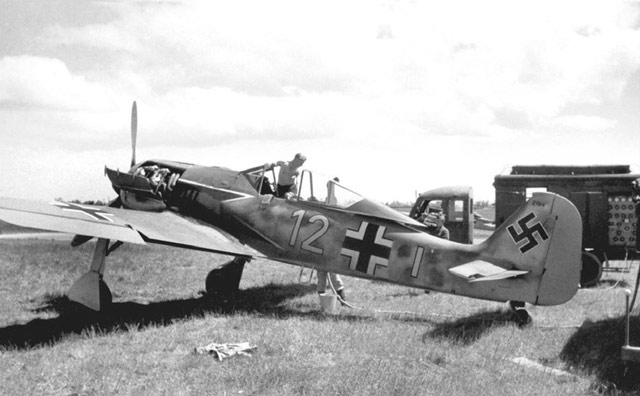
Fw-190 in France, June 1942 worldwartwo.filminspector.com
Focke-Wulf Fw-190A-2, 7./JG2, Theville, France, June 1942. The plane is still a bit of a mystery to Allied forces at this time.

European Air Operations: The weather is poor (10/10), with clouds down to 2000 feet. There are few operations during the day, typical during a relatively quiet spring 1942 on the Channel Front.

After dark, RAF Bomber Command attacks the German port of Emden. On the way back to base at 00:47, Luftwaffe pilot Oblt. Ludwig Becker of 6./NJG 2 in a Bf 110 shoots down a Wellington III (X3279) into the Waddenzee. All six crewmen perish.

Hptm. Johannes Seifert of I./JG 26 (KIA 25 November 1943) is awarded the Ritterkreuz (Knight's Cross of the Iron Cross) for 36 victories.
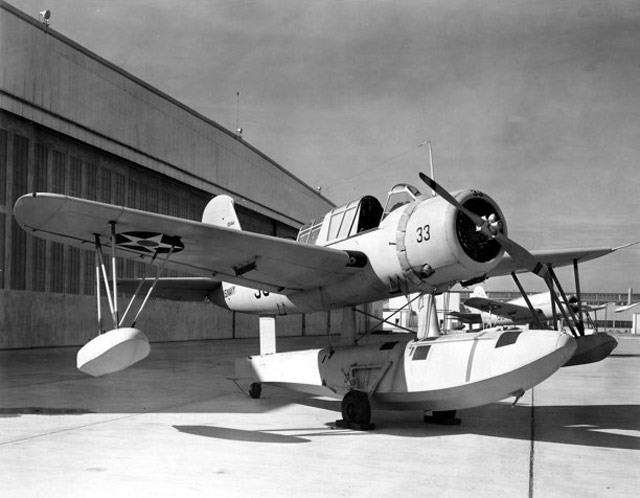
Kingfisher seaplane in Jacksonville, Florida, 7 June 1942 worldwartwo.filminspector.com
A US Navy Vought OS2U Kingfisher seaplane on the ramp at Naval Air Station Jacksonville, Florida, 7 June 1942 (US Navy). 

Battle of the Atlantic: U-653 (Kptlt. Gerhard Feiler), on its third patrol out of Brest, torpedoes and sinks seaplane tender USS Gannet (AVP-8) northwest of Bermuda. The ship sinks within four minutes. PBM Mariner seaplanes of VP-74 rescue 22 men, while USS Hamilton picks up 40 more. There are 16 deaths. 

U-159 (Kptlt. Helmut Friedrich Witte), on its second patrol out of Lorient, torpedoes and sinks 3382-ton US freighter Edith 200 miles southeast of Kingston, Jamaica. The ship sinks within twelve minutes. Witte surfaces after the attack to question the survivors and give them direction. He also, in an unusual move, scavenges various supplies that are bobbing in the water such as food, clothing, and even toys. The ship's survivors make it to Black River, Jamaica, in a week.

Italian submarine Leonardo da Vinci torpedoes and sinks 6956-ton British freighter Chile 350 miles southwest of Monrovia, Liberia. There are five deaths and 39 survivors.

U-107 (Kptlt. Harald Gelhaus), on its sixth patrol out of Lorient, torpedoes and sinks 3910-ton Honduran freighter Castilla near Jamaica. The ship sinks within minutes and no lifeboats can be launched. There are 24 dead and 35 survivors, who are picked up by USS Nike (WPC 112).

U-107 also torpedoes and sinks 3249-ton US freighter Sterling Steel Bridge (formerly Suwied) near Cozumel, Mexico. The ship sinks within three minutes, preventing any distress calls. There are six dead and 27 survivors. The survivors are picked up after 19 hours by USCGC Nemesis (WPC 111). This sinking, which occurs around midnight, is sometimes cited as occurring on 8 June.

U-158 (Kptlt. Erwin Rostin), on its second patrol out of Lorient, torpedoes and sinks 5234-ton Panamanian freighter Hermis due west of Havana, Cuba and due north of the extreme western tip of Cuba. Despite being hit by two torpedoes, the ship remains afloat and steaming in a circle, so Rostin surfaces and shells the freighter, setting it on fire, but it remains afloat for 12 more hours. There are one death and 46 survivors, who are picked up by US Army transport Toloa and taken to Kingston, Jamaica.

German 2967-ton freighter Joao Pessoa strikes rocks and sinks two miles from San Sebastian, Spain. Casualties are unknown.
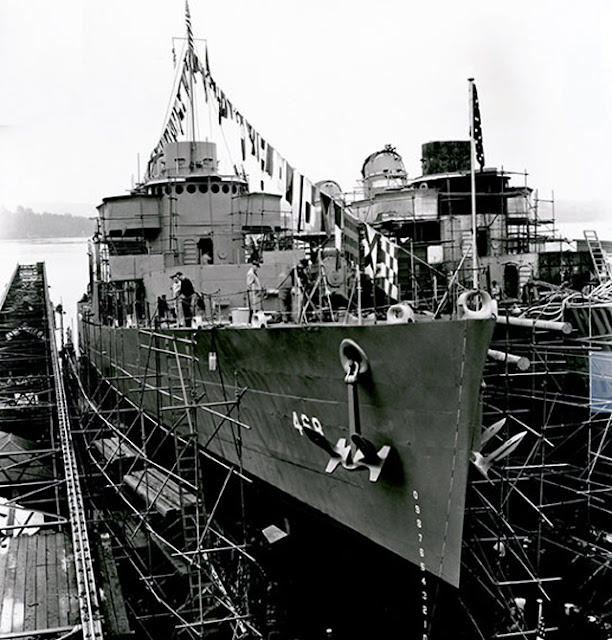
USS Taylor being launched in Maine, 7 June 1942 worldwartwo.filminspector.com
Launch of USS Taylor (DD-468) at the Bath Iron Works in Bath, Maine, on 7 June 1942. The ship is named after  Rear Admiral William Rogers Taylor (US Taylor Reunion Association).

Battle of the Mediterranean: The Axis forces around Bir Hakeim continue small-scale attacks. The 90th Light Division has managed to send pioneers through one minefield and into an interior minefield within about 800 meters (900 yards) of the fortress. The Free French garrison, while low on supplies, continues to hold out. During the day, the British Desert Air Force (DAF) launches several attacks against the exposed pioneers, while Luftwaffe Stukas pound the fort.

Much of the fighting at this stage of the battle revolves around supply lines, which are of vital concern in the desert. The British launch minor attacks by the 7th Motor Brigade and 29th Indian Infantry Brigade against Axis supply lines without much success. One last convoy manages to get through to Bir Hakeim in heavy fog after dark. Meanwhile, German General Erwin Rommel use the fog to reposition his forces for a determined assault on Bir Hakeim from the north on the 8th.

Besieged within Bir Hakeim, Brigadier General Marie-Pierre Koenig requests permission to withdraw due to his supply problems. Lieutenant-General Neil Ritchie, commanding the British Eighth Army, denies the request. Ritchie has his reasons - he anticipates the loss of Libya and needs to buy time while he builds a last-ditch defensive position at the little Egyptian town of El Alamein. Koenig, knowing that he can't hold out much longer, begins contemplating a breakout.

Italian submarine Sebastiano Veniero (Cdr Elio Zappetti) is lost due to two Catalina attacks of RAF No. 240 Squadron between the Balearic Islands and Sardinia around noontime. All 57-58 men on board perish.
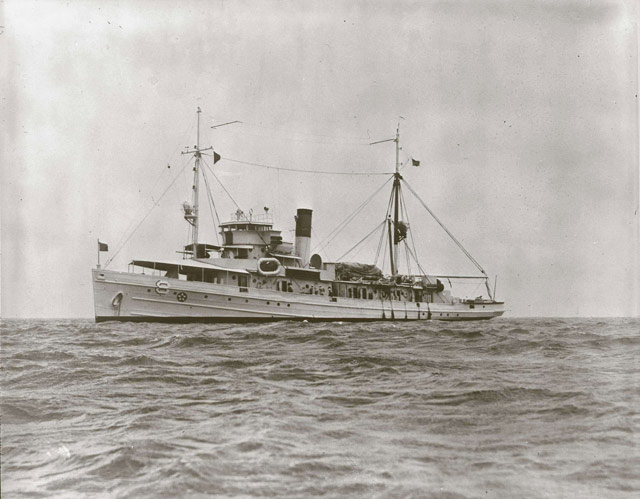
USS Gannet, sunk on 7 June 1942 worldwartwo.filminspector.com
USS Gannet, sunk by U-653 on 7 June 1942.

Special Operations: British Commandos execute Operation Albumen, another in a long sequence of overnight operations against Axis coastal targets. This one is on the Greek island of Crete, where Luftwaffe forces have been supporting the currently successful campaign of German General Erwin Rommel in Libya. Operation Albumen has several different coordinated sabotage operations.

Led by Captain G.I.A. Duncan of the Black Watch and assisted by local partisans, the Commandos destroy five aircraft and damage 29 others, along with several vehicles and stores, at Kastelli. At Heraklion, George Jellico leads members of the Free French Forces and Hellenic Army to plant Lewes bombs, destroying about 20 Junkers Ju 88 medium bombers. Similar attacks at Tympaki and Maleme do not accomplish anything because there were no aircraft at the former location and the latter was too well guarded. The Germans lose a dozen soldiers.

Aside from the damage caused directly by Operation Albumen, there are some lasting consequences. While the Commandos escape, the German authorities take and execute 50 local hostages. German Crete commander General Alexander Andrae ultimately is replaced by General Bruno Bräuer in November 1942 partly as a consequence of this raid.
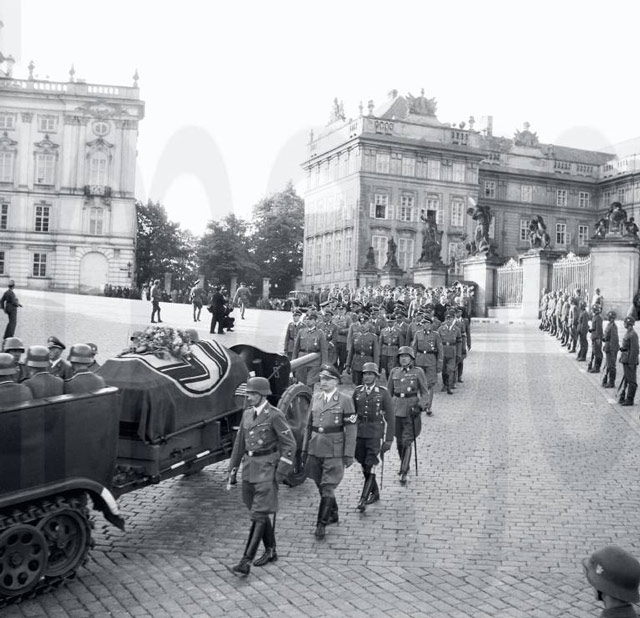
Funeral in Prague of Reinhard Heydrich, 7 June 1942 worldwartwo.filminspector.com
Funeral procession of Reinhard Heydrich in Prague, 7 June 1942. Note his flag-draped coffin on a caisson on the left.

German Homefront: The German authorities in Prague hold a massive, ostentatious funeral for assassinated Reichsprotektor Reinhard Heydrich. Afterward, the coffin is sent by train to Berlin for a second funeral to be held on 9 June. The second funeral is planned to be even more elaborate and ostentatious and is to be attended by the entire Reich leadership including Adolf Hitler. The Prague authorities continue to search for the assassins, who remain in the city moving between safe houses. Severe reprisals are in progress, with many more planned.

British Homefront: Scientist Alan Blumlein, the inventor of stereo sound recording among many other things, dies when a Halifax bomber in which he is testing H2S airborne radar crashes in Herefordshire. The crash apparently is due to improper aircraft maintenance. Due to Blumlein's importance to the war effect, the British government does not announce Blumlein's death until 1945. This delay leads to various conspiracy theories about the true cause of Blumlein's death. In 2017, the US Recording Academy posthumously awards Alan Blumlein a Technical Grammy for his contributions to the recording field.
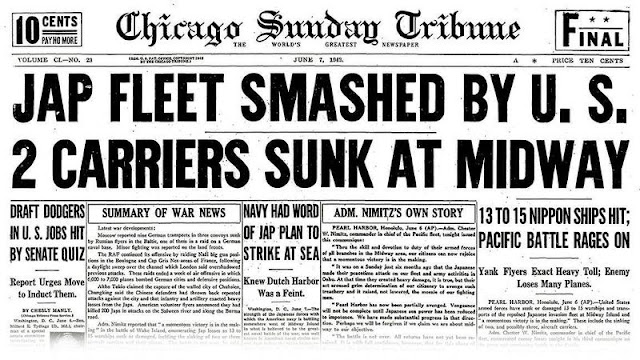
Chicago Sunday Tribune, 7 June 1942 worldwartwo.filminspector.com
The 7 June 1942 Chicago Sunday Tribune, featuring the article in the center "Navy Had Word of Japanese Plan to Strike at Sea" which almost got the reporter and newspaper in big trouble.

American Homefront: In a remarkable journalistic coup, the Chicago Tribune breaks the news of the codebreaking that contributed heavily to the US Navy victory in the Battle of Midway. Under the headline "Navy Had Word of Japanese Plan to Strike at Sea," the article describes how Naval Intelligence allowed Admiral Nimitz to pre-position his forces to ambush the Japanese fleet. While this article displays a clear breach of critical military security that might aid the Japanese, nothing comes of it. The Japanese military shows no signs of becoming aware that the Americans have broken their codes.

In Great Britain, Winston Churchill is known for having a short fuse with regard to sensitive press leaks like this. His government engages in many displays of censorship and attempted censorship. However, the US government ultimately lets the matter pass because events show that the disclosures do not interfere with the war effort.

Future History: Muammar Muhammad Abu Minyar al-Gaddafi is born in Qasr Abu Hadi, Sirte, Italian Libya. From a poor tribal family, he joins the Libyan military in 1963. In 1964, Muammar Gaddafi forms the "Central Committee of the Free Officers Movement," a revolutionary group styled after the teachings of a former Egyptian leader. In mid-1969, while Libyan King Idris is on vacation in Turkey and Greece, Gaddafi leads a bloodless coup and established the Libyan Arab Republic. Self-styled as the "Brotherly Leader and Guide of the Revolution of Libya," Muammar Gaddafi thereafter rules Libya as a dictator. He develops a cult of personality and remains in power until 20 October 2011, when Muammar Gaddafi perishes while trying to flee from an insurrection.
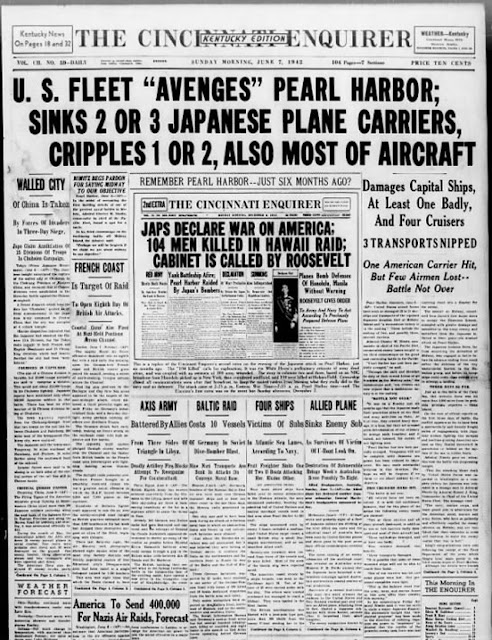
Cincinnati Enquirer, 7 June 1942 worldwartwo.filminspector.com
The 7 June 1942 Cincinnati Enquirer headlines the Battle of Midway as "Avenging" Pearl Harbor. It even reprints its front page from the Pearl Harbor report on this front page to hammer home that point. Unusually for this stage of the war, the report actually underplays the American victory, claiming only "2 or 3" Japanese carriers sunk when actually four were sunk. Still, this is very accurate reporting this close to the actual battle.

2021

Sunday, October 3, 2021

June 3, 1942: Start of Battle of Midway

Wednesday 3 June 1942

Dutch Harbor on fire, 3 June 1942 worldwartwo.filminspector.com
Fires burning at Dutch Harbor after the 3 June 1942 Japanese air raid (US Army).

Battle of the Pacific: At 09:04 on 3 June 1942, Ensign Charles R. Eaton, patrolling 470 miles from Midway Island, spots three Japanese ships. The Japanese quickly fire on him with anti-aircraft guns but he escapes and radios in his sighting. This is the first encounter of what will become the Battle of Midway.

At about the same time, another airman, Ensign Jack Reid, is patrolling 500 nautical miles (580 miles, 930 km) southwest of Midway in his PBY-SA when he also spots some ships in the distance. At 09:25, he radios in, "Sighted main body." He follows up with more details, ultimately reporting 11 ships at 11:00 before being ordered to return to base. Reid has not spotted the main Japanese force but rather transport ships commanded by Admiral Tanaka.

Lt. Col. Walter C. Sweeney leads a force of nine B-17 bombers stationed at Midway against the ships spotted by Reid at 12:30. Sweeney's force scores no hits and barely makes it back to Midway, landing at 21:45.

Another U.S. strike departs at 21:15, this time four PBY Catalinas bent on a night attack. Arriving over the target at 01:00 on 4 June, they score one hit on the Japanese force, a torpedo strike on the bows of tanker Akebono Maru that kills 13 sailors. Transport Kiosumi Maru also sustains some strafing damage that kills four crewmen. This attack features the only successful U.S. air-launched torpedo strike of the Battle of Midway.
Battle of Midway painting, 3 June 1942 worldwartwo.filminspector.com
"Battle of Midway, 3 June 1942" - "US Navy aircraft carrier USS Yorktown and its escorts defend themselves from incoming Japanese aircraft, one of which has splashed down into the ocean" (Rodolfo Claudus ca. 1950) (Naval History and Heritage Command).

The second prong of the Japanese strategy (Operation AL) is an invasion of some of the Aleutian Islands. The Americans know about this from their codebreaking but have concentrated the bulk of their naval forces at Midway. Planes from two light Japanese aircraft carriers (Ryujo and Junyo) under the command of Vice-Admiral Boshiro Hosogaya take off in a dense fog and rough seas to raid the Dutch Harbor Naval Operating Base and Fort Mears at Dutch Harbor on Amaknak Island, Alaska. Only about half of the planes make it to the target. Despite some heavy anti-aircraft fire, the Japanese Nakajima B5N, Navy "Kate," Bombers drop 16 bombs on Fort Mears, then get clean away before P-40s stationed at Cold Bay arrive. There are 25 dead and many other casualties, while the Japanese lose only one plane.

The attack on Dutch Harbor is only a distraction from the main Japanese objective in the Aleutians, which is to occupy islands Kiska and Attu further down the chain. During this raid, the Japanese planes sink the 3497-ton U.S. passenger ship Northwestern (no casualties). Japanese cruisers launch four Nakajima E8N2 Navy Type 95 reconnaissance seaplanes, Allied Code Name "Dave," to fly over Umnak, losing one to U.S. ground fire. A PBY-5A Catalina of VP-42 locates the Japanese ships, while the Japanese shoot down another PBY and take three of its crew as prisoners aboard the cruiser Takao. A Japanese "Zeke" bomber crashlands in a bog on Akutan Island and U.S. forces later recover it and the dead pilot.

The five Japanese submarines waiting off the coast of Australia near Sydney to pick up the crews of the mini-submarines that attacked Sydney Harbour give up hope and disperse. The mini-sub crews are all dead, though two men nearly made it to the rendezvous point before being killed by troops. I-24, one of these five submarines, then torpedoes and sinks 4812-ton Australian ore carrier Iron Chieftain in the Tasman Sea 35 miles east of Manly (there is a monument to the 12 dead crewmen of Iron Chieftain outside Newcastle railway station). There are 27 survivors. The sinking of Iron Chieftain helps lead to the formation of convoys along the Australian coast between New South Wales, Victoria, and South Australia.

I-20 is the last of the five Japanese submarines to depart from the recovery area. During the afternoon, it surfaces and fires flares and sends radio signals, but nobody appears. Finally, at 18:00, it, too, departs.

U.S. Navy 115-ton patrol boat Vagabond collides with patrol craft PC-569 while patrolling west of the Golden Gate Bridge and sinks. There are no casualties.

U.S. 16-ton fishing trawler sinks in Sitka Sound in the Alexander Archipelago in Southeast Alaska near Saint Lazaria Island off of Cape Edgecumbe in Kruzof Island. The cause of the sinking is unidentified, but it may be due to enemy action.

B-17 bombers of the 5th USAAF Air Force bomb Rabaul. They hit a wharf, a warehouse area, and a military camp.

Marines waiting out the bombing of Dutch Harbor, 3 June 1942 worldwartwo.filminspector.com
"Japanese attack on Dutch Harbor, June 3, 1942. Group of Marines on the "alert" between attacks. Smoke from burning fuel tanks in the background had been set afire by a dive bomber the previous day. Alaska." (National Archives 80-G-12076).

Battle of the Indian Ocean: The 10th USAAF Air Force sends 6 B-25s of the 11th Bombardment Squadron, 7th Bomber Group, from Dinjan, India, to bomb Lashio, Burma. They then continue on to Kunming in perhaps the first example of "shuttle bombing." The mission turns into a disaster when three bombers crash into the Himalayas at 10,000 feet in heavy overcast conditions and a fourth runs out of fuel and crashes near Chan-i, China. Only two of the bombers actually reach Kunming, where they are fired upon by Chinese fighter planes that have not been informed of the operation and one radio operator is killed..

At Diego Suarez, the British complete emergency repairs to the 30x30-foot hole blown in battleship HMS Ramillies from a mini-sub attack and it departs for more permanent repairs at Durban.
Finnish anti-tank gun being used, 3 June 1942 worldwartwo.filminspector.com
Finnish Lahti L-39 anti-tank gun in use on 3 June 1942 (Military Museum of Finland (Kuva)).

Eastern Front: The German artillery fire and air assault on Sevastopol continue today as the Germans try to weaken the Soviet defenses for a full-scale assault. The target area today for the rolling bombardment is the defensive area facing the German 30th Army Corps south of the city.

General Franz Halder at Fuhrer Headquarters notes in his war diary: 
The enemy has reacted to our artillery attack on Sevastopol with counterbattery fire. Work on fortification in progress. Ship movements. No important changes on the other fronts.
General von Manstein, commander of 11th Army, plans to begin his attack on Sevastopol (Operation Sturgeon Catch (Störfang)) on 7 June. He is quickly redeploying troops from the eastern half of Crimea, where some Soviet holdouts in caves are causing trouble, to the west to participate in the Sevastopol assault. It is a very peculiar situation for the Germans on the Eastern Front where the hot spot is to the west and not the east.

Oblt. Siegfreid Freytag of 6./JG 77 claims his 50th victory. He soon will transfer to the Mediterranean Theater.
Dutch Harbor fires, 3 June 1942 worldwartwo.filminspector.com
"Siems Drake warehouse afire, following the attack by Japanese carrier aircraft. Note fire fighting parties at work, and S. S. NORTHWESTERN burning at left." Dutch Harbor, 3 June 1942. (Naval History and Heritage Command 80-G-12056).

European Air Operations: The weather over the Channel Front is clear and warm. There are no major attacks today. RAF No. 403 Squadron (RCAF) moves from Southend to Martlesham. At RAF Chelveston, a small Hotspur glider of the Airborne Forces Experimental Establishment (AFEE) 14th Operational Training Unit breaks up mid-air near Greetham Village, Ruland, and the crew bales out (one killed and one uninjured).
Ore freighter City of Alma, sunk on 3 June 1942 worldwartwo.filminspector.com
U.S. ore freighter City of Alma, sunk by U-172 on 3 June 1942.

Battle of the Atlantic: U-404 (Kptlt. Otto von Bülow), on its third patrol out of Brest, torpedoes and sinks 1345-ton Swedish freighter Anna 210 miles northwest of Bermuda. Von Bülow begins his attack with two torpedoes at 03:09 and 04:50 but misses with both. Finally, at 05:10, he surfaces and uses his deck gun. The attack is a little controversial because von Bülow's crew clearly sees Swedish (neutral) markings, but he decides to attack anyway because the ship is acting suspiciously (zig-zagging and without navigational lights). There are no dead among the 32-man crew, though two men are wounded in the attack. The survivors take to the boats and are picked up within 13 hours by Swiss freighter Saentis, which also picks up survivors of freighter West Notus, sunk by the same U-boat on 1 June.

U-172 (Kptlt. Carl Emmermann), on its second patrol out of Lorient, torpedoes and sinks the 5446-ton U.S. freighter City of Alma 400 miles northeast of San Juan, Puerto Rico. The ship is carrying manganese ore and sinks within three minutes. The radio operator remains on board to send a distress call but the ship sinks so quickly that he goes down with the ship without sending any messages. There are 29 dead and 10 survivors, who survive in a lifeboat and are picked up by U.S. patrol boat USS YP-67. Third Mate Hugh Parks Brown, Jr. the Merchant Marine Distinguished Service Medal for saving other crewmen.

U-156 (Kptlt. Werner Hartenstein), on its third patrol out of Lorient, stops 80-ton British schooner Lillian near Grenada and Barbados (40 miles south of Barbados) after the ship first ignores a command to stop (warning shot through the rigging). A few crew remain aboard the ship and attempt to sail away while others take to the boats. The U-boat chases the fleeing ship after questioning the men in the boats and finally sinks it with gunfire. Hartenstein apparently uses the incident for target practice, or maybe he is just angry (and tired, as he already has sunk or damaged 11 ships on this patrol), as he uses an astounding 52 rounds of 37mm and 270 rounds of 20 mm) to sink the wooden ship. There are three dead and 22 survivors.

U-502 (Kptlt. Jürgen von Rosenstiel), on its fourth patrol out of Lorient, torpedoes and sinks 6940-ton U.S. freighter M.F. Elliott 150 miles northwest of Trinidad (west of St. George's Island). The ship, carrying just water ballast, sinks within six minutes. There are 13 dead and 32 survivors, who are picked up by Brazilian tanker Santa Maria after five days adrift.
Die Wehrmacht magazine, 3 June 1942 worldwartwo.filminspector.com
Die Wehrmacht Magazine, 3 June 1942.

U-432 (Kptlt. Heinz-Otto Schultze), on its fifth patrol out of La Pallice, spots two fishing trawlers 170 miles east of Thatchers Island in the Bay of Fundy (northeast of Boston) and surfaces. After allowing the crewmen to leave their vessels, Schultze uses his deck gun on the trawlers. Sunk are 41-ton Aeolus and 102-ton Ben and Josephine. All of the fishermen (14 men total) survive, making landfall at Mount Desert Coast Guard Light Station after 36 hours.

U-126 (Kptlt. Ernst Bauer), on its fourth patrol out of Lorient, torpedoes and sinks 10,990-ton Norwegian tanker Høegh Giant 400 miles east of Guiana. Bauer attacks at 11:24 and hits with one of three torpedoes, but the ship continues sailing. He then surfaces, but the tanker crew use the deck gun to fire at the U-boat, forcing Bauer to submerge and chase it. A long ordeal results, with Bauer finally getting into firing range at over 14 hours later 01:40 on 4 June. Two torpedoes hit, and the crew abandons the ship. The tanker finally sinks at 04:24 after Bauer has to fire a coup de grâce. Bauer clearly is furious about the entire incident. He surfaces and, when he does not get the answers he wants from the men in the lifeboats, he has his men fire over the boats, wounding one survivor with a stray bullet. The survivors spend at least ten days at sea, with most landing at Devil Island after ten days and the rest being picked up after 15 days. While the survivors are being transported to New Orleans aboard freighter Robert E. Lee, that ship also is sunk (by U-166), but all the survivors of Høegh Giant survive that sinking, too.

U.S. 5686-ton freighter Steel Worker hits a mine and sinks 3000 yards from Mishayampi, Murmansk. The ship has traveled all the way from Philadelphia with foodstuffs only to be sunk less than two miles from its destination. There are no casualties.

German Navy whaler V-1510 Unitas VI, being used as a patrol boat, strikes a wreck and sinks at the entrance of Dieppe, France. No known casualties. This incident is sometimes claimed to have occurred on 2 June 1942.

RAF Vickers Wellington bombers of No. 172 Squadron damage Italian submarine Luigi Torelli near Aviles, Spain. The ship is towed to Aviles and beached. After temporary repairs, it is refloated and taken to Spain for permanent repairs.

Damaged freighter Orari being patched at Malta, 3 June 1942 worldwartwo.filminspector.com
Freighter Orari having a temporary patch installed at Malta on 3 June 1942. © IWM A 10774.

Battle of the Mediterranean: German General Erwin Rommel and the bulk of the Afrika Korps remain bottled up in The Cauldron, a defensive position west of Tobruk. However, while no longer on the offensive, they now have cleared supply lanes to the west and are receiving reinforcements. The siege of Free French forces at the fortress of Bir Hakeim continues with little change in the situation today as the Axis forces bombard the entrenched French with artillery and Luftwaffe attacks.

The air war is going surprisingly poorly for the RAF. The pilots of III./JG 53 claim three victories over the British in the vicinity of El Alamein. One of the issues is that the Luftwaffe has brought elite units to North Africa.

Air activity over the front is ferocious. Oblt. Hans-Joachim Marseille of 3./JG 27 claims 6 Tomahawks of SAAF No. 5 Sqdn. and damage to two others in 12 minutes. Among his victims is an ace with five victories, Captain Botha, who himself had just shot down three Junkers Ju-87 Stuka dive bombers. Marseilles and the other planes clear the skies, opening them up for more Stuka attacks on Bir Hakeim. Joachim Marseilles now has 75 victories and will receive the Eichenlaub (oak leaves) to his Iron Cross on 6 June as a reward. He quickly is becoming a legend, and one of the men in his unit, Hans-Arnold Stahlschmidt, writes in a letter home, "Marseille is able to shoot like a young God. Above all, he is able to do what only a few can - to shoot with perfection while turning."

U-331 (Kptlt. Hans-Diedrich Freiherr von Tiesenhausen), on its seventh patrol out of Messina, torpedoes and sinks Royal Navy trawler HMT Cocker off Bardia, Libya. There are 15 missing/dead, with one wounded man (Ty/Lt D M Engeler RANVR) surviving.

Battle of the Black Sea: German Navy ferry barge (Marinefahrprahm) F 145 hits a mine and sinks in the Black Sea southeast of Odesa. there are nine deaths.
Greek freighter Pindos being commisssioned, 3 June 1942 worldwartwo.filminspector.com
Greek destroyer Pindos being commissioned at Swan Hunters, Wallsend on Tyne, 3 June 1942. © IWM A 8677.

Special Operations: British special forces (No. 6 Commando) stage an overnight raid on the German radar site at Plage-Ste-Cecile, France (between Le Touquet and Boulougne). This is Operation Bristle, one of a number of Commando missions during 1942 designed to give the special forces training and experience. The Germans, however, prevent the Commandos from achieving their objectives. Empty-handed, the Commandos depart and are still at sea at dawn when the Luftwaffe appears overhead and causes damage to two motor launches and a motor gunboat. One Commando and two naval personnel are killed and 19 others are wounded. The force manages to make it back to port only due to the fortuitous arrival of RAF forces to scatter the attacking Luftwaffe planes.

Reinhard Heydrich, shot by British/Czech Special Operations Executive agents on 27 May during Operation Anthropoid, appears to be recovering from the attack when he suddenly collapses while eating lunch around noon. He lapses into a coma from which he never recovers. One theory is that this relapse is caused by a systemic infection, another by a pulmonary embolism.

New Auschwitz prisoner on 3 June 1942 worldwartwo.filminspector.com
Chaskel Bittner, shown, is transferred from Montelupich prison in Cracow to Auschwitz on 3 June 1942. Bittner becomes No. 37249. He perishes at the camp on 26 June (Auschwitz Memorial).

British Homefront: The British government nationalizes the milk industry and coal mines.

American Homefront: The Rodgers & Hart (Richard Rodgers and Lorenz Hart) musical "By Jupiter" premieres at the Schubert Theater on Broadway. Starring Ray Bolger and Vera-Ellen, the play is set in the land of the Amazons, who do battle with a Greek army led by Theseus and Hercules and then engage in romantic complications. Nanette Fabray later joins the cast. The play is a big hit and runs for 427 performances until 12 June 1943. While little remembered, "By Jupiter" is Rodgers and Hart's longest-running Broadway hit and final original full-length work.

Future History: Curtis Lee Mayfield is born in Chicago, Illinois. He begins a musical career in a gospel choir, then joins the vocal group The Impressions in the mid-1950s. He also becomes a songwriter, including the hit "People Get Ready" in 1965. Mayfield turns solo in 1970 and engages in various projects, including creating the soundtrack to the film "Super Fly" in 1972. While performing in 1990, Mayfield is paralyzed during an accident involving lighting equipment, but he continues recording. Curtis Mayfield passes away on 26 December 1999.
Flak guns shown in the 3 June 1942 Die Wehrmacht magazine worldwartwo.filminspector.com
Flak batteries shown in the 3 June 1942 Die Wehrmacht Magazine.


2021