Showing posts with label HMS Ramillies. Show all posts

Friday, November 12, 2021

June 8, 1942: Japanese Submarines Shell Australia

Monday 8 June 1942

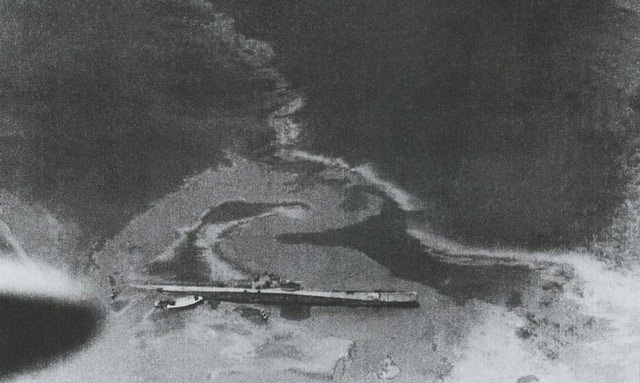
Italian submarine beached in Spain, 8 June 1942 worldwartwo.filminspector.com
Italian submarine Luigi Torelli lying beached near Santander, Spain, on 8 June 1942. The submarine commander beached it after suffering damage from Allied aircraft on 6 June 1942 using Leigh Lights. It is ultimately repaired and restored to service.

Battle of the Pacific: In a coordinated attack in the early morning hours of 8 June 1942, two Japanese submarines fire their 140 mm deck guns at Sydney and Newcastle, Australia. The purpose is more symbolic than militarily effective, but it certainly catches the attention of a lot of people.

I-24 opens the attack by firing ten shells targeting the Sydney Harbour Bridge. They land in the suburbs of Bellevue Hill, Rose Bay, and Woollahra, with one shell landing in the harbor. One person is injured by falling masonry and debris even though only one of the ten shells explodes. There is no response from shore batteries due to the brevity of the attack.

Two hours later, Japanese submarine I-21 (Cdr Matsumura Kanji) shells the Australian city of Newcastle, New South Wales, on 8 June 1942 from a distance of 9 km (5.6 miles) northeast of Stockton Beach. The target this time is the BHP steelworks. It fires 34 shells, including 8 illumination rounds, but once again only one shell detonates. The attack does no significant damage, aside from destroying a house on Parnell Place. Fort On the alert due to the previous Sydney attack, Scratchley gunners respond with four shells but have little chance of scoring a hit on the submarine in the dark.

The only fatality from these attacks is a US Army Air Force pilot, Lieutenant Georg Cantello, who disobeys orders and takes off from Bankstown airport in a P-39 Aircobra to attack the submarines. He perishes when his plane crashes due to mechanical issues in Hammondville paddock. There is a memorial park, Lt. Cantello Reserve, in the City of Liverpool with a monument in his honor.
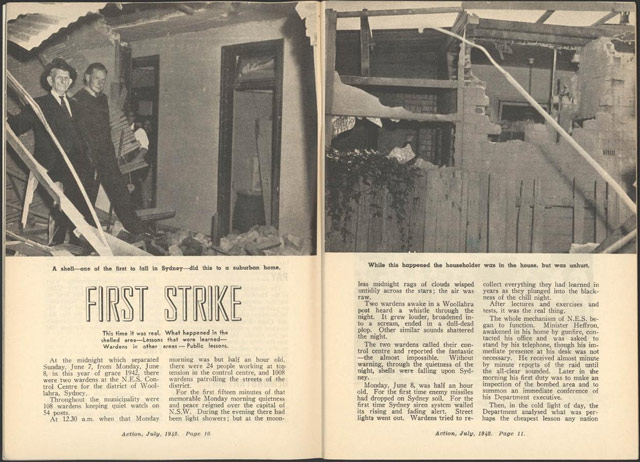
Japanese bombardment of Sydney, 8 June 1942 worldwartwo.filminspector.com
Australian "Action" magazine, the Official Journal of the National Emergency Services, has photos and a description of the 8 June 1942 shelling of Sydney in its July issue.

In response to the Japanese offensive in Australian waters that began with the attack on Sydney Harbour on 31 May 1942, the Australian government begins convoy operations on the east coast. Today, the first one, Convoy CO 1, departs from Newcastle bound for Whyalla.

The crew of a US Navy PBY-5A Catalina based at Dutch Harbor, Unalaska Island, spots two destroyers and four transport ships in Kiska Harbor. The crew then fly on to Attu and spot the Japanese presence there, too. This is the first news that the Japanese have invaded Alaska. An LB-30 of 11th Air Force also spots the Japanese.

In Hawaii, Admiral Chester Nimitz has ordered USS Enterprise and Hornet, now free due to the victory at Midway, to sail north to the Aleutian Islands in response to the attacks on Dutch Harbor. However, he quickly countermands this order when informed of the invasions at Attu and Kiska, fearing attacks on his carriers by land-based aircraft. The Japanese, meanwhile, are digging in on the islands and building airfields. Admiral Frank Fletcher, now aboard the aircraft carrier USS Saratoga, resumes command of the three-carrier task force northwest of Hawaii from Raymond Spruance. His carriers and the 11th Air Force in Alaska search for the remaining Japanese fleet but the planes spot only open water.

General Douglas MacArthur, Supreme Commander of Allied Forces in the Southwest Pacific Area (SWPA) in Melbourne, submits his first proposal for an Allied counteroffensive in the Pacific. He lists New Guinea, New Ireland, and New Britain as the initial objectives. It receives immediate opposition from Admiral Ernest King, Commander in Chief, United States Fleet (COMINCH), and Chief of Naval Operations (CNO), who, among other objections, does not like the idea of an Army general commanding an amphibious force. Negotiations over a compromise plan begin shortly. Another issue is that the Japanese remain on the offensive despite their recent defeat at Midway and that will affect operational choices.
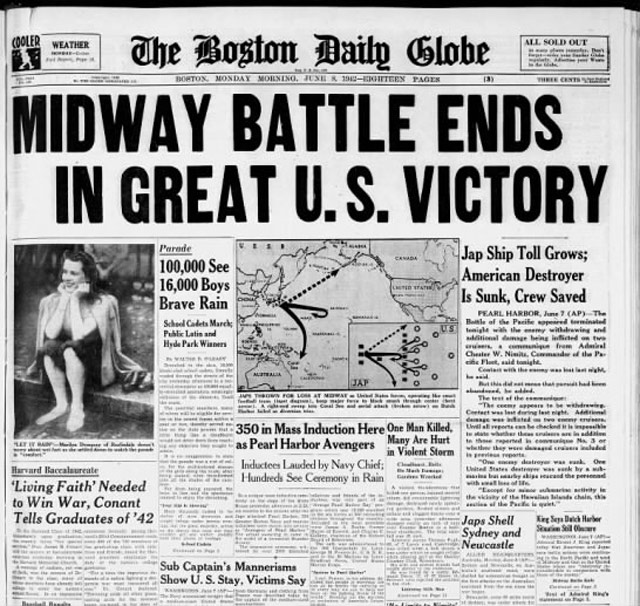
The Boston Daily Globe, 8 June 1942 worldwartwo.filminspector.com
The Boston Daily Globe of 8 June 1942 is full of cheery news about the US victory at the Battle of Midway. The very careful wartime manipulation of war news is evident in the header "American Destroyer Is Sunk, Crew Saved." That is absolutely true, but there is no mention of the far more consequential sinking of the USS Yorktown. 

Battle of the Indian Ocean: Japanese submarine I-16 uses its deck gun to sink 4847-ton Greek freighter Aghios Georgios IV between Aden and Table Bay in the Mozambique Channel. There are seven deaths.

I-20 torpeoes and sinks 5209-ton Greek freighter Christos Markettos off Mombassa. There are two deaths.

I-10 (Cdr Otani) torpedoes and sinks 5224-ton British freighter King Lud in the Mozambique Channel 350 miles east of Beira. All 39 people on board perish. This is I-10's third victory in the vicinity.

I-10 also uses its deck gun to sink 2158-ton Norwegian freighter Wilford in the Mozambique Channel in the same general vicinity east of Beira. There are nine deaths. Some sources place this sinking on 7 June 1942.

Norwegian freighter Wilton, sunk on 8 June 1942 worldwartwo.filminspector.com
Norwegian freighter Wilford, sunk by I-10 in the Mozambique Channel on 8 June 1942.

Eastern Front: German General Erich von Manstein's 11th Army continues its attack on Sevastopol in Crimea but makes little progress. Soviet counterattacks also fail, leading to a virtual stalemate. The German LIV Corps, aided by strong artillery fire and furious Luftwaffe attacks, do make some progress in the northern sector where the largest artillery batteries are located. Already the corps has lost 1700 casualties in exchange for a shallow bulge into the Red Army lines that is 3 km deep and 5 km wide. German 30 Corps in the south has suffered 496 casualties for minor penetrations into the out Soviet defensive line.

There are fierce dogfights over Sevastopol, with both sides represented by veteran ace fighter pilots. The Luftwaffe gets the better of the encounters. Lt. Ludwig-Wilhelm Burckhardt of 6./JG 77 downs 2 Soviet fighters and Oblt. Anton Hackl of 5./JG 77 destroys three Russian planes to bring his score to 57 victories. Hptm. Kurt Ubben of Stab III./JG 77 brings his score to 70 victories after he downs a Russian fighter.

There is growing frustration in Manstein's headquarters with the pace of the offensive. Luftwaffe General Wolfram von Richtofen observes that his planes fly 1200 sorties during the day without achieving much and lamely explains, "We hope gradually to beat down the enemy by mass bombing."  He complains that flying so many missions is 'extremely strenuous." Conditions are made worse on both men and equipment by sweltering  105° Fahrenheit (40° Celsius) heat.

At Fuhrer Headquarters in East Prussia, General Halder is okay with the progress, but there is a hint of concern in his diary entry:
Assault of Sevastopol makes satisfactory progress on the first day against stiff opposition; high ammunition expenditures and severe losses. All other fronts quiet. Successful counterattacks at Kirishi.  
Kirishi, meanwhile is a town 115 kilometers (71 mi) southeast of St. Petersburg on the Volkhov River that defends Lyuban. The front has stayed stagnant there since the fall of 1941, a sign of the stalled German offensive into the USSR.

European Air Operations: The weather remains unsettled throughout the day, getting worse as time goes by. During RAF air patrols along the continent coast, they sink 7003-ton German patrol boat Sperrbrecher 15 Taronga off Scharhörn. The ship makes port but is a complete loss and written off.
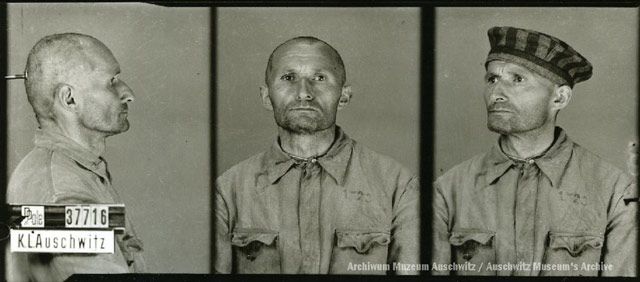
Auschwitz victim executed on 8 June 1942 worldwartwo.filminspector.com
Polish teacher Władysław Dobija, executed at Auschwitz on 8 June 1942 (Auschwitz Memorial). 

Battle of the Atlantic: U-135 (Kptlt. Friedrich-Hermann Praetorius), on its third patrol out of Brest, torpedoes and sinks 4549-ton Norwegian freighter Pleasantville 200 miles northwest of Bermuda. There are two dead and 45 survivors, 10 of whom who are picked up about 24 hours later by freighter Chickasaw City while the remaining 35 are picked up by freighter Paderewski on 11 June.

U-504 (KrvKpt. Hans-Georg Friedrich Poske), on its third patrol out of Lorient, uses its deck gun to sink 3901-ton Honduran freighter Tela in the Gulf of Mexico near Rio Bravo. The ship sinks by the stern within five minutes There are 11 dead and 43 survivors, who abandon ship in two lifeboats and two rafts and are picked up twelve hours later by freighter Port of Montreal. Their adventure is not over, as U-68 sinks Port of Montreal in turn on 10 June 1942, during which two of the Tela survivors perish.

U-504 also uses its deck gun to sink 1512-ton British freighter Rosenborg in the same general area east of the Yucatan Peninsula. This is after Poske misses with two torpedoes. He must use 60 shots to sink the ship. There are four dead and 23 survivors, who are picked up by Norwegian freighter Geisha.

U-172 (Kptlt. Carl Emmermann), on its second patrol out of Lorient, torpedoes and sinks 1654-ton US freighter Sicilien 10 miles south of Cape Beata, Dominican Republic. There are 46 dead and 31 survivors, who get in rafts and make it to Barahona, Dominican Republic.

U-128 (Kptlt. Ulrich Heyse), on its third patrol out of Lorient, torpedoes and sinks 9234-ton Norwegian tanker South Africa 400 miles east of Trinidad. The ship breaks in two and sinks within two minutes. Survival is made difficult due to the tanker's full load of 9614 tons of lube distillate and 4146 tons of diesel oil. Heyse surfaces and points out a man in the water that the lifeboats then pick up, gives the men some cans of bread and two bottles of rum, and directs them toward land. There are six dead and 36 survivors in two lifeboats. The subsequent sequence of events almost defies belief. One lifeboat (14 men) is spotted by freighter Plaudit, but the men refuse rescue after getting some supplies because it is heading to Pernambuco on 12 June and sail on toward Trinidad. They then decline another rescue offer from sailing vessel Minnie M. Mosher before making landfall at Galara Light (Toko Bay) on 16 June. The other lifeboat (25 men) is spotted by tanker Acastra on 12 June, but the men also refuse rescue after taking on supplies because it is heading for Freetown. They also decline an offer on the 13th from Argentinian tanker 13 de Diciembre after taking on supplies. They are picked up by an American seaplane tender on 14 June 45 miles east of Trinidad.

U-107 torpedoes and sinks 3249-ton US freighter Suwied 140 miles southeast of Cozumel Island. the ship sinks within three minutes, preventing a distress call. There are six dead and 33 survivors, who are picked up by USCGC Nemesis (WPC 111) after 19 hours. Some sources place this sinking on 7 June 1942, where I also discuss this sinking.

British patrol boat HMT Catherine founders off Scapa Flow. Casualties are unknown.
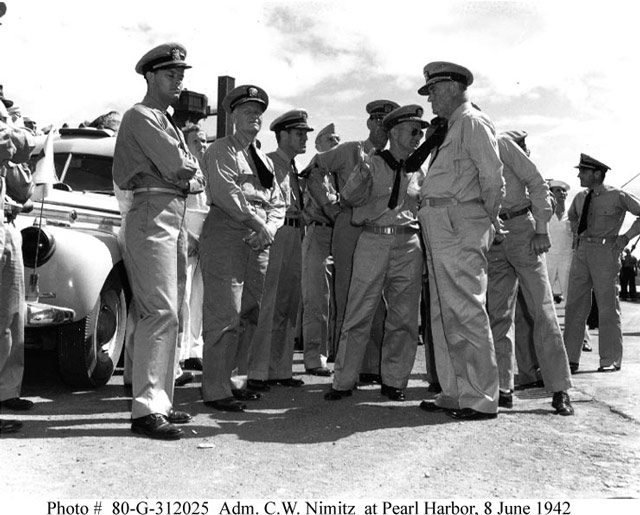
Admiral Chester Nimitz and his staff on 8 June 1942 worldwartwo.filminspector.com
Admiral Chester Nimitz (second from left) and his party await the arrival of survivors of USS Yorktown aboard Fulton (As-11), 8 June 1942. Also visible are Rear Admiral William L. Calhoun in the right front and Rear Admiral Lloyd J. Wiltse, of Nimitz' staff, in the center background (Naval History and Heritage Command 80-G-312025).

Battle of the Mediterranean: The situation in Libya remains unchanged today. The Germans continue their attack on the fortress of Bir Hakeim but make no progress, while the British 7th Motor Brigade and 29th Indian Infantry Brigade attempt raids on the Axis supply lines.

Time is on General Erwin Rommel's side because the Free French at Bir Hakeim cannot be resupplied and they are running low on everything. Today, Rommel personally leads an attack on the fortress from the north beginning at 10:00, supported by a massive Luftwaffe assault by 45 Ju 87 Stukas, 3 Junkers Ju 88 medium bombers, and ten Messerschmidt Me-110 fighter-bombers escorted by 54 Bf-109 fighters (3 losses two German and one Italian).

While the attack continues throughout the afternoon supported by another attack by 60 Stukas, the defenses hold. The British Desert Air Force (DAF) flies 478 sorties (8 fighter losses) during the day and drops supplies to the garrison after dark. The Italian Macchi C 202 fighters are particularly effective, shooting down three RAF planes.

In a friendly fire incident, the Italian submarine Alagi (Cdr Serio Puccini) spots a convoy 20 nautical miles north of Cape Bon, Tunisia. Captain Puccini assumes it is an Allied one, but it is a typical Axis convoy from Naples to Tripoli. Puccini fires three torpedoes and sinks 5085-ton Italian destroyer Antoniotto Usodimare. There are 141 killed and 165 survivors. This sinking is sometimes listed as occurring on 8 August 1942.

U-83 (Kptlt. Hans-Werner Kraus), on its eighth patrol out of Salamis, gets two victories today. First, it uses its deck gun to sink 100-ton Palestinian sailing ship Esther six miles northwest of Sidon, Lebanon. There are no survivors.

U-83 then uses its deck gun to sink 231-ton Egyptian freighter Said 15 miles southwest of Jaffa. This is after U-83 missed with two torpedoes, and it takes 50 rounds to sink the ship. There are five dead and nine survivors.
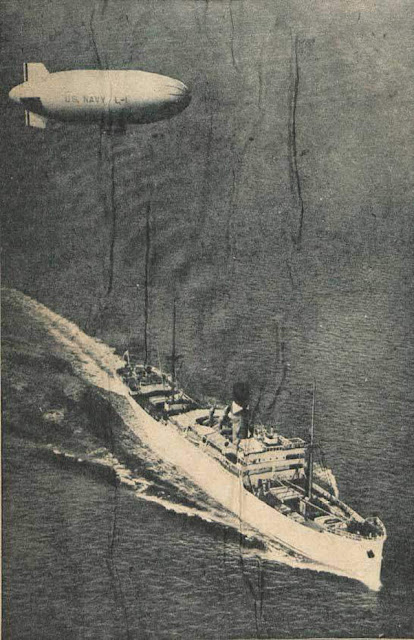
A US Naval blimp of the type involved in a fatal crash on 8 June 1942 worldwartwo.filminspector.com
US Navy blimp L-1. This is of the same class as L-2, which crashed in a fatal accident on 8 June 1942. It is shown above Panamanian freighter Musa.

US/Soviet Relations:  Soviet Ambassador to the United States Maxim M. Litvinov informs Harry Hopkins that the Soviet Union is agreeable to the establishment of a Lend-Lease air corridor between Alaska and Siberia. Since Japan is not at war with the USSR, it could not interfere with such flights without instigating a conflict with the Soviets.

US Military: The European Theater of Operations, United States Army (ETOUSA) is formed by the Department of War, though it doesn't begin operation officially until 4 July 1942. Its organizational divisions are Army Ground Forces (AGF), United States Army Air Forces (USAAF), and Army Service Forces (ASF) operations north of Italy and the Mediterranean coast. It replaces United States Army Forces in the British Isles (USAFBI) and its first commander for a brief period of time is Maj. Gen. James E. Chaney. The AGF currently has the 34th Infantry Division in Northern Island, which has released British troops from duties by patrolling the border between British Northern Ireland and the neutral Irish Free State.

Brigadier General Howard C Davidson, commander of VII Fighter Command, is promoted to Commanding General, 7th Air Force.

Canadian Military: Royal Canadian Air Force's No. 111 (Fighter) Squadron flies its Curtiss P-40 Kittyhawk fighters to Elmendorf Field, Alaska. This is part of the RCAF effort to reinforce Allied defenses on its western flank.

German Homefront: Following the elaborate funeral of Reinhard Heydrich on 7 June 1942, the Prague authorities embark on vicious reprisals. The Gestapo, with little to go on, receives a spurious report that the small town of Lidice is the hiding place of Heydrich's assassins and plans an operation to destroy it. This report is based on nothing but the town's reputation as the home of some Czech army officers who are now in hiding in Great Britain. A radio transmitter belonging to the Silver A team (a three-man Allied infiltration team that supported Operation Anthropoid, the assassination of Heydrich) is found in the village of Ležáky and so it, too, is targeted. Heydrich's two assassins, Jozef Gabčík and Jan Kubiš, remain at large shuttling between safe houses in Prague. A second Heydrich funeral is scheduled for Berlin on 9 June.
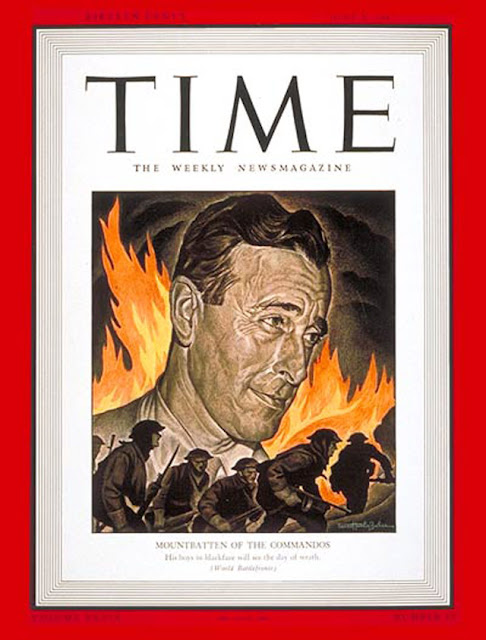
Time magazine 8 June 1942 worldwartwo.filminspector.com
"Mountbatten of the Commandos" is on the cover of the 8 June 1942 Time magazine (cover credit: Ernest Hamlin Baker).

British Homefront: The Guardian publishes an editorial today noting increasingly harsh living conditions in the Reich "since last winter." Its main theme is that "since last autumn’s clear failure to “annihilate” the Russians, the German civilian front has been increasingly tired and dispirited." This reflects the wishful thinking of RAF Bomber Command led by General Arthur"Bomber" Harris, who believes that his forces can crush the Reich from the air by destroying its people's will to fight. In this sole and strict sense, the Allied bombing campaign is proving to be a massive failure, as people in Germany may be down but the bombing is not making them demand surrender as they did in 1918.
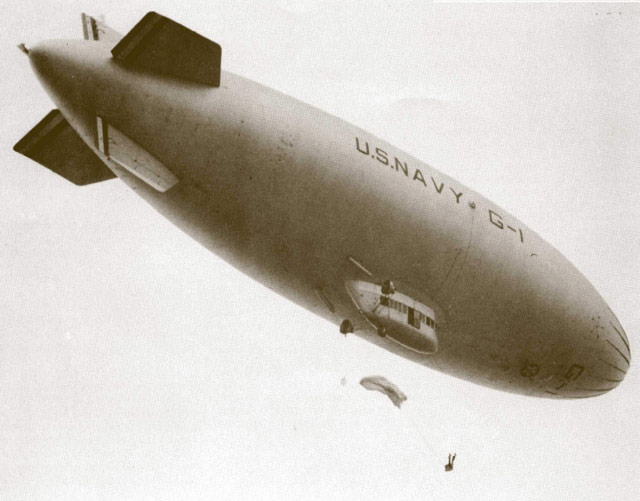
Naval airship G-1, involved in a fatal crash on 8 June 1942 worldwartwo.filminspector.com
US Navy Airship G-1, involved in a fatal crash on 8 June 1942. It is shown dropping a parachutist.

American Homefront: During the night, two U.S. Navy airships (G-1 and L-2) collide five miles north of Manasquan, New Jersey, while performing experimental visual and photographic reconnaissance at 400 feet. Twelve men, naval personnel and civilian technicians, perish. The blimps fall into the sea and only the co-pilot of L-2, Ensign Howard Fahey, survives. Only three bodies are recovered.

Due to the victory at the Battle of Midway, the US government cancels the invasion alert for the West Coast.

Bing Crosby makes a new recording of "Silent Night," which he first recorded on 21 February 1935, for his holiday compilation album "Merry Christmas." This is one of four recordings Bing makes of the "Silent Night." One of the reasons Crosby keeps returning to the song is that the recordings are so popular that the music label, Decca, complains that repeated stampings quickly wear out the master tapes.

Model Jane Greer models women's uniforms in the 8 June 1942 issue of Life magazine (see below), posing in a "Nurse's Aide" uniform on the cover. Movie producer and inventor Howard Hughes spots her and decides to make her an actress. He signs her to a personal services contract, which was somewhat customary for actresses at the time but gave him inordinate control over her career which he fully exploited. This begins Greer's decades-long Hollywood acting career and a very turbulent relationship with Hughes wherein he alternately helps and hurts her career and personal relationships. Greer is best known for film noirs, particularly with RKO, such as "Out of the Past" (1947), "The Big Steal" (1949), "Run for the Sun" (1956), and "Man of a Thousand Faces" (1957). Greer passes away on 24 August 2001.

Future History: Peter Grimwade is born in Ayr, Ayrshire, Scotland, UK. he becomes a noted television director, particularly on the Doctor Who series in the early 1980s. He passes away on 15 May 1990.

Life magazine, 8 June 1942 worldwartwo.filminspector.com
Life magazine, 8 June 1942, features a "Nurse's Aid" on the cover. It is actually model Jane Greer, who parleys this break into a memorable acting career.


2021

Sunday, October 3, 2021

June 3, 1942: Start of Battle of Midway

Wednesday 3 June 1942

Dutch Harbor on fire, 3 June 1942 worldwartwo.filminspector.com
Fires burning at Dutch Harbor after the 3 June 1942 Japanese air raid (US Army).

Battle of the Pacific: At 09:04 on 3 June 1942, Ensign Charles R. Eaton, patrolling 470 miles from Midway Island, spots three Japanese ships. The Japanese quickly fire on him with anti-aircraft guns but he escapes and radios in his sighting. This is the first encounter of what will become the Battle of Midway.

At about the same time, another airman, Ensign Jack Reid, is patrolling 500 nautical miles (580 miles, 930 km) southwest of Midway in his PBY-SA when he also spots some ships in the distance. At 09:25, he radios in, "Sighted main body." He follows up with more details, ultimately reporting 11 ships at 11:00 before being ordered to return to base. Reid has not spotted the main Japanese force but rather transport ships commanded by Admiral Tanaka.

Lt. Col. Walter C. Sweeney leads a force of nine B-17 bombers stationed at Midway against the ships spotted by Reid at 12:30. Sweeney's force scores no hits and barely makes it back to Midway, landing at 21:45.

Another U.S. strike departs at 21:15, this time four PBY Catalinas bent on a night attack. Arriving over the target at 01:00 on 4 June, they score one hit on the Japanese force, a torpedo strike on the bows of tanker Akebono Maru that kills 13 sailors. Transport Kiosumi Maru also sustains some strafing damage that kills four crewmen. This attack features the only successful U.S. air-launched torpedo strike of the Battle of Midway.
Battle of Midway painting, 3 June 1942 worldwartwo.filminspector.com
"Battle of Midway, 3 June 1942" - "US Navy aircraft carrier USS Yorktown and its escorts defend themselves from incoming Japanese aircraft, one of which has splashed down into the ocean" (Rodolfo Claudus ca. 1950) (Naval History and Heritage Command).

The second prong of the Japanese strategy (Operation AL) is an invasion of some of the Aleutian Islands. The Americans know about this from their codebreaking but have concentrated the bulk of their naval forces at Midway. Planes from two light Japanese aircraft carriers (Ryujo and Junyo) under the command of Vice-Admiral Boshiro Hosogaya take off in a dense fog and rough seas to raid the Dutch Harbor Naval Operating Base and Fort Mears at Dutch Harbor on Amaknak Island, Alaska. Only about half of the planes make it to the target. Despite some heavy anti-aircraft fire, the Japanese Nakajima B5N, Navy "Kate," Bombers drop 16 bombs on Fort Mears, then get clean away before P-40s stationed at Cold Bay arrive. There are 25 dead and many other casualties, while the Japanese lose only one plane.

The attack on Dutch Harbor is only a distraction from the main Japanese objective in the Aleutians, which is to occupy islands Kiska and Attu further down the chain. During this raid, the Japanese planes sink the 3497-ton U.S. passenger ship Northwestern (no casualties). Japanese cruisers launch four Nakajima E8N2 Navy Type 95 reconnaissance seaplanes, Allied Code Name "Dave," to fly over Umnak, losing one to U.S. ground fire. A PBY-5A Catalina of VP-42 locates the Japanese ships, while the Japanese shoot down another PBY and take three of its crew as prisoners aboard the cruiser Takao. A Japanese "Zeke" bomber crashlands in a bog on Akutan Island and U.S. forces later recover it and the dead pilot.

The five Japanese submarines waiting off the coast of Australia near Sydney to pick up the crews of the mini-submarines that attacked Sydney Harbour give up hope and disperse. The mini-sub crews are all dead, though two men nearly made it to the rendezvous point before being killed by troops. I-24, one of these five submarines, then torpedoes and sinks 4812-ton Australian ore carrier Iron Chieftain in the Tasman Sea 35 miles east of Manly (there is a monument to the 12 dead crewmen of Iron Chieftain outside Newcastle railway station). There are 27 survivors. The sinking of Iron Chieftain helps lead to the formation of convoys along the Australian coast between New South Wales, Victoria, and South Australia.

I-20 is the last of the five Japanese submarines to depart from the recovery area. During the afternoon, it surfaces and fires flares and sends radio signals, but nobody appears. Finally, at 18:00, it, too, departs.

U.S. Navy 115-ton patrol boat Vagabond collides with patrol craft PC-569 while patrolling west of the Golden Gate Bridge and sinks. There are no casualties.

U.S. 16-ton fishing trawler sinks in Sitka Sound in the Alexander Archipelago in Southeast Alaska near Saint Lazaria Island off of Cape Edgecumbe in Kruzof Island. The cause of the sinking is unidentified, but it may be due to enemy action.

B-17 bombers of the 5th USAAF Air Force bomb Rabaul. They hit a wharf, a warehouse area, and a military camp.

Marines waiting out the bombing of Dutch Harbor, 3 June 1942 worldwartwo.filminspector.com
"Japanese attack on Dutch Harbor, June 3, 1942. Group of Marines on the "alert" between attacks. Smoke from burning fuel tanks in the background had been set afire by a dive bomber the previous day. Alaska." (National Archives 80-G-12076).

Battle of the Indian Ocean: The 10th USAAF Air Force sends 6 B-25s of the 11th Bombardment Squadron, 7th Bomber Group, from Dinjan, India, to bomb Lashio, Burma. They then continue on to Kunming in perhaps the first example of "shuttle bombing." The mission turns into a disaster when three bombers crash into the Himalayas at 10,000 feet in heavy overcast conditions and a fourth runs out of fuel and crashes near Chan-i, China. Only two of the bombers actually reach Kunming, where they are fired upon by Chinese fighter planes that have not been informed of the operation and one radio operator is killed..

At Diego Suarez, the British complete emergency repairs to the 30x30-foot hole blown in battleship HMS Ramillies from a mini-sub attack and it departs for more permanent repairs at Durban.
Finnish anti-tank gun being used, 3 June 1942 worldwartwo.filminspector.com
Finnish Lahti L-39 anti-tank gun in use on 3 June 1942 (Military Museum of Finland (Kuva)).

Eastern Front: The German artillery fire and air assault on Sevastopol continue today as the Germans try to weaken the Soviet defenses for a full-scale assault. The target area today for the rolling bombardment is the defensive area facing the German 30th Army Corps south of the city.

General Franz Halder at Fuhrer Headquarters notes in his war diary: 
The enemy has reacted to our artillery attack on Sevastopol with counterbattery fire. Work on fortification in progress. Ship movements. No important changes on the other fronts.
General von Manstein, commander of 11th Army, plans to begin his attack on Sevastopol (Operation Sturgeon Catch (Störfang)) on 7 June. He is quickly redeploying troops from the eastern half of Crimea, where some Soviet holdouts in caves are causing trouble, to the west to participate in the Sevastopol assault. It is a very peculiar situation for the Germans on the Eastern Front where the hot spot is to the west and not the east.

Oblt. Siegfreid Freytag of 6./JG 77 claims his 50th victory. He soon will transfer to the Mediterranean Theater.
Dutch Harbor fires, 3 June 1942 worldwartwo.filminspector.com
"Siems Drake warehouse afire, following the attack by Japanese carrier aircraft. Note fire fighting parties at work, and S. S. NORTHWESTERN burning at left." Dutch Harbor, 3 June 1942. (Naval History and Heritage Command 80-G-12056).

European Air Operations: The weather over the Channel Front is clear and warm. There are no major attacks today. RAF No. 403 Squadron (RCAF) moves from Southend to Martlesham. At RAF Chelveston, a small Hotspur glider of the Airborne Forces Experimental Establishment (AFEE) 14th Operational Training Unit breaks up mid-air near Greetham Village, Ruland, and the crew bales out (one killed and one uninjured).
Ore freighter City of Alma, sunk on 3 June 1942 worldwartwo.filminspector.com
U.S. ore freighter City of Alma, sunk by U-172 on 3 June 1942.

Battle of the Atlantic: U-404 (Kptlt. Otto von Bülow), on its third patrol out of Brest, torpedoes and sinks 1345-ton Swedish freighter Anna 210 miles northwest of Bermuda. Von Bülow begins his attack with two torpedoes at 03:09 and 04:50 but misses with both. Finally, at 05:10, he surfaces and uses his deck gun. The attack is a little controversial because von Bülow's crew clearly sees Swedish (neutral) markings, but he decides to attack anyway because the ship is acting suspiciously (zig-zagging and without navigational lights). There are no dead among the 32-man crew, though two men are wounded in the attack. The survivors take to the boats and are picked up within 13 hours by Swiss freighter Saentis, which also picks up survivors of freighter West Notus, sunk by the same U-boat on 1 June.

U-172 (Kptlt. Carl Emmermann), on its second patrol out of Lorient, torpedoes and sinks the 5446-ton U.S. freighter City of Alma 400 miles northeast of San Juan, Puerto Rico. The ship is carrying manganese ore and sinks within three minutes. The radio operator remains on board to send a distress call but the ship sinks so quickly that he goes down with the ship without sending any messages. There are 29 dead and 10 survivors, who survive in a lifeboat and are picked up by U.S. patrol boat USS YP-67. Third Mate Hugh Parks Brown, Jr. the Merchant Marine Distinguished Service Medal for saving other crewmen.

U-156 (Kptlt. Werner Hartenstein), on its third patrol out of Lorient, stops 80-ton British schooner Lillian near Grenada and Barbados (40 miles south of Barbados) after the ship first ignores a command to stop (warning shot through the rigging). A few crew remain aboard the ship and attempt to sail away while others take to the boats. The U-boat chases the fleeing ship after questioning the men in the boats and finally sinks it with gunfire. Hartenstein apparently uses the incident for target practice, or maybe he is just angry (and tired, as he already has sunk or damaged 11 ships on this patrol), as he uses an astounding 52 rounds of 37mm and 270 rounds of 20 mm) to sink the wooden ship. There are three dead and 22 survivors.

U-502 (Kptlt. Jürgen von Rosenstiel), on its fourth patrol out of Lorient, torpedoes and sinks 6940-ton U.S. freighter M.F. Elliott 150 miles northwest of Trinidad (west of St. George's Island). The ship, carrying just water ballast, sinks within six minutes. There are 13 dead and 32 survivors, who are picked up by Brazilian tanker Santa Maria after five days adrift.
Die Wehrmacht magazine, 3 June 1942 worldwartwo.filminspector.com
Die Wehrmacht Magazine, 3 June 1942.

U-432 (Kptlt. Heinz-Otto Schultze), on its fifth patrol out of La Pallice, spots two fishing trawlers 170 miles east of Thatchers Island in the Bay of Fundy (northeast of Boston) and surfaces. After allowing the crewmen to leave their vessels, Schultze uses his deck gun on the trawlers. Sunk are 41-ton Aeolus and 102-ton Ben and Josephine. All of the fishermen (14 men total) survive, making landfall at Mount Desert Coast Guard Light Station after 36 hours.

U-126 (Kptlt. Ernst Bauer), on its fourth patrol out of Lorient, torpedoes and sinks 10,990-ton Norwegian tanker Høegh Giant 400 miles east of Guiana. Bauer attacks at 11:24 and hits with one of three torpedoes, but the ship continues sailing. He then surfaces, but the tanker crew use the deck gun to fire at the U-boat, forcing Bauer to submerge and chase it. A long ordeal results, with Bauer finally getting into firing range at over 14 hours later 01:40 on 4 June. Two torpedoes hit, and the crew abandons the ship. The tanker finally sinks at 04:24 after Bauer has to fire a coup de grâce. Bauer clearly is furious about the entire incident. He surfaces and, when he does not get the answers he wants from the men in the lifeboats, he has his men fire over the boats, wounding one survivor with a stray bullet. The survivors spend at least ten days at sea, with most landing at Devil Island after ten days and the rest being picked up after 15 days. While the survivors are being transported to New Orleans aboard freighter Robert E. Lee, that ship also is sunk (by U-166), but all the survivors of Høegh Giant survive that sinking, too.

U.S. 5686-ton freighter Steel Worker hits a mine and sinks 3000 yards from Mishayampi, Murmansk. The ship has traveled all the way from Philadelphia with foodstuffs only to be sunk less than two miles from its destination. There are no casualties.

German Navy whaler V-1510 Unitas VI, being used as a patrol boat, strikes a wreck and sinks at the entrance of Dieppe, France. No known casualties. This incident is sometimes claimed to have occurred on 2 June 1942.

RAF Vickers Wellington bombers of No. 172 Squadron damage Italian submarine Luigi Torelli near Aviles, Spain. The ship is towed to Aviles and beached. After temporary repairs, it is refloated and taken to Spain for permanent repairs.

Damaged freighter Orari being patched at Malta, 3 June 1942 worldwartwo.filminspector.com
Freighter Orari having a temporary patch installed at Malta on 3 June 1942. © IWM A 10774.

Battle of the Mediterranean: German General Erwin Rommel and the bulk of the Afrika Korps remain bottled up in The Cauldron, a defensive position west of Tobruk. However, while no longer on the offensive, they now have cleared supply lanes to the west and are receiving reinforcements. The siege of Free French forces at the fortress of Bir Hakeim continues with little change in the situation today as the Axis forces bombard the entrenched French with artillery and Luftwaffe attacks.

The air war is going surprisingly poorly for the RAF. The pilots of III./JG 53 claim three victories over the British in the vicinity of El Alamein. One of the issues is that the Luftwaffe has brought elite units to North Africa.

Air activity over the front is ferocious. Oblt. Hans-Joachim Marseille of 3./JG 27 claims 6 Tomahawks of SAAF No. 5 Sqdn. and damage to two others in 12 minutes. Among his victims is an ace with five victories, Captain Botha, who himself had just shot down three Junkers Ju-87 Stuka dive bombers. Marseilles and the other planes clear the skies, opening them up for more Stuka attacks on Bir Hakeim. Joachim Marseilles now has 75 victories and will receive the Eichenlaub (oak leaves) to his Iron Cross on 6 June as a reward. He quickly is becoming a legend, and one of the men in his unit, Hans-Arnold Stahlschmidt, writes in a letter home, "Marseille is able to shoot like a young God. Above all, he is able to do what only a few can - to shoot with perfection while turning."

U-331 (Kptlt. Hans-Diedrich Freiherr von Tiesenhausen), on its seventh patrol out of Messina, torpedoes and sinks Royal Navy trawler HMT Cocker off Bardia, Libya. There are 15 missing/dead, with one wounded man (Ty/Lt D M Engeler RANVR) surviving.

Battle of the Black Sea: German Navy ferry barge (Marinefahrprahm) F 145 hits a mine and sinks in the Black Sea southeast of Odesa. there are nine deaths.
Greek freighter Pindos being commisssioned, 3 June 1942 worldwartwo.filminspector.com
Greek destroyer Pindos being commissioned at Swan Hunters, Wallsend on Tyne, 3 June 1942. © IWM A 8677.

Special Operations: British special forces (No. 6 Commando) stage an overnight raid on the German radar site at Plage-Ste-Cecile, France (between Le Touquet and Boulougne). This is Operation Bristle, one of a number of Commando missions during 1942 designed to give the special forces training and experience. The Germans, however, prevent the Commandos from achieving their objectives. Empty-handed, the Commandos depart and are still at sea at dawn when the Luftwaffe appears overhead and causes damage to two motor launches and a motor gunboat. One Commando and two naval personnel are killed and 19 others are wounded. The force manages to make it back to port only due to the fortuitous arrival of RAF forces to scatter the attacking Luftwaffe planes.

Reinhard Heydrich, shot by British/Czech Special Operations Executive agents on 27 May during Operation Anthropoid, appears to be recovering from the attack when he suddenly collapses while eating lunch around noon. He lapses into a coma from which he never recovers. One theory is that this relapse is caused by a systemic infection, another by a pulmonary embolism.

New Auschwitz prisoner on 3 June 1942 worldwartwo.filminspector.com
Chaskel Bittner, shown, is transferred from Montelupich prison in Cracow to Auschwitz on 3 June 1942. Bittner becomes No. 37249. He perishes at the camp on 26 June (Auschwitz Memorial).

British Homefront: The British government nationalizes the milk industry and coal mines.

American Homefront: The Rodgers & Hart (Richard Rodgers and Lorenz Hart) musical "By Jupiter" premieres at the Schubert Theater on Broadway. Starring Ray Bolger and Vera-Ellen, the play is set in the land of the Amazons, who do battle with a Greek army led by Theseus and Hercules and then engage in romantic complications. Nanette Fabray later joins the cast. The play is a big hit and runs for 427 performances until 12 June 1943. While little remembered, "By Jupiter" is Rodgers and Hart's longest-running Broadway hit and final original full-length work.

Future History: Curtis Lee Mayfield is born in Chicago, Illinois. He begins a musical career in a gospel choir, then joins the vocal group The Impressions in the mid-1950s. He also becomes a songwriter, including the hit "People Get Ready" in 1965. Mayfield turns solo in 1970 and engages in various projects, including creating the soundtrack to the film "Super Fly" in 1972. While performing in 1990, Mayfield is paralyzed during an accident involving lighting equipment, but he continues recording. Curtis Mayfield passes away on 26 December 1999.
Flak guns shown in the 3 June 1942 Die Wehrmacht magazine worldwartwo.filminspector.com
Flak batteries shown in the 3 June 1942 Die Wehrmacht Magazine.


2021

Saturday, September 25, 2021

May 29, 1942: Japanese at Madagascar

Friday 29 May 1942


USS Yorktown in dry dock, 29 May 1942 worldwartwo.filminspector.com
USS Yorktown in Dry Dock #1 of the Pearl Harbor Navy Yard, 29 May 1942 (Naval History and Heritage Command 80-G-13065).

Battle of the Pacific: Frantic repairs on USS Yorktown in a Pearl Harbor drydock continue on 29 May 1942 as two other US aircraft carriers, Enterprise and Hornet, approach Midway Island. The US Navy has only one other aircraft carrier in the Pacific, Saratoga, but it is undergoing repairs at San Diego and is unavailable for the expected battle about to occur at Midway.

US Navy submarine tender Thornton (AVD-11) arrives at the French Frigate Shoals to relieve minelayer Preble (DM-20). The Americans know that the Japanese have been using this location as a staging location for attacks on Hawaii. Japanese submarine I-123 arrives late in the day with fuel for a reconnaissance plane that is scheduled to arrive soon but is unable to set up the operation due to the US presence.

US Navy seaplane tender Ballard (AVD-10) arrives at Midway with eleven motor torpedo boats (PT boats) of Motor Torpedo Boat Squadron MTBRon 1 (Lt. Clinton McKellar Jr.). They are there to supplement the local defense forces, which are under the command of Captain Cyril T. Simard.

Japanese naval intelligence (COMINT) is monitoring US naval communications and suspects from radio chatter there that a US naval task force has departed recently (TF 16 recently left for Midway). Admiral Yamamoto's strict radio silence order, however, prevents this information from being forwarded to Admiral Nagumo, whose carriers are approaching Midway.

Admiral Yamamoto sails out of the inland sea today with a support force for the Midway operation. His radio intelligence has identified six US Navy submarines nearby, but none are spotted.

US Navy submarine USS Swordfish (Lt Cdr Chester C. Smith SS-193) attacks a Japanese army convoy at the southwestern entrance to Balabac Strait, Philippines. It sinks 1946-ton freighter Tatsufuku Maru. Swordfish also damages freighter Rio de Janeiro Maru.

PBY-5 Catalinas based at Noumea, New Caledonia join RAAF Catalinas in bombing Tulagi Island, the site of a Japanese seaplane base near Guadalcanal in the Solomon Islands.

Japanese submarine I-21 launches its E14Y "Glen" seaplane for an uneventful reconnaissance mission over Sydney, Australia.

HMS Illustrious, 29 May 1942 worldwartwo.filminspector.com
"The aircraft carrier HMS ILLUSTRIOUS is seen ahead of HMS WARSPITE." The photo was taken in the Indian Ocean on 29 May 1942. (© IWM A 10655).

Battle of the Indian Ocean: A large Japanese submarine force takes up station off Madagascar after a long and arduous journey across the Indian Ocean. They are there to launch mini-submarines to attack the British Far Eastern Fleet. This is "Divine Dragon Operation No. 2."

I-10 launches its E14Y "Glen" floatplane (crewed by Lt. (j.g.) Araki Toshio and Ito Yoshiharu) for a reconnaissance mission above the harbor at Diego Suarez. The men spot numerous targets in the harbor, including battleship HMS Ramillies and numerous destroyers, corvettes, troopships, a tanker, an ammunition ship, a freighter, and a hospital ship. Three submarines - I-16, I-18, and I-20 - attempt to launch a mini-sub attack today, but only two of the mini-submarines are launched properly. The other two proceed toward the harbor.

Unlike many other such flights, the British spot this one and sound the alert. The British battleship quickly changes its anchorage in the harbor. After the floatplane returns, I-10 Captain Ishizaki orders a mini-submarine attack of his own for 0230 on 31 May.

Four B-17 bombers of the 10th Air Force bomb Myitkyina Airfield in Burma.

Eighteen Japanese Zeros and 17 P-39 Aircobras have a furious dogfight over Hood Bay southeast of Port Moresby. The Japanese lose four planes to one P-39F. One of the Japanese pilots crash-lands and is shot and killed while resisting arrest.

USS Quincy in NYC, 29 May 1942 worldwartwo.filminspector.com
Heavy cruiser USS Quincy (CA-39) at the Brooklyn Navy Yard, 29 May 1942.

Eastern Front: The German victors at Kharkov count Soviet prisoners as mass surrenders continue. At Fuhrer Headquarters, General Franz Halder writes simply, "All quiet along the entire front (including Byeloi)."

European Air Operations: Despite continued poor weather, the RAF sends planes on patrols late in the day. RAF planes bomb and sink 1839-ton Danish (German) freighter Niels R. Finsen, carrying a load of coke, west of Borkum. They also sink 750-ton German minesweeper Sperrbrecher-150 (Viriato) near the Dutch West Frisian island of Ameland. The RAF planes also sink 285-ton German patrol boat V-1103 off Ameland (three deaths). An RCAF sweep over Cap Gris-Nez to Dunkirk encounters heavy flak.
British freighter Allister, sunk on 29 May 1942 worldwartwo.filminspector.com
British banana boat Allister, sunk on 29 May 1942.

Battle of the Atlantic: As it continues toward the Soviet Union, Convoy PQ-16 divides in half with six ships making for Archangel and the rest for Murmansk. The Germans, having sunk seven of its ships, have no more success against it.

U-504 (KrvKpt. Hans-Georg Friedrich Poske), on its third patrol out of Lorient, torpedoes and sinks 1597-ton British banana boat Allister 54 miles south of Grand Cayman Island. The ship breaks in half and sinks quickly. There are 15 dead and 8 survivors, who spend eight days at sea before being picked up by an unidentified passing ship and landed at Port au Prince, Haiti.

U-156 (Kptlt. Werner Hartenstein), on its third patrol out of Lorient, torpedoes and sinks 1913-ton British freighter Norman Prince 70 miles west of Martinique. Hartenstein chased the ship for eight hours before getting into firing position. There are 16 dead and 33 survivors, who are picked up by Vichy French freighter Angoulême and interned at Martinique. While on the island, they meet Lt.z.S Dietrich von dem Borne, who was injured in a gun explosion on U-156 in February and put ashore for humanitarian reasons. One survivor clings to a door for three days before being picked up by USCGC Unalga (WPG 53).

U-107 (Kptlt. Harald Gelhaus), on its sixth patrol out of Lorient, torpedoes and sinks 2599-ton British freighter Western Head in the Windward Passage 50 miles east of Guantanamo Bay, Cuba. There are 24 deaths and six survivors, who are picked up by a US Navy patrol ship and taken to Guantanamo Bay.

Italian submarine Barbarigo, on patrol in the South Atlantic near Brazil, torpedoes and uses its deck gun to sink 4836-ton British freighter Charlbury.

German 750-ton Sperrbrecher (literally, mine barrage breaker, or minesweeper)  150 Viriato hits a mine and sinks off Dunkirk.
Kansas City Star, 29 May 1942 worldwartwo.filminspector.com
Kansas City Star, 29 May 1942. One of the headlines states, "Smash Deep Axis Thrust" at Tobruk, which is a bit of an overstatement.

Battle of the Mediterranean: With the Afrika Korps advance into the British Gazala Line stalled at Bir Hakeim, badly needed supply trucks of the Trieste and Ariete divisions reach the Axis forces after clearing a path through minefields. The British Desert Air Force (DAF) is active, intercepting two raids by Luftwaffe Junkers Ju 87 Stuka dive-bombers and also attacking Axis supply vehicles.

The Free French men in the fortress of Bir Hakeim also need supplies. However, the Axis forces have them surrounded and one breakout attempt already has failed. A detachment led by Capitaine Gabriel de Sairigné sorties out and destroys three German tanks today.

General Erwin Rommel, having lost the initiative and still facing supply issues, cleverly uses Allied minefields to protect his flanks and assumes a defensive posture even as his forces continue to reduce Bir Hakeim. Uncoordinated British attacks achieve nothing. A British armored brigade attacks the Ariete Division near the fortress, but the Italians beat them off. This becomes known as "The Cauldron."

British destroyers HMS Hero, Eridge, and Hurworth, after being alerted to a U-boat's presence by a patroling Blenheim bomber of RAF No. 203 Squadron, use depth charges to sink U-568 (Kptlt. Joachim Preuss), on its fifth patrol out of La Spezia, northeast of Tobruk. All 47 crewmen survive.

British submarine Turbulent has a big day, sinking two ships. It torpedoes and sinks 3175-ton Italian freighter Capo Arma 70 miles northwest of Benghazi. Casualties are unknown.

Turbulent also torpedoes and sinks Italian destroyer Emanuele Pessagno 85 miles northwest of Benghazi. There are 140 deaths and 85 survivors.

Italian 1160-ton freighter Penelope, torpedoed on 19 May 1942 by British submarine Thrasher, finally sinks.

Supermarine Wlarus, 29 May 1942 worldwartwo.filminspector.com
"A Supermarine Walrus taxiing up to WARSPITE after returning from anti-submarine patrol. In the background are HMS ILLUSTRIOUS and the destroyer HMS LOOKOUT, 29 May 1942." Note the crewman on top of the plane to attach the hook to lift it.

Battle of the Black Sea: Soviet submarine SHCH-214 rams and sinks 90-ton Turkish sailing vessel Hudavendiar east of Cape Igneada, Turkey. This is one of several sinkings of neutral Turkish vessels in the Black Sea during 1942, but they do not provoke a diplomatic crisis.

Soviet submarine A-3 torpedoes and sinks 3595-ton Romanian freighter Sulina off Odessa.

Partisans: Reinhard Heydrich remains in critical care in a Prague hospital following an assassination attempt by British/Czech agents. Heinrich Himmler's personal physician, Dr. Karl Gebhardt, assumes responsibility for Heydrich's care, which includes large doses of morphine for the pain. Gebhardt does not (according to his own account) administer the antibacterial drug sulfanilamide despite its recommendation by Hitler's personal doctor, Theodor Morell.
Newlywed in Ann Arbor, Michigan, 29 May 1942 worldwartwo.filminspector.com
A newlywed, Mrs. Robert Cramer, in Ann Arbor, Michigan, 29 May 1942 © The Ann Arbor News.

German Military: Adolf Hitler issues Fuhrer Directive No. 42. This cancels Operation Isabella, a wishful plan to invade Spain and Portugal. It also refines a projected plan to invade Vichy France, Operation Attila, and replaces it with Case Anton (which ultimately is executed). Fuhrer Directive No. 42 is issued due to a "continual shifting of our forces in the West." It suggests that Spanish leader Francisco Franco's appeasement of Hitler by sending troops to the Eastern Front is working and that he views the lukewarm support offered by the Vichy government and French partisan activities as a growing nuisance.

The directive also states that "The Italians may also, if the situation requires, have to take action in Tunisia." The situation will require this later in 1942, but the Germans will take care of matters themselves.

Australian Military: Today is the first flight of the Commonwealth Aircraft Corporation CA-12 Boomerang fight. It is the only Australian-produced plane of World War II.

Holocaust: The Germans extend their requirement that Jews over six years of age wear a yellow badge to Paris. This is the eighth German decree on the subject of anti-Jewish measures and comes into effect on 7 June 1942.

US Army soldiers, 29 May 1942 worldwartwo.filminspector.com
African-American US Army 2nd lts. Henry Harris, Frank Frederick Doughton, Elmer B. Kountze, and Rogers H. Beardon pinning on their new brass rank insignias, Ft. Benning, Georgia, US, 29 May 1942 (National Archives).

American Homefront: Warner Bros. premiere "Yankee Doodle Dandy" in New York City. Featuring songs by George M. Cohan and starring James Cagney, Joan Leslie, and Walter Huston, the film is a huge success and the company's biggest box-office success to date. Cagney wins the Academy Award for Best Actor, and the film wins other awards for its music and sound recording. Congress selects it for preservation in 1993. In a patriotic gesture, Warner Bros. sells war bonds for entrance to the premiere ranging in value from $25 to $25,000.

Future History: Actor John Barrymore, born John Sidney Blyth in Philadelphia, Pennsylvania (and buried there), passes away in Los Angeles, California from illness. Barrymore is known as one of the great stage and film actors of the early 20th Century and is sometimes referred to as "The Great Barrymore." However, he is probably best remembered most these days for his wildly eccentric life that involved alcoholism, bankruptcy, four marriages, and a life largely led in the pages of tabloid magazines. He also founds the "Barrymore family of actors" that continues down to the present day with his granddaughter, Drew Barrymore.

Yosano Akiko passes away in Tokyo, Japan, from a stroke. She is remembered as a poet and feminist. While sometimes called a pacifist, in fact, many of Akiko's later works support the wars against China, the United States, and the United Kingdom. One of her poems even praises Bushido, or the samurai code urging men to die in battle for the Emperor. Akiko has enjoyed a resurgence in popularity in recent years.

Traffic accident in San Francisco, 29 May 1942 worldwartwo.filminspector.com
A traffic accident at Folsom and Army Streets in San Francisco, 29 May 1942 (San Francisco Police Department Photograph Bureau Negatives / Bureau of Accident Investigation and Prevention, San Francisco Police Department Records, via San Francisco Public Library).

May 1942


2021