Showing posts with label USS Saratoga. Show all posts

Friday, December 24, 2021

June 11, 1942: U.S-Soviet Lend-Lease Agreement

Thursday 11 June 1942
Rommel in North Africa worldwartwo.filminspector.com
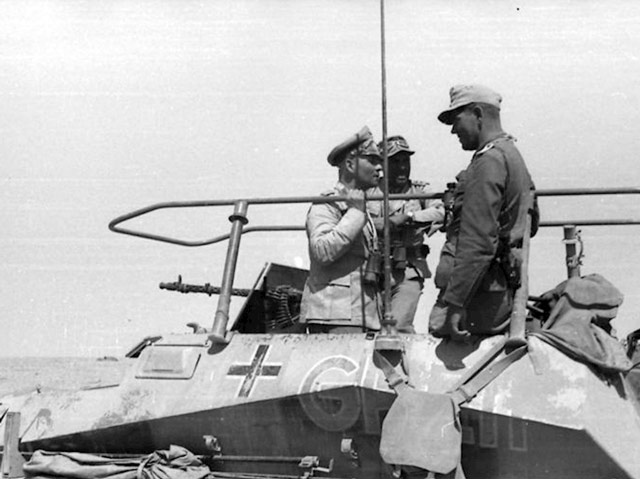
German General Erwin Rommel in his command vehicle in North Africa, 11 June 1942 (Zwilling, Ernst A., Federal Archive Image 101I-443-1589-08).

Eastern Front: General Erich von Manstein's 11th Army continues battering away at Red Army defenses outside Sevastopol, Crimea, on 11 June 1942. His troops of the LIV Corps are having the most success north of the port, where the heaviest German artillery is located. The Soviet 345th Division counterattacks on the borderline between the Wehrmacht 132nd and 50th Divisions, but quick Luftwaffe intervention (1070 sorties while dropping 1000 tons of bombs today) prevents a rupture. The Red Army and LIV Corps, however, continue taking heavy casualties.

While progress is still being made at Sevastopol, the local commanders are getting concerned at the high cost of the small local gains. Luftwaffe General Wolfram von Richthofen, in command at Fliegerkorps VIII, comments sourly in his war diary that his forces have "only enough left for 1.5 more days of bombing." His mood is black, and he adds that "the specter of failure now seriously looms." On the spur of the moment, Richthofen decides that his bombers are dispersing their efforts too widely. He thus changes bombing procedures to conserve resources. The new tactic of "column bombing" involves bomber attacks on only specifically designated targets while the aircraft fly one after another in narrow air corridors.

The Red Air Force also is proving to be a nuisance, though not to the Luftwaffe. Instead, the Soviets are making nightly raids on German positions in the "rear" to the east at places like Simferopol, Theodosiya, Eupatoria, and Yalta. The Luftwaffe can see the attacks coming on their radar but do not have any night fighters to intercept them. Fortunately for the Germans, the Red Air Force bombing runs are very inaccurate, so the raids for the most part are ineffective.

Off the Crimean coast, a mini-war at sea also is brewing. The Soviets are running fast convoys to Sevastopol every night, and early in the morning, the Kriegsmarine decides to do something about it. For the first time, Axis small craft (MTBs and motorboats) manned by Italians attack a Soviet convoy near Cape Khersones. It is believed, but not absolutely certain, that they sink a Soviet ship.  

Back at Fuhrer Headquarters in East Prussia, General Halder also is getting impatient with Manstein's progress. He notes that the Soviet artillery at Sevastapol "is quite troublesome." However, further north, "The Voshansk attack is making very satisfactory progress." Meanwhile, the situation at Ninth Army is "unclear," with the Soviets "unaccountably" abandoning territory. This new Red Army tactic of not fighting for every inch of ground but instead trading space for time and tactical regrouping will befuddle and mislead the German High Command throughout the summer.

Battle of the Black Sea: Soviet submarine A-5 torpedoes and sinks 5695-ton Romanian freighter Ardeal off Odessa. Ardeal's captain beaches the ship to avoid sinking but is later repaired and returned to service.
British POWs in North Africa worldwartwo.filminspector.com
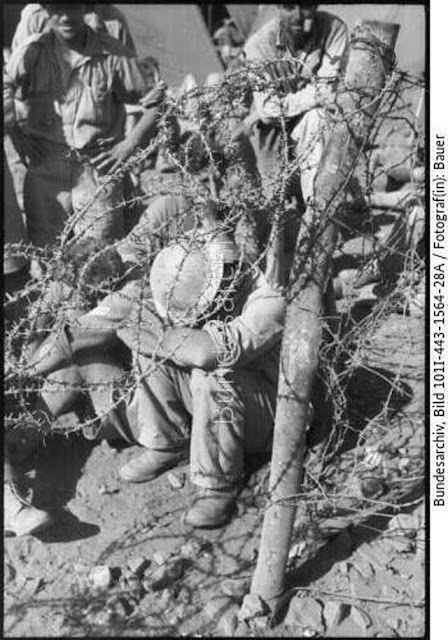
British POWs in North Africa, 11 June 1942 (Farmer, Federal Archive Image 101I-443-1564-28A).

Battle of the Pacific: USS Saratoga rendezvouses with fellow carriers Enterprise and Hornet. It transfers 19 SBD Dauntless, five TBD Devastator of VT-5, and 10 VT-8 Avenger planes to the two other carriers to replace their losses at the Battle of Midway. The ships then turn head to Pearl Harbor in foul weather.

Reinforcements for the Pacific Fleet are on the way. USS Wasp and battleship North Carolina, along with escorting destroyers, pass through the Panama Canal. Battleships just barely fit through the channel with mere feet (sometimes only inches) to spare on each side. The Japanese know the importance of the Canal and have plans to block it throughout the war.

The U.S. 11th Air Force make their first attack on the Japanese on Kiska Island in the Aleutian chain. The attack is made by five B-24 and five B-17 bombers flying from Cold Bay and loading their bomb racks at Umnak Island. PBY Catalinas also participate in the attack. on Kiska Harbor. The attack only scores some near misses on the Japanese ships while losing a B-24 (Captain Jack F. Todd) to anti-aircraft fire. This begins a 48-hour period during which the Catalinas make repeated attacks without much success.

British POWs in North Africa worldwartwo.filminspector.com
British and South African POWs in North Africa, 11 June 1942 (Zwilling, Ernst A., Image 101I-443-1589-34A).

Battle of the Indian Ocean: German raider Michel (HSK-9) uses its guns to sink 5186-ton British freighter Lylepark southeast of Cocos Islands (northwest of Perth, Australia). Michel is on her way from Japan for a hunting raid off the coast of South America.

Japanese submarine I-20 torpedoes and sinks 7926-ton British freighter Mahronda in the Mozambique Channel. There are two deaths and 40 survivors. The survivors are rescued by the Royal Indian Navy ship HMIS Orissa. This is an unusual situation where a German ship sinks a ship further west than a Japanese submarine in the Indian Ocean on the same day.

Australian corvette HMAS Wallaroo (J 222) sinks after colliding with a ship it is escorting, U.S. Liberty Ship Henry Gilbert Costin. The sinking ironically occurs because the ships are sailing without navigation lights in overcast weather to avoid detection by the enemy. Wallaroo sinks while trying to return to Fremantle, while the other ship makes it back. There are three deaths.

European Air Operations: The foul weather that has characterized the spring of 1942 continues today. It is 10/10ths clouds during the morning, but visibility clears a bit by noon. RAF fighters attack Koksijde and the Furnes Canal, sinking and damaging barges. The attacks are broken off after encountering heavy anti-aircraft fire at Nieuport. These attacks in low visibility are quite hazardous, and several planes narrowly avoid collisions or hitting ground obstructions.

Battle of the Baltic: German support ship MRS-11 Osnabruck hits a mine and sinks off Tallinn, Estonia. There are 84 deaths. The ship is later salvaged.
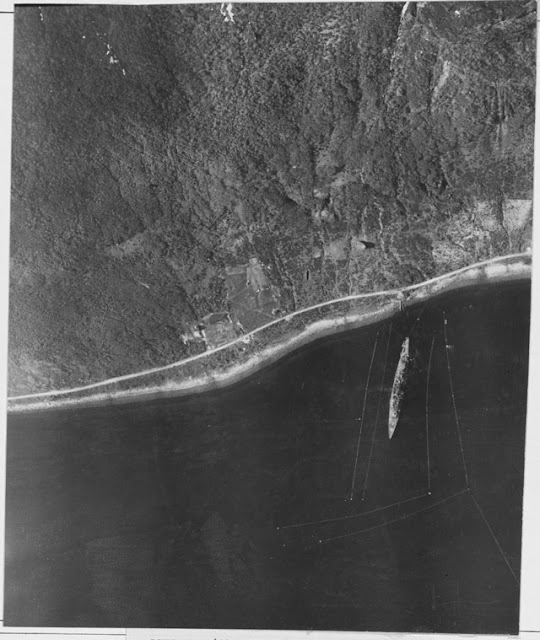
German cruiser Lutzow spotted by Allied air reconnaissance 11 June 1942 worldwartwo.filminspector.com
German heavy cruiser Lutzow photographed by Allied air reconnaissance, 11 June 1942 (Naval History and Heritage Command NH 110843).

Battle of the Atlantic: Italian submarine Leonardo da Vinci uses torpedoes and gunfire to sink 5483-ton Dutch freighter Alioth in the Atlantic Ocean near Freetown, Sierra Leone. Everyone survives.

U-504 (Kptlt. Hans-Georg Friedrich Poske), on its third patrol out of Lorient, torpedoes and sinks 4282-ton Dutch freighter Crijnssen 85 miles southwest of the Cayman Islands. There are one death and 93 survivors, who abandon the ship in four lifeboats and a gig. The sinking is especially traumatic for some on board because there are a dozen survivors of Sylvan Arrow (sunk by U-155 on 20 May 1942) and one from U.S. tanker T.C. McCobb (sunk by Italian submarine Pietro Calvi on 31 March 1942). The survivors in one lifeboat and the gig from Crijnssen are picked up by the U.S. freighter Lebore, which itself is sunk by U-172 a few days later. The other lifeboats make landfall in Mexico aside from four crewmembers on a raft who are picked up by the Panamanian tanker J.A. Mowinckel.
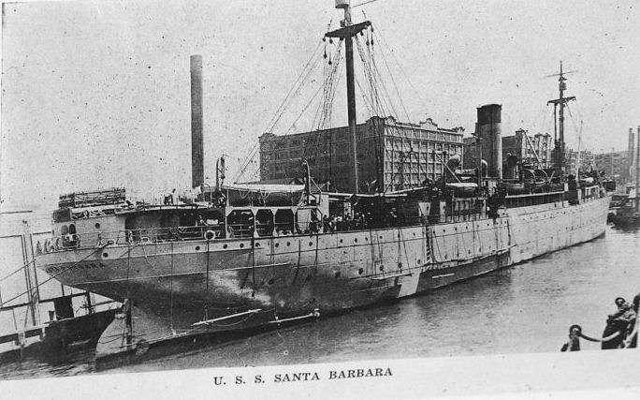
Freighter American sunk on 11 June 1942 worldwartwo.filminspector.com
SS American, originally the Santa Barbara, was sunk by U-504 on 11 June 1942. 

Much later in the day, U-504 also torpedoes and sinks 4846-ton U.S. freighter American off Honduras. The ship is hit by two torpedoes and sinks within 25 minutes. There are four deaths and 34 survivors, who are picked up by British freighter Kent. One survivor perishes after being picked up.

U-159 (Kptlt. Helmut Friedrich Witte), on its second patrol out of Lorient, torpedoes and sinks 7130-ton British freighter Fort Good Hope northwest of Colon, Panama. Two torpedoes hit and sink the freighter (carrying wheat, timber, lead, and zinc) within half an hour. There are two deaths and 45 survivors, who are picked up by U.S. gunboat USS Erie (PG 50).

U-455 (Kptlt. Hans-Heinrich Giessler), on its third patrol out of St. Nazaire, torpedoes and sinks 6914-ton British tanker Geo H. Jones northeast of the Azores. The tanker is a straggler from Convoy SL-111 heading from Aruba to Freetown. There are two dead and 40 survivors, who are picked up by HMIS Orissa (J 200).

U-157 (KrvKpt. Wolf Henne), on its second patrol out of Lorient, torpedoes and sinks 6401-ton U.S. tanker Hagan five miles off the north coast of Cuba. Hagan is simply steaming a straight course independently and thus is an ideal target. Two torpedoes hit the engine room and fuel bunkers, sinking the ship, which is carrying 2,676 barrels of blackstrap molasses, fairly quickly. There are six dead and 38 survivors, who make landfall in Cuba in two lifeboats. This is the only victory for U-157 in its career, which ends a couple of days later when it is sunk.

U-94 (Oblt. Otto Ites), on its ninth patrol out of St. Nazaire, torpedoes and sinks 4458pton British freighter Pontypridd northeast of St. John's, Newfoundland. Pontypridd is a straggler from Convoy ONS-100. There are two dead and 46 survivors, who are picked up by HMCS Chambly (K 116).

U-158 (Kptlt. Erwin Rostin), on its second patrol out of Lorient, torpedoes and sinks 13,467-ton Panamanian tanker/transport Sheherazade 20 miles west of Ship Shoal Buoy, Louisiana. Sheherazade is a French ship turned over to the U.S. War Shipping Administration (WSA). There are one dead and 58 survivors, who are rescued by shrimp boat Midshipman and fishing vessel 40 Fathoms. The rescue happens quickly enough that nine men are found swimming after having jumped overboard.

Norwegian 6049-ton freighter Haugarland hits a mine and sinks off Terschelling, Netherlands. It appears that everyone survives.

U.S. 9310-ton tanker F.W. Abrams hits a U.S.  defensive mine and sinks east of Morehead City, North Carolina (near Cape Hatteras). The 36 men on board make it to shore near Morehead City. A tug ("Relief") attempts salvage of the floating wreck without success.

U-87 mines the waters off Boston, Massachusetts, while U-373 mines the area near Delaware Bay.
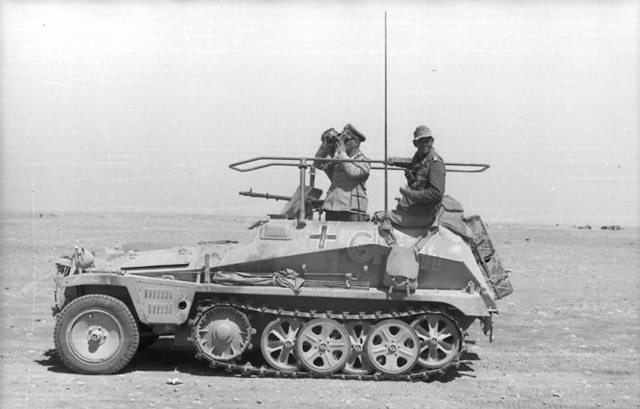
Rommel in North Africa worldwartwo.filminspector.com
General Rommel in his Sd.Kfz. 250 command truck, 11 June 1942 (Zwilling, Ernst A., Federal Archive Image 101I-443-1589-09).

Battle of the Mediterranean: German General Erwin Rommel's Afrika Korps occupies the fortress of Bir Hakeim, which has been a roadblock in his advance toward Tobruk. The Free French defenders have almost all escaped to British lines to the south save for a small rear guard left to delay the attackers. The French and British pull back from their advanced position outside the fortress to Gasr-el-Arid early in the morning, completing the breakout by 2700 men and women (there are some female nurses).

After finally clearing this obstacle, about which he later comments "seldom in Africa was I given such a hard-fought struggle," Rommel quickly resumes his offensive, sending the 15th Panzer and 90th Light Divisions toward El Adem. The British 201st Guard Brigade in the Knightbridge Box, which blocks the way to Tobruk to the east, comes under severe pressure. While the Allied defense of Bir Hakeim has seriously disrupted Rommel's overly ambitious timetable, his advance now regains momentum.
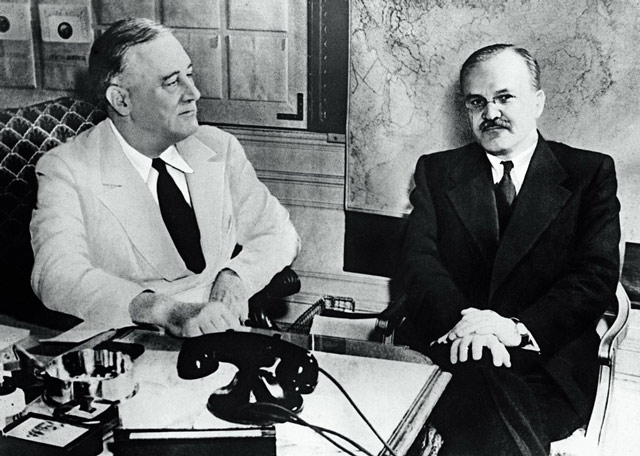
Molotov and FDR in Washington on 11 June 1942 worldwartwo.filminspector.com
Soviet Foreign Minister Vyacheslav Molotov and U.S. President Franklin D. Roosevelt meet in Washington, D.C., to finalize the lend-lease agreement, 11 June 1942 (Alliance.rusarchives.ru).

US/Soviet Relations: The United States and Soviet Union sign a lend-lease agreement. The agreement contemplates "mutually advantageous economic relations" between the two powers, with the agreement to continue in force "until a date to be agreed upon by the two governments." U.S. Secretary of State Cordell Hull and Soviet Ambassador Maxim Litvinov sign for their respective governments.

Article 1 sets out the main purpose of the agreement:
The Government of the United States of America will continue to supply the Government of the Union of Soviet Socialist Republics with such defense articles, defense services, and defense information as the President of the United States of America shall authorize to be transferred or provided.
This agreement, however, is not specific on certain key points. These become a lingering bone of contention during the post-war era. Significantly, the title to the equipment supplied by the U.S. is not transferred to the Soviet Union. The U.S. believes it still "owns" the items and retains rights to them, while the USSR believes it now owns them because they were freely given.

Technically, under the U.S. interpretation of the agreement, the Soviet Union is obligated to return any intact equipment or compensate the United States for it after the war. The USSR, perhaps understandably, has a vastly different interpretation. This leads to awkward exchanges between the two governments in the late 1940s in which the United States demands either the return of the intact equipment or payment for them, including limitations on the equipment's transfer to other countries. Ultimately, the United States simply demands payment for the "civilian-type articles remaining in existence."

Of course, the United States already has abandoned military equipment of its own at bases around the world because it is obsolete and considered too expensive to return to the homeland. Thus, there seem to be deeper reasons underlying the disagreement. It is entertaining to ponder the reactions of the Soviets when they receive these petty and abrasive demands for payment for goods they always assumed were given for free to win the war at the cost of Soviet blood. These pointless and unproductive "negotiations" help to poison the relations between the two nations and contribute to the growth of the Cold War, a hostile relationship that more or less continues to the present day.
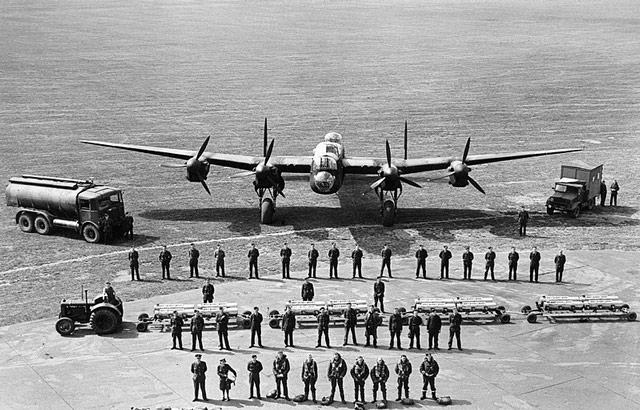
An Avro Lancaster and its crew on 11 June 1942 worldwartwo.filminspector.com
An Avro Lancaster and the personnel and equipment needed to keep it flying. This photograph was taken at Scampton, Lincolnshire, on 11 June 1942.  © IWM CH 15362.

German Military: Adolf Hitler issues Führer Directive 32. It sets out operations to be undertaken after the defeat of the Soviet Union, including the capture of Gibraltar with or without Spain's cooperation and resumption of the "siege of England." It is a curious mixture of far-sighted planning and mundane objectives such as the capture of Tobruk. It presupposes the quick defeat of the USSR in the coming Case Blue summer offensive and, like many of Hitler's grand strategies, assumes launch conditions that do not yet exist.

U.S. Military: With the threat to the U.S. west coast vastly reduced due to the Japanese defeat at Midway, the 97th Bombardment Group deployed for emergency purposes on the coast is transferred back to New England for eventual movement to join the Eighth Air Force in Great Britain.

Holocaust: Adolf Eichmann holds a meeting for his underlings controlling Jewish Affairs in France, Belgium, and Holland. This meeting sparks a systemic deportation scheme for Jewish residents of those areas to the extermination camps in the East that affects tens of thousands of people.

German Homefront: Michael Kitzelmann, 26, is executed at Orel Prison after being court-martialed and convicted of crimes against the state. Kitzelmann, a Wehrmacht lieutenant, was denounced by a sergeant for saying things that "undermined the military." He was in a hospital being treated for wounds when the allegations against him were made, but apparently, he made them previously while serving on the Eastern Front. The statements apparently concerned certain atrocities that Kitzelmann witnessed against the Russian population. While Kitzelmann became outspoken, he also had earned the Iron Cross Second Class and the Wound Badge in Gold.

TheGerman Bundestag rehabilitated Kitzelmann on 8 September 2009. A plaque in his memory is at the Johann-Michael-Sailer-school in Dillingen an der Donau.

American Homefront: The New England Journal of Medicine reports a case of "internal anthrax," which is considered quite novel because the vast majority of cases are of the cutaneous type. The patient died after showing progressively worse symptoms and a full autopsy was performed. Penicillin, still in its experimental phase, will become the accepted treatment for anthrax in 1944. 
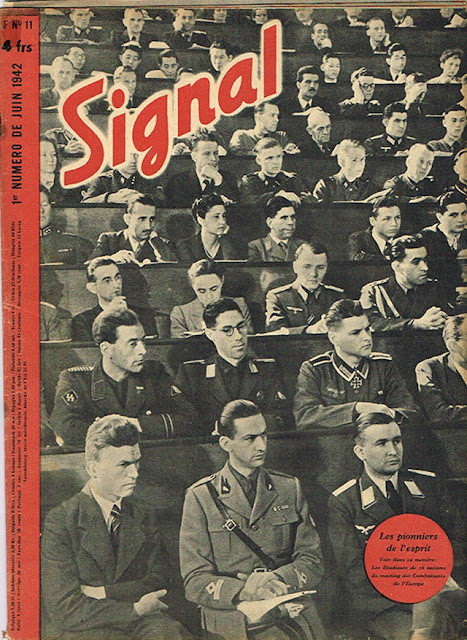
German Signal magazine from June 1942 worldwartwo.filminspector.com
Signal magazine, June 1942.

2021

Monday, October 18, 2021

June 6, 1942: Japanese Invade Aleutian Islands

Saturday 6 June 1942

Battle of Midway 6 June 1942 worldwartwo.filminspector.com
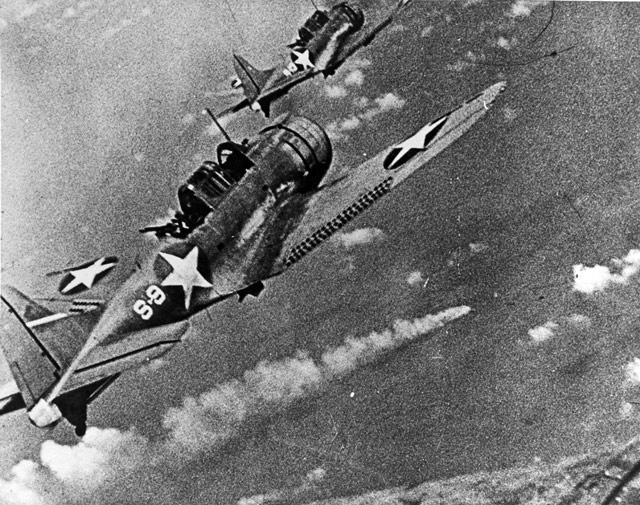
"SBD Dauntless dive bombers from USS Hornet (CV-8) approaching the burning Japanese heavy cruiser Mikuma to make the third set of attacks on her, during the early afternoon of 6 June 1942. Mikuma had been hit earlier by strikes from Hornet and USS Enterprise (CV-6), leaving her dead in the water and fatally damaged." Naval History and Heritage Command 80-G-17054.

Battle of the Pacific: Despite having suffered staggering losses off Midway Island on 4 June, the Japanese follow through on their subsidiary campaign in the Aleutian Islands on 6 June 1942. The Japanese Northern Area Fleet, commanded by Vice-Admiral Boshiro Hosogaya, lands 500 troops of the elite Maizura 3rd Special Landing Force and 700 laborers on Kiska Island at 10:27. 

This is the first invasion of the continental United States since the War of 1812, though Alaska is not yet a state. The local Unangax (Aleuts) offer virtually no resistance and no U.S. military forces intervene at this time despite some fruitless bombers searching for the Japanese. There are U.S. soldiers of the U.S. Navy meteorological service on Kiska, but they disappear into the rugged interior. The Japanese rename the island Narukami.

Eight P-38s do spot and attack a ship, but it turns out to be a Soviet freighter. The Americans, though, are quite concerned about both a Japanese land invasion south toward Washington State through Canada and Japanese bombing raids from the Aleutians (neither of which the Japanese plan) and begin preparing a response.

Off Midway Island, things just keep getting worse for the Japanese. Having lost four irreplaceable aircraft carriers to the U.S. Navy's one, they now lose another important ship. Douglas SBD Dauntless dive bombers attack and sink cruiser Mikuma, already damaged in previous days' raids. Mikuma and fellow cruiser Mogami are heading for refuge at Wake Island when 31 SBDs from USS Enterprise and Hornet attack and hit Mikuma with five bombs and Mogami with six.
Japanese cruiser Mikuma under attack, 6 June 1942 worldwartwo.filminspector.com
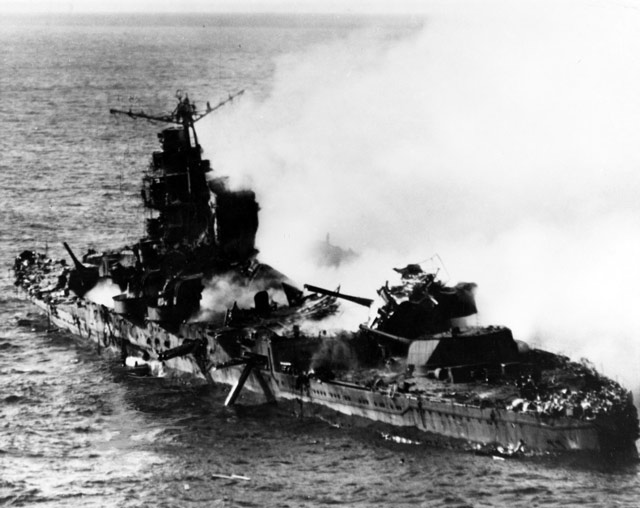
"Japanese heavy cruiser Mikuma, photographed from a USS Enterprise (CV-6) SBD aircraft during the afternoon of 6 June 1942, after she had been bombed by planes from Enterprise and USS Hornet (CV-8). Note her shattered midships structure, torpedo dangling from the after port side tubes and wreckage atop her number four eight-inch gun turret." Naval History and Heritage Command 80-G-414422.

While the Mikuma may theoretically have survived that many bomb hits, one of them sets off the torpedoes it is carrying and they destroy the ship. There are 650 deaths and 240 survivors, who are picked up by destroyers Asashio and Arashio (both also hit by one bomb each. U.S. Navy submarine Trout investigates the scene on 9 June and picks up an additional two Japanese crewmen and makes them POWs.

An example of the "fog of war" almost causes a tragedy for the U.S. forces. A late-morning B-17 raid by 26 bombers based on Midway (led by Lt. Col. Brooke Allen) against the fleeing Japanese cruisers fails to find them. However, they do spot a target and six B-17s drop their loads on it thinking it is one of the cruisers. In fact, it is U.S. submarine Grayling. Fortunately for the Americans, level-bombing accuracy at sea lives down to its terrible reputation, no harm is done, and Grayling quickly dives before any bombs come close. 

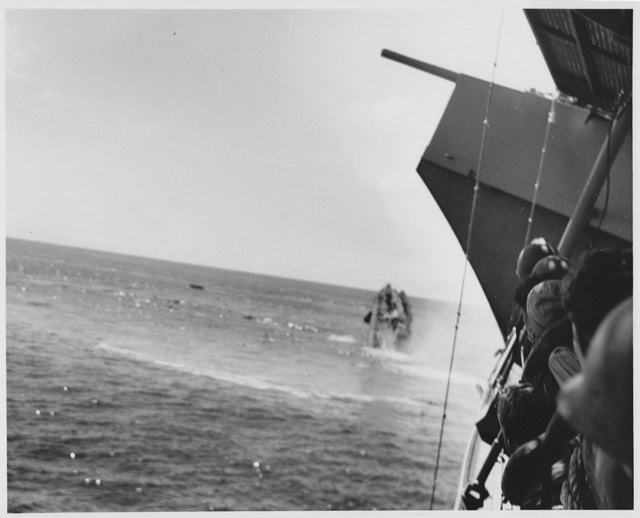
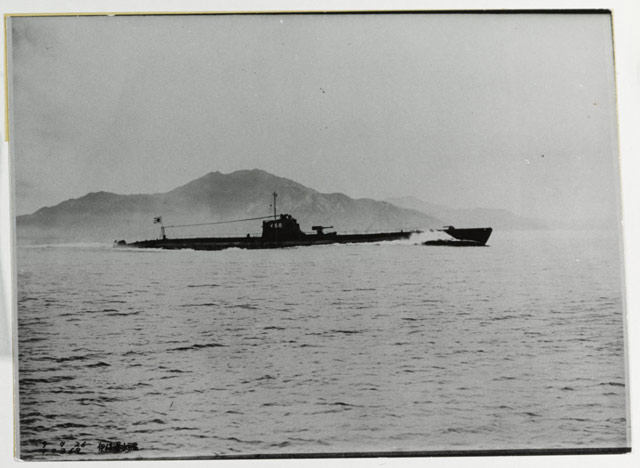
The Japanese do "get one back" when submarine I-168, which previously shelled Midway Island, spots crippled USS Yorktown and attacks. In addition to pumping one more torpedo into the badly listing aircraft carrier, the submarine torpedoes and sinks the U.S. Navy destroyer USS Hammann (DD-412) around noon. Hammann has been providing auxiliary power to USS Yorktown as a damage control party desperately tries to keep it from sinking. Only one of four torpedoes hits the destroyer, but it is enough to break the ship in half. The destroyer sinks in just four minutes, and after it slips under, its armed depth charges explode, causing a violent underwater explosion and killing many men in the water. There are 80 deaths from the 192-man crew. I-168, despite being surrounded by U.S. Navy screening destroyers, escapes with minor damage.
US destroyer Hammann sinking, 6 June 1942 worldwartwo.filminspector.com
"USS Hammann (DD-412) sinking with stern high, after being torpedoed by Japanese submarine I-168 in the afternoon of 6 June 1942. Photographed from the starboard forecastle deck of USS Yorktown (CV-5) by Photographer 2nd Class William G. Roy. Angular structure in right foreground is the front of Yorktown's forward starboard 5-inch gun gallery. Note knotted lines hanging down from the carrier's flight deck, remaining from her initial abandonment on 4 June." Naval History and Heritage Command 80-G-32320.

With ships on both sides still sinking (such as Yorktown) and already sunk, there are hundreds of men struggling to survive in the waters around Midway. The island's PT-boats and PBY Catalinas spend this and surrounding days picking up 27 men.

U.S. fleet carrier Saratoga, which missed the Battle of Midway due to repairs and upgrades being performed on the West Coast, arrives in Honolulu today. It quickly prepares to depart on the 7th to ferry replacement aircraft and crew to Enterprise and Hornet still stationed northeast of Midway. While most histories record 7 June 1942 as the final day of the Battle of Midway, today effectively marks the end of major hostilities.

The state-controlled Tokyo press quickly informs the public of the "great victory" in the Aleutian Islands. However, no mention is made of the catastrophic events for the Japanese Navy off of Midway Island until the war is over.
Japanese submarine U-168 which sank US destroyer Hammann on 6 June 1942 worldwartwo.filminspector.com
"I-168. (Japanese Submarine, 1933-1943) Underway in March 1934, probably during her trials. This submarine was renamed I-168 in May 1942. She torpedoed USS Yorktown (CV-5) on 6 June 1942, causing damage that led to the carrier's sinking the following morning." Naval History and Heritage Command NH 73054 I-68.

Battle of the Indian Ocean: Japanese submarine I-16 torpedoes, shells, and sinks 3839-ton Yugoslav freighter Susak in the Mozambique Channel. There are seven deaths.

I-10 torpedoes and sinks U.S. freighter Melvin H. Baker 45 miles off the mainland coast. All 48 men aboard survive and are picked up by British freighter Twickenham.

Eastern Front: German General Erich von Manstein makes his final preparations for Operation Stoerfang ("Sturgeon Catch"), the land assault against Sevastopol.  Meanwhile, the Luftwaffe continues an overpowering assault against the port, facing virtually no opposition from airports almost within sight of the defenders. Between 3 and 6 June, the Luftwaffe has flown 2355 sorties, dropping 1800 tons of high explosives 23,800 1.1kg incendiary bombs. In the two weeks from 24 May to 6 June, the Luftwaffe also has dropped 638,000 propaganda leaflets (50,000 per day) with instructions on how to surrender.

The massive artillery barrage that includes the biggest guns in military history, including the Karl and Gustav guns, shifts its targeting today to the defenses south of the city that face the German 30th Army Corps.

Rather than evacuating the port, the Soviets actually make every effort to reinforce it, slipping flotilla leader Tashkent, the destroyer Bezuprechnyi, and transport Abkhaziya through the blockade to deliver 2,785 more Red Army defenders.
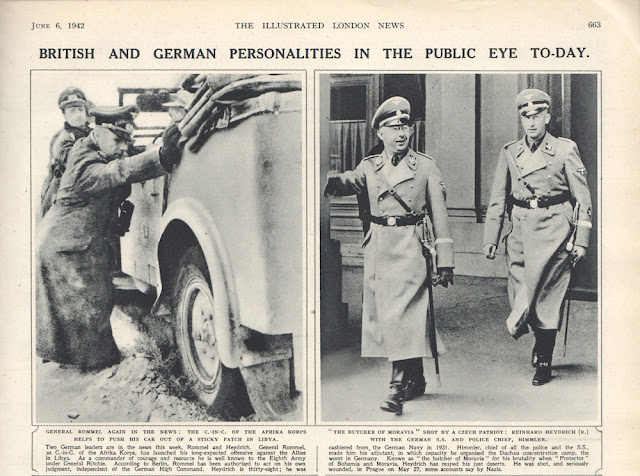
Illustrated London News, 6 June 1942 worldwartwo.filminspector.com
The Illustrated London News of 6 June 1942 features photos of German General Erwin Rommel, left, and recently deceased General Reinhard Heydrich, right (with Heinrich Himmler). Rommel is shown pushing his command car out of some trouble.

European Air Operations: The weather is warm, with plenty of ground haze below 1500 feet. The RAF focuses mainly on convoy protection.

R.A.A.F. Catalinas of RAF No. 10 Squadron, using Leigh Lights, bomb and damage Italian submarine Luigi Torelli in the Bay of Biscay. The submarine's crew manages to beach it at Santander, Spain, to prevent sinking. There is one death and one wounded crewman. The ship is temporarily repaired and sailed to France on 14 July for permanent repairs.

Hptm. Helmut Lent, Gruppenkommanduer of II./NJG 2, is awarded the Eichenlaub (No. Ninety-eight) after 34 night victories and 8 by day.
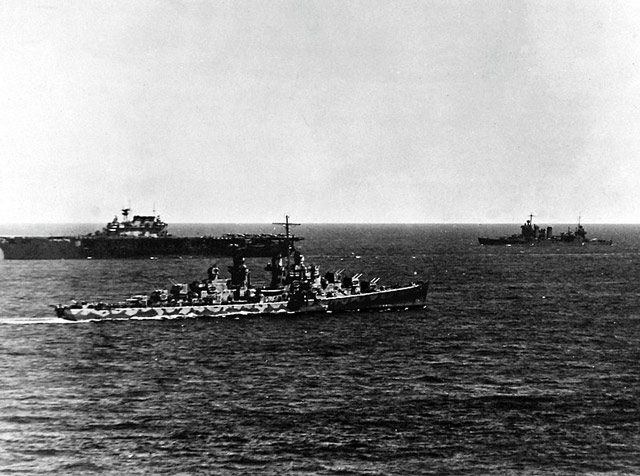
USS Atlanta with Hornet in the background, 6 June 1942 worldwartwo.filminspector.com
"A close-up of USS Atlanta (CL 51) with USS Hornet (CV 8) and USS Phelps (DD 360), all of Task Force 16, in background. Picture was made during the third day of the battle as Atlanta came up to offer assistance to the destroyer, which had broken down temporarily because of fuel shortage." 6 June 1942. Naval History and Heritage Command 80-G-88908

Battle of the Atlantic: It is a busy day for two German raiders operating in the South Atlantic east of Brazil. The 1940-41 glory days of the raiders are over and now they have to operate in remote areas to avoid detection. That doesn't mean they don't get the occasional moment of excitement. This happens during the Action of 6 June 1942.

In one incident, German raider Michel (Schiffe 28) spots disabled and drifting 7176-ton U.S. freighter George Clymer midway between Brazil and Africa. The Michel launches its motor torpedo boat Esan, which torpedoes and badly damages the freighter. One man perishes in the attack. The crew abandons the ship but reboards it on the 8th when it does not sink. however, the situation is hopeless and the crew is picked up by the British armed merchant cruiser HMS Alcantara. That is the last anyone sees of George Clymer, which remains stubbornly afloat. Exactly when and where the George Clymer sinks is unknown.

German raider Stier (Schiffe 23) has been quietly operating in the South Atlantic with limited success since leaving Royan, France in late May 1942. Today, Stier is cruising 500 miles (800 km) east of Pernambuco, Brazil, in overcast weather when it spots 10,170-ton U.S. tanker Stanvac Calcutta. Appearing suddenly out of a squall, Stier fires a warning shot and signals the tanker's crew to prepare to be boarded.

The Stanvac Calcutta, however, is heavily armed for a tanker. It has one 4-inch (102 mm)/50-caliber naval gun salvaged from World War I and a 5 inch (127 mm)/25-caliber anti-aircraft gun. Stier, meanwhile, has six 150-millimeter (6 in) guns, one 37 mm (1.5 in) gun, two 20 mm (0.79 in) cannons, and two torpedo tubes. So, there's a lot of firepower on both sides, though Stier outguns the tanker by a substantial margin.

The tanker's crew, led by Captain Gustav O. Karlsson, decides to not comply with the Stier's order to stop and opens fire. Led by Ensign Edward L. Anderson, the tanker's gunners get off several shots with both guns (the larger gun in the gun, smaller in the bow). Despite missing with most of their shots, the gunners do hit and disable one of Stier's 150mm guns. The Stier's crew then returns fire with 148 shells.

The battle lasts for 15 minutes, during which the Germans score a hit on the tanker's bridge, killing Captain Karlsson and several others. The Americans continue firing until their ammunition is exhausted. At this point, Stier Captain Horst Gerlach fires a torpedo that strikes Stanvac Calcutta on the port side. This kills several sailors and causes damage that leads to a sharp list and eventual sinking. The tanker's crew then abandons ship. Gerlach's men lower their own boats and rescue the Americans struggling in the water.

The Action of 6 June 1942 shows several hard truths about the Battle of the Atlantic. One is that merchant ships armed with a few guns stand little chance against raiders like Stier that are designed for combat even if they aren't true warships. Another is that these surface combats kill a lot of crewmen, as Stanvac Calcutta has 16 men killed in action, one dying later onboard Stier, fourteen men wounded, and 37 prisoners taken (the Stier only suffers two wounded men).

Actions like that of 6 June 1942 call into question the whole concept of arming merchant ships, which requires a lot of effort and dedicated gunners on hundreds of ships. However, later events involving Stier will redeem this idea somewhat. For their pains, the Stanvac Calcutta's crew later are awarded the Merchant Marine Gallant Ship Citation and Ensign Anderson is promoted (while a POW) to the rank of lieutenant commander. The tanker crew winds up in a Japanese POW camp.
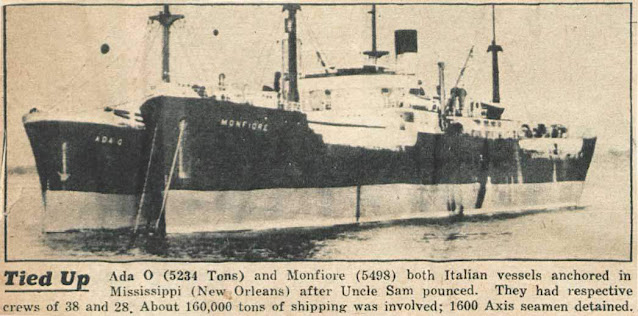
Freighter Hermis in the background, sunk on 6 June 1942 worldwartwo.filminspector.com
Coal-burning freighter Hermis is shown at left while still called "Ada O." Hermis was an Italian vessel anchored in New Orleans when seized in 1941 and pressed into U.S. service. Sunk on 6 June 1942.

There are also the usual U-boat sinkings, these days confined to the Caribbean.

U-68 (KrvKpt. Karl-Friedrich Merten), on its fourth patrol out of Lorient, torpedoes and sinks 13,006-ton Panamanian tanker C.O. Stillman 60 miles southwest of Puerto Rico. There are three deaths and 55 survivors,  most of whom are picked up by US Coast Guard patrol boat #83310 while 30 sail their lifeboats to Puerto Rico.

U-107 (Kptlt. Harald Gelhaus), on its sixth patrol out of Lorient, torpedoes and sinks 3910-ton Honduran freighter Castilla east of Cancun and south of western Cuba. One torpedo hits and causes the ship to sink quickly stern-first. The crew can't launch lifeboats and take to three rafts. There are 24 deaths (including one who dies on a raft) 35 survivors, who are picked up by USS Nike (WPC-112) after six days. Some sources place this sinking on 7 June 1942.

U-158 (Kptlt. Erwin Rostin), on its second patrol out of Lorient, torpedoes and sinks 5234-ton Panamanian freighter Hermis west of Havana and northeast of Cancun. Two torpedoes strike the ship on the port side but the engines continue running due to an inability to stop them due to damage. Rostin surfaces and uses his deck gun to finish off the freighter, setting it on fire. There is one death and 46 survivors, who are picked up by US Army transport Toloa. The ship does not sink for at least 12 hours and this sinking is sometimes listed as occurring on 7 June 1942.

Dutch 197-ton freighter Antares hits a mine and sinks off the Dutch coast.
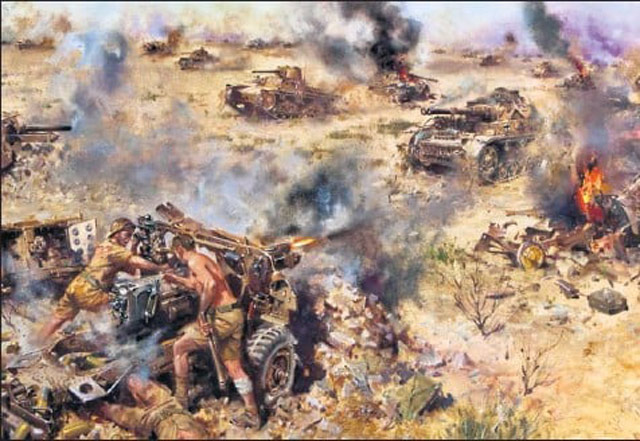
"Battle of Knightsbridge 6th June 1942" worldwartwo.filminspector.com
"The Battle of Knightsbridge, 6th June 1942," by Terence Cuneo (1907-1996). Shown are the 426th Battery of the 107th Regiment Royal Horse Artillery and the South Nottinghamshire Hussars, panzer of the Afrika Korps attacking. The 426th ultimately was forced to surrender.

Battle of the Mediterranean: After a wild day of attack and counter-attack between German and British troops on 5 June, the front settles down again today. However, German General Erwin Rommel retains command of the battlefield after his forces destroyed dozens of Allied tanks. He sends out armed reconnaissance to test the British lines and maintains pressure on the surrounded Free French garrison at Bir Hakeim. For their part, the British engage in harassing attacks against the German supply lines using the 7th Motor Brigade and 29th Indian Infantry Brigade.

The main action of the day is an attack at 11:00 by the German 90th Light Division against Bir Hakeim. This involves a determined effort by troops and pioneers to clear a way through the minefields surrounding the fortress, which are divided into two perimeters. By nightfall, the Germans manage to get through the outer minefield and into the inner minefield to within 800 meters (900 yards) of the fortress. The advance, while threatening to the Free French, also leaves the German troops exposed to Desert Air Force attacks on the 7th.

The Battle of Knightsbridge proceeds as the 15th Panzer Division attacks northward. The British 22nd Armoured Brigade continues to give ground after having lost dozens of its tanks. The German objective is El Adem, but the 201st Guard Brigade is ferociously defending the approaches to Tobruk.

Operation Aberdeen, the Eighth Army's counterattack begun on 4/5 June against the German Afrika Korps panzers, ends today after having accomplished nothing but the loss of numerous British troops and tanks. British Eighth Army commander General Neil Ritchie and Middle East Commander-in-Chief Claude Auchinleck now face the prospect of not only losing the battle but also all of Libya and much of Egypt unless they can find some way to stop Rommel's attacks. Among the desperate options considered are withdrawing the Free French from Bir Hakeim to free up the 7th Motor Brigade. However, this is rejected as the French seem to be in a good defensive situation.

Oblt. Hans-Joachim Marseille of 3./JG 27, currently operating in North Africa, receives the Eichenlaub for achieving 75 victories. Marseille once was considered a disciplinary problem but now is revered by his colleagues as a legend.
Battle of the Gazala Line, 6 June 1942" worldwartwo.filminspector.com
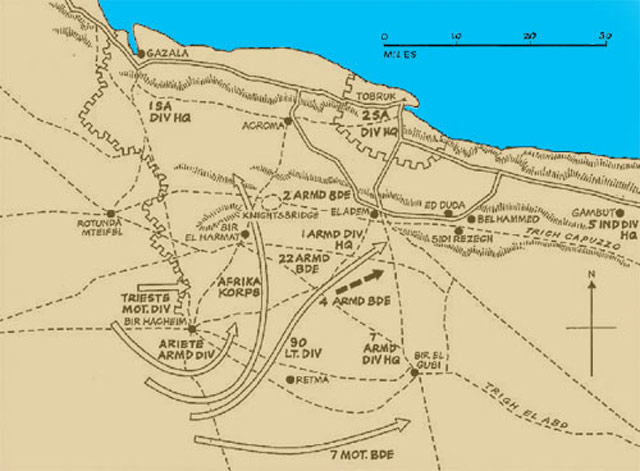
A map showing the military situation in Libya ca. 6 June 1942. The 15th Panzer Division thrust through the British Knightsbridge defensive position is shown by the upward arrow in the center, with a separate thrust to the south of Tobruk at the upper right. The map makes clear the extreme jeopardy of the Allied position at Tobruk, though nobody on either side is thinking about it just yet.

American Homefront: At the Belmont Stakes, the third jewel of the Triple Crown, the chestnut stallion Shut Out is the winner. Having also won the Kentucky Derby, Shut Out just misses immortality by having lost the Preakness Stakes to Alsab. Shut Out continues racing until 1944, when it is retired and put out to stud until passing away in 1964.

Future History: Klaus Bednarz is born in  Falkensee, Province of Brandenburg, Germany. Bednarz becomes a popular West German correspondent, author, and television host, particularly of the TV show Monitor. Klaus Bednarz passes away on 14 April 2015.
L'Illustration, 6 June 1942" worldwartwo.filminspector.com
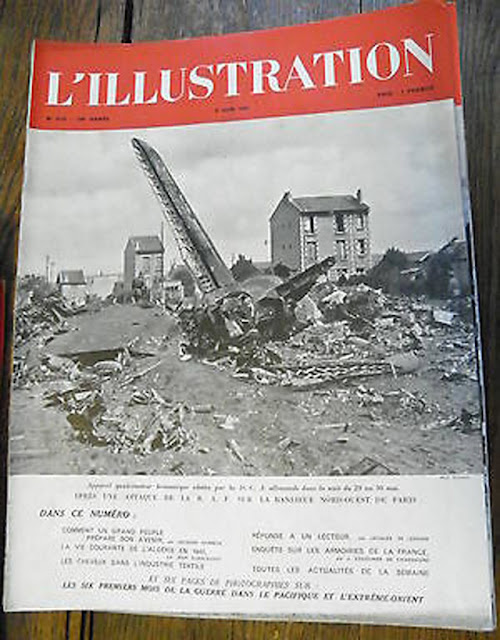
L'Illustration, 6 June 1942.

2021

Monday, April 26, 2021

May 14, 1942: Where in the World is AF

Thursday 14 May 1942

HMS Trinidad sinking, 14 May 1942 worldwartwo.filminspector.com
HMS Trinidad after being fatally damaged by Luftwaffe bombers in the Barents Sea on 14 May 1942. It had to be scuttled.
Battle of the Pacific: On 14 May 1942, the Commander in Chief, United States Navy, and Chief of Naval Operations Admiral Ernest J. King strongly suspects that the Japanese are planning another big operation. He instructs Admiral Chester Nimitz to declare a state of  "Fleet Opposed Invasion" and gives Nimitz complete control of all military resources in the central Pacific, including those in the Hawaiian Islands. There is a growing consensus within the naval intelligence service that the next Japanese moves will be toward Midway Island and Dutch Harbor in the Aleutian Islands, but this is not yet absolutely certain.

Led by the naval intelligence office in Hawaii, HYPO, naval codebreakers in Washington and at Station CAST in Melbourne, Australia, have cracked the main Japanese fleet code, called JN-25B. Unfortunately, even reading the Japanese communications in plain language does not completely reveal where the attack will take place. The Japanese refer to their next main target cryptically as being at "AF." Unfortunately for the codebreakers (but a sign of good code discipline by the Japanese), the messages do not identify where AF is. Different people in naval intelligence come up with different theories, but there is no certainty.
Admiral Turner and General Vandegrift in 1942 worldwartwo.filminspector.com
"Rear Admiral Richmond Kelly Turner, USN (left), and Major General Alexander A. Vandegrift, USMC. Working on the flag bridge of USS McCawley (AP-10), at the time of the Guadalcanal-Tulagi operation, circa July-August 1942." Naval History and Heritage Command 80-CF-112-4-63.
The head of the War Plans Division in Washington, D.C., Admiral Richmond K. Turner, does not believe the conclusion by HYPO and CAST that Midway is the target. Instead, he relies on the Navy's main codebreaking unit in Washington, OP-20-G (Station NEGAT), which draws a different conclusion. Perhaps influenced by Turner's personal preconceptions and beliefs, the station concludes that AF is the Hawaiin Islands and not Midway. Wherever AF is, other decrypted communications have established that it is going to be bombed, strafed, and subjected to an amphibious assault before too long, so everyone understands the urgency.

Turner has complete control over OP-20-G and forbids its members from disseminating any interpretation of AF as Midway Island. The situation turns into a classic bureaucratic turf war with everyone determined to make their point of view prevail. At HYPO in Hawaii, Commander Joseph J. Rochefort sees how Turner (who has caused Rochefort problems in the past) is distorting the intelligence results and resolves to force Turner to accept the evidence as he sees it.

Rochefort consults his staff members for ideas on how to break the logjam. One of them, Jasper Holmes, comes up with the idea of planting news of a false water shortage crisis at Midway in order to see if that will dupe the Japanese into unknowingly revealing the identity of AF. Following military protocol, Rochefort takes the idea to his superior, Chief Intelligence Officer Edwin T. Layton, who then mentions it to Admiral Nimitz. Nimitz ultimately likes the idea and approves it. 
USS Saratoga, 14 May 1942 worldwartwo.filminspector.com
USS Saratoga at the Puget Sound Navy yard, 14 May 1942. If you look closely at the upper right, you also can see an unidentified battleship (US Navy).
All of this will take a couple of weeks to set up and get the necessary approvals. Nimitz orders a message sent to Midway using an undersea cable (that the Japanese presumably aren't reading) telling them to send a false radio message about a water shortage. They will do this using a code the Japanese are known to have broken. Just to "get the message out" further, Midway also sends an uncoded radio signal about the water shortage. This sets in motion one of the greatest military intelligence successes of World War II.

Nimitz also engages in his own game of bluff with the Japanese. Since the intelligence is hardening that the next Japanese objective is Midway, he needs Admiral Halsey's Task Force 16 ready for it. Halsey, however, is still east of the Solomons to counter the expected Japanese invasions of Nauru and Ocean Island. Nimitz orders Halsey to make sure the Japanese see his ships. Once that is accomplished, Halsey is to head back to Pearl Harbor and prepare for the Midway battle. Nimitz also places eight submarines along the suspected path of Japanese carriers Zuikaku and Shōkaku.

Fifth Air Force sends B-17 and B-26 bombers to attack Rabaul and Lae.

Battle of the Indian Ocean: British forces retreating in Burma are congregating at the border town of Tamu. The Japanese are content to solidify their control of the rest of the country, where there are still scattered Allied units that have not yet reached safety.

While the Allied ground forces in Burma are retreating, the US Army Air Force 10th Air Force is on the offensive. Several B-17 bombers attack Myitkyina for the second time. Extensive damage is done to airport runways and buildings.
The Charlotte News, 14 May 1942 worldwartwo.filminspector.com
The Charlotte News, 14 May 1942.
Eastern Front: After a very dangerous start to the battle at Kharkov for the Germans, they begin to regain their equilibrium and blunt the Soviet drive west. While the Luftwaffe remains badly outnumbered over the battle, it gradually succeeds in establishing air superiority. On the Soviet side, Marshal Semyon Timoshenko is forced to bring up his reserve air units, which also are quickly ground up. Gaining control of the air enables the Luftwaffe's ground attack planes called up from Crimea to attack effectively. At Fuhrer Headquarter, General Franz Halder indicates the view there that the situation south and east of the city is the crisis point.

The Soviets are attacking along two fronts on either side of Kharkov, across the Barvenkovo River in the north (Soviet Southwestern Front) and from a Soviet projection into the front at Izyum (the "Izyum Bulge) to the south (Southern Front). The plan requires both pincers to advance and meet to the west of Kharkov. In the Soviet view, one of the main purposes is simply as a spoiling attack to prevent the Germans from launching a major offensive toward Moscow. What the Soviets don't realize is that the Germans have no immediate plans for Moscow and instead have, like them, concentrated their power along the southern sector of the front - right where the Red Army is attacking.

The Germans are having their greatest success in slowing the offensive on the northern sector despite the Soviets initially having more success there. The Germans are attacking Soviet pincers in several localized offensive using fresh reserves that, because of the early Red Army successes there, have been sent to the north pincer rather than the southern one.
Map of the Caucasus in The Charlotte News, 14 May 1942 worldwartwo.filminspector.com
A map of the Caucasus from the 14 May 1942 The Charlotte News. 
Hitler discusses the Kharkov situation with General Ewald von Kleist, in command of the 1st Panzer Army along the southern salient. He tells Kleist to use the 3rd Panzer Corps in a quick counterattack toward the base of the Soviet breakthrough. The options are to try to contain the Soviets or to cut them off. Typically, Hitler prefers the latter option. If it succeeds, it potentially would encircle the Soviet troops in the south. However, if it fails, the summer offensive is off and the strategic situation radically deteriorates for the Reich. Allowing the Soviet offensive to mushroom to the west while trying to cut off the Red Army's communications to the east is a bold strategy that will either lead to a brilliant victory or a debilitating defeat.

In Crimea, meanwhile, the Soviet defense is collapsing. General Erich von Manstein has three divisions approaching Kerch today, threatening the only good Red Army escape route. However, Hitler still mandates a full Luftwaffe effort there at the expense of the Kharkov front.

European Air Operations: A lull in operations by both sides continues, most likely due to the weather.
U-84 at Brest, 14 May 1942 worldwartwo.filminspector.com
U-84 enters the submarine pen at Brest, 14 April 1942 (Federal Archive Fig. 101II-MW-4905-07).
Battle of the Atlantic: U-564 (Kptlt. Reinhard Suhren), on its fifth mission out of Brest, torpedoes and sinks Mexican tanker Potrero del Llano off Cape Florida. This is a mistake, as Mexico is a neutral country. While watching the ship early in the morning, Suhren misreads the Mexican flag as Italian (which, due to the variation of the flag being flown, is an easy mistake to make). In any event, Suhren, not realizing the ship is Mexican, decides it is a legitimate war target. He torpedoes Potrero del Llano, causing 13 deaths and 22 survivors, who are picked up by USS PC-536. This sinking causes a diplomatic incident between Mexico and Germany. After another sinking on 20 May 1942, Mexico declares war two days later.

After being bombed and damaged in the Arctic Ocean by the Luftwaffe on 14 May 1942 and then running into one of its own torpedos, 8821-ton Royal Navy cruiser HMS Trinidad, now trying to return to the UK for permanent repairs and with speed reduced to 20 knots, is attacked by 20+ Ju-88s. One bomb hits near the previous damage and starts a fire that gets out of control. It must be scuttled by HMS Matchless the next day. There are 63-69 deaths, including 4 Czech airmen.

U-507 (KrvKpt. Harro Schacht), on its second mission out of Lorient, torpedoes and damages 4148ptno Honduran freighter Amapala in the Gulf of Mexico. US Coast Guard Cutter Boutwell takes Amapala in tow, but it eventually sinks. There are one death and 57 survivors, rescued by patrol aircraft and fishing schooner Gonzalez.

U-155 (Kptlt. Adolf Cornelius Piening), on its second patrol out of Lorient, torpedoes and sinks 2483-ton Belgian freighter Brabant in the Caribbean southwest of Grenada. There are three deaths and 34 survivors.

U-162 (FrgKpt. Jürgen Wattenberg), on its second patrol out of Lorient, torpedoes and sinks 6917-ton British tanker British Colony 90 nautical miles (170 km) northeast of Bridgetown, Barbados. There are four deaths and 43 survivors.

U-125 (Kptlt. Ulrich Folkers), on its fourth patrol out of Lorient, torpedoes and sinks 2493-ton Honduran freighter Comayagua in the Caribbean 14 nautical miles (26 km0 southwest of Grand Cayman Island. There are seven deaths and 35 survivors, who are rescued by British freighter Cimboco.

U-506 (Kptlt. Erich Würdemann), on its second patrol out of Lorient, torpedoes and damages 6821-ton US tanker David McKelvy 35 nautical miles (65 km) south of the Mississippi River. While the ship is beached on the Louisiana coast, it is written off. There are 17 deaths and 25 survivors, who are rescued by USCGC Boutwell.

German minesweeper M 1307 Neufisch I hits a mine and sinks off Esbjerg, Denmark. There are eight deaths.
Lt. Upholff of U-84, 14 May 1942 worldwartwo.filminspector.com
The commander of U-84, Horst Upholff (center) and Heinrich Lehmann Willenbrock (left) upon U-84's return from a patrol on 14 May 1942. U-84 sank two ships of 8,240 tons on the patrol (Federal Archive Image 101II-MW-4905-23).
Battle of the Mediterranean: Greek 6692-ton freighter Mount Olympus hits a mine and sinks off Port Said. There are three deaths and 27 survivors.

British submarine HMS Turbulent sinks 243-ton Italian schooner San Giusto. There are 1 death and 11 survivors.

Air attacks continue against Malta despite its improved air defenses. RAF pilots John "Tony" Boyd and Colin Finlay are shot down and killed.

Battle of the Black Sea: Soviet 1326-ton destroyer Dzerjinsky hits a mine and sinks off Sevastopol. There are 260 deaths.
Women's London fashions, 14 May 1942 worldwartwo.filminspector.com
Norman Hartnell exhibits his first collection of utility dresses for women, 14 May 1942 (AP Photo).
Special Operations: Operation Fritham takes place. This is a Norwegian attempt, launched from the River Clyde aboard ice-breaker D/S Isbjørn and the sealer Selis, to secure coal mines on Spitsbergen, Svalbard. The icebreaker turns out to be absolutely necessary, as the bay is covered in ice. The two ships are discovered almost immediately by a Junkers Ju 88 reconnaissance plane. Before the ships can make it to their destination, however, four FW 200 Condor bombers arrive and sink the icebreaker and set the other ship on fire. No equipment can be rescued from the ships.

With thirteen men dead and nine others badly wounded, the remaining crews take refuge in nearby houses abandoned since Operation Gauntlet in 1941. This essentially ends the effectiveness of the operation, and it turns into a survival exercise that ultimately is ended without results.
Beaufort fighter, 14 May 1942 worldwartwo.filminspector.com
Beaufort Mk II of RAF No. 86 Squadron, 14 May 1942.
Spy Stuff: U-213 (Oblt. Amelung von Varendorff), on its second patrol out of Lorient, has been laying mines near St. John's, Newfoundland, but it has a passenger who it lets off near the town of St. Martins, New Brunswick. This Lieutenant M.A. Langbein, who has documents identifying him as "Alfred Haskins" of Toronto, Ontario. Langbein's role is to monitor convoys leaving Halifax, Nova Scotia.

Once ashore, Langbein acts in a very un-spy fashion. He destroys his radio and makes it to Ottawa, Ontario, which isn't the best place to observe convoys from. Langbein ultimately surrenders himself to authorities late in 1944, having done no spying but having run through the thousands of dollars his spymasters have provided him.
President Franklin Roosevelt signs legislation, 14 May 1942 worldwartwo.filminspector.com
President Franklin D. Roosevelt approved legislation establishing the Women’s Army Auxiliary Corps (WAAC), 14 May 1942.
US Military: President Roosevelt signs legislation authored by Massachusetts Republican Rep. Edith Nourse Rogers creating the Women’s Army Auxiliary Corps. It authorizes a voluntary enrollment program for up to 150,000 women in non-combat roles. Under the WAAC umbrella, women fill a variety of jobs including as medical care professionals, welfare workers, clerks, cooks, messengers, military postal employees, chauffeurs, and telephone and telegraph operators. In 1943, this evolves into the Women's Army Corps.

Full convoys begin along the US East Coast. The first convoy departs from Hampton Roads, Virginia, to Key West, Florida.

Australian Homefront: Food and clothing rationing to begin.

American Homefront: The Cincinnati Symphony Orchestra premieres Aaron Copeland's "Lincoln Portrait." The piece includes narration that is often handled by celebrities such as Tom Hanks, Charlton Heston, and James Earl Jones.

Future History: Atanacio Pérez Rig is born in Ciego de Ávila, Cuba. As a boy, he plays baseball for the team of the sugar mill that employs his father, and, eventually, he works. In 1960, Cincinnati Reds scout Tony Pacheco sees him playing on the sugar factory team and signs him to a contract with the Reds' instructional team in Havana. Known professionally as Tony Pérez, he does well, sets various team batting records in the Reds' system, and is called up to the major league team on 26 July 1964. Tony Pérez goes on to a Hall of Fame career, including being a seven-time all-star and a three-time World Series champion. He has his uniform number (No. 24) retired by the organization. Perez also has managed the Florida Marlins. As of 2021, Tony Perez remains closely associated with the Reds organization.
Ted Williams and Bobby Doerr, 14 May 1942 worldwartwo.filminspector.com
On 14 May 1942, Boston Red Sox left fielder Ted Williams, left, tests the arm of Red Sox second baseman Bobby Doerr before their game against the White Sox, in Chicago. Williams will join the US Navy Reserve on 22 May 1942.

May 1942


2021