Showing posts with label FW 190. Show all posts

Monday, November 8, 2021

June 7, 1942: Manstein Attacks Sevastopol in Crimea

Sunday 7 June 1942

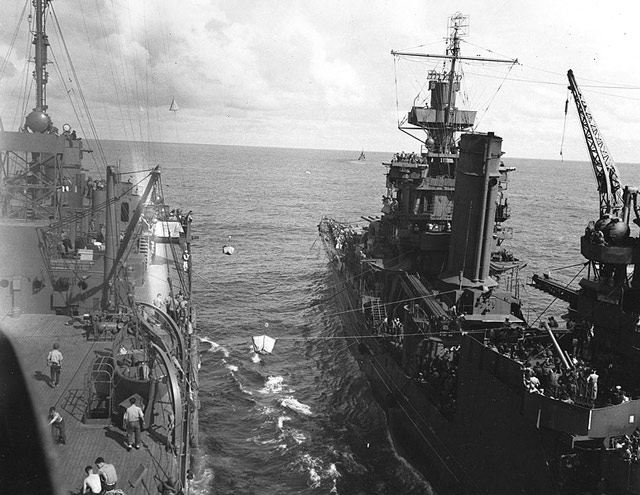
Transfer of Yorktown survivors at sea, 7 June 1942 worldwartwo.filminspector.com
"USS Portland (CA-33), at right, transfers USS Yorktown survivors to USS Fulton (AS-11) on 7 June 1942, following the battle of Midway. Fulton transported the men to Pearl Harbor." Naval History and Heritage Command 80-G-312028.

Battle of the Pacific: US aircraft carrier USS Yorktown (CV-5) sinks just after dawn on 7 June 1942, marking the definitive end of the Battle of Midway. Yorktown capsizes due to the combined effects of previous Japanese naval air strikes and torpedoes from I-168. The Battle of Midway has been a decisive American victory, with the Japanese losing four fleet aircraft carriers and a cruiser.

Continuing with their grand operational plan whose main component already has been thwarted at Midway, the Japanese occupy Attu Island in the Aleutians. There is no opposition to the 1143 men of the North Sea Detachment, and it is unclear if the US even knows about this latest invasion for a day or two. There are only 44 US civilians and 42 Aleut natives on Attu. One US civilian, Charles Jones, dies during the Attu invasion of unknown causes. The Japanese send everyone to camps in Japan, with only 25 of the 86 inhabitants surviving the war. The Japanese also capture nine of ten US Navy sailors manning a weather station on Kiska, with the tenth man (wearing a summer uniform) evading capture in the interior for 45 days.

The Japanese now occupy two islands at the extreme end of the Aleutian Island chain (Attu and Kiska). The Japanese high command anticipates that the US Navy will intervene and sends two light carriers to the vicinity in order to stage an ambush. In fact, Admiral Chester Nimitz does intend to send USS Enterprise and Hornet to the Aleutians, but he has not yet issued the necessary orders.

While Admiral Raymond A. Spruance has chosen not to pursue the retreating Japanese fleet - a decision for which he receives criticism - the US Army Air Force decides otherwise. Major General Clarence L. Tinker, Commander, 7th Air Force, personally leads a bomber strike from Hawaii. He perishes when his plane crashes near Midway.
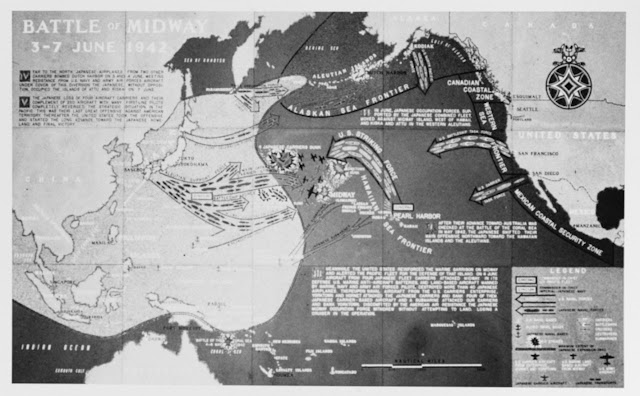
Map of Battle of Midway June 1942 worldwartwo.filminspector.com
"Located in the southeast room of the visitors building of Manila American Cemetery and Memorial. Map was designed by Margaret Bruton and fabricated by P. Grassi American Terrazzo Company of South Francisco." Naval History and Heritage Command NH 114452.

Admiral Frank Fletcher, who ceded command of US Task Force 18 around Midway Island due to the loss of his ship, the Yorktown, transfers his flag to aircraft carrier Saratoga, which has recently arrived from the US west coast. Saratoga departs Pearl Harbor today carrying replacement aircraft for the two remaining carriers involved in the battle. Fletcher thus is able to resume command of the task force on 8 June. He learns that Spruance has withdrawn to the east in order to refuel his ships and quickly orders search missions for the Japanese, who are heading back to Japan. However, the opportunity to continue the battle and "finish off the Japanese" has been lost.

While he has presided over the dramatic victory off Midway, Spruance manages to destroy much of the reputation he could have gained. This is due to his perceived lack of aggressiveness following the heat of the battle. Spruance's "discretion is the better part of valor" approach is controversial - then and now - and contrasts poorly with the aggressive tactics of Admiral "Bull" Halsey, who was unable to command the fleet at Midway due to health concerns. Now that Fletcher is back in command, Spruance is quickly reassigned from his field command to serve as Admiral Nimitz's chief of staff, though he does recover to have some important commands in 1943-1945.

Japanese submarine I-26 (Cdr Yokota) torpedoes and sinks 3545-ton US refrigerated freighter Coast Trader thirty miles off the Strait of Juan de Fuca on the US west coast. The ship is carrying refrigerated ammonia, which leaks due to the explosion and incapacitates some of the crew. There is one death. The remaining 56 men make it to a lifeboat, which local fishing vessel Virginia I tows to Neah Bay, and two rafts that Canadian corvette Edmunston (K-106) finds.

US submarine Grouper (SS-214) is mistakenly bombed by USAAF B-17 bombers looking for the Japanese fleet. It escapes undamaged, reflecting typical poor aim by level bombers against shipping in the Pacific.
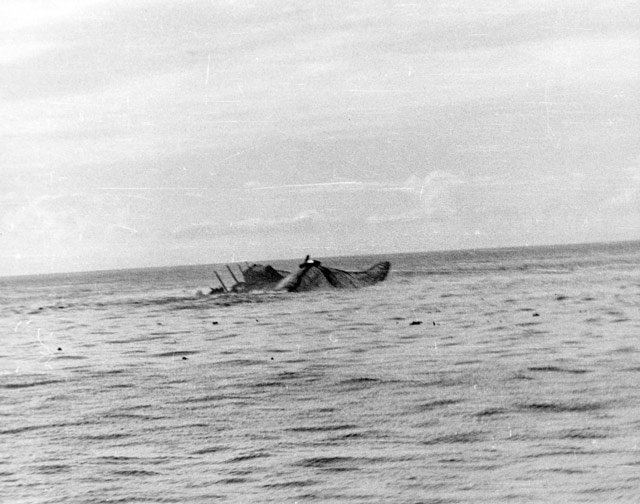
USS Yorktown sinks at Battle of Midway 7 June 1942 worldwartwo.filminspector.com
"USS Yorktown (CV-5) sinking, just after dawn on 7 June 1942, as seen from an accompanying destroyer." Naval History and Heritage Command NH 106000.

Battle of the Indian Ocean: Japanese submarine I-18 shells and sinks 2158-ton Norwegian freighter Wilford in the Indian Ocean off the Mozambique Coast. There are nine deaths and 34 survivors. All but two of the survivors, who are picked up by a Marinha Portuguesa gunboat, reach land in their lifeboats.

Eastern Front: In Crimea, German General Erich von Manstein begins Unternehmen Störfang (Operation Sturgeon Catch), the assault on Sevastopol. The port is well-defended, surrounded by rugged forests and bunkers that include 11 batteries and strong points north of Severnaya Bay.

The German 11th Army is weak, with many divisions seriously understrength. This is because Adolf Hitler is husbanding his fresh troops for the grand offensive, Case Blue, that he plans to launch in a few weeks. There are many fresh divisions and thousands of idle troops just north of the Crimea. It is an artificial manpower shortage, as opposed to the real one that are to come. Thus, Manstein must rely heavily on his artillery and airpower to make up for a weak thrust on land. Assisting the Germans are units of the Romanian Army, including the 1st Mountain Division and 18th Division, which are strong but lack their own artillery and air support.
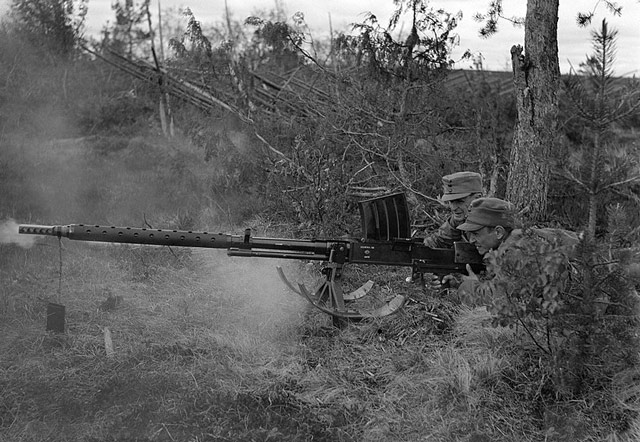
Finnish Lahti L-39 antitank gun in use, 7 June 1942 worldwartwo.filminspector.com
Lahti L-39 anti-tank gun in use, 7 June 1942 (Martin Persson, SA-kuva).

Aiding the assault are the Germans' heavy artillery that includes an 800 mm gun (Schwere Gustav), three 600 mm guns (Karl-Gerät self-propelled mortars), two 280 mm railway guns, two 420 mm guns, two 355 mm howitzers, and four 305 mm mortars. These massive artillery pieces have been firing at the Soviet defenses for days and have destroyed some key Soviet bunkers. The Luftwaffe's 8th Air Corps already has flown 3,069 sorties against the port, dropping 2,264 tons of high explosives and 23,800 incendiary bombs.

Following the massive preparatory bombardment, German 30 Corps attacks in the south while LIV Corps does so in the north. The southern attack stalls, but the LIV Corps makes good progress (this is the sector where the heaviest artillery has is located). The 132nd Infantry Division heads down the river while the 22nd Infantry Division attacks further east. The Soviets have planted numerous minefields that slow the Axis troops down. 

For Manstein, it is a mixed picture, with some advances in the north, few gains in the south, and failed attacks by the German 24th and 50th Infantry Divisions. In LIV Corps' four divisions alone there are 2,357 casualties, including 340 men killed. In addition, some of the units are running low on ammunition. However, the Germans take the key Red Army defensive position at Belbek, and Red Army casualties also have been severe. With his attempt at a quick victory a failure, Manstein now is looking at a depressing battle of attrition against the numerous enemy forces unless he can get the attack moving in the coming days.
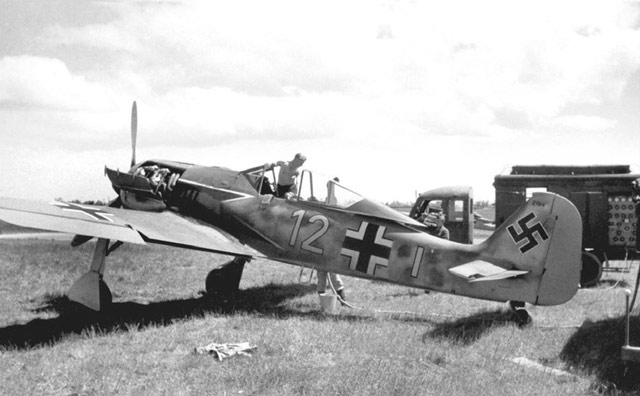
Fw-190 in France, June 1942 worldwartwo.filminspector.com
Focke-Wulf Fw-190A-2, 7./JG2, Theville, France, June 1942. The plane is still a bit of a mystery to Allied forces at this time.

European Air Operations: The weather is poor (10/10), with clouds down to 2000 feet. There are few operations during the day, typical during a relatively quiet spring 1942 on the Channel Front.

After dark, RAF Bomber Command attacks the German port of Emden. On the way back to base at 00:47, Luftwaffe pilot Oblt. Ludwig Becker of 6./NJG 2 in a Bf 110 shoots down a Wellington III (X3279) into the Waddenzee. All six crewmen perish.

Hptm. Johannes Seifert of I./JG 26 (KIA 25 November 1943) is awarded the Ritterkreuz (Knight's Cross of the Iron Cross) for 36 victories.
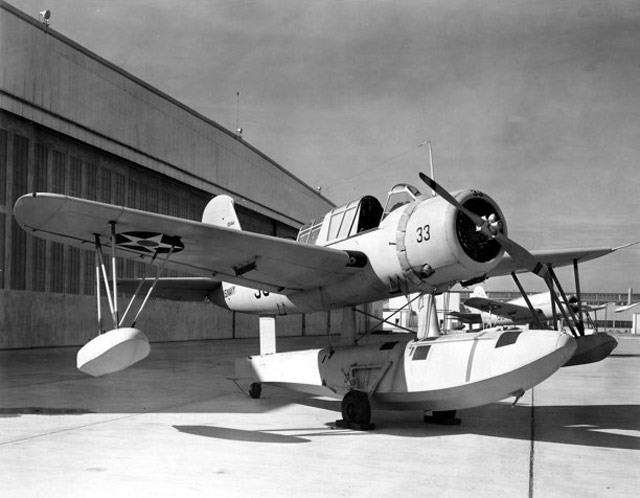
Kingfisher seaplane in Jacksonville, Florida, 7 June 1942 worldwartwo.filminspector.com
A US Navy Vought OS2U Kingfisher seaplane on the ramp at Naval Air Station Jacksonville, Florida, 7 June 1942 (US Navy). 

Battle of the Atlantic: U-653 (Kptlt. Gerhard Feiler), on its third patrol out of Brest, torpedoes and sinks seaplane tender USS Gannet (AVP-8) northwest of Bermuda. The ship sinks within four minutes. PBM Mariner seaplanes of VP-74 rescue 22 men, while USS Hamilton picks up 40 more. There are 16 deaths. 

U-159 (Kptlt. Helmut Friedrich Witte), on its second patrol out of Lorient, torpedoes and sinks 3382-ton US freighter Edith 200 miles southeast of Kingston, Jamaica. The ship sinks within twelve minutes. Witte surfaces after the attack to question the survivors and give them direction. He also, in an unusual move, scavenges various supplies that are bobbing in the water such as food, clothing, and even toys. The ship's survivors make it to Black River, Jamaica, in a week.

Italian submarine Leonardo da Vinci torpedoes and sinks 6956-ton British freighter Chile 350 miles southwest of Monrovia, Liberia. There are five deaths and 39 survivors.

U-107 (Kptlt. Harald Gelhaus), on its sixth patrol out of Lorient, torpedoes and sinks 3910-ton Honduran freighter Castilla near Jamaica. The ship sinks within minutes and no lifeboats can be launched. There are 24 dead and 35 survivors, who are picked up by USS Nike (WPC 112).

U-107 also torpedoes and sinks 3249-ton US freighter Sterling Steel Bridge (formerly Suwied) near Cozumel, Mexico. The ship sinks within three minutes, preventing any distress calls. There are six dead and 27 survivors. The survivors are picked up after 19 hours by USCGC Nemesis (WPC 111). This sinking, which occurs around midnight, is sometimes cited as occurring on 8 June.

U-158 (Kptlt. Erwin Rostin), on its second patrol out of Lorient, torpedoes and sinks 5234-ton Panamanian freighter Hermis due west of Havana, Cuba and due north of the extreme western tip of Cuba. Despite being hit by two torpedoes, the ship remains afloat and steaming in a circle, so Rostin surfaces and shells the freighter, setting it on fire, but it remains afloat for 12 more hours. There are one death and 46 survivors, who are picked up by US Army transport Toloa and taken to Kingston, Jamaica.

German 2967-ton freighter Joao Pessoa strikes rocks and sinks two miles from San Sebastian, Spain. Casualties are unknown.
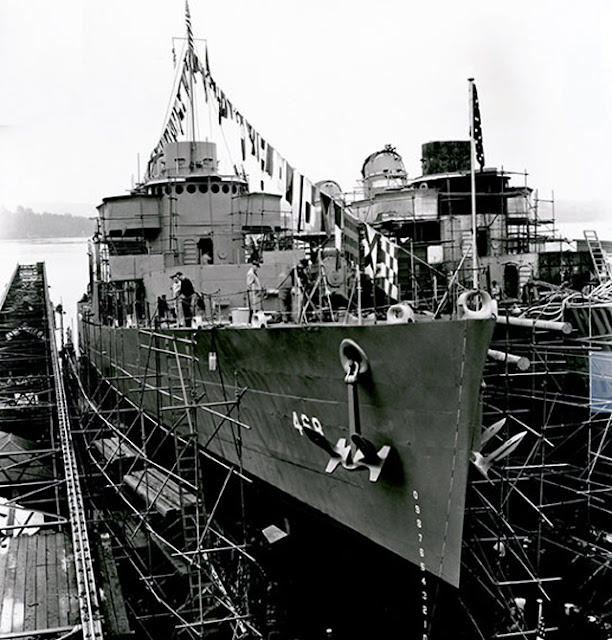
USS Taylor being launched in Maine, 7 June 1942 worldwartwo.filminspector.com
Launch of USS Taylor (DD-468) at the Bath Iron Works in Bath, Maine, on 7 June 1942. The ship is named after  Rear Admiral William Rogers Taylor (US Taylor Reunion Association).

Battle of the Mediterranean: The Axis forces around Bir Hakeim continue small-scale attacks. The 90th Light Division has managed to send pioneers through one minefield and into an interior minefield within about 800 meters (900 yards) of the fortress. The Free French garrison, while low on supplies, continues to hold out. During the day, the British Desert Air Force (DAF) launches several attacks against the exposed pioneers, while Luftwaffe Stukas pound the fort.

Much of the fighting at this stage of the battle revolves around supply lines, which are of vital concern in the desert. The British launch minor attacks by the 7th Motor Brigade and 29th Indian Infantry Brigade against Axis supply lines without much success. One last convoy manages to get through to Bir Hakeim in heavy fog after dark. Meanwhile, German General Erwin Rommel use the fog to reposition his forces for a determined assault on Bir Hakeim from the north on the 8th.

Besieged within Bir Hakeim, Brigadier General Marie-Pierre Koenig requests permission to withdraw due to his supply problems. Lieutenant-General Neil Ritchie, commanding the British Eighth Army, denies the request. Ritchie has his reasons - he anticipates the loss of Libya and needs to buy time while he builds a last-ditch defensive position at the little Egyptian town of El Alamein. Koenig, knowing that he can't hold out much longer, begins contemplating a breakout.

Italian submarine Sebastiano Veniero (Cdr Elio Zappetti) is lost due to two Catalina attacks of RAF No. 240 Squadron between the Balearic Islands and Sardinia around noontime. All 57-58 men on board perish.
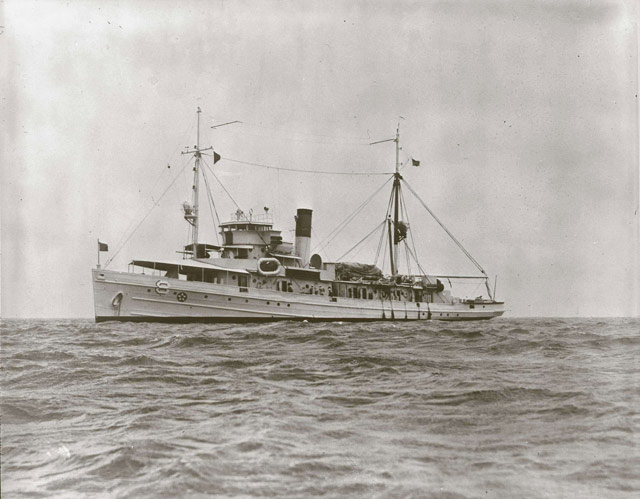
USS Gannet, sunk on 7 June 1942 worldwartwo.filminspector.com
USS Gannet, sunk by U-653 on 7 June 1942.

Special Operations: British Commandos execute Operation Albumen, another in a long sequence of overnight operations against Axis coastal targets. This one is on the Greek island of Crete, where Luftwaffe forces have been supporting the currently successful campaign of German General Erwin Rommel in Libya. Operation Albumen has several different coordinated sabotage operations.

Led by Captain G.I.A. Duncan of the Black Watch and assisted by local partisans, the Commandos destroy five aircraft and damage 29 others, along with several vehicles and stores, at Kastelli. At Heraklion, George Jellico leads members of the Free French Forces and Hellenic Army to plant Lewes bombs, destroying about 20 Junkers Ju 88 medium bombers. Similar attacks at Tympaki and Maleme do not accomplish anything because there were no aircraft at the former location and the latter was too well guarded. The Germans lose a dozen soldiers.

Aside from the damage caused directly by Operation Albumen, there are some lasting consequences. While the Commandos escape, the German authorities take and execute 50 local hostages. German Crete commander General Alexander Andrae ultimately is replaced by General Bruno Bräuer in November 1942 partly as a consequence of this raid.
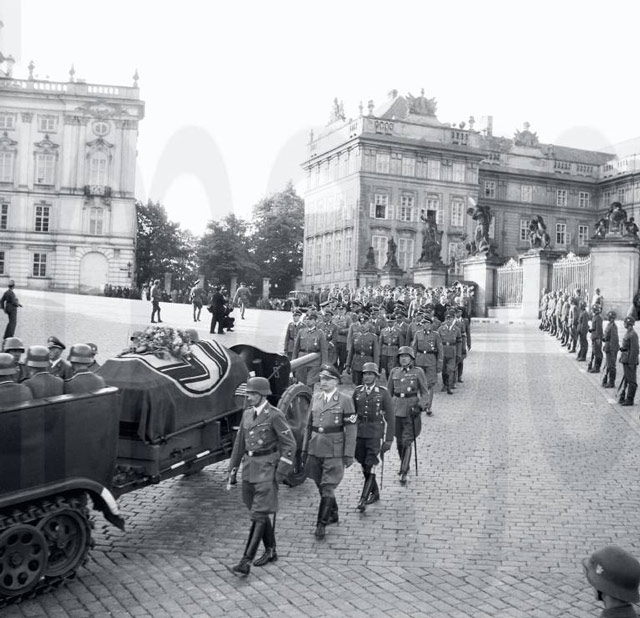
Funeral in Prague of Reinhard Heydrich, 7 June 1942 worldwartwo.filminspector.com
Funeral procession of Reinhard Heydrich in Prague, 7 June 1942. Note his flag-draped coffin on a caisson on the left.

German Homefront: The German authorities in Prague hold a massive, ostentatious funeral for assassinated Reichsprotektor Reinhard Heydrich. Afterward, the coffin is sent by train to Berlin for a second funeral to be held on 9 June. The second funeral is planned to be even more elaborate and ostentatious and is to be attended by the entire Reich leadership including Adolf Hitler. The Prague authorities continue to search for the assassins, who remain in the city moving between safe houses. Severe reprisals are in progress, with many more planned.

British Homefront: Scientist Alan Blumlein, the inventor of stereo sound recording among many other things, dies when a Halifax bomber in which he is testing H2S airborne radar crashes in Herefordshire. The crash apparently is due to improper aircraft maintenance. Due to Blumlein's importance to the war effect, the British government does not announce Blumlein's death until 1945. This delay leads to various conspiracy theories about the true cause of Blumlein's death. In 2017, the US Recording Academy posthumously awards Alan Blumlein a Technical Grammy for his contributions to the recording field.
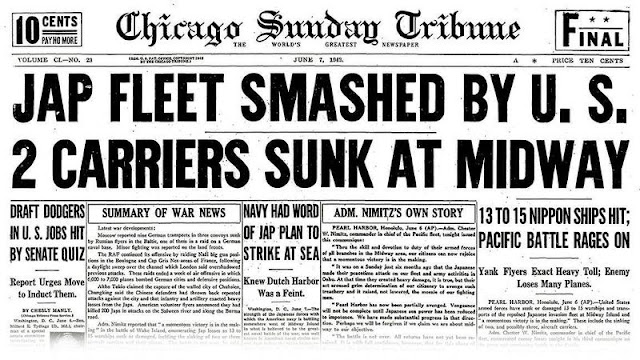
Chicago Sunday Tribune, 7 June 1942 worldwartwo.filminspector.com
The 7 June 1942 Chicago Sunday Tribune, featuring the article in the center "Navy Had Word of Japanese Plan to Strike at Sea" which almost got the reporter and newspaper in big trouble.

American Homefront: In a remarkable journalistic coup, the Chicago Tribune breaks the news of the codebreaking that contributed heavily to the US Navy victory in the Battle of Midway. Under the headline "Navy Had Word of Japanese Plan to Strike at Sea," the article describes how Naval Intelligence allowed Admiral Nimitz to pre-position his forces to ambush the Japanese fleet. While this article displays a clear breach of critical military security that might aid the Japanese, nothing comes of it. The Japanese military shows no signs of becoming aware that the Americans have broken their codes.

In Great Britain, Winston Churchill is known for having a short fuse with regard to sensitive press leaks like this. His government engages in many displays of censorship and attempted censorship. However, the US government ultimately lets the matter pass because events show that the disclosures do not interfere with the war effort.

Future History: Muammar Muhammad Abu Minyar al-Gaddafi is born in Qasr Abu Hadi, Sirte, Italian Libya. From a poor tribal family, he joins the Libyan military in 1963. In 1964, Muammar Gaddafi forms the "Central Committee of the Free Officers Movement," a revolutionary group styled after the teachings of a former Egyptian leader. In mid-1969, while Libyan King Idris is on vacation in Turkey and Greece, Gaddafi leads a bloodless coup and established the Libyan Arab Republic. Self-styled as the "Brotherly Leader and Guide of the Revolution of Libya," Muammar Gaddafi thereafter rules Libya as a dictator. He develops a cult of personality and remains in power until 20 October 2011, when Muammar Gaddafi perishes while trying to flee from an insurrection.
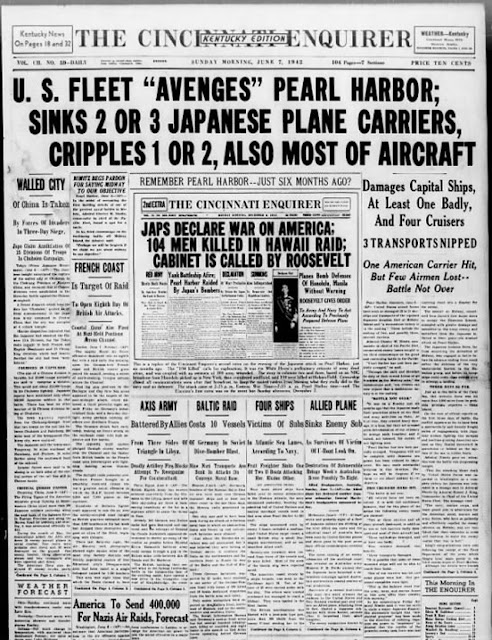
Cincinnati Enquirer, 7 June 1942 worldwartwo.filminspector.com
The 7 June 1942 Cincinnati Enquirer headlines the Battle of Midway as "Avenging" Pearl Harbor. It even reprints its front page from the Pearl Harbor report on this front page to hammer home that point. Unusually for this stage of the war, the report actually underplays the American victory, claiming only "2 or 3" Japanese carriers sunk when actually four were sunk. Still, this is very accurate reporting this close to the actual battle.

2021

Friday, September 17, 2021

May 27, 1942: Heydrich Fatally Wounded in Prague

Wednesday 27 May 1942

Reinhard Heydrich death car 27 May 1942 worldwartwo.filminspector.com
The car, bearing license plate SS-3, in which Reinhard Heydrich was attacked in Prague on 27 May 1942. Incidentally, the current whereabouts of this particular vehicle are hotly disputed among historians (Federal Archive Image 146-1972-039-44T).

Battle of the Pacific: USS Yorktown arrives at Pearl Harbor on 27 May 1942, requiring extensive repairs in a hurry if it is to participate in the anticipated Japanese attack on Midway Island in early June. This begins a frenzied, around-the-clock repair job in drydock on the carrier. Her flight deck must be repaired and whole sections of the internal frame cut out and replaced. Fortunately, the elevators are undamaged, which makes it possible for the Pearl Harbor Naval Shipyard to return Yorktown to operational status within 72 hours.

The Japanese, meanwhile, cannot use two of their aircraft carriers, Zuikaku and Shōkaku, due to their damage at the Battle of the Coral Sea. However, Admiral Yamamoto is confident that his four large carriers Akagi, Kaga, Soryu, and Hiryu with a total of 229 embarked aircraft will suffice. The First Mobile Carrier Force/Carrier Strike Force (Kido Butai) under Admiral Nagumo departs for Midway from the Inland Sea today, and other units depart from Saipan and Guam, effectively beginning the operation.

In a mishap that is a sign of things to come, the crew of Japanese submarine I-19 is preparing to launch its "Glen" scout plane for reconnaissance over Bogoslof Island in the Aleutians when a US destroyer on patrol enters the area. The Japanese have to dive immediately, destroying the plane. However, I-25 successfully launches its plane for an overflight of Kodiak Island without incident.

The USAAF continues beefing up its air forces in the Aleutians, with Patrol Wing 4 commander arriving in Kodiak Island from Seattle.

B-17s of the Fifth Air Force bomb the Japanese overseas headquarters at Rabaul. P-39s fo the 8th Fighter Group fight Japanese Zeros attacking Port Moresby, losing two P-39Fs.

US Marines and Navy Seabees of the 8th Defense Battalion move southwest from Samoa to occupy the Wallis Islands, a French possession. They will remain there through 1943. While unbelievably dull, the stay will be broken up by a visit by First Lady Eleanor Roosevelt during her tour of the Pacific.

Hitler and Bose 27 May 1942 worldwartwo.filminspector.com
Subhas Chandra Bose with Adolf Hitler (right) at Wolfsschanze, East Prussia, on 27 May 1942. Bose is an Indian nationalist who the Axis leaders hope will stir up an uprising in India against the Allies.

Battle of the Indian Ocean:  While the Burma campaign "officially" concluded on 26 May, Japan and its allies are still busy occupying bypassed areas. Today, Thai forces capture Kengtung, Burma.

The Tenth Air Force transfers the B-17s of the 11th Bombardment Squadron of the 7th Bomber Group from Karachi to Lahabad, India.

Eastern Front: The Soviet armies southeast of Kharkov are trapped in a ten-mile by two-mile pocket but are still fighting hard to escape. The Luftwaffe proves deadly over the pocket, with  Ju 87s, Ju 88s, and He 111s raining down SD-2 cluster bombs and SC250 bombs on the milling masses of Red Army troops and their T-34 tanks clogging the roads. There is no refuge in the pocket, and three Soviet generals perish in the 26th-27th May fighting.

At Fuhrer Headquarters in East Prussia, General Franz Halder notes:
At Izyum, an attack from outside was repelled. Reduction of the pocket is progressing; the enemy has been split into smaller groups, which are dwindling as our prisoner take mounts.
Unusually, and in a sign of the importance he places on the Kharkov victory, Halder returns to this situation later in his report:
Army Group intends to develop the success west of Izyum into further offensive operations east of Kharkov and east of the Donets, at Izyum, in order to gain further successes in the area before the start of operation "Blau."
Red Army General Timoshenko, meanwhile, is still ordering offensive operations for the trapped men to break out. However, the Germans have a clear advantage now and mass surrenders are beginning.

European Air Operations: It is another quiet day on the Channel Front in unsettled weather. The RCAF does an anti-shipping sweep over the North Sea and along the Dutch Coast. RAF No. 121 Squadron badly damages two minesweepers off Flushing Harbor, destroys one Bf 109 fighter (shot down by Jimmy Daley), and damages four others. 
British freighter Empire Purcell sinking 27 May 1942 worldwartwo.filminspector.com
British freighter Empire Purcell of PQ-16, on fire after being bombed in the Arctic. Shortly after this picture was taken, ammunition in the hold exploded, destroying the ship.

Battle of the Atlantic: It is a brutal day for the Allies in the Arctic. The Luftwaffe has been reinforced in northern Norway at Hitler's orders, and today that decision pays dividends. Convoy PQ-16, spotted by a reconnaissance plane on 25 May, comes under fierce air attack about 100 miles southeast of Bear Island. The convoy, bereft of air cover, suffers horribly in three major attacks, one at mid-day (three ships sunk, one damaged), the second in mid-afternoon (one sunk and one damaged), and then in the evening under the midnight sun (two ships sunk, one damaged. The only good news for the Allies is that the convoy suffers no more losses after today due to the arrival on the 28th of three Soviet destroyers and four minesweepers that enhance anti-aircraft protection.

The ships hit today that sink include:
  • 5689-ton US freighter Alamar (all 45 men survive) (later sunk as a navigation hazard by US submarine USS Trident).
  • 7457-ton British freighter Empire Lawrence (19 dead)
  • 7049-ton British freighter Empire Purcell (8 dead)
  • 5481-ton US freighter Mormacsul (3 dead) (later sunk as a hazard to navigation by USS Trident).
  • 6167-ton US freighter City of Joliet (all survive) (actually sinks on 28 May)
  • 5171-ton British freighter Lowther Castle (sunk by an aerial torpedo).
U-753 (KrvKpt. Alfred Manhardt von Mannstein), on its fourth patrol out of La Pallice, torpedoes and sinks 6578-ton Danish tanker Hamlet off Morgan City, Louisiana. Everyone survives, picked up in their lifeboat by fishing vessels.

U-558 (Kptlt. Günther Krech), on its seventh patrol out of Brest, torpedoes and sinks 2622-ton US Army transport USAT Jack 100 miles southwest of Port Salut, Haiti. The ship sinks quickly, within four minutes, and the suction swamps a lifeboat. Another, damaged, lifeboat contains 16 survivors, who are picked up by submarine USS Grunion (SS-216) on 31 May. Another seven men spend 32 days on a raft before being found, while five others on a raft disappear. There are 37 deaths, including 8 US Army personnel traveling as passengers.

U-172 (Kptlt. Carl Emmermann), on its second patrol out of Lorient, torpedoes and sinks 8940-ton British tanker Athelknight southeast of Bermuda. This is U-172's first sinking of the war. Athelknight had been part of Convoy OS-28, but the convoy was dispersed. There are nine dead and 43 survivors. The crew spends about a month before being saved, 25 men picked up by British freighter Empire Austin after 28 days, and the remaining 18 men in a lifeboat that manages to sail 1200 miles to St. Bartholomew Island, Leeward Islands on 23 June.

U-578 (KrvKpt. Ernst-August Rehwinkel), on its fourth patrol out of St. Nazaire, torpedoes and sinks 6269-ton Dutch freighter Polyphemus off Bermuda. The ship, with a crew of 61, is also carrying 14 survivors of the Norwegian freighter Norland. Rehwinkel surfaces and gives the survivors some cigarettes and directions to land. There are 60 survivors of the 75 men on board, most of whom make it to Nantucket Island. Along the way, U-566 (Kptlt Borchert) also spots one of the lifeboats, also surfaces, and also gives the men some supplies and directions.

British 710-ton minesweeper HMS Fitzroy sinks from unexplained causes, likely from hitting a British mine, 40 nautical miles east of Great Yarmouth. There are 13 deaths.

British 501-ton trawler HMS Arctic Pioneer sinks after colliding with battleship King George V off Portsmouth. It is later raised, refloated, repaired, and returned to service.

US 37-ton scow K No. 12 founders and sinks eight miles west of Cape Saint Elias, Alaska. Everyone survives.

Dutch 482-ton coaster Oorlogschip hits a mine and sinks off Hoek van Holland. Casualties are unknown.

Athelknight sunk on 27 May 1942 worldwartwo.filminspector.com
M/V Athelknight, shown here in a pre-war photo as a "modern tanker," was sunk by U-172 off Bermuda on 27 May 1942.

Battle of the Mediterranean: A day after launching a feint against the center of the British Gazala Line in Libya, General Erwin Rommel launches his main attack from the south. The attack has been meticulously planned out so that Allied minefields will provide cover for the Axis flank and rear.

Rommel splits his forces to accomplish multiple objectives at once. The 90th Light Division at the far right of the attack has the most success, capturing British supply dumps at El Adem. The 15th Panzer Division in the center, runs into the British 4th Armoured Brigade of the 7th Armoured Division and, after a terrific fight, pushes the British M3 (Grant) tanks back toward El Adem. The Italian Ariete Division of XX Motorized Corps blasts through the 3rd Indian Motor Brigade of 7th Armoured Division, which loses 23 tanks and 440 men killed and about 1000 prisoners, but the Italians then run into trouble. The 21st Panzer Division finds a gap and advances without opposition.

The key issue for Rommel today is at Bir Hakeim. There, the 1st Free French Brigade under General Marie-Pierre Kœnig defends an old fort and is well dug in. Rommel has placed too much confidence in the Ariete Division and underestimated the Free French. The Italians are stopped cold at the fort with the loss of 31-41 tanks of the IX Tank Battalion. Although the Axis forces surround it, Bir Hakeim with its effective French fortifications remains a problem for the Afrika Korps well into June. Overall, Rommel's attack today is a success, achieving complete surprise and smashing into the Allied defenses.

USS Yorktown on 27 May 1942 worldwartwo.filminspector.com
USS Yorktown (CV-5) arrives in Pearl Harbor, 27 May 1942, escorted by tug Hoga (YT-146). Yorktown proceeds directly to drydock for repairs, The tip of the sunken USS Arizona's mast can be seen just to the right of Yorktown (Naval History and Heritage Command 80-G-21931). 

Special Operations: Two specially trained soldiers of the Czechoslovak army-in-exile, Jan Kubiš and Warrant Officer Jozef Gabčík, have been hiding out in occupied Czechoslovakia since 28 December 1941 on a unique mission. They are there to carry out Operation Anthropoid, which is an assassination operation against Stellvertretender Reichsprotektor (Deputy/Acting Reich-Protector) of the provinces the Reich calls Bohemia and Moravia (Czechoslovakia) Reinhard Heydrich.

A devoted supporter of Adolf Hitler's agenda and a key instigator of the Holocaust, Heydrich is widely feared throughout Czechoslovakia for his brutal and uncompromising methods. In addition to his duties in Czechoslovakia, Heydrich remains chief of the Reich Security Main Office. He was the leader of the infamous "Wannsee Conference" on 20 January 1942 that formulated the master plan for the Holocaust. In fact, the plan to establish killing centers at Belzec, Sobibor, and Treblinka is codenamed "Operation Reinhard" (Aktion Reinhard) in his honor. He is a true celebrity throughout Occupied Europe.

Heydrich has been Deputy Reich Protektor (the actual Protektor is a figurehead, Konstantin von Neurath) of Bohemia and Moravia since 27 September 1941. This appointment is widely seen as a reward for his slavish devotion to Reichsfuhrer-SS Heinrich Himmler and the Third Reich. Tellingly, Neurath has been on "leave" since Heydrich's appointment because he has been too "soft" on the Czechs, whose labor is badly needed for the war effort.

Today, the two agents, trained by the British Special Operations Executive (SOE), spring into action. After a quiet morning, at around 11:00 Heydrich has his driver take him from his home to the airport to fly to Berlin. He has an appointment for a meeting with Hitler, who may have a new assignment for him. The agents ambush Heydrich's open-top Mercedes 320 Cabriolet B chauffeur-driven limousine at Prague 8-Libeň near Bulovka Hospital. This is a fairly crowded area with tram stations nearby.

Reinhard Heydrich assassination location 27 May 1942 worldwartwo.filminspector.com
A view of the location of the Reinhard Heydrich assassination, with the death car. The assassins chose this spot because Heydrich's car had to slow down to make a turn here.

Gabčík steps forward and attempts to use a Sten submachine gun, which he has concealed under a raincoat, to fire at Heydrich. However, the gun jams. Incredibly, Heydrich, apparently believing that Gabčík is a lone attacker, tells the driver to stop. He then, stands up in the rear of the limo and draws his Luger pistol to fire at Gabčík. If Heydrich had just told his driver to proceed, he would have suffered no consequences from the attack.

Instead, events now take a deadly turn. Kubiš is nearby and throws a modified anti-tank grenade (concealed in a briefcase) at Heydrich. However, Kubiš makes a poor throw and the bomb falls short, landing against the limo's rear wheel. When it explodes, shrapnel and pieces of the car hit Heydrich, badly injuring him, though he does not realize how badly immediately. Kubiš himself also is lightly wounded by shrapnel.

At that point, Heydrich and his driver, SS-Oberscharführer Johannes Klein, leap out of the Mercedes. Heydrich heads toward Gabčík, standing with his jammed gun, while Klein (whose own gun has jammed) chases Kubiš, who pedals away on a bicycle through crowds of people taking the trams nearby.

A gunfight then erupts between Gabčík and Heydrich, both using pistols. Heydrich soon collapses, apparently from his bomb injuries, while Klein turns and pursues Gabčík, who also flees on a bicycle. Gabčík escapes after shooting Klein in the leg.

Two people, a Czech woman and an off-duty policeman, flag down a passing delivery van and have it drive Heydrich, who is conscious but in severe pain, to nearby Bulovka Hospital. Surgeons there, primarily Dr. Walter Diek, Dr. Slanina, and Professor Hollbaum, do what they can, but Heydrich is in very bad shape (he passes away on 4 June 1942).

Adolf Hitler and Himmler are furious when they hear the news of the attack. Himmler sends his top SS doctor, Karl Gebhardt, to care for Heydrich, while Hitler ponders sending notorious SS General Erich von dem Bach-Zelewski, currently serving in anti-partisan duties in the occupied USSR, to Prague to conduct reprisals. Zelewski is well known throughout the SS for his brutal methods and complete lack of human sentiment when such would conflict with his orders, so Hitler's desires are obvious.

Himmler, however, talks Hitler out of this, claiming Zelewski can't be spared from the Front. He also dissuades Hitler from his most brutal planned reprisals, namely, simply exterminating 10,000 Czechs known to be "politically unreliable." Himmler is not being a "nice guy," he simply knows that Czech labor is important to the war effort and is thinking strategically.

As the day ends, Heydrich remains barely alive, while Kubiš and Gabčík, who think they have failed in their mission to kill Heydrich and know they are being hunted down, are sheltering at a local safe house. Hitler appoints Kurt Daluege, chief of the national uniformed Ordnungspolizei (Order Police), to replace Heydrich. Daluege turns out to be just as bad as Zelewski might have been, destroying entire towns such as Lidice in an orgy of bloodshed. Daluege quickly issues a deadline of 18 June for the two agents to be caught or, he warns, the people of Czechoslovakia will face extreme reprisals. However, Daluege doesn't wait until that date to begin a campaign of terror against any Czechs and Czech municipalities that he thinks have anything remotely to do with the two agents.
British landing exercises on 27 May 1942 worldwartwo.filminspector.com
"Troops wade ashore from a tank landing craft during a combined operations exercise at Thorness Bay on the Isle of Wight, 27 May 1942." © IWM H 20202.

Partisans: Near Bryansk, the German anti-partisan Operation Hannover makes some ground as the heavy rains ease up. A German pincer movement has its points meet at Furtsevo. However, Soviet General Below has escaped with his men. Overall, the results are disappointing for Fourth Army, which thought it could trap Belov and end the threat he and his men pose. On the bright side for the Germans, about 2/3 of the Soviet volunteers it had sent into the pocket as spies return (or are caught in the pincer) and provide some useful information.

General Halder sees the glass as half full:
The attacks against Cav. Corps Belov resulted in a gratifying success. Here, too, the enemy has been split into smaller groups; some still are putting up stubborn resistance.
Halder obviously does not yet know that Belov has escaped, and is relying on overly optimistic reports from field commanders. It will take five days to sort things out and figure out who was captured and who escaped.

Holocaust: The requirement that began in the Balkans that Jewish residents wear a yellow identification badge extends to Belgium.

Preparations begin for Operation Fahndung nach deutschem Blut (roughly, "Find German Blood")This is a German plot to kidnap Polish children deemed "racially German" and raise them in Germany. Planning for Operation Zamość, an operation to clear all Poles from the Zamość region of Poland and replace them with Germans, also begins.

Guards at Auschwitz shoot 168 prisoners against the execution wall in the courtyard of Block 11. The victims are members of the group of Polish painters, artists, and actors who were arrested at the Artists' Cafe in Krakow on 16 April 1942. The reason they are chosen is due to the fact the executions are done in reprisal for the murder of a Luftwaffe commander in Krakow.
British landing exercises with a Churchill tank on 27 May 1942 worldwartwo.filminspector.com
A Churchill tank leaves a tank landing craft (TLC 121) during combined operations exercises at Thorness Bay on the Isle of Wight, 27 May 1942.

Japanese Government: Prime Minister Hideki Tojo, leader of the "War Party," addresses the Diet. The speech is notable for his encouragement of Indians to follow Subhas Chandra Bose and rise up against the Allies and assert independence. This is not just a product of wishful thinking, as many Indian troops, such as those in Singapore, already have changed sides.

American Homefront: "Prelude to War," an official US Government film stating who the enemies of the United States are and why they are being fought, receives national release after premiering in New York City on 13 May 1942. It also was shown as an army training film before this release. "Prelude to War" features Walter Huston as the narrator and includes footage of top German leaders such as Adolf Hitler, Joseph Goebbels, Hermann Goering, and Rudolf Hess. This film is marketed with the tagline, "Your boy wants to see it!"

There is nothing subtle about this film, directed by Frank Capra. It is proud to serve as obvious propaganda and does a very good job of it. "Prelude to War" is now in the public domain. In 2000, the United States Library of Congress mandated that this film be included among "culturally significant" films selected for preservation in the National Film Registry.
Gun camera footage of an Fw 190 being shot down in May 1942 worldwartwo.filminspector.com
A gun-coupled camera aboard a British RAF Spitfire plane made this record of a German Focke-Wulf Fw 190 fighter aircraft getting shot down in May 1942, over an unknown location. The Fw 190 was still a mystery plane to the RAF at this point. Note the pilot bailing out (AP Photo).

May 1942


2021