Showing posts with label Doolittle Raid. Show all posts

Sunday, August 21, 2022

June 17, 1942: The Mersa Matruh Stakes Begin

Wednesday 17 June 1942

Maxim Gorki fortress after the German capture 17 June 1942 worldwartwo.filminspector.com
Maxim Gorki fort after the German capture, 17 June 1942 (Glanz, Federal Archive RH 82 Bild-00146).  

Battle of the Mediterranean: The North African campaign breaks wide open on 17 June 1942 as British attempts at forming a new defensive line east of Tobruk fail. The British 8th Army continues to lose its grip on the approaches to Tobruk. Before dawn, it evacuates the defensive box at El Adem, and later in the day at Sidi Rezegh. A counterattack by the British 4th Armored Brigade at Sidi Rezegh loses 30% of its tanks.

Afrika Korps commander General Erwin Rommel leads the 21st Panzer Division personally in his command car. They take RAF Gambut by 22:00, capturing 15 flyable aircraft and fuel supplies. The panzers reach the coastal road south to Bardia at 23:30, effectively encircling Tobruk and cutting its defenders off from Egypt except by naval resupply. 

June 17, 1942, is usually considered the start of the second siege of Tobruk (the first being a successful British/ Australian defense from 10 April - 17 December 1941). This is a disaster that stuns Winston Churchill and makes him look around for yet another military commander in North Africa.

The situation is chaotic for the British, and General Ritchie orders the complete abandonment of Libya by any British forces that can escape. They are to head for Mersa Matruh, Egypt - if they can make it there ahead of General Rommel's panzers (a garrison of 30,000 is left in Tobruk). This becomes known sarcastically within the 8th Army as the "Mersa Matruh Stakes" (after horseracing Stakes races) and the "Gazala Gallop." Mersa Matruh is a full 100 miles/ 160 km to the east and the Afrika Korps appears to be unstoppable, so the need for speed is evident.

The Staffelkapitaen of 3./JG 27, Oblt. Hans-Joachim Marseilles, raises his victory score to 99 early in the day. Toward sunset, his fellow pilots convince him to fly another mission to hit the century mark, and indeed that is what happens. Marseilles shoots down a lone Hawker Hurricane south of Gambut Airfield,, becoming only the 11th Luftwaffe fighter to hit that mark and the first to do so entirely against the Western Allies (victories against the Russians are considered much easier). But Marseilles does not stop there, he also climbs from his first "low victory" to claim a high-flying Photo-reconnaissance Spitfire for victory 101. He claims another six RAF planes in total during the day. JG 27 is aided by recaptured airbases closer to the front, its new Ain-el-Gazala base was recaptured only on 16 June.

Having become a propaganda hero now when not long ago he was considered something of a malcontent and screwup, Marseilles now is put on a 2-month leave and sent to Fuhrer Headquarters to receive a new decoration.

Germans at Soviet Fort Maxim Gorki 17 June 1942 Worldwartwo.filminspector.com
Germans enter shattered Fort Maxim Gorki, 17 June 1942 (Glanz, Federal Archive RH 82 Bild-00150).

Eastern Front: There are still Soviet holdouts in the Maxim Gorki fortress in Crimea who control underground passages and some gun emplacements. These need to be eliminated to clear the way to Severnaya Bay and take Sevastopol from the north. A Junkers Ju 87 Stuka pilot, Oberleutnant Maue, scores a direct hit on the fort's 30.5cm eastern naval gun, knocking it out. Heavy siege howitzers (such as the massive Dora and Karl guns) are working on the other heavy Soviet guns and Wehrmacht engineers who reach the fort late in the day. There still are about 1000 Soviets hiding out in the three-level fortress.

Luftwaffe General Wolfram von Richthofen, already ordered to report to a new assignment but still in the theater until the 23rd, writes:

During the night, the 54th Army Corps positioned itself, then overran the Red front lines and took the majority of the forts north of Severnaya Bay. We [the Luftwaffe] pin down the artillery east of Sevastopol and at the front and destroy much. We [hit] the forts again and again.

Richthofen is not exaggerating - the Luftwaffe has flown a total of 3899 sorties and dropped 3086 tons of bombs since 13 June. Later in the day, he adds in typical WWII German Nietzschean rhetoric that "our giant fire-magic fell on Battery Headland. The infantry were very enthusiastic!"

Around this date - the German and Soviet versions differ on several key points, including the dates - Soviet General Belov, who is leading a large mixed force of Soviet troops and partisans, escapes a huge German dragnet for him. He escapes with some of his men (again, how many is unclear) across the Rollbahn (main road) that the Germans control about ten miles east of Roslavl. Reflecting an enduring and somewhat bizarre German fascination with some adversaries, General Franz Halder writes in his war diary:

Cavalry Corps Belov is now floating around the area west of Kirov. Quite a man, that we have to send no less than seven divisions after him.

Halder does not mention that Belov has accomplished little beyond making the Germans ignore other important things to focus on him as he hides out in the woods and swamps near Bryansk.

The remaining Soviet pocket in the north near Velizh also receives attention in Halder's notes for the day:

In [the] North, we have neither positive nor negative evidence on the enemy's intention of giving up the Velizh pocket. In any event, [Army Group] North has freed the larger part of Eight Armored Divisions for a southward drive through Demyansk. On the Volkhov, attacks were again repelled and the sack further compressed.

Unknown to Halder, who has been paying little attention to this sector (which probably reflects the same about Hitler), the Volkhov pocket contains a very big prize: Soviet General Andrey Vlasov, the leader of Second Shock Army. His forces penetrated deep into the German lines during the latter stages of the winter counteroffensive, but now they are trapped. Unlike Belov, he has little hope of escape on the ground, and he refuses to abandon his men and fly out. Unknown to anyone but himself, Vlasov also is an anti-Bolshevist who believes that Stalin is an enemy of the people. Or, perhaps he is just the ultimate opportunist. In any event, with no way to fight out of the trap his army is in and little hope of rehabilitating his career following this complete defeat, Vlasov soon must make important and far-reaching decisions about his allegiance.

Hangar deck of USS Long Island, 17 June 1942 worldwartwo.filminspector.com
A Grumman F4F-4 Wildcat on the hangar deck of escort carrier USS Long Island (AVG-1), 17 June 1942. Also visible are other Wildcats and a Curtiss SOC-3A Seagull (Naval History & Heritage Command 80-G-14524).

Battle of the Pacific: The USAAF 11th Air Force plans a bombing run on the Japanese positions on Kiska Harbor, but it is scrubbed due to bad weather. Other patrol missions also are canceled.

US Navy aircraft carrier USS Saratoga flies off P-40s of the 73rd Fighter Squadron, 18th Fighter Group to Midway Island. These replace planes lost during the Battle of Midway. The P-40s immediately commence dawn to dusk patrols that last until 23 June 1943.

Syracuse Post-Standard, 17 June 1942 worldwartwo.filminspector.com
The Syracuse, New York, Post-Standard has quite a fanciful headline about a supposed battering of the Italian Fleet. In fact, there were no "U.S. Fliers" involved in the battle of 15 June 1942, and it was the British Fleet, not the Italian, that was "battered." This particularly egregious headline reflects the standards during the first year of the (U.S.) war, when there were insufficient "good" military successes and so some were just fabricated by the press to sell newspapers.

European Air Operations: The Bay of Biscay is of vital importance to the Axis as the route of U-boats to the open ocean, so it maintains constant patrols. British destroyer HMS Wild Swan, sailing through a pack of Spanish trawlers after refueling as a convoy escort (not of the trawlers, the convoy is over the horizon), is spotted and attacked by a dozen Luftwaffe Junkers Ju 88 bombers. At the cost of six of their own planes, the bombers score four near-misses that destroy Wild Swan's steering control. It collides with one of the trawlers, and both ships sink. The bombers also sink three other trawlers. There are 31 dead due to exposure after the sinking, with 133 survivors and 11 additional survivors from the trawler Wild Swan had collided with (some sources say there are 158 total survivors, perhaps including some from the other sunk trawlers, all picked up in any event by HMS Vansittart). Wild Swan commander Claude Sclater receives the DSO for the gallant action despite losing his ship.

Michigan Daily, 17 June 1942 worldwartwo.filminspector.com
The Michigan Daily of 17 June 1942 buries a gripping story of tourists in Virginia Beach, Virginia, watching U-boat sinkings. Much more prominence is given on the same page to a water main break in Seattle. 

Battle of the Atlantic: U-129 torpedoes and sinks 3274-ton U.S. freighter Millinocket north of La Isabela, Cuba. There are 11 dead and 24 survivors, who are picked up by Cuban fishing boats.

U-158 torpedoes 1560-ton Norwegian tanker Moira southeast of Port Isabel, Texas. There are one dead and 18 survivors, who are rescued by U.S. fishing boats. 

U-158 gets a second victim, 3601-ton Panamanian freighter San Blas, east of Matamoros, Mexico/McAllen, Texas. There are 30 deaths and 14 survivors, who are picked up by a U.S. Navy Consolidated PBY Catalina.

Axis mines laid in the Chesapeake Bay by U-701 (Kptlt. Horst Degen) early on 13 June 1942 claim another victim, 7177-ton U.S. collier Santore. The ship capsizes and sinks in less than two minutes. The burning ship can be seen from shore. There are three deaths and 43 survivors, who are rescued by the U.S. Coast Guard. The wreck is raised and scrapped in 1954. This mining of Chesapeake Bay claims five ships (only 15 mines were laid) and is considered the most successful mining operation in American waters during World War II.

Spy Stuff: Either later on 16 June or early on 17 June, U-202 lands four German agents at Ponte Vedra Beach, Florida. They follow four other German spies who landed on Long Island on 12/13 June as part of Operation Pastorius. The New York group (or at least their leader) already is planning to defect to the FBI. Unlike the other group, the Florida spies do not wear their uniforms ashore, only bathing suits and their military caps. They promptly put on civilian attire and board trains to Chicago, Illinois, and Cincinnati, Ohio.

Joyce Randolph on cover of first issue of Yank, 17 June 1942 worldwartwo.filminspector.com
Actress Joyce Randolph on the premiere cover of "Yank" magazine, 17 June 1942. Randolph, 97 as of the time of writing, becomes famous as Trixie Norton on "The Honeymooners." 

US Military: Flight Captain Jackie Cochran, RAF Air Transport Auxiliary, who will go on to form the Women Airforce Service Pilots (WASPs), begins a mission that will see her become the first woman to ferry a bomber across the Atlantic. She leaves Montreal to pick up her plane at Gander, Newfoundland and will arrive in the British Isles on 19 June aboard her twin-engine Lockheed Model 414 Hudson Mk.V. 

Today is the first issue of "Yank, the Army Weekly." It is written by enlisted rank soldiers. Never available for public purchase, "Yank" eventually reaches a circulation of over 2.5 million in 41 countries. It lasts until the last day of 1945. Popular cartoons include "G.I. Joe," "Sad Sack," and work by Bil Keane of Family Circus. The 1st Armored Division at Fort Bliss revives the magazine in 2014.

President Roosevelt signs a bill raising the minimum service pay to $50 per month.

Japanese Homefront: Japanese Prime Minister Hideki Tojo survives an assassination attempt by 31-year-old Park Soowon of Korea. Tojo is hit in the left arm near the old war ministry building in Tokyo. Soowon is immediately dispatched in a hail of bullets.

Radio Tokyo today finally acknowledges the Doolittle Raid of mid-April, calling it a “stunt raid of very little consequence.” While this, in actuality, is quite true, it was a great morale boost for the Allied side. The propaganda newscaster goes to great lengths to point out that only 11 crewmen escaped to Cairo and the remaining 61 were being hunted down or were dead already (a great exaggeration). The Americans are warned that further "pointless stunts" will result in harsh reprisals and "100% loss" of the enemy fliers. 

American Homefront: President Roosevelt orders the Army to oversee the construction of an atomic weapons complex. This will be done by the US Army Corps of Engineers. This is the first step in the building of the Oak Ridge, Tennessee nuclear facility, Hanford, Washington, reactor, and the weapons lab at Los Alamos, New Mexico as part of the Manhattan Project. 

Green Bay Packers newsletter, 17 June 1942 worldwartwo.filminspector.com
A Green Bay Packers newsletter dated 17 June 1942. Reflecting the times, it contains a "Packers Honor Roll" of players now serving in the armed forces.

2022

Sunday, May 16, 2021

May 19, 1942: Soviet Panic at Kharkov

Tuesday 19 May 1942

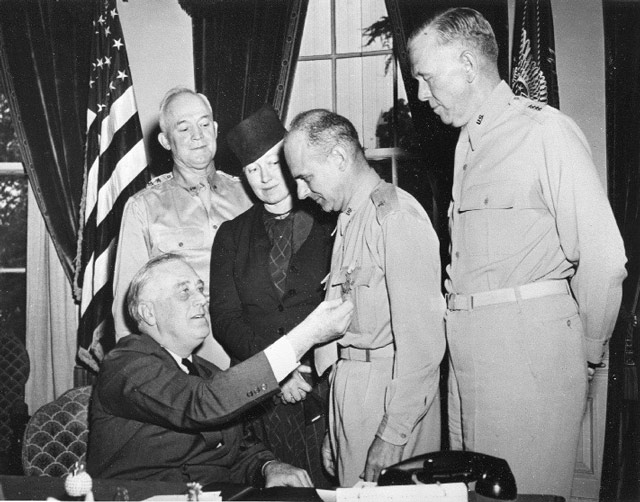
Roosevelts gives Doolittle Medal of Honor 19 May 1942 worldwartwo.filminspector.com
President Franklin D. Roosevelt presents the Medal of Honor to Brigadier General James Harold Doolittle in a ceremony at The White House, 19 May 1942. The President is seated at the left. Standing, left to right, are Lieutenant General Henry H. Arnold, Chief of the Army Air Forces; Mrs. Doolittle; Brigadier General Doolittle; and General George Catlett Marshall, Jr., Chief of Staff, United States Army. (Franklin D. Roosevelt Library and Museum, Photographic Collection, NPx. 65-696).
Battle of the Pacific: US Admirals "Bull" Halsey and Frank Fletcher are bringing their Task Forces 16 and 17 east toward Hawaii on 19 May 1942 in anticipation of a major Japanese attack. Nobody is completely sure where the attack will occur, but the consensus is that Midway Island will be the target. Light cruiser USS Nashville (CL-43) sails through the expected area of the attack from Midway to the western Aleutians today but does not see any enemy ships.

Japanese submarine I-21 launches a seaplane to reconnoiter Suva Bay, Fiji.

Battle of the Indian Ocean: The Japanese have sent a detachment of submarines, "Detachment A," to the Indian Ocean to scout for opportunities. Today, submarine I-30 launches a seaplane to reconnoiter Zanzibar and Dar-es-Salaam.
Crashed B-25B, 19 May 1942 worldwartwo.filminspector.com
A B-25B of the 39th Bomb Squadron forced to crashland at Westover Field, Massachusetts, on 19 May 1942 due to issues with the landing gear. Everyone survived. The pilot, Lt. John Henebry, ultimately becomes a major general and writes a book about his wartime experiences, "The Grim Reapers: At Work in the Pacific Theater" (2002).
Eastern Front: Commander of Army Group South Field Marshal Fedor von Bock presses his advantage against a disbelieving Red Army south of Kharkov. Having coordinated plans with First Panzer Army commander General Ewald on Kleist on the 18th, he orders Sixth Army commander General Friedrich Paulus to begin an attack from Merefa southwest of Kharkov. The objective is to occupy and distract the Soviet forces far to the west of where Kleist's panzers are attempting to surround them.

Kleist's III Panzer Corps, meanwhile, is brushing aside opposition as it continues eating into the Soviet supply corridor. The 14th Panzer Division crosses the Bereka River to take Petrovskoye while other divisions head west to block an expected Red Army breakout attempt. This narrows the mouth of the bulge to fifteen miles and deprives the Red Army forces to the west of a critical Donets river crossing.

Soviet Southwest Front, led by Marshal Semyon Timoshenko, finally begins to react to the growing Wehrmacht threat. After continuing to attack German VIII Corps south of Kharkov in the morning, it quickly breaks off the attacks and begins sending units to block Kleist's panzers to the southeast. The Luftwaffe controls the skies and sees and attacks the red Army columns on the roads. The German pilots, enjoying complete aerial dominance, claim to destroy 29 tanks during the day.

The Sixth Army war diary summarizes the situation at the end of the day: "The enemy's offensive strength has cracked. The breakthrough to Kharkov is therewith prevented."
Panzer 38(t) in Crimea, 19 May 1942 worldwartwo.filminspector.com
A German Panzer 38(t) leaves a landing craft on a beach near Yalta, May 1942 (Federal Archive B 145 Fig. F016214-0021A).
It is unclear where the Soviet orders to break off the attack in the morning came from. Post-war Soviet histories claim they came from Timoshenko on his own authority. If so, it is a dramatic turnaround by Timoshenko, who has been telling Stalin all along that the German counterattacks are not a threat. The Stavka finally reverses course at the end of the day and orders the advanced Sixth Army and Bobkin Group to terminate the offensive toward Kharkov and head southeast to confront Kleist's panzers.  
 
At his midnight conference, Hitler calls von Bock and tells him to hurry up and finish the encirclement. Kleist is to send 14th Panzer Division the final fifteen miles to reach Balakleya, where German troops of Paulus' Sixth Army await. Bock immediately calls Kleist's chief of staff and tells him to take the next town, Protopopovka, "under all circumstances and as soon as in any way possible." The fate of 600,000 Soviet soldiers to the west hangs in the balance. At Fuhrer Headquarters, General Franz Halder notes briefly in his diary that "The situation east of Kharkov is no longer dangerous."

In Crimea, General Manstein's 11th Army continues mopping up resistance in the Kerch region. Some histories record the 19th as the day of German victory in Crimea, and General Franz Halder records in his war diary that "The Kerch offensive can be regarded as closed." However, there remain Red Army holdouts (including at the port of Sevastopol), including thousands congregating in catacombs south of Kerch. In the air, Luftwaffe ace Gordon "Mac" Gollob continues a torrid victory streak, shooting down three more Soviet R-5 reconnaissance planes to raise his victory total to 99.
Japanese-American internees, 19 May 1942 worldwartwo.filminspector.com
Internees await relocation in Centerville, California. May 19, 1942. Dorothea Lange, photographer. Gelatin silver print. Collection of Oakland Museum of California. Gift of Paul S. Taylor.
European Air Operations: The weather clears sufficiently for both sides to resume their bombing operations. This is only a brief interruption of activity in what otherwise is a very quiet month along the Channel Front.

The Luftwaffe ends its lull by attacking Hull in another "Baedeker Raid." There are 50 deaths, 58 seriously injured, and extensive damage, especially in the Alexandria dock area. The bombing accuracy is quite good, especially relative to recent RAF attempts, with hits on the Blackburn aircraft factory at Brough (west of Hull). Extensive fires erupt along Scarborough Lane and Westbourne Avenue. The attack is notable for the use of an 1,800kg bomb and a 1,000kg bomb. Other areas hit include Hedon (east of Hull), Hornsea, and Withernsea. The Luftwaffe loses two Junkers Ju 88 bombers and a Dornier Do-217.

RAF Bomber Command mounts its first major raid in eleven days. The target is Mannheim. A total of 197 bombers (11 lost) embark, with 105 bomber crews claiming to hit the city. However, accuracy is very poor, and very few bombs actually hit the city. Local authorities estimate that bombs from only about ten bombers actually hit the city. However, the bombs that do hit cause an appreciable amount of damage to some small businesses in the harbor areas. There are only two deaths in the city.

In minor raids, 65 RAF bombers (one lost) attack St. Nazaire but cause little damage. Another 9 bombers lay mines off Lorient and near Heligoland, while 13 bombers drop leaflets over France.
Survivors of SS Heredia, 19 May 1942 worldwartwo.filminspector.com
The Downs family, survivors of the sinking of freighter SS Heredia on 19 May 1942 by U-506.
Battle of the Atlantic: U-506 (Kptlt. Erich Würdemann), on its second patrol out of Lorient, torpedoes and sinks 4732-ton US refrigerated freighter Heredia at 02:00 two nautical miles (3.7 km) southeast of the Ship Shoal Buoy off Louisiana. The ship sinks very quickly, giving no time to launch the boats. There are 36 deaths and 26 survivors, who are rescued by local shrimpers Conquest, J. Edwin Treakle, Papa Joe, and Shellwater, with three of the survivors picked up by a seaplane.

U-103 (Kptlt. Werner Winter), on its seventh patrol out of Lorient, torpedoes and sinks 5037-ton US freighter Ogontz 70 nautical miles (130 km) southeast of Cozumel, Mexico. There are 19 deaths and 22 survivors, who are rescued by US tanker Esso Dover.

U-751 (Kptlt. Gerhard Bigalk), on its sixth patrol out of St. Nazaire, torpedoes, shells, and sinks 3110-ton US freighter Isabela 35 nautical miles (65 km) south of Navassa Island Lighthouse. There are three deaths and 34 survivors, who make it to Cape Briton, Haiti, in lifeboats. This is the final victory for U-751.

An Italian submarine torpedoes and sinks Swedish 5747-ton steel cargo freighter Tisnaren somewhere in the Atlantic between Brazil and Senegal. Italian submarines Comandante Cappellini and Barbarigo are operating in this area but it is not definite which is the attacker.

At Hvalfjordur, Iceland, some merchant marine sailors aboard US freighter SS Ironclad notice that there is a shipment of liquor (it is en route to the US Ambassador to Moscow, Admiral William H. Standley, USN (Ret.)). They decide to help themselves and discipline breaks down, with fighting breaking out. At the behest of an armed guard officer on board, troops from the battleship USS Washington are sent over to restore order. Ironclad is removed from convoy PQ 16.
Tugboat Iriquois in Puget Sound, 19 May 1942 worldwartwo.filminspector.com
Tugboat Iriquois at sea, 19 May 1942 (Puget Sound Maritime Historical Society).
Battle of the Mediterranean: Royal Navy submarine HMS Thrasher torpedoes and sinks 1160-ton Italian freighter Penelope a few miles northwest of Monopoli, Italy.

Malta has been heavily reinforced with Spitfire fighters recently and the results are plain in the daytime sky. While Luftwaffe fighter sweeps over the island continue, the new defenders lead to a much-reduced bomber threat. In fact, they enable RAF bombers to go back on the offensive. Today, RAF bombers attack an Italian convoy northbound from Tripoli, though no ships are sunk.

Manhattan Project: Having just taken over the atom bomb research program, Robert Oppenheimer sends a letter to Ernest O. Lawrence updating him on progress. He writes that the atomic bomb design is solved "in principle" and projects that "six good physicists" should be able to work out the details within six months.

Joint Allied Command: The 30th and final in a series of Post-Arcadia meetings of the Combined Chiefs of Staff takes place in Washington, D.C. Among the topics discussed is an expected German advance toward the Persian Gulf from Syrian bases, the selection of targets for the nascent USAAF Eighth Air Force, and German development of a "new odorless gas, suitable for a surprise attack by inclusion in bombardments from the ground or from the air."
Crash site in Quebec, 19 May 1942 worldwartwo.filminspector.com
The crash site at No. 9 Bombing and Gunner School, Quebec.
Canadian Military: A Battle Mk. I crashes at No. 9 Bombing and Gunnery School, Mt.-Joli, Quebec, killing the four crewmen. This school is part of the British Commonwealth Air Training Plan, so the passengers include airmen from Canada, New Zealand, and Australia.

US Military: Brigadier General Ira C. Eaker, commander of Eighth Air Force, assumes command of all US air units in the United Kingdom.

Pursuant to a recent agreement between the United States and Panama, the 31st Fighter Squadron, 37th Fighter Group, 6th Air Force transfers its P-39 and P-40 fighters from Chorrera, Panama, to Albrook Field, Canal Zone.

Australian Military: A Tugan LJW7 Gannet aircraft flying from Batchelor Field (northern Australia) to Groote Eylandt makes a forced crash landing in a swamp in remote Arnhem Bay. The crew survives and scavengers the ruined airplane to make a raft. They survive an epic 33-day journey to the Milingimbi mission. Survivor George Booth later writes a book, "33 Days," describing how local natives helped the crew survive. This real-life story has echoes in the motion picture "Flight of the Phoenix" (1965) starring Jimmy Stewart.
General Jimmy Doolittle, 1942 worldwartwo.filminspector.com
Brigadier General James Harold Doolittle, U.S. Army Air Forces, 1942. (U.S. Air Force).
President Roosevelt presents the Medal of Honor to Lt. Colonel James Doolittle, who is also promoted to brigadier general, for the 18 April 1942 Doolittle raid. The citation reads:

For conspicuous leadership above and beyond the call of duty, involving personal valor and intrepidity at an extreme hazard to life. With the apparent certainty of being forced to land in enemy territory or to perish at sea, Lt. Col. Doolittle personally led a squadron of Army bombers, manned by volunteer crews, in a highly destructive raid on the Japanese mainland.

While, in fact, not a particularly damaging air raid as the citation reads, the Doolittle Raid was a major morale booster after the series of defeats at Singapore, Bataan, and elsewhere. It also influences Japanese strategy to its detriment, making it more defensive and paranoid.

American Homefront: The Western Defense Command issues Civilian Restrictive Order No. 1. This forces all Japanese-Americans in California, Oregon, Washington State, and southern Arizona to move into relocation camps. These camps are located in numerous states between eastern California and the Mississippi River. The total number of persons ultimately sent to camps is approximately 122,000.

Paul Waner of the Braves becomes the third National Leaguer to get 3000 hits (following Honus Wagner and Cap Anson).

Future History: Frederick "Curly" Neal is born in Greensboro, North Carolina. Curly Neal becomes a celebrity as the Harlem Globetrotters' featured ballhandler from 1963-1985. He also is featured in the animated Hanna-Barbera cartoon "Harlem Globetrotters." The Globetrotters retire Neal's No. 22 on 15 February 2008. Frederick Neal passes away in Houston on 26 March 2020.
Look magazine 19 May 1942 worldwartwo.filminspector.com
Look magazine of 19 May 1942 features a Marine Corps Sergeant Otto Nuske on the cover.

May 1942


2021

Wednesday, January 20, 2021

April 19, 1942: British in Burma Escape

Sunday 19 April 1942

USS Nevada leaving Pearl Harbor April 19, 1942 worldwartwo.filminspector.com
USS Nevada leaves Pearl Harbor for a trial run on April 19, 1942, after hurried repairs from the 7 December 1941 air raid (U.S. Navy).

Battle of the Pacific: The Doolittle raiders end their mission in the early morning hours of 19 April 1942 by crashing in China or ditching their B-25 bombers in the sea. Ultimately, 15 of the 16 planes are destroyed in crashes. One crew lands near Vladivostok, Russia, where the crew is interned because the USSR is not at war with Japan (they escape in 1943). The Japanese capture eight crewmen, of whom three are executed as "war criminals." One crewman dies of disease in prison. Most of the remaining crewmen are helped by Chinese civilians and manage to return home via Burma and India. Colonel Doolittle, who lands in a rice paddy near Chun Chow and is helped by local civilians, is promoted (in absentia) to Brigadier General.

The Japanese search hard for the Doolittle crews and while doing so execute an estimated 250,000 Chinese civilians in reprisal. In Tokyo, the raid takes the military command by surprise and alarms it even though the attack actually caused little damage. The danger is that it has exposed shortcomings in the sea "outfield" defensive perimeter. It recalls some units to the home islands for defense and beefs up sea patrols. Admiral Yamamoto speeds up spans for the invasion of Midway in order to provide better security on the sea approaches to Japan. Because the life of the Emperor was placed in jeopardy by the raid, the official position is that it is unpatriotic to argue against the adoption of a more defensive strategy.
Bataan April 19, 1942 worldwartwo.filminspector.com
The Sunday Tribune of 19 April 1942 has many pictures of the recent surrender of Bataan.
In Washington, D.C., there are wild rumors of a raid (due to Japanese radio reports that "Enemy bombers appeared over Tokyo for the first time in the current war"), but the White House and War Department issue no statements. President Roosevelt is in Hyde Park, New York, and finally is informed about the raid. Advisor Samuel Rosenman suggests that if any reporters ask where the raid originated, he could tell them it came from "Shangri-La," a fantasy Himalayan city in James Hilton's novel "Lost Horizon."

In the Philippines, the Japanese complete the capture of Cebu Island. A Japanese submarine shells and sinks 1406-ton Philippine freighter El Cano off Corregidor. The Japanese lose guard boat No. 21 Nanshin Maru (scuttled) and No. 1 Iwate Maru (sinks) as a result of the air attacks from the USS Enterprise in preparation for the Doolittle raid.
San Francisco Chronicle 19 April 1942 worldwartwo.filminspector.com
The press is full of reports of a daring air raid on Japan, but there is no official word yet and the details are only provided by Japanese radio broadcasts. San Francisco Chronicle, 19 April 1942.
Battle of the Indian Ocean: The British 1st Burma Division, about 7000 men, crosses the Pin Chaung River in Burma on 19 April 1942, meeting up with an advancing Chinese relief column. The Chinese attack at 08:00 and make little progress, but attack again in the afternoon and make contact with the British around 16:00 after the Japanese pull back to the south and east. The British under the command of Captain J.A. Clifford thereby avoid being trapped and save the troops. Clifford stays in the vicinity to collect stragglers, some of whom have escaped after being captured.

The Chinese leader, General Lo Cho-Ying, had refused to rescue the British, but subordinate commander General Sun Li-Jen responded favorably to a telephone appeal from British commander Major General James Bruce Scott and led 1121 men to help the British. The 1st Burma Division is in poor condition, having lost its heavy equipment and with many Burmese troops having deserted. King George VI will award General Sun with the Commander of the Order of the British Empire medal and also some of his subordinate commanders with other awards. The Chinese remain in the area to attack south toward the Yenangyaung oil fields but face heavy Japanese opposition. All told, the Japanese have lost 700 killed in the battle around the Yenangyoung oil fields while the Allies have lost roughly 550 men - and control of the installation.
Finnish 2nd Lieutenant 19 April 1942 worldwartwo.filminspector.com
A Finnish Second Lieutenant takes a break, April 1942 (SA-Kuva).
Eastern Front: Lieutenant General Mikhail Grigoryevich Yefremov, commander of the Soviet 33rd Army, commits suicide to avoid being taken prisoner by the Germans near Vyazma. He does so while personally leading a failed breakout attempt across a highway out of a pocket south and east of Smolensk that had formed during a Soviet attempt to take Vyazma in February 1942. The Germans had found a copy of orders for the breakout in the uniform of a dead Soviet soldier and were ready and waiting at the crossing point. They form three lines of defense at the road and destroy the remnants of the 33rd Army with withering machine-gun and artillery fire.

A separate breakout attempt by General Pavel Belov's 1st Guards Cavalry Corps from the Smolensk/Vyazma pocket is undetected by the Germans and succeeds in crossing the road to reach the Soviet 10th Army. A monument to Yefremov is later placed in Vyazma and he posthumously is awarded the Order of the Red Banner. Belov, on the other hand, gains greatly in prestige and soon will be awarded command of the 61st Army.

In Crimea, the battles along the Parpach Narrows have died down, but the Luftwaffe is making its enhanced presence known. Today, German bombers damage tanker I. Stalin along with three other transport ships. General Manstein has managed to keep his casualties relatively low during the battles while General Kozlov's Crimean Front has lost 40% of its manpower, 52% of its tanks, and 25% of its artillery during its failed offensives. Manstein now begins planning a final offensive (Unternehmen Trappenjagd or "Bustard Hunt") to clear the Soviets out of the Kerch Peninsula once the spring thaw arrives in early May. The Soviet Stavka asks Stalin to consider withdrawing from the exposed position but the commander in chief is undecided.

Near Demyansk, General Seydlitz's relief force continues slowly grinding toward the pocket where almost 100,000 German troops are trapped. The Soviets are resisting bitterly but have nowhere to retreat between the relief column and the Lovat River. General Halder notes casually in his war diary, "Still all quiet on the front."
Hitler Youth induction ceremony 19 April 1942 worldwartwo.filminspector.com
A Hitler Youth induction ceremony for ten-year-olds in Berlin, 19 April 1942 (Federal Archive Image 183-J01181).
European Air Operations: It is a quiet day on the Channel Front. The only activity is minelaying overnight in the Frisian Islands, during which the RAF loses one Hampden and one Wellington bomber.

Battle of the Atlantic: U-130 (KrvKpt. Ernst Kals) shells the Royal Dutch Shell refineries at Ballen Bay on Curacao in the Netherlands West Indies. A total of twelve shells cause minimal damage.

U-136 (Kptlt. Heinrich Zimmermann) torpedoes and sinks armed US freighter Steel Maker west of Bermuda. The submarine stops to question the survivors in their life boats, and Captain politely says, "I am sorry to have to sink you and do this to you, but this is war." He promises to inform the Allies of their position. Although only one crewman perishes and 36 men survive, the survivors drift in the current and the last man is not rescued until 18 May 1942. (Sources conflict on U-136's activities today but this is according to the US Navy Chronology).

U-136 also torpedoes and damages freighter Axtell J. Byles (named for a football player) off Wimble Shoals, North Carolina. The tanker makes it to Hampton Roads under its own power with no injuries to the crew.

German auxiliary cruiser Michel (formerly Polish freighter Bielsko and then hospital ship Bonn), under the command of FK (later KzS) Helmuth von Ruckteschell, shells and sinks 7468-ton British tanker Patella in the South Atlantic. There are five dead. The Germans take 60 crewmen as prisoners. This is Michel's first victory after breaking out through the English Channel and sailing on 20 March 1942.

US 7500-ton freighter Exminster collides with freighter Algic at the entrance to Cape Cod Canal, Cape Cod Bay, Massachusetts, and sinks. Algic suffers minimal damage. Exminster later is raised and towed to New York but ultimately scrapped in 1946.

US Navy destroyer Broome (DD-210) rescues 27 survivors from freighter Alcoa Guide, sunk by U-123 on 16 April 1942.

Convoy PQ-14 arrives at Murmansk, USSR.
Lima news 19 April 1942 worldwartwo.filminspector.com
The Lima, Ohio, News headlines the Doolittle Raid on 19 April 1942.
Battle of the Mediterranean: U-81 (Kptlt. Friedrich Guggenberger), on its fifth patrol out of La Spezia, rams and sinks 90-ton Egyptian sailing vessel Hefz el Rahman off the coast of Palestine. Royal Navy destroyer HMS Umbra torpedoes and sinks 4219-ton Italian freighter Assunta de Grigori off Sfax, Tunisia.

There are heavy air raids on Malta, as there have been since mid-March. The RAF has no planes in service on the island, so the Luftwaffe has complete control of the skies aside from anti-aircraft fire. The bombers drop 436 tons of bombs (442,376 kg) and single out anti-aircraft batteries for special attention, hitting 15 of them and killing 13 gunners. Also suffering damage are all major airfields and Grand Harbour. In Hamrun, 34 civilians perish when a bomb strikes St. Paul's Home for the Elderly, run by the Little Sisters of the Poor.

German Military: At his hunting lodge at the Rominten Heath in East Prussia, Hermann Goering gives a speech to his top Luftflotte commanders about the war in the East. "The Russian is an enemy of barbarous methods. They ought not to be initiated by us, but we've got to show a sterner face." While Goering is reticent about saying exactly what this "sterner face" means, his meaning is clear.

US Military: Battleship USS Nevada leaves Pearl Harbor for a trial run after extensive repairs from torpedo and bomb damage suffered during the 7 December 1941 Japanese air raid. She will proceed to Puget Sound Navy Yard for major repairs and modernization.

American Homefront: Bernard Joseph Smith wins the Boston Marathon with a new record time of 2:26:51.

Warren Spahn makes his major league debut for the Boston Braves, retiring the two batters he faces.

Secretary of the Treasury Henry Morgenthau encourages Americans to spend 10 percent of their income on war savings bonds.

Reserve Cavalry officer Lt. Ronald Reagan (he enlisted in 1937) is called to active duty. His first assignment is with the San Francisco Port of Embarkation at Fort Mason, California, as a liaison officer of the Port and Transportation Office. He is unable to serve overseas because the army has classified him as fit only for limited service due to his poor eyesight.
Ronald Reagan and Jane Wyman 19 April 1942 worldwartwo.filminspector.com
Ronald Reagan bids farewell to wife Jane Wyman in Los Angeles on April 19, 1942. He is off to report for duty as a lieutenant in the U.S. Army (AP Photo).

April 1942

April 1, 1942: Convoys Come to the USA 
April 2, 1942: Doolittle Raiders Leave Port
April 3, 1942: Japanese Attack in Bataan
April 4, 1942: Luftwaffe Attacks Kronstadt
April 5, 1942: Japanese Easter Sunday Raid on Ceylon
April 6, 1942: Japanese Devastation In Bay of Bengal
April 7, 1942: Valletta, Malta, Destroyed
April 8, 1942: US Bataan Defenses Collapse
April 9, 1942: US Defeat in Bataan
April 10, 1942: The Bataan Death March
April 11, 1942: The Sea War Heats Up
April 12, 1942: Essen Raids Conclude Dismally
April 13, 1942: Convoy QP-10 Destruction
April 14, 1942: Demyansk Breakout Attempt
April 15, 1942: Sobibor Extermination Camp Opens
April 16, 1942: Oil Field Ablaze in Burma
April 17, 1942: The Disastrous Augsburg Raid
April 18, 1942: The Doolittle Raid bombs Japan
April 19, 1942: British in Burma Escape
April 20, 1942: The Operation Calendar Disaster
April 21, 1942: Germans Relieve Demyansk

2021