Showing posts with label I-10. Show all posts

Wednesday, April 13, 2022

June 12, 1942: First US Air Raid On Occupied Europe

Friday 12 June 1942

Free French attack in North Africa, 12 June 1942 worldwartwo.filminspector.com
Free French on the attack near Bir Hackeim, 12 June 1942 © IWM E 13313.

Eastern Front: On vacation in Berchtesgaden, Adolf Hitler is full of hope and secret dread for the coming "decisive" summer offensive in the Soviet Union. The whole point of the attack, he muses, is to "clear the table" and win the war. "If I do not get the oil of Maikop and Grozny, then I must end this war," Hitler admits to his cronies.

The current attacks are not going well, let alone ones in the future. The assault on entrenched Russian defenses at the Crimean port of Sevastopol continues on 12 June 1942 without much progress by either side. The Soviets receive reinforcements when cruiser Molotov and destroyer Bditel'nyy evade the Axis blockade and deliver 2,314 soldiers, 190 tons of ammunition, and 28 artillery pieces to the besieged garrison.

German ground attacks continue without much success. In the critical northeast sector, LIV Corps continues its relentless attacks and loses 1957 men in the fighting of 11-12 June, but the Soviet defenders also are in bad shape. 

The Germans, though, are determined. Super-heavy artillery piece "Dora" and eleven 420 mm mortars open fire on Fort Stalin, which guards the approaches to Severnaya Bay but have little impact. Finally, a dive-bombing attack by Junkers  Ju-87 Stukas of StG 77 knocks out three of the fort's main 76.2 mm guns, and General Erich von Manstein's 11th Army assembles an attack force to take the fort for early on the morning of 13 June.

Resistance to superior orders is fairly common within the Wehrmacht, but everyone in uniform knows that it must be done "the right way." An example occurs today in Crimea. Luftwaffe General Wolfram von Richtofen has forbidden all air attacks in the Black Sea for fear of hitting Axis naval vessels. The local German naval commander, Vizeadmiral Gotting, vehemently disagrees, but von Richtofen's order is final and he will not listen to any complaints.

Accordingly, Gotting meets today in private with von Richtofen's naval liaison, Koneradmiral von Eyssen - who gives von Richtofen all of his naval information. Together they secretly agree that the order prohibiting Luftwaffe operations at sea is counterproductive and they jointly limit the order to a very small restricted zone directly off Crimea - without, of course, telling von Richtofen. Von Eyssen then coordinates this with Luftwaffe Oberst Wolfgang von Wild, who commands Lufftwaffe forces (Fliegerfuhrer Sud) operating over the Black Sea. Von Wild also agrees that von Richtofen's order is nonsense, and all three men subvert von Richtofen's direct order. This is the "right" way to disobey orders in the Third Reich and is done by different commanders throughout the war.

At Fuhrer Headquarters in East Prussia (Hitler is on vacation on the Obersalzberg), General Franz Halder has a disturbing conference with Vice Admiral Fricke and his aide. It is disturbing because, as Halder records in his diary, "Those people are dreaming in terms of continents." He writes that they "assume without another thought" massive German land victories that will obtain ports on the Persian Gulf and on the East African coast. "The problems of the Atlantic," Halder notes with incredulity, "are treated with off-hand superiority and those of the Black Sea with criminal unconcern."  Halder, of course, has first-hand information on just how precarious the Axis position in the USSR really is.

Battle of the Pacific: Both sides are heading for home following the decisive American victory at Midway Island. Admiral Frank Fletcher, in command aboard USS Saratoga, is one day's sail from Pearl Harbor, while Admiral Nagumo is still two days' sail from Hashirajima. the Americans are eagerly publicizing their victory, while the Japanese are keeping their losses a guarded secret known only to the Emperor and a small number of high-ranking naval personnel.

USS Swordfish (Lt. Cdr. Chester C. Smith SS-193), operating northwest of Poulo Wai in the Gulf of Siam (later Gulf of Thailand), torpedoes and sinks Japanese freighter Burma Maru. The wreck is discovered in February 2017.

Japanese submarine I-21, operating off the east coast of Australia, torpedoes and sinks 5527-ton Panamanian coke freighter Guatemala while on the surface. The freighter is traveling in an eight-ship convoy from Newcastle to Whyalla, such convoys having been organized only recently due to the recent submarine assault on Sydney Harbor. HMAS Doomba picks up the crew, all of whom survive.

In China, the American Volunteer Group (Flying Tigers) has a big day. At dawn, the 1st Squadron shoots down four Ki-27 Nate bombers and five other twin-engine plans over Kweilin (Guilin, on the west bank of the Li River).

B-17s of the 5th Air Force bomb Lakunai Airfield and Vunakanau at the Japanese main overseas base of Rabaul.

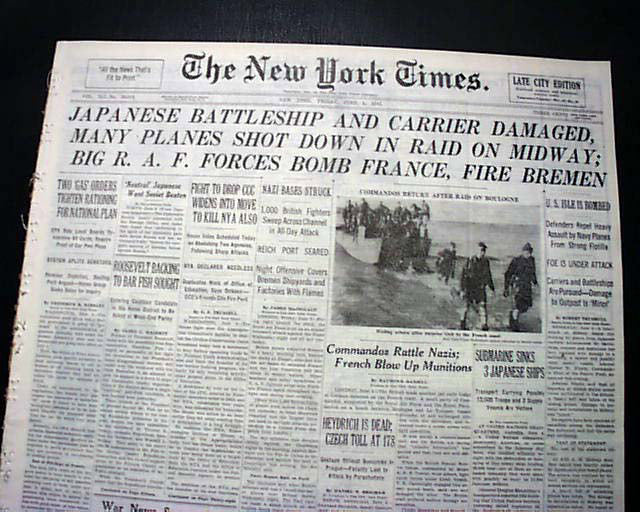
NY Times 12 June 1942 worldwartwo.filminspector.com
NY Times, 12 June 1942.

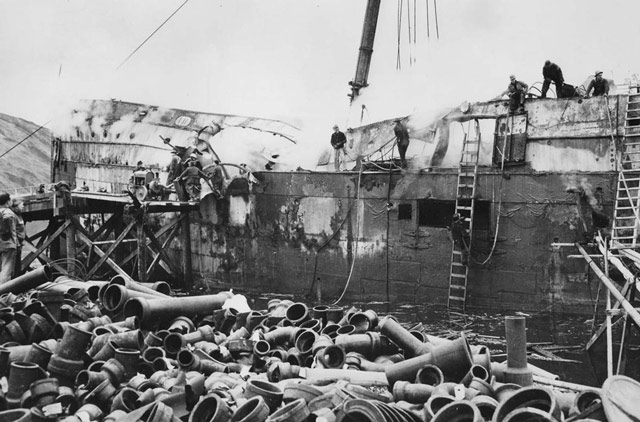
Battle of the Indian Ocean: Japanese submarine I-10 shells and sinks 2052-ton Panamania freighter Hellenic Trader in the northwestern Mozambique Channel near Bahla de Cruz. Later in the day, I-10 torpedoes and sinks 5064-ton British freighter Cliftonhall.

Japanese submarine I-16 torpedoes and sinks 3748-ton Yugoslav freighter Supetar in the Mozambique Channel near Cabo de Sao Sebastiao.

Japanese submarine I-20 shells and sinks 5063-ton British freighter Clifton Hall in the Mozambique Channel off Angoche, Mozambique.

European Air Operations: A small force of a dozen U.S. Army Air Force B-24 Liberators flying from northeast Egypt bomb the Ploesti, Romania, oil fields after taking off at 22:30 on 11 June. The bombing is extremely inaccurate due to poor weather and no appreciable damage is caused. The bombers encounter flak and a few enemy fighters. Altogether, the planes drop 24 tons of bombs, with a thirteenth bomber attacking the port of Constanta. The bombers then proceed on to Habbaniyah, Iraq, making this an early example of shuttle bombing. Four bombers make it to Habbaniyah, while the others land at other fields in Iraq and Syria. Four of the bombers land in Turkey and their crews are interned. 

This is the first offensive mission by U.S. planes over Europe during World War II. General Dwight D. Eisenhower comments drily that the failed attack "did something to dispel the illusion that big planes could win the war." The bombers are from the Halverson Project 63, or HALPRO and have flown across the Atlantic for the mission. This small force forms the genesis of the 1st Provisional Bombardment Group (PBG) and the 376th Heavy Bombardment Group, completing another 450 missions.

The poor weather of spring 1942 continues and gets worse throughout the day on the Channel Front, but it is mild enough in the morning and early afternoon for some operations.

Group Captain Ken Gatward and navigator Flight Sargeant George Fern conduct The Beaufighter Raid on Paris, or Operation Squabble. This has been delayed for a month due to poor weather. This is a daring propaganda strafing run on a German parade down the Champs-Élysées that includes dropping Tricolor flags on prominent monuments (the Arc de Triomphe and the French Naval Ministry, currently being used as Kriegsmarine headquarters).

The two men take off from RAF Thorney Island in rain and clouds, but the weather clears sufficiently to carry out the mission. Flying at an extremely low altitude, the Beaufighter circles the Eiffel Tower at 12:27 and then heads for the Champs-Élysées. It turns out there is no German military parade (it hasn't begun yet), but the men drop the flags as intended. After strafing the Ministry building, the men return to RAF Northolt at 13:53. During the strafing run, the plane suffers a birdstrike, and the French crow is found in the starboard radiator. Gatward receives the DFC and Fern the DFM for their efforts.

RAF aircraft of Coastal Command engage in routine convoy patrols. They bomb and sink 1497-ton Swedish freighter Senta 30 nautical miles Cuxhaven, Germany (near the Weser River). There are no casualties.

RAF Beaufighter, 12 June 1942 worldwartwo.filminspector.com
Beaufighter Mk IC T4800 code ND-C of No. 236 Squadron RAF on the ground at Wattisham Suffolk 12 June 1942.

Battle of the Baltic: Swedish 1046-ton Bojan hits a mine and sinks off Saßnitz, Germany.

Battle of the Atlantic: German cruiser Michel, operating off the coast of Brazil, on 6 June had spotted the disabled 7176-ton U.S. freighter George Clymer and launched its MTB Esan. The MTB torpedoed the freighter and the crew abandoned ship. However, the ship remained afloat, and the crew re-embarked. British armed merchant cruiser HMS Alcantara has remained in the vicinity of the badly damaged ship since arriving on the scene on 8 June, but today departs, leaving the freighter still afloat. It is assumed that George Clymer eventually sinks.

U-158 (Kptlt. Erwin Rostin), on its second patrol out of Lorient, torpedoes and sinks US 8192-ton tanker Cities Service of Toledo 20 miles east of the Trinity Shoal Buoy in the Gulf of Mexico. There are 15 deaths.

U-124 (Kptlt. Johann Mohr), on its ninth patrol out of Lorient, torpedoes and sinks 4093-ton British freighter Dartford south of Cape Race. There are 17 survivors and 30 deaths.

U-129 (Kptlt. Hans-Ludwig Witt), on its fifth patrol out of Lorient, torpedoes and sinks 9005-ton refrigerated cargo freighter Hardwicke Grange 120 nautical miles (220 km) north of Puerto Rico. There are three deaths and 78 survivors. The survivors are in four lifeboats for two weeks, and each lifeboat lands in a different country: Cuba, the Dominican Republic, Jamaica, and Haiti.

German 125-ton minesweeper M-4212 (formerly Belgian trawler Marie-Frans) hits a mine and sinks south of Vieux-Boucau-les-Bains, France. The mine was laid previously by French submarine Rubis.

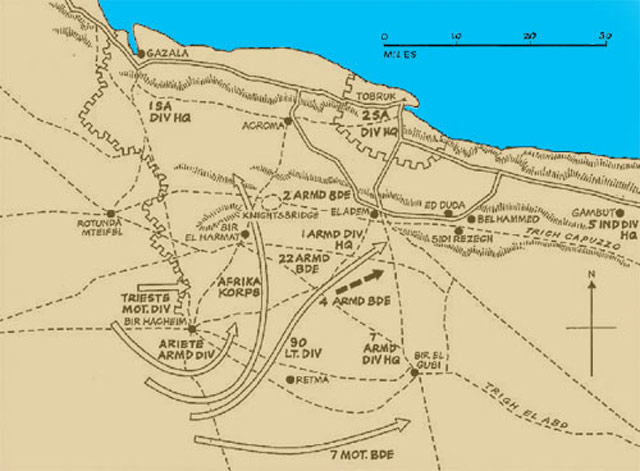
Map of North African campaign, 12 June 1942 worldwartwo.filminspector.com
Map of North African campaign, 12 June 1942.

Battle of the Mediterranean: The British in the El Adem "box" are under intense pressure by General Erwin Rommel's 15th Panzer Division and give ground as the Germans attempt to break out of  "the Cauldron." The 2nd and 4th Armoured Brigades retreat 6 km (3.7 miles) in disarray, leaving only the 29th Indian Infantry Brigade holding its ground. Rommel orders the 21st  Panzer Division to join the attack on the 13th. A breakthrough here would open a pathway to Tobruk.

The Allies are only in as good a situation as they are due to the previous stout Free French defense at Bir Hakeim. Now that the fortress has fallen, the Germans can bring much greater pressure to bear on the British. Today, General Auchinleck praises the French, saying, "The United Nations need to be filled with admiration and gratitude in respect of these French troops and their brave General Kœnig."

While the intense Luftwaffe air campaign against Malta has eased in recent weeks, it remains in a precarious position due to supply shortages. Today, the Royal Navy begins Operations Harpoon and Vigorous, typical convoy missions to the embattled island. Harpoon sets out from Haifa, Palestine, while Vigorous begins at Gibraltar.

Convoy MW4 leaves Gibraltar heading east with six merchantmen (the British Troilus, Burdwan and Orari, the Dutch Tanimbar, the American Chant, and the tanker Kentucky) carrying 43,000 short tons (39,000 t) of cargo and oil. It is protected by Force X, which includes distant cover by battleship HMS Malaya and aircraft carriers Argus and Eagle.

The westward operation is a little more complicated. Convoy MW-11a embarks from Haifa with five merchantmen (British Ajax, City of Edinburgh, City of Pretoria, City of Lincoln, and Elizabeth Bakke) heading west. It is escorted by the 7th destroyer flotilla. This convoy has trouble immediately when Elizabeth Bakke is ordered back to port because it cannot maintain station due to overloading and its poor condition. Convoy MW11b departs from Alexandria, Egypt, with a tanker (Bulkoil), a merchantman (Potaro), and a decommissioned battleship (Centurion) being used as a freighter. It is escorted by five destroyers, four corvettes, and two rescue ships (Antwerp and Malines). There also is a third convoy from this direction that departs from Port Said, MW-11C, composed of freighters Aagtekirk, Bhutan, City of Calcutta, and Rembrandt.

The objective is to confuse and disperse the Axis defenses with all of these simultaneous convoys. In theory, this should enable maximum resupply of the island despite inevitable losses.

Unknown to the British, the Axis knows all about these operations already due to a major security breach by the US Military Attaché in Egypt, Colonel Bonner Fellers. Italian military intelligence (Servizio Informazioni Militare) has broken the American code and thus has deciphered Fellers' detailed reports to Washington. While not strictly Fellers' fault, better precautions could have avoided this. In any event, this incident proves that codebreaking during World War II was not just a one-way street that benefited only the Allies.

With the Axis ready and waiting, the attacks begin almost immediately. In the evening, 15 Junkers Ju 88 bombers of I Kampfgeschwader 54 based in Crete attack MW-11c. They score a near-miss on City of Calcutta, which slows it and forces the freighter to divert to Tobruk along with its towed MBT, escorted by two escorts. During the night, MW-11c slows to arrange a rendezvous with the other two convoys off Mersa Matruh.

Separately, U-77 (Kptlt. Heinrich Schonder), on its sixth patrol out of La Spezia, torpedoes and sinks the Royal Navy destroyer HMS Grove (L77) off Sollum, Egypt. The ship sinks in 14 minutes with 110 deaths and 79 survivors. Escort destroyer HMS Tetcott picks up the survivors.

SS Hardwicke Grange, sunk on 12 June 1942 worldwartwo.filminspector.com
British refrigerated freighter Hardwicke Grange, sunk by U-129 on 12 June 1942.

Spy Stuff: U-202 (Kptlt. Hans-Heinz Linder), on its sixth patrol out of Brest, arrives off the south coast of Long Island, New York, in early-morning darkness and disembarks four German spies/saboteurs. The four men land at Amagansett. This is Operation Pastorius, one of a series of such operations planned to disrupt the economy of the United States. They are wearing German Navy uniforms to avoid being shot as spies if captured during the landing. However, upon landing and finding themselves alone on the beach, they quickly change into civilian clothes and bury their uniforms and other equipment.

A problem quickly develops when Coast Guardsman John C. Cullen spots the men posing as fishermen on a raft. Cullen also notices the submarine and sees that the men are armed. He approaches them, and the spies give Cullen $200 to keep quiet. Cullen takes the money but alerts his superiors later in the day, by which time the four spies have taken the LIRR into Manhattan.

Anne Frank's diary, begun on 12 June 1942 worldwartwo.filminspector.com
The first page of Anne Frank's diary, written on 12 June 1942.

Holocaust: In Amsterdam, Anne Frank is gifted a red-and-white plaid diary on her thirteenth birthday. The Franks, German Jewish refugees, have not yet gone into hiding. Her first entry begins, "On Friday, June 12th, I woke up at six o’clock and no wonder; it was my birthday." Later in the entry, she says, "I hope I will be able to confide everything to you, as I have never been able to confide in anyone, and I hope you will be a great source of comfort and support."

US Military: The US Army activates the 100th Infantry Battalion, composed of Japanese-Americans from Hawaii.

German Military: Oblt. Egon Albrecht becomes Staffelkapitaen of 1./ZG 1.

George Bush joins the US Navy, 12 June 1942 worldwartwo.filminspector.com
George Bush during World War II.

Russian Homefront: Russian revolutionary Anna Yakimova dies in Novosibirisk, aged 86. She was a prime early agitator against the Tsar around the turn of the 20th Century.

American Homefront: In the evening, a tornado hits the southwest section of Oklahoma City near Will Rogers Airfield. Local sources (the Ada Evening News) report 21 dead, 25 critically injured, and 250 made homeless.

Future President George Herbert Walker Bush graduates from high school and immediately enlists in the U.S. Navy despite already having been admitted to Yale University.

Future History: Bert Sakmann is born in Stuttgart, German Reich. He grows up to become a noted cell physiologist who wins the Nobel Prize in Physiology or Medicine with Erwin Neher in 1991. As of this writing, Sakmann leads an emeritus research group at the Max Planck Institute of Neurobiology in Heidelberg, Germany.

Memorial to the 100th Infantry Brigade, activate on 12 June 1942 worldwartwo.filminspector.com
Brothers in Valor Monument in Honolulu, Hawaii, commemorating the 100th Infantry Battalion and other Japanese-American units in World War II (Photo: Sarah Sundin).


2022

Friday, November 12, 2021

June 8, 1942: Japanese Submarines Shell Australia

Monday 8 June 1942

Italian submarine beached in Spain, 8 June 1942 worldwartwo.filminspector.com
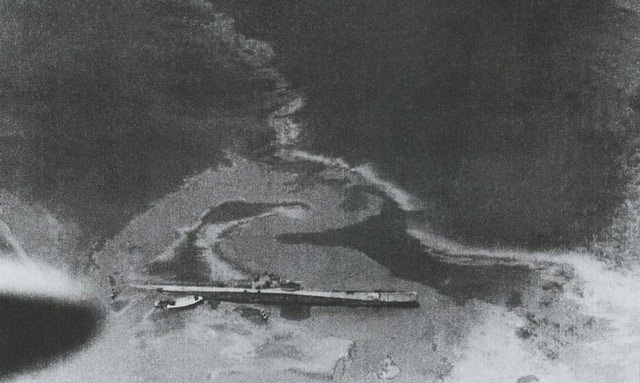
Italian submarine Luigi Torelli lying beached near Santander, Spain, on 8 June 1942. The submarine commander beached it after suffering damage from Allied aircraft on 6 June 1942 using Leigh Lights. It is ultimately repaired and restored to service.

Battle of the Pacific: In a coordinated attack in the early morning hours of 8 June 1942, two Japanese submarines fire their 140 mm deck guns at Sydney and Newcastle, Australia. The purpose is more symbolic than militarily effective, but it certainly catches the attention of a lot of people.

I-24 opens the attack by firing ten shells targeting the Sydney Harbour Bridge. They land in the suburbs of Bellevue Hill, Rose Bay, and Woollahra, with one shell landing in the harbor. One person is injured by falling masonry and debris even though only one of the ten shells explodes. There is no response from shore batteries due to the brevity of the attack.

Two hours later, Japanese submarine I-21 (Cdr Matsumura Kanji) shells the Australian city of Newcastle, New South Wales, on 8 June 1942 from a distance of 9 km (5.6 miles) northeast of Stockton Beach. The target this time is the BHP steelworks. It fires 34 shells, including 8 illumination rounds, but once again only one shell detonates. The attack does no significant damage, aside from destroying a house on Parnell Place. Fort On the alert due to the previous Sydney attack, Scratchley gunners respond with four shells but have little chance of scoring a hit on the submarine in the dark.

The only fatality from these attacks is a US Army Air Force pilot, Lieutenant Georg Cantello, who disobeys orders and takes off from Bankstown airport in a P-39 Aircobra to attack the submarines. He perishes when his plane crashes due to mechanical issues in Hammondville paddock. There is a memorial park, Lt. Cantello Reserve, in the City of Liverpool with a monument in his honor.

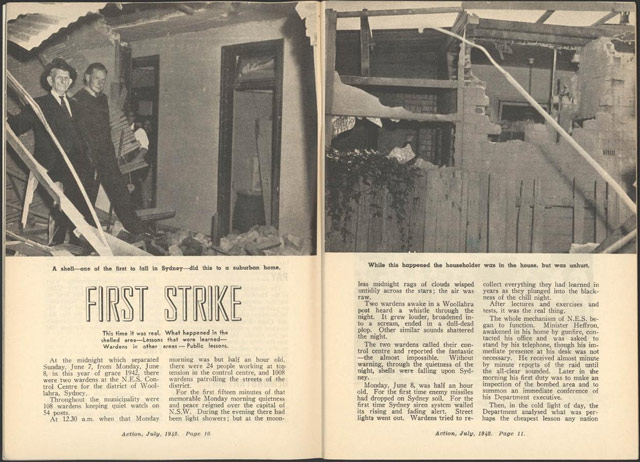
Japanese bombardment of Sydney, 8 June 1942 worldwartwo.filminspector.com
Australian "Action" magazine, the Official Journal of the National Emergency Services, has photos and a description of the 8 June 1942 shelling of Sydney in its July issue.

In response to the Japanese offensive in Australian waters that began with the attack on Sydney Harbour on 31 May 1942, the Australian government begins convoy operations on the east coast. Today, the first one, Convoy CO 1, departs from Newcastle bound for Whyalla.

The crew of a US Navy PBY-5A Catalina based at Dutch Harbor, Unalaska Island, spots two destroyers and four transport ships in Kiska Harbor. The crew then fly on to Attu and spot the Japanese presence there, too. This is the first news that the Japanese have invaded Alaska. An LB-30 of 11th Air Force also spots the Japanese.

In Hawaii, Admiral Chester Nimitz has ordered USS Enterprise and Hornet, now free due to the victory at Midway, to sail north to the Aleutian Islands in response to the attacks on Dutch Harbor. However, he quickly countermands this order when informed of the invasions at Attu and Kiska, fearing attacks on his carriers by land-based aircraft. The Japanese, meanwhile, are digging in on the islands and building airfields. Admiral Frank Fletcher, now aboard the aircraft carrier USS Saratoga, resumes command of the three-carrier task force northwest of Hawaii from Raymond Spruance. His carriers and the 11th Air Force in Alaska search for the remaining Japanese fleet but the planes spot only open water.

General Douglas MacArthur, Supreme Commander of Allied Forces in the Southwest Pacific Area (SWPA) in Melbourne, submits his first proposal for an Allied counteroffensive in the Pacific. He lists New Guinea, New Ireland, and New Britain as the initial objectives. It receives immediate opposition from Admiral Ernest King, Commander in Chief, United States Fleet (COMINCH), and Chief of Naval Operations (CNO), who, among other objections, does not like the idea of an Army general commanding an amphibious force. Negotiations over a compromise plan begin shortly. Another issue is that the Japanese remain on the offensive despite their recent defeat at Midway and that will affect operational choices.

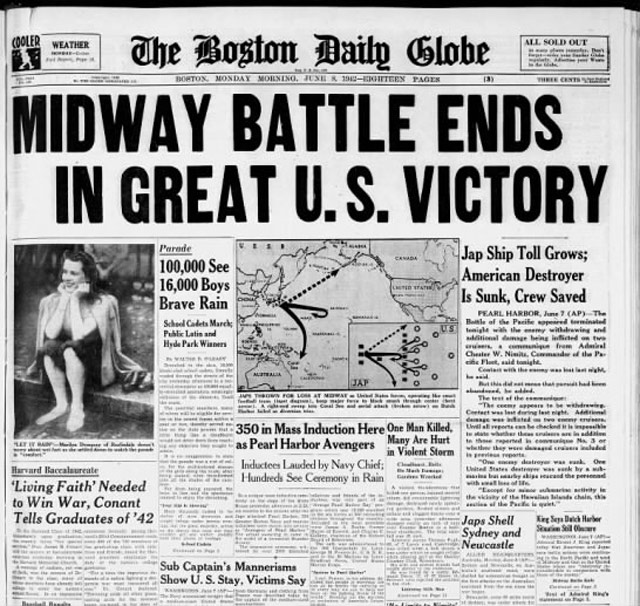
The Boston Daily Globe, 8 June 1942 worldwartwo.filminspector.com
The Boston Daily Globe of 8 June 1942 is full of cheery news about the US victory at the Battle of Midway. The very careful wartime manipulation of war news is evident in the header "American Destroyer Is Sunk, Crew Saved." That is absolutely true, but there is no mention of the far more consequential sinking of the USS Yorktown. 

Battle of the Indian Ocean: Japanese submarine I-16 uses its deck gun to sink 4847-ton Greek freighter Aghios Georgios IV between Aden and Table Bay in the Mozambique Channel. There are seven deaths.

I-20 torpeoes and sinks 5209-ton Greek freighter Christos Markettos off Mombassa. There are two deaths.

I-10 (Cdr Otani) torpedoes and sinks 5224-ton British freighter King Lud in the Mozambique Channel 350 miles east of Beira. All 39 people on board perish. This is I-10's third victory in the vicinity.

I-10 also uses its deck gun to sink 2158-ton Norwegian freighter Wilford in the Mozambique Channel in the same general vicinity east of Beira. There are nine deaths. Some sources place this sinking on 7 June 1942.

Norwegian freighter Wilton, sunk on 8 June 1942 worldwartwo.filminspector.com
Norwegian freighter Wilford, sunk by I-10 in the Mozambique Channel on 8 June 1942.

Eastern Front: German General Erich von Manstein's 11th Army continues its attack on Sevastopol in Crimea but makes little progress. Soviet counterattacks also fail, leading to a virtual stalemate. The German LIV Corps, aided by strong artillery fire and furious Luftwaffe attacks, do make some progress in the northern sector where the largest artillery batteries are located. Already the corps has lost 1700 casualties in exchange for a shallow bulge into the Red Army lines that is 3 km deep and 5 km wide. German 30 Corps in the south has suffered 496 casualties for minor penetrations into the out Soviet defensive line.

There are fierce dogfights over Sevastopol, with both sides represented by veteran ace fighter pilots. The Luftwaffe gets the better of the encounters. Lt. Ludwig-Wilhelm Burckhardt of 6./JG 77 downs 2 Soviet fighters and Oblt. Anton Hackl of 5./JG 77 destroys three Russian planes to bring his score to 57 victories. Hptm. Kurt Ubben of Stab III./JG 77 brings his score to 70 victories after he downs a Russian fighter.

There is growing frustration in Manstein's headquarters with the pace of the offensive. Luftwaffe General Wolfram von Richtofen observes that his planes fly 1200 sorties during the day without achieving much and lamely explains, "We hope gradually to beat down the enemy by mass bombing."  He complains that flying so many missions is 'extremely strenuous." Conditions are made worse on both men and equipment by sweltering  105° Fahrenheit (40° Celsius) heat.

At Fuhrer Headquarters in East Prussia, General Halder is okay with the progress, but there is a hint of concern in his diary entry:
Assault of Sevastopol makes satisfactory progress on the first day against stiff opposition; high ammunition expenditures and severe losses. All other fronts quiet. Successful counterattacks at Kirishi.  
Kirishi, meanwhile is a town 115 kilometers (71 mi) southeast of St. Petersburg on the Volkhov River that defends Lyuban. The front has stayed stagnant there since the fall of 1941, a sign of the stalled German offensive into the USSR.

European Air Operations: The weather remains unsettled throughout the day, getting worse as time goes by. During RAF air patrols along the continent coast, they sink 7003-ton German patrol boat Sperrbrecher 15 Taronga off Scharhörn. The ship makes port but is a complete loss and written off.
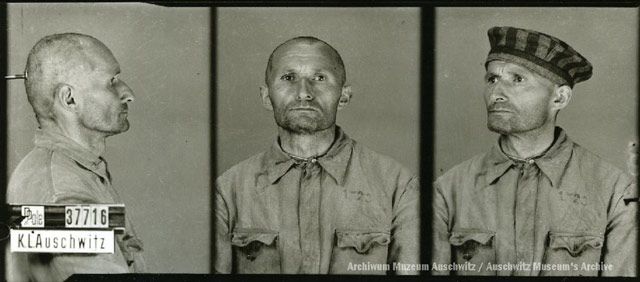
Auschwitz victim executed on 8 June 1942 worldwartwo.filminspector.com
Polish teacher Władysław Dobija, executed at Auschwitz on 8 June 1942 (Auschwitz Memorial). 

Battle of the Atlantic: U-135 (Kptlt. Friedrich-Hermann Praetorius), on its third patrol out of Brest, torpedoes and sinks 4549-ton Norwegian freighter Pleasantville 200 miles northwest of Bermuda. There are two dead and 45 survivors, 10 of whom who are picked up about 24 hours later by freighter Chickasaw City while the remaining 35 are picked up by freighter Paderewski on 11 June.

U-504 (KrvKpt. Hans-Georg Friedrich Poske), on its third patrol out of Lorient, uses its deck gun to sink 3901-ton Honduran freighter Tela in the Gulf of Mexico near Rio Bravo. The ship sinks by the stern within five minutes There are 11 dead and 43 survivors, who abandon ship in two lifeboats and two rafts and are picked up twelve hours later by freighter Port of Montreal. Their adventure is not over, as U-68 sinks Port of Montreal in turn on 10 June 1942, during which two of the Tela survivors perish.

U-504 also uses its deck gun to sink 1512-ton British freighter Rosenborg in the same general area east of the Yucatan Peninsula. This is after Poske misses with two torpedoes. He must use 60 shots to sink the ship. There are four dead and 23 survivors, who are picked up by Norwegian freighter Geisha.

U-172 (Kptlt. Carl Emmermann), on its second patrol out of Lorient, torpedoes and sinks 1654-ton US freighter Sicilien 10 miles south of Cape Beata, Dominican Republic. There are 46 dead and 31 survivors, who get in rafts and make it to Barahona, Dominican Republic.

U-128 (Kptlt. Ulrich Heyse), on its third patrol out of Lorient, torpedoes and sinks 9234-ton Norwegian tanker South Africa 400 miles east of Trinidad. The ship breaks in two and sinks within two minutes. Survival is made difficult due to the tanker's full load of 9614 tons of lube distillate and 4146 tons of diesel oil. Heyse surfaces and points out a man in the water that the lifeboats then pick up, gives the men some cans of bread and two bottles of rum, and directs them toward land. There are six dead and 36 survivors in two lifeboats. The subsequent sequence of events almost defies belief. One lifeboat (14 men) is spotted by freighter Plaudit, but the men refuse rescue after getting some supplies because it is heading to Pernambuco on 12 June and sail on toward Trinidad. They then decline another rescue offer from sailing vessel Minnie M. Mosher before making landfall at Galara Light (Toko Bay) on 16 June. The other lifeboat (25 men) is spotted by tanker Acastra on 12 June, but the men also refuse rescue after taking on supplies because it is heading for Freetown. They also decline an offer on the 13th from Argentinian tanker 13 de Diciembre after taking on supplies. They are picked up by an American seaplane tender on 14 June 45 miles east of Trinidad.

U-107 torpedoes and sinks 3249-ton US freighter Suwied 140 miles southeast of Cozumel Island. the ship sinks within three minutes, preventing a distress call. There are six dead and 33 survivors, who are picked up by USCGC Nemesis (WPC 111) after 19 hours. Some sources place this sinking on 7 June 1942, where I also discuss this sinking.

British patrol boat HMT Catherine founders off Scapa Flow. Casualties are unknown.
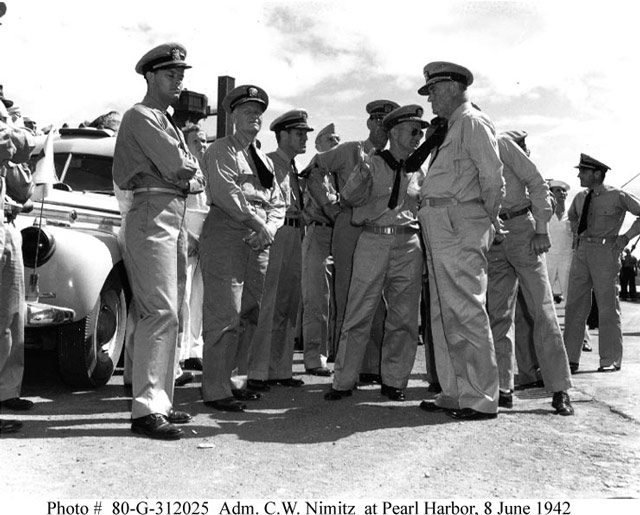
Admiral Chester Nimitz and his staff on 8 June 1942 worldwartwo.filminspector.com
Admiral Chester Nimitz (second from left) and his party await the arrival of survivors of USS Yorktown aboard Fulton (As-11), 8 June 1942. Also visible are Rear Admiral William L. Calhoun in the right front and Rear Admiral Lloyd J. Wiltse, of Nimitz' staff, in the center background (Naval History and Heritage Command 80-G-312025).

Battle of the Mediterranean: The situation in Libya remains unchanged today. The Germans continue their attack on the fortress of Bir Hakeim but make no progress, while the British 7th Motor Brigade and 29th Indian Infantry Brigade attempt raids on the Axis supply lines.

Time is on General Erwin Rommel's side because the Free French at Bir Hakeim cannot be resupplied and they are running low on everything. Today, Rommel personally leads an attack on the fortress from the north beginning at 10:00, supported by a massive Luftwaffe assault by 45 Ju 87 Stukas, 3 Junkers Ju 88 medium bombers, and ten Messerschmidt Me-110 fighter-bombers escorted by 54 Bf-109 fighters (3 losses two German and one Italian).

While the attack continues throughout the afternoon supported by another attack by 60 Stukas, the defenses hold. The British Desert Air Force (DAF) flies 478 sorties (8 fighter losses) during the day and drops supplies to the garrison after dark. The Italian Macchi C 202 fighters are particularly effective, shooting down three RAF planes.

In a friendly fire incident, the Italian submarine Alagi (Cdr Serio Puccini) spots a convoy 20 nautical miles north of Cape Bon, Tunisia. Captain Puccini assumes it is an Allied one, but it is a typical Axis convoy from Naples to Tripoli. Puccini fires three torpedoes and sinks 5085-ton Italian destroyer Antoniotto Usodimare. There are 141 killed and 165 survivors. This sinking is sometimes listed as occurring on 8 August 1942.

U-83 (Kptlt. Hans-Werner Kraus), on its eighth patrol out of Salamis, gets two victories today. First, it uses its deck gun to sink 100-ton Palestinian sailing ship Esther six miles northwest of Sidon, Lebanon. There are no survivors.

U-83 then uses its deck gun to sink 231-ton Egyptian freighter Said 15 miles southwest of Jaffa. This is after U-83 missed with two torpedoes, and it takes 50 rounds to sink the ship. There are five dead and nine survivors.
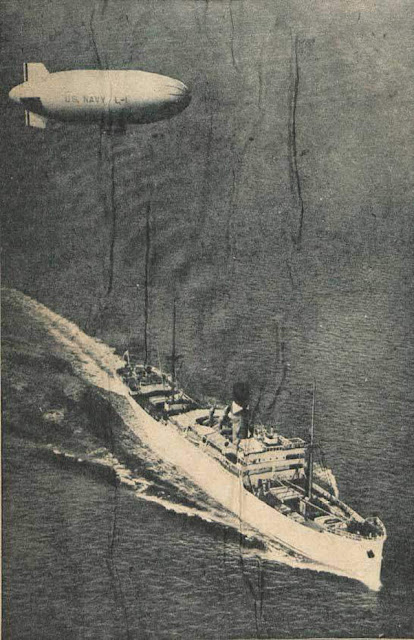
A US Naval blimp of the type involved in a fatal crash on 8 June 1942 worldwartwo.filminspector.com
US Navy blimp L-1. This is of the same class as L-2, which crashed in a fatal accident on 8 June 1942. It is shown above Panamanian freighter Musa.

US/Soviet Relations:  Soviet Ambassador to the United States Maxim M. Litvinov informs Harry Hopkins that the Soviet Union is agreeable to the establishment of a Lend-Lease air corridor between Alaska and Siberia. Since Japan is not at war with the USSR, it could not interfere with such flights without instigating a conflict with the Soviets.

US Military: The European Theater of Operations, United States Army (ETOUSA) is formed by the Department of War, though it doesn't begin operation officially until 4 July 1942. Its organizational divisions are Army Ground Forces (AGF), United States Army Air Forces (USAAF), and Army Service Forces (ASF) operations north of Italy and the Mediterranean coast. It replaces United States Army Forces in the British Isles (USAFBI) and its first commander for a brief period of time is Maj. Gen. James E. Chaney. The AGF currently has the 34th Infantry Division in Northern Island, which has released British troops from duties by patrolling the border between British Northern Ireland and the neutral Irish Free State.

Brigadier General Howard C Davidson, commander of VII Fighter Command, is promoted to Commanding General, 7th Air Force.

Canadian Military: Royal Canadian Air Force's No. 111 (Fighter) Squadron flies its Curtiss P-40 Kittyhawk fighters to Elmendorf Field, Alaska. This is part of the RCAF effort to reinforce Allied defenses on its western flank.

German Homefront: Following the elaborate funeral of Reinhard Heydrich on 7 June 1942, the Prague authorities embark on vicious reprisals. The Gestapo, with little to go on, receives a spurious report that the small town of Lidice is the hiding place of Heydrich's assassins and plans an operation to destroy it. This report is based on nothing but the town's reputation as the home of some Czech army officers who are now in hiding in Great Britain. A radio transmitter belonging to the Silver A team (a three-man Allied infiltration team that supported Operation Anthropoid, the assassination of Heydrich) is found in the village of Ležáky and so it, too, is targeted. Heydrich's two assassins, Jozef Gabčík and Jan Kubiš, remain at large shuttling between safe houses in Prague. A second Heydrich funeral is scheduled for Berlin on 9 June.
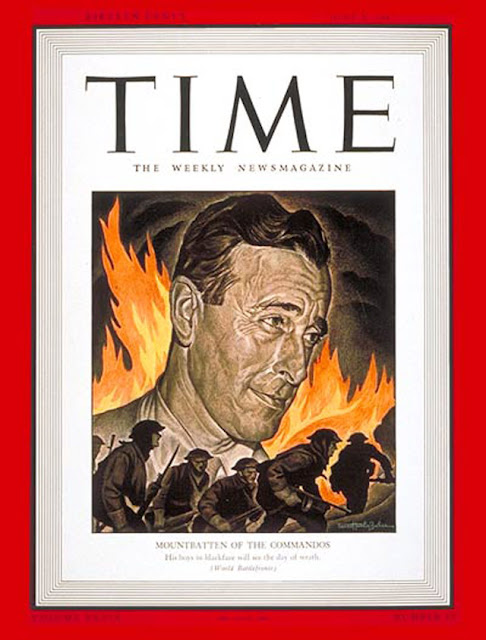
Time magazine 8 June 1942 worldwartwo.filminspector.com
"Mountbatten of the Commandos" is on the cover of the 8 June 1942 Time magazine (cover credit: Ernest Hamlin Baker).

British Homefront: The Guardian publishes an editorial today noting increasingly harsh living conditions in the Reich "since last winter." Its main theme is that "since last autumn’s clear failure to “annihilate” the Russians, the German civilian front has been increasingly tired and dispirited." This reflects the wishful thinking of RAF Bomber Command led by General Arthur"Bomber" Harris, who believes that his forces can crush the Reich from the air by destroying its people's will to fight. In this sole and strict sense, the Allied bombing campaign is proving to be a massive failure, as people in Germany may be down but the bombing is not making them demand surrender as they did in 1918.

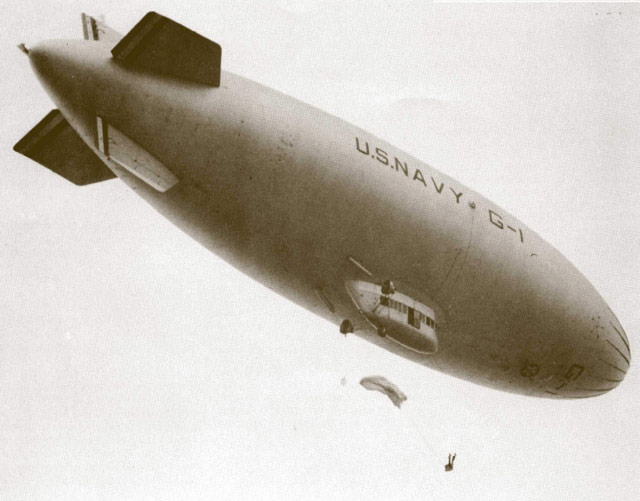
Naval airship G-1, involved in a fatal crash on 8 June 1942 worldwartwo.filminspector.com
US Navy Airship G-1, involved in a fatal crash on 8 June 1942. It is shown dropping a parachutist.

American Homefront: During the night, two U.S. Navy airships (G-1 and L-2) collide five miles north of Manasquan, New Jersey, while performing experimental visual and photographic reconnaissance at 400 feet. Twelve men, naval personnel and civilian technicians, perish. The blimps fall into the sea and only the co-pilot of L-2, Ensign Howard Fahey, survives. Only three bodies are recovered.

Due to the victory at the Battle of Midway, the US government cancels the invasion alert for the West Coast.

Bing Crosby makes a new recording of "Silent Night," which he first recorded on 21 February 1935, for his holiday compilation album "Merry Christmas." This is one of four recordings Bing makes of the "Silent Night." One of the reasons Crosby keeps returning to the song is that the recordings are so popular that the music label, Decca, complains that repeated stampings quickly wear out the master tapes.

Model Jane Greer models women's uniforms in the 8 June 1942 issue of Life magazine (see below), posing in a "Nurse's Aide" uniform on the cover. Movie producer and inventor Howard Hughes spots her and decides to make her an actress. He signs her to a personal services contract, which was somewhat customary for actresses at the time but gave him inordinate control over her career which he fully exploited. This begins Greer's decades-long Hollywood acting career and a very turbulent relationship with Hughes wherein he alternately helps and hurts her career and personal relationships. Greer is best known for film noirs, particularly with RKO, such as "Out of the Past" (1947), "The Big Steal" (1949), "Run for the Sun" (1956), and "Man of a Thousand Faces" (1957). Greer passes away on 24 August 2001.

Future History: Peter Grimwade is born in Ayr, Ayrshire, Scotland, UK. he becomes a noted television director, particularly on the Doctor Who series in the early 1980s. He passes away on 15 May 1990.

Life magazine, 8 June 1942 worldwartwo.filminspector.com
Life magazine, 8 June 1942, features a "Nurse's Aid" on the cover. It is actually model Jane Greer, who parleys this break into a memorable acting career.


2021

Monday, October 18, 2021

June 6, 1942: Japanese Invade Aleutian Islands

Saturday 6 June 1942

Battle of Midway 6 June 1942 worldwartwo.filminspector.com
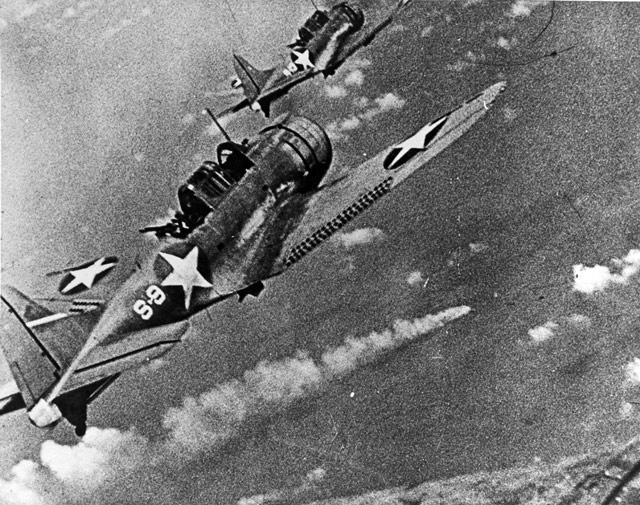
"SBD Dauntless dive bombers from USS Hornet (CV-8) approaching the burning Japanese heavy cruiser Mikuma to make the third set of attacks on her, during the early afternoon of 6 June 1942. Mikuma had been hit earlier by strikes from Hornet and USS Enterprise (CV-6), leaving her dead in the water and fatally damaged." Naval History and Heritage Command 80-G-17054.

Battle of the Pacific: Despite having suffered staggering losses off Midway Island on 4 June, the Japanese follow through on their subsidiary campaign in the Aleutian Islands on 6 June 1942. The Japanese Northern Area Fleet, commanded by Vice-Admiral Boshiro Hosogaya, lands 500 troops of the elite Maizura 3rd Special Landing Force and 700 laborers on Kiska Island at 10:27. 

This is the first invasion of the continental United States since the War of 1812, though Alaska is not yet a state. The local Unangax (Aleuts) offer virtually no resistance and no U.S. military forces intervene at this time despite some fruitless bombers searching for the Japanese. There are U.S. soldiers of the U.S. Navy meteorological service on Kiska, but they disappear into the rugged interior. The Japanese rename the island Narukami.

Eight P-38s do spot and attack a ship, but it turns out to be a Soviet freighter. The Americans, though, are quite concerned about both a Japanese land invasion south toward Washington State through Canada and Japanese bombing raids from the Aleutians (neither of which the Japanese plan) and begin preparing a response.

Off Midway Island, things just keep getting worse for the Japanese. Having lost four irreplaceable aircraft carriers to the U.S. Navy's one, they now lose another important ship. Douglas SBD Dauntless dive bombers attack and sink cruiser Mikuma, already damaged in previous days' raids. Mikuma and fellow cruiser Mogami are heading for refuge at Wake Island when 31 SBDs from USS Enterprise and Hornet attack and hit Mikuma with five bombs and Mogami with six.
Japanese cruiser Mikuma under attack, 6 June 1942 worldwartwo.filminspector.com
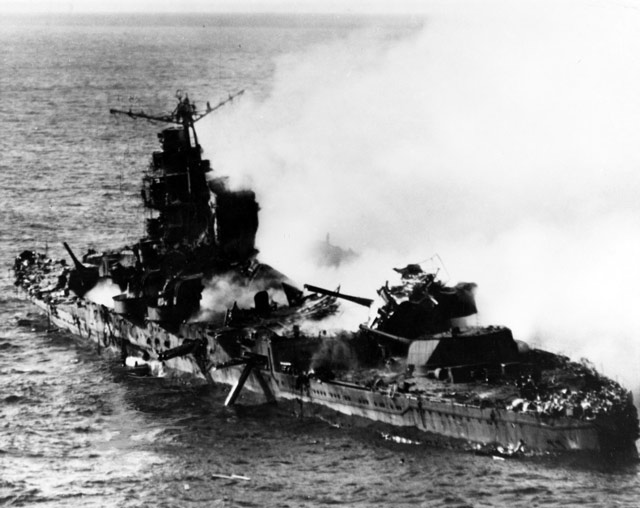
"Japanese heavy cruiser Mikuma, photographed from a USS Enterprise (CV-6) SBD aircraft during the afternoon of 6 June 1942, after she had been bombed by planes from Enterprise and USS Hornet (CV-8). Note her shattered midships structure, torpedo dangling from the after port side tubes and wreckage atop her number four eight-inch gun turret." Naval History and Heritage Command 80-G-414422.

While the Mikuma may theoretically have survived that many bomb hits, one of them sets off the torpedoes it is carrying and they destroy the ship. There are 650 deaths and 240 survivors, who are picked up by destroyers Asashio and Arashio (both also hit by one bomb each. U.S. Navy submarine Trout investigates the scene on 9 June and picks up an additional two Japanese crewmen and makes them POWs.

An example of the "fog of war" almost causes a tragedy for the U.S. forces. A late-morning B-17 raid by 26 bombers based on Midway (led by Lt. Col. Brooke Allen) against the fleeing Japanese cruisers fails to find them. However, they do spot a target and six B-17s drop their loads on it thinking it is one of the cruisers. In fact, it is U.S. submarine Grayling. Fortunately for the Americans, level-bombing accuracy at sea lives down to its terrible reputation, no harm is done, and Grayling quickly dives before any bombs come close. 

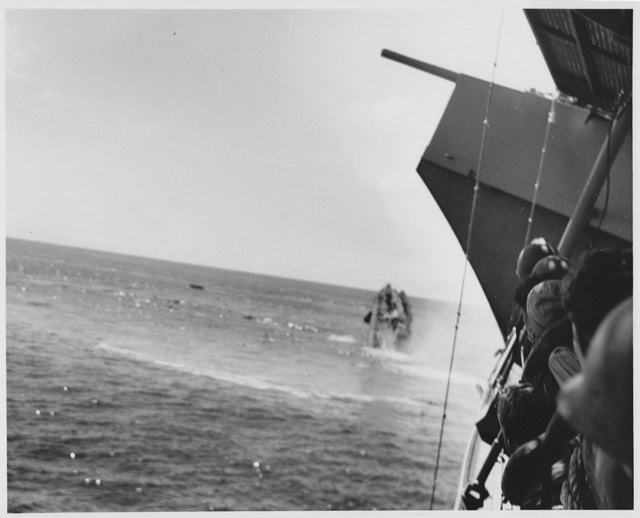
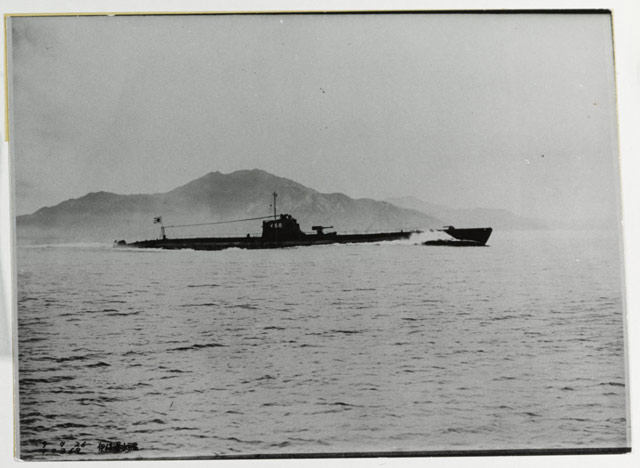
The Japanese do "get one back" when submarine I-168, which previously shelled Midway Island, spots crippled USS Yorktown and attacks. In addition to pumping one more torpedo into the badly listing aircraft carrier, the submarine torpedoes and sinks the U.S. Navy destroyer USS Hammann (DD-412) around noon. Hammann has been providing auxiliary power to USS Yorktown as a damage control party desperately tries to keep it from sinking. Only one of four torpedoes hits the destroyer, but it is enough to break the ship in half. The destroyer sinks in just four minutes, and after it slips under, its armed depth charges explode, causing a violent underwater explosion and killing many men in the water. There are 80 deaths from the 192-man crew. I-168, despite being surrounded by U.S. Navy screening destroyers, escapes with minor damage.
US destroyer Hammann sinking, 6 June 1942 worldwartwo.filminspector.com
"USS Hammann (DD-412) sinking with stern high, after being torpedoed by Japanese submarine I-168 in the afternoon of 6 June 1942. Photographed from the starboard forecastle deck of USS Yorktown (CV-5) by Photographer 2nd Class William G. Roy. Angular structure in right foreground is the front of Yorktown's forward starboard 5-inch gun gallery. Note knotted lines hanging down from the carrier's flight deck, remaining from her initial abandonment on 4 June." Naval History and Heritage Command 80-G-32320.

With ships on both sides still sinking (such as Yorktown) and already sunk, there are hundreds of men struggling to survive in the waters around Midway. The island's PT-boats and PBY Catalinas spend this and surrounding days picking up 27 men.

U.S. fleet carrier Saratoga, which missed the Battle of Midway due to repairs and upgrades being performed on the West Coast, arrives in Honolulu today. It quickly prepares to depart on the 7th to ferry replacement aircraft and crew to Enterprise and Hornet still stationed northeast of Midway. While most histories record 7 June 1942 as the final day of the Battle of Midway, today effectively marks the end of major hostilities.

The state-controlled Tokyo press quickly informs the public of the "great victory" in the Aleutian Islands. However, no mention is made of the catastrophic events for the Japanese Navy off of Midway Island until the war is over.
Japanese submarine U-168 which sank US destroyer Hammann on 6 June 1942 worldwartwo.filminspector.com
"I-168. (Japanese Submarine, 1933-1943) Underway in March 1934, probably during her trials. This submarine was renamed I-168 in May 1942. She torpedoed USS Yorktown (CV-5) on 6 June 1942, causing damage that led to the carrier's sinking the following morning." Naval History and Heritage Command NH 73054 I-68.

Battle of the Indian Ocean: Japanese submarine I-16 torpedoes, shells, and sinks 3839-ton Yugoslav freighter Susak in the Mozambique Channel. There are seven deaths.

I-10 torpedoes and sinks U.S. freighter Melvin H. Baker 45 miles off the mainland coast. All 48 men aboard survive and are picked up by British freighter Twickenham.

Eastern Front: German General Erich von Manstein makes his final preparations for Operation Stoerfang ("Sturgeon Catch"), the land assault against Sevastopol.  Meanwhile, the Luftwaffe continues an overpowering assault against the port, facing virtually no opposition from airports almost within sight of the defenders. Between 3 and 6 June, the Luftwaffe has flown 2355 sorties, dropping 1800 tons of high explosives 23,800 1.1kg incendiary bombs. In the two weeks from 24 May to 6 June, the Luftwaffe also has dropped 638,000 propaganda leaflets (50,000 per day) with instructions on how to surrender.

The massive artillery barrage that includes the biggest guns in military history, including the Karl and Gustav guns, shifts its targeting today to the defenses south of the city that face the German 30th Army Corps.

Rather than evacuating the port, the Soviets actually make every effort to reinforce it, slipping flotilla leader Tashkent, the destroyer Bezuprechnyi, and transport Abkhaziya through the blockade to deliver 2,785 more Red Army defenders.
Illustrated London News, 6 June 1942 worldwartwo.filminspector.com
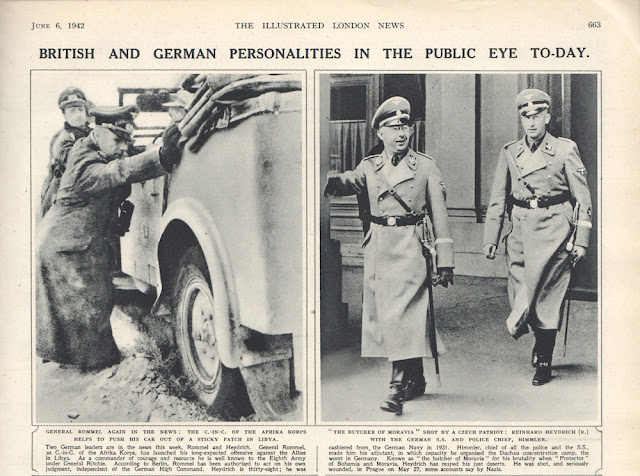
The Illustrated London News of 6 June 1942 features photos of German General Erwin Rommel, left, and recently deceased General Reinhard Heydrich, right (with Heinrich Himmler). Rommel is shown pushing his command car out of some trouble.

European Air Operations: The weather is warm, with plenty of ground haze below 1500 feet. The RAF focuses mainly on convoy protection.

R.A.A.F. Catalinas of RAF No. 10 Squadron, using Leigh Lights, bomb and damage Italian submarine Luigi Torelli in the Bay of Biscay. The submarine's crew manages to beach it at Santander, Spain, to prevent sinking. There is one death and one wounded crewman. The ship is temporarily repaired and sailed to France on 14 July for permanent repairs.

Hptm. Helmut Lent, Gruppenkommanduer of II./NJG 2, is awarded the Eichenlaub (No. Ninety-eight) after 34 night victories and 8 by day.
USS Atlanta with Hornet in the background, 6 June 1942 worldwartwo.filminspector.com
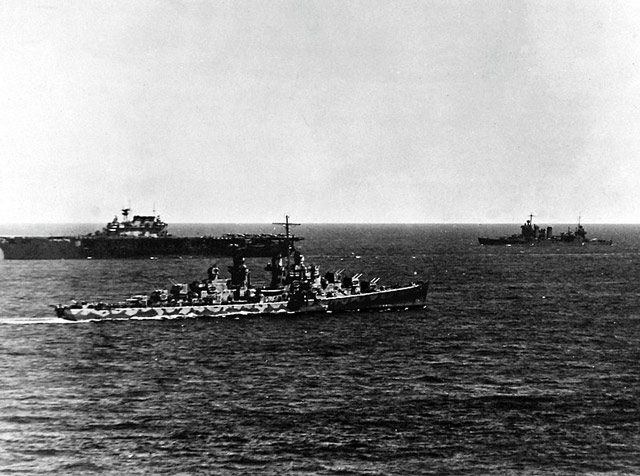
"A close-up of USS Atlanta (CL 51) with USS Hornet (CV 8) and USS Phelps (DD 360), all of Task Force 16, in background. Picture was made during the third day of the battle as Atlanta came up to offer assistance to the destroyer, which had broken down temporarily because of fuel shortage." 6 June 1942. Naval History and Heritage Command 80-G-88908

Battle of the Atlantic: It is a busy day for two German raiders operating in the South Atlantic east of Brazil. The 1940-41 glory days of the raiders are over and now they have to operate in remote areas to avoid detection. That doesn't mean they don't get the occasional moment of excitement. This happens during the Action of 6 June 1942.

In one incident, German raider Michel (Schiffe 28) spots disabled and drifting 7176-ton U.S. freighter George Clymer midway between Brazil and Africa. The Michel launches its motor torpedo boat Esan, which torpedoes and badly damages the freighter. One man perishes in the attack. The crew abandons the ship but reboards it on the 8th when it does not sink. however, the situation is hopeless and the crew is picked up by the British armed merchant cruiser HMS Alcantara. That is the last anyone sees of George Clymer, which remains stubbornly afloat. Exactly when and where the George Clymer sinks is unknown.

German raider Stier (Schiffe 23) has been quietly operating in the South Atlantic with limited success since leaving Royan, France in late May 1942. Today, Stier is cruising 500 miles (800 km) east of Pernambuco, Brazil, in overcast weather when it spots 10,170-ton U.S. tanker Stanvac Calcutta. Appearing suddenly out of a squall, Stier fires a warning shot and signals the tanker's crew to prepare to be boarded.

The Stanvac Calcutta, however, is heavily armed for a tanker. It has one 4-inch (102 mm)/50-caliber naval gun salvaged from World War I and a 5 inch (127 mm)/25-caliber anti-aircraft gun. Stier, meanwhile, has six 150-millimeter (6 in) guns, one 37 mm (1.5 in) gun, two 20 mm (0.79 in) cannons, and two torpedo tubes. So, there's a lot of firepower on both sides, though Stier outguns the tanker by a substantial margin.

The tanker's crew, led by Captain Gustav O. Karlsson, decides to not comply with the Stier's order to stop and opens fire. Led by Ensign Edward L. Anderson, the tanker's gunners get off several shots with both guns (the larger gun in the gun, smaller in the bow). Despite missing with most of their shots, the gunners do hit and disable one of Stier's 150mm guns. The Stier's crew then returns fire with 148 shells.

The battle lasts for 15 minutes, during which the Germans score a hit on the tanker's bridge, killing Captain Karlsson and several others. The Americans continue firing until their ammunition is exhausted. At this point, Stier Captain Horst Gerlach fires a torpedo that strikes Stanvac Calcutta on the port side. This kills several sailors and causes damage that leads to a sharp list and eventual sinking. The tanker's crew then abandons ship. Gerlach's men lower their own boats and rescue the Americans struggling in the water.

The Action of 6 June 1942 shows several hard truths about the Battle of the Atlantic. One is that merchant ships armed with a few guns stand little chance against raiders like Stier that are designed for combat even if they aren't true warships. Another is that these surface combats kill a lot of crewmen, as Stanvac Calcutta has 16 men killed in action, one dying later onboard Stier, fourteen men wounded, and 37 prisoners taken (the Stier only suffers two wounded men).

Actions like that of 6 June 1942 call into question the whole concept of arming merchant ships, which requires a lot of effort and dedicated gunners on hundreds of ships. However, later events involving Stier will redeem this idea somewhat. For their pains, the Stanvac Calcutta's crew later are awarded the Merchant Marine Gallant Ship Citation and Ensign Anderson is promoted (while a POW) to the rank of lieutenant commander. The tanker crew winds up in a Japanese POW camp.
Freighter Hermis in the background, sunk on 6 June 1942 worldwartwo.filminspector.com
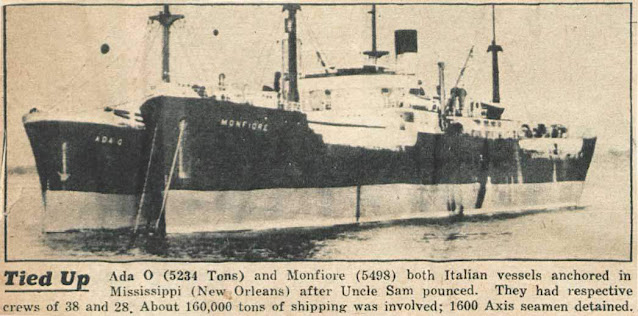
Coal-burning freighter Hermis is shown at left while still called "Ada O." Hermis was an Italian vessel anchored in New Orleans when seized in 1941 and pressed into U.S. service. Sunk on 6 June 1942.

There are also the usual U-boat sinkings, these days confined to the Caribbean.

U-68 (KrvKpt. Karl-Friedrich Merten), on its fourth patrol out of Lorient, torpedoes and sinks 13,006-ton Panamanian tanker C.O. Stillman 60 miles southwest of Puerto Rico. There are three deaths and 55 survivors,  most of whom are picked up by US Coast Guard patrol boat #83310 while 30 sail their lifeboats to Puerto Rico.

U-107 (Kptlt. Harald Gelhaus), on its sixth patrol out of Lorient, torpedoes and sinks 3910-ton Honduran freighter Castilla east of Cancun and south of western Cuba. One torpedo hits and causes the ship to sink quickly stern-first. The crew can't launch lifeboats and take to three rafts. There are 24 deaths (including one who dies on a raft) 35 survivors, who are picked up by USS Nike (WPC-112) after six days. Some sources place this sinking on 7 June 1942.

U-158 (Kptlt. Erwin Rostin), on its second patrol out of Lorient, torpedoes and sinks 5234-ton Panamanian freighter Hermis west of Havana and northeast of Cancun. Two torpedoes strike the ship on the port side but the engines continue running due to an inability to stop them due to damage. Rostin surfaces and uses his deck gun to finish off the freighter, setting it on fire. There is one death and 46 survivors, who are picked up by US Army transport Toloa. The ship does not sink for at least 12 hours and this sinking is sometimes listed as occurring on 7 June 1942.

Dutch 197-ton freighter Antares hits a mine and sinks off the Dutch coast.
"Battle of Knightsbridge 6th June 1942" worldwartwo.filminspector.com
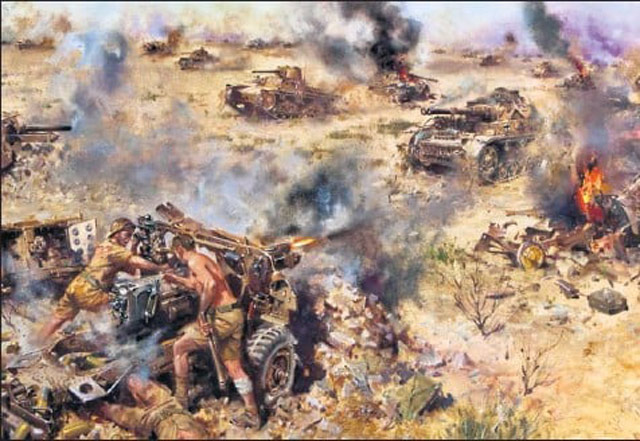
"The Battle of Knightsbridge, 6th June 1942," by Terence Cuneo (1907-1996). Shown are the 426th Battery of the 107th Regiment Royal Horse Artillery and the South Nottinghamshire Hussars, panzer of the Afrika Korps attacking. The 426th ultimately was forced to surrender.

Battle of the Mediterranean: After a wild day of attack and counter-attack between German and British troops on 5 June, the front settles down again today. However, German General Erwin Rommel retains command of the battlefield after his forces destroyed dozens of Allied tanks. He sends out armed reconnaissance to test the British lines and maintains pressure on the surrounded Free French garrison at Bir Hakeim. For their part, the British engage in harassing attacks against the German supply lines using the 7th Motor Brigade and 29th Indian Infantry Brigade.

The main action of the day is an attack at 11:00 by the German 90th Light Division against Bir Hakeim. This involves a determined effort by troops and pioneers to clear a way through the minefields surrounding the fortress, which are divided into two perimeters. By nightfall, the Germans manage to get through the outer minefield and into the inner minefield to within 800 meters (900 yards) of the fortress. The advance, while threatening to the Free French, also leaves the German troops exposed to Desert Air Force attacks on the 7th.

The Battle of Knightsbridge proceeds as the 15th Panzer Division attacks northward. The British 22nd Armoured Brigade continues to give ground after having lost dozens of its tanks. The German objective is El Adem, but the 201st Guard Brigade is ferociously defending the approaches to Tobruk.

Operation Aberdeen, the Eighth Army's counterattack begun on 4/5 June against the German Afrika Korps panzers, ends today after having accomplished nothing but the loss of numerous British troops and tanks. British Eighth Army commander General Neil Ritchie and Middle East Commander-in-Chief Claude Auchinleck now face the prospect of not only losing the battle but also all of Libya and much of Egypt unless they can find some way to stop Rommel's attacks. Among the desperate options considered are withdrawing the Free French from Bir Hakeim to free up the 7th Motor Brigade. However, this is rejected as the French seem to be in a good defensive situation.

Oblt. Hans-Joachim Marseille of 3./JG 27, currently operating in North Africa, receives the Eichenlaub for achieving 75 victories. Marseille once was considered a disciplinary problem but now is revered by his colleagues as a legend.
Battle of the Gazala Line, 6 June 1942" worldwartwo.filminspector.com
A map showing the military situation in Libya ca. 6 June 1942. The 15th Panzer Division thrust through the British Knightsbridge defensive position is shown by the upward arrow in the center, with a separate thrust to the south of Tobruk at the upper right. The map makes clear the extreme jeopardy of the Allied position at Tobruk, though nobody on either side is thinking about it just yet.

American Homefront: At the Belmont Stakes, the third jewel of the Triple Crown, the chestnut stallion Shut Out is the winner. Having also won the Kentucky Derby, Shut Out just misses immortality by having lost the Preakness Stakes to Alsab. Shut Out continues racing until 1944, when it is retired and put out to stud until passing away in 1964.

Future History: Klaus Bednarz is born in  Falkensee, Province of Brandenburg, Germany. Bednarz becomes a popular West German correspondent, author, and television host, particularly of the TV show Monitor. Klaus Bednarz passes away on 14 April 2015.
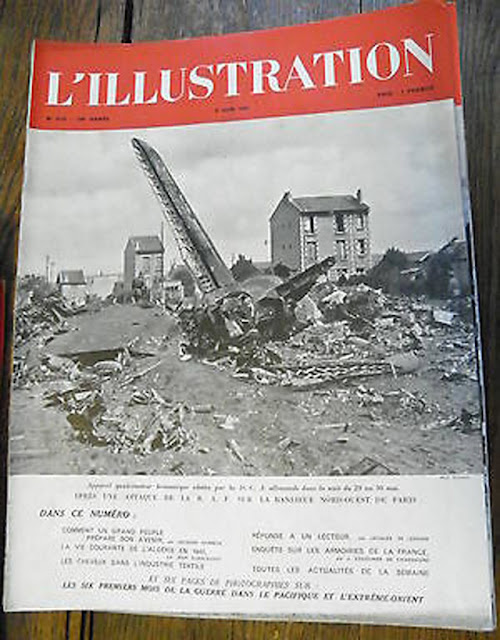
L'Illustration, 6 June 1942" worldwartwo.filminspector.com
L'Illustration, 6 June 1942.

2021

Tuesday, October 12, 2021

June 5, 1942: Last Moments of Admiral Yamaguchi

Friday 5 June 1942

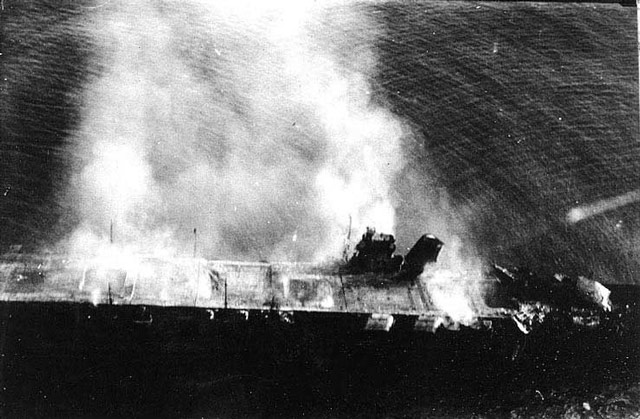
Hiryu sinking 5 June 1942 worldwartwo.filminspector.com
"Japanese aircraft carrier Hiryu ("Flying Dragon") burning shortly after sunrise on 5 June 1942, a few hours before she sank. Photographed by a plane from the carrier Hosho. Note collapsed flight deck at right. Part of the forward elevator is standing upright just in front of the island, where it had been thrown by an explosion in the hangar." It is Admiral Yamaguchi's funeral pyre. (US Naval History and Heritage Command NH 73064).

Battle of the Pacific: Admiral Chester Nimitz takes the unusual step of announcing the results of the Battle of Midway to the press on 5 June 1942 even as the battle continues. It is clear to everyone that this has been a complete debacle for the Japanese. It can only get worse for them now that the U.S. Navy has an overwhelming advantage due to the sinking of the four Japanese aircraft carriers.

Following the 4 June destruction of the four Japanese fleet carriers, Midway Island's defenders receive a vague report at 04:15 from the submarine USS Tambor (Cdr John Murphy), first sent to Hawaii, that the remaining Japanese fleet is approaching. Murphy later makes a half-hearted attack run on the ships, but misses. Upon receiving the report from Pearl, the island's defenders quickly launch eight B-17 bombers from Eastern Island, but the crews cannot spot anything in the early morning haze.

At 06:30, another report comes in from a Midway-based PBY Catalina that it has sighted "2 battleships" heading away from the island. A follow-up message says "Ships damaged, streaming oil." Marine Aircraft Group 22 then sends up two flights VMSB-24, six Dauntlesses (Capt. Marshall A. Tyler) and six Vought SB2U Vindicators (Captain Richard E. Fleming). The "battleships" turn out to be heavy cruisers Mikuma and Mogami. They are streaming oil because they collided during the night. The planes spot the oil slick, which allows them to zero in on the cruisers.

Admiral Yamaguchi's last moments 5 June 1942 worldwartwo.filminspector.com
"Last moments of Admiral Yamaguchi," war art painting by Kita Renzo. "Rear Admiral Tamon Yamaguchi, commander of the Japanese Carrier Striking Force's Carrier Division Two, elected to remain aboard his flagship Hiryu when she was abandoned during the early morning of 5 June 1942. He is depicted here in the middle of the scene as he bids farewell to his staff." Naval History and Heritage Command SC 301067


Tyler and his men attack Mogami but only score some near misses. Fleming then dives on Mikuma from out of the sun. Fleming does not survive - there is contradictory evidence whether his plane crashes into the Mikuma or the water nearby. The attack starts a fire that kills the men in Mikuma's engine room.

With the Mikuma crippled, eight B-17s (Lt. Col. Brooke Allen) then attack Mogami, but only score some near misses. Mikuma and Mogami ten head westward to escape, with Mikuma eventually sinking on the 6 June. Late in the day, Admiral Yamamoto orders all ships in the vicinity of Midway to retire. Japanese destroyers scuttle blazing carriers Hiryu and Akagi early in the day. The leader of the carrier force, Rear Admiral Tamon Yamaguchi, having lost his entire command, refuses to leave Hiryu and goes down with the ship.

For his heroism in leading the successful attack on Mikuma, U.S. Marine Richard Eugene Fleming will be posthumously awarded the Medal of Honor, the highest U.S. military decoration. President Franklin D. Roosevelt gives it to his mother on 24 November 1942.

To the northeast of Midway, Admiral Raymond Spruance, in charge of the combined task force 16 that includes aircraft carriers USS Enterprise and Hornet, seeks out but cannot find the Japanese surface fleet. Late in the day, he sends out scout planes, but they narrowly miss spotting Admiral Nagumo's main fleet. They do spot a destroyer and attack it, but miss. The planes return after dark, and the carrier crews must turn on their lights for the planes to land.

Spruance is extremely put out at the unacceptably vague report from submarine Tambor early in the day because it is vague and unhelpful. He also is upset at Commander Murphy for a lack of aggressiveness in not attacking the ships he spotted. He will have Murphy relieved of his command when Tambor returns to Pearl Harbor.
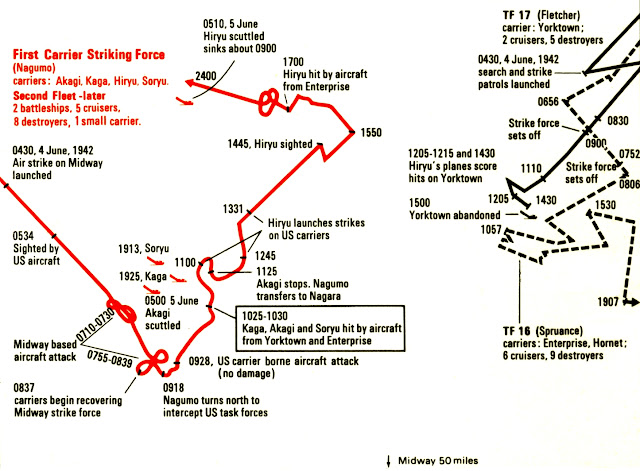
Map of Battle of Midway 5 June 1942 worldwartwo.filminspector.com
Map of the Battle of Midway 4-5 June 1942 (Onwar.com).

Rear Adm. Robert A. Theobald, in command of Task Force 8, which has been stationed uneventfully about 400 miles south of Kodiak Island in the Aleutians, receives a report of enemy warships in the Bering Sea. The report states that they are heading south toward Unalaska Island. Theobald sends his task force, which has no aircraft carriers, to investigate.

Intended U.S. air attacks using land-based bombers fail due to weather conditions. While six B-17 Flying Fortresses do report bombing enemy shipping, it turns out that in the hazy conditions they actually bomb some uninhabited islands (Pribilof Islands). While all these failed air attacks are going on, the Japanese order 1200 men of the Adak-Attu Occupation Force under Rear Admiral Omori Sentaro to proceed toward Attu for a landing on the 6th.

In reality, the Japanese force near the Aleutian Islands under the command of Vice Adm. Boshiro Hosogaya is moving south, but only to join Admiral Yamamoto's remaining fleet in the general vicinity of Midway Island. They are to join Yamamoto's forces in a desperate effort to lure the U.S. Navy carriers into surface combat. However, late in the day, Yamamoto decides that this plan will not work and sends Hosogaya back north to complete the landings in the western Aleutians. The Japanese high command in Tokyo dispatches two aircraft carriers from Japan to reinforce Hosogaya. Their hope is that the U.S. carriers might try to intervene in the Aleutian Island landings and be destroyed.

USS Yorktown remains afloat, though listing badly. At great hazard, a salvage party of 29 officers and 141 enlisted men board the sinking ship to see if anything can be done to save it. After the damage it has taken from multiple strikes, it is amazing that Yorktown still floats.

U.S. Navy submarine Pompano torpedoes and damages Japanese 131-ton guard ship Sumiyoshi Maru No. 8 off Truk Island. The entire crew survives by transferring to nearby ship Shoko Maru.

The Fifth Air Force sends B-17s to bomb a coal jetty, wharves, and a warehouse at Rabaul.
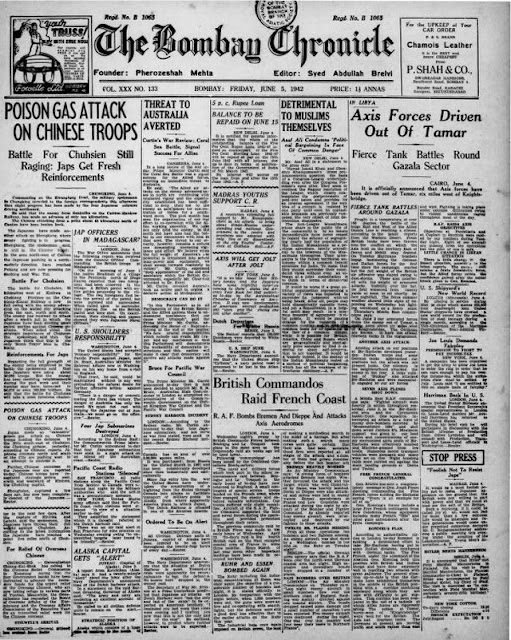
Bombay Chronicle 5 June 1942 worldwartwo.filminspector.com
The 5 June 1942 Bombay Chronicle headlines "Poison Gas Attack on Chinese Troops."

Battle of the Indian Ocean: There is a lot of Japanese naval activity off the west African coast today. The Japanese high command has sent a large force of submarines and other vessels to the vicinity of Madagascar in an attempt to decimate the British Far Eastern Fleet, and today that concentration of power pays off for them.

Japanese armed merchant cruisers Hokoku Maru and Aikoku Maru, operating 350 nautical miles (650 km) northeast of Durban, shell and sink 6757-ton British freighter Elysia. There are 22 dead. Elysia takes four days to sink. Hokoku Maru and Aikoku are there primarily to resupply the large number of Japanese submarines in the area.

Off the coast of Mozambique in the Mozambique Channel, Japanese submarine I-10 gets two successes. It sinks 2639-ton Panamanian freighter Atlantic Gulf (2 dead), and also 4999-ton US armed freighter Melvin H. Baker. British freighter Twickenham rescues the crew of Melvin H. Baker.

Japanese submarine I-20 torpedoes and sinks 5086-ton Panamanian freighter Johnstown off Mozambique. There are two deaths.
Dutch Harbor 5 June 1942 worldwartwo.filminspector.com
A damaged U.S. ship at Dutch Harbor following Japanese air attacks, Alaska, on 5 June 1942.

Eastern Front: In the Crimean Peninsula, General Erich von Manstein prepares to launch his long-awaited attack on the Soviet holdouts at Sevastopol. His 11th Army has LIV Corps to the north, 30th Corps (General Maximilian Fretter-Pico) to the south, and Romanian Mountain Corps 3 (General de divizie Gheorghe Avramescu) to the east. 

The Luftwaffe (Generaloberst Wolfram Freiherr von Richthofen) attacks throughout the day, as do 700 large German artillery pieces. Manstein's 203,800 men, including 65 Sturmgeschütz III self-propelled assault guns, oppose 118,000 Red Army troops holding the port. Today, the German bombardment, which has been rotating each day, shifts to the northern Red Army defensive line facing LIV Corps.

Fw. Anton "Toni" Hafner of 8./JG 51 claims 7 Soviet planes today to bring his score to 43 victories.

European Air Operations: It is a very hot day with some ground haze. The RAF engages in mostly convoy patrols with a few going along the French to Dutch coasts. RAF No. 141 Squadron pilot Warrant Officer Hamar shoots down a Dornier Do 217 E 20 km west of Leiden.
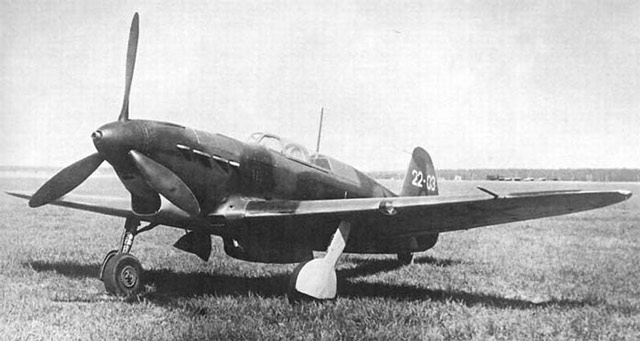
Yak-7B prototype 5 June 1942 worldwartwo.filminspector.com
Yakovlev Yak-7B prototype no.22-03 during trials in June 1942. It will become a useful close support fighter that serves first with the 42nd Fighter Aviation Regiment (IAP) at the North-Western front and then at Stalingrad and in the Caucasus.

Battle of the Atlantic: U-68 (KrvKpt. Karl-Friedrich Merten), on its fourth patrol out of Lorient, torpedoes and sinks 6693-ton U.S. tanker L.J. Drake in the Caribbean southeast of Santo Domingo. Merten uses three torpedoes, all of which hit and create a huge fireball. All 41 men aboard perish.

U-172 (Kptlt. Carl Emmermann), on its second patrol out of Lorient, torpedoes and sinks 3480-ton US freighter Delfina 130 miles northwest of San Juan, Puerto Rico. Emmerman has to follow the freighter for seven hours, during which he misses the ship with three torpedoes (due to malfunctions, not poor aim). The ship sinks within 20 minutes. There are four dead and 27 survivors, some of whom make landfall at Montecristi, Dominican Republic, and others are quickly picked up by US patrol boat USS YP-67.

U-94 (Oblt. Otto Ites), on its ninth patrol out of St. Nazaire, uses its deck gun and sinks 320-ton Portugues three-masted sailing ship Maria da Glória in codfish fishing grounds off Greenland. Ites does not see any markings so assumes it is an enemy vessel. Once the ship raises the Portuguese flag, Ites stops shooting, but it is too late for the ship. Once the crew abandons the ship, Ites resumes firing and sinks it. There are 36 dead and 8 survivors.

U-159 (Kptlt. Helmut Friedrich Witte), on its second patrol out of Lorient, uses its deck gun against 265-ton Brazilian sailing ship Paracury southeast of Santo Domingo in roughly the same area as where U-68 sinks L.J. Drake. The seas are rough, so the U-boat uses its 20mm anti-aircraft gun to punch holes in the waterline, causing it to capsize. Casualties are unknown. The ship remains afloat long enough for someone to find it, salvage it, and return it to service.
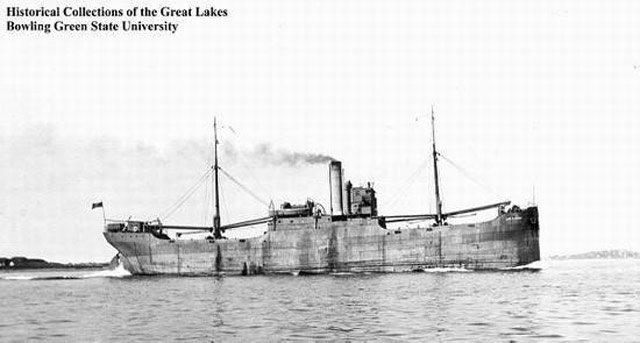
US freighter Velma Lykes, sunk 5 June 1942 worldwartwo.filminspector.com
U.S. freighter Velma Lykes, sunk on 5 June 1942 by U-158 in the Caribbean (Bowling Green State University).

U-158 (Kptlt. Erwin Rostin), on its second patrol out of Lorient, torpedoes and sinks 2572-ton U.S. freighter Velma Lykes off Puerto Juarrez, Yucatan Peninsula, Mexico. The ship sinks within one minute. There are 15 dead and 17 survivors, who cling to rafts and are picked up on the 6th by freighter Ardenvorhr after being spotted by a Catalina. The men of the Velma Lykes have further troubles when U-68 torpedoes and sinks their rescue ship, but they all survive that sinking, too.

British 1798-ton freighter Sonja Maersk runs aground and sinks off Ketch Harbor, Nova Scotia, due to heavy fog. There are no casualties.
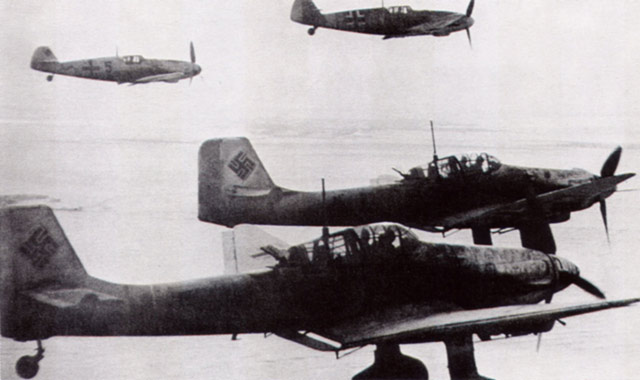
Stukas and Bf 109s June 1942 worldwartwo.filminspector.cmo
Messerschmitt Bf 109F4 JG5 Black 1 and 5 escorting Ju 87 Stukas of SG5.1 in Russia, June 1942

Battle of the Mediterranean: The land battle in Libya has been deadlocked for a week, and today the British Eighth Army decides to do something about it. General Neil Ritchie's forces launch Operation Aberdeen, an attempt to encircle German General Erwin Rommel's forces in "the Cauldron." Rommel's forces, meanwhile, still encircle the Free French outpost at Bir Hakeim.

The Axis forces in the Cauldron, however, have had time to prepare killing zones with their tanks and anti-tank gun positions. The British make no progress with their early-morning attacks from the north and only slight progress by the 7th Armoured and 5th Indian divisions from the east. The British 32nd Army Tank Brigade in the north loses 50-70 tanks.

Rommel, fortified by the morning success against the British tanks, reacts quickly. In the afternoon, he splits his forces, counterattacking east toward Bir el Hatmat with Ariete and 21st Panzer divisions and to the north with elements of the 15th Panzer Division. The attack to the east has great success, forcing the headquarters of two British divisions, two brigades, and others to flee in a panic. This effectively decapitates the British response. The 15th Panzer attack to the north also has success, forcing the 22nd Armoured Brigade back with a loss of 60 of its 156 tanks. This turns into a wild retreat in which the British abandon three Indian infantry battalions, a reconnaissance regiment, and four artillery regiments to be captured. The front then settles down for the night.

At Bir Hakeim, the surrounded  Free French remain safe within their fortifications but are running out of supplies such as food and water. The Desert Air Force flies cover overhead to disperse Luftwaffe attacks, but Axis artillery continues to batter away at the fort. The German 90th Light Division prepares to attack the fort on 6 June using pioneers to clear the minefields around it.

Convoy WS-19Z, which carries Force X, sails from the Clyde for Gibraltar. This is the prelude to Operation Harpoon, or the Battle of Pantelleria, when an eastbound convoy sailing from Gibraltar will pass a westbound convoy out of Alexandria (Operation Vigorous) in mid-June. Unknown to the Allies, who have been reading German codes with Operation Ultra, the Italian military intelligence service (Servizio Informazioni Militare) has broken the U.S. code being used in the Mediterranean. The Axis thus has an early warning of these two joint operations due to communications made by the U.S. Military Attaché in Egypt, Colonel Bonner Fellers.
NY Times headlines June 1942 worldwartwo.filminspector.cmo
For once, the U.S. media actually downplays the real war news. The 5 June 1942 NY Times headlines that "Japanese Battleship and Carrier Damaged" when, in fact, the Japanese have lost four carriers. However, the truth comes out today as Admiral Nimitz lists the real successes at the Battle of Midway.

US/Axis Relations: The United States declares war on Bulgaria, Hungary, and Romania. Relations also now are strained with Finland due to its hosting Adolf Hitler to celebrate Marshal Mannerheim's 75th birthday on 4 June.

US Military: General Brehon B. Somervell, commander of the Army Service Forces, completes an inspection of US forces in Northern Island.

Two Douglas A-24 Dauntless dive bombers collide at Charters Towers, Queensland, Australia at 1000-1500 feet during a training flight. Three of the four men survive by parachuting out, but pilot 2nd Lt. Norman J. Davidson, whose plane was hit by the other plane's propeller from underneath, perishes.
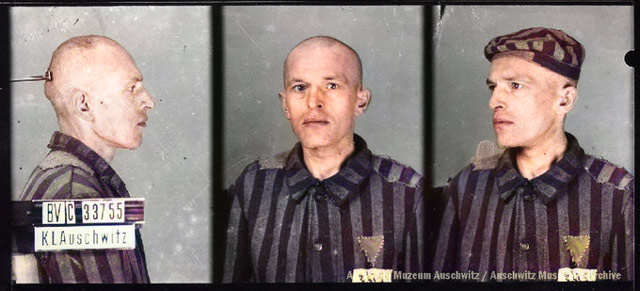
Auschwitz victim June 1942 worldwartwo.filminspector.cmo
Sloveč cabman Vaclav Novotny perishes in Auschwitz on 5 June 1942. Auschwitz Memorial (colorized).

Holocaust: Train Convoy No. 2 deporting people from France departs today for the East. The edict authorizing this train specifies that it should "deport Communists, Jews and anti-social elements to the East, in retaliation." Helmut Knochen (March 14, 1910 – April 4, 2003), the senior commander of the Sicherheitspolizei (Security Police) and Sicherheitsdienst in Paris, oversees the operation. SS Captain (Hauptsturmführer) Theodor Dannecker, leader of the Judenreferat at the SD office in Paris, has composed the list of deportees. 

This batch is composed of about 1000 mostly Jewish men aged 18 to 54, primarily Poles who fled the occupation there. They were arrested at Drancy, Beaune-la-Rolande, and Pithiviers and then taken to Compiègne between 14 May and 20 August 1941. Many of these men have been found unfit for work. Of these men, roughly 800 are taken to Auschwitz and are dead within ten weeks.
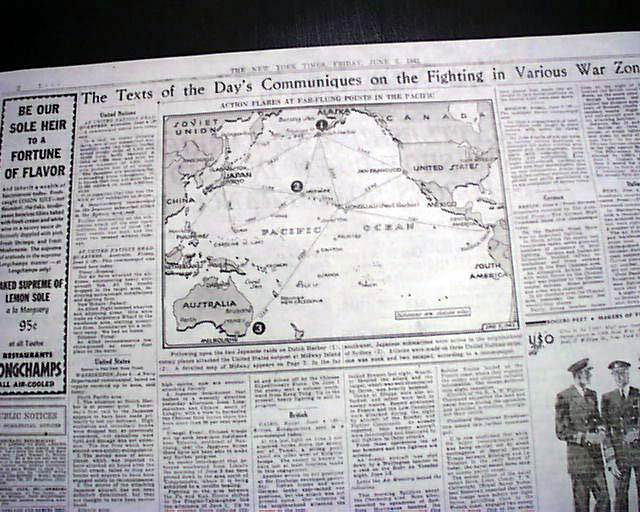
Map of Pacific battles in NY Times 5 June 1942 worldwartwo.filminspector.cmo
A war map in the 5 June 1942 NY Times helpfully shows American readers where the sites of three recent battles in the Pacific, at Midway, Sydney, and the Aleutians, are.

British Homefront: King George VI publishes his 1942 Birthday Honours. This involves various awards, rewards, appointments, and bestowing of honors. Among many other announcements, the economist John Maynard Keynes is made a Baron, filmmaker Alexander Korda is made a Knight Bachelor, and RAF Air Chief Marshal Charles Portal is awarded the Knight Grand Cross of the Order of the Bath (GCB).

American Homefront: Former child actress Virginia Lee Corbin, known at the start of her career as Baby Virginia Corbin, passes away at the age of 31 in Chicago, Illinois from tuberculosis. She is one of many silent film actors unable to transition to the talkies and retired shortly before her death. 
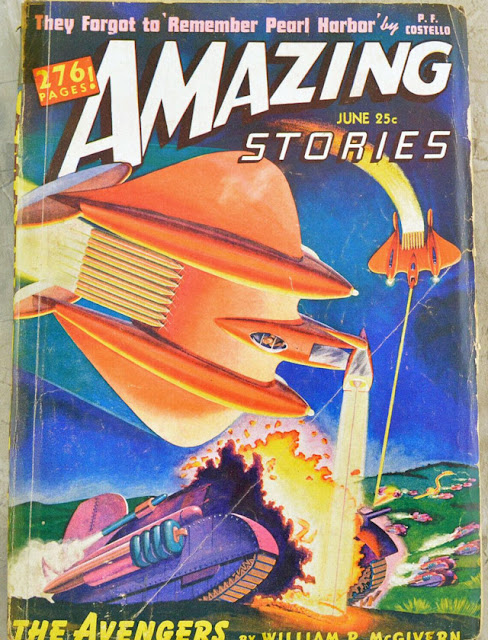
Amazing Stories June 1942 worldwartwo.filminspector.cmo
This June 1942 edition of Amazing Stories features the short story "The Avengers" by William P. McGivern. Hey, whatever happened to them? Actually, these Avengers are different than the Stan Lee ones, which debuted in Avengers #1 issued September 1963.


2021