Showing posts with label U-124. Show all posts

Sunday, August 28, 2022

June 18, 1942: Rommel Reaches Tobruk

Thursday 18 June 1942

General Erwin Rommel, North Africa, 18 June 1942 worldwartwo.filminspector.com
Erwin Rommel in North Africa, 18 June 1942 (Gemini, Ernst A., Federal Archives Image 146-2002-010-05A).

Eastern Front: The German advance toward Sevastopol, Crimea, gains a second wind on 18 June 1942 following the fall of key Soviet fortress Maxim Gorki north of Severnaya Bay. Luftwaffe operations over the port become much less hazardous as bombers of KG 51 destroy an effective Soviet anti-aircraft platform in the bay.

The Germans continue their mopping up of Soviet resistance north of the bay. The 132nd Infantry Division accepts the surrender of the Soviet 95th Rifle Division and Coastal Battery 12 at 09:00, while the 24th Infantry Division captures Bartenyevka at the mouth of the bay and the 22nd ID catches up with them. The Soviet defenders counterattack with the 138th Naval Brigade, which has no artillery or air support and is wiped out. In the south, the Wehrmacht attack remains stalled before Sapun Ridge, though Romanian troops are moving up the Chernaya River toward Sevastopol.

At Fuhrer Headquarters, Hitler has returned from his vacation. General Franz Halder briefly notes in his war diary the success at Sevastopol, but lavished much more ink on the partisan situation farther north:

In [Army Group] Center, [Soviet] Corps Belov ... has been split into several groups. We must reckon with the ability of some elements to fight their way through the forests toward Kirov, and that the enemy at Kirov will support these breakout attempts by launching an attack of his own.

He also notes in passing that the Soviet troops trapped on the Volkhov "are running short of food."

Battle of the Black Sea: German Kriegsmarine motor torpedo boat S 102 torpedoes and sinks 2048-ton Soviet freighter Belostok near Balaklava, Crimea. There are 388 deaths.

An Italian mini-submarine scores another success when it sinks another Soviet submarine sailing on the surface near Cape Sarych, Crimea. This is the second such sinking in four nights.

British POWs in North Africa, 18 June 1942 worldwartwo.filminspector.com
British POWs under guard behind barbed wire, near Bir Hacheim, North Africa, 18 June 1942 (Bockelmann, Werner, Federal Archives Picture 101I-443-1583-11).

Battle of the Pacific: Three 11th Air Force USAAF B-17s, an LB-30, and four B-24 bombers attack Japanese shipping at Kiska in the Aleutian Islands and sink 6537-ton Japanese oiler Nissan Maru. There is one death. One B-24 is lost with casualties, the Japanese possibly lose two scout planes.

Japanese aircraft raiding Port Moresby bomb and badly damage 4561-ton Australian passenger ship MV Macdhui. There are 10 deaths. The ship's remains are still visible on the reef south of Tatana Island.

Japanese  2206-ton freighter Tairyu Maru runs aground and is wrecked off Gyoji Island, Korea. Casualties are unknown.

Luftwaffe Bf 109 over North Africa, 18 June 1942 worldwartwo.filminspector.com
A Bf 109 fighter of JG 53 escorting a reconnaissance plane in North Africa (Bockelmann, Werner, Federal Archive Picture 101I-443-1588-09).

Battle of the Atlantic: U-159 (Kptlt. Helmut Friedrich Witte), on its second patrol out of Lorient, uses its deck gun to sink 1417-ton Dutch freighter Flora north of Manaure, Colombia. Conserving torpedoes is important on these missions far from home port, so U-boat captains like to use their gun instead of torpedoes even though it is somewhat riskier and less certain. There are one death and 36 survivors, who are briefly questioned by the U-boat crew and then land on the Colombian coast on 19 June. The ship is only in this location because it picked up some survivors from two other recently sunk ships, Surrey and Ardenvohr, and dropped them off at Cristobal.

U-172 (Kptlt. Carl Emmermann), also on its second patrol out of Lorient, similarly uses its deck gun to sink a ship in the Caribbean, this one 1958-ton British tanker Motorex northwest of Colón, Panama. There are one death and 20 survivors. This is a continuation of a quite successful patrol for U-172, which now has sunk seven ships and is running low on torpedoes.

U-124 (Kptlt. Johann Mohr), on its ninth patrol out of Lorient, torpedoes and badly damages U.S. tanker Seattle Spirit south of Greenland/ east of Newfoundland and Labrador. Seattle Spirit is sailing with Convoy ONS-102 in rough seas. The ship is armed, but the sinking takes place too quickly to use the guns. One of four torpedoes hits in the engine room and the ship quickly floods, but the crew and seven Canadian passengers manage to get off in three lifeboats. There are four deaths and 51 survivors, who are picked up by HMCS Agassiz. The Canadian corvette then scuttles Seattle Spirit. After this, Mohr heads back to base having sunk seven ships of 32,429 tons on this patrol.

Royal Navy destroyer HMS Albrighton, accompanied by steam gun boats HM SGB 6, 7, and 8, sinks German minesweeper R 41 during a sweep of the Seine Bay. The British lose SGB 7 during the raid. 

During the same action, German 810-ton freighter Turquoise is running from the gunboats when it runs aground six nautical miles (11 km) from Port-en-Bessin-Huppain, Lower Normandy, France. The ship is a total loss.

Luftwaffe Me 110 in North Africa, 18 June 1942 worldwartwo.filminspector.com
A Luftwaffe Lieutenant on the field telephone in front of an Me 110 fighter plane in North Africa near Bir Hacheim, 18 June 1942 (Bockelmann, Werner, Federal Archives Picture 101I-443-1588-11). 

Battle of the Mediterranean: German General Erwin Rommel's panzers advance rapidly against fading British resistance, reaching Gambut (Kambut), Libya. This is the site of a major RAF base, and the airfield is perfectly positioned for the Luftwaffe to bomb Tobruk.

Now on the outskirts of the port, Rommel's troops advance with their 2 German and one Italian armored divisions for a frontal assault after clearing out any pockets of resistance. Rommel's plan is to attack the southeastern perimeter, held by the 2/7th Gurka Rifles at the coast and the 2/5th Mahrattas and 2nd Cameron Highlands further inland, in a couple of days. He will use his two German panzer divisions, 15 and 21 Panzer, near the coast and the Italian Trieste and Ariete Divisions further inland.

British tug SS Vsion sinks at Mersa Matruh, Egypt, of unknown causes. No casualties.

An unusual German rescue concludes when U-83 makes port in Messina, Italy. The U-boat rescued the crew of a downed DO-24T-2 of Seenofstaffel 7 based at Suda (Souda), Crete. The Dornier had rescued a downed Bf-109 pilot, Lt. Heinrich Hesse of 7./JG 53, but then lost its tail while trying to take off and been left floating aimlessly in the Mediterranean. U-83 then was vectored to the Dornier by a passing Heinkel He 111.

New York Times, 18 June 1942 worldwartwo.filminspector.com
The 18 June 1942 NY Times manages to get every key fact in its headlines wrong in a jingoistic sort of way.

Spy Stuff: There are now two German spy rings in the United States operating as Operation Pastorius. One ring is in a Manhattan hotel, while the other is traveling north by train from their landing at Ponte Vedra, Florida. The leader of the New York group, George John Dasch, already has begun the process of turning himself and his confederates over to the FBI, but for now, both groups remain unrestrained and with full freedom of action.

POWs: The first of two wartime prisoner exchanges between the Allies and Japan begins today. The U.S. government has chartered the Swedish cruise ship M.S. Gripsholm for such exchanges, and today it leaves with a load of Japanese civilians for Rio de Janeiro and then Mozambique, where the exchange is to be made. Spain represents Japan and Switzerland represents the Allies in these negotiations. The Gripsholm's passengers are mainly Japanese diplomats or businessmen who happened to be in the U.S. when war broke out. The Japanese have brought1554 Allied prisoners there to be picked up by the Gripsholm. The Japanese prisoners are picked up in Mozambique and taken to Japan aboard the Asamu Maru and Conte Verde. The Gripsholm will arrive back in New York on 25 August with its exchanged Allied prisoners. The next exchange will be in August 1943.

German Military: Luftwaffe squadron 7./JG 54 moves to Kotly near Leningrad and begins sweeps to protect German minesweepers in the Gulf of Finland.

Having been placed on leave for getting his 100th victory, Luftwaffe ace Oblt. Hans-Joachim Marseille of 3./JG 27 is informed that he has been awarded the Schwerter (swords) to his Ritterkreuz (Iron Cross). Marseille departs from North Africa for Fuhrer Headquarters on a Junker Ju 52/3m.
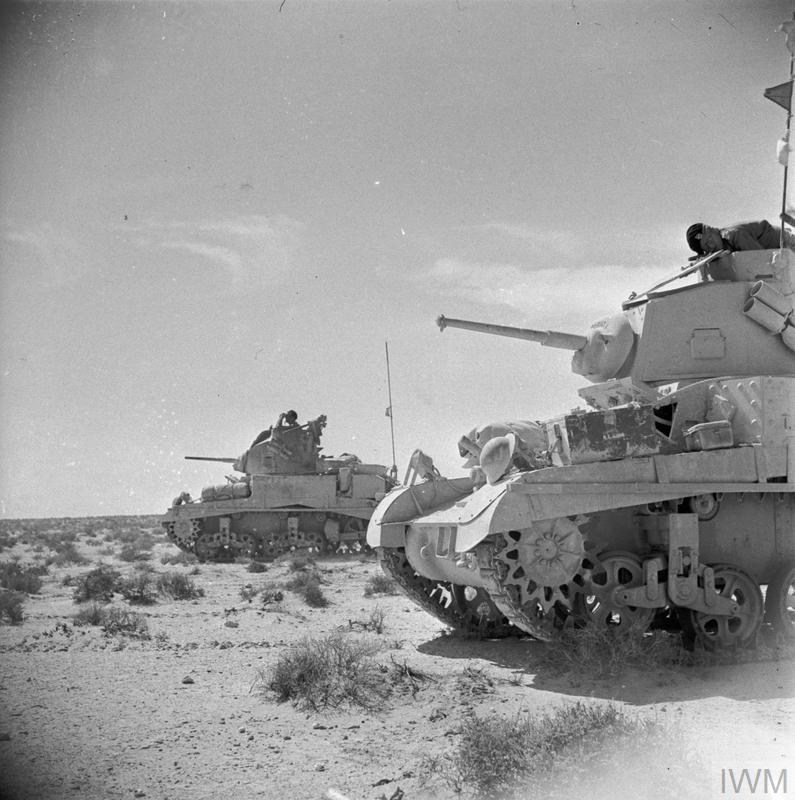
British Army Stuart tanks in North Africa, 18 June 1942 worldwartwo.filminspector.com
Two Stuart tanks advancing in the Western Desert, 18 June 1942 © IWM E 13534.

US Military: Bernard Whitfield Robinson becomes the first black U.S. Navy commissioned officer.

The air echelon of the 69th Bombardment Squadron, 38th BG (Medium) flies from Hickam Field in Hawaii with its B-26s to New Caledonia. It will fly reconnaissance missions for the rest of the year.

Major General Carl Spaatz arrives in London to formally take command of Eighth Air Force.

The U.S military begins developing the first medical air evacuation service. This will begin operation later in the year during the construction of the Alcan Highway and in Burma, New Guinea, and Guadalcanal.

German Homefront: Following a lengthy investigation when a partisan provides information in exchange for cash, German troops find and gun down the two assassins of Reichsprotektor of Bohemia and Moravia Reinhard Heydrich. The two men, Jan Kubiš and Jozef Gabčík, are found in Cyril and Methodius Cathedral in Prague. After a ferocious six-hour gun battle, German security troops overcome the opposition at a cost of 14 of their own number. This follows a brutal two-week period during which 13,000 Czechs are arrested and tortured. The two men, flown into the Reich as part of British/Czech Operation Anthropoid, receive many posthumous honors.

British Homefront: Free French leader Charles de Gaulle gives a "unity" speech at the Royal Albert Hall in London.

American Homefront: British Prime Minister Winston Churchill arrives in Washington, D.C. The Americans want to invade France, but Churchill convinces them that invading French North Africa makes more sense. The two sides also discuss atomic research and agree to share information. This is not the best time for Churchill to be visiting, with his troops struggling in North Africa, but everything seemed fine when he left London.

Future History: James Paul McCartney is born in Liverpool, England to a volunteer firefighter, James, and a licensed nurse. Both parents are of Irish descent. An excellent student, McCartney tests into the Liverpool Institute grammar school in 1953, and around this time his father encourages him to embrace music. One day on the bus to the Institute, he meets younger student George Harrison. McCartney's mother passes away on 31 October 1956, and on 6 July 1957 he meets older John Lennon at a church festival. Lennon leads a band, the Quarrymen, and McCartney soon joins, followed a year later by Harrison. The band has some local success and in 1960 gets a gig in Hamburg, Germany. After several personnel changes, the band renames itself The Beatles and goes on to international success, with McCartney and Lennon writing the vast majority of their oeuvre. As of this writing, McCartney remains a performer, songwriter, and influencer in the music scene while leading his own band.

Roger Joseph Ebert is born in Urbana, Illinois. He becomes a celebrity film critic for the Chicago Sun-Times until his death on 4 April 2013, hosting television review shows along with Chicago Tribune critic Gene Siskel. 

Nicholas John Tate is born in Sydney, New South Wales, Australia. He becomes a character actor best known for roles in "Space: 1999" in the 1970s and the Australian soap opera "Sons and Daughters." He remains active as an actor as of this writing.

Thabo Mvuyelwa Mbeki is born in Mbewuleni, Eastern Cape, South Africa. He becomes the second president of South Africa, following Nelson Mandela, from 14 June 1999 to 24 September 2008. He remains active in South African politics as of this writing.

A Japanese decoy airfield on Kiska in the Aleutians, 18 June 1942 worldwartwo.filminspector.com
Japanese decoy "aircraft" on Kiska Island in the Aleutians, 18 June 1942 (U.S. Navy).


2022

Wednesday, April 13, 2022

June 12, 1942: First US Air Raid On Occupied Europe

Friday 12 June 1942

Free French attack in North Africa, 12 June 1942 worldwartwo.filminspector.com
Free French on the attack near Bir Hackeim, 12 June 1942 © IWM E 13313.

Eastern Front: On vacation in Berchtesgaden, Adolf Hitler is full of hope and secret dread for the coming "decisive" summer offensive in the Soviet Union. The whole point of the attack, he muses, is to "clear the table" and win the war. "If I do not get the oil of Maikop and Grozny, then I must end this war," Hitler admits to his cronies.

The current attacks are not going well, let alone ones in the future. The assault on entrenched Russian defenses at the Crimean port of Sevastopol continues on 12 June 1942 without much progress by either side. The Soviets receive reinforcements when cruiser Molotov and destroyer Bditel'nyy evade the Axis blockade and deliver 2,314 soldiers, 190 tons of ammunition, and 28 artillery pieces to the besieged garrison.

German ground attacks continue without much success. In the critical northeast sector, LIV Corps continues its relentless attacks and loses 1957 men in the fighting of 11-12 June, but the Soviet defenders also are in bad shape. 

The Germans, though, are determined. Super-heavy artillery piece "Dora" and eleven 420 mm mortars open fire on Fort Stalin, which guards the approaches to Severnaya Bay but have little impact. Finally, a dive-bombing attack by Junkers  Ju-87 Stukas of StG 77 knocks out three of the fort's main 76.2 mm guns, and General Erich von Manstein's 11th Army assembles an attack force to take the fort for early on the morning of 13 June.

Resistance to superior orders is fairly common within the Wehrmacht, but everyone in uniform knows that it must be done "the right way." An example occurs today in Crimea. Luftwaffe General Wolfram von Richtofen has forbidden all air attacks in the Black Sea for fear of hitting Axis naval vessels. The local German naval commander, Vizeadmiral Gotting, vehemently disagrees, but von Richtofen's order is final and he will not listen to any complaints.

Accordingly, Gotting meets today in private with von Richtofen's naval liaison, Koneradmiral von Eyssen - who gives von Richtofen all of his naval information. Together they secretly agree that the order prohibiting Luftwaffe operations at sea is counterproductive and they jointly limit the order to a very small restricted zone directly off Crimea - without, of course, telling von Richtofen. Von Eyssen then coordinates this with Luftwaffe Oberst Wolfgang von Wild, who commands Lufftwaffe forces (Fliegerfuhrer Sud) operating over the Black Sea. Von Wild also agrees that von Richtofen's order is nonsense, and all three men subvert von Richtofen's direct order. This is the "right" way to disobey orders in the Third Reich and is done by different commanders throughout the war.

At Fuhrer Headquarters in East Prussia (Hitler is on vacation on the Obersalzberg), General Franz Halder has a disturbing conference with Vice Admiral Fricke and his aide. It is disturbing because, as Halder records in his diary, "Those people are dreaming in terms of continents." He writes that they "assume without another thought" massive German land victories that will obtain ports on the Persian Gulf and on the East African coast. "The problems of the Atlantic," Halder notes with incredulity, "are treated with off-hand superiority and those of the Black Sea with criminal unconcern."  Halder, of course, has first-hand information on just how precarious the Axis position in the USSR really is.

Battle of the Pacific: Both sides are heading for home following the decisive American victory at Midway Island. Admiral Frank Fletcher, in command aboard USS Saratoga, is one day's sail from Pearl Harbor, while Admiral Nagumo is still two days' sail from Hashirajima. the Americans are eagerly publicizing their victory, while the Japanese are keeping their losses a guarded secret known only to the Emperor and a small number of high-ranking naval personnel.

USS Swordfish (Lt. Cdr. Chester C. Smith SS-193), operating northwest of Poulo Wai in the Gulf of Siam (later Gulf of Thailand), torpedoes and sinks Japanese freighter Burma Maru. The wreck is discovered in February 2017.

Japanese submarine I-21, operating off the east coast of Australia, torpedoes and sinks 5527-ton Panamanian coke freighter Guatemala while on the surface. The freighter is traveling in an eight-ship convoy from Newcastle to Whyalla, such convoys having been organized only recently due to the recent submarine assault on Sydney Harbor. HMAS Doomba picks up the crew, all of whom survive.

In China, the American Volunteer Group (Flying Tigers) has a big day. At dawn, the 1st Squadron shoots down four Ki-27 Nate bombers and five other twin-engine plans over Kweilin (Guilin, on the west bank of the Li River).

B-17s of the 5th Air Force bomb Lakunai Airfield and Vunakanau at the Japanese main overseas base of Rabaul.

NY Times 12 June 1942 worldwartwo.filminspector.com
NY Times, 12 June 1942.

Battle of the Indian Ocean: Japanese submarine I-10 shells and sinks 2052-ton Panamania freighter Hellenic Trader in the northwestern Mozambique Channel near Bahla de Cruz. Later in the day, I-10 torpedoes and sinks 5064-ton British freighter Cliftonhall.

Japanese submarine I-16 torpedoes and sinks 3748-ton Yugoslav freighter Supetar in the Mozambique Channel near Cabo de Sao Sebastiao.

Japanese submarine I-20 shells and sinks 5063-ton British freighter Clifton Hall in the Mozambique Channel off Angoche, Mozambique.

European Air Operations: A small force of a dozen U.S. Army Air Force B-24 Liberators flying from northeast Egypt bomb the Ploesti, Romania, oil fields after taking off at 22:30 on 11 June. The bombing is extremely inaccurate due to poor weather and no appreciable damage is caused. The bombers encounter flak and a few enemy fighters. Altogether, the planes drop 24 tons of bombs, with a thirteenth bomber attacking the port of Constanta. The bombers then proceed on to Habbaniyah, Iraq, making this an early example of shuttle bombing. Four bombers make it to Habbaniyah, while the others land at other fields in Iraq and Syria. Four of the bombers land in Turkey and their crews are interned. 

This is the first offensive mission by U.S. planes over Europe during World War II. General Dwight D. Eisenhower comments drily that the failed attack "did something to dispel the illusion that big planes could win the war." The bombers are from the Halverson Project 63, or HALPRO and have flown across the Atlantic for the mission. This small force forms the genesis of the 1st Provisional Bombardment Group (PBG) and the 376th Heavy Bombardment Group, completing another 450 missions.

The poor weather of spring 1942 continues and gets worse throughout the day on the Channel Front, but it is mild enough in the morning and early afternoon for some operations.

Group Captain Ken Gatward and navigator Flight Sargeant George Fern conduct The Beaufighter Raid on Paris, or Operation Squabble. This has been delayed for a month due to poor weather. This is a daring propaganda strafing run on a German parade down the Champs-Élysées that includes dropping Tricolor flags on prominent monuments (the Arc de Triomphe and the French Naval Ministry, currently being used as Kriegsmarine headquarters).

The two men take off from RAF Thorney Island in rain and clouds, but the weather clears sufficiently to carry out the mission. Flying at an extremely low altitude, the Beaufighter circles the Eiffel Tower at 12:27 and then heads for the Champs-Élysées. It turns out there is no German military parade (it hasn't begun yet), but the men drop the flags as intended. After strafing the Ministry building, the men return to RAF Northolt at 13:53. During the strafing run, the plane suffers a birdstrike, and the French crow is found in the starboard radiator. Gatward receives the DFC and Fern the DFM for their efforts.

RAF aircraft of Coastal Command engage in routine convoy patrols. They bomb and sink 1497-ton Swedish freighter Senta 30 nautical miles Cuxhaven, Germany (near the Weser River). There are no casualties.

RAF Beaufighter, 12 June 1942 worldwartwo.filminspector.com
Beaufighter Mk IC T4800 code ND-C of No. 236 Squadron RAF on the ground at Wattisham Suffolk 12 June 1942.

Battle of the Baltic: Swedish 1046-ton Bojan hits a mine and sinks off Saßnitz, Germany.

Battle of the Atlantic: German cruiser Michel, operating off the coast of Brazil, on 6 June had spotted the disabled 7176-ton U.S. freighter George Clymer and launched its MTB Esan. The MTB torpedoed the freighter and the crew abandoned ship. However, the ship remained afloat, and the crew re-embarked. British armed merchant cruiser HMS Alcantara has remained in the vicinity of the badly damaged ship since arriving on the scene on 8 June, but today departs, leaving the freighter still afloat. It is assumed that George Clymer eventually sinks.

U-158 (Kptlt. Erwin Rostin), on its second patrol out of Lorient, torpedoes and sinks US 8192-ton tanker Cities Service of Toledo 20 miles east of the Trinity Shoal Buoy in the Gulf of Mexico. There are 15 deaths.

U-124 (Kptlt. Johann Mohr), on its ninth patrol out of Lorient, torpedoes and sinks 4093-ton British freighter Dartford south of Cape Race. There are 17 survivors and 30 deaths.

U-129 (Kptlt. Hans-Ludwig Witt), on its fifth patrol out of Lorient, torpedoes and sinks 9005-ton refrigerated cargo freighter Hardwicke Grange 120 nautical miles (220 km) north of Puerto Rico. There are three deaths and 78 survivors. The survivors are in four lifeboats for two weeks, and each lifeboat lands in a different country: Cuba, the Dominican Republic, Jamaica, and Haiti.

German 125-ton minesweeper M-4212 (formerly Belgian trawler Marie-Frans) hits a mine and sinks south of Vieux-Boucau-les-Bains, France. The mine was laid previously by French submarine Rubis.

Map of North African campaign, 12 June 1942 worldwartwo.filminspector.com
Map of North African campaign, 12 June 1942.

Battle of the Mediterranean: The British in the El Adem "box" are under intense pressure by General Erwin Rommel's 15th Panzer Division and give ground as the Germans attempt to break out of  "the Cauldron." The 2nd and 4th Armoured Brigades retreat 6 km (3.7 miles) in disarray, leaving only the 29th Indian Infantry Brigade holding its ground. Rommel orders the 21st  Panzer Division to join the attack on the 13th. A breakthrough here would open a pathway to Tobruk.

The Allies are only in as good a situation as they are due to the previous stout Free French defense at Bir Hakeim. Now that the fortress has fallen, the Germans can bring much greater pressure to bear on the British. Today, General Auchinleck praises the French, saying, "The United Nations need to be filled with admiration and gratitude in respect of these French troops and their brave General Kœnig."

While the intense Luftwaffe air campaign against Malta has eased in recent weeks, it remains in a precarious position due to supply shortages. Today, the Royal Navy begins Operations Harpoon and Vigorous, typical convoy missions to the embattled island. Harpoon sets out from Haifa, Palestine, while Vigorous begins at Gibraltar.

Convoy MW4 leaves Gibraltar heading east with six merchantmen (the British Troilus, Burdwan and Orari, the Dutch Tanimbar, the American Chant, and the tanker Kentucky) carrying 43,000 short tons (39,000 t) of cargo and oil. It is protected by Force X, which includes distant cover by battleship HMS Malaya and aircraft carriers Argus and Eagle.

The westward operation is a little more complicated. Convoy MW-11a embarks from Haifa with five merchantmen (British Ajax, City of Edinburgh, City of Pretoria, City of Lincoln, and Elizabeth Bakke) heading west. It is escorted by the 7th destroyer flotilla. This convoy has trouble immediately when Elizabeth Bakke is ordered back to port because it cannot maintain station due to overloading and its poor condition. Convoy MW11b departs from Alexandria, Egypt, with a tanker (Bulkoil), a merchantman (Potaro), and a decommissioned battleship (Centurion) being used as a freighter. It is escorted by five destroyers, four corvettes, and two rescue ships (Antwerp and Malines). There also is a third convoy from this direction that departs from Port Said, MW-11C, composed of freighters Aagtekirk, Bhutan, City of Calcutta, and Rembrandt.

The objective is to confuse and disperse the Axis defenses with all of these simultaneous convoys. In theory, this should enable maximum resupply of the island despite inevitable losses.

Unknown to the British, the Axis knows all about these operations already due to a major security breach by the US Military Attaché in Egypt, Colonel Bonner Fellers. Italian military intelligence (Servizio Informazioni Militare) has broken the American code and thus has deciphered Fellers' detailed reports to Washington. While not strictly Fellers' fault, better precautions could have avoided this. In any event, this incident proves that codebreaking during World War II was not just a one-way street that benefited only the Allies.

With the Axis ready and waiting, the attacks begin almost immediately. In the evening, 15 Junkers Ju 88 bombers of I Kampfgeschwader 54 based in Crete attack MW-11c. They score a near-miss on City of Calcutta, which slows it and forces the freighter to divert to Tobruk along with its towed MBT, escorted by two escorts. During the night, MW-11c slows to arrange a rendezvous with the other two convoys off Mersa Matruh.

Separately, U-77 (Kptlt. Heinrich Schonder), on its sixth patrol out of La Spezia, torpedoes and sinks the Royal Navy destroyer HMS Grove (L77) off Sollum, Egypt. The ship sinks in 14 minutes with 110 deaths and 79 survivors. Escort destroyer HMS Tetcott picks up the survivors.

SS Hardwicke Grange, sunk on 12 June 1942 worldwartwo.filminspector.com
British refrigerated freighter Hardwicke Grange, sunk by U-129 on 12 June 1942.

Spy Stuff: U-202 (Kptlt. Hans-Heinz Linder), on its sixth patrol out of Brest, arrives off the south coast of Long Island, New York, in early-morning darkness and disembarks four German spies/saboteurs. The four men land at Amagansett. This is Operation Pastorius, one of a series of such operations planned to disrupt the economy of the United States. They are wearing German Navy uniforms to avoid being shot as spies if captured during the landing. However, upon landing and finding themselves alone on the beach, they quickly change into civilian clothes and bury their uniforms and other equipment.

A problem quickly develops when Coast Guardsman John C. Cullen spots the men posing as fishermen on a raft. Cullen also notices the submarine and sees that the men are armed. He approaches them, and the spies give Cullen $200 to keep quiet. Cullen takes the money but alerts his superiors later in the day, by which time the four spies have taken the LIRR into Manhattan.

Anne Frank's diary, begun on 12 June 1942 worldwartwo.filminspector.com
The first page of Anne Frank's diary, written on 12 June 1942.

Holocaust: In Amsterdam, Anne Frank is gifted a red-and-white plaid diary on her thirteenth birthday. The Franks, German Jewish refugees, have not yet gone into hiding. Her first entry begins, "On Friday, June 12th, I woke up at six o’clock and no wonder; it was my birthday." Later in the entry, she says, "I hope I will be able to confide everything to you, as I have never been able to confide in anyone, and I hope you will be a great source of comfort and support."

US Military: The US Army activates the 100th Infantry Battalion, composed of Japanese-Americans from Hawaii.

German Military: Oblt. Egon Albrecht becomes Staffelkapitaen of 1./ZG 1.

George Bush joins the US Navy, 12 June 1942 worldwartwo.filminspector.com
George Bush during World War II.

Russian Homefront: Russian revolutionary Anna Yakimova dies in Novosibirisk, aged 86. She was a prime early agitator against the Tsar around the turn of the 20th Century.

American Homefront: In the evening, a tornado hits the southwest section of Oklahoma City near Will Rogers Airfield. Local sources (the Ada Evening News) report 21 dead, 25 critically injured, and 250 made homeless.

Future President George Herbert Walker Bush graduates from high school and immediately enlists in the U.S. Navy despite already having been admitted to Yale University.

Future History: Bert Sakmann is born in Stuttgart, German Reich. He grows up to become a noted cell physiologist who wins the Nobel Prize in Physiology or Medicine with Erwin Neher in 1991. As of this writing, Sakmann leads an emeritus research group at the Max Planck Institute of Neurobiology in Heidelberg, Germany.

Memorial to the 100th Infantry Brigade, activate on 12 June 1942 worldwartwo.filminspector.com
Brothers in Valor Monument in Honolulu, Hawaii, commemorating the 100th Infantry Battalion and other Japanese-American units in World War II (Photo: Sarah Sundin).


2022

Thursday, November 18, 2021

June 9, 1942: Nimitz Changes Strategy

Tuesday 9 June 1942

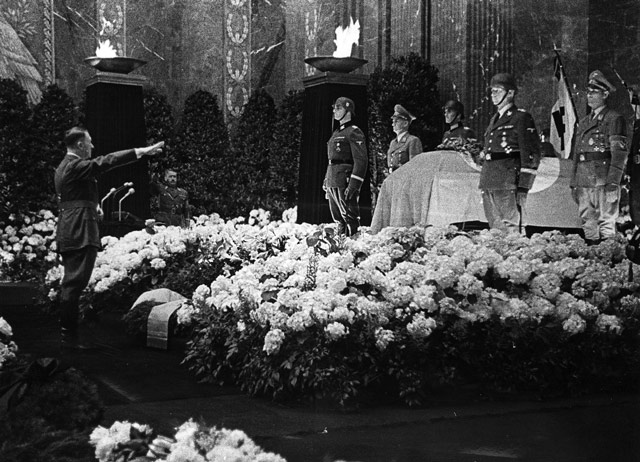
Hitler at Reinhard Heydrich's funeral, 9 June 1942 worldwartwo.filminspector.com
Adolf Hitler at Reinhard Heydrich's funeral (Narodowe Archiwum Cyfrowe, sygn. 2-13241).

Battle of the Pacific: Learning of the Japanese capture of Kiska on 9 June 1942, Admiral Chester Nimitz cancels his orders to Admiral Jack Fletcher to take his three aircraft carriers (USS Enterprise, Hornet, and Saratoga) north to the Aleutians. Nimitz now does not want them exposed to Japanese land bombers operating from Kiska and Attu. This unknowingly frustrates a Japanese plan to ambush them with the reinforced fleet of Admiral Boshirō Hosogaya.

Nimitz now is thinking offensively (as is General Douglas MacArthur in Melbourne, who submitted his own proposal for an advance led by the Army on 8 June 1942). He wants to keep his carrier force intact for a thrust due west across the central Pacific. This Nimitz and his team in Hawaii see as the main Allied strategy from now on. This is contrary to MacArthur's proposal to advance north from Australia, setting up a classic "turf war" between the US Army and Navy.

The Japanese high command, despite the minor successes in the Aleutians, is reeling from the early June results at Midway. The solution is denial and a coverup. The Imperial Japanese Navy prepares a vague and unrealistic summary of the battle to the military liaison conference. Admiral Chūichi Nagumo takes his time preparing an accurate summary of Japanese losses. He remains completely unaware that the Americans knew his complete battle plan in May and thinks his force was only discovered on the 5th. The Japanese public is kept completely in the dark, with media focusing entirely on the Aleutians.
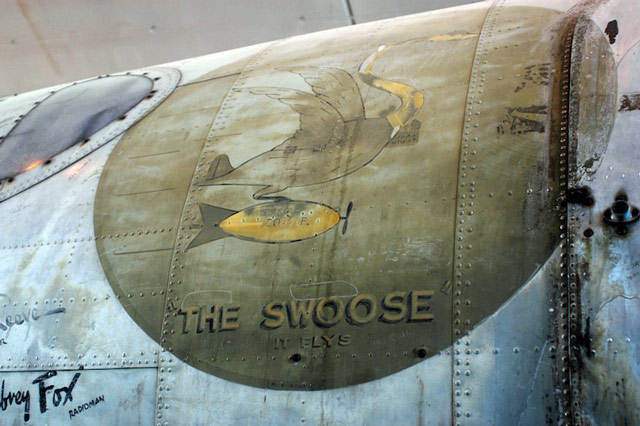
The Swoose ferried LBJ to Port Moresby on 9 June 1942 worldwartwo.filminspector.com
Artwork depicting "The Swoose" on the B-17D aircraft that carried Lyndon Baines Johnson to Port Moresby on 8 June 1942. The aircraft is currently being restored in Dayton, Ohio (U.S. Air Force photo courtesy of the National Museum of the United States Air Force).

Navy Reserve Lieutenant Lyndon B. Johnson, the future President, makes an aerial inspection tour from his location in Townsville, Australia. Johnson already has had an interesting time Down Under, having helped to quell a mutiny by African-African troops on 22 May 1942. The B-26 Marauder flying the mission has engine trouble after departing from Port Moresby and has to return to base, but the USAAF 19th Bombardment Squadron of the 22nd Bomber Group completes its mission (flying from Townsville to Port Moresby for refueling) to bomb Lae, New Guinea. The Port Moresby stage of the mission has to be delayed for an hour to accommodate LBJ, who arrives from Townsville in General Brett's VIP B-17D "The Swoose." 

The mission is hazardous even though Johnson misses out on the actual bombing run. LBJ narrowly escapes death because he switches bombers at the last minute due to a pilot change, and the plane he leaves crashes into the sea off Salamaua, killing everyone on board. LBJ then also escapes potential harm when the B-17 on the flight back to Townsville gets lost and almost runs out of fuel. It has to make an emergency landing at remote Carisbrooke Station near Winton. This B-17D, incidentally, survives and is the property of the National Air and Space Museum in Washington, D.C. The strange sequence of events results in General MacArthur awarding Johnson a Silver Star, the Army's third-highest decoration. Johnson soon after heads back to D.C. in accordance with FDR's requirement that all members of Congress return to their legislative duties. He remains in the US Naval Reserve until January 1964.

The Japanese complete their occupation of the Philippines and declare it secure.

US 24-ton freighter Husky founders two miles off Cape Constantine in Nushagak Bay, Aleutian Islands. Everyone survives.

US submarine USS Trout (SS-202) picks up two survivors of the sunken Japanese heavy cruiser Mikuma.

There is fierce fighting near the town of Chuhsien, China. Both sides take heavy casualties.

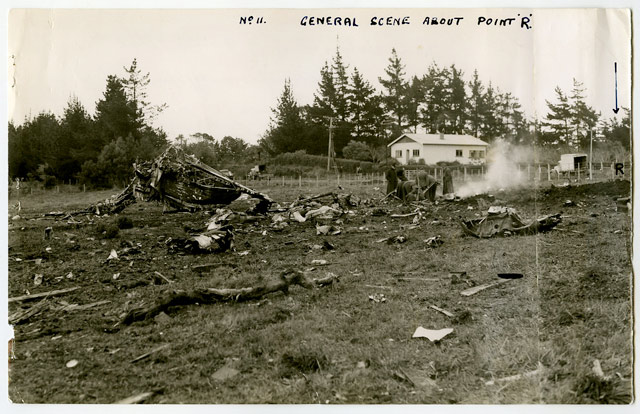
B-17 crash site in New Zealand, 9 June 1942 worldwartwo.filminspector.com
Crash site of a B-17 near Whenuapai Aerodrome, Auckland, New Zealand, 9 June 1942. All 11 men on board are killed (Archives New Zealand Reference: ADQA 17211 AIR1 572 25/2/588).

Battle of the Indian Ocean: The Japanese Divine Dragon Operation No. 2 submarine force, in which the Japanese high command placed high hopes, remains operational in the Mozambique Channel. However,  it is now clear to the local commanders that the operation now has turned into a standard submarine patrol and that initial plans to target the British Far Eastern Fleet are obsolete. Accordingly, Lieutenant Commander Otani Kiyonori of I-18 has his men destroy and jettison mini-submarine M-18b, effectively ending the operation.

Around this time, British divers discover the remains of M-20b, which carried out the most successful attack at Diego Suarez. It is sitting upright on a reef in heavy surf (remnants remain there to this day). They salvage the propellers, now on display at the gravesite of its occupants, Lieutenant (j.g.) Akieda Saburo and POIC Takemoto Masami. They were killed on 2 June 1942 by a British patrol on the mainland while attempting to rendezvous with I-20.

The Japanese have not given up on the Indian Ocean by any means. On 5 June 1942, auxiliary cruisers Aikoku Maru and Hokoko Maru caught 6757-ton British passenger ship Elysia 350 miles northeast of Durban. They torpedoed it, and today it sinks, causing 22 deaths. 

Battleship HMS Ramillies, previously damaged by a Japanese mini-submarine in late May 1942, arrives in Durban for repairs accompanied by light cruiser Emerald and three destroyers. The damage ultimately will require a return to the UK at Portsmouth on 8 September that will last until the summer of 1943.
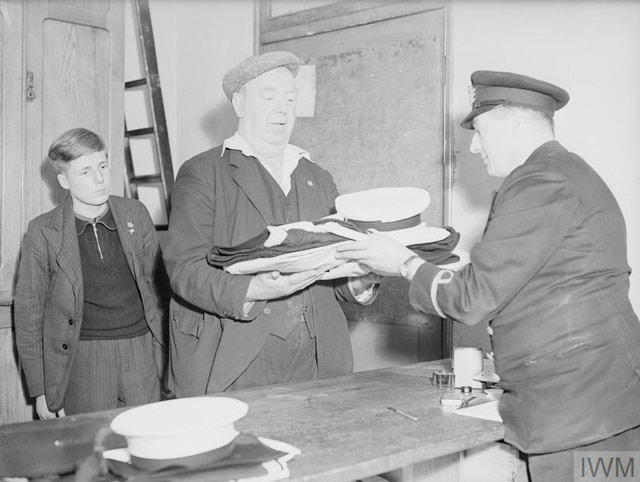
A new recruit for the Royal Navy, age 62, 9 June 1942 worldwartwo.filminspector.com
A new recruit, age 62, joins the Royal Navy, 9 June 1942. ""Owd Bob" drawing his petty officer's rig on board the Armed Merchant Cruiser Depot ship HMS MERSEY. Behind him is Tommy Harding, age 18, another new entry who volunteered for this special naval service." © IWM A 8807.

Eastern Front: German General Erich von Manstein's assault on Sevastopol has shown signs of turning into a battle of attrition, exactly what he didn't want. The priority is to take Sevastopol before the Case Blue offensive on the main front begins, and that now is looking doubtful. Luftwaffe General Wolfram von Richtofen begins changing attack priorities from assisting the front-line troops to attacking Soviet supply lines, a bad sign that the plan is faltering. The Luftwaffe is fully committed, flying 1044 sorties and dropping 954 tons of bombs, putting a strain on men, equipment, and logistics.

However, the German offensive is not dead, not by any means. General Franz Halder, remaining in East Prussia while the Fuhrer attends the Reinhard Heydrich funeral (see below), comments:
At Sevastopol, good progress despite strong enemy counter-attacks. Otherwise, all quiet. Army Group Center reports breakout of Cavalry Corps Belov to the south.
Halder does have his own grips about the Storfang operation. Writing about a meeting during the day with General Buhle, he comments acidly, "Report on Sevastopol. My suspicion that the Artillery Command is not of the best is confirmed."

The Red Navy is doing what it can to help its comrades ashore. Early in the morning, Soviet destroyers spot Axis mini-submarines operating from Yalta on their radar screens and unsuccessfully attack them. This new development induces Vice-Admiral Oktyabrskii to order his naval captains to concentrate less on offshore gunfire support of the army and more on keeping the sea lanes to Sevastopol clear. He also tells them to switch to area fire rather than targeted fire and cuts back on the number of surface vessel supply missions. This forces an increase in submarine supply missions. While they don't know it, the Axis mini-submariners thus achieve a tactical victory without sinking a single ship.

LIV Corps continues to make slow progress in the north, assisted greatly by an intense artillery bombardment laid down by the biggest guns ever used in combat. The 132nd Infantry clears a key obstacle, the Haccius Ridge, and the 22nd Infantry Division destroys the elite Soviet 79th Naval Infantry Brigade.

General Paulus' Sixth Army counterattacks against Red Army forces in the Kharkov sector. Paulus has plenty of troops because Sixth Army is fated to lead the Case Blue offensive toward Stalingrad. During this attack, Uffz. Wilhelm Crinius of 3./JG 53 shoots down two Soviet Il-2 Shturmovik ground-attack planes for his first two victories.

European Air Operations: Weather is poor on the Channel Front, with 10/10ths cloud cover down to 1500 feet and getting worse as the day proceeds.

A Polish squadron raids Essen. British Wellington IV R1725 crashes into the North Sea, 20 km west of Texel, Netherlands, while en route to bomb Essen. All six crewmen perish. Another Wellington targeting Essen, IV Z1412, is shot down by the nightfighter pilot Oblt. L.Fellerer of II/NJG 2. it crashlands on the beach 2 km west of St. Maartensvlotbrug. The five crewmen survive. A Wellington manages to make it back for a crashlanding after being attacked three times by Me-110 night fighters from below and astern, and the odds of survival are so iffy that the copilot bails out 20 miles west of Essen after the bombing run.

USAAF bombers in Alaska, June 1942 worldwartwo.filminspector.com
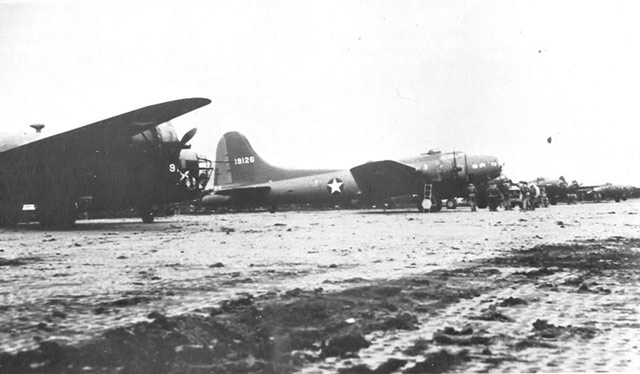
"36th Bombardment Squadron LB-30 Liberator and a Boeing B-17E Fortress (41-9126) at Fort Glenn Army Air Base, Alaska, June 1942. 9126 was lost Aug 28, 1942." USAAF photo via Chloe, John Hale, (1984), Top Cover for America. the Air Force in Alaska. 1920–1983, Pictorial Histories Publishing Company, ISBN 0-933126-47-6.

Battle of the Atlantic: U-124 (Kptlt. Johann Mohr), on its ninth patrol out of Lorient, torpedoes and sinks 940-ton French corvette FFL Mimosa (K11, Captain Roger R.L. Birot) 600 miles southeast of Cape Farewell in the British Isles. The Mimosa is an escort for Convoy ONS-100 and sinks within three minutes because the depth charges falling off the ship explode. The other escorts don't even notice the ship is missing until dawn breaks. There are 65-67 deaths and only four surviving French sailors, who are picked up by HMCS Assiniboine.

U-502 (Kptlt. Jürgen von Rosenstiel), on its fourth patrol out of Lorient, torpedoes 6589-ton US tanker Franklin K. Lane 35-40 miles (65 km) northeast of La Guiara and Cape Blanco, Venezuela. It is scuttled by the British destroyer HMS Churchill. The ship, a member of Convoy TO-5, is carrying 73,000 barrels of crude oil to Aruba for processing. There are four deaths and 37 survivors.

U-502 also gets another victim from the same convoy today, 5085-ton Belgian freighter Bruxelles. The ship manages to evade two torpedoes, but a third one blows a seven-meter (yard) hole in the side and the ship sinks within four minutes. The crew acts quickly and manages to launch lifeboats. Destroyer Churchill picks them up quickly. There are 53 survivors and one death.

U-432 (Kptlt. Heinz-Otto Schultze), on its fifth patrol out of La Pallice, torpedoes and damages 7073-ton Norwegian freighter Kronprinsen of Convoy BX-23A south of Cape Sable. The ship is taken in tow and beached at West Pubnico, Nova Scotia. Ultimately, the ship is repaired and returned to service.

U-432 also damages 8593-ton British freighter Malayan Prince with a torpedo that misses the Kronprinsen. The ship manages to remain with the convoy and is later repaired and returned to service in July 1942.
USS Southard at Mare Island, 9 June 1942 worldwartwo.filminspector.com
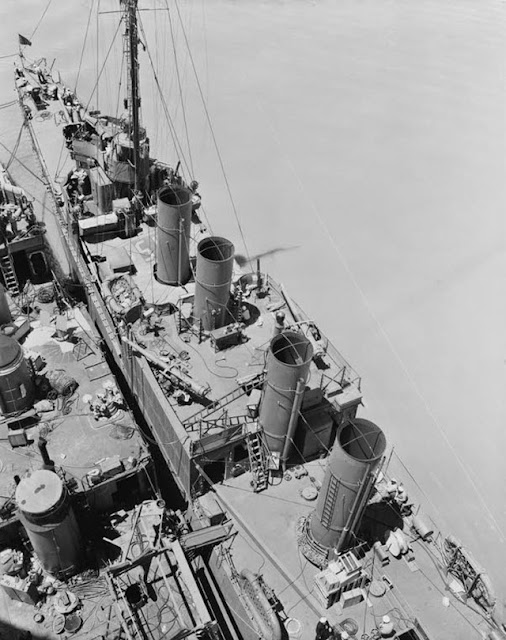
Four-stack destroyer USS Southard (DMS-10), Mare Island, 9 June 1942. She has just been converted into a minesweeper (Rickard, J (15 September 2018), USS Southard (DMS-10), Mare Island, 9 June 1942).

Battle of the Mediterranean: Early in the morning, the Luftwaffe sends 20 Junkers Ju 88 and 40 Ju 87 Stukas escorted by 50 Bf 109 and Me 110 fighters against the Free French in Bir Hakeim. However, thick smoke and dust force them to turn back. A second attack around noontime by 124 Stukas and 76 Ju 88s, escorted by 168 Bf 109s, has more luck. During this attack, Oblt. Hans-Joachim Marseilles of 3./JG 27 downs four RAF planes.

German artillery also opens up on the fortifications in the morning as General Erwin Rommel readies a final assault. After the planes and big guns have softened up the defenses, units of the 15th and 21st Panzer Divisions, the 90th Light Division, and Italian infantry launch a two-pronged attack.

Rommel's objective is the "high ground" near the fortress, a small rise called Point 186. The Italian Trieste Division makes good progress, overrunning a reinforced French force that is hampered by supply issues. The German advance gains steam in the afternoon when the 15th Panzer breaches the French line in the center, forcing a desperate counterattack with Bren Carriers that succeeds. Oberstleutnant Ernst-Günther Baade leads the Rifle Regiment 115 to within 200 meters (yards) of the fortress by dusk.

Overhead, the Luftwaffe establishes dominance due to previous losses in the RAF Desert Air Force despite frantic pleas for cover from French General Kœnig. The French are low on supplies and everyone can see the writing on the wall. British Major-General Frank Messervy, commander of the 7th Armoured Division, reports that a breakout should be attempted, and at 23:00 Kœnig signals for permission to evacuate the fortress. Lieutenant-General Neil Ritchie, commander of the 8th Army, replies that he'll prepare a thrust from the south but the fortress will have to hold out for another day or two. 

With water and ammunition running out and casualties mounting, Kœnig orders a breakout anyway. The French formation quickly loses coherence in the darkness and the Axis forces react quickly. The retreat turns into desperate hand-to-hand combat but does make progress into the early morning hours of the 10th.

Italian Caproni bombers catch 1584-ton Swedish freighter Stureborg in the eastern Mediterranean and sink it with torpedoes and bombs. There are 20 deaths and only one survivor, whose raft reaches land near Gaza. Ten men in total started out on the raft but nine perished because it drifted for 19 days and they had no food or water.

U-83 (Kptlt. Hans-Werner Kraus), on its eighth patrol out of Salamis, shells and sinks 175-ton Palestinian sailing ship Typhoon four miles southeast of Sidon, Lebanon. Everyone survives.

RAF Catalinas of No. 240 Squadron sinks Italian submarine Zaffiro in the western Mediterranean southeast of Palma de Mallorca, Balearic Islands. There are no survivors.
USS Hammann survivors arrive at Pearl Harbor, 9 June 1942 worldwartwo.filminspector.com
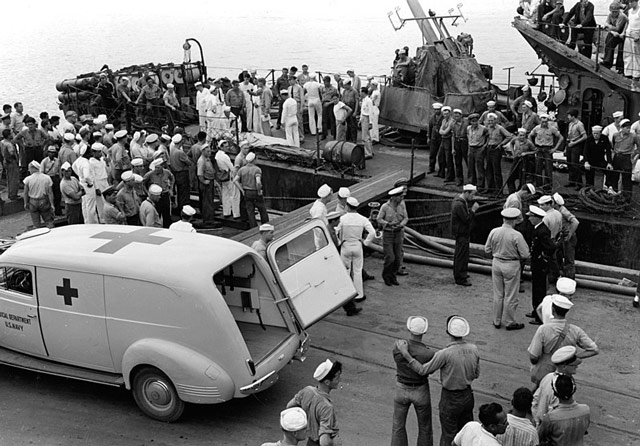
Survivors of the destroyer USS Hammann (DD-412), torpedoed and sunk on 6 June 1942 at the Battle of Midway, are brought ashore at Pearl Harbor, 9 June 1942 (Naval History and Heritage Command 80-G-312064).

Joint Allied Planning: The United States and British governments form the Combined Production and Resources Board. The purpose is to plan and coordinate production in each country to best serve war needs. It operates independently and competes with the Combined Munitions Assignment Board, which is under the jurisdiction of the Combined Chiefs of Staff. President Roosevelt's crony Harry Hopkins is the American leader behind the scenes, though Donald Nelson is the chair. 

While sometimes criticized as ineffective, the Board changes the military procurement process based on statistical analysis and perceived priorities. It provides some order to the former chaotic ordering system directly to industry used by the militaries of the respective countries. British representatives tend to feel the Board favors the US and prefer to exert their influence through the Munitions Board because they feel the Combined Chiefs give them more of an equal say. Canada feels left out and eventually is admitted to the Board as an equal partner. 

The real weakness of the Board is that its leaders don't really have much of an idea themselves of what the war effort needs or where the war is going until it is really too far along to matter. As the military strategy and objectives change - sometimes at the last minute - the Board must follow along and thus always is a step behind actual needs. Its findings also have to be implemented by the respective governments which may not necessarily agree completely with its decisions and thus may not treat them with a sense of urgency.

US Military: The Navy establishes a naval operating base at Kodiak, Alaska.
Heinrich Himmler leads the parade at the Reinhard Heydrich funeral, Berlin, 9 June 1942 worldwartwo.filminspector.com
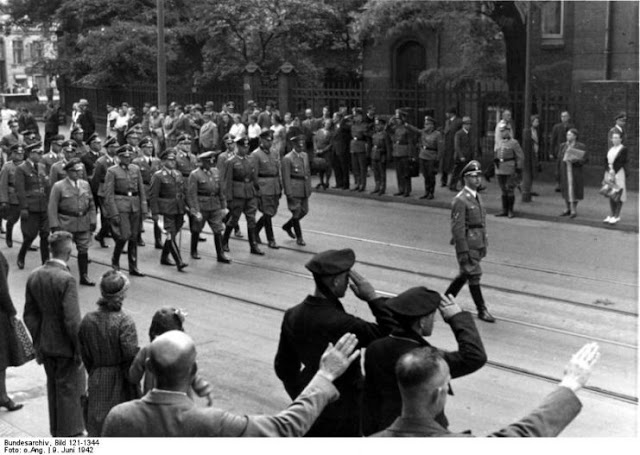
Reichsfuhrer-SS Heinrich Himmler leads the procession at Reinhard Heydrich's Berlin funeral on 9 June 1942. Visible in the front row from left are Robert Ley, Karl-Hermann Frank, Erhard Milch, Sepp Dietrich, Sergeant Heinz Heydrich (Reinhard's younger brother), police chief Kurt Daluege (Heydrich's successor in Bohemia and Moravia), and Wilhelm Frick (Federal Archive Picture 121-1344).

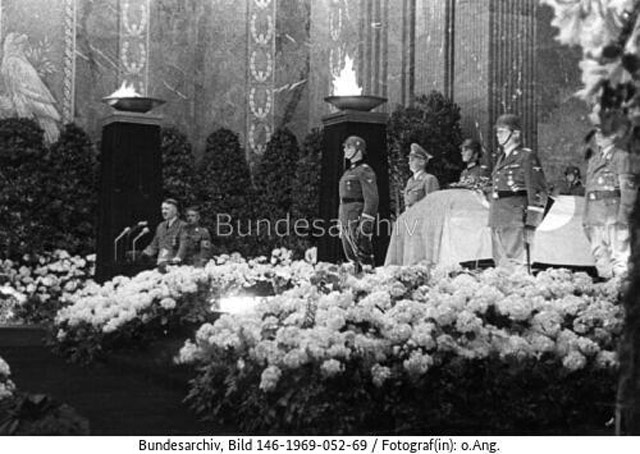
German Homefront: The government holds the second funeral for Reinhard Heydrich, who was shot by British agents on 27 May 1942. This second funeral is in Berlin (the first, on 7 June, was in Prague). All of the top Reich officials attend, including Adolf Hitler and Hermann Goering. Hitler awards Heydrich the German Order, the highest honor in the Third Reich, posthumously. After the ceremony, Heinrich Himmler tells his subordinates to ramp up the Holocaust.

Heydrich is interred in a plot at the Invalidenfriedhof in Berlin. The location, once well known, since the war has become secret to prevent fascist gatherings.

Privately, Hitler blames Heydrich's own lax security precautions on his demise. He tells his cronies that a man as important to the war effort as Heydrich never should have been driving in an unguarded open-air car through streets filled with people. Hitler, of course, is (rightly) paranoid about his own personal security and routinely changes his routes and timing to frustrate would-be assassins. This already has saved his life at least once, when he evaded a bomb planted at the Munich Brown House (Braunes Haus) on 8 November 1939.

Due to the Gestapo's mistaken belief that the Heydrich assassins operated from the town of Lidice, the local German authorities begin to obliterate it today. Today and tomorrow, they kill 199 men and deport 195 women to the Ravensbrück concentration camp. There are 95 children in the town, 81 of whom later perish at the Chelmno camp. Eight are adopted by German families. The German security forces also prepare to destroy the town of Ležáky.

The two agents who assassinated Heydrich, Jozef Gabčík and Jan Kubiš, remain at large despite a massive German manhunt. The local authorities make it clear to the Czech people that if they are not turned over, more blood will be spilled. They also promise a bounty of a million Reichsmarks. Since everyone knows the German threats are not just empty words and Lidice is the proof, this reaches some receptive ears.
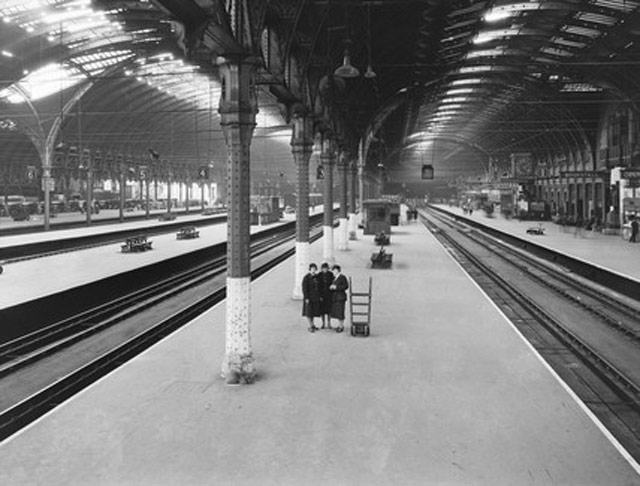
Paddington Station, London, UK, 9 June 1942 worldwartwo.filminspector.com
Platforms 2 and 3 of Paddington Station, London, UK, 9 June 1942 (Science & Society 10442395).

American Homefront: Lord Louis Mountbatten, Chief of the British Commandos, arrived in Washington for tactical conversations with US officers. Also returning from London are Generals Dwight D. Eisenhower, Henry "Hap" Arnold, and Mark Clark.

Ronald Reagan, who enlisted in the USAAF on 15 May 1942 as a private, receives a transfer to become the public relations officer for the First Motion Picture Unit in Burbank, California, under director John Ford. In this role, Reagan will be instrumental in "discovering" a young aviation worker in Burbank who will turn into film star Marilyn Monroe. He ends the war with the rank of Captain.

Future History: Heydrich's death leads to a series of prolonged court cases in the 1950s by his widow, Lina. She successfully argues to the West German government that she is entitled to a full pension as she widow of a German general. She writes a 1976 memoir, Leben mit einem Kriegsverbrecher (Living With a War Criminal), remarries, and passes away in 1985. Three of their four children survive the war.

Raymond "Ossie" Clark is born in Warrington, Lancashire, England. He becomes a top fashion designer during the "Carnaby Street" height of British fashion in the Swinging Sixties. He passes away on 6 August 1996 after being stabbed by a former lover.
Adolf Hitler speaks at the Reinhard Heydrich funeral, 9 June 1942 worldwartwo.filminspector.com
Adolf Hitler gives a memorial address at the funeral of Reinhard Heydrich in the New Reich Chancellery, 9 June 1942 (Federal Archive Image 146-1969-052-69).

2021

Thursday, April 22, 2021

May 12, 1942: Soviets Attack At Kharkov

Tuesday 12 May 1942

Winston Churchill 12 May 1942 worldwartwo.filminspector.com
A wartime press photograph of Prime Minister Winston S. Churchill on 12 May 1942. He is addressing the Parliamentary Home Guard in London while carrying his gas mask.
Battle of the Pacific: Despite the failure of Operation Mo during the Battle of the Coral Sea, the Japanese continue with Operation RY on 12 May 1942. This was intended as a follow-up to the Port Moresby invasion, but since that invasion was stopped by the US fleet, Operation Ry takes center stage. This is an invasion of Nauru and Ocean Island for their phosphate deposits.

Despite the fact that the Japanese invasion fleet is at sea from Rabaul, Operation RY already is in trouble. Just as the invasion of Port Moresby had to be postponed indefinitely (to 3 July), Operation RY also is postponed today. This is due to the sinking of the Japanese flagship, minelayer Okinoshima, by S-42. While the Japanese don't know this, US Admiral "Bull" Halsey is fast approaching with his Task Force 16 and is almost ready to engage the invasion force. The Japanese fix a new date of 17 May for the Operation RY invasion, but Halsey aboard USS Enterprise and accompanying aircraft carrier Hornet (the units that launched the Doolittle Raid on 18 April) will have something to say about that if it proceeds.
USS Charger 12 May 1942 worldwartwo.filminspector.com
The U.S. Navy escort carrier USS Charger (AVG-30) at anchor on 12 May 1942. She is painted in Camouflage Measure 12 (Modified) (Naval History and Heritage Command NH 55073).
Battle of the Indian Ocean: The monsoon season begins today in Burma, slowing operations just as the spring thaw ("rasputitsa") has done recently in the Soviet Union. The Japanese expand their control in eastern Burma by crossing the Salween River. Their next objective in this region is Kengtung. The 2nd Burma Infantry Brigade completes a long march north through the Myitha Valley and joins with the Chin Hills Battalion, Burma Frontier Force about 15 miles south of Kalemyo. Here, the 2nd Brigade can take trucks to the border town of Tamu where the British are assembling a frontier force to defend India.
Midway pilots May 1942 worldwartwo.filminspector.com
The pilots of the U.S. Marine Corps scout bomber squadron VMSB-241 on Midway between 17 April (when Henderson took command) and 28 May 1942 (when Frazer and Smith were detached). Those marked with an “x” were killed during the upcoming Battle of Midway, 4-6 June 1942 (U.S. Navy photo 80-G-40283/Everett Collection Historical (USN reference number may be wrong)).
Eastern Front: Marshal Semyon Timoshenko launches a major offensive to recover the Ukrainian city of Kharkov, a major industrial center and the fourth city of the Soviet Union. His military commissar is native Nikita Khrushchev, who has great powers as Timoshenko's political "minder." Timoshenko has built up a 3:2 advantage in infantry and 2:1 in tanks at the attack points.

The Soviet attack begins with an hour-long artillery barrage at 06:30, then a twenty-minute air assault. This effective preparation sharply limits the Wehrmacht's response, and the subsequent ground assault makes good progress. There are two main lines of attack, from the Volchansk (north of Kharkov) and Barvenkovo (south) areas, which are intended to converge and form a pincer trapping the German forward units. The infantry units make such good progress during the morning that Timoshenko prepares his second echelon, usually kept in reserve for an eventual breakthrough, for immediate use.

While caught largely by surprise (some Germans apparently did have some knowledge that an attack was coming), the Sixth Army under General Paulus recovers fairly quickly. The Luftwaffe has sufficient fighters in the area to establish aerial supremacy, but the bombers remain to the south in Crimea with General Erich von Manstein's 11th Army. Thus, the effectiveness of German control of the air is less than it could be. The Wehrmacht infantry also is able to launch some local counterattacks, including three near the Soviet village of Nepokrytaia.

The attack is proceeding north and south of Kharkov, with the main effort to the south. The goal is to engulf the city. Soviet tanks range within eleven miles of the city. To protect the city, Army Group South commander Field Marshal Fedor von Bock releases the 23rd Panzer Division and the 71st and 113th Infantry Divisions. At the end of the day, the Red Army has advanced 10 km (6.2 miles). However, it fails to score a clean breakthrough.
Panzer IV in Crimea May 1942 worldwartwo.filminspector.com
Russia, Crimea, Kerch peninsula - Panzer IV (turret number 924) and mounted infantry in combat, May 1942 (Federal Archive B 145 Fig. F016223-0024).
The May 1942 Soviet Kharkov offensive is doomed to failure even before it begins for a very specific reason. The Germans at Adolf Hitler's insistence have been flooding the Army Group South rear areas with troops preparing for the grand summer offensive, Case Blue, that he intends to be the decisive campaign of the war. Paulus has been planning a preliminary offensive in the exact area of the Soviet attack, Operation Fridericus, and thus has units that are at full strength. In fact, the three divisions that Bock releases today to save Kharkov were intended to spearhead Fridericus and thus are fully staffed and ready for action. The real question is what effect this Soviet attack will have on Hitler's grand strategy for the summer, but the Red Army offensive is driving into a dead end.

At Fuhrer Headquarters, General Franz Halder writes in his war diary, 

Heavy attacks at Volchansk and in VIII Corps sector against Sixth Army, objective Kharkov. The enemy used 100 tanks in each attack and has scored considerable initial successes. Air Force units must be diverted from the Crimea to this battle area. 23rd Armored Division is released for commitment at the front.

While Halder sees the necessity of transferring Luftwaffe units to the Kharkov battle, Hitler insists that they remain in Crimea until that battle is completely won.

In Crimea, Manstein's Operation Trappenjagd is proceeding toward a quick and successful conclusion. The Germans have trapped the Soviet 51st Army in a pocket on the northern half of the line (at the Parpach narrows) while other units (22nd Panzer Division and the 132nd and 170th Infantry Divisions) are making good progress toward the ultimate objective, Kerch. One German unit, the Grodeck Brigade, already has penetrated the second Soviet defensive line (the "Sultanovka Line") and that line shows little chance of holding once the other Wehrmacht divisions attack. Halder writes, "Good progress on the Kerch peninsula: 29,000 prisoners, 220 guns, 170 tanks, etc."

European Air Operations: There are no operations due to inclement weather.
USS Massachusetts 12 May 1942 worldwartwo.filminspector.com
USS Massachusetts. "Entering Boston Harbor, Massachusetts, after leaving the Fore River Shipyard at Quincy, 12 May 1942. Photographed from an altitude of approximately 400 feet. Note harbor defense net system at top, with a Net Tender (AN) in attendance." (Naval History and Heritage Command NH 97254).
Battle of the Atlantic: Wolfpack Hecht attacks Convoy ON-92 in the mid-Atlantic southeast of Cape Farewell with great success, sinking five ships and possibly damaging a sixth in a night of savagery. U-124 (Kptlt. Johann Mohr), on its ninth patrol out of Lorient, has a big night, sinking four ships of the convoy. The four victims of U-124 (16,100 tons in total) are:
  • 7065-ton British CAM ship Empire Dell (2 dead 46 survivors)
  • 4959-ton British freighter Llanover (all 46 survive)
  • 5389-ton British Cristales (all 82 survive)
  • 4371-ton Greek freighter Mount Parnes (all 33 survive)
U-94 (Oblt. Otto Ites), on its ninth patrol out of St. Nazaire, torpedoes accompanies U-124 and sinks 5630-ton Panamanian freighter Cocle, which is traveling with convoy ON 92 midway between Ireland and Nova Scotia. There are five deaths and 37 survivors, who are rescued by British freighter Bury. Cocle served as the flag ship for Admiral Richard E. Byrd during his Second Arctic Expedition. There are five dead and 37 survivors.

The "Battle of the St. Lawrence Seaway" opens today with the sinking of 5364-ton British freighter Nicoya by U-553. It sinks south of Anticosti, Quebec, Canada. There are six deaths and 82 survivors.

U-553 also torpedoes and sinks 4712-ton Dutch freighter Leto 8 nautical miles north of Cap-de-la-Madeleine, Quebec, Canada. There are 12 deaths and 41 survivors.

U-507 torpedoes and sinks 10,731-ton US tanker Virginia about one and a half miles off Southwest Pass, Louisiana, in the Gulf of Mexico. the three torpedoes set off a massive fireball that prevents the launch of lifeboats. There are 27 deaths and 14 survivors, who are rescued by motor torpedo boat USS PT-157.

German patrol boats UJ 1101, UJ 1108, and UJ 1110 sink Soviet Northern Fleet submarine K-23 off Nordkinn Cape in the Barents Sea. All 71 men aboard the submarine perish. 

Luftwaffe planes bomb and sink 424-ton Soviet patrol boat Brilliant in or near the Iokanga River near the Barents Sea. It is raised on 25 September 1942 and returned to service in June 1944.
Rhodesian soldiers training 12 May 1942 worldwartwo.filminspector.com
"Rhodesian troops of the 60th King's Royal Rifles training with a 2-inch mortar, 12 May 1942." North Africa. © IWM E 11699.
Battle of the Mediterranean: The Luftwaffe sends fourteen Junkers Ju 52 transport planes of III./KGzbV 1 from Maleme/Crete heading to Derna Cyrenaica. Each carries a standard complement of 20 soldiers. About 80 km off the North Africa coast, a formation of 14 Beaufighter and Kittyhawk fighters intercepts the German planes. A one-sided battle ensues in which nine of the virtually defenseless Ju 52 transport planes are shot down and another 2 are forced to land on the shoreline.

The Luftwaffe's raids on three Royal Navy destroyers north of Mersa Matruh, Egypt, claim their final victim during the early morning hours of 12 May. Badly damaged destroyer HMS Jackal is taken under tow by fellow destroyer Jervis, but the damage proves to be too great. After the Jackal's crew abandons the ship, Jervis scuttles it with a torpedo. There are nine dead. This completes the Luftwaffe's sinking of three of four destroyers that had been stalking an Italian convoy to North Africa.

The air battle over Malta heats up even further today as the Luftwaffe shoots down nine Supermarine Spitfires and damages another two on the ground. Despite the losses, the RAF planes still badly disrupt the Axis attempts to bomb the island. The British still have dozens of operational Spitfires after the recent deliveries.
US Marines in Ireland 12 May 1942 worldwartwo.filminspector.com
Men of US 1st Provisional Marine Battalion arriving at Belfast, Northern Ireland, United Kingdom, 12 May 1942 (The United States Marine Corps Frederick and Henry Strybing Collection).
Battle of the Black Sea: German aircraft sink several Soviet transport ships at or near Kerch that are ferrying wounded soldiers back to the mainland. They are:
  • Soviet ship Berezan
  • 712-ton Krasny Flot
  • 348-ton Krasny Moryak
  • Soviet patrol boat PK-083
  • Soviet patrol boat SKA-0133
  • Soviet patrol boat SKA-0183
  • Soviet patrol boat SKA-0411
  • Soviet patrol boat SKA-0611
  • Soviet patrol boat SKA-0811. 
German Military: Lt. Max-Hellmuth Ostermann of 7./JG 54 on the Eastern Front becomes the 6th fighter pilot in aviation history to reach 100 victories. While flying his Bf 109F-4, Ostermann is badly wounded in the right arm and upper thigh but makes it back to base and goes to the hospital for an extended stay. For this, Ostermann will receive the Knight's Cross of the Iron Cross with Oak Leaves and Swords at the hands of Adolf Hitler in June 1942.

US Military: Aircraft of the 8th Army Air Force begin arriving in Great Britain. Planes with sufficient range to fly use the South Atlantic air ferry route linking the US with West Africa via Natal, Brazil.

Holocaust: At Auschwitz Birkenau, 1500 Polish Jews are killed in gas chambers. This is considered the beginning of the final phase of mass murder in the Third Reich.
Japanese-American soldier 12 May 1942 worldwartwo.filminspector.com
Japanese-American soldier, 12 May 1942 (National Archives 537850).
American Homefront: 20th Century Fox and Darryl F. Zanuck release "This Above All," directed by Anatole Litvak and starring Tyrone Power and Joan Fontaine. It is a wartime romance that serves various propaganda purposes by showing a wealthy woman who joins the  Women's Auxiliary Air Force (WAAF), a hero who wins a medal at Dunkirk, and so forth. The film goes on to win an Oscar for art direction and is nominated in several other technical categories. 

Future History: Ian Robins Dury is born in Harrow, Middlesex, England, the son of a local bus driver. He becomes a major figure during the punk/new wave eras of rock music, including being the frontman for Ian Dury and the Blockheads. Dury also branches out into acting, including a role in Peter Greenaway's The Cook, the Thief, His Wife & Her Lover (1989). Ian Dury passes away in 2000 at the age of 57.
Auschwitz victim Artur Paraszewski 12 May 1942 worldwartwo.filminspector.com
21-year-old Artur Paraszewski, gassed at Auschwitz on 12 May 1942 (Auschwitz Memorial/Muzeum Auschwitz).

May 1942


2021