Showing posts with label U-432. Show all posts

Thursday, November 18, 2021

June 9, 1942: Nimitz Changes Strategy

Tuesday 9 June 1942

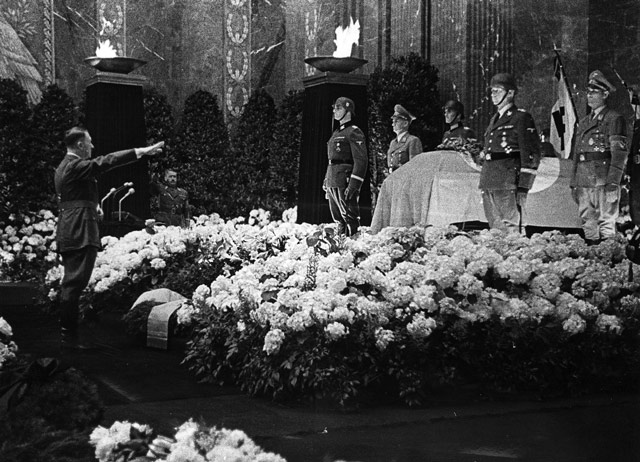
Hitler at Reinhard Heydrich's funeral, 9 June 1942 worldwartwo.filminspector.com
Adolf Hitler at Reinhard Heydrich's funeral (Narodowe Archiwum Cyfrowe, sygn. 2-13241).

Battle of the Pacific: Learning of the Japanese capture of Kiska on 9 June 1942, Admiral Chester Nimitz cancels his orders to Admiral Jack Fletcher to take his three aircraft carriers (USS Enterprise, Hornet, and Saratoga) north to the Aleutians. Nimitz now does not want them exposed to Japanese land bombers operating from Kiska and Attu. This unknowingly frustrates a Japanese plan to ambush them with the reinforced fleet of Admiral Boshirō Hosogaya.

Nimitz now is thinking offensively (as is General Douglas MacArthur in Melbourne, who submitted his own proposal for an advance led by the Army on 8 June 1942). He wants to keep his carrier force intact for a thrust due west across the central Pacific. This Nimitz and his team in Hawaii see as the main Allied strategy from now on. This is contrary to MacArthur's proposal to advance north from Australia, setting up a classic "turf war" between the US Army and Navy.

The Japanese high command, despite the minor successes in the Aleutians, is reeling from the early June results at Midway. The solution is denial and a coverup. The Imperial Japanese Navy prepares a vague and unrealistic summary of the battle to the military liaison conference. Admiral Chūichi Nagumo takes his time preparing an accurate summary of Japanese losses. He remains completely unaware that the Americans knew his complete battle plan in May and thinks his force was only discovered on the 5th. The Japanese public is kept completely in the dark, with media focusing entirely on the Aleutians.
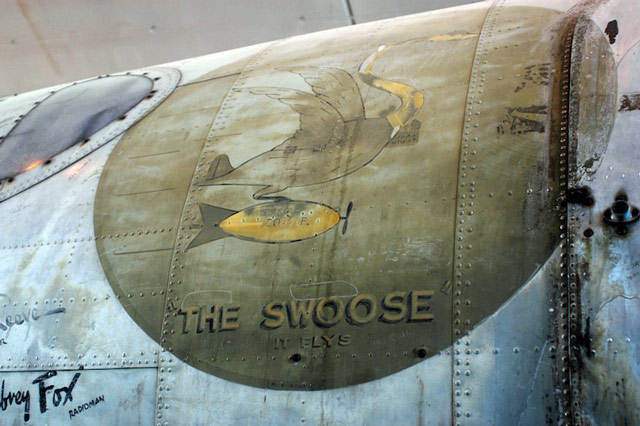
The Swoose ferried LBJ to Port Moresby on 9 June 1942 worldwartwo.filminspector.com
Artwork depicting "The Swoose" on the B-17D aircraft that carried Lyndon Baines Johnson to Port Moresby on 8 June 1942. The aircraft is currently being restored in Dayton, Ohio (U.S. Air Force photo courtesy of the National Museum of the United States Air Force).

Navy Reserve Lieutenant Lyndon B. Johnson, the future President, makes an aerial inspection tour from his location in Townsville, Australia. Johnson already has had an interesting time Down Under, having helped to quell a mutiny by African-African troops on 22 May 1942. The B-26 Marauder flying the mission has engine trouble after departing from Port Moresby and has to return to base, but the USAAF 19th Bombardment Squadron of the 22nd Bomber Group completes its mission (flying from Townsville to Port Moresby for refueling) to bomb Lae, New Guinea. The Port Moresby stage of the mission has to be delayed for an hour to accommodate LBJ, who arrives from Townsville in General Brett's VIP B-17D "The Swoose." 

The mission is hazardous even though Johnson misses out on the actual bombing run. LBJ narrowly escapes death because he switches bombers at the last minute due to a pilot change, and the plane he leaves crashes into the sea off Salamaua, killing everyone on board. LBJ then also escapes potential harm when the B-17 on the flight back to Townsville gets lost and almost runs out of fuel. It has to make an emergency landing at remote Carisbrooke Station near Winton. This B-17D, incidentally, survives and is the property of the National Air and Space Museum in Washington, D.C. The strange sequence of events results in General MacArthur awarding Johnson a Silver Star, the Army's third-highest decoration. Johnson soon after heads back to D.C. in accordance with FDR's requirement that all members of Congress return to their legislative duties. He remains in the US Naval Reserve until January 1964.

The Japanese complete their occupation of the Philippines and declare it secure.

US 24-ton freighter Husky founders two miles off Cape Constantine in Nushagak Bay, Aleutian Islands. Everyone survives.

US submarine USS Trout (SS-202) picks up two survivors of the sunken Japanese heavy cruiser Mikuma.

There is fierce fighting near the town of Chuhsien, China. Both sides take heavy casualties.
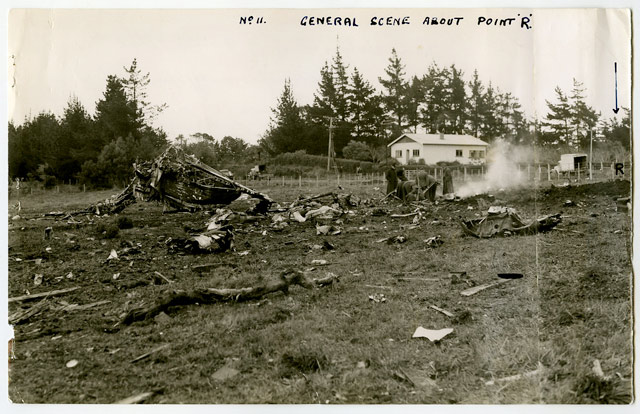
B-17 crash site in New Zealand, 9 June 1942 worldwartwo.filminspector.com
Crash site of a B-17 near Whenuapai Aerodrome, Auckland, New Zealand, 9 June 1942. All 11 men on board are killed (Archives New Zealand Reference: ADQA 17211 AIR1 572 25/2/588).

Battle of the Indian Ocean: The Japanese Divine Dragon Operation No. 2 submarine force, in which the Japanese high command placed high hopes, remains operational in the Mozambique Channel. However,  it is now clear to the local commanders that the operation now has turned into a standard submarine patrol and that initial plans to target the British Far Eastern Fleet are obsolete. Accordingly, Lieutenant Commander Otani Kiyonori of I-18 has his men destroy and jettison mini-submarine M-18b, effectively ending the operation.

Around this time, British divers discover the remains of M-20b, which carried out the most successful attack at Diego Suarez. It is sitting upright on a reef in heavy surf (remnants remain there to this day). They salvage the propellers, now on display at the gravesite of its occupants, Lieutenant (j.g.) Akieda Saburo and POIC Takemoto Masami. They were killed on 2 June 1942 by a British patrol on the mainland while attempting to rendezvous with I-20.

The Japanese have not given up on the Indian Ocean by any means. On 5 June 1942, auxiliary cruisers Aikoku Maru and Hokoko Maru caught 6757-ton British passenger ship Elysia 350 miles northeast of Durban. They torpedoed it, and today it sinks, causing 22 deaths. 

Battleship HMS Ramillies, previously damaged by a Japanese mini-submarine in late May 1942, arrives in Durban for repairs accompanied by light cruiser Emerald and three destroyers. The damage ultimately will require a return to the UK at Portsmouth on 8 September that will last until the summer of 1943.
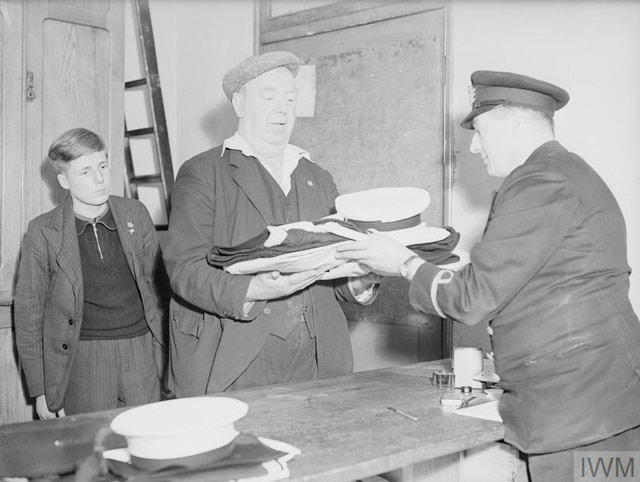
A new recruit for the Royal Navy, age 62, 9 June 1942 worldwartwo.filminspector.com
A new recruit, age 62, joins the Royal Navy, 9 June 1942. ""Owd Bob" drawing his petty officer's rig on board the Armed Merchant Cruiser Depot ship HMS MERSEY. Behind him is Tommy Harding, age 18, another new entry who volunteered for this special naval service." © IWM A 8807.

Eastern Front: German General Erich von Manstein's assault on Sevastopol has shown signs of turning into a battle of attrition, exactly what he didn't want. The priority is to take Sevastopol before the Case Blue offensive on the main front begins, and that now is looking doubtful. Luftwaffe General Wolfram von Richtofen begins changing attack priorities from assisting the front-line troops to attacking Soviet supply lines, a bad sign that the plan is faltering. The Luftwaffe is fully committed, flying 1044 sorties and dropping 954 tons of bombs, putting a strain on men, equipment, and logistics.

However, the German offensive is not dead, not by any means. General Franz Halder, remaining in East Prussia while the Fuhrer attends the Reinhard Heydrich funeral (see below), comments:
At Sevastopol, good progress despite strong enemy counter-attacks. Otherwise, all quiet. Army Group Center reports breakout of Cavalry Corps Belov to the south.
Halder does have his own grips about the Storfang operation. Writing about a meeting during the day with General Buhle, he comments acidly, "Report on Sevastopol. My suspicion that the Artillery Command is not of the best is confirmed."

The Red Navy is doing what it can to help its comrades ashore. Early in the morning, Soviet destroyers spot Axis mini-submarines operating from Yalta on their radar screens and unsuccessfully attack them. This new development induces Vice-Admiral Oktyabrskii to order his naval captains to concentrate less on offshore gunfire support of the army and more on keeping the sea lanes to Sevastopol clear. He also tells them to switch to area fire rather than targeted fire and cuts back on the number of surface vessel supply missions. This forces an increase in submarine supply missions. While they don't know it, the Axis mini-submariners thus achieve a tactical victory without sinking a single ship.

LIV Corps continues to make slow progress in the north, assisted greatly by an intense artillery bombardment laid down by the biggest guns ever used in combat. The 132nd Infantry clears a key obstacle, the Haccius Ridge, and the 22nd Infantry Division destroys the elite Soviet 79th Naval Infantry Brigade.

General Paulus' Sixth Army counterattacks against Red Army forces in the Kharkov sector. Paulus has plenty of troops because Sixth Army is fated to lead the Case Blue offensive toward Stalingrad. During this attack, Uffz. Wilhelm Crinius of 3./JG 53 shoots down two Soviet Il-2 Shturmovik ground-attack planes for his first two victories.

European Air Operations: Weather is poor on the Channel Front, with 10/10ths cloud cover down to 1500 feet and getting worse as the day proceeds.

A Polish squadron raids Essen. British Wellington IV R1725 crashes into the North Sea, 20 km west of Texel, Netherlands, while en route to bomb Essen. All six crewmen perish. Another Wellington targeting Essen, IV Z1412, is shot down by the nightfighter pilot Oblt. L.Fellerer of II/NJG 2. it crashlands on the beach 2 km west of St. Maartensvlotbrug. The five crewmen survive. A Wellington manages to make it back for a crashlanding after being attacked three times by Me-110 night fighters from below and astern, and the odds of survival are so iffy that the copilot bails out 20 miles west of Essen after the bombing run.
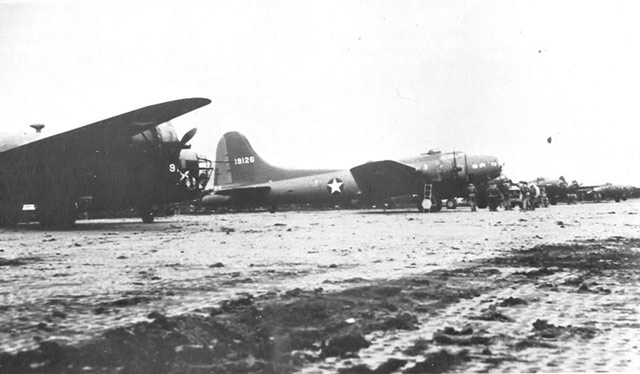
USAAF bombers in Alaska, June 1942 worldwartwo.filminspector.com
"36th Bombardment Squadron LB-30 Liberator and a Boeing B-17E Fortress (41-9126) at Fort Glenn Army Air Base, Alaska, June 1942. 9126 was lost Aug 28, 1942." USAAF photo via Chloe, John Hale, (1984), Top Cover for America. the Air Force in Alaska. 1920–1983, Pictorial Histories Publishing Company, ISBN 0-933126-47-6.

Battle of the Atlantic: U-124 (Kptlt. Johann Mohr), on its ninth patrol out of Lorient, torpedoes and sinks 940-ton French corvette FFL Mimosa (K11, Captain Roger R.L. Birot) 600 miles southeast of Cape Farewell in the British Isles. The Mimosa is an escort for Convoy ONS-100 and sinks within three minutes because the depth charges falling off the ship explode. The other escorts don't even notice the ship is missing until dawn breaks. There are 65-67 deaths and only four surviving French sailors, who are picked up by HMCS Assiniboine.

U-502 (Kptlt. Jürgen von Rosenstiel), on its fourth patrol out of Lorient, torpedoes 6589-ton US tanker Franklin K. Lane 35-40 miles (65 km) northeast of La Guiara and Cape Blanco, Venezuela. It is scuttled by the British destroyer HMS Churchill. The ship, a member of Convoy TO-5, is carrying 73,000 barrels of crude oil to Aruba for processing. There are four deaths and 37 survivors.

U-502 also gets another victim from the same convoy today, 5085-ton Belgian freighter Bruxelles. The ship manages to evade two torpedoes, but a third one blows a seven-meter (yard) hole in the side and the ship sinks within four minutes. The crew acts quickly and manages to launch lifeboats. Destroyer Churchill picks them up quickly. There are 53 survivors and one death.

U-432 (Kptlt. Heinz-Otto Schultze), on its fifth patrol out of La Pallice, torpedoes and damages 7073-ton Norwegian freighter Kronprinsen of Convoy BX-23A south of Cape Sable. The ship is taken in tow and beached at West Pubnico, Nova Scotia. Ultimately, the ship is repaired and returned to service.

U-432 also damages 8593-ton British freighter Malayan Prince with a torpedo that misses the Kronprinsen. The ship manages to remain with the convoy and is later repaired and returned to service in July 1942.
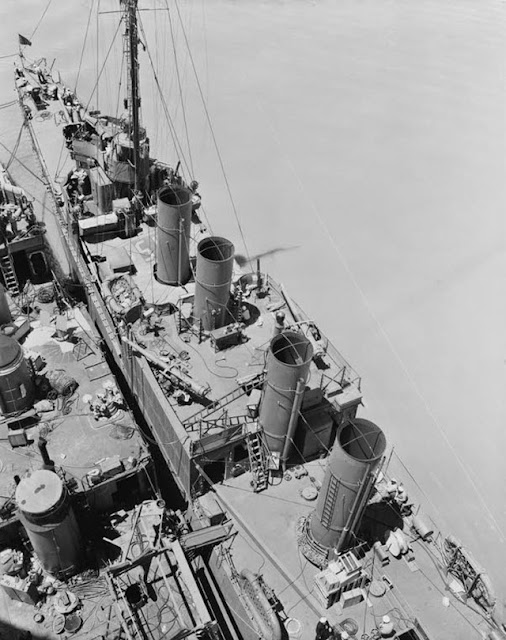
USS Southard at Mare Island, 9 June 1942 worldwartwo.filminspector.com
Four-stack destroyer USS Southard (DMS-10), Mare Island, 9 June 1942. She has just been converted into a minesweeper (Rickard, J (15 September 2018), USS Southard (DMS-10), Mare Island, 9 June 1942).

Battle of the Mediterranean: Early in the morning, the Luftwaffe sends 20 Junkers Ju 88 and 40 Ju 87 Stukas escorted by 50 Bf 109 and Me 110 fighters against the Free French in Bir Hakeim. However, thick smoke and dust force them to turn back. A second attack around noontime by 124 Stukas and 76 Ju 88s, escorted by 168 Bf 109s, has more luck. During this attack, Oblt. Hans-Joachim Marseilles of 3./JG 27 downs four RAF planes.

German artillery also opens up on the fortifications in the morning as General Erwin Rommel readies a final assault. After the planes and big guns have softened up the defenses, units of the 15th and 21st Panzer Divisions, the 90th Light Division, and Italian infantry launch a two-pronged attack.

Rommel's objective is the "high ground" near the fortress, a small rise called Point 186. The Italian Trieste Division makes good progress, overrunning a reinforced French force that is hampered by supply issues. The German advance gains steam in the afternoon when the 15th Panzer breaches the French line in the center, forcing a desperate counterattack with Bren Carriers that succeeds. Oberstleutnant Ernst-Günther Baade leads the Rifle Regiment 115 to within 200 meters (yards) of the fortress by dusk.

Overhead, the Luftwaffe establishes dominance due to previous losses in the RAF Desert Air Force despite frantic pleas for cover from French General Kœnig. The French are low on supplies and everyone can see the writing on the wall. British Major-General Frank Messervy, commander of the 7th Armoured Division, reports that a breakout should be attempted, and at 23:00 Kœnig signals for permission to evacuate the fortress. Lieutenant-General Neil Ritchie, commander of the 8th Army, replies that he'll prepare a thrust from the south but the fortress will have to hold out for another day or two. 

With water and ammunition running out and casualties mounting, Kœnig orders a breakout anyway. The French formation quickly loses coherence in the darkness and the Axis forces react quickly. The retreat turns into desperate hand-to-hand combat but does make progress into the early morning hours of the 10th.

Italian Caproni bombers catch 1584-ton Swedish freighter Stureborg in the eastern Mediterranean and sink it with torpedoes and bombs. There are 20 deaths and only one survivor, whose raft reaches land near Gaza. Ten men in total started out on the raft but nine perished because it drifted for 19 days and they had no food or water.

U-83 (Kptlt. Hans-Werner Kraus), on its eighth patrol out of Salamis, shells and sinks 175-ton Palestinian sailing ship Typhoon four miles southeast of Sidon, Lebanon. Everyone survives.

RAF Catalinas of No. 240 Squadron sinks Italian submarine Zaffiro in the western Mediterranean southeast of Palma de Mallorca, Balearic Islands. There are no survivors.
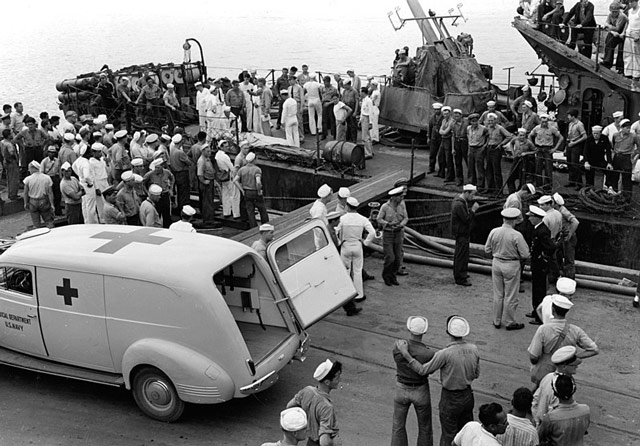
USS Hammann survivors arrive at Pearl Harbor, 9 June 1942 worldwartwo.filminspector.com
Survivors of the destroyer USS Hammann (DD-412), torpedoed and sunk on 6 June 1942 at the Battle of Midway, are brought ashore at Pearl Harbor, 9 June 1942 (Naval History and Heritage Command 80-G-312064).

Joint Allied Planning: The United States and British governments form the Combined Production and Resources Board. The purpose is to plan and coordinate production in each country to best serve war needs. It operates independently and competes with the Combined Munitions Assignment Board, which is under the jurisdiction of the Combined Chiefs of Staff. President Roosevelt's crony Harry Hopkins is the American leader behind the scenes, though Donald Nelson is the chair. 

While sometimes criticized as ineffective, the Board changes the military procurement process based on statistical analysis and perceived priorities. It provides some order to the former chaotic ordering system directly to industry used by the militaries of the respective countries. British representatives tend to feel the Board favors the US and prefer to exert their influence through the Munitions Board because they feel the Combined Chiefs give them more of an equal say. Canada feels left out and eventually is admitted to the Board as an equal partner. 

The real weakness of the Board is that its leaders don't really have much of an idea themselves of what the war effort needs or where the war is going until it is really too far along to matter. As the military strategy and objectives change - sometimes at the last minute - the Board must follow along and thus always is a step behind actual needs. Its findings also have to be implemented by the respective governments which may not necessarily agree completely with its decisions and thus may not treat them with a sense of urgency.

US Military: The Navy establishes a naval operating base at Kodiak, Alaska.
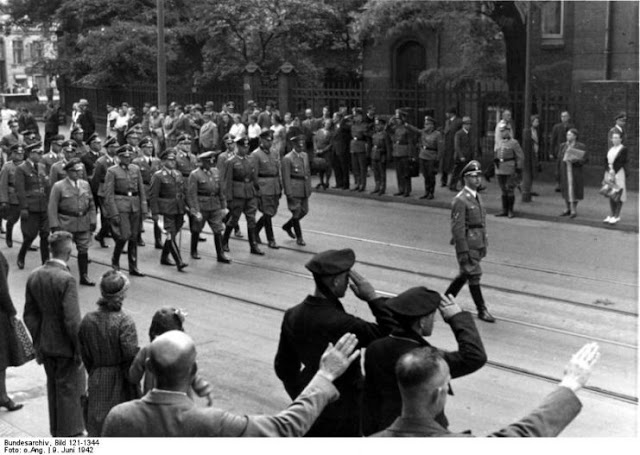
Heinrich Himmler leads the parade at the Reinhard Heydrich funeral, Berlin, 9 June 1942 worldwartwo.filminspector.com
Reichsfuhrer-SS Heinrich Himmler leads the procession at Reinhard Heydrich's Berlin funeral on 9 June 1942. Visible in the front row from left are Robert Ley, Karl-Hermann Frank, Erhard Milch, Sepp Dietrich, Sergeant Heinz Heydrich (Reinhard's younger brother), police chief Kurt Daluege (Heydrich's successor in Bohemia and Moravia), and Wilhelm Frick (Federal Archive Picture 121-1344).

German Homefront: The government holds the second funeral for Reinhard Heydrich, who was shot by British agents on 27 May 1942. This second funeral is in Berlin (the first, on 7 June, was in Prague). All of the top Reich officials attend, including Adolf Hitler and Hermann Goering. Hitler awards Heydrich the German Order, the highest honor in the Third Reich, posthumously. After the ceremony, Heinrich Himmler tells his subordinates to ramp up the Holocaust.

Heydrich is interred in a plot at the Invalidenfriedhof in Berlin. The location, once well known, since the war has become secret to prevent fascist gatherings.

Privately, Hitler blames Heydrich's own lax security precautions on his demise. He tells his cronies that a man as important to the war effort as Heydrich never should have been driving in an unguarded open-air car through streets filled with people. Hitler, of course, is (rightly) paranoid about his own personal security and routinely changes his routes and timing to frustrate would-be assassins. This already has saved his life at least once, when he evaded a bomb planted at the Munich Brown House (Braunes Haus) on 8 November 1939.

Due to the Gestapo's mistaken belief that the Heydrich assassins operated from the town of Lidice, the local German authorities begin to obliterate it today. Today and tomorrow, they kill 199 men and deport 195 women to the Ravensbrück concentration camp. There are 95 children in the town, 81 of whom later perish at the Chelmno camp. Eight are adopted by German families. The German security forces also prepare to destroy the town of Ležáky.

The two agents who assassinated Heydrich, Jozef Gabčík and Jan Kubiš, remain at large despite a massive German manhunt. The local authorities make it clear to the Czech people that if they are not turned over, more blood will be spilled. They also promise a bounty of a million Reichsmarks. Since everyone knows the German threats are not just empty words and Lidice is the proof, this reaches some receptive ears.
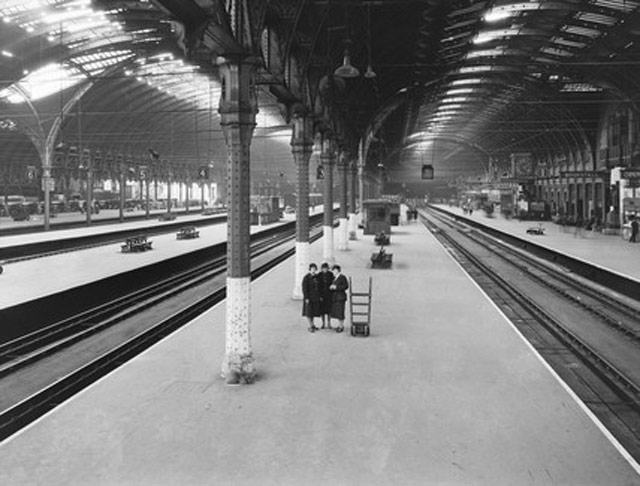
Paddington Station, London, UK, 9 June 1942 worldwartwo.filminspector.com
Platforms 2 and 3 of Paddington Station, London, UK, 9 June 1942 (Science & Society 10442395).

American Homefront: Lord Louis Mountbatten, Chief of the British Commandos, arrived in Washington for tactical conversations with US officers. Also returning from London are Generals Dwight D. Eisenhower, Henry "Hap" Arnold, and Mark Clark.

Ronald Reagan, who enlisted in the USAAF on 15 May 1942 as a private, receives a transfer to become the public relations officer for the First Motion Picture Unit in Burbank, California, under director John Ford. In this role, Reagan will be instrumental in "discovering" a young aviation worker in Burbank who will turn into film star Marilyn Monroe. He ends the war with the rank of Captain.

Future History: Heydrich's death leads to a series of prolonged court cases in the 1950s by his widow, Lina. She successfully argues to the West German government that she is entitled to a full pension as she widow of a German general. She writes a 1976 memoir, Leben mit einem Kriegsverbrecher (Living With a War Criminal), remarries, and passes away in 1985. Three of their four children survive the war.

Raymond "Ossie" Clark is born in Warrington, Lancashire, England. He becomes a top fashion designer during the "Carnaby Street" height of British fashion in the Swinging Sixties. He passes away on 6 August 1996 after being stabbed by a former lover.

Adolf Hitler speaks at the Reinhard Heydrich funeral, 9 June 1942 worldwartwo.filminspector.com
Adolf Hitler gives a memorial address at the funeral of Reinhard Heydrich in the New Reich Chancellery, 9 June 1942 (Federal Archive Image 146-1969-052-69).

2021

Sunday, October 3, 2021

June 3, 1942: Start of Battle of Midway

Wednesday 3 June 1942

Dutch Harbor on fire, 3 June 1942 worldwartwo.filminspector.com
Fires burning at Dutch Harbor after the 3 June 1942 Japanese air raid (US Army).

Battle of the Pacific: At 09:04 on 3 June 1942, Ensign Charles R. Eaton, patrolling 470 miles from Midway Island, spots three Japanese ships. The Japanese quickly fire on him with anti-aircraft guns but he escapes and radios in his sighting. This is the first encounter of what will become the Battle of Midway.

At about the same time, another airman, Ensign Jack Reid, is patrolling 500 nautical miles (580 miles, 930 km) southwest of Midway in his PBY-SA when he also spots some ships in the distance. At 09:25, he radios in, "Sighted main body." He follows up with more details, ultimately reporting 11 ships at 11:00 before being ordered to return to base. Reid has not spotted the main Japanese force but rather transport ships commanded by Admiral Tanaka.

Lt. Col. Walter C. Sweeney leads a force of nine B-17 bombers stationed at Midway against the ships spotted by Reid at 12:30. Sweeney's force scores no hits and barely makes it back to Midway, landing at 21:45.

Another U.S. strike departs at 21:15, this time four PBY Catalinas bent on a night attack. Arriving over the target at 01:00 on 4 June, they score one hit on the Japanese force, a torpedo strike on the bows of tanker Akebono Maru that kills 13 sailors. Transport Kiosumi Maru also sustains some strafing damage that kills four crewmen. This attack features the only successful U.S. air-launched torpedo strike of the Battle of Midway.
Battle of Midway painting, 3 June 1942 worldwartwo.filminspector.com
"Battle of Midway, 3 June 1942" - "US Navy aircraft carrier USS Yorktown and its escorts defend themselves from incoming Japanese aircraft, one of which has splashed down into the ocean" (Rodolfo Claudus ca. 1950) (Naval History and Heritage Command).

The second prong of the Japanese strategy (Operation AL) is an invasion of some of the Aleutian Islands. The Americans know about this from their codebreaking but have concentrated the bulk of their naval forces at Midway. Planes from two light Japanese aircraft carriers (Ryujo and Junyo) under the command of Vice-Admiral Boshiro Hosogaya take off in a dense fog and rough seas to raid the Dutch Harbor Naval Operating Base and Fort Mears at Dutch Harbor on Amaknak Island, Alaska. Only about half of the planes make it to the target. Despite some heavy anti-aircraft fire, the Japanese Nakajima B5N, Navy "Kate," Bombers drop 16 bombs on Fort Mears, then get clean away before P-40s stationed at Cold Bay arrive. There are 25 dead and many other casualties, while the Japanese lose only one plane.

The attack on Dutch Harbor is only a distraction from the main Japanese objective in the Aleutians, which is to occupy islands Kiska and Attu further down the chain. During this raid, the Japanese planes sink the 3497-ton U.S. passenger ship Northwestern (no casualties). Japanese cruisers launch four Nakajima E8N2 Navy Type 95 reconnaissance seaplanes, Allied Code Name "Dave," to fly over Umnak, losing one to U.S. ground fire. A PBY-5A Catalina of VP-42 locates the Japanese ships, while the Japanese shoot down another PBY and take three of its crew as prisoners aboard the cruiser Takao. A Japanese "Zeke" bomber crashlands in a bog on Akutan Island and U.S. forces later recover it and the dead pilot.

The five Japanese submarines waiting off the coast of Australia near Sydney to pick up the crews of the mini-submarines that attacked Sydney Harbour give up hope and disperse. The mini-sub crews are all dead, though two men nearly made it to the rendezvous point before being killed by troops. I-24, one of these five submarines, then torpedoes and sinks 4812-ton Australian ore carrier Iron Chieftain in the Tasman Sea 35 miles east of Manly (there is a monument to the 12 dead crewmen of Iron Chieftain outside Newcastle railway station). There are 27 survivors. The sinking of Iron Chieftain helps lead to the formation of convoys along the Australian coast between New South Wales, Victoria, and South Australia.

I-20 is the last of the five Japanese submarines to depart from the recovery area. During the afternoon, it surfaces and fires flares and sends radio signals, but nobody appears. Finally, at 18:00, it, too, departs.

U.S. Navy 115-ton patrol boat Vagabond collides with patrol craft PC-569 while patrolling west of the Golden Gate Bridge and sinks. There are no casualties.

U.S. 16-ton fishing trawler sinks in Sitka Sound in the Alexander Archipelago in Southeast Alaska near Saint Lazaria Island off of Cape Edgecumbe in Kruzof Island. The cause of the sinking is unidentified, but it may be due to enemy action.

B-17 bombers of the 5th USAAF Air Force bomb Rabaul. They hit a wharf, a warehouse area, and a military camp.

Marines waiting out the bombing of Dutch Harbor, 3 June 1942 worldwartwo.filminspector.com
"Japanese attack on Dutch Harbor, June 3, 1942. Group of Marines on the "alert" between attacks. Smoke from burning fuel tanks in the background had been set afire by a dive bomber the previous day. Alaska." (National Archives 80-G-12076).

Battle of the Indian Ocean: The 10th USAAF Air Force sends 6 B-25s of the 11th Bombardment Squadron, 7th Bomber Group, from Dinjan, India, to bomb Lashio, Burma. They then continue on to Kunming in perhaps the first example of "shuttle bombing." The mission turns into a disaster when three bombers crash into the Himalayas at 10,000 feet in heavy overcast conditions and a fourth runs out of fuel and crashes near Chan-i, China. Only two of the bombers actually reach Kunming, where they are fired upon by Chinese fighter planes that have not been informed of the operation and one radio operator is killed..

At Diego Suarez, the British complete emergency repairs to the 30x30-foot hole blown in battleship HMS Ramillies from a mini-sub attack and it departs for more permanent repairs at Durban.
Finnish anti-tank gun being used, 3 June 1942 worldwartwo.filminspector.com
Finnish Lahti L-39 anti-tank gun in use on 3 June 1942 (Military Museum of Finland (Kuva)).

Eastern Front: The German artillery fire and air assault on Sevastopol continue today as the Germans try to weaken the Soviet defenses for a full-scale assault. The target area today for the rolling bombardment is the defensive area facing the German 30th Army Corps south of the city.

General Franz Halder at Fuhrer Headquarters notes in his war diary: 
The enemy has reacted to our artillery attack on Sevastopol with counterbattery fire. Work on fortification in progress. Ship movements. No important changes on the other fronts.
General von Manstein, commander of 11th Army, plans to begin his attack on Sevastopol (Operation Sturgeon Catch (Störfang)) on 7 June. He is quickly redeploying troops from the eastern half of Crimea, where some Soviet holdouts in caves are causing trouble, to the west to participate in the Sevastopol assault. It is a very peculiar situation for the Germans on the Eastern Front where the hot spot is to the west and not the east.

Oblt. Siegfreid Freytag of 6./JG 77 claims his 50th victory. He soon will transfer to the Mediterranean Theater.
Dutch Harbor fires, 3 June 1942 worldwartwo.filminspector.com
"Siems Drake warehouse afire, following the attack by Japanese carrier aircraft. Note fire fighting parties at work, and S. S. NORTHWESTERN burning at left." Dutch Harbor, 3 June 1942. (Naval History and Heritage Command 80-G-12056).

European Air Operations: The weather over the Channel Front is clear and warm. There are no major attacks today. RAF No. 403 Squadron (RCAF) moves from Southend to Martlesham. At RAF Chelveston, a small Hotspur glider of the Airborne Forces Experimental Establishment (AFEE) 14th Operational Training Unit breaks up mid-air near Greetham Village, Ruland, and the crew bales out (one killed and one uninjured).
Ore freighter City of Alma, sunk on 3 June 1942 worldwartwo.filminspector.com
U.S. ore freighter City of Alma, sunk by U-172 on 3 June 1942.

Battle of the Atlantic: U-404 (Kptlt. Otto von Bülow), on its third patrol out of Brest, torpedoes and sinks 1345-ton Swedish freighter Anna 210 miles northwest of Bermuda. Von Bülow begins his attack with two torpedoes at 03:09 and 04:50 but misses with both. Finally, at 05:10, he surfaces and uses his deck gun. The attack is a little controversial because von Bülow's crew clearly sees Swedish (neutral) markings, but he decides to attack anyway because the ship is acting suspiciously (zig-zagging and without navigational lights). There are no dead among the 32-man crew, though two men are wounded in the attack. The survivors take to the boats and are picked up within 13 hours by Swiss freighter Saentis, which also picks up survivors of freighter West Notus, sunk by the same U-boat on 1 June.

U-172 (Kptlt. Carl Emmermann), on its second patrol out of Lorient, torpedoes and sinks the 5446-ton U.S. freighter City of Alma 400 miles northeast of San Juan, Puerto Rico. The ship is carrying manganese ore and sinks within three minutes. The radio operator remains on board to send a distress call but the ship sinks so quickly that he goes down with the ship without sending any messages. There are 29 dead and 10 survivors, who survive in a lifeboat and are picked up by U.S. patrol boat USS YP-67. Third Mate Hugh Parks Brown, Jr. the Merchant Marine Distinguished Service Medal for saving other crewmen.

U-156 (Kptlt. Werner Hartenstein), on its third patrol out of Lorient, stops 80-ton British schooner Lillian near Grenada and Barbados (40 miles south of Barbados) after the ship first ignores a command to stop (warning shot through the rigging). A few crew remain aboard the ship and attempt to sail away while others take to the boats. The U-boat chases the fleeing ship after questioning the men in the boats and finally sinks it with gunfire. Hartenstein apparently uses the incident for target practice, or maybe he is just angry (and tired, as he already has sunk or damaged 11 ships on this patrol), as he uses an astounding 52 rounds of 37mm and 270 rounds of 20 mm) to sink the wooden ship. There are three dead and 22 survivors.

U-502 (Kptlt. Jürgen von Rosenstiel), on its fourth patrol out of Lorient, torpedoes and sinks 6940-ton U.S. freighter M.F. Elliott 150 miles northwest of Trinidad (west of St. George's Island). The ship, carrying just water ballast, sinks within six minutes. There are 13 dead and 32 survivors, who are picked up by Brazilian tanker Santa Maria after five days adrift.
Die Wehrmacht magazine, 3 June 1942 worldwartwo.filminspector.com
Die Wehrmacht Magazine, 3 June 1942.

U-432 (Kptlt. Heinz-Otto Schultze), on its fifth patrol out of La Pallice, spots two fishing trawlers 170 miles east of Thatchers Island in the Bay of Fundy (northeast of Boston) and surfaces. After allowing the crewmen to leave their vessels, Schultze uses his deck gun on the trawlers. Sunk are 41-ton Aeolus and 102-ton Ben and Josephine. All of the fishermen (14 men total) survive, making landfall at Mount Desert Coast Guard Light Station after 36 hours.

U-126 (Kptlt. Ernst Bauer), on its fourth patrol out of Lorient, torpedoes and sinks 10,990-ton Norwegian tanker Høegh Giant 400 miles east of Guiana. Bauer attacks at 11:24 and hits with one of three torpedoes, but the ship continues sailing. He then surfaces, but the tanker crew use the deck gun to fire at the U-boat, forcing Bauer to submerge and chase it. A long ordeal results, with Bauer finally getting into firing range at over 14 hours later 01:40 on 4 June. Two torpedoes hit, and the crew abandons the ship. The tanker finally sinks at 04:24 after Bauer has to fire a coup de grâce. Bauer clearly is furious about the entire incident. He surfaces and, when he does not get the answers he wants from the men in the lifeboats, he has his men fire over the boats, wounding one survivor with a stray bullet. The survivors spend at least ten days at sea, with most landing at Devil Island after ten days and the rest being picked up after 15 days. While the survivors are being transported to New Orleans aboard freighter Robert E. Lee, that ship also is sunk (by U-166), but all the survivors of Høegh Giant survive that sinking, too.

U.S. 5686-ton freighter Steel Worker hits a mine and sinks 3000 yards from Mishayampi, Murmansk. The ship has traveled all the way from Philadelphia with foodstuffs only to be sunk less than two miles from its destination. There are no casualties.

German Navy whaler V-1510 Unitas VI, being used as a patrol boat, strikes a wreck and sinks at the entrance of Dieppe, France. No known casualties. This incident is sometimes claimed to have occurred on 2 June 1942.

RAF Vickers Wellington bombers of No. 172 Squadron damage Italian submarine Luigi Torelli near Aviles, Spain. The ship is towed to Aviles and beached. After temporary repairs, it is refloated and taken to Spain for permanent repairs.

Damaged freighter Orari being patched at Malta, 3 June 1942 worldwartwo.filminspector.com
Freighter Orari having a temporary patch installed at Malta on 3 June 1942. © IWM A 10774.

Battle of the Mediterranean: German General Erwin Rommel and the bulk of the Afrika Korps remain bottled up in The Cauldron, a defensive position west of Tobruk. However, while no longer on the offensive, they now have cleared supply lanes to the west and are receiving reinforcements. The siege of Free French forces at the fortress of Bir Hakeim continues with little change in the situation today as the Axis forces bombard the entrenched French with artillery and Luftwaffe attacks.

The air war is going surprisingly poorly for the RAF. The pilots of III./JG 53 claim three victories over the British in the vicinity of El Alamein. One of the issues is that the Luftwaffe has brought elite units to North Africa.

Air activity over the front is ferocious. Oblt. Hans-Joachim Marseille of 3./JG 27 claims 6 Tomahawks of SAAF No. 5 Sqdn. and damage to two others in 12 minutes. Among his victims is an ace with five victories, Captain Botha, who himself had just shot down three Junkers Ju-87 Stuka dive bombers. Marseilles and the other planes clear the skies, opening them up for more Stuka attacks on Bir Hakeim. Joachim Marseilles now has 75 victories and will receive the Eichenlaub (oak leaves) to his Iron Cross on 6 June as a reward. He quickly is becoming a legend, and one of the men in his unit, Hans-Arnold Stahlschmidt, writes in a letter home, "Marseille is able to shoot like a young God. Above all, he is able to do what only a few can - to shoot with perfection while turning."

U-331 (Kptlt. Hans-Diedrich Freiherr von Tiesenhausen), on its seventh patrol out of Messina, torpedoes and sinks Royal Navy trawler HMT Cocker off Bardia, Libya. There are 15 missing/dead, with one wounded man (Ty/Lt D M Engeler RANVR) surviving.

Battle of the Black Sea: German Navy ferry barge (Marinefahrprahm) F 145 hits a mine and sinks in the Black Sea southeast of Odesa. there are nine deaths.
Greek freighter Pindos being commisssioned, 3 June 1942 worldwartwo.filminspector.com
Greek destroyer Pindos being commissioned at Swan Hunters, Wallsend on Tyne, 3 June 1942. © IWM A 8677.

Special Operations: British special forces (No. 6 Commando) stage an overnight raid on the German radar site at Plage-Ste-Cecile, France (between Le Touquet and Boulougne). This is Operation Bristle, one of a number of Commando missions during 1942 designed to give the special forces training and experience. The Germans, however, prevent the Commandos from achieving their objectives. Empty-handed, the Commandos depart and are still at sea at dawn when the Luftwaffe appears overhead and causes damage to two motor launches and a motor gunboat. One Commando and two naval personnel are killed and 19 others are wounded. The force manages to make it back to port only due to the fortuitous arrival of RAF forces to scatter the attacking Luftwaffe planes.

Reinhard Heydrich, shot by British/Czech Special Operations Executive agents on 27 May during Operation Anthropoid, appears to be recovering from the attack when he suddenly collapses while eating lunch around noon. He lapses into a coma from which he never recovers. One theory is that this relapse is caused by a systemic infection, another by a pulmonary embolism.

New Auschwitz prisoner on 3 June 1942 worldwartwo.filminspector.com
Chaskel Bittner, shown, is transferred from Montelupich prison in Cracow to Auschwitz on 3 June 1942. Bittner becomes No. 37249. He perishes at the camp on 26 June (Auschwitz Memorial).

British Homefront: The British government nationalizes the milk industry and coal mines.

American Homefront: The Rodgers & Hart (Richard Rodgers and Lorenz Hart) musical "By Jupiter" premieres at the Schubert Theater on Broadway. Starring Ray Bolger and Vera-Ellen, the play is set in the land of the Amazons, who do battle with a Greek army led by Theseus and Hercules and then engage in romantic complications. Nanette Fabray later joins the cast. The play is a big hit and runs for 427 performances until 12 June 1943. While little remembered, "By Jupiter" is Rodgers and Hart's longest-running Broadway hit and final original full-length work.

Future History: Curtis Lee Mayfield is born in Chicago, Illinois. He begins a musical career in a gospel choir, then joins the vocal group The Impressions in the mid-1950s. He also becomes a songwriter, including the hit "People Get Ready" in 1965. Mayfield turns solo in 1970 and engages in various projects, including creating the soundtrack to the film "Super Fly" in 1972. While performing in 1990, Mayfield is paralyzed during an accident involving lighting equipment, but he continues recording. Curtis Mayfield passes away on 26 December 1999.
Flak guns shown in the 3 June 1942 Die Wehrmacht magazine worldwartwo.filminspector.com
Flak batteries shown in the 3 June 1942 Die Wehrmacht Magazine.


2021

Sunday, September 26, 2021

May 31, 1942: The Attack on Sydney Harbour

Sunday 31 May 1942

Sydney Harbour mini-sub attack 31 May 1942 worldwartwo.filminspector.com
A Japanese mini-sub that entered Sydney Harbour on the night of 31 May 1942 but got caught in netting. The crew, unable to escape, scuttled it with themselves inside (Gordon Short, The Sydney Morning Herald).

Battle of the Pacific: After dark on 31 May 1942, three Japanese Kō-hyōteki-class mini-submarines, (M-14, M-21, and M-24) and their two-man crews enter Sydney Harbour, Australia. Only one of the subs, M-24, makes a successful attack, firing its two torpedoes to sink converted ferry HMAS Kuttabul (21 dead, 19 Australians and 2 British). The M-24 crew then attempts to exit the harbor only to wreck off Sydney's Northern Beaches at Bungan Head (sub discovered in 2006).

This begins a two-week-long campaign by the "mother" submarines to disrupt shipping in the area, during which they sink three ships and kill 50 sailors. The "Attack on Sydney Harbour," which includes submarines shelling Sydney and Newcastle on 8 June 1942, is the only time those cities have been attacked.
B-17E taking off at Midway, 31 May 1942 worldwartwo.filminspector.com
"U.S. Army Air Force Boeing B-17E Flying Fortress bombers of the 431st Bombardment Squadron take off from the airfield on Eastern Island, Midway Atoll, on the afternoon of 31 May 1942. The plane in the center is an early-model B-17E-BO (s/n 41-2397), with a Bendix remotely controlled belly turret, flown by 1st Lt. Kinney." Naval History and Heritage Command USAF-22635-AC.

In the Central Pacific, both Japanese and US carriers are converging on Midway Island. The Japanese intend to invade, but they don't know the US Navy has discovered their plans and is lying in wait. The sides are roughly equal, with four Japanese fleet carriers opposing three US fleet carriers and land aircraft based on Midway. At Midway, B-17 bombers begin flying search operations looking for the Japanese ships. These searches, which include PBY Catalinas, focus on the seas to the north.

Admiral Nimitz is not taking any chances regarding the outcome of the upcoming confrontation at Midway. He already has ordered his only reserve aircraft carrier, USS Saratoga, to complete its repairs at San Diego and head to Pearl Harbor ASAP. Today, the navy shifts two battleships, Colorado and Maryland, to San Francisco to protect the west coast in case of a Japanese breakthrough.

US Navy submarine USS Pollack (SS-180) torpedoes and sinks Japanese auxiliary submarine chaser Shunsei Maru No. 5 off Murotosan, Japan.

B-17s of the 5th Air Force attack Lae and Salamaua, New Guinea.

Australian ship sunk in Sydney Harbour, 31 May 1942 worldwartwo.filminspector.com
Australian Navy depot ship (former ferry Kuttabul) sunk by a Japanese mini-submarine in Sydney Harbour on the night of 31 May 1942 (Gordon Short, The Sydney Morning Herald). 

Battle of the Indian Ocean: As one group of Japanese mini-subs attacks Sydney Harbour, another group has been attacking Royal Navy warships at Diego Suarez, Madagascar. Having blown a 30x30 foot hole in battleship HMS Ramillies and sunk freighter British Loyalty, the two subs exit the bay and head northwest. M-16b is lost and never found, while M-20b - the one that made the attacks - winds up beached at Nosy Antalikely (Antali Keli) islet after its battery runs out. The two crewmen receive help from friendly locals, make it to the mainland, and head for their recovery area at Cape Amber on foot.

With their cover blown, Japanese submarine I-10 launches its "Glen" seaplane for the second day in a row to fly over Diego Suarez. The British, oblivious, fail to notice.
Australian ship sunk in Sydney Harbour, 31 May 1942 worldwartwo.filminspector.com
Kuttabul lying on the bottom in Sydney Harbour after being torpedoed on 31 May 1942.

Eastern Front: The front has settled down since the German victory southeast of Kharkov, where the victors are busy counting prisoners. At Fuhrer Headquarters in East Prussia, General Franz Halder comments about the upcoming Case Blue that "Build-up is proceeding according to plan."

The Germans have another big opportunity to the north, where large Soviet forces are essentially trapped on the wrong side of the Volkhov River. Halder comments, "The enemy's intention to pull out of the Volkhov bulge is now quite obvious; not clear about Pogostye bulge."

What Halder doesn't know is that General Lieutenant A. A. Vlasov, commander of the 2nd Shock Army in the bulge, has repeatedly asked for permission to retreat but has been denied. Now, Vlasov's army is so weak that it doesn't matter whether he is allowed to retreat or not. Vlasov is preparing a final, desperate breakout at Myasnoi Bor that will decide the fate of his army.
HMS Highlander at sea, 31 May 1942 worldwartwo.filminspector.com
British destroyer HMS Highlander at sea, 31 May 1942 (© IWM FL 1984).

European Air Operations: While Cologne recovers from the stunning 1000-plane RAF Bomber Command raid of 30/31 May, the British try again with a massive raid against Essen. This one, however, achieves little in comparison to the firestorm created at Cologne.

The de Haviland Mosquito bomber makes its operational debut today. Four of the bombers of RAF No. 105 Squadron visit Cologne to drop a few more bombs and take some reconnaissance photos.

The Luftwaffe retaliates for the Cologne raid with a "Baedecker Raid" against Canterbury. It causes large fires that lead to heavy damage.
Artist depiction of RAF attack on Cologne, 31 May 1942 worldwartwo.filminspector.com
Mass bomber raid on Cologne (The National Archives UK, artist unknown).

Battle of the Atlantic: The final six ships of Convoy PQ-16 make port in Archangel, ending the convoy. PQ-16 lost eight ships, six to air attack, one to a mine, and one to U-703. Despite the losses, the Allies consider the convoy a success because of the badly needed war supplies brought to the Soviet Union. It also includes Heavy Lift Ships including SS Empire Elgar that remain in the USSR to facilitate convoy unloading for 14 months.

U-107 (Kptlt. Harald Gelhaus), on its sixth patrol out of Lorient, torpedoes and sinks 4536-ton Panamanian freighter Bushranger west of Jamaica. This sinking is sometimes said to have occurred on 1 June, as different accounts have the torpedo hitting before or after midnight on the 31st. There are 17 dead and 26 survivors, who are picked up on 12 June by UCGS USS Nike.

U-506 (Kptlt. Erich Würdemann)g, on its second patrol out of Lorient, gets its final victory of a patrol during which it has sunk eight ships of 39,906 tons and damaged three more of 23,358 tons. This victim is 2292-ton British freighter Fred W. Greene, which sinks 200 miles southeast of Bermuda. The ship is carrying 725 tons of military stores and general cargo, including 48 motor trucks, construction equipment, beer, cigarettes, and 48 bags of mail. Würdemann has to use his deck gun because he is out of torpedoes. There are five dead and 36 survivors, who are picked up on the 1st by two different US destroyers, Bernadou (DD 153) and Ludlow (DD 438).

U-432 (Kptlt. Heinz-Otto Schultze), on its fifth patrol out of La Pallice, torpedoes and sinks 1188-ton Canadian freighter Liverpool Packet 15 miles west of Seal Island (near Cape Sable), Nova Scotia. There are two deaths and 19 survivors, who make it to shore in their lifeboat at Seal Island.

Italian submarine Comandante Cappellini torpedoes and sinks 8214-ton British tanker Dinsdale southwest of St. Paul Rocks off Brazil. There are thirteen deaths.

Comandante Cappellini also torpedoes and sinks 8214-ton British Royal Fleet Auxiliary RFA Dinsdale northeast of Pernambuco. There are five dead and 52 survivors.
British anti-tank gun in North Africa, 31 May 1942 worldwartwo.filminspector.com
Truck-mounted 6-pdr anti-tank gun in the Western Desert, 31 May 1942.

Battle of the Mediterranean: With German General Erwin Rommel's Afrika Korps having pulled back into a defensive position called "The Cauldron," the battle along the Gazala Line has entered a new phase. The key factor for both sides is supplies for thirsty men and tanks. To solve this problem, Rommel sends the 90th Light Division and the Italian Trieste Division to assault the British 150th Infantry Brigade blocking the supplies in the 'Sidi Muftah box." The attack, launched in the morning, continues throughout the day, making good progress but not breaking through the British defenders.

In Rome, General Albert Kesselring is tired of having the British sink his supply ships to Rommel. Today, he submits a plan to invade Malta to the Italian Commando Supremo. However, the ultimate decision rests with Hitler, and he isn't ready to repeat a Crete-style invasion.
The Arizona Daily Star, 31 May 1942 worldwartwo.filminspector.com
The Arizona Daily Star for 31 May 1942 headlines the previous day's Memorial Day celebrations. Off to the side is a column about the British counterattack against Rommel in Libya.

On the Allied side, the supply situation of the Free French holding out at the fortress of Bir Hakeim is alleviated when fifty supply trucks of the 101st Transport Company break through the German encirclement. A French raid from the fort destroys five tanks and a German armored vehicle repair shop. In the air overhead, things do not go as well for the Allies. They lose fifteen fighters and a bomber, their worst losses of the battle, to nine Luftwaffe losses. 

British submarine HMS Proteus and Taku torpedo and badly damage 6836-ton Italian freighter Gino Allegri about 80 miles west of Benghazi. The ship remains afloat until finished off by RAF aircraft.

HMS Proteus also torpedoes and sinks 1571-ton Italian freighter Bravo northwest of Benghazi.

Obfw. Erich Krenzke of 6./JG 27 is captured after he is forced to crash-land his Bf 109F-4 behind British lines near Acroma and El Adem. He finishes his career with eight victories.
Fascist hikers in France, 31 May 1942 worldwartwo.filminspector.com
An Italian hiking group organized by the Fascists in Mulhouse, France, hike through Upper Alsace, 31 May 1942 (Proietti, Ugo, Federal Archive Image 212-357)

Battle of the Black Sea: Soviet submarine SHCH-214 shells and sinks 85-ton Turkish sailing ship Mahbubdihan northeast of Cape Igneada, Turkey.

US Military: US ration strength in Northern Ireland as of this date is 32,202, including 1626 officers, 102 nurses, 16 warrant officers, and 30,458 enlisted men.

American Homefront: Golfer Sam Snead, known as "Slammin' Sammy Snead," wins the PGA Championship at Seaview Country Club in Galloway Township, New Jersey. It is the first of what become seven major titles. Immediately after this event, which is the last major championships held until 1944, Snead joins the US Navy and serves in it for the remainder of World War II. Following his honorable discharge, Snead resumes winning tournaments (a record 82 PGA Tour events) until he retires in 1987. As of this writing, Snead remains tied for the most lifetime PGA Tour events won.
Bomb damage in Cologne from raid of 30/31 May 1942 worldwartwo.filminspector.com
Bomb damage in Cologne city center from the May 30/31 RAF 1000-plane raid. This is Unter Goldschmied (Federal Archive Picture 121-1334).

May 1942


2021

Wednesday, August 11, 2021

May 23, 1942: German Forces Surround Soviet Armies at Kharkov

Saturday 23 May 1942

Jewish deportees in Stropkov, Slovakia, 23 May 1942 worldwartwo.filminspector.com
Jewish residents of Stropkov, Slovakia, being deported to concentration camps (Majdanek and Auschwitz) on 23 May 1942. Yad Vashem Photo Archives 3132/1.

Battle of the Pacific: Following US Naval Intelligence descriptions of Japanese communications, both sides on 23 May 1942 know that a major confrontation soon will occur at Midway Island. The key difference is that the Japanese don't know that the Allies know about their invasion plans. In fact, the Japanese believe that they sunk two US Navy carriers, USS Lexington and Yorktown, at the Battle of the Coral Sea and that the Midway operation will be fairly routine. In fact, only the Lexington sank and the Yorktown has joined up with USS Enterprise to return to Pearl Harbor at high speed in preparation for the battle.

There is still some Allied resistance in the occupied Philippines, though it is gradually dying out. During one of these incidents, Lt. Comdr. Ryland Dillard Tisdale, 47 (who had retired in the 1930s but returned to service in July 1940 due to the contingency of war) perishes at Tamparan. He dies in an action against the Moros, who are collaborating with the Japanese. He receives the Silver Star posthumously. The citation notes that Tisdale was offered passage out of Corregidor on the last plane out but offered up his seat to another. Tisdale escaped from the island along with a few others shortly before the surrender. Tisdale falls today in a "last stand" near Dansalan (Marawi, Lanao del Sur, Philippines, since 1956) along with a small group of officers and enlisted men, including civilians, that includes Lieutenant Colonel Vesy of the Philippine Army.

Five B-25 bombers of the 3rd Bomber Group attack Lae, New Guinea. They damage the airfield and buildings there. Two bombers fail to return.

US Navy patrol boat USS YP-277 hits a mine and sinks at the French Frigate Shoals in the Northwestern Hawaiian Islands. The US Navy is keeping a close eye on this area due to Japanese attempts to use them to bomb Hawaii.

Japanese submarine I-29 launches its Yokosuka "Glen" seaplane for an uneventful reconnaissance mission over Sydney, Australia. This is one of a continuing series of Japanese reconnaissance flights over Allied areas in the southwest Pacific that are rarely noticed.

P-40 of the Flying Tigers in Kunming, China, 23 May 1942 worldwartwo.filmisnpector.com
Curtiss Hawk P-40 Tomahawk with pilot Robert T. Smith at the controls in Kunming, China, 23 May 1942. Photo: akg-images / Robert T. Smith.

Battle of the Indian Ocean: Japanese and Chinese troops clash in inconclusive fighting along the Hsipaw-Mogok road in northern Burma. The Japanese have no intention of invading China from this direction, though the Chinese do not know this. The Japanese in Burma already have achieved their main objectives of closing the Burma Road and establishing a defensive front along the Indian border.

Eastern Front: A carefully laid German trap south of Kharkov springs shut as the Soviet 6th and 57th Armies desperately try to avoid being surrounded near Izyum. Early in the morning, the 16th Panzer Division (Hube) and the 23rd Panzer Division meet ten miles west of Balakleya. This forms a ten-mile wide German corridor from north to south to the east of the Soviet offensive forces. This is generally considered to be the activity that surrounds the Soviets and traps them, though technically the 14th Panzer Division already has formed a thin line to the east.

Soviet Marshal Timoshenko has staked everything on a breakout attempt by these two armies today south of Kharkov, but it fails. At Fuhrer Headquarters, General Franz Halder writes confidently in his diary that "The Izyum pocket is firmly closed." However, things are still a bit more tentative than that.

The Soviets outnumber the Wehrmacht troops at the key points, but the Red Army breakout effort is dissipated today in multiple counterattacks to relieve surrounded formations to consolidate their overall defensive position. In addition, the German forces may be relatively small, but they include elite panzer units hemming the Soviets in on a narrow corridor to the east. The Soviets have by no means given up and are preparing more breakout attempts during the coming days. Halder notes that "Pressure from within [the Izyum] pocket seems to be preparing and will be felt from 24 May onwards." 

German soldiers on the scene remain puzzled that the Red Army forces to the east haven't tried a strong relief effort. Stalin does not like to retreat, especially from such a massive offensive operation. Plus, he tacitly is putting the onus on Timoshenko to prove his worth and regain the initiative - or suffer the consequences personally.

Meanwhile, the other prong of the Soviet offensive north of Kharkov has ground to a complete halt. Halder notes that "the enemy has withdrawn his tanks behind the Donets, but is still holding the western bank with its strong forces." The Soviets are only mounting local thrusts in this area that the Wehrmacht easily parries. Halder concludes this diary entry with a rare dash of emotion, writing, "The bulges shrink!" 

The overriding Wehrmacht concern remains the preparation for the upcoming "decisive" summer offensive on the southern third of the front, Operation Blau. Halder confers with Luftwaffe Colonel Meister about air preparations for this today and with others (including Colonel Balck, a top field commander) about training and personnel issues. All is calm and serene in East Prussia.

Soviet flak on the southern front downs three Henschel Hs 129B-1 ground attack planes belonging to II./SchG 1. The Hs 129B-1 have only arrived in Crimea within the past two weeks and each is equipped with a 30 mm (1.2 inch) MK 101 cannon.

Following a dramatic run of victories during the Crimea campaign, Major Gordon "Mac" Gollob, Geschwaderkommodore of JG 77, receives his reward. He is awarded the Knights Cross (no. 17). Gollob continues to shoot down Red Army planes seemingly at will from his base near Kerch and now has 107 victories.

European Air Operations: Luftwaffe experimental unit Erg.u.Lehr. Kdo 17 (formerly Erg.u.Lehr. Kdo 100) mounts an afternoon daylight raid on the Avonmouth docks using 7 He 111s. The weather is poor, providing some cover, and the real purpose of the missions is to test out planes guided by both X- and Y-Verfahren direction-finding equipment. The raid is not very successful, as one plane is lost and the bombers drop their loads six miles from the target at Severn Tunnel Junction. From the British perspective, the Luftwaffe raid is very meaningful. For the first time, RAF technicians detect the Luftwaffe's X-signals. The RAF immediately begins developing countermeasures.

Saturday Evening Post 23 May 1942 worldwartwo.filminspector.com
The Saturday Evening Post for 23 May 1942 features the beginning of a new serial featuring Perry Mason by Erle Stanley Gardner.

Battle of the Atlantic: U-588 (Kptlt. Victor Vogel), on its third patrol out of St. Nazaire, torpedoes and sinks 4545-ton British freighter Margot southeast of Philadelphia, Pennsylvania. There are one death and 44 survivors. Swedish freighter Sagoland picks up the survivors. After this sinking, U-588 returns to port after a successful cruise during which it has sunk or damaged 27,106 tons of Allied shipping. As things turn out, this is U-588's final victory because it is sunk early on its next patrol.

U-558 (Kptlt. Günther Krech), on its seventh patrol out of Brest, torpedoes and damages 7061-ton US tanker William Boyce Thompson (en route from New York to Curaçao in ballast) at 00:53 about 120 miles south of Kington, Jamaica. While the torpedo opens a hole of 20 feet on the starboard side, tankers are famous for survivability due to their compartmentalized construction. The fact that the tanker is carrying no cargo further helps it. The tanker escapes northward zigzagging at full speed with a smokescreen. There are no injuries, and the tanker makes it to Guantanamo Bay, Cuba.

U-432 (Kptlt. Heinz-Otto Schultze), on its fifth patrol out of La Pallice, torpedoes and sinks 4455-ton British freighter Zurichmoor 400 nautical miles (740 km) east of Philadelphia, Pennsylvania. All 45 men on board perish.

U-155 (Kptlt. Adolf Cornelius Piening), on its second patrol out of Lorient, torpedoes and sinks 2220-ton Panamanian Design 1049 freighter Watsonville in Saint Vincent Passage (in the Caribbean between Saint Lucia and Saint Vincent). Everyone survives.

U-103 (Kptlt. Werner Winter) torpedoes and badly damages 6625-ton US tanker Samuel Q. Brown about 100 nautical miles (190 km) south of Cape Corrientes, Cuba (extreme western tip of Cuba). There are two deaths when the torpedoes hit and 53 survivors. The crew gathers in two lifeboats and the U-boat surfaces to question them. A US Navy seaplane based at Upham, Canal Zone, locates the damaged ship and quickly and lands to pick up five injured crew. The rest have to wait a couple of days to be rescued by USS Goff, which scuttles the flaming tanker.

German 4626-ton freighter Asuncion hits a mine and sinks off the coast in the extreme north of Norway in the general vicinity of Sandland.

German 254-ton trawler/Vorpostenboot V 1808 Dortmund hits a mine and sinks in the southern North Sea. It sinks in an area south of the Dogger Bank off the coast of The Netherlands known as the "Broad Fourteens" due to its consistent 14-fathom (84 feet, 26 m) depth.

Midland Michigan Theater 23 May 1942 worldwartwo.filminspector.cmo
A new movie palace, The Midland Theater, opens on 23 May 1942 in Midland, Michigan. The first film is "Captain of the Clouds" starring James Cagney.

Battle of the Mediterranean: Activity is stirring along the North African front as the temperature rises. Gruppenkommandure of  I./JG 27 Oblt. Gustav Rodel downs two planes to bring his total to 41 kills. His unit downs a total of a dozen RAF Tomahawks and Kittyhawks.

Oberlieutenant Hans-Joachim Marseille also downs two bombers today southeast of Tobruk. This brings his own victory total to 64 planes. His victims are a pair of No. 223 Sqdn Martin "Baltimore" bombers on their first flights with their unit. While unit commands in the Luftwaffe generally go to the most successful pilots, Marseille is considered "trouble" by his superiors despite his obvious talent. Thus, Marseille remains an ordinary pilot who simply continues racking up victories without having to worry about administrative duties.

On Malta, things have quieted down considerably since the arrival of numerous defensive RAF Spitfires recently. There is a raid at 07:16 by five Cant 1007 Italian bombers with a large escort of Italian RE2001s, Macchi 200s, and Luftwaffe Bf 109s. The planes come in from the north and are met by a dozen Spitfires of Nos. 126 and 601 Squadrons based at Luqa. The RAF planes down two Re 2001s, two Bf 109s, one Cant bomber (probable). Two other Cant 1007s are damaged along with a Re 2001 and a Bf 109. The only RAF damage is to a Spitfire that returns safely to base. The Italian bombers do get through, however. They drop ten 100kg bombs apiece on Ta Qali airfield, causing craters.

Liberty magazine 23 May 1942 worldwartwo.filminspector.com
Abbott and Costello grace the cover of Liberty magazine, 23 May 1942. This apparently is to promote their film "Rio Rita," released on 11 March 1942, about wartime spies on the Mexican border.

Battle of the Black Sea: Soviet submarine ShCh-205 torpedoes and sinks Turkish 330-ton freighter Safak off Burgas, Bulgaria. This obviously is a military mistake, as the USSR is not at war with Turkey and has no wish to antagonize it at this time. Then again, there are historical enmities between the two powers that date back centuries and continue after this war.

US Military: The 7th Air Force transfers the 31 Bombardment Squadron's B-17s and B-18s from Hickam Field to Kipapa.

German Government: Adolf Hitler gives a speech to the Reichsleiters and Gauleiters in Berlin in which he justifies the concentration camps. According to Hitler, these are necessary to prevent an uprising. This is part of a very gradual and almost indiscernible trend in Hitler's 1942 speeches toward a defensive, paranoid, and almost fearful tone. British Intelligence has a pioneer social scientist, Mark Abrams, watching Hitler's speeches closely and he notes this tendency in a report marked "Secret." The aim is ""to reconstruct, if possible, what was in Hitler's mind when he composed and delivered the speech."

Abrams asks a fellow academic, Joseph McCurdy, to write up a report on these findings. McCurdy concludes that Hitler's speeches now have a "dull flatness of the delivery" and show "a man who is seriously contemplating the possibility of utter defeat." Hitler also is developing a "Jew phobia" and increasingly sees them as a "universal diabolical agency" versus himself, who represents "the incarnation of the spirit of good."

US Government: Grand Duchess Charlotte of Luxembourg meets with President Roosevelt in Washington, D.C. before returning to her wartime home in Montreal.
The New Yorker 23 May 1942 worldwartwo.filminspector.com
The New Yorker, 23 May 1942. Painting by Ilonka Karasz.

American Homefront: Japanese are not the only enemy aliens being imprisoned at internment camps in the United States. Today, Lt. Colonel Horace Rogers writes a letter to the Provost Marshal General in Washington, D.C., confirming the arrival of 13 new internees, mostly German, at Camp McCoy, Wisconsin. The internees will be at Camp McCoy for the duration of the war.

"Grand Central Murder" opens today, starring Van Heflin and Virginia Grey.

Future History: Peter Frederick Wedlock is born in Bristol, England. He gets some singing experience in the church choir at St. Mary Redcliffe. After becoming a teacher, Fred Wedlock becomes a regular performer on the folk circuit. This leads him to record albums beginning with "The Folker" (1971), "Frollicks" (1973), and, most notably, "The Oldest Swinger in Town" (1981) (the title track becomes a hit single). Fred Wedlock passes away on 4 March 2010 in Bath, Somerset, with his funeral held at St. Mary Redcliffe where he had begun singing.

Colliers 23 May 1942 worldwartwo.filminspector.com
Collier's magazine, 23 May 1942.

May 1942


2021