Showing posts with label U-94. Show all posts

Friday, December 24, 2021

June 11, 1942: U.S-Soviet Lend-Lease Agreement

Thursday 11 June 1942
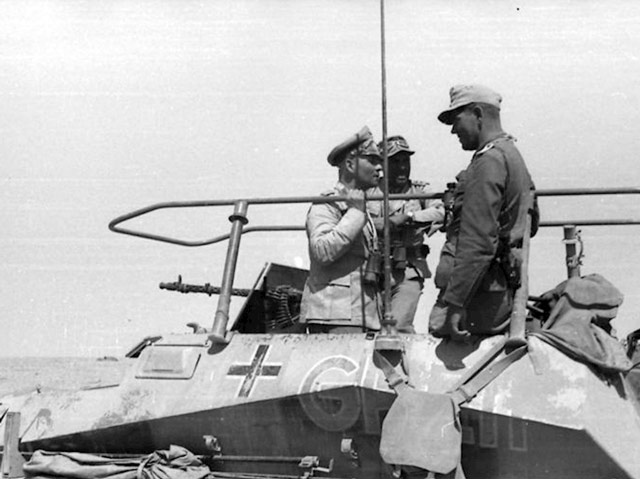
Rommel in North Africa worldwartwo.filminspector.com
German General Erwin Rommel in his command vehicle in North Africa, 11 June 1942 (Zwilling, Ernst A., Federal Archive Image 101I-443-1589-08).

Eastern Front: General Erich von Manstein's 11th Army continues battering away at Red Army defenses outside Sevastopol, Crimea, on 11 June 1942. His troops of the LIV Corps are having the most success north of the port, where the heaviest German artillery is located. The Soviet 345th Division counterattacks on the borderline between the Wehrmacht 132nd and 50th Divisions, but quick Luftwaffe intervention (1070 sorties while dropping 1000 tons of bombs today) prevents a rupture. The Red Army and LIV Corps, however, continue taking heavy casualties.

While progress is still being made at Sevastopol, the local commanders are getting concerned at the high cost of the small local gains. Luftwaffe General Wolfram von Richthofen, in command at Fliegerkorps VIII, comments sourly in his war diary that his forces have "only enough left for 1.5 more days of bombing." His mood is black, and he adds that "the specter of failure now seriously looms." On the spur of the moment, Richthofen decides that his bombers are dispersing their efforts too widely. He thus changes bombing procedures to conserve resources. The new tactic of "column bombing" involves bomber attacks on only specifically designated targets while the aircraft fly one after another in narrow air corridors.

The Red Air Force also is proving to be a nuisance, though not to the Luftwaffe. Instead, the Soviets are making nightly raids on German positions in the "rear" to the east at places like Simferopol, Theodosiya, Eupatoria, and Yalta. The Luftwaffe can see the attacks coming on their radar but do not have any night fighters to intercept them. Fortunately for the Germans, the Red Air Force bombing runs are very inaccurate, so the raids for the most part are ineffective.

Off the Crimean coast, a mini-war at sea also is brewing. The Soviets are running fast convoys to Sevastopol every night, and early in the morning, the Kriegsmarine decides to do something about it. For the first time, Axis small craft (MTBs and motorboats) manned by Italians attack a Soviet convoy near Cape Khersones. It is believed, but not absolutely certain, that they sink a Soviet ship.  

Back at Fuhrer Headquarters in East Prussia, General Halder also is getting impatient with Manstein's progress. He notes that the Soviet artillery at Sevastapol "is quite troublesome." However, further north, "The Voshansk attack is making very satisfactory progress." Meanwhile, the situation at Ninth Army is "unclear," with the Soviets "unaccountably" abandoning territory. This new Red Army tactic of not fighting for every inch of ground but instead trading space for time and tactical regrouping will befuddle and mislead the German High Command throughout the summer.

Battle of the Black Sea: Soviet submarine A-5 torpedoes and sinks 5695-ton Romanian freighter Ardeal off Odessa. Ardeal's captain beaches the ship to avoid sinking but is later repaired and returned to service.
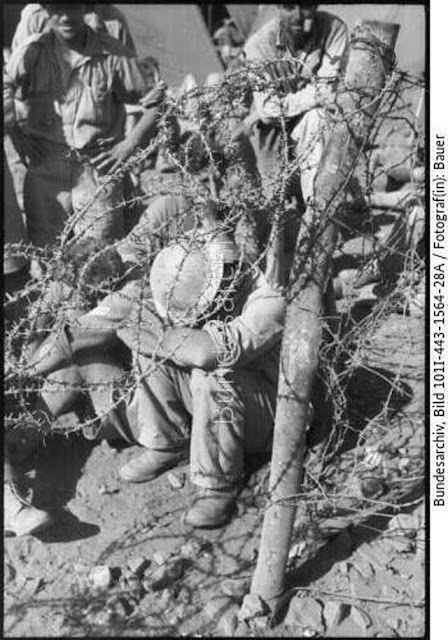
British POWs in North Africa worldwartwo.filminspector.com
British POWs in North Africa, 11 June 1942 (Farmer, Federal Archive Image 101I-443-1564-28A).

Battle of the Pacific: USS Saratoga rendezvouses with fellow carriers Enterprise and Hornet. It transfers 19 SBD Dauntless, five TBD Devastator of VT-5, and 10 VT-8 Avenger planes to the two other carriers to replace their losses at the Battle of Midway. The ships then turn head to Pearl Harbor in foul weather.

Reinforcements for the Pacific Fleet are on the way. USS Wasp and battleship North Carolina, along with escorting destroyers, pass through the Panama Canal. Battleships just barely fit through the channel with mere feet (sometimes only inches) to spare on each side. The Japanese know the importance of the Canal and have plans to block it throughout the war.

The U.S. 11th Air Force make their first attack on the Japanese on Kiska Island in the Aleutian chain. The attack is made by five B-24 and five B-17 bombers flying from Cold Bay and loading their bomb racks at Umnak Island. PBY Catalinas also participate in the attack. on Kiska Harbor. The attack only scores some near misses on the Japanese ships while losing a B-24 (Captain Jack F. Todd) to anti-aircraft fire. This begins a 48-hour period during which the Catalinas make repeated attacks without much success.

British POWs in North Africa worldwartwo.filminspector.com
British and South African POWs in North Africa, 11 June 1942 (Zwilling, Ernst A., Image 101I-443-1589-34A).

Battle of the Indian Ocean: German raider Michel (HSK-9) uses its guns to sink 5186-ton British freighter Lylepark southeast of Cocos Islands (northwest of Perth, Australia). Michel is on her way from Japan for a hunting raid off the coast of South America.

Japanese submarine I-20 torpedoes and sinks 7926-ton British freighter Mahronda in the Mozambique Channel. There are two deaths and 40 survivors. The survivors are rescued by the Royal Indian Navy ship HMIS Orissa. This is an unusual situation where a German ship sinks a ship further west than a Japanese submarine in the Indian Ocean on the same day.

Australian corvette HMAS Wallaroo (J 222) sinks after colliding with a ship it is escorting, U.S. Liberty Ship Henry Gilbert Costin. The sinking ironically occurs because the ships are sailing without navigation lights in overcast weather to avoid detection by the enemy. Wallaroo sinks while trying to return to Fremantle, while the other ship makes it back. There are three deaths.

European Air Operations: The foul weather that has characterized the spring of 1942 continues today. It is 10/10ths clouds during the morning, but visibility clears a bit by noon. RAF fighters attack Koksijde and the Furnes Canal, sinking and damaging barges. The attacks are broken off after encountering heavy anti-aircraft fire at Nieuport. These attacks in low visibility are quite hazardous, and several planes narrowly avoid collisions or hitting ground obstructions.

Battle of the Baltic: German support ship MRS-11 Osnabruck hits a mine and sinks off Tallinn, Estonia. There are 84 deaths. The ship is later salvaged.
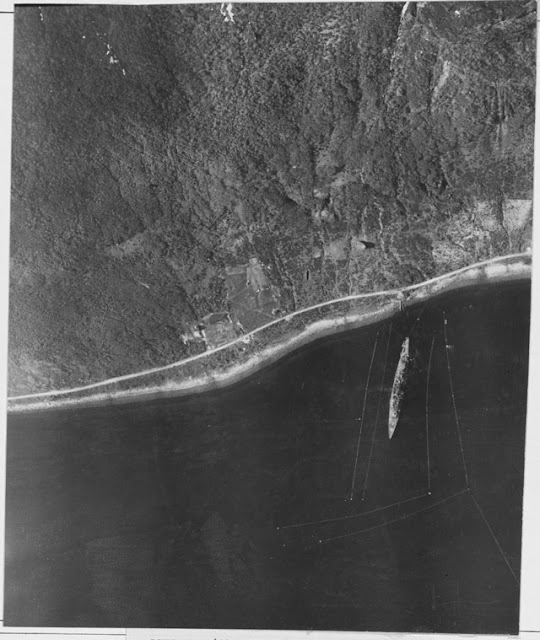
German cruiser Lutzow spotted by Allied air reconnaissance 11 June 1942 worldwartwo.filminspector.com
German heavy cruiser Lutzow photographed by Allied air reconnaissance, 11 June 1942 (Naval History and Heritage Command NH 110843).

Battle of the Atlantic: Italian submarine Leonardo da Vinci uses torpedoes and gunfire to sink 5483-ton Dutch freighter Alioth in the Atlantic Ocean near Freetown, Sierra Leone. Everyone survives.

U-504 (Kptlt. Hans-Georg Friedrich Poske), on its third patrol out of Lorient, torpedoes and sinks 4282-ton Dutch freighter Crijnssen 85 miles southwest of the Cayman Islands. There are one death and 93 survivors, who abandon the ship in four lifeboats and a gig. The sinking is especially traumatic for some on board because there are a dozen survivors of Sylvan Arrow (sunk by U-155 on 20 May 1942) and one from U.S. tanker T.C. McCobb (sunk by Italian submarine Pietro Calvi on 31 March 1942). The survivors in one lifeboat and the gig from Crijnssen are picked up by the U.S. freighter Lebore, which itself is sunk by U-172 a few days later. The other lifeboats make landfall in Mexico aside from four crewmembers on a raft who are picked up by the Panamanian tanker J.A. Mowinckel.
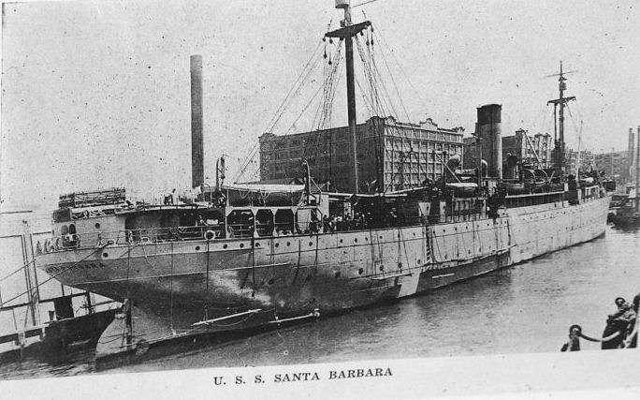
Freighter American sunk on 11 June 1942 worldwartwo.filminspector.com
SS American, originally the Santa Barbara, was sunk by U-504 on 11 June 1942. 

Much later in the day, U-504 also torpedoes and sinks 4846-ton U.S. freighter American off Honduras. The ship is hit by two torpedoes and sinks within 25 minutes. There are four deaths and 34 survivors, who are picked up by British freighter Kent. One survivor perishes after being picked up.

U-159 (Kptlt. Helmut Friedrich Witte), on its second patrol out of Lorient, torpedoes and sinks 7130-ton British freighter Fort Good Hope northwest of Colon, Panama. Two torpedoes hit and sink the freighter (carrying wheat, timber, lead, and zinc) within half an hour. There are two deaths and 45 survivors, who are picked up by U.S. gunboat USS Erie (PG 50).

U-455 (Kptlt. Hans-Heinrich Giessler), on its third patrol out of St. Nazaire, torpedoes and sinks 6914-ton British tanker Geo H. Jones northeast of the Azores. The tanker is a straggler from Convoy SL-111 heading from Aruba to Freetown. There are two dead and 40 survivors, who are picked up by HMIS Orissa (J 200).

U-157 (KrvKpt. Wolf Henne), on its second patrol out of Lorient, torpedoes and sinks 6401-ton U.S. tanker Hagan five miles off the north coast of Cuba. Hagan is simply steaming a straight course independently and thus is an ideal target. Two torpedoes hit the engine room and fuel bunkers, sinking the ship, which is carrying 2,676 barrels of blackstrap molasses, fairly quickly. There are six dead and 38 survivors, who make landfall in Cuba in two lifeboats. This is the only victory for U-157 in its career, which ends a couple of days later when it is sunk.

U-94 (Oblt. Otto Ites), on its ninth patrol out of St. Nazaire, torpedoes and sinks 4458pton British freighter Pontypridd northeast of St. John's, Newfoundland. Pontypridd is a straggler from Convoy ONS-100. There are two dead and 46 survivors, who are picked up by HMCS Chambly (K 116).

U-158 (Kptlt. Erwin Rostin), on its second patrol out of Lorient, torpedoes and sinks 13,467-ton Panamanian tanker/transport Sheherazade 20 miles west of Ship Shoal Buoy, Louisiana. Sheherazade is a French ship turned over to the U.S. War Shipping Administration (WSA). There are one dead and 58 survivors, who are rescued by shrimp boat Midshipman and fishing vessel 40 Fathoms. The rescue happens quickly enough that nine men are found swimming after having jumped overboard.

Norwegian 6049-ton freighter Haugarland hits a mine and sinks off Terschelling, Netherlands. It appears that everyone survives.

U.S. 9310-ton tanker F.W. Abrams hits a U.S.  defensive mine and sinks east of Morehead City, North Carolina (near Cape Hatteras). The 36 men on board make it to shore near Morehead City. A tug ("Relief") attempts salvage of the floating wreck without success.

U-87 mines the waters off Boston, Massachusetts, while U-373 mines the area near Delaware Bay.
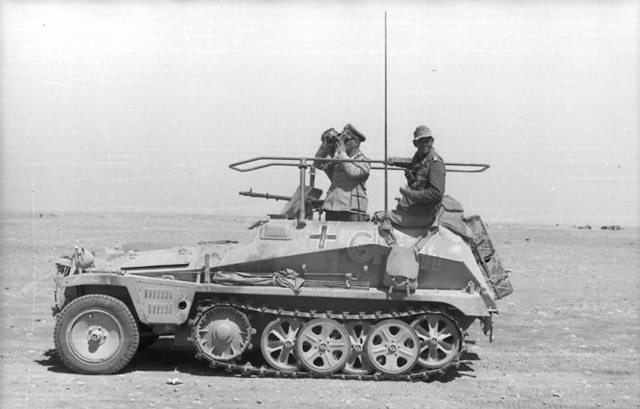
Rommel in North Africa worldwartwo.filminspector.com
General Rommel in his Sd.Kfz. 250 command truck, 11 June 1942 (Zwilling, Ernst A., Federal Archive Image 101I-443-1589-09).

Battle of the Mediterranean: German General Erwin Rommel's Afrika Korps occupies the fortress of Bir Hakeim, which has been a roadblock in his advance toward Tobruk. The Free French defenders have almost all escaped to British lines to the south save for a small rear guard left to delay the attackers. The French and British pull back from their advanced position outside the fortress to Gasr-el-Arid early in the morning, completing the breakout by 2700 men and women (there are some female nurses).

After finally clearing this obstacle, about which he later comments "seldom in Africa was I given such a hard-fought struggle," Rommel quickly resumes his offensive, sending the 15th Panzer and 90th Light Divisions toward El Adem. The British 201st Guard Brigade in the Knightbridge Box, which blocks the way to Tobruk to the east, comes under severe pressure. While the Allied defense of Bir Hakeim has seriously disrupted Rommel's overly ambitious timetable, his advance now regains momentum.
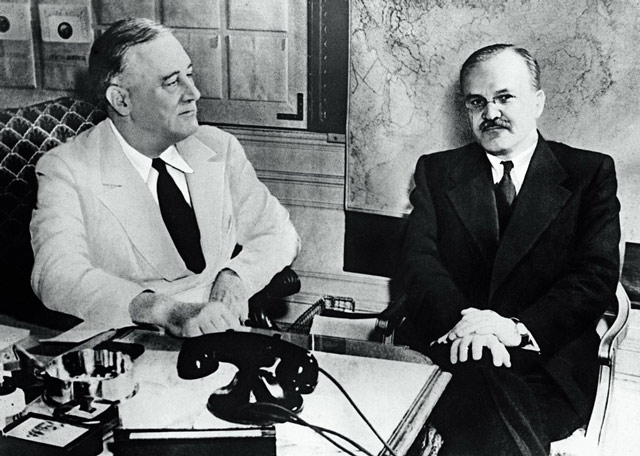
Molotov and FDR in Washington on 11 June 1942 worldwartwo.filminspector.com
Soviet Foreign Minister Vyacheslav Molotov and U.S. President Franklin D. Roosevelt meet in Washington, D.C., to finalize the lend-lease agreement, 11 June 1942 (Alliance.rusarchives.ru).

US/Soviet Relations: The United States and Soviet Union sign a lend-lease agreement. The agreement contemplates "mutually advantageous economic relations" between the two powers, with the agreement to continue in force "until a date to be agreed upon by the two governments." U.S. Secretary of State Cordell Hull and Soviet Ambassador Maxim Litvinov sign for their respective governments.

Article 1 sets out the main purpose of the agreement:
The Government of the United States of America will continue to supply the Government of the Union of Soviet Socialist Republics with such defense articles, defense services, and defense information as the President of the United States of America shall authorize to be transferred or provided.
This agreement, however, is not specific on certain key points. These become a lingering bone of contention during the post-war era. Significantly, the title to the equipment supplied by the U.S. is not transferred to the Soviet Union. The U.S. believes it still "owns" the items and retains rights to them, while the USSR believes it now owns them because they were freely given.

Technically, under the U.S. interpretation of the agreement, the Soviet Union is obligated to return any intact equipment or compensate the United States for it after the war. The USSR, perhaps understandably, has a vastly different interpretation. This leads to awkward exchanges between the two governments in the late 1940s in which the United States demands either the return of the intact equipment or payment for them, including limitations on the equipment's transfer to other countries. Ultimately, the United States simply demands payment for the "civilian-type articles remaining in existence."

Of course, the United States already has abandoned military equipment of its own at bases around the world because it is obsolete and considered too expensive to return to the homeland. Thus, there seem to be deeper reasons underlying the disagreement. It is entertaining to ponder the reactions of the Soviets when they receive these petty and abrasive demands for payment for goods they always assumed were given for free to win the war at the cost of Soviet blood. These pointless and unproductive "negotiations" help to poison the relations between the two nations and contribute to the growth of the Cold War, a hostile relationship that more or less continues to the present day.
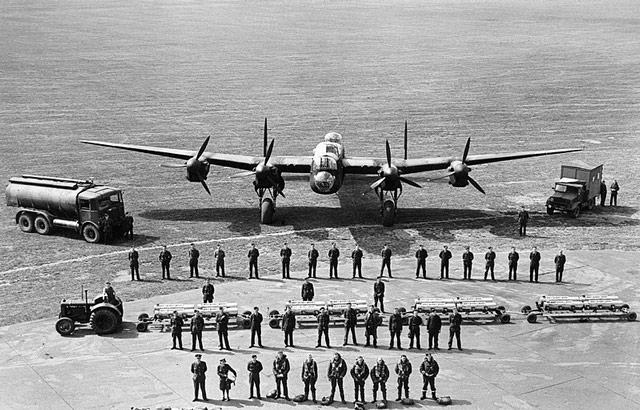
An Avro Lancaster and its crew on 11 June 1942 worldwartwo.filminspector.com
An Avro Lancaster and the personnel and equipment needed to keep it flying. This photograph was taken at Scampton, Lincolnshire, on 11 June 1942.  © IWM CH 15362.

German Military: Adolf Hitler issues Führer Directive 32. It sets out operations to be undertaken after the defeat of the Soviet Union, including the capture of Gibraltar with or without Spain's cooperation and resumption of the "siege of England." It is a curious mixture of far-sighted planning and mundane objectives such as the capture of Tobruk. It presupposes the quick defeat of the USSR in the coming Case Blue summer offensive and, like many of Hitler's grand strategies, assumes launch conditions that do not yet exist.

U.S. Military: With the threat to the U.S. west coast vastly reduced due to the Japanese defeat at Midway, the 97th Bombardment Group deployed for emergency purposes on the coast is transferred back to New England for eventual movement to join the Eighth Air Force in Great Britain.

Holocaust: Adolf Eichmann holds a meeting for his underlings controlling Jewish Affairs in France, Belgium, and Holland. This meeting sparks a systemic deportation scheme for Jewish residents of those areas to the extermination camps in the East that affects tens of thousands of people.

German Homefront: Michael Kitzelmann, 26, is executed at Orel Prison after being court-martialed and convicted of crimes against the state. Kitzelmann, a Wehrmacht lieutenant, was denounced by a sergeant for saying things that "undermined the military." He was in a hospital being treated for wounds when the allegations against him were made, but apparently, he made them previously while serving on the Eastern Front. The statements apparently concerned certain atrocities that Kitzelmann witnessed against the Russian population. While Kitzelmann became outspoken, he also had earned the Iron Cross Second Class and the Wound Badge in Gold.

TheGerman Bundestag rehabilitated Kitzelmann on 8 September 2009. A plaque in his memory is at the Johann-Michael-Sailer-school in Dillingen an der Donau.

American Homefront: The New England Journal of Medicine reports a case of "internal anthrax," which is considered quite novel because the vast majority of cases are of the cutaneous type. The patient died after showing progressively worse symptoms and a full autopsy was performed. Penicillin, still in its experimental phase, will become the accepted treatment for anthrax in 1944. 
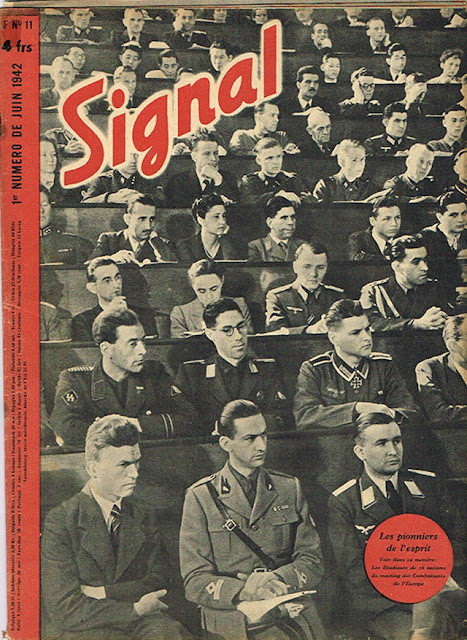
German Signal magazine from June 1942 worldwartwo.filminspector.com
Signal magazine, June 1942.

2021

Friday, November 26, 2021

June 10, 1942: Germans Destroy Town of Lidice to Retaliate for Heydrich Assassination

Wednesday 10 June 1942

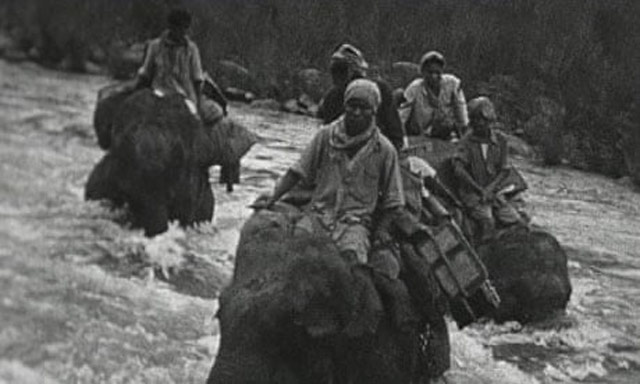
Elephants rescuing refugees in Burma, 10 June 1942 worldwartwo.filminspector.com
A still from a film taken by Gyles Mackrell, the tea planter who used elephants to save refugees in Burma. (Source: Cambridge University/PA).

Eastern Front: Army Group South begins Operation Wilhelm, a short envelopment across the Donets River east of Kharkov, on 10 June 1942. This is not the opening of the main summer offensive, but just a preliminary attack to improve the launching pad for Case Blue. The offensive launches in rainy weather when III Panzer Corps captures two bridges across the Burluk River and turns upstream. The VIII Corps attacks north of Volchansk, taking three bridges on the Donets and bypassing Volchansk on the northeast.

While Army Group South commander Field Marshal Fedor von Bock calls the day's results "gratifying" and General Halder notes the attack has "started off well," the rain slows down the tanks and disrupts the tight timeline. Only the infantry keeps trudging along. The plan is for Sixth Army's VIII Corps to turn south once east of Volchansk to meet First Panzer Army's III Panzer Corps heading up from the south. Speed is of the essence, both because this is only one of a sequence of operations on the docket that all depend on each other's success and because the Germans want to trap the Soviet 28th Army west of the pincers before it can escape to the east.

Meanwhile, General Erich von Manstein's siege of Sevastopol continues to stumble. The Red Army forces in the port launch a counterattack today that is stopped with the heavy assistance of the Luftwaffe dropping anti-personnel bombs on them. No Axis progress at all is made in the south, where the 30th Corps is stopped by the 109th Rifle Division. Soviet defenses on the Sapun Ridge (Sapun-gora) prove highly resistant to Axis attacks. The German bright spot is in the north, where the 132d Infantry Division clears the Haccius Ridge, while the Soviets hold the Maxim Gorky fort only due a fierce defense put up by the Soviet 1st Battalion of the 241st Rifle Regiment.

At Fuhrer Headquarters, General Halder has a lot to say today, mostly coming across as a pundit who has no personal stake or influence on what he is describing, like a football announcer who has no impact on what he is saying:
Notwithstanding heavy enemy counterattacks, good progress at Sevastopol. It appears that the enemy has moved artillery and infantry from the southern sector to the threatened northern sector; the attack tomorrow, therefore, is to be launched with maximum surprise.
In other words, the initiative is no longer completely in German hands. In any event, the whole campaign in Crimea is a sideshow and is not expected to have a significant effect on the larger war.

The stress is getting to  Luftwaffe commander General Wolfram von Richthofen. He becomes obsessed that there will be "friendly fire" incidents on Kriegsmarine ships and submarines. The commander of the German Black Sea Fleet (Admiral Schwarzes Meer) Vice-Admiral Friedrich Götting obligingly orders ships to sport prominent large Swastika flags as identification.

However, this good-faith gesture does not mollify Richtofen. Konteradmiral (Rear-Admiral) Robert Eyssen then sends Götting a message:
As it is impossible always to be informed if and when submarines and light forces of the German and Italian navies are in Crimean waters, Commanding General, 8th Air Corps [von Richthofen], has given orders prohibiting his planes from making any attacks whatsoever on any submarines or light forces, including Russian vessels in the entire Black Sea.
This is a strange situation, as there haven't been any friendly-fire incidents involving the ships. It leaves everyone but Richthofen shaking their heads. Götting is confused and exclaims:
There is no valid reason why these air attacks on submarines and light forces should be prohibited in the whole Black Sea area, as at present the German and Italian E-boats and submarines are only operating in the Crimean area.
Working behind von Richthofen's back, Götting then has Eyssen discreetly talk the matter over with the commander of Luftwaffe planes operating out to sea and not near Sevastopol where mistakes are likeliest, General Wolfgang von Wild. Eyssen and Von WIld privately agree that the prohibition makes no sense. Von Wild agrees to disobey this clear order and continue air attacks at sea (which the Kriegsmarine wants) outside of a small zone near Sevastopol.

This is a classic case of how these types of matters are handled in the Wehrmacht, technically insubordinate but just adapting to reality. It happens more and more as the war goes on, Wehrmacht fortunes deteriorate, and the German situation does not match up with Adolf Hitler's perception of reality.
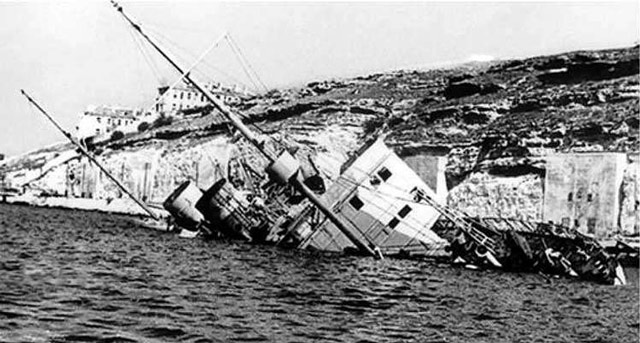
Sunken Soviet ship at Sevastopol, 10 June 1942 worldwartwo.filminspector.com
Abkhaziya after the 10 June 1942 Luftwaffe attack.

Luftwaffe Junkers Ju-88 bombers catch Soviet passenger/ cargo ship Abkhaziya at port in Sevastopol and sink it. Eight people lose their lives. The ship is raised after the war and broken up. The bombers also sink Soviet destroyer Svobodny (or Svobodney) at the south bay at Sevastopol. Svobodny has a crew of 271, but casualties are unknown.

Operation Kreml, a Wehrmacht deception campaign, shifts into high gear today. Army, corps, and division staffs begin holding meetings to discuss resuming the offensive toward Moscow by 1 August. The Luftwaffe also increases reconnaissance flights over Moscow and surrounding areas. Only the top people such as chiefs of staff and branch chiefs know the entire concept of an offensive toward Moscow is a complete sham and that the true orientation of the summer offensive is toward Stalingrad.

Operation Wilhelm, a Sixth Army operation near Izyum, begins today. It is a shallow pincer movement across the Burluk River intended to trap Soviet forces and set the stage for Case Blau. This minor local offensive is sometimes grandly styled as the beginning of the German summer offensive, but it is more a local, preliminary operation to secure a better launching pad for the main offensive. The operational plan is for VIII Corps in the north (south of Belgorod) to meet up with III Panzer Corps (east of Chuguyev/Kharkov) near Belyy Kolodez.  A quick look at the map shows that the  Germans have further to travel north and south than to the east, giving the Soviet forces plenty of time to escape the jaws of the pincer - which is exactly what happens.
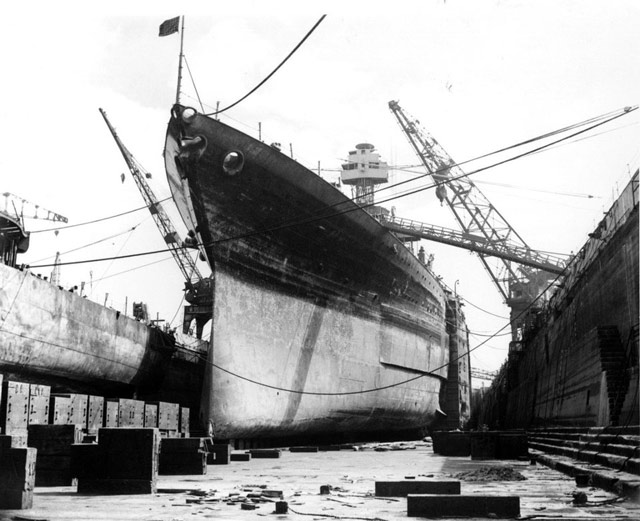
USS West Virginia at Pearl Harbor, 10 June 1942 worldwartwo.filminspector.com
USS West Virginia (BB-48) is shown still in a Pearl Harbor drydock getting its damage from the 7 December 1941 raid repaired. Photo was taken 10 June 1942. In a few months, it will sail to Puget Sound Naval Shipyard for permanent repairs. (US Navy). 

Battle of the Pacific: The Imperial Japanese Navy today reports the results of the Battle of Midway to the military liaison conference in deliberately vague terms in order to not lose face after its staggering losses there. Admiral Chūichi Nagumo is not present and will not submit a detailed report until 15 June. The main Japanese goal now is to hide the results of the defeat as completely as possible, and elaborate steps are planned to do this once the fleet returns to Japan.

As part of this deception campaign, Tokyo radio today grandly announces the unopposed occupation of Attu and Kiska in the Aleutians as a "great victory." US Patrol Wing 4 is flying patrols over the two islands and now knows that they are occupied, but this silly broadcast could have given the US significant information under slightly different circumstances. In any event, this is an example of the blatant propaganda of World War II. Just to be fair, the Allies sometimes hide their own losses as long as possible, too (see, for example, the sinking of HMS Barham, sunk on 25 November 1941), but this takes disinformation that is not outright lying (what is broadcast is reasonably accurate, it's just the emphasis and omissions that make this pure deception) to another level.

Some practical steps based on the failed tactics of the battle are taken. From now on, returning planes will be refueled and re-armed on the flight deck rather than taken below to the hangars. All unused fuel lines are to be drained in order to reduce the chance of catastrophic fires. New carrier designs are prepared to incorporate only two flight deck elevators, which proved to be a severe vulnerability of the old designs. Enhanced training in damage control and firefighting is mandated, but this is commonly seen as "unheroic" and instituted more in theory than actual practice. 

The Japanese reaction is understandable and does contain some good ideas, but the Japanese economy cannot replace the losses with nearly the capability of US industry. It is a classic case of "shutting the barn door after the horses have escaped." Training of replacement pilots must be accelerated, and this causes a drop in quality right when USAAF pilots are benefiting from their combat experience. The experienced crews, meanwhile, become overworked and dispirited, adding to the problems. The ships can and will be replaced, but the veteran pilots cannot.

The Japanese practice of mistreating prisoners that has permeated the war in the Pacific to date continues. While the Japanese attempt to cover their tracks carefully, they savagely execute the three U.S. Navy airmen taken prisoner during the battle in medieval style. Two are killed by tieing them to water-filled gasoline cans and then throwing them overboard.

Fifth Air Force raids Rabaul, bombing airfields and buildings.

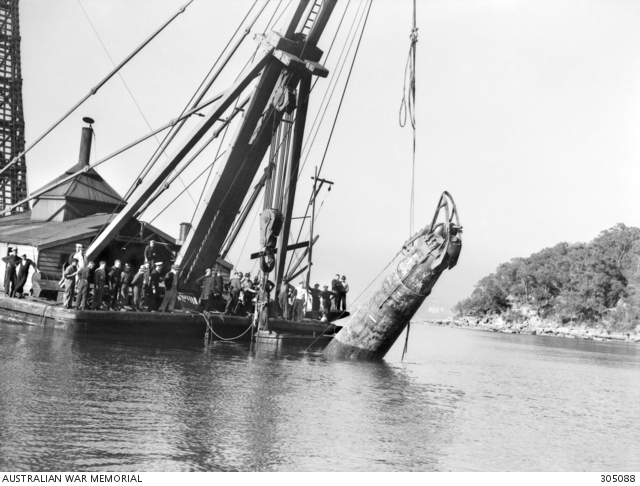
In Sydney Harbour, Australian authorities use a crane to raise mini-submarine M-21 from the depths. Four Japanese crew members of the submarines are cremated and buried today with full naval honors at the Eastern Suburbs Crematorium.

Convoy OC 1, the first from Melbourne to Newcastle, begins today. This is part of tightened control over commercial sea traffic around Australia as a result of the Japanese attacks at Sydney Harbour and elsewhere.
USRaising a sunken Japanese mini-submarine at Sydney Harbor, 10 June 1942 worldwartwo.filminspector.com
A floating crane raising mini-submarine No. 21 in Sydney Harbour, 10 June 1942. Source: Australian War Memorial 30588.

Battle of the Indian Ocean: Gyles Mackrell, a 53-year-old British tea exporter in the Indian provinces of Assam, uses about 20 elephants with Indian drivers to rescue at least 68 Burmese refugees (his own claim in his diary) or perhaps over 200 people (modern scholarship) fleeing the Japanese invaders across the treacherous Daphna River (swollen by monsoon rains) to India. Some are trapped on an island in the middle of the river that later washes away after the rescue. The elephants must walk more than 100 miles to even reach the river. The operation continues through the summer in spite of an order from British authorities to end it. Mackrell becomes known as "The Elephant Man" and is awarded the George Medal.

European Air Operations: The weather is 7/10th Cumulus clouds at 1500 feet (meters), so missions for the day are mostly scrubbed. The pilots spend the day watching combat films by Station Intelligence and the men find other ways to occupy themselves.
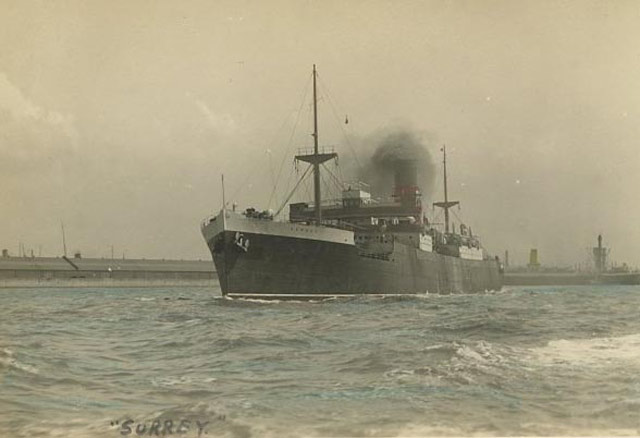
SS Surrey, sunk by U-68 on 10 June 1942 worldwartwo.filminspector.com
SS Surrey, sunk by U-68 on 10 June 1942, under way.

Battle of the Atlantic: U-68 (KrvKpt. Karl-Friedrich Merten), on its fourth patrol out of Lorient, torpedoes and sinks three British freighters, 8581-ton Surrey, 5025-ton Ardenvohr, and 5882-ton Port Montreal, all northeast of the Panama Canal.

In the first action, Merten fires three torpedoes at Surrey, two of which hit, and one at Ardenvohr. Of the two ships, Ardenvohr sinks quicker, within about eight minutes. About 45 minutes after the first strikes on Ardenvohr, Merten fires a coup de grâce that fails to explode, and then a second that does. There is an unusual incident when Merten picks up a British seaman from Surrey found clinging to a buoy to rescue him, then finds a lifeboat and lets the man join his crewmates. There are a dozen dead and 55 survivors of Surrey and one dead and 70 survivors from Ardenvohr.

Five or six hours later, Merten spots Port Montreal about 178 miles north of Cristobal, Panama. The ship's crew also spots U-68, but it is too late. As it turns to run, the freighter is hit by a torpedo in the stern and this causes it to sink fast. Merten describes it in his personal war diary as a lucky hit. It may have been luckier than that for the ship's crew, because Port Montreal is carrying 7500 tons of ammunition that could have created quite an explosion if the ship had been hit broadside. There are two dead and 86 survivors, who are picked up on 16 June by Colombian schooner Hiloa.

U-94 (Oblt. Otto Ites), on its ninth patrol out of St. Nazaire, also makes a convoy attack and hits multiple ships, this time southeast of Cape Farewell. All three torpedoes strike, though it is unclear which ship got hit twice. In any event, both ships sink. The victims are two British freighters, 4855-ton Ramsay and 6147-ton Empire Clough. There are eight survivors and 40 dead on Ramsay and five dead and 44 survivors on Empire Clough. Survivors of the ships are picked up by Portuguese trawler Argus, escort destroyer HMS Vervain (K 190), and the escort destroyer HMS Dianthus (K 95).
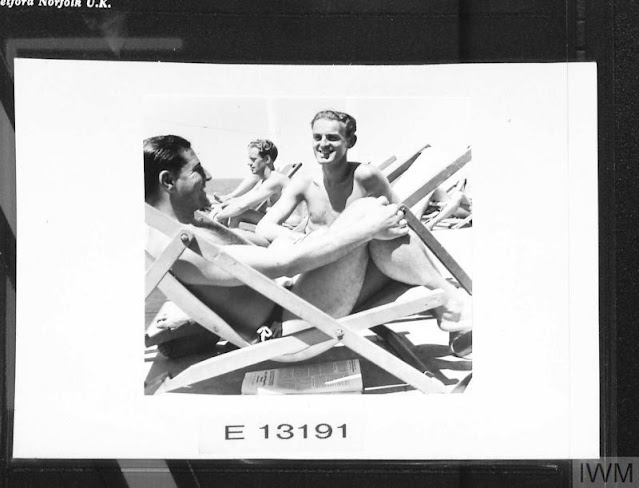
Allied soldiers enjoying a day at the club in Beirut  on 10 June 1942 worldwartwo.filminspector.com
"Original wartime caption: The British swimming club at Beirut is a popular rendezvous for both Free French and British forces." 10 June 1942. © IWM E 13191.

U-129 (Kptlt. Hans-Ludwig Witt), on its fifth patrol out of Lorient, torpedoes and sinks 4362-ton Norwegian freighter L.A. Christensen well east of Miami while en route from Durban to Philadelphia. The ship sinks within 12 minutes, but the crew has enough time to launch the lifeboats and all 31 crewmen survive. They are picked up after 12 hours by Norwegian freighter Bill. This is the first victory in a very successful cruise by U-129 during which it sinks over 40,000 tons of shipping.

U-107 (Kptlt. Harald Gelhaus) is usually credited with the sinking of 2606-ton US freighter Merrimack about 60 miles from Cozumel Island, Mexico. I have my doubts, because my records show that U-107 is in between patrols on 10 June 1942, but it's possible. More likely in my view is that an unidentified Italian submarine did the deed. Anyway, most of the crew abandons ship in one overcrowded lifeboat (the other is destroyed by the explosion). Unfortunately, all in the boat perish when it is sucked into the freighter's still-spinning propeller. Other men, including the master, simply jump overboard and make it to rafts. This proves to be the more successful strategy. Overall, 31 crewmen survive and 43 perish, with the lucky men in the water spotted by a PBY Catalina and picked up by USS Borie (DD 215).

Speaking of Italian submarines, Leonardo da Vinci uses its deck gun and a torpedo to sink 5483-ton Dutch freighter Alioth the ship is en route from Birkenhead to Capetown. I can't find a more precise location, but Italian submarines tend to operate south of the Mediterranean and often in the general vicinity of Sierra Leone. I'm guessing this was near Freetown. Everybody survives. This sinking is sometimes listed as occurring on 11 June 1942. Italian submarine captain records tend to be much spottier than their more precise and detailed Kriegsmarine counterparts.

Soviet submarine D-3 ("Krasnovgardeyets") mysteriously sinks with all hands in Varangerfjord, Norway (at the most northeastern portion of Norway, north of Finland). One theory is that the submarine hit a mine.

Norwegian 6049-ton freighter Haugarland hits a mine and sinks in the North Sea off Terschelling, Netherlands. The ship takes a day to sink, so this is usually listed as occurring on 11 June 1942.

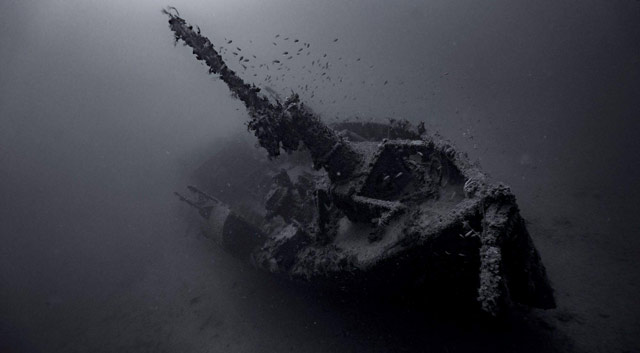
Royal Navy 96-ton drifter Groundswell, being used as minesweeper under the name Trusty Star, either hits a mine and sinks off Malta or is sunk there in an air raid. Either way, casualties are unknown.
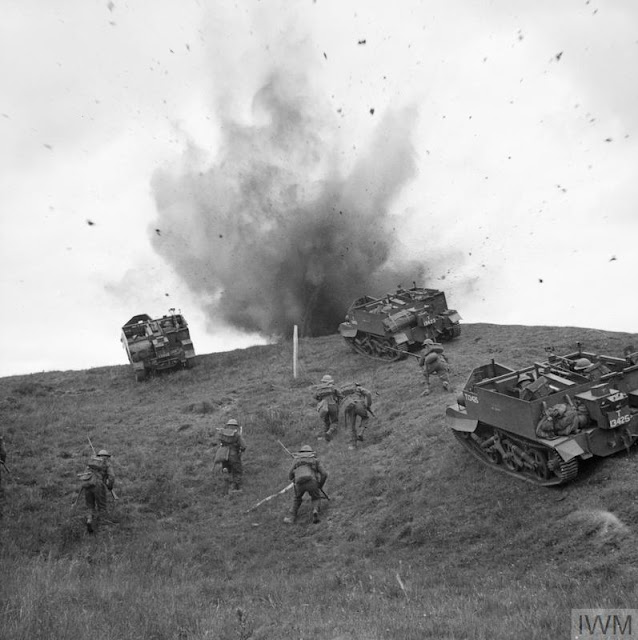
British Army war maneuvers near Sudbury on 10 June 1942 worldwartwo.filminspector.com
"Universal carriers and infantry of 10th Battalion, Royal Berkshire Regiment advance 'under fire' during training near Sudbury in Suffolk, 10 June 1942." © IWM H 20536

Battle of the Mediterranean: Fierce air battles continue above the fortress of Bir Hakeim, with the RAF's Desert Air Force flying more slightly more sorties than the Axis but also losing more planes. The Free French at Bir Hakeim begin retreating in small groups from Bir Hakeim during the early morning hours but continue to maintain the defense of the fortress throughout the day. The French are almost out of ammunition but manage to hold their lines against a determined Afrika Korps attack in the north. The Messmer and Lamaze units counterattack to restore the line, supported by Bren Gun Carriers, but expend their last mortar rounds during the day. The French are reduced to searching the corpses of their comrades for rifle ammunition.

After dark, the French send sappers to clear mines from the western side of the fortress to open an escape route and General Kœnig drives out around 20:30 in a Ford ambulance driven by Susan Travers, the only (unofficial at this time) female member of the French Foreign Legion who is assigned tot he medical detail. Kœnig and Travers barely make it out in their bullet-ridden vehicle. A small force of the Foreign Legion remains behind at the fort to disguise the retreat.

The Axis troops quickly get wind of this retreat and send up a flare, showing the column of French vehicles heading west and south. The 90th Light Division tries to block the road, but Kœnig orders the column to blast through, which it does during a wild mêlée in the dark. British troops of the 550 Company Royal Army Service Corps (RASC), escorted by the 2nd King's Royal Rifle Corps (KRRC) and the 2nd Rifle Brigade, assist the breakout from the south. Despite suffering many casualties, including the day's hero, Lamaze, Capitaine Charles Bricogne, and Lieutenant Dewey, most of the French manage to escape to British lines at Bir el Gubi. Foreign Legion commander Amilakhvari performs the sacrificial duty of remaining in command of a skeleton force holding out in the fortress.

Everyone with a map can see that Tobruk is in danger, so the British ramp up their supply activities to the port. That leads to a great deal of activity along the convoy route and some Allied losses today.

U-559 (Kptlt. Hans Heidtmann), on its eighth patrol out of Salamis, attacks two ships in Convoy AT-49 heading to Tobruk. At 04:56, Heidtmann attacks the convoy by firing three torpedoes and reports hits on a tanker and freighter. The former is 4681-ton Norwegian tanker Athene, which blazes for a full day before sinking due to its cargo of 600 tons of aviation fuel. There are 14 dead and 17 survivors. The latter ship is 5917-ton British oiler Brambleleaf, whose crew abandons ship and are picked up by RHS Vasilissa Olga (D 15) (seven dead and 53 survivors). Brambleleaf is towed to Alexandria, where it is used as an oil hulk until it suddenly sinks on 15 September 1944.

U-81 (Kptlt. Friedrich Guggenberger), on its seventh patrol out of Salamis, torpedoes and sinks 2073-ton British freighter Havre in the same Tobruk convoy. There are 20 dead and 30 survivors, who are picked up by British armed trawler HMS Parktown.

Operation Harpoon, another complicated convoy operation with British ships sailing from both ends of the Mediterranean to resupply Malta and British forces in Egypt, begins today. It is under the command of Admiral Vian on the Alexandria side and Admiral Curteis on the Gibraltar side. Some freighter sail independently, depending on the convoys to distract the Axis defenses.
HMS Trusty Star, sunk on 10 June 1942 worldwartwo.filminspector.com
HMS Trusty Star, sunk 10 June 1942, on the seafloor. Source: Gration, Dave, Heritage Malta.  

Partisans: German and Ustaše authorities begin the Kozara Offensive, an attack against partisan forces around the mountain of Kozara in the former Yugoslavia. The Germans supply 15,000 soldiers and the Independent State of Croatia over 20,000. The Hungarians supply five monitor ships.

As with most anti-partisan operations, the Kozara Offensive suffers from the difficulty of telling actual partisans from ordinary civilians. The mountainous, forested terrain also gives the defenders ample opportunities to take potshots at the advancing Axis forces from concealment. This leads to several times as many casualties on the Axis side. The partisan forces concentrate their units in the city of Široka Luka, with a major formation led by Josip Broz Tito. The Axis troops take many captives, but it is difficult to tell the partisans and civilians apart and the Germans wind up shipping them from Kozara to Sajmište concentration camp.

Applied Science: The US Navy establishes Project Sail at NAS Quonset Point, Rhode Island. This program will perform airborne testing of Magnetic Anomaly Detection (MAD) and other advanced projects such as 10 cm radar.

US/Soviet Relations: Soviet Foreign Minister Molotov is in Washington, D.C., as the Allies attempt to iron over some differences in strategy. Stalin wanted an invasion of northwestern Europe in 1941, and Molotov now presses home the urgent need for one in 1942. However, President Franklin Roosevelt fobs him off with vague phrases and unenforceable "wishes" and "hopes" that it might happen. In fact, Roosevelt knows that the Joint Chiefs of Staff have no plans whatsoever for an invasion of France in 1942. Instead, they are beginning to look at North Africa as the place to start. As a sign of good faith and comity among allies despite their other disagreements, Secretary of State Cordell Hull and  Foreign Minister Maxim Litvinov jointly sign a new Lend-Lease Agreement.

US Military: The second contingent of the 1st Armored Division arrives at Belfast on passenger ship Oriente. The division still does not have its full complement of tanks. Other soldiers from the 141st Armored Signals Company arrive on Dutchess of York, and the 47th Armored Medical Battalion arrives on SS North King.

German Military: Bernhard Woldenga, Geschwaderkommodore of JG 27, is promoted to a staff posting. The Luftwaffe often does this with officer pilots who are considered too valuable to lose in combat (Adolf Galland is the best example of this) or too vulnerable to keep flying for some reason. Woldenga is ill, so this case is probably the latter reason. Replacing him is Major Eduard Neumann replaces Woldenga, Hptm. Gerhard Homuth replaces Neumann as Gruppenkommandeur of I./JG 27, and Oblt. Hans-Joachim Marseilles replaces Homuth as Staffelkapitaen of 3./JG 27. This is quite a change of fate for Marseilles, who began his Luftwaffe career as a virtual outcast due to his unorthodox ways.
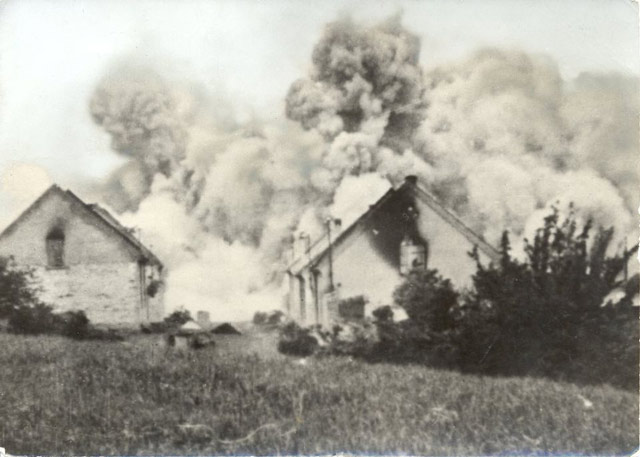
Germans destroy Lidice on 10 June 1942 worldwartwo.filminspector.com
German occupation authorities blow up the town of Lidice, 10 June 1942. Source: Lidice Memorial.

German Homefront: Having decided for spurious reasons that the Czech village of Lidice (20 km west of Prague) harbored the assassins of Reinhard Heydrich, the local authorities destroy the town. The operation is savage and permanent. The town has 503 residents and all who are found are disposed of in some fashion. 

The Germans arrive right after midnight and herd all the villagers into the main square. The Germans shoot all 173-199 men aged 14 to 84 that they find at a local farmhouse and send 195 women to Ravensbrück concentration camp (four pregnant women are forced to have abortions and then are sent to the camp). Women who refuse to leave their husbands are shot with them. The women are not told what happened to their husbands. The Germans make a point of tracking down village residents who happen to be out of town that day and kill them, too. The authorities then destroy every building and even dig up the town cemetery. 

The men are stood in long rows and there they fall. The photos show them laid out in eerily precise order in rows outside the farmhouse awaiting burial. Inmates at local concentration camp Terezin are made to dig mass graves for the victims.

Of the 95 children in Lidice, 81 are sent to Chelmno extermination camp in Łódź, Poland, to die, while eight or nine who have Germanic features are adopted by German families after first being brought to Puschkau, Poland, to learn German ways. In all, only 17 children survive the war. One of them, Václav Zelenka, later becomes mayor of the rebuilt town of Lidice.

The Germans carefully the results of the operation. They show it proudly widely to illustrate to anyone thinking of challenging their rule what might happen to their homes, too. It becomes worldwide news and helps harden hearts against the Third Reich.

The Germans also plan to destroy the smaller Czech village of Ležáky, which actually does have a connection to the Allies as evidenced by a forbidden radio transmitter belonging to Operation Silver A, a three-man Czech squad trained and inserted by the British SOE and RAF that is separate from, but assisted, Operation Anthropoid (the mission to assassinate Heydrich). All adults in Ležáky are to be killed and the leader of Silver A, Alfréd Bartoš, commits suicide.

The two agents who assassinated Heydrich, Jozef Gabčík, Jan Kubiš, remain at large despite a massive German manhunt. They are being shuttled between safe houses provided by the Jindra group. Frustrated, the Germans have adopted a carrot-and-stick approach to this problem, offering a huge reward and threatening further savage reprisals if the men are not betrayed. This is being heard with receptive ears.
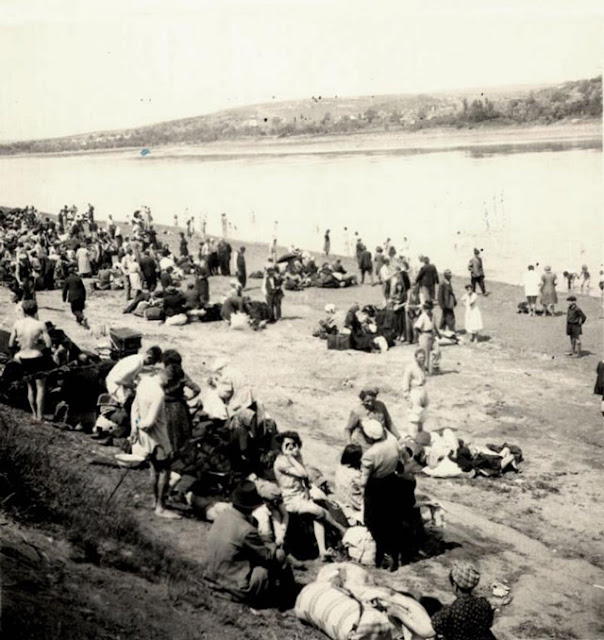
Jewish residents assembling at the Dneipr River for transport to concentration camps, 10 June 1942 worldwartwo.filminspector.com
Jewish inhabitants are assembled on the western bank of the Dneister River. They await deportation by Romanian authorities, who control the area based on ancient claims, to the Transnistria region across the river. Yad Vashem.

British Homefront: As announced in the King's Birthday Honours on 5 June 1942, economist John Maynard Keynes receives a hereditary peerage. He acquires the title "Baron Keynes, of Tilton, in the County of Sussex," and now is entitled to sit in the House of Lords on the Liberal Party benches.

American Homefront: Congress gives final approval to the "Big Inch" pipeline. This will transport crude oil from its production site in Texas to the northeast. This has become necessary due to U-boat successes against tankers along the east coast of the United States.

Future History: Gordon Henry Burns is born in Belfast, Northern Ireland. He becomes a popular Northern Irish journalist and broadcaster. Notable jobs include serving as the host of "The Krypton Factor" from 1977-1995 and serving as the chief anchorman of the BBC regional news show "North West Tonight" from January 1997 to October 2011. Burns, who is the second cousin of popular British singer/songwriter Ed Sheeran, enters retirement in 2013.

Ernest Preston Manning is born in Edmonton, Alberta, Canada. He becomes a member of Parliament for Calgary Southwest in 1993 under the Reform Party and leads the party until it is abolished in 2000. He then switches to the Canadian Alliance from 2000 to 2003 and has been in the Conservative Party since 2003.
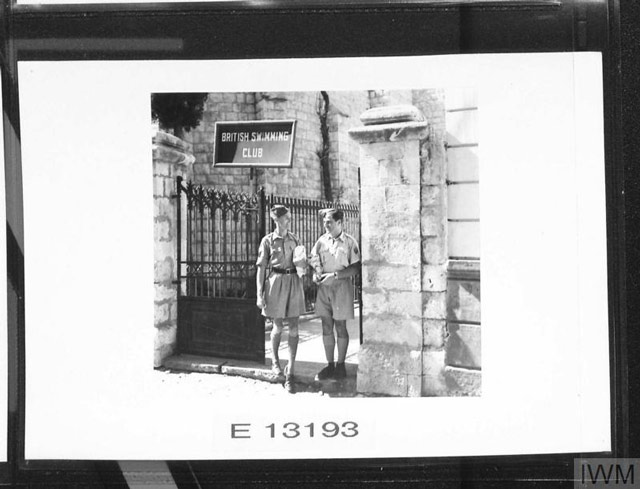
Allied soldiers at a swimming club in Beirut, Lebanon, 10 June 1942 worldwartwo.filminspector.com
"Original wartime caption: A British and Free French soldier set out in search of another diversion from the British Swimming Club." 10 June 1942. © IWM E 13193.

2021

Tuesday, October 12, 2021

June 5, 1942: Last Moments of Admiral Yamaguchi

Friday 5 June 1942

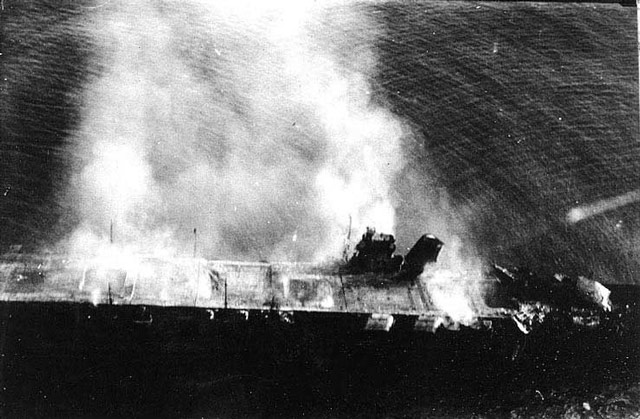
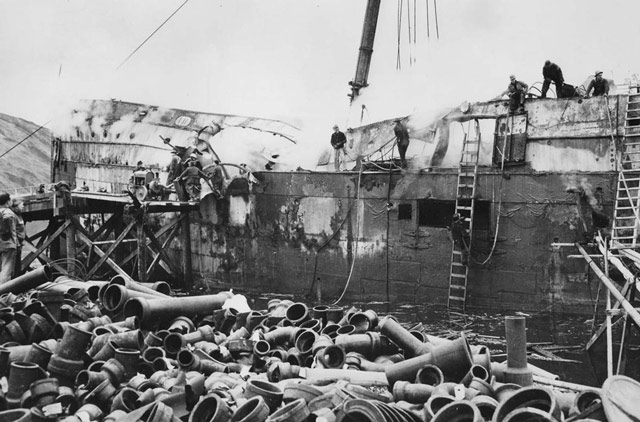
Hiryu sinking 5 June 1942 worldwartwo.filminspector.com
"Japanese aircraft carrier Hiryu ("Flying Dragon") burning shortly after sunrise on 5 June 1942, a few hours before she sank. Photographed by a plane from the carrier Hosho. Note collapsed flight deck at right. Part of the forward elevator is standing upright just in front of the island, where it had been thrown by an explosion in the hangar." It is Admiral Yamaguchi's funeral pyre. (US Naval History and Heritage Command NH 73064).

Battle of the Pacific: Admiral Chester Nimitz takes the unusual step of announcing the results of the Battle of Midway to the press on 5 June 1942 even as the battle continues. It is clear to everyone that this has been a complete debacle for the Japanese. It can only get worse for them now that the U.S. Navy has an overwhelming advantage due to the sinking of the four Japanese aircraft carriers.

Following the 4 June destruction of the four Japanese fleet carriers, Midway Island's defenders receive a vague report at 04:15 from the submarine USS Tambor (Cdr John Murphy), first sent to Hawaii, that the remaining Japanese fleet is approaching. Murphy later makes a half-hearted attack run on the ships, but misses. Upon receiving the report from Pearl, the island's defenders quickly launch eight B-17 bombers from Eastern Island, but the crews cannot spot anything in the early morning haze.

At 06:30, another report comes in from a Midway-based PBY Catalina that it has sighted "2 battleships" heading away from the island. A follow-up message says "Ships damaged, streaming oil." Marine Aircraft Group 22 then sends up two flights VMSB-24, six Dauntlesses (Capt. Marshall A. Tyler) and six Vought SB2U Vindicators (Captain Richard E. Fleming). The "battleships" turn out to be heavy cruisers Mikuma and Mogami. They are streaming oil because they collided during the night. The planes spot the oil slick, which allows them to zero in on the cruisers.

Admiral Yamaguchi's last moments 5 June 1942 worldwartwo.filminspector.com
"Last moments of Admiral Yamaguchi," war art painting by Kita Renzo. "Rear Admiral Tamon Yamaguchi, commander of the Japanese Carrier Striking Force's Carrier Division Two, elected to remain aboard his flagship Hiryu when she was abandoned during the early morning of 5 June 1942. He is depicted here in the middle of the scene as he bids farewell to his staff." Naval History and Heritage Command SC 301067


Tyler and his men attack Mogami but only score some near misses. Fleming then dives on Mikuma from out of the sun. Fleming does not survive - there is contradictory evidence whether his plane crashes into the Mikuma or the water nearby. The attack starts a fire that kills the men in Mikuma's engine room.

With the Mikuma crippled, eight B-17s (Lt. Col. Brooke Allen) then attack Mogami, but only score some near misses. Mikuma and Mogami ten head westward to escape, with Mikuma eventually sinking on the 6 June. Late in the day, Admiral Yamamoto orders all ships in the vicinity of Midway to retire. Japanese destroyers scuttle blazing carriers Hiryu and Akagi early in the day. The leader of the carrier force, Rear Admiral Tamon Yamaguchi, having lost his entire command, refuses to leave Hiryu and goes down with the ship.

For his heroism in leading the successful attack on Mikuma, U.S. Marine Richard Eugene Fleming will be posthumously awarded the Medal of Honor, the highest U.S. military decoration. President Franklin D. Roosevelt gives it to his mother on 24 November 1942.

To the northeast of Midway, Admiral Raymond Spruance, in charge of the combined task force 16 that includes aircraft carriers USS Enterprise and Hornet, seeks out but cannot find the Japanese surface fleet. Late in the day, he sends out scout planes, but they narrowly miss spotting Admiral Nagumo's main fleet. They do spot a destroyer and attack it, but miss. The planes return after dark, and the carrier crews must turn on their lights for the planes to land.

Spruance is extremely put out at the unacceptably vague report from submarine Tambor early in the day because it is vague and unhelpful. He also is upset at Commander Murphy for a lack of aggressiveness in not attacking the ships he spotted. He will have Murphy relieved of his command when Tambor returns to Pearl Harbor.
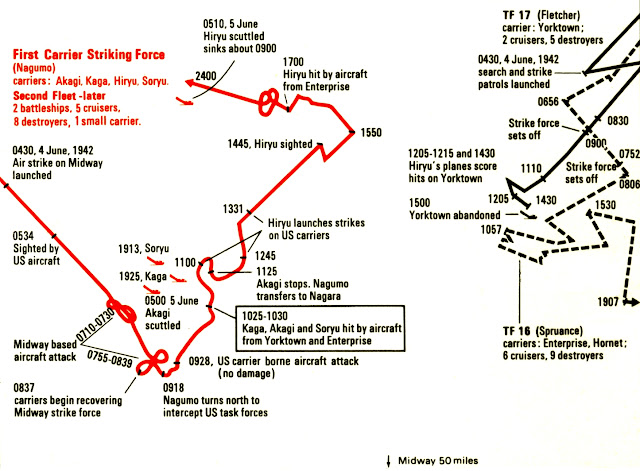
Map of Battle of Midway 5 June 1942 worldwartwo.filminspector.com
Map of the Battle of Midway 4-5 June 1942 (Onwar.com).

Rear Adm. Robert A. Theobald, in command of Task Force 8, which has been stationed uneventfully about 400 miles south of Kodiak Island in the Aleutians, receives a report of enemy warships in the Bering Sea. The report states that they are heading south toward Unalaska Island. Theobald sends his task force, which has no aircraft carriers, to investigate.

Intended U.S. air attacks using land-based bombers fail due to weather conditions. While six B-17 Flying Fortresses do report bombing enemy shipping, it turns out that in the hazy conditions they actually bomb some uninhabited islands (Pribilof Islands). While all these failed air attacks are going on, the Japanese order 1200 men of the Adak-Attu Occupation Force under Rear Admiral Omori Sentaro to proceed toward Attu for a landing on the 6th.

In reality, the Japanese force near the Aleutian Islands under the command of Vice Adm. Boshiro Hosogaya is moving south, but only to join Admiral Yamamoto's remaining fleet in the general vicinity of Midway Island. They are to join Yamamoto's forces in a desperate effort to lure the U.S. Navy carriers into surface combat. However, late in the day, Yamamoto decides that this plan will not work and sends Hosogaya back north to complete the landings in the western Aleutians. The Japanese high command in Tokyo dispatches two aircraft carriers from Japan to reinforce Hosogaya. Their hope is that the U.S. carriers might try to intervene in the Aleutian Island landings and be destroyed.

USS Yorktown remains afloat, though listing badly. At great hazard, a salvage party of 29 officers and 141 enlisted men board the sinking ship to see if anything can be done to save it. After the damage it has taken from multiple strikes, it is amazing that Yorktown still floats.

U.S. Navy submarine Pompano torpedoes and damages Japanese 131-ton guard ship Sumiyoshi Maru No. 8 off Truk Island. The entire crew survives by transferring to nearby ship Shoko Maru.

The Fifth Air Force sends B-17s to bomb a coal jetty, wharves, and a warehouse at Rabaul.
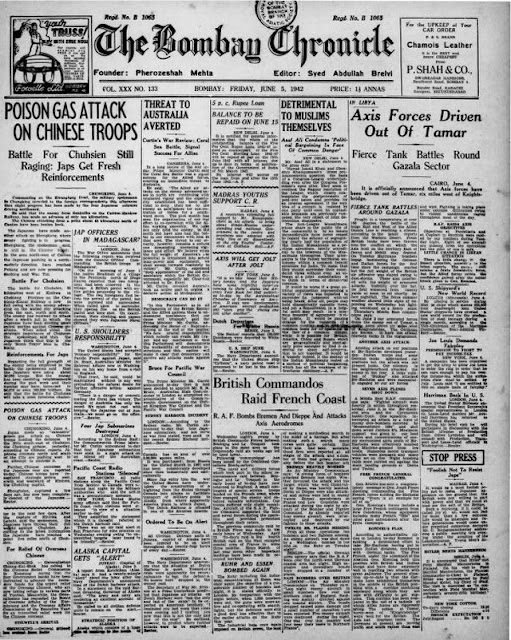
Bombay Chronicle 5 June 1942 worldwartwo.filminspector.com
The 5 June 1942 Bombay Chronicle headlines "Poison Gas Attack on Chinese Troops."

Battle of the Indian Ocean: There is a lot of Japanese naval activity off the west African coast today. The Japanese high command has sent a large force of submarines and other vessels to the vicinity of Madagascar in an attempt to decimate the British Far Eastern Fleet, and today that concentration of power pays off for them.

Japanese armed merchant cruisers Hokoku Maru and Aikoku Maru, operating 350 nautical miles (650 km) northeast of Durban, shell and sink 6757-ton British freighter Elysia. There are 22 dead. Elysia takes four days to sink. Hokoku Maru and Aikoku are there primarily to resupply the large number of Japanese submarines in the area.

Off the coast of Mozambique in the Mozambique Channel, Japanese submarine I-10 gets two successes. It sinks 2639-ton Panamanian freighter Atlantic Gulf (2 dead), and also 4999-ton US armed freighter Melvin H. Baker. British freighter Twickenham rescues the crew of Melvin H. Baker.

Japanese submarine I-20 torpedoes and sinks 5086-ton Panamanian freighter Johnstown off Mozambique. There are two deaths.
Dutch Harbor 5 June 1942 worldwartwo.filminspector.com
A damaged U.S. ship at Dutch Harbor following Japanese air attacks, Alaska, on 5 June 1942.

Eastern Front: In the Crimean Peninsula, General Erich von Manstein prepares to launch his long-awaited attack on the Soviet holdouts at Sevastopol. His 11th Army has LIV Corps to the north, 30th Corps (General Maximilian Fretter-Pico) to the south, and Romanian Mountain Corps 3 (General de divizie Gheorghe Avramescu) to the east. 

The Luftwaffe (Generaloberst Wolfram Freiherr von Richthofen) attacks throughout the day, as do 700 large German artillery pieces. Manstein's 203,800 men, including 65 Sturmgeschütz III self-propelled assault guns, oppose 118,000 Red Army troops holding the port. Today, the German bombardment, which has been rotating each day, shifts to the northern Red Army defensive line facing LIV Corps.

Fw. Anton "Toni" Hafner of 8./JG 51 claims 7 Soviet planes today to bring his score to 43 victories.

European Air Operations: It is a very hot day with some ground haze. The RAF engages in mostly convoy patrols with a few going along the French to Dutch coasts. RAF No. 141 Squadron pilot Warrant Officer Hamar shoots down a Dornier Do 217 E 20 km west of Leiden.
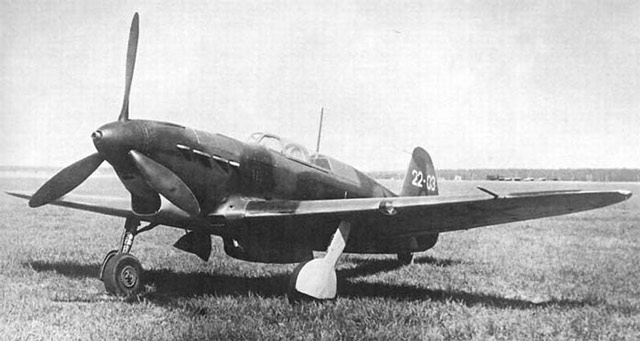
Yak-7B prototype 5 June 1942 worldwartwo.filminspector.com
Yakovlev Yak-7B prototype no.22-03 during trials in June 1942. It will become a useful close support fighter that serves first with the 42nd Fighter Aviation Regiment (IAP) at the North-Western front and then at Stalingrad and in the Caucasus.

Battle of the Atlantic: U-68 (KrvKpt. Karl-Friedrich Merten), on its fourth patrol out of Lorient, torpedoes and sinks 6693-ton U.S. tanker L.J. Drake in the Caribbean southeast of Santo Domingo. Merten uses three torpedoes, all of which hit and create a huge fireball. All 41 men aboard perish.

U-172 (Kptlt. Carl Emmermann), on its second patrol out of Lorient, torpedoes and sinks 3480-ton US freighter Delfina 130 miles northwest of San Juan, Puerto Rico. Emmerman has to follow the freighter for seven hours, during which he misses the ship with three torpedoes (due to malfunctions, not poor aim). The ship sinks within 20 minutes. There are four dead and 27 survivors, some of whom make landfall at Montecristi, Dominican Republic, and others are quickly picked up by US patrol boat USS YP-67.

U-94 (Oblt. Otto Ites), on its ninth patrol out of St. Nazaire, uses its deck gun and sinks 320-ton Portugues three-masted sailing ship Maria da Glória in codfish fishing grounds off Greenland. Ites does not see any markings so assumes it is an enemy vessel. Once the ship raises the Portuguese flag, Ites stops shooting, but it is too late for the ship. Once the crew abandons the ship, Ites resumes firing and sinks it. There are 36 dead and 8 survivors.

U-159 (Kptlt. Helmut Friedrich Witte), on its second patrol out of Lorient, uses its deck gun against 265-ton Brazilian sailing ship Paracury southeast of Santo Domingo in roughly the same area as where U-68 sinks L.J. Drake. The seas are rough, so the U-boat uses its 20mm anti-aircraft gun to punch holes in the waterline, causing it to capsize. Casualties are unknown. The ship remains afloat long enough for someone to find it, salvage it, and return it to service.
US freighter Velma Lykes, sunk 5 June 1942 worldwartwo.filminspector.com
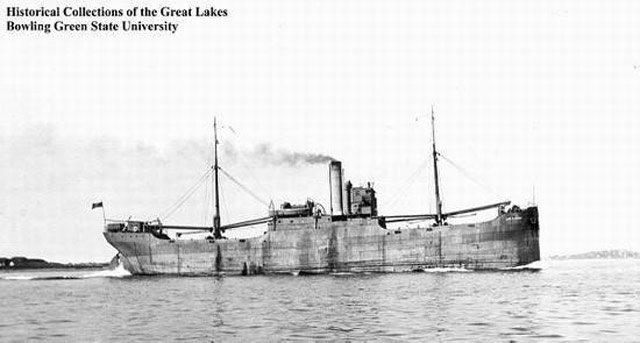
U.S. freighter Velma Lykes, sunk on 5 June 1942 by U-158 in the Caribbean (Bowling Green State University).

U-158 (Kptlt. Erwin Rostin), on its second patrol out of Lorient, torpedoes and sinks 2572-ton U.S. freighter Velma Lykes off Puerto Juarrez, Yucatan Peninsula, Mexico. The ship sinks within one minute. There are 15 dead and 17 survivors, who cling to rafts and are picked up on the 6th by freighter Ardenvorhr after being spotted by a Catalina. The men of the Velma Lykes have further troubles when U-68 torpedoes and sinks their rescue ship, but they all survive that sinking, too.

British 1798-ton freighter Sonja Maersk runs aground and sinks off Ketch Harbor, Nova Scotia, due to heavy fog. There are no casualties.
Stukas and Bf 109s June 1942 worldwartwo.filminspector.cmo
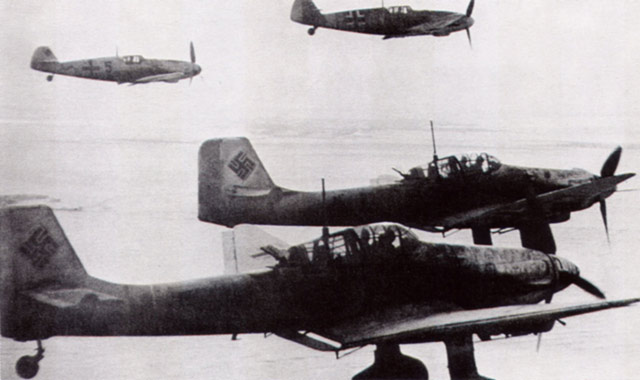
Messerschmitt Bf 109F4 JG5 Black 1 and 5 escorting Ju 87 Stukas of SG5.1 in Russia, June 1942

Battle of the Mediterranean: The land battle in Libya has been deadlocked for a week, and today the British Eighth Army decides to do something about it. General Neil Ritchie's forces launch Operation Aberdeen, an attempt to encircle German General Erwin Rommel's forces in "the Cauldron." Rommel's forces, meanwhile, still encircle the Free French outpost at Bir Hakeim.

The Axis forces in the Cauldron, however, have had time to prepare killing zones with their tanks and anti-tank gun positions. The British make no progress with their early-morning attacks from the north and only slight progress by the 7th Armoured and 5th Indian divisions from the east. The British 32nd Army Tank Brigade in the north loses 50-70 tanks.

Rommel, fortified by the morning success against the British tanks, reacts quickly. In the afternoon, he splits his forces, counterattacking east toward Bir el Hatmat with Ariete and 21st Panzer divisions and to the north with elements of the 15th Panzer Division. The attack to the east has great success, forcing the headquarters of two British divisions, two brigades, and others to flee in a panic. This effectively decapitates the British response. The 15th Panzer attack to the north also has success, forcing the 22nd Armoured Brigade back with a loss of 60 of its 156 tanks. This turns into a wild retreat in which the British abandon three Indian infantry battalions, a reconnaissance regiment, and four artillery regiments to be captured. The front then settles down for the night.

At Bir Hakeim, the surrounded  Free French remain safe within their fortifications but are running out of supplies such as food and water. The Desert Air Force flies cover overhead to disperse Luftwaffe attacks, but Axis artillery continues to batter away at the fort. The German 90th Light Division prepares to attack the fort on 6 June using pioneers to clear the minefields around it.

Convoy WS-19Z, which carries Force X, sails from the Clyde for Gibraltar. This is the prelude to Operation Harpoon, or the Battle of Pantelleria, when an eastbound convoy sailing from Gibraltar will pass a westbound convoy out of Alexandria (Operation Vigorous) in mid-June. Unknown to the Allies, who have been reading German codes with Operation Ultra, the Italian military intelligence service (Servizio Informazioni Militare) has broken the U.S. code being used in the Mediterranean. The Axis thus has an early warning of these two joint operations due to communications made by the U.S. Military Attaché in Egypt, Colonel Bonner Fellers.
NY Times headlines June 1942 worldwartwo.filminspector.cmo
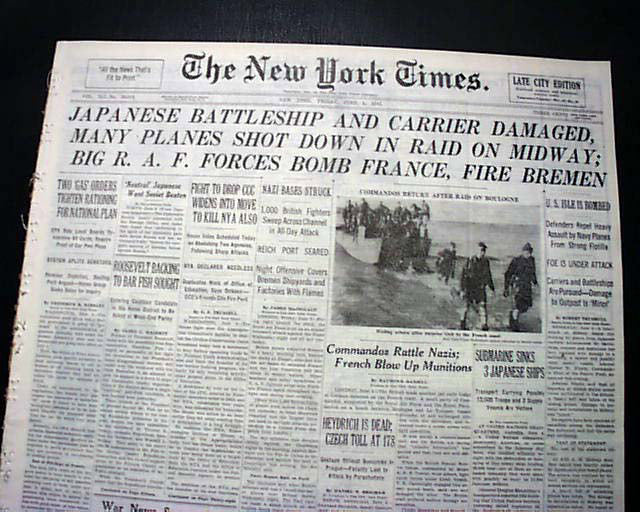
For once, the U.S. media actually downplays the real war news. The 5 June 1942 NY Times headlines that "Japanese Battleship and Carrier Damaged" when, in fact, the Japanese have lost four carriers. However, the truth comes out today as Admiral Nimitz lists the real successes at the Battle of Midway.

US/Axis Relations: The United States declares war on Bulgaria, Hungary, and Romania. Relations also now are strained with Finland due to its hosting Adolf Hitler to celebrate Marshal Mannerheim's 75th birthday on 4 June.

US Military: General Brehon B. Somervell, commander of the Army Service Forces, completes an inspection of US forces in Northern Island.

Two Douglas A-24 Dauntless dive bombers collide at Charters Towers, Queensland, Australia at 1000-1500 feet during a training flight. Three of the four men survive by parachuting out, but pilot 2nd Lt. Norman J. Davidson, whose plane was hit by the other plane's propeller from underneath, perishes.
Auschwitz victim June 1942 worldwartwo.filminspector.cmo
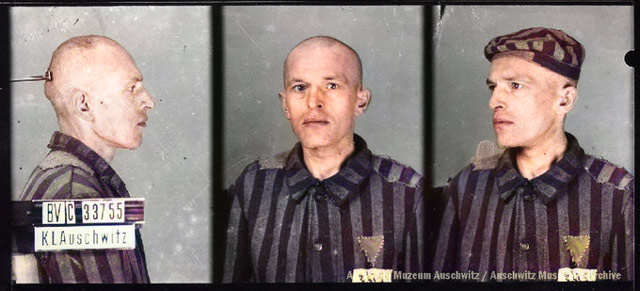
Sloveč cabman Vaclav Novotny perishes in Auschwitz on 5 June 1942. Auschwitz Memorial (colorized).

Holocaust: Train Convoy No. 2 deporting people from France departs today for the East. The edict authorizing this train specifies that it should "deport Communists, Jews and anti-social elements to the East, in retaliation." Helmut Knochen (March 14, 1910 – April 4, 2003), the senior commander of the Sicherheitspolizei (Security Police) and Sicherheitsdienst in Paris, oversees the operation. SS Captain (Hauptsturmführer) Theodor Dannecker, leader of the Judenreferat at the SD office in Paris, has composed the list of deportees. 

This batch is composed of about 1000 mostly Jewish men aged 18 to 54, primarily Poles who fled the occupation there. They were arrested at Drancy, Beaune-la-Rolande, and Pithiviers and then taken to Compiègne between 14 May and 20 August 1941. Many of these men have been found unfit for work. Of these men, roughly 800 are taken to Auschwitz and are dead within ten weeks.
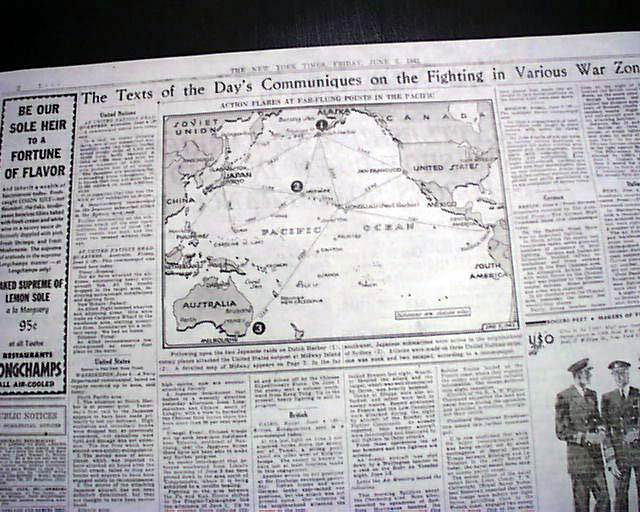
Map of Pacific battles in NY Times 5 June 1942 worldwartwo.filminspector.cmo
A war map in the 5 June 1942 NY Times helpfully shows American readers where the sites of three recent battles in the Pacific, at Midway, Sydney, and the Aleutians, are.

British Homefront: King George VI publishes his 1942 Birthday Honours. This involves various awards, rewards, appointments, and bestowing of honors. Among many other announcements, the economist John Maynard Keynes is made a Baron, filmmaker Alexander Korda is made a Knight Bachelor, and RAF Air Chief Marshal Charles Portal is awarded the Knight Grand Cross of the Order of the Bath (GCB).

American Homefront: Former child actress Virginia Lee Corbin, known at the start of her career as Baby Virginia Corbin, passes away at the age of 31 in Chicago, Illinois from tuberculosis. She is one of many silent film actors unable to transition to the talkies and retired shortly before her death. 
Amazing Stories June 1942 worldwartwo.filminspector.cmo
This June 1942 edition of Amazing Stories features the short story "The Avengers" by William P. McGivern. Hey, whatever happened to them? Actually, these Avengers are different than the Stan Lee ones, which debuted in Avengers #1 issued September 1963.


2021