Tuesday 9 June 1942
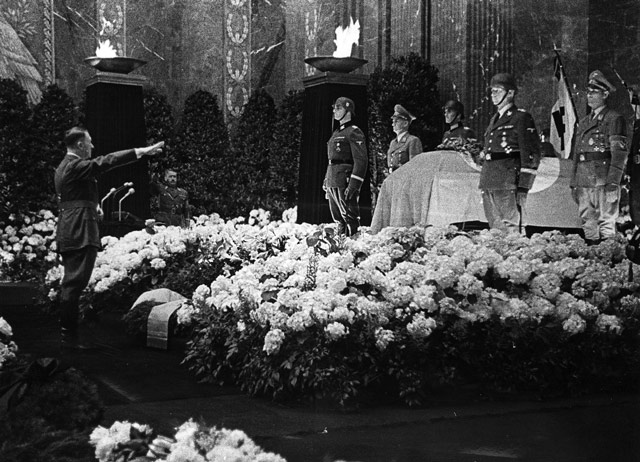 |
| Adolf Hitler at Reinhard Heydrich's funeral (Narodowe Archiwum Cyfrowe, sygn. 2-13241). |
Battle of the Pacific: Learning of the Japanese capture of Kiska on 9 June 1942, Admiral Chester Nimitz cancels his orders to Admiral Jack Fletcher to take his three aircraft carriers (USS Enterprise, Hornet, and Saratoga) north to the Aleutians. Nimitz now does not want them exposed to Japanese land bombers operating from Kiska and Attu. This unknowingly frustrates a Japanese plan to ambush them with the reinforced fleet of Admiral Boshirō Hosogaya.
Nimitz now is thinking offensively (as is General Douglas MacArthur in Melbourne, who submitted his own proposal for an advance led by the Army on 8 June 1942). He wants to keep his carrier force intact for a thrust due west across the central Pacific. This Nimitz and his team in Hawaii see as the main Allied strategy from now on. This is contrary to MacArthur's proposal to advance north from Australia, setting up a classic "turf war" between the US Army and Navy.
The Japanese high command, despite the minor successes in the Aleutians, is reeling from the early June results at Midway. The solution is denial and a coverup. The Imperial Japanese Navy prepares a vague and unrealistic summary of the battle to the military liaison conference. Admiral Chūichi Nagumo takes his time preparing an accurate summary of Japanese losses. He remains completely unaware that the Americans knew his complete battle plan in May and thinks his force was only discovered on the 5th. The Japanese public is kept completely in the dark, with media focusing entirely on the Aleutians.
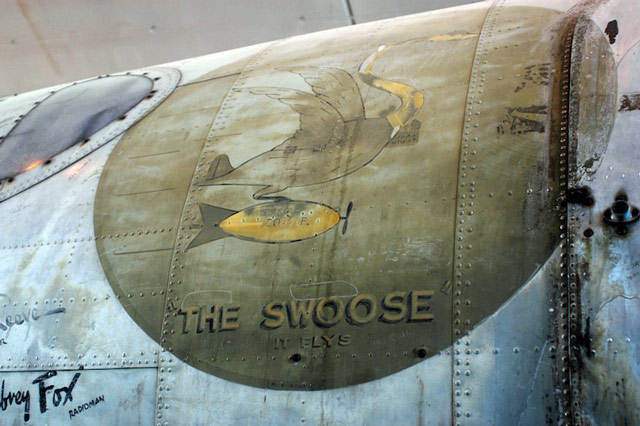 |
| Artwork depicting "The Swoose" on the B-17D aircraft that carried Lyndon Baines Johnson to Port Moresby on 8 June 1942. The aircraft is currently being restored in Dayton, Ohio (U.S. Air Force photo courtesy of the National Museum of the United States Air Force). |
Navy Reserve Lieutenant Lyndon B. Johnson, the future President, makes an aerial inspection tour from his location in Townsville, Australia. Johnson already has had an interesting time Down Under, having helped to quell a mutiny by African-African troops on 22 May 1942. The B-26 Marauder flying the mission has engine trouble after departing from Port Moresby and has to return to base, but the USAAF 19th Bombardment Squadron of the 22nd Bomber Group completes its mission (flying from Townsville to Port Moresby for refueling) to bomb Lae, New Guinea. The Port Moresby stage of the mission has to be delayed for an hour to accommodate LBJ, who arrives from Townsville in General Brett's VIP B-17D "The Swoose."
The mission is hazardous even though Johnson misses out on the actual bombing run. LBJ narrowly escapes death because he switches bombers at the last minute due to a pilot change, and the plane he leaves crashes into the sea off Salamaua, killing everyone on board. LBJ then also escapes potential harm when the B-17 on the flight back to Townsville gets lost and almost runs out of fuel. It has to make an emergency landing at remote Carisbrooke Station near Winton. This B-17D, incidentally, survives and is the property of the National Air and Space Museum in Washington, D.C. The strange sequence of events results in General MacArthur awarding Johnson a Silver Star, the Army's third-highest decoration. Johnson soon after heads back to D.C. in accordance with FDR's requirement that all members of Congress return to their legislative duties. He remains in the US Naval Reserve until January 1964.
The Japanese complete their occupation of the Philippines and declare it secure.
US 24-ton freighter Husky founders two miles off Cape Constantine in Nushagak Bay, Aleutian Islands. Everyone survives.
US submarine USS Trout (SS-202) picks up two survivors of the sunken Japanese heavy cruiser Mikuma.
There is fierce fighting near the town of Chuhsien, China. Both sides take heavy casualties.
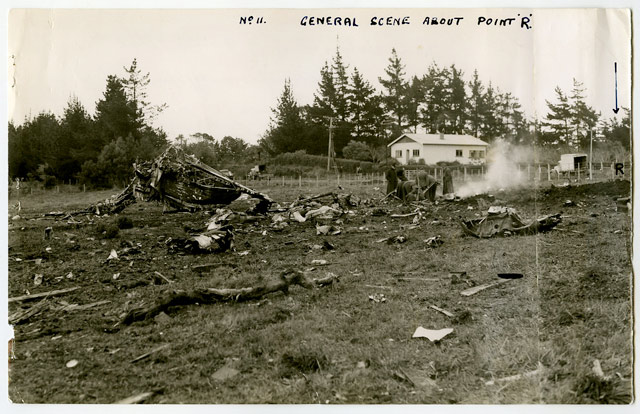 |
| Crash site of a B-17 near Whenuapai Aerodrome, Auckland, New Zealand, 9 June 1942. All 11 men on board are killed (Archives New Zealand Reference: ADQA 17211 AIR1 572 25/2/588). |
Battle of the Indian Ocean: The Japanese Divine Dragon Operation No. 2 submarine force, in which the Japanese high command placed high hopes, remains operational in the Mozambique Channel. However, it is now clear to the local commanders that the operation now has turned into a standard submarine patrol and that initial plans to target the British Far Eastern Fleet are obsolete. Accordingly, Lieutenant Commander Otani Kiyonori of I-18 has his men destroy and jettison mini-submarine M-18b, effectively ending the operation.
Around this time, British divers discover the remains of M-20b, which carried out the most successful attack at Diego Suarez. It is sitting upright on a reef in heavy surf (remnants remain there to this day). They salvage the propellers, now on display at the gravesite of its occupants, Lieutenant (j.g.) Akieda Saburo and POIC Takemoto Masami. They were killed on 2 June 1942 by a British patrol on the mainland while attempting to rendezvous with I-20.
The Japanese have not given up on the Indian Ocean by any means. On 5 June 1942, auxiliary cruisers Aikoku Maru and Hokoko Maru caught 6757-ton British passenger ship Elysia 350 miles northeast of Durban. They torpedoed it, and today it sinks, causing 22 deaths.
Battleship HMS Ramillies, previously damaged by a Japanese mini-submarine in late May 1942, arrives in Durban for repairs accompanied by light cruiser Emerald and three destroyers. The damage ultimately will require a return to the UK at Portsmouth on 8 September that will last until the summer of 1943.
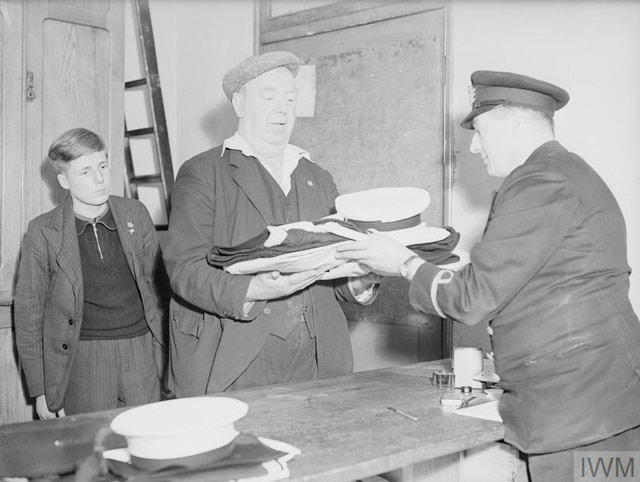 |
| A new recruit, age 62, joins the Royal Navy, 9 June 1942. ""Owd Bob" drawing his petty officer's rig on board the Armed Merchant Cruiser Depot ship HMS MERSEY. Behind him is Tommy Harding, age 18, another new entry who volunteered for this special naval service." © IWM A 8807. |
Eastern Front: German General Erich von Manstein's assault on Sevastopol has shown signs of turning into a battle of attrition, exactly what he didn't want. The priority is to take Sevastopol before the Case Blue offensive on the main front begins, and that now is looking doubtful. Luftwaffe General Wolfram von Richtofen begins changing attack priorities from assisting the front-line troops to attacking Soviet supply lines, a bad sign that the plan is faltering. The Luftwaffe is fully committed, flying 1044 sorties and dropping 954 tons of bombs, putting a strain on men, equipment, and logistics.
However, the German offensive is not dead, not by any means. General Franz Halder, remaining in East Prussia while the Fuhrer attends the Reinhard Heydrich funeral (see below), comments:
At Sevastopol, good progress despite strong enemy counter-attacks. Otherwise, all quiet. Army Group Center reports breakout of Cavalry Corps Belov to the south.
Halder does have his own grips about the Storfang operation. Writing about a meeting during the day with General Buhle, he comments acidly, "Report on Sevastopol. My suspicion that the Artillery Command is not of the best is confirmed."
The Red Navy is doing what it can to help its comrades ashore. Early in the morning, Soviet destroyers spot Axis mini-submarines operating from Yalta on their radar screens and unsuccessfully attack them. This new development induces Vice-Admiral Oktyabrskii to order his naval captains to concentrate less on offshore gunfire support of the army and more on keeping the sea lanes to Sevastopol clear. He also tells them to switch to area fire rather than targeted fire and cuts back on the number of surface vessel supply missions. This forces an increase in submarine supply missions. While they don't know it, the Axis mini-submariners thus achieve a tactical victory without sinking a single ship.
LIV Corps continues to make slow progress in the north, assisted greatly by an intense artillery bombardment laid down by the biggest guns ever used in combat. The 132nd Infantry clears a key obstacle, the Haccius Ridge, and the 22nd Infantry Division destroys the elite Soviet 79th Naval Infantry Brigade.
General Paulus' Sixth Army counterattacks against Red Army forces in the Kharkov sector. Paulus has plenty of troops because Sixth Army is fated to lead the Case Blue offensive toward Stalingrad. During this attack, Uffz. Wilhelm Crinius of 3./JG 53 shoots down two Soviet Il-2 Shturmovik ground-attack planes for his first two victories.
European Air Operations: Weather is poor on the Channel Front, with 10/10ths cloud cover down to 1500 feet and getting worse as the day proceeds.
A Polish squadron raids Essen. British Wellington IV R1725 crashes into the North Sea, 20 km west of Texel, Netherlands, while en route to bomb Essen. All six crewmen perish. Another Wellington targeting Essen, IV Z1412, is shot down by the nightfighter pilot Oblt. L.Fellerer of II/NJG 2. it crashlands on the beach 2 km west of St. Maartensvlotbrug. The five crewmen survive. A Wellington manages to make it back for a crashlanding after being attacked three times by Me-110 night fighters from below and astern, and the odds of survival are so iffy that the copilot bails out 20 miles west of Essen after the bombing run.
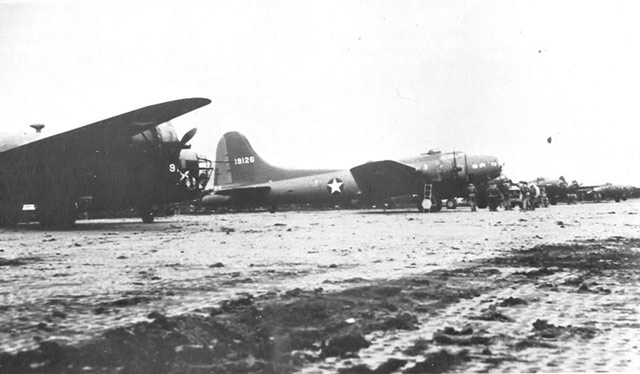 |
| "36th Bombardment Squadron LB-30 Liberator and a Boeing B-17E Fortress (41-9126) at Fort Glenn Army Air Base, Alaska, June 1942. 9126 was lost Aug 28, 1942." USAAF photo via Chloe, John Hale, (1984), Top Cover for America. the Air Force in Alaska. 1920–1983, Pictorial Histories Publishing Company, ISBN 0-933126-47-6. |
Battle of the Atlantic: U-124 (Kptlt. Johann Mohr), on its ninth patrol out of Lorient, torpedoes and sinks 940-ton French corvette FFL Mimosa (K11, Captain Roger R.L. Birot) 600 miles southeast of Cape Farewell in the British Isles. The Mimosa is an escort for Convoy ONS-100 and sinks within three minutes because the depth charges falling off the ship explode. The other escorts don't even notice the ship is missing until dawn breaks. There are 65-67 deaths and only four surviving French sailors, who are picked up by HMCS Assiniboine.
U-502 (Kptlt. Jürgen von Rosenstiel), on its fourth patrol out of Lorient, torpedoes 6589-ton US tanker Franklin K. Lane 35-40 miles (65 km) northeast of La Guiara and Cape Blanco, Venezuela. It is scuttled by the British destroyer HMS Churchill. The ship, a member of Convoy TO-5, is carrying 73,000 barrels of crude oil to Aruba for processing. There are four deaths and 37 survivors.
U-502 also gets another victim from the same convoy today, 5085-ton Belgian freighter Bruxelles. The ship manages to evade two torpedoes, but a third one blows a seven-meter (yard) hole in the side and the ship sinks within four minutes. The crew acts quickly and manages to launch lifeboats. Destroyer Churchill picks them up quickly. There are 53 survivors and one death.
U-432 (Kptlt. Heinz-Otto Schultze), on its fifth patrol out of La Pallice, torpedoes and damages 7073-ton Norwegian freighter Kronprinsen of Convoy BX-23A south of Cape Sable. The ship is taken in tow and beached at West Pubnico, Nova Scotia. Ultimately, the ship is repaired and returned to service.
U-432 also damages 8593-ton British freighter Malayan Prince with a torpedo that misses the Kronprinsen. The ship manages to remain with the convoy and is later repaired and returned to service in July 1942.
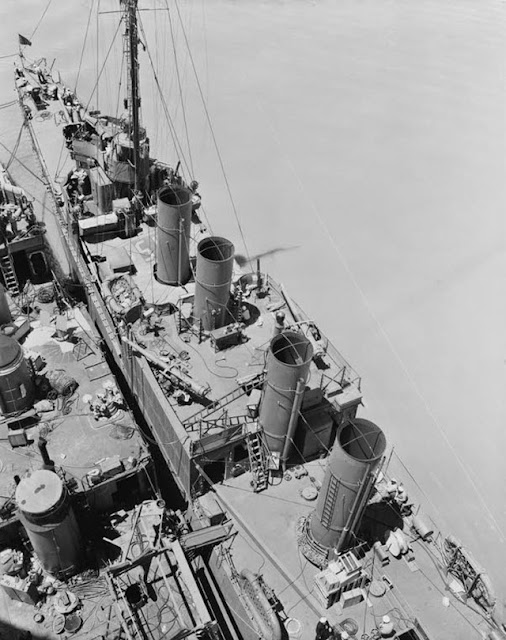 |
| Four-stack destroyer USS Southard (DMS-10), Mare Island, 9 June 1942. She has just been converted into a minesweeper (Rickard, J (15 September 2018), USS Southard (DMS-10), Mare Island, 9 June 1942). |
Battle of the Mediterranean: Early in the morning, the Luftwaffe sends 20 Junkers Ju 88 and 40 Ju 87 Stukas escorted by 50 Bf 109 and Me 110 fighters against the Free French in Bir Hakeim. However, thick smoke and dust force them to turn back. A second attack around noontime by 124 Stukas and 76 Ju 88s, escorted by 168 Bf 109s, has more luck. During this attack, Oblt. Hans-Joachim Marseilles of 3./JG 27 downs four RAF planes.
German artillery also opens up on the fortifications in the morning as General Erwin Rommel readies a final assault. After the planes and big guns have softened up the defenses, units of the 15th and 21st Panzer Divisions, the 90th Light Division, and Italian infantry launch a two-pronged attack.
Rommel's objective is the "high ground" near the fortress, a small rise called Point 186. The Italian Trieste Division makes good progress, overrunning a reinforced French force that is hampered by supply issues. The German advance gains steam in the afternoon when the 15th Panzer breaches the French line in the center, forcing a desperate counterattack with Bren Carriers that succeeds. Oberstleutnant Ernst-Günther Baade leads the Rifle Regiment 115 to within 200 meters (yards) of the fortress by dusk.
Overhead, the Luftwaffe establishes dominance due to previous losses in the RAF Desert Air Force despite frantic pleas for cover from French General Kœnig. The French are low on supplies and everyone can see the writing on the wall. British Major-General Frank Messervy, commander of the 7th Armoured Division, reports that a breakout should be attempted, and at 23:00 Kœnig signals for permission to evacuate the fortress. Lieutenant-General Neil Ritchie, commander of the 8th Army, replies that he'll prepare a thrust from the south but the fortress will have to hold out for another day or two.
With water and ammunition running out and casualties mounting, Kœnig orders a breakout anyway. The French formation quickly loses coherence in the darkness and the Axis forces react quickly. The retreat turns into desperate hand-to-hand combat but does make progress into the early morning hours of the 10th.
Italian Caproni bombers catch 1584-ton Swedish freighter Stureborg in the eastern Mediterranean and sink it with torpedoes and bombs. There are 20 deaths and only one survivor, whose raft reaches land near Gaza. Ten men in total started out on the raft but nine perished because it drifted for 19 days and they had no food or water.
U-83 (Kptlt. Hans-Werner Kraus), on its eighth patrol out of Salamis, shells and sinks 175-ton Palestinian sailing ship Typhoon four miles southeast of Sidon, Lebanon. Everyone survives.
RAF Catalinas of No. 240 Squadron sinks Italian submarine Zaffiro in the western Mediterranean southeast of Palma de Mallorca, Balearic Islands. There are no survivors.
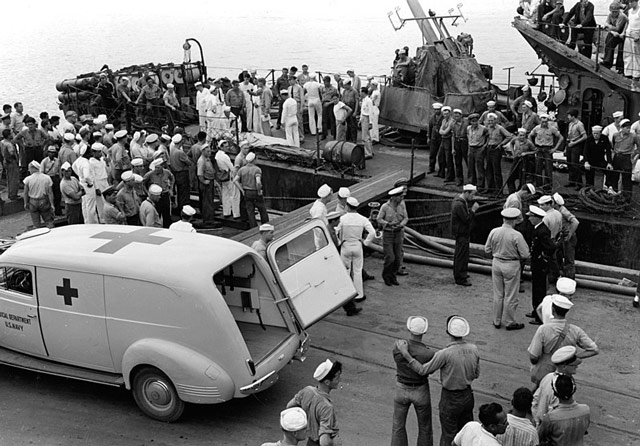 |
| Survivors of the destroyer USS Hammann (DD-412), torpedoed and sunk on 6 June 1942 at the Battle of Midway, are brought ashore at Pearl Harbor, 9 June 1942 (Naval History and Heritage Command 80-G-312064). |
Joint Allied Planning: The United States and British governments form the Combined Production and Resources Board. The purpose is to plan and coordinate production in each country to best serve war needs. It operates independently and competes with the Combined Munitions Assignment Board, which is under the jurisdiction of the Combined Chiefs of Staff. President Roosevelt's crony Harry Hopkins is the American leader behind the scenes, though Donald Nelson is the chair.
While sometimes criticized as ineffective, the Board changes the military procurement process based on statistical analysis and perceived priorities. It provides some order to the former chaotic ordering system directly to industry used by the militaries of the respective countries. British representatives tend to feel the Board favors the US and prefer to exert their influence through the Munitions Board because they feel the Combined Chiefs give them more of an equal say. Canada feels left out and eventually is admitted to the Board as an equal partner.
The real weakness of the Board is that its leaders don't really have much of an idea themselves of what the war effort needs or where the war is going until it is really too far along to matter. As the military strategy and objectives change - sometimes at the last minute - the Board must follow along and thus always is a step behind actual needs. Its findings also have to be implemented by the respective governments which may not necessarily agree completely with its decisions and thus may not treat them with a sense of urgency.
US Military: The Navy establishes a naval operating base at Kodiak, Alaska.
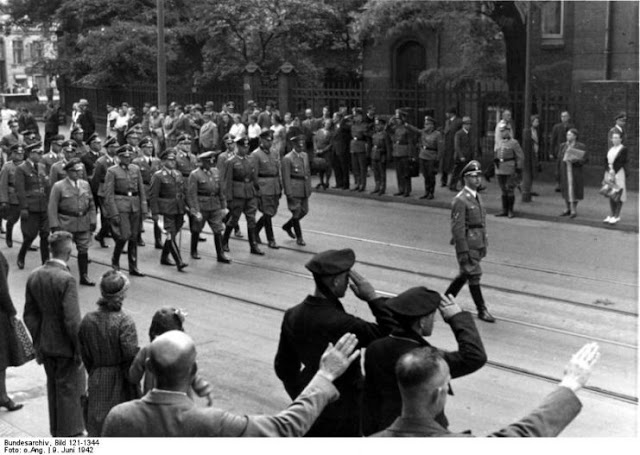 |
| Reichsfuhrer-SS Heinrich Himmler leads the procession at Reinhard Heydrich's Berlin funeral on 9 June 1942. Visible in the front row from left are Robert Ley, Karl-Hermann Frank, Erhard Milch, Sepp Dietrich, Sergeant Heinz Heydrich (Reinhard's younger brother), police chief Kurt Daluege (Heydrich's successor in Bohemia and Moravia), and Wilhelm Frick (Federal Archive Picture 121-1344). |
German Homefront: The government holds the second funeral for Reinhard Heydrich, who was shot by British agents on 27 May 1942. This second funeral is in Berlin (the first, on 7 June, was in Prague). All of the top Reich officials attend, including Adolf Hitler and Hermann Goering. Hitler awards Heydrich the German Order, the highest honor in the Third Reich, posthumously. After the ceremony, Heinrich Himmler tells his subordinates to ramp up the Holocaust.
Heydrich is interred in a plot at the Invalidenfriedhof in Berlin. The location, once well known, since the war has become secret to prevent fascist gatherings.
Privately, Hitler blames Heydrich's own lax security precautions on his demise. He tells his cronies that a man as important to the war effort as Heydrich never should have been driving in an unguarded open-air car through streets filled with people. Hitler, of course, is (rightly) paranoid about his own personal security and routinely changes his routes and timing to frustrate would-be assassins. This already has saved his life at least once, when he evaded a bomb planted at the Munich Brown House (Braunes Haus) on 8 November 1939.
Due to the Gestapo's mistaken belief that the Heydrich assassins operated from the town of Lidice, the local German authorities begin to obliterate it today. Today and tomorrow, they kill 199 men and deport 195 women to the Ravensbrück concentration camp. There are 95 children in the town, 81 of whom later perish at the Chelmno camp. Eight are adopted by German families. The German security forces also prepare to destroy the town of Ležáky.
The two agents who assassinated Heydrich, Jozef Gabčík and Jan Kubiš, remain at large despite a massive German manhunt. The local authorities make it clear to the Czech people that if they are not turned over, more blood will be spilled. They also promise a bounty of a million Reichsmarks. Since everyone knows the German threats are not just empty words and Lidice is the proof, this reaches some receptive ears.
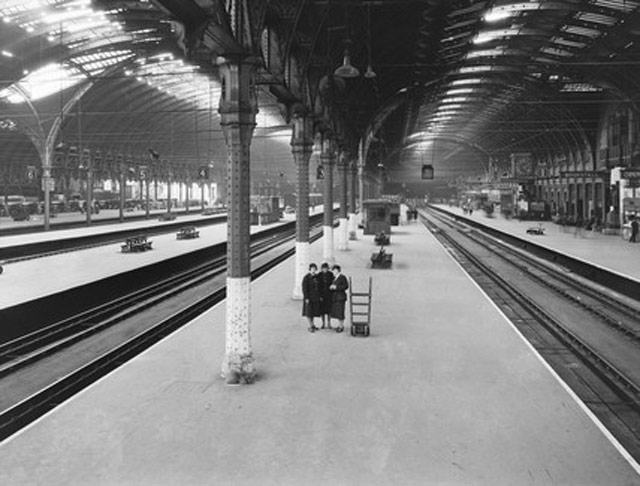 |
| Platforms 2 and 3 of Paddington Station, London, UK, 9 June 1942 (Science & Society 10442395). |
American Homefront: Lord Louis Mountbatten, Chief of the British Commandos, arrived in Washington for tactical conversations with US officers. Also returning from London are Generals Dwight D. Eisenhower, Henry "Hap" Arnold, and Mark Clark.
Ronald Reagan, who enlisted in the USAAF on 15 May 1942 as a private, receives a transfer to become the public relations officer for the First Motion Picture Unit in Burbank, California, under director John Ford. In this role, Reagan will be instrumental in "discovering" a young aviation worker in Burbank who will turn into film star Marilyn Monroe. He ends the war with the rank of Captain.
Future History: Heydrich's death leads to a series of prolonged court cases in the 1950s by his widow, Lina. She successfully argues to the West German government that she is entitled to a full pension as she widow of a German general. She writes a 1976 memoir, Leben mit einem Kriegsverbrecher (Living With a War Criminal), remarries, and passes away in 1985. Three of their four children survive the war.
Raymond "Ossie" Clark is born in Warrington, Lancashire, England. He becomes a top fashion designer during the "Carnaby Street" height of British fashion in the Swinging Sixties. He passes away on 6 August 1996 after being stabbed by a former lover.
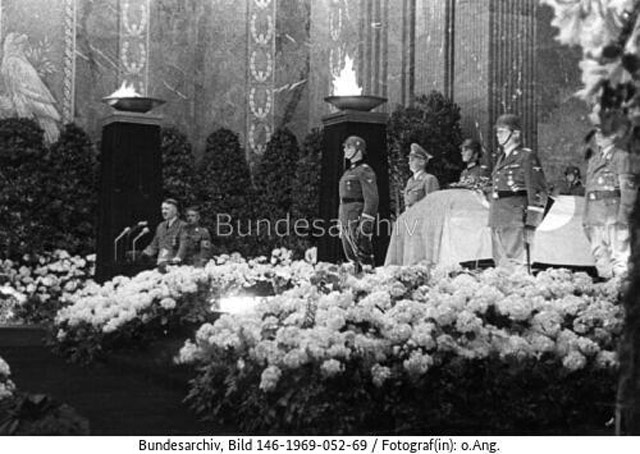 |
| Adolf Hitler gives a memorial address at the funeral of Reinhard Heydrich in the New Reich Chancellery, 9 June 1942 (Federal Archive Image 146-1969-052-69). |
2021


