Showing posts with label Molotov. Show all posts

Friday, December 24, 2021

June 11, 1942: U.S-Soviet Lend-Lease Agreement

Thursday 11 June 1942
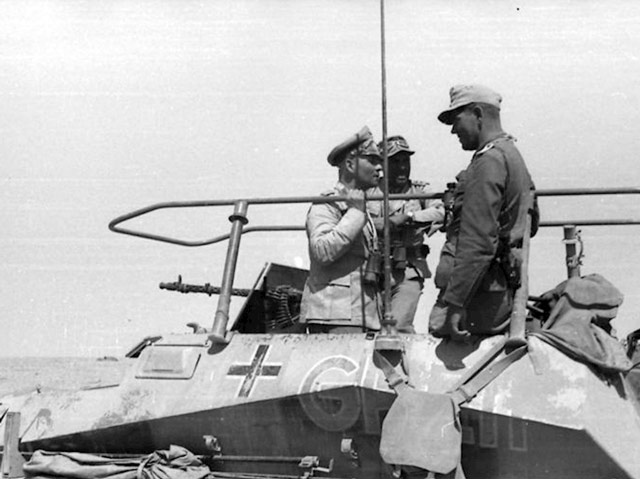
Rommel in North Africa worldwartwo.filminspector.com
German General Erwin Rommel in his command vehicle in North Africa, 11 June 1942 (Zwilling, Ernst A., Federal Archive Image 101I-443-1589-08).

Eastern Front: General Erich von Manstein's 11th Army continues battering away at Red Army defenses outside Sevastopol, Crimea, on 11 June 1942. His troops of the LIV Corps are having the most success north of the port, where the heaviest German artillery is located. The Soviet 345th Division counterattacks on the borderline between the Wehrmacht 132nd and 50th Divisions, but quick Luftwaffe intervention (1070 sorties while dropping 1000 tons of bombs today) prevents a rupture. The Red Army and LIV Corps, however, continue taking heavy casualties.

While progress is still being made at Sevastopol, the local commanders are getting concerned at the high cost of the small local gains. Luftwaffe General Wolfram von Richthofen, in command at Fliegerkorps VIII, comments sourly in his war diary that his forces have "only enough left for 1.5 more days of bombing." His mood is black, and he adds that "the specter of failure now seriously looms." On the spur of the moment, Richthofen decides that his bombers are dispersing their efforts too widely. He thus changes bombing procedures to conserve resources. The new tactic of "column bombing" involves bomber attacks on only specifically designated targets while the aircraft fly one after another in narrow air corridors.

The Red Air Force also is proving to be a nuisance, though not to the Luftwaffe. Instead, the Soviets are making nightly raids on German positions in the "rear" to the east at places like Simferopol, Theodosiya, Eupatoria, and Yalta. The Luftwaffe can see the attacks coming on their radar but do not have any night fighters to intercept them. Fortunately for the Germans, the Red Air Force bombing runs are very inaccurate, so the raids for the most part are ineffective.

Off the Crimean coast, a mini-war at sea also is brewing. The Soviets are running fast convoys to Sevastopol every night, and early in the morning, the Kriegsmarine decides to do something about it. For the first time, Axis small craft (MTBs and motorboats) manned by Italians attack a Soviet convoy near Cape Khersones. It is believed, but not absolutely certain, that they sink a Soviet ship.  

Back at Fuhrer Headquarters in East Prussia, General Halder also is getting impatient with Manstein's progress. He notes that the Soviet artillery at Sevastapol "is quite troublesome." However, further north, "The Voshansk attack is making very satisfactory progress." Meanwhile, the situation at Ninth Army is "unclear," with the Soviets "unaccountably" abandoning territory. This new Red Army tactic of not fighting for every inch of ground but instead trading space for time and tactical regrouping will befuddle and mislead the German High Command throughout the summer.

Battle of the Black Sea: Soviet submarine A-5 torpedoes and sinks 5695-ton Romanian freighter Ardeal off Odessa. Ardeal's captain beaches the ship to avoid sinking but is later repaired and returned to service.
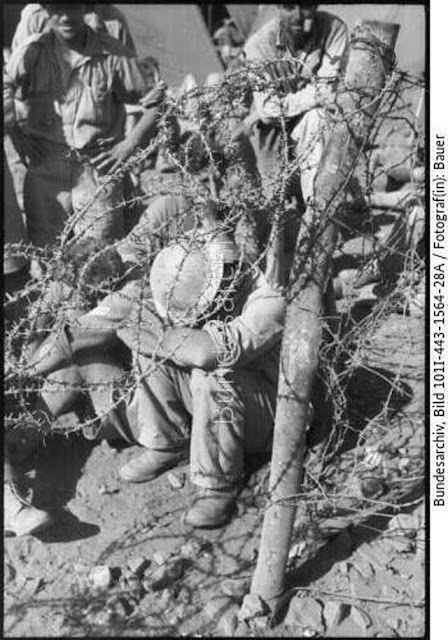
British POWs in North Africa worldwartwo.filminspector.com
British POWs in North Africa, 11 June 1942 (Farmer, Federal Archive Image 101I-443-1564-28A).

Battle of the Pacific: USS Saratoga rendezvouses with fellow carriers Enterprise and Hornet. It transfers 19 SBD Dauntless, five TBD Devastator of VT-5, and 10 VT-8 Avenger planes to the two other carriers to replace their losses at the Battle of Midway. The ships then turn head to Pearl Harbor in foul weather.

Reinforcements for the Pacific Fleet are on the way. USS Wasp and battleship North Carolina, along with escorting destroyers, pass through the Panama Canal. Battleships just barely fit through the channel with mere feet (sometimes only inches) to spare on each side. The Japanese know the importance of the Canal and have plans to block it throughout the war.

The U.S. 11th Air Force make their first attack on the Japanese on Kiska Island in the Aleutian chain. The attack is made by five B-24 and five B-17 bombers flying from Cold Bay and loading their bomb racks at Umnak Island. PBY Catalinas also participate in the attack. on Kiska Harbor. The attack only scores some near misses on the Japanese ships while losing a B-24 (Captain Jack F. Todd) to anti-aircraft fire. This begins a 48-hour period during which the Catalinas make repeated attacks without much success.

British POWs in North Africa worldwartwo.filminspector.com
British and South African POWs in North Africa, 11 June 1942 (Zwilling, Ernst A., Image 101I-443-1589-34A).

Battle of the Indian Ocean: German raider Michel (HSK-9) uses its guns to sink 5186-ton British freighter Lylepark southeast of Cocos Islands (northwest of Perth, Australia). Michel is on her way from Japan for a hunting raid off the coast of South America.

Japanese submarine I-20 torpedoes and sinks 7926-ton British freighter Mahronda in the Mozambique Channel. There are two deaths and 40 survivors. The survivors are rescued by the Royal Indian Navy ship HMIS Orissa. This is an unusual situation where a German ship sinks a ship further west than a Japanese submarine in the Indian Ocean on the same day.

Australian corvette HMAS Wallaroo (J 222) sinks after colliding with a ship it is escorting, U.S. Liberty Ship Henry Gilbert Costin. The sinking ironically occurs because the ships are sailing without navigation lights in overcast weather to avoid detection by the enemy. Wallaroo sinks while trying to return to Fremantle, while the other ship makes it back. There are three deaths.

European Air Operations: The foul weather that has characterized the spring of 1942 continues today. It is 10/10ths clouds during the morning, but visibility clears a bit by noon. RAF fighters attack Koksijde and the Furnes Canal, sinking and damaging barges. The attacks are broken off after encountering heavy anti-aircraft fire at Nieuport. These attacks in low visibility are quite hazardous, and several planes narrowly avoid collisions or hitting ground obstructions.

Battle of the Baltic: German support ship MRS-11 Osnabruck hits a mine and sinks off Tallinn, Estonia. There are 84 deaths. The ship is later salvaged.
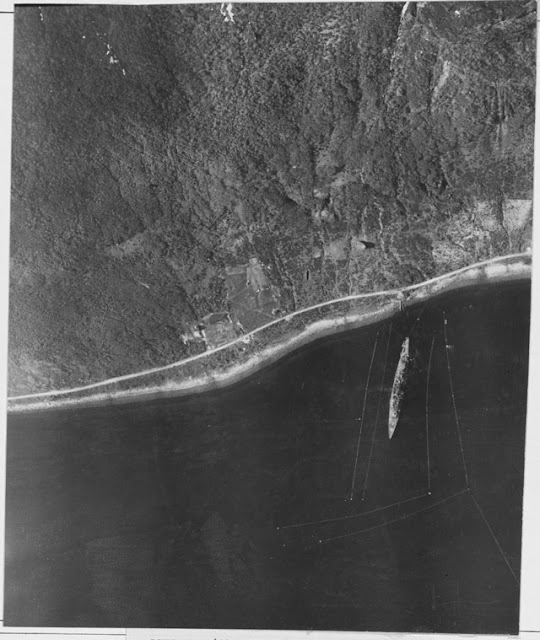
German cruiser Lutzow spotted by Allied air reconnaissance 11 June 1942 worldwartwo.filminspector.com
German heavy cruiser Lutzow photographed by Allied air reconnaissance, 11 June 1942 (Naval History and Heritage Command NH 110843).

Battle of the Atlantic: Italian submarine Leonardo da Vinci uses torpedoes and gunfire to sink 5483-ton Dutch freighter Alioth in the Atlantic Ocean near Freetown, Sierra Leone. Everyone survives.

U-504 (Kptlt. Hans-Georg Friedrich Poske), on its third patrol out of Lorient, torpedoes and sinks 4282-ton Dutch freighter Crijnssen 85 miles southwest of the Cayman Islands. There are one death and 93 survivors, who abandon the ship in four lifeboats and a gig. The sinking is especially traumatic for some on board because there are a dozen survivors of Sylvan Arrow (sunk by U-155 on 20 May 1942) and one from U.S. tanker T.C. McCobb (sunk by Italian submarine Pietro Calvi on 31 March 1942). The survivors in one lifeboat and the gig from Crijnssen are picked up by the U.S. freighter Lebore, which itself is sunk by U-172 a few days later. The other lifeboats make landfall in Mexico aside from four crewmembers on a raft who are picked up by the Panamanian tanker J.A. Mowinckel.
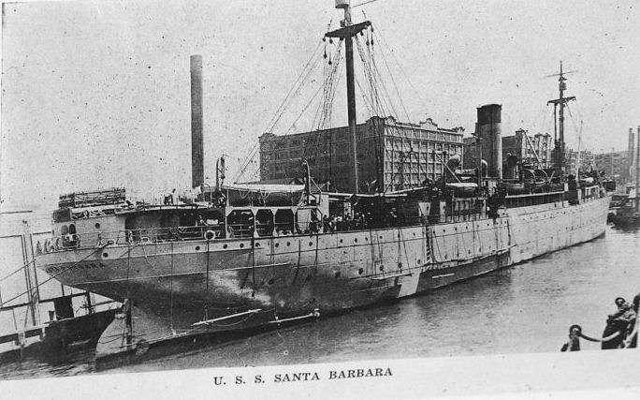
Freighter American sunk on 11 June 1942 worldwartwo.filminspector.com
SS American, originally the Santa Barbara, was sunk by U-504 on 11 June 1942. 

Much later in the day, U-504 also torpedoes and sinks 4846-ton U.S. freighter American off Honduras. The ship is hit by two torpedoes and sinks within 25 minutes. There are four deaths and 34 survivors, who are picked up by British freighter Kent. One survivor perishes after being picked up.

U-159 (Kptlt. Helmut Friedrich Witte), on its second patrol out of Lorient, torpedoes and sinks 7130-ton British freighter Fort Good Hope northwest of Colon, Panama. Two torpedoes hit and sink the freighter (carrying wheat, timber, lead, and zinc) within half an hour. There are two deaths and 45 survivors, who are picked up by U.S. gunboat USS Erie (PG 50).

U-455 (Kptlt. Hans-Heinrich Giessler), on its third patrol out of St. Nazaire, torpedoes and sinks 6914-ton British tanker Geo H. Jones northeast of the Azores. The tanker is a straggler from Convoy SL-111 heading from Aruba to Freetown. There are two dead and 40 survivors, who are picked up by HMIS Orissa (J 200).

U-157 (KrvKpt. Wolf Henne), on its second patrol out of Lorient, torpedoes and sinks 6401-ton U.S. tanker Hagan five miles off the north coast of Cuba. Hagan is simply steaming a straight course independently and thus is an ideal target. Two torpedoes hit the engine room and fuel bunkers, sinking the ship, which is carrying 2,676 barrels of blackstrap molasses, fairly quickly. There are six dead and 38 survivors, who make landfall in Cuba in two lifeboats. This is the only victory for U-157 in its career, which ends a couple of days later when it is sunk.

U-94 (Oblt. Otto Ites), on its ninth patrol out of St. Nazaire, torpedoes and sinks 4458pton British freighter Pontypridd northeast of St. John's, Newfoundland. Pontypridd is a straggler from Convoy ONS-100. There are two dead and 46 survivors, who are picked up by HMCS Chambly (K 116).

U-158 (Kptlt. Erwin Rostin), on its second patrol out of Lorient, torpedoes and sinks 13,467-ton Panamanian tanker/transport Sheherazade 20 miles west of Ship Shoal Buoy, Louisiana. Sheherazade is a French ship turned over to the U.S. War Shipping Administration (WSA). There are one dead and 58 survivors, who are rescued by shrimp boat Midshipman and fishing vessel 40 Fathoms. The rescue happens quickly enough that nine men are found swimming after having jumped overboard.

Norwegian 6049-ton freighter Haugarland hits a mine and sinks off Terschelling, Netherlands. It appears that everyone survives.

U.S. 9310-ton tanker F.W. Abrams hits a U.S.  defensive mine and sinks east of Morehead City, North Carolina (near Cape Hatteras). The 36 men on board make it to shore near Morehead City. A tug ("Relief") attempts salvage of the floating wreck without success.

U-87 mines the waters off Boston, Massachusetts, while U-373 mines the area near Delaware Bay.
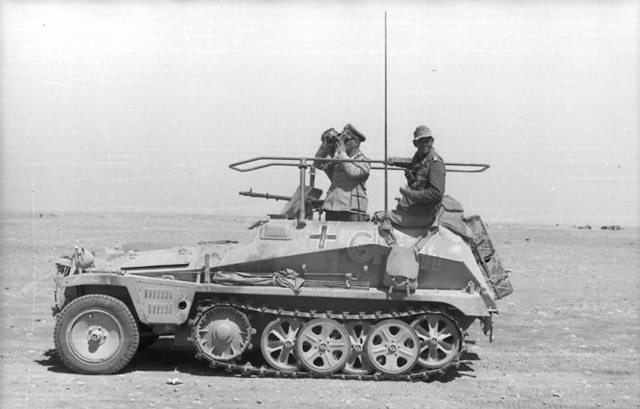
Rommel in North Africa worldwartwo.filminspector.com
General Rommel in his Sd.Kfz. 250 command truck, 11 June 1942 (Zwilling, Ernst A., Federal Archive Image 101I-443-1589-09).

Battle of the Mediterranean: German General Erwin Rommel's Afrika Korps occupies the fortress of Bir Hakeim, which has been a roadblock in his advance toward Tobruk. The Free French defenders have almost all escaped to British lines to the south save for a small rear guard left to delay the attackers. The French and British pull back from their advanced position outside the fortress to Gasr-el-Arid early in the morning, completing the breakout by 2700 men and women (there are some female nurses).

After finally clearing this obstacle, about which he later comments "seldom in Africa was I given such a hard-fought struggle," Rommel quickly resumes his offensive, sending the 15th Panzer and 90th Light Divisions toward El Adem. The British 201st Guard Brigade in the Knightbridge Box, which blocks the way to Tobruk to the east, comes under severe pressure. While the Allied defense of Bir Hakeim has seriously disrupted Rommel's overly ambitious timetable, his advance now regains momentum.
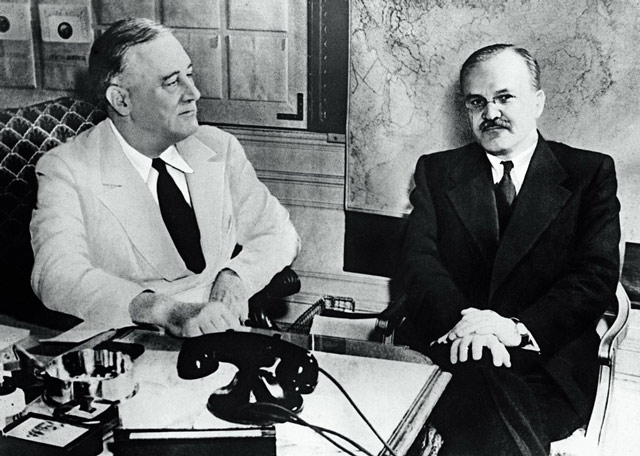
Molotov and FDR in Washington on 11 June 1942 worldwartwo.filminspector.com
Soviet Foreign Minister Vyacheslav Molotov and U.S. President Franklin D. Roosevelt meet in Washington, D.C., to finalize the lend-lease agreement, 11 June 1942 (Alliance.rusarchives.ru).

US/Soviet Relations: The United States and Soviet Union sign a lend-lease agreement. The agreement contemplates "mutually advantageous economic relations" between the two powers, with the agreement to continue in force "until a date to be agreed upon by the two governments." U.S. Secretary of State Cordell Hull and Soviet Ambassador Maxim Litvinov sign for their respective governments.

Article 1 sets out the main purpose of the agreement:
The Government of the United States of America will continue to supply the Government of the Union of Soviet Socialist Republics with such defense articles, defense services, and defense information as the President of the United States of America shall authorize to be transferred or provided.
This agreement, however, is not specific on certain key points. These become a lingering bone of contention during the post-war era. Significantly, the title to the equipment supplied by the U.S. is not transferred to the Soviet Union. The U.S. believes it still "owns" the items and retains rights to them, while the USSR believes it now owns them because they were freely given.

Technically, under the U.S. interpretation of the agreement, the Soviet Union is obligated to return any intact equipment or compensate the United States for it after the war. The USSR, perhaps understandably, has a vastly different interpretation. This leads to awkward exchanges between the two governments in the late 1940s in which the United States demands either the return of the intact equipment or payment for them, including limitations on the equipment's transfer to other countries. Ultimately, the United States simply demands payment for the "civilian-type articles remaining in existence."

Of course, the United States already has abandoned military equipment of its own at bases around the world because it is obsolete and considered too expensive to return to the homeland. Thus, there seem to be deeper reasons underlying the disagreement. It is entertaining to ponder the reactions of the Soviets when they receive these petty and abrasive demands for payment for goods they always assumed were given for free to win the war at the cost of Soviet blood. These pointless and unproductive "negotiations" help to poison the relations between the two nations and contribute to the growth of the Cold War, a hostile relationship that more or less continues to the present day.
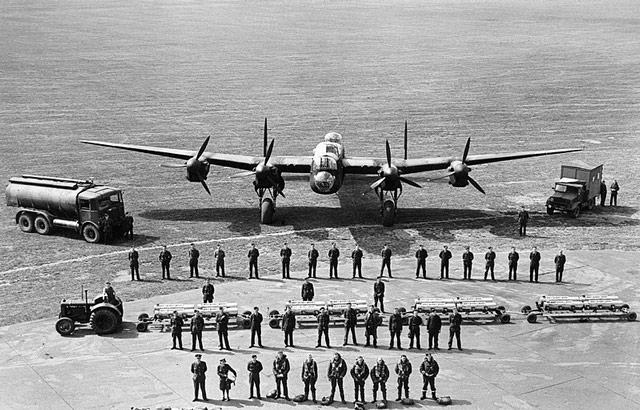
An Avro Lancaster and its crew on 11 June 1942 worldwartwo.filminspector.com
An Avro Lancaster and the personnel and equipment needed to keep it flying. This photograph was taken at Scampton, Lincolnshire, on 11 June 1942.  © IWM CH 15362.

German Military: Adolf Hitler issues Führer Directive 32. It sets out operations to be undertaken after the defeat of the Soviet Union, including the capture of Gibraltar with or without Spain's cooperation and resumption of the "siege of England." It is a curious mixture of far-sighted planning and mundane objectives such as the capture of Tobruk. It presupposes the quick defeat of the USSR in the coming Case Blue summer offensive and, like many of Hitler's grand strategies, assumes launch conditions that do not yet exist.

U.S. Military: With the threat to the U.S. west coast vastly reduced due to the Japanese defeat at Midway, the 97th Bombardment Group deployed for emergency purposes on the coast is transferred back to New England for eventual movement to join the Eighth Air Force in Great Britain.

Holocaust: Adolf Eichmann holds a meeting for his underlings controlling Jewish Affairs in France, Belgium, and Holland. This meeting sparks a systemic deportation scheme for Jewish residents of those areas to the extermination camps in the East that affects tens of thousands of people.

German Homefront: Michael Kitzelmann, 26, is executed at Orel Prison after being court-martialed and convicted of crimes against the state. Kitzelmann, a Wehrmacht lieutenant, was denounced by a sergeant for saying things that "undermined the military." He was in a hospital being treated for wounds when the allegations against him were made, but apparently, he made them previously while serving on the Eastern Front. The statements apparently concerned certain atrocities that Kitzelmann witnessed against the Russian population. While Kitzelmann became outspoken, he also had earned the Iron Cross Second Class and the Wound Badge in Gold.

TheGerman Bundestag rehabilitated Kitzelmann on 8 September 2009. A plaque in his memory is at the Johann-Michael-Sailer-school in Dillingen an der Donau.

American Homefront: The New England Journal of Medicine reports a case of "internal anthrax," which is considered quite novel because the vast majority of cases are of the cutaneous type. The patient died after showing progressively worse symptoms and a full autopsy was performed. Penicillin, still in its experimental phase, will become the accepted treatment for anthrax in 1944. 
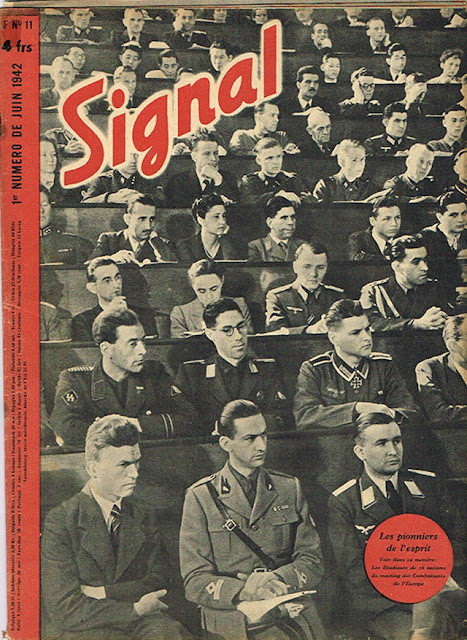
German Signal magazine from June 1942 worldwartwo.filminspector.com
Signal magazine, June 1942.

2021

Tuesday, September 14, 2021

May 26, 1942: Rommel Pounces in North Africa

Tuesday 26 May 1942

USS Hornet 26 May 1942 worldwartwo.filminspector.com
USS Hornet at Pearl Harbor, 26 May 1942 (Naval History and Heritage Command 80-G-66129).

Battle of the Pacific: After a hard sail from the Southwest Pacific, USS Enterprise arrives at Pearl Harbor on 26 May 1942. USS Yorktown, damaged at the Battle of the Coral Sea, is roughly 24 hours behind. Vice Admiral William Halsey has been in command of the task force (TF 16), but he has suffered a case of dermatitis and now it is under the command of Rear Admiral Raymond A. Spruance. Repair crews are standing by to undertake repairs to Yorktown once it arrives, with the plan being for Enterprise, Yorktown, and USS Hornet to quickly depart for Midway Island.

US Navy aircraft ferry USS Kitty Hawk (AKV-1) arrives at Midway with reinforcements. These include 3-inch (76.2 mm) antiaircraft guns of the 3rd Defense Battalion, a light tank platoon, and reinforcements for Marine Air Group Twenty Two (MAG-22). None of these men, of course, realize how close the battle is.

Meanwhile, the Japanese are finally ready to begin their operation to take Midway and islands in the Aleutians. The Japanese Northern Force (two light carriers) departs from Japan toward the Aleutians. The main force (Kido Butai) allocated to Midway remains in the Inland Sea for another day. The Japanese have no idea that the US Navy has broken their codes and knows with precision the date and places of their planned invasions. A Japanese "Glen" seaplane reconnoiters Kiska Island in the Aleutians and has no issues.

The US Navy has no intention of interfering with the Aleutians Island invasion and instead will concentrate all of its forces at Midway. However, the 11th Air Force based at Elmendorf Field near Anchorage has been sending some air reinforcements to the Aleutian Islands. Today, it sends the P-40s of the 11th Fighter Squadron, 28th Composite Group to Umnak, Aleutians.

USS Salmon torpedoes and sinks Japanese 11,441-ton repair ship Asahi 100 miles southwest of Cape Paderas (south of Phan Thiet, Vietnam). There are sixteen deaths, but 582 crewmen and Captain Tamura survive.

Battle of the Indian Ocean: Today, 26 May 1942, is considered the end of the Burma campaign as the last of the Allied forces slip out of Burma. General "Vinegar Joe" Stilwell has gotten out with his command by walking through jungles with 114 people, including nurses, a Chinese general with his personal bodyguards, mechanics, some civilians, a news reporter, and British commandos. The Japanese have complete control of Burma, part of which is now garrisoned by Thai troops. While the Chinese fear an invasion across the Himalayas, the Japanese are not looking in that direction but instead have their eyes set on eventually invading India.

NY Daily Mirror 26 May 1942 worldwartwo.filminspector.com
The 26 May 1942 New York Daily Mirror is full of stirring news about the successful Soviet offensive south of Kharkov - where the Red Army actually is staring a massive defeat in the face.

Eastern Front: After the failure of one breakout attempt from their pocket southeast of Kharkov, Red Army soldiers try again this morning a little to the north. This attack is not quite as forceful as the one on the 25th toward Petrovskoye and only comes within four miles of succeeding. German Army Group South commander Field Marshal Fedor von Bock watches the proceedings from a hill south of Lozovenka. He sees the Luftwaffe's best ground-attack aircraft (Ju 87 Stukas, Ju 88 medium bombers, and He 111 medium bombers) pound the masses of Soviet troops clogging the roads. He remarks that it is "an overpowering picture."

Back at Fuhrer Headquarters, General Franz Halder writes:

In the Izyum pocket, desperate break-out attempts to the east continue. Our attack has divided the pocket into two smaller pocket. More feeble attempts from the outside.

Halder further notes that the other prong of the Soviet pincer movement also is ending: ""On the front east of Kharkov, the attacks are dying down. The enemy concentrations are thinning."

Three Soviet generals, including Major General I.V. Bobkin, die in the fighting. By the afternoon, hordes of Red Army soldiers are trapped in a 10x2 mile pocket in the Bereka Valley. The 23rd Panzer Division and the 1st Mountain Division drive in past streams of surrendering Soviet soldiers. Red Army General Timoshenko continues trying to direct offensive operations within the pocket, but it would take a miracle for a breakout to succeed now. The Germans still remain astonished that the Red Army hasn't tried a major relief operation from the east.

Soviet 12-ton river minesweeping launch No. 916 is sunk today, perhaps by scuttling.

European Air Operations: Poor weather continues to hamper operations on the Channel Front. The Royal Canadian Air Force reports "Weather, unsettled with occasional showers."

A Bristol Beaufighter Mk 11F of RAF No. 125 (Newfoundland) Squadron crashes ear Eastern Breakwater, Swansea Harbour, Swansea, Glamorgan. The crew survives.

U-333 arrives in port on 26 May 1942 worldwartwo.filminspector.com
U-333 (Kptlt Peter-Erich Cremer) arrives back at its base at Saint-Nazaire on 26 May 1942. Note damage to the conning tower. Böttger, Gerd, Federal Archive Fig. 101II MW-4457-08.

Battle of the Atlantic: U-103 (Kptlt. Werner Winter), on its seventh patrol out of Lorient, torpedoes and sinks 5588-ton US freighter 125 miles (232 km) northwest of Montego Bay, Jamaica. All 35 men take to the lifeboats, where Winter questions them and gives them some cigarettes. A Cuban gunboat rescues 33 of the men, while two are picked up by a US Navy seaplane.

U-106 (Kptlt. Hermann Rasch), on its sixth patrol out of Lorient, stops 5030-ton US freighter Carrabulle in the Gulf of Mexico with a siren and a shot across the bow. The Carrabulle's radio operator sends a distress call, then the entire crew of eight officers and 32 men take to two lifeboats. Rasch waits until the instant the second lifeboat hits the water before torpedoing the freighter, which sinks the ship and also destroys that lifeboat. The entire incident is unusual, with a report that Rasch asks the first lifeboat if everyone is clear, is told no, and then laughs and fires anyway. There are 22 dead, all from the second lifeboat, and 18 survivors who are picked up by US freighter Thompson Lykes.

U-703 (Kptlt. Heinz Bielfeld), on its second patrol out of Skjomenfjord, torpedoes and sinks 6191-ton US freighter Syros 200 miles southwest of Bear Island. Syros is traveling as part of Convoy PQ-16 toward Murmansk. The attack is made at 02:59, which is daylight at this latitude at this time. The crew is unable to use the lifeboats and use three rafts. Fortunately, help is nearby, but still a dozen men die and there are 28 survivors. The survivors have an eventful ride back to Iceland on US freighter Hybert when it blunders into a British minefield northwest of Iceland and sinks, but they all survive that sinking, too.

Luftwaffe planes based in Norway find US freighter Carlton, which was part of PQ-16 but had engine trouble and now is under tow by British trawler HMS Northern Spray. The planes somewhat surprisingly make no hits on this easy target. 

German artillery near Murmansk makes a rare hit on a ship when it sinks 860-ton Norwegian tanker Vardø near Murmansk. The tanker, loaded with oil and gasoline, sinks quickly. Casualties are unknown.

French 4578-ton freighter Enseigne Maurice Préchac springs a leak and sinks east of the Azores.

Map of Battle of Gazala 26 May 1942 worldwartwo.filminspector.com
A general overview map of the Battle of Gazala that began on 26 May 1942. Indicated in red are the Italian feints and then General Rommel's cartwheel to the southeast.

Battle of the Mediterranean: German General Erwin Rommel breaks a long stalemate in the Western Desert. At 14:00, the Italian X and XXI Corps attack the center of the British Gazala line.  This is Operation Venice (Unternehmen Venezia). Only a few German units are involved in this attack, while other units drive north to support the attack. Rommel's ground forces are aided significantly by the Luftwaffe's JG 27 and III./JG 53 fighter forces.

However, the Italian assault is only a feint. It is designed to draw Allied attention and reserves north and away from Rommel's main target. After dark, Rommel with the 15th Panzer Division personally leads Panzerarmee Afrika, the Deutsches Afrikakorps (DAK), Italian XX Motorised Corps, and the German 90th Light Afrika Division in a sweeping arc through the desert to the southeast. His intention is to launch a powerful thrust into what Rommel considers to be the most vulnerable sector of the British Gazala defensive line, a fort at Bir Hacheim largely occupied by Free French forces. If everything works perfectly, Rommel may be able to make a thrust to the coast and cut off large Allied formations and maybe even capture the port of Tobruk.

Royal Navy 195-ton minesweeper HMS Eddy hits a mine and sinks near Grand Harbour, Malta.

Partisans: The German anti-partisan attack near Bryansk, Operation Hannover, remains stalled by heavy rains. General Halder notes in his war diary, "the attack against Cav. Corps Belov is still hampered by adverse weather, and is making only slow progress."

Signing of Anglo-Soviet Agreement of 26 May 1942 worldwartwo.filminspector.com
"A general scene showing delegates enjoying a walk in the gardens of 10 Downing Street, following the signing of the Anglo-Soviet Alliance. Left to right, they are Mr. Sabolev, Mr. Papov, Ivan Maisky (Soviet Ambassador to London), Anthony Eden (British Secretary of State for Foreign Affairs), Molotov (Soviet Foreign Secretary), Prime Minister Winston Churchill, and an unidentified naval officer." © IWM CH 5701.

Spy Stuff: Four German saboteurs depart from Lorient, France, on board a submarine. This is part of Operation Pastorius. They are bound for a landing at Amagansett, Long Island, New York, which they will reach early on 13 June 1942. This group is led by George John Dash, a former private in the US Army Air Corps stationed in Honolulu before being honorably discharged, then re-enlisting and serving at Fort Ontario in Oswego, New York. Another group led by Edward Kerling and bound for Ponte Vedra Beach, Florida, also departs by U-boat around this time (one group departs on 26 May, the other on 28 May, the sources conflict on which left first and the U-boats are not identified in the sources).

The other saboteurs in Dasch's group are Ernest Peter Burger, Heinrich Harm Heink, and Richard Quirin. They have been trained at the Oberkommando der Wehrmacht, the German High Command, on an estate at Quenz Lake, near Brandenburg and Berlin. Their mission is to find stuff and blow it up. Dasch ultimately betrays the entire operation and alerts the FBI..

Allied Relations: Lieutenant General Henry H "Hap" Arnold, Commanding General USAAF; Rear Admiral John H Towers, USN, Chief of the Bureau of Aeronautics; and RAF Air Chief Marshall Sir Charles F Portal have a meeting in London. Prime Minister Winston Churchill opens the meeting at 10 Downing Street. The main topic of these discussions is the basing of US bombers and fighters in the United Kingdom for offensive operations against the Reich.

Reinhard Heydrich in Prague on 26 May 1942 worldwartwo.filminspector.com
Reinhard Heydrich attends 'Prague Music Week" with his wife, Lina Heydrich, at the Waldstein Palace, Prague, Czechoslovakia, on 26 May 1942. Federal Archives Image 146-1972-039-24.

Anglo/Soviet Relations: In London, British Foreign Secretary Anthony Eden n and Soviet Foreign Minister Vyacheslav Molotov sign the Twenty-Year Mutual Assistance Agreement Between the United Kingdom and the Union of Soviet Socialist Republics, better known as the Anglo-Soviet Treaty of 1942. The agreement codifies a de facto wartime alliance between the two powers, with a political part of the agreement to continue for twenty years regardless of the duration of hostilities.

The treaty is bilateral, which is somewhat unusual given the cozy relationship between Great Britain and the United States and the other Allies. However, British Prime Minister Winston Churchill at this stage of the war is in constant communication with US President Franklin Roosevelt and would not do anything to threaten that relationship. The core of the agreement is that neither party will seek a separate peace, which all of the Allies agree with but hitherto have had difficulty securing Stalin's formal commitment. In this way, the Anglo-Soviet Treaty of 1942 is a key step in building a united front among all of the Allies. Otherwise, the agreement basically just recognizes the current state of affairs between the United Kingdom and the Soviet Union.

P-61 Black Widow first flight is on 26 May 1942 worldwartwo.filminspector.com
Northrop Corporation XP-61 "Black Widow" prototype 41-19509 at Northrop Field, 1942. (U.S. Air Force).

US Military: Test pilot Vance Breese makes the first flight of the Northrop XP-61 Black Widow night fighter. The flight takes place at Northrop Field in Hawthorne, California. The Army Air Force places great hopes in this plane because it is the first purpose-designed night fighter, and the US is desperately short of such planes. However, the Black Widow gets bogged down in development issues and is largely superseded by the time it can become operational.

Jet-assisted takeoff (JATO) is demonstrated with a Brewster F2A-3 Buffalo at NAS Anacostia, D.C. The plane uses five British antiaircraft solid propellant rocket motors and its takeoff distance is reduced by 49%.

Japanese Homefront: Radio Tokyo reports that "America and Britain... have now been exterminated.. the British and American fleets cannot appear on the oceans." This apparently is based on supposed naval losses in the Battle of the Coral Sea. However, US losses there were much smaller than the Japanese think.

American Homefront: First Lady Eleanor Roosevelt visits Muhlenberg College to celebrate Women's Day.

Congress passes the National Housing Act Amendments of 1942 (May 26, 1942, ch. 319, § 15, 56 Stat. 305). These deal with providing rental housing for war workers in areas determined critical for defense work by the War Production Board, which estimates that housing will be needed for 1.3 million workers, including 100,000 in dormitories and 285,000 family dwelling units. The plan is for many low-income workers to be able to buy their dwellings, though many will rent. A lot of these homes will be mobile homes, a new concept at this time, because defense production needs may change and the homes may need to be moved. You ever wonder where mobile homes originated? Look no further.

Eleanor Roosevelt 26 May 1942 worldwartwo.filminspector.com
Eleanor Roosevelt arrives at Muhlenberg College; photographer unknown, “Women's Day: Tuesday, May 26, 1942.,” Muhlenberg College Historical Photograph Collections, accessed September 15, 2021.

May 1942


2021

Wednesday, May 19, 2021

May 20, 1942: Churchill and Molotov Negotiate

Wednesday 20 May 1942

Churchill and Molotov, 20 May 1942 worldwartwo.filminspector.com
Prime Minister Winston Churchill greets Soviet Foreign Minister Molotov in the back garden of No. 10 Downing Street, 20 May 1942. Also seen in the photo are  Deputy Prime Minister Clement Attlee, British Foreign Secretary Anthony Eden, and others (The Daily Telegraph).
Battle of the Pacific: Admiral Nimitz approves a secret operation on 20 May 1942 to ascertain Japanese plans. One of the codebreakers in the Honolulu station, Jasper Holmes, has come up with a way to ascertain the location of "AF," known from decrypts to be the target for an upcoming Japanese invasion. Using an undersea cable that is known to be secure, Nimitz today sends a message to the Midway Island base commander telling him to send out a radio message that there is a "water shortage" at the island. "At the present time, we have only enough water for two weeks. Please supply us immediately."

Just to make certain the intended Japanese recipients get the radio message, the island commander also is instructed to send the request for help both in a code the Japanese are known to have broken and "in the clear" (without coding). The US naval intelligence offices in three locations - Melbourne, Honolulu, and Washington - then sit back to see what develops.

The Japanese indeed are preparing an offensive operation against Midway. Today, Admiral Yamamoto sends out Operational Order 14. This details a complex plan to coordinate invasions of the Aleutian Islands and Midway with troops from Saipan.

A Yeoman in the US Navy Fleet Radio Unit in Melbourne, Australia (FRUMEL), Bill Tremblay, is working late. At 23:30, he identifies Yamamoto's message as important even though it is badly garbled. After Tremblay discusses it with his superiors, the message is put on a fast track for decryption. That, however, will take several days. The Honolulu station also intercepts a copy of the message which also is garbled, but largely in different places. Between the two interceptions, a large portion of the lengthy message can be decrypted.

B-17s based in Australia bomb the airfield at Koepang, Timor, continuing a series of missions against the base. These missions are effective at silencing antiaircraft guns at the airfield.
Baltimore News-Post 20 May 1942 worldwartwo.filminspector.com
Due to the meeting of Brigadier General Jimmy Doolittle and President Franklin Roosevelt in the White House on 19 May, the newspapers on 20 May are full of hints of new raids on Japan. Here, the Baltimore News-Post gives these rumors a banner headline. In fact, no such raids are planned.
Battle of the Indian Ocean: Today is generally viewed as the completion of the Japanese conquest of Burma. The British formally dissolve Burma Corps, transferring all soldiers formerly under General William Slim to the British IV Corps. Slim is reassigned to Indian XV Corps.

Meanwhile, India is receiving a steady flow of reinforcements from the United States. Another unit of the 10th Air Force in the China-Burma-India Theater arrives at Karachi, India, from the US today. It is the 11th Bombardment Squadron, 7th Bomber Group (Heavy), and flies B-17s. The 11th will become active and fly its first mission on 3 June 1942
Marshal Timoshenko worldwartwo.filminspector.com
The troops of Soviet Marshal Timoshenko, shown, are in big trouble around Kharkov on 20 May 1942.
Eastern Front: The Wehrmacht commits more units to its attempt to encircle the Red Army troops wheeling about in confusion south of Kharkov. The Luftwaffe is particularly effective at sealing the pocket, sending Junkers Ju 87 Stukas from StG 77 to destroy five of the Soviet bridges across the Donets River and damage four others. Kampfgeschwader 3 (KG 3), meanwhile, focuses on the roads in the developing pocket that are crowded with Soviet columns that have belatedly been turned 180 degrees to face the growing threat to their communications. Such a maneuver is difficult even in normal times, as the roads east are crowded with service troops, equipment, and other obstacles. The going is slow, and the Soviets are running out of time.

Turning an army around is one of the most difficult maneuvers in warfare. The entire orientation is inverted, with the cutting edge of tanks, infantry, and artillery having to reverse course in a perfectly coordinated ballet that is difficult in peacetime, let alone under fire. The army's "tail," or supply establishment, likewise has to change position to be just the right distance from the front line - which is moving who knows where. Ammunition dumps wind up in the wrong places, headquarters have to move and are out of touch, unit commanders don't even know where their soldiers are. Add to that blocked roads through rough terrain caused by air and artillery attacks and it's easy for chaos to erupt. This is exactly what happens to the Red Army south of Kharkov in May 1942.

Fulfilling a direct order from Field Marshal Fedor von Bock, the 14th Panzer Division advances further north from Petrovskoye and takes Protopopovka. This eliminates another key Soviet Donets river crossing and narrows the mouth of the breakthrough from there to Balakleya down to a dozen miles.

The Germans, though, are running a big risk. They are drawing only a thin line between the huge Red Army forces to the east and west. It is eight miles long and, in most places, only two miles wide. This easily could be pierced by fierce Red Army attacks. The German III Panzer Corps heads west to try and expand the width of this cordon. However, the Germans have to rely on Romanian troops that are less than enthusiastic to stick their heads into this potential noose (at Fuhrer headquarters, General Franz Halder notes that "the Romanians have gained only a little ground").
Von Kleist worldwartwo.filminspector.com
Von Kleist.
Determined to seal his victory, General Ewald von Kleist risks it all and sends the 16th Panzer Division (General Hube), the 60th Motorized Division, and the 1st Mountain Division to support the exposed 14th Panzer Division. These are the best troops in the First Panzer Army, the cream of the Wehrmacht. It is a huge gamble because Soviet counterattacks from either or both sides easily could cut off all of these divisions in the exposed salient. This would turn German victory into defeat. Bock convinces Sixth Army commander Friedrich Paulus (direct orders don't always work in these situations even in the Wehrmacht), whose troops are north of the bulge, to support this ambitious move by releasing the 3rd and 23rd Panzer Divisions. They will advance south from Balakleya and meet Kleist's advancing panzers. Even if they meet, however, it is unclear if they can hold their positions against furious counterattacks. It is an audacious gambit.

Someone is going to have a massive victory that may decide the entire summer campaign. It's just not perfectly clear yet who that will be. How hard the Red Army on opposite sides of the German advance will resist this encircling move is the big imponderable.

Bock knows the decisive moment of the entire campaign, perhaps the entire war has arrived. He writes in his war diary, confidently but perhaps more hopefully:

[T]tonight I have given orders aimed at completely sealing off the Izyum bulge. Now everything will turn out well after all.

Only one thing stands in Bock's path to victory: the Red Army. However, something strange is going on. The Germans are astonished to see no signs of either a determined breakout or a relief attack from the East. The thin German lines are holding and consolidating even though they are outgunned and outmanned by enemy troops just out of sight. It's a mystery that only deepens.
Arizona Daily Star 20 May 1942 worldwartwo.filminspector.com
The Arizona Daily Star of 20 May 1942 features news from the Eastern Front battle of Kharkov that suggests the Red Army is doing well there. "Russian Planes blast at German Tanks Along Highway."
General Manstein's 11th Army eliminates the final above-ground pocket of Soviet resistance south of Kerch today (there are still Red Army soldiers operating out of catacombs in the region). The German success in the Kerch peninsula means many Luftwaffe resources can be transferred to the Kharkov battle, but there is still unfinished business in Crimea to the west. Luftwaffe ace Gordon "Mac" Gollob completes one of the longest sustained victory streaks of the war by shooting down two enemy aircraft, a DB-3 and a LaGG-3. This gives him 101 victories, a major milestone, and 14 victories over the past five days since taking command of JG 77. Gollob is the tenth Luftwaffe pilot to reach the century mark. After these victories, JG 77 is transferred west to help with the conquest of Sevastopol.

The German victory in the Kerch peninsula now is complete. It was an overwhelming triumph. While Fliegerkorps VIII has lost 37 aircraft, the Soviets lose 417. While between 37,000 and 116,045 Red Army soldiers make it back to the mainland, an estimated 162,282 do not. The Germans take about 150,000 soldiers and others (many are civilians) prisoner. The 11th Army loses only 7588 men in total, about ten tanks, and a dozen artillery pieces. The Soviets effectively lose three armies and nine divisions, with nine other divisions requiring major rebuilding.

European Air Operations: There are no major raids by either side today, perhaps due to the weather. The RAF's 197-plane raid on Mannheim on the night of 19/20 May accomplishes very little and causes only two fatalities in the city.

During an intruder operation to Soesterberg Airfield, German Flak of the 2./leichte Flak-Abteilung 764 downs an RCAF Douglas DB-7B Boston Mk III. All three crewmen perish.
MV Norland sinking on 20 May 1942 worldwartwo.filminspector.com
MV Norland on fire and sinking after being torpedoed by U-108 on 20 May 1942.
Battle of the Atlantic: German raider Michel shells and sinks 4245-ton Norwegian freighter Kattegat in the South Atlantic. Michel's crew takes the entire 32-man crew of Kattegat as prisoners.

U-108 (KrvKpt. Klaus Scholtz), on its seventh patrol out of Lorient, torpedoes, shells, and sinks 8134-ton Norwegian tanker Norland in the mid-Atlantic. Norland is part of Convoy ON 93. The entire 48-man crew survives and is rescued by Dutch freighter Polyphemus and USS PT-453.

U-753 (KrvKpt. Alfred Manhardt von Mannstein), on its fourth patrol out of La Pallice, gets its first victory of the wary. It torpedoes and sinks 7191-ton US Liberty ship George Calvert in the Caribbean near the Yucatan Channel. There are three deaths and 48 survivors.

U-155 (Kptlt. Adolf Cornelius Piening), on its second patrol out of Lorient, torpedoes and badly damages 7797-ton Panamanian tanker Sylvan Arrow in the Caribbean southwest of Grenada. There are one death and 43 survivors, who are picked up by the destroyer USS Barney. Sylvan Arrow sinks while under tow on 28 May.
Wreck of SS Halo, sunk on 20 May 1942 worldwartwo.filminspector.com
Wreck of SS Halo, sunk on 20 May 1942 by U-506, lying on the seafloor.
U-506 (Kptlt. Erich Würdemann), on its second patrol out of Lorient, torpedoes and sinks 6986-ton US tanker Halo 50 miles south of Louisiana. There are 39 deaths and three survivors, who are rescued by Mexican freighter Oaxaca and British freighter Otina. This is the ninth victory of the patrol for U-506 and it isn't over yet. The wreck of the Halo, which was carrying 64,103 barrels of crude oil, is found during a pipeline survey in July 2000 lying in 470 feet (78 fathoms, 143 m) of water.

U-158 (Kptlt. Erwin Rostin), on its second patrol out of Lorient, torpedoes and sinks 8,113-ton British tanker Darina 500 nautical miles (930 km) southeast of Bermuda. There are six deaths and 50 survivors, who are rescued by British freighter British Ardour, Norwegian freighter Dagrun, and US freighter Exanthia. This is the first victory of what will be an eventful patrol for U-158.

US Navy yard patrol craft USS YP-387 sinks after colliding with collier Jason off Delaware. There are six deaths and 15 survivors who are rescued by Jason.
Map of Doolittle raid, 20 May 1942 Chicago Daily Tribune worldwartwo.filminspector.com
The 20 May 1942 Chicago Daily Tribune contains a map and account of the 18 April Doolittle Raid on Japan.
Battle of the Mediterranean: U-431 (Kptlt. Wilhelm Dommes), on its sixth patrol out of La Spezia, torpedoes and sinks 4216-ton British tanker Eocene off Sollum, Egypt. The tanker is part of convoy AT-46. All 43 crewmen survive, rescued by Royal Navy HMT Cocker.

Due to a large number of RAF Supermarine Spitfires now on Malta, the Axis bombing raids now are usually composed of hit-and-run attacks by Luftwaffe fighter-bombers. The main objectives are still the airfields, and Luqa Airfield is attacked several times today after dark. Compared to the situation of a month ago, however, the attacks are minor and cause little damage.

Battle of the Baltic: Norwegian (Axis) freighter Vestra hits a mine and sinks in the Skagerrak near the Falsterbo Lighthouse, Sweden. The ship sinks in shallow water and is refloated, repaired, and returned to service.

Anglo/Soviet Relations: Soviet Foreign Minister Vyacheslav Molotov arrives in London to hold talks on opening a second front. Churchill does not take to Molotov, later saying about him, "I have never seen a human being who more perfectly represented the modern conception of a robot." (WSC, WWII, Vol. I p. 288-9). Molotov, as usual, is all business, just as he was with Hitler in November 1940. He emphasizes Soviet claims on territory in Poland and the Baltic States, matters that Churchill views as premature. Despite their issues, the two men immediately begin work toward preparing a twenty-year treaty of friendship. The final agreement is signed on 26 May 1942.
WCCA headquarters in Woodland, California, 20 May 1942 worldwartwo.filminspector.com
Woodland, California, 20 May 1942. Entrance to American Legion Hall, being used by the Wartime Civil Control Administration (W.C.C.A.) to assist persons of Japanese ancestry in settling their affairs before they depart for internment camps (Dorothea Lange, National Archives at College Park NARA record 1372774).
US Military: The US Navy Department issues a press release on 20 May 1942, "Recruiting of [African Americans] to Begin June 1." It also releases a separate press release, "Marines Announce Plans for Recruiting [African Americans]."

The new Navy recruits are to receive the normal eight weeks of training at the established Great Lakes facilities. This will qualify them for a sixteen-week vocational school at the Hampton Institute in Virginia. They will be trained there as electricians, carpenters, ship fitters, machinists, metalsmiths, firemen, and cooks. Heretofore, African Americans in the Navy have been confined to the stewards' branch. Fearful of crew shortages in this area, the Navy refuses to allow transfers out of the stewards' branch to the general service until May 1945.

The black Marine Corps recruits have a somewhat different experience. The Marine Corps does not have a training center prepared, so the recruits must be placed on inactive duty status while one is set up. Eventually, a facility is constructed at Montford Point, near New River, North Carolina, and Camp Lejeune. Prospective Marine Corps recruits face often insurmountable obstacles such as tight quotas for black marines and other restrictions.

Admiral John S. McCain arrives at Noumea, New Caledonia, in seaplane tender USS Tangier. He assumes command as the new Commander Aircraft South Pacific Forces (COMAIRSOPAC). McCain now is responsible for tender and shore-based aviation in the South Pacific Area (SOPAC) under admiral Nimitz. This area is to the east of the Southwest Pacific Area and south of the Central Pacific Area. SOPAC encompasses the Ellice, Phoenix, Marquesas, Tuamotu, Samoa, Fiji, and New Hebrides island groups plus New Caledonia and New Zealand. However, it does not yet include Guadalcanal or Tulagi and thus does not include areas of likely conflict. It includes, though, the main route from the United States to Australia and is of immense strategic importance.

Submarine USS Kingfish (SS-234) is commissioned.
MLB schedule, 20 May 1942 worldwartwo.filminspector.com
The Major League Baseball schedule for 20 May 1942, sponsored by Carstairs White Seal Blended Whiskey.
British Government: A two-day debate on the war situation concludes in Parliament. PM Leslie Hore-Belisha, the Secretary of State for War under former Prime Minister Neville Chamberlain, is particularly critical of the Churchill government's handling of the war situation. He notes that there is not yet a "method of continuous cooperate" with the United States and that the different Allies are speaking with "disunited voices." Hore-Belisha proposes government reforms that will maintain "a clear-cut distinction" between "impartial, undiluted military opinion and what is a political decision." This is an obvious attack on Churchill, who is suspected by some of managing the war for his own personal political benefit.

American Homefront: Henry Ford begins the construction of a memorial to inventor George Washington Carver in Greenfield Village adjacent to the Logan County Courthouse. This project has been Ford's dream since meeting Carver, who is still alive to watch the building go up and be completed, in 1937.

Future History: Carlos Norman Hathcock is born in Little Rock, Arkansas. He joins the US military during the Vietnam War and becomes a Marine Corps Gunnery Sergeant. He earns the nickname "White Feather Sniper" due to his habit of wearing a bush hat with a feather in it. Hathcock becomes a legendary sniper, and the Viet Cong place a $30,000 bounty on him. In his most famous encounter, he is sent specifically to eliminate an elite Viet Cong sniper known as "The Cobra." He accomplishes the task with a bullet that travels up Cobra's scope and into his eye. Carlos Norman Hathcock survives the war and passes away on 23 February 1999.
Internees leaving Woodland, California, 20 May 1942 worldwartwo.filminspector.com
West Coast internees bound for a camp. (Dorothea Lange, Woodland, California, May 20, 1942. Courtesy National Archives and Records Administration).

May 1942


2021