Showing posts with label Marseille. Show all posts

Sunday, August 28, 2022

June 18, 1942: Rommel Reaches Tobruk

Thursday 18 June 1942

General Erwin Rommel, North Africa, 18 June 1942 worldwartwo.filminspector.com
Erwin Rommel in North Africa, 18 June 1942 (Gemini, Ernst A., Federal Archives Image 146-2002-010-05A).

Eastern Front: The German advance toward Sevastopol, Crimea, gains a second wind on 18 June 1942 following the fall of key Soviet fortress Maxim Gorki north of Severnaya Bay. Luftwaffe operations over the port become much less hazardous as bombers of KG 51 destroy an effective Soviet anti-aircraft platform in the bay.

The Germans continue their mopping up of Soviet resistance north of the bay. The 132nd Infantry Division accepts the surrender of the Soviet 95th Rifle Division and Coastal Battery 12 at 09:00, while the 24th Infantry Division captures Bartenyevka at the mouth of the bay and the 22nd ID catches up with them. The Soviet defenders counterattack with the 138th Naval Brigade, which has no artillery or air support and is wiped out. In the south, the Wehrmacht attack remains stalled before Sapun Ridge, though Romanian troops are moving up the Chernaya River toward Sevastopol.

At Fuhrer Headquarters, Hitler has returned from his vacation. General Franz Halder briefly notes in his war diary the success at Sevastopol, but lavished much more ink on the partisan situation farther north:

In [Army Group] Center, [Soviet] Corps Belov ... has been split into several groups. We must reckon with the ability of some elements to fight their way through the forests toward Kirov, and that the enemy at Kirov will support these breakout attempts by launching an attack of his own.

He also notes in passing that the Soviet troops trapped on the Volkhov "are running short of food."

Battle of the Black Sea: German Kriegsmarine motor torpedo boat S 102 torpedoes and sinks 2048-ton Soviet freighter Belostok near Balaklava, Crimea. There are 388 deaths.

An Italian mini-submarine scores another success when it sinks another Soviet submarine sailing on the surface near Cape Sarych, Crimea. This is the second such sinking in four nights.

British POWs in North Africa, 18 June 1942 worldwartwo.filminspector.com
British POWs under guard behind barbed wire, near Bir Hacheim, North Africa, 18 June 1942 (Bockelmann, Werner, Federal Archives Picture 101I-443-1583-11).

Battle of the Pacific: Three 11th Air Force USAAF B-17s, an LB-30, and four B-24 bombers attack Japanese shipping at Kiska in the Aleutian Islands and sink 6537-ton Japanese oiler Nissan Maru. There is one death. One B-24 is lost with casualties, the Japanese possibly lose two scout planes.

Japanese aircraft raiding Port Moresby bomb and badly damage 4561-ton Australian passenger ship MV Macdhui. There are 10 deaths. The ship's remains are still visible on the reef south of Tatana Island.

Japanese  2206-ton freighter Tairyu Maru runs aground and is wrecked off Gyoji Island, Korea. Casualties are unknown.

Luftwaffe Bf 109 over North Africa, 18 June 1942 worldwartwo.filminspector.com
A Bf 109 fighter of JG 53 escorting a reconnaissance plane in North Africa (Bockelmann, Werner, Federal Archive Picture 101I-443-1588-09).

Battle of the Atlantic: U-159 (Kptlt. Helmut Friedrich Witte), on its second patrol out of Lorient, uses its deck gun to sink 1417-ton Dutch freighter Flora north of Manaure, Colombia. Conserving torpedoes is important on these missions far from home port, so U-boat captains like to use their gun instead of torpedoes even though it is somewhat riskier and less certain. There are one death and 36 survivors, who are briefly questioned by the U-boat crew and then land on the Colombian coast on 19 June. The ship is only in this location because it picked up some survivors from two other recently sunk ships, Surrey and Ardenvohr, and dropped them off at Cristobal.

U-172 (Kptlt. Carl Emmermann), also on its second patrol out of Lorient, similarly uses its deck gun to sink a ship in the Caribbean, this one 1958-ton British tanker Motorex northwest of Colón, Panama. There are one death and 20 survivors. This is a continuation of a quite successful patrol for U-172, which now has sunk seven ships and is running low on torpedoes.

U-124 (Kptlt. Johann Mohr), on its ninth patrol out of Lorient, torpedoes and badly damages U.S. tanker Seattle Spirit south of Greenland/ east of Newfoundland and Labrador. Seattle Spirit is sailing with Convoy ONS-102 in rough seas. The ship is armed, but the sinking takes place too quickly to use the guns. One of four torpedoes hits in the engine room and the ship quickly floods, but the crew and seven Canadian passengers manage to get off in three lifeboats. There are four deaths and 51 survivors, who are picked up by HMCS Agassiz. The Canadian corvette then scuttles Seattle Spirit. After this, Mohr heads back to base having sunk seven ships of 32,429 tons on this patrol.

Royal Navy destroyer HMS Albrighton, accompanied by steam gun boats HM SGB 6, 7, and 8, sinks German minesweeper R 41 during a sweep of the Seine Bay. The British lose SGB 7 during the raid. 

During the same action, German 810-ton freighter Turquoise is running from the gunboats when it runs aground six nautical miles (11 km) from Port-en-Bessin-Huppain, Lower Normandy, France. The ship is a total loss.

Luftwaffe Me 110 in North Africa, 18 June 1942 worldwartwo.filminspector.com
A Luftwaffe Lieutenant on the field telephone in front of an Me 110 fighter plane in North Africa near Bir Hacheim, 18 June 1942 (Bockelmann, Werner, Federal Archives Picture 101I-443-1588-11). 

Battle of the Mediterranean: German General Erwin Rommel's panzers advance rapidly against fading British resistance, reaching Gambut (Kambut), Libya. This is the site of a major RAF base, and the airfield is perfectly positioned for the Luftwaffe to bomb Tobruk.

Now on the outskirts of the port, Rommel's troops advance with their 2 German and one Italian armored divisions for a frontal assault after clearing out any pockets of resistance. Rommel's plan is to attack the southeastern perimeter, held by the 2/7th Gurka Rifles at the coast and the 2/5th Mahrattas and 2nd Cameron Highlands further inland, in a couple of days. He will use his two German panzer divisions, 15 and 21 Panzer, near the coast and the Italian Trieste and Ariete Divisions further inland.

British tug SS Vsion sinks at Mersa Matruh, Egypt, of unknown causes. No casualties.

An unusual German rescue concludes when U-83 makes port in Messina, Italy. The U-boat rescued the crew of a downed DO-24T-2 of Seenofstaffel 7 based at Suda (Souda), Crete. The Dornier had rescued a downed Bf-109 pilot, Lt. Heinrich Hesse of 7./JG 53, but then lost its tail while trying to take off and been left floating aimlessly in the Mediterranean. U-83 then was vectored to the Dornier by a passing Heinkel He 111.

New York Times, 18 June 1942 worldwartwo.filminspector.com
The 18 June 1942 NY Times manages to get every key fact in its headlines wrong in a jingoistic sort of way.

Spy Stuff: There are now two German spy rings in the United States operating as Operation Pastorius. One ring is in a Manhattan hotel, while the other is traveling north by train from their landing at Ponte Vedra, Florida. The leader of the New York group, George John Dasch, already has begun the process of turning himself and his confederates over to the FBI, but for now, both groups remain unrestrained and with full freedom of action.

POWs: The first of two wartime prisoner exchanges between the Allies and Japan begins today. The U.S. government has chartered the Swedish cruise ship M.S. Gripsholm for such exchanges, and today it leaves with a load of Japanese civilians for Rio de Janeiro and then Mozambique, where the exchange is to be made. Spain represents Japan and Switzerland represents the Allies in these negotiations. The Gripsholm's passengers are mainly Japanese diplomats or businessmen who happened to be in the U.S. when war broke out. The Japanese have brought1554 Allied prisoners there to be picked up by the Gripsholm. The Japanese prisoners are picked up in Mozambique and taken to Japan aboard the Asamu Maru and Conte Verde. The Gripsholm will arrive back in New York on 25 August with its exchanged Allied prisoners. The next exchange will be in August 1943.

German Military: Luftwaffe squadron 7./JG 54 moves to Kotly near Leningrad and begins sweeps to protect German minesweepers in the Gulf of Finland.

Having been placed on leave for getting his 100th victory, Luftwaffe ace Oblt. Hans-Joachim Marseille of 3./JG 27 is informed that he has been awarded the Schwerter (swords) to his Ritterkreuz (Iron Cross). Marseille departs from North Africa for Fuhrer Headquarters on a Junker Ju 52/3m.
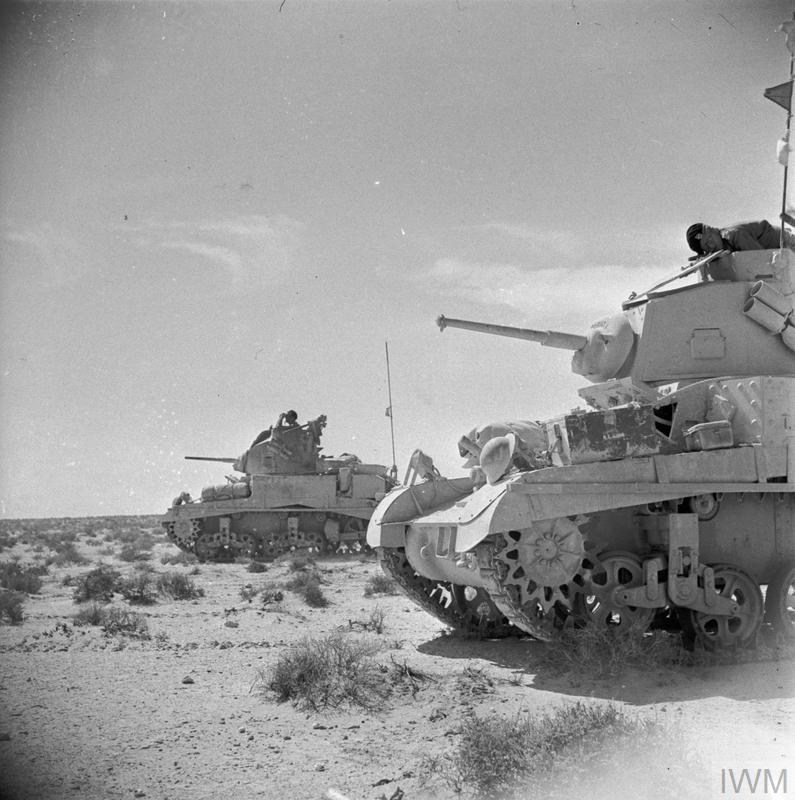
British Army Stuart tanks in North Africa, 18 June 1942 worldwartwo.filminspector.com
Two Stuart tanks advancing in the Western Desert, 18 June 1942 © IWM E 13534.

US Military: Bernard Whitfield Robinson becomes the first black U.S. Navy commissioned officer.

The air echelon of the 69th Bombardment Squadron, 38th BG (Medium) flies from Hickam Field in Hawaii with its B-26s to New Caledonia. It will fly reconnaissance missions for the rest of the year.

Major General Carl Spaatz arrives in London to formally take command of Eighth Air Force.

The U.S military begins developing the first medical air evacuation service. This will begin operation later in the year during the construction of the Alcan Highway and in Burma, New Guinea, and Guadalcanal.

German Homefront: Following a lengthy investigation when a partisan provides information in exchange for cash, German troops find and gun down the two assassins of Reichsprotektor of Bohemia and Moravia Reinhard Heydrich. The two men, Jan Kubiš and Jozef Gabčík, are found in Cyril and Methodius Cathedral in Prague. After a ferocious six-hour gun battle, German security troops overcome the opposition at a cost of 14 of their own number. This follows a brutal two-week period during which 13,000 Czechs are arrested and tortured. The two men, flown into the Reich as part of British/Czech Operation Anthropoid, receive many posthumous honors.

British Homefront: Free French leader Charles de Gaulle gives a "unity" speech at the Royal Albert Hall in London.

American Homefront: British Prime Minister Winston Churchill arrives in Washington, D.C. The Americans want to invade France, but Churchill convinces them that invading French North Africa makes more sense. The two sides also discuss atomic research and agree to share information. This is not the best time for Churchill to be visiting, with his troops struggling in North Africa, but everything seemed fine when he left London.

Future History: James Paul McCartney is born in Liverpool, England to a volunteer firefighter, James, and a licensed nurse. Both parents are of Irish descent. An excellent student, McCartney tests into the Liverpool Institute grammar school in 1953, and around this time his father encourages him to embrace music. One day on the bus to the Institute, he meets younger student George Harrison. McCartney's mother passes away on 31 October 1956, and on 6 July 1957 he meets older John Lennon at a church festival. Lennon leads a band, the Quarrymen, and McCartney soon joins, followed a year later by Harrison. The band has some local success and in 1960 gets a gig in Hamburg, Germany. After several personnel changes, the band renames itself The Beatles and goes on to international success, with McCartney and Lennon writing the vast majority of their oeuvre. As of this writing, McCartney remains a performer, songwriter, and influencer in the music scene while leading his own band.

Roger Joseph Ebert is born in Urbana, Illinois. He becomes a celebrity film critic for the Chicago Sun-Times until his death on 4 April 2013, hosting television review shows along with Chicago Tribune critic Gene Siskel. 

Nicholas John Tate is born in Sydney, New South Wales, Australia. He becomes a character actor best known for roles in "Space: 1999" in the 1970s and the Australian soap opera "Sons and Daughters." He remains active as an actor as of this writing.

Thabo Mvuyelwa Mbeki is born in Mbewuleni, Eastern Cape, South Africa. He becomes the second president of South Africa, following Nelson Mandela, from 14 June 1999 to 24 September 2008. He remains active in South African politics as of this writing.

A Japanese decoy airfield on Kiska in the Aleutians, 18 June 1942 worldwartwo.filminspector.com
Japanese decoy "aircraft" on Kiska Island in the Aleutians, 18 June 1942 (U.S. Navy).


2022

Monday, October 18, 2021

June 6, 1942: Japanese Invade Aleutian Islands

Saturday 6 June 1942

Battle of Midway 6 June 1942 worldwartwo.filminspector.com
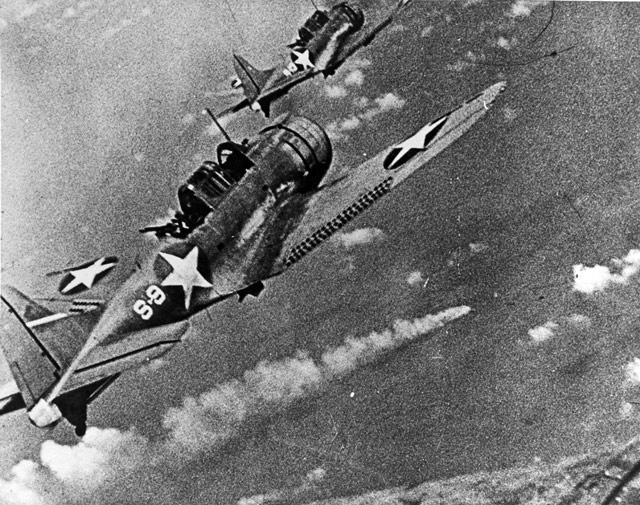
"SBD Dauntless dive bombers from USS Hornet (CV-8) approaching the burning Japanese heavy cruiser Mikuma to make the third set of attacks on her, during the early afternoon of 6 June 1942. Mikuma had been hit earlier by strikes from Hornet and USS Enterprise (CV-6), leaving her dead in the water and fatally damaged." Naval History and Heritage Command 80-G-17054.

Battle of the Pacific: Despite having suffered staggering losses off Midway Island on 4 June, the Japanese follow through on their subsidiary campaign in the Aleutian Islands on 6 June 1942. The Japanese Northern Area Fleet, commanded by Vice-Admiral Boshiro Hosogaya, lands 500 troops of the elite Maizura 3rd Special Landing Force and 700 laborers on Kiska Island at 10:27. 

This is the first invasion of the continental United States since the War of 1812, though Alaska is not yet a state. The local Unangax (Aleuts) offer virtually no resistance and no U.S. military forces intervene at this time despite some fruitless bombers searching for the Japanese. There are U.S. soldiers of the U.S. Navy meteorological service on Kiska, but they disappear into the rugged interior. The Japanese rename the island Narukami.

Eight P-38s do spot and attack a ship, but it turns out to be a Soviet freighter. The Americans, though, are quite concerned about both a Japanese land invasion south toward Washington State through Canada and Japanese bombing raids from the Aleutians (neither of which the Japanese plan) and begin preparing a response.

Off Midway Island, things just keep getting worse for the Japanese. Having lost four irreplaceable aircraft carriers to the U.S. Navy's one, they now lose another important ship. Douglas SBD Dauntless dive bombers attack and sink cruiser Mikuma, already damaged in previous days' raids. Mikuma and fellow cruiser Mogami are heading for refuge at Wake Island when 31 SBDs from USS Enterprise and Hornet attack and hit Mikuma with five bombs and Mogami with six.
Japanese cruiser Mikuma under attack, 6 June 1942 worldwartwo.filminspector.com
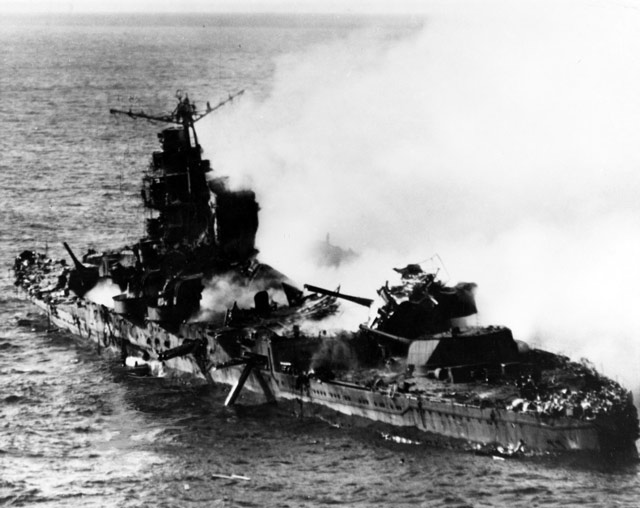
"Japanese heavy cruiser Mikuma, photographed from a USS Enterprise (CV-6) SBD aircraft during the afternoon of 6 June 1942, after she had been bombed by planes from Enterprise and USS Hornet (CV-8). Note her shattered midships structure, torpedo dangling from the after port side tubes and wreckage atop her number four eight-inch gun turret." Naval History and Heritage Command 80-G-414422.

While the Mikuma may theoretically have survived that many bomb hits, one of them sets off the torpedoes it is carrying and they destroy the ship. There are 650 deaths and 240 survivors, who are picked up by destroyers Asashio and Arashio (both also hit by one bomb each. U.S. Navy submarine Trout investigates the scene on 9 June and picks up an additional two Japanese crewmen and makes them POWs.

An example of the "fog of war" almost causes a tragedy for the U.S. forces. A late-morning B-17 raid by 26 bombers based on Midway (led by Lt. Col. Brooke Allen) against the fleeing Japanese cruisers fails to find them. However, they do spot a target and six B-17s drop their loads on it thinking it is one of the cruisers. In fact, it is U.S. submarine Grayling. Fortunately for the Americans, level-bombing accuracy at sea lives down to its terrible reputation, no harm is done, and Grayling quickly dives before any bombs come close. 

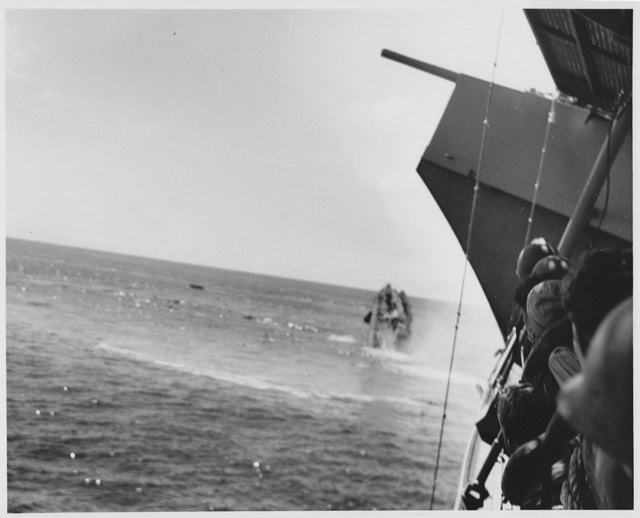
The Japanese do "get one back" when submarine I-168, which previously shelled Midway Island, spots crippled USS Yorktown and attacks. In addition to pumping one more torpedo into the badly listing aircraft carrier, the submarine torpedoes and sinks the U.S. Navy destroyer USS Hammann (DD-412) around noon. Hammann has been providing auxiliary power to USS Yorktown as a damage control party desperately tries to keep it from sinking. Only one of four torpedoes hits the destroyer, but it is enough to break the ship in half. The destroyer sinks in just four minutes, and after it slips under, its armed depth charges explode, causing a violent underwater explosion and killing many men in the water. There are 80 deaths from the 192-man crew. I-168, despite being surrounded by U.S. Navy screening destroyers, escapes with minor damage.
US destroyer Hammann sinking, 6 June 1942 worldwartwo.filminspector.com
"USS Hammann (DD-412) sinking with stern high, after being torpedoed by Japanese submarine I-168 in the afternoon of 6 June 1942. Photographed from the starboard forecastle deck of USS Yorktown (CV-5) by Photographer 2nd Class William G. Roy. Angular structure in right foreground is the front of Yorktown's forward starboard 5-inch gun gallery. Note knotted lines hanging down from the carrier's flight deck, remaining from her initial abandonment on 4 June." Naval History and Heritage Command 80-G-32320.

With ships on both sides still sinking (such as Yorktown) and already sunk, there are hundreds of men struggling to survive in the waters around Midway. The island's PT-boats and PBY Catalinas spend this and surrounding days picking up 27 men.

U.S. fleet carrier Saratoga, which missed the Battle of Midway due to repairs and upgrades being performed on the West Coast, arrives in Honolulu today. It quickly prepares to depart on the 7th to ferry replacement aircraft and crew to Enterprise and Hornet still stationed northeast of Midway. While most histories record 7 June 1942 as the final day of the Battle of Midway, today effectively marks the end of major hostilities.

The state-controlled Tokyo press quickly informs the public of the "great victory" in the Aleutian Islands. However, no mention is made of the catastrophic events for the Japanese Navy off of Midway Island until the war is over.
Japanese submarine U-168 which sank US destroyer Hammann on 6 June 1942 worldwartwo.filminspector.com
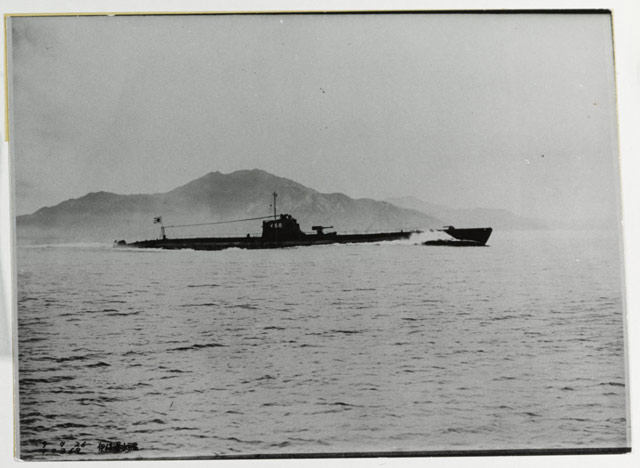
"I-168. (Japanese Submarine, 1933-1943) Underway in March 1934, probably during her trials. This submarine was renamed I-168 in May 1942. She torpedoed USS Yorktown (CV-5) on 6 June 1942, causing damage that led to the carrier's sinking the following morning." Naval History and Heritage Command NH 73054 I-68.

Battle of the Indian Ocean: Japanese submarine I-16 torpedoes, shells, and sinks 3839-ton Yugoslav freighter Susak in the Mozambique Channel. There are seven deaths.

I-10 torpedoes and sinks U.S. freighter Melvin H. Baker 45 miles off the mainland coast. All 48 men aboard survive and are picked up by British freighter Twickenham.

Eastern Front: German General Erich von Manstein makes his final preparations for Operation Stoerfang ("Sturgeon Catch"), the land assault against Sevastopol.  Meanwhile, the Luftwaffe continues an overpowering assault against the port, facing virtually no opposition from airports almost within sight of the defenders. Between 3 and 6 June, the Luftwaffe has flown 2355 sorties, dropping 1800 tons of high explosives 23,800 1.1kg incendiary bombs. In the two weeks from 24 May to 6 June, the Luftwaffe also has dropped 638,000 propaganda leaflets (50,000 per day) with instructions on how to surrender.

The massive artillery barrage that includes the biggest guns in military history, including the Karl and Gustav guns, shifts its targeting today to the defenses south of the city that face the German 30th Army Corps.

Rather than evacuating the port, the Soviets actually make every effort to reinforce it, slipping flotilla leader Tashkent, the destroyer Bezuprechnyi, and transport Abkhaziya through the blockade to deliver 2,785 more Red Army defenders.
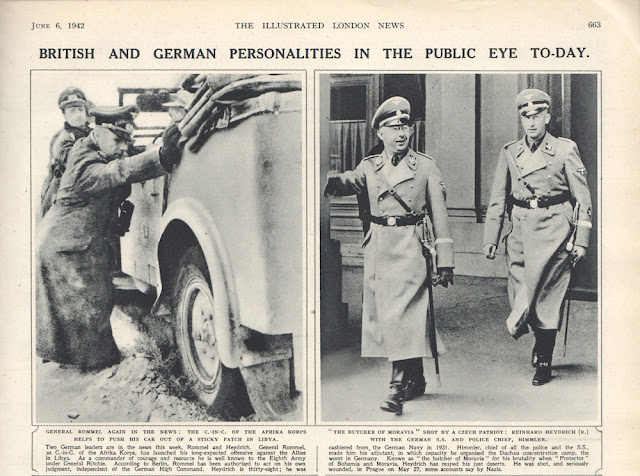
Illustrated London News, 6 June 1942 worldwartwo.filminspector.com
The Illustrated London News of 6 June 1942 features photos of German General Erwin Rommel, left, and recently deceased General Reinhard Heydrich, right (with Heinrich Himmler). Rommel is shown pushing his command car out of some trouble.

European Air Operations: The weather is warm, with plenty of ground haze below 1500 feet. The RAF focuses mainly on convoy protection.

R.A.A.F. Catalinas of RAF No. 10 Squadron, using Leigh Lights, bomb and damage Italian submarine Luigi Torelli in the Bay of Biscay. The submarine's crew manages to beach it at Santander, Spain, to prevent sinking. There is one death and one wounded crewman. The ship is temporarily repaired and sailed to France on 14 July for permanent repairs.

Hptm. Helmut Lent, Gruppenkommanduer of II./NJG 2, is awarded the Eichenlaub (No. Ninety-eight) after 34 night victories and 8 by day.
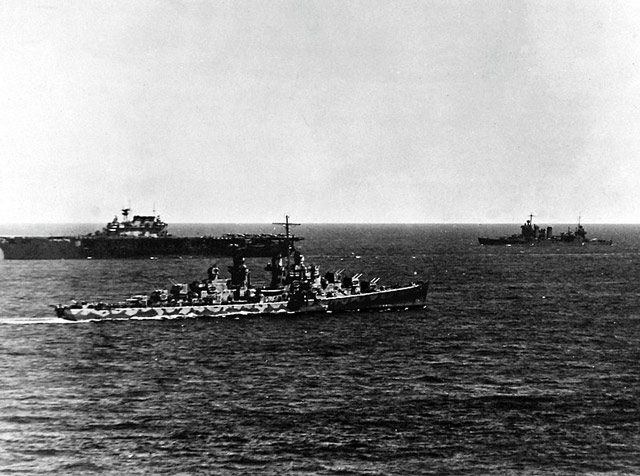
USS Atlanta with Hornet in the background, 6 June 1942 worldwartwo.filminspector.com
"A close-up of USS Atlanta (CL 51) with USS Hornet (CV 8) and USS Phelps (DD 360), all of Task Force 16, in background. Picture was made during the third day of the battle as Atlanta came up to offer assistance to the destroyer, which had broken down temporarily because of fuel shortage." 6 June 1942. Naval History and Heritage Command 80-G-88908

Battle of the Atlantic: It is a busy day for two German raiders operating in the South Atlantic east of Brazil. The 1940-41 glory days of the raiders are over and now they have to operate in remote areas to avoid detection. That doesn't mean they don't get the occasional moment of excitement. This happens during the Action of 6 June 1942.

In one incident, German raider Michel (Schiffe 28) spots disabled and drifting 7176-ton U.S. freighter George Clymer midway between Brazil and Africa. The Michel launches its motor torpedo boat Esan, which torpedoes and badly damages the freighter. One man perishes in the attack. The crew abandons the ship but reboards it on the 8th when it does not sink. however, the situation is hopeless and the crew is picked up by the British armed merchant cruiser HMS Alcantara. That is the last anyone sees of George Clymer, which remains stubbornly afloat. Exactly when and where the George Clymer sinks is unknown.

German raider Stier (Schiffe 23) has been quietly operating in the South Atlantic with limited success since leaving Royan, France in late May 1942. Today, Stier is cruising 500 miles (800 km) east of Pernambuco, Brazil, in overcast weather when it spots 10,170-ton U.S. tanker Stanvac Calcutta. Appearing suddenly out of a squall, Stier fires a warning shot and signals the tanker's crew to prepare to be boarded.

The Stanvac Calcutta, however, is heavily armed for a tanker. It has one 4-inch (102 mm)/50-caliber naval gun salvaged from World War I and a 5 inch (127 mm)/25-caliber anti-aircraft gun. Stier, meanwhile, has six 150-millimeter (6 in) guns, one 37 mm (1.5 in) gun, two 20 mm (0.79 in) cannons, and two torpedo tubes. So, there's a lot of firepower on both sides, though Stier outguns the tanker by a substantial margin.

The tanker's crew, led by Captain Gustav O. Karlsson, decides to not comply with the Stier's order to stop and opens fire. Led by Ensign Edward L. Anderson, the tanker's gunners get off several shots with both guns (the larger gun in the gun, smaller in the bow). Despite missing with most of their shots, the gunners do hit and disable one of Stier's 150mm guns. The Stier's crew then returns fire with 148 shells.

The battle lasts for 15 minutes, during which the Germans score a hit on the tanker's bridge, killing Captain Karlsson and several others. The Americans continue firing until their ammunition is exhausted. At this point, Stier Captain Horst Gerlach fires a torpedo that strikes Stanvac Calcutta on the port side. This kills several sailors and causes damage that leads to a sharp list and eventual sinking. The tanker's crew then abandons ship. Gerlach's men lower their own boats and rescue the Americans struggling in the water.

The Action of 6 June 1942 shows several hard truths about the Battle of the Atlantic. One is that merchant ships armed with a few guns stand little chance against raiders like Stier that are designed for combat even if they aren't true warships. Another is that these surface combats kill a lot of crewmen, as Stanvac Calcutta has 16 men killed in action, one dying later onboard Stier, fourteen men wounded, and 37 prisoners taken (the Stier only suffers two wounded men).

Actions like that of 6 June 1942 call into question the whole concept of arming merchant ships, which requires a lot of effort and dedicated gunners on hundreds of ships. However, later events involving Stier will redeem this idea somewhat. For their pains, the Stanvac Calcutta's crew later are awarded the Merchant Marine Gallant Ship Citation and Ensign Anderson is promoted (while a POW) to the rank of lieutenant commander. The tanker crew winds up in a Japanese POW camp.
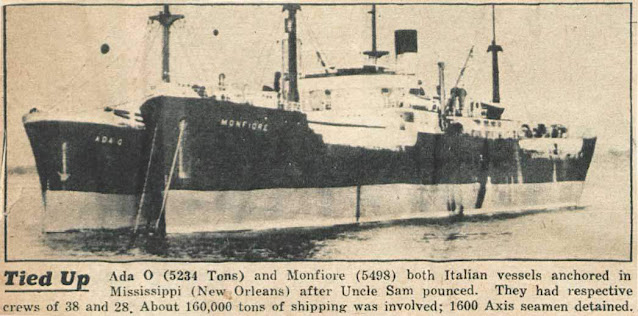
Freighter Hermis in the background, sunk on 6 June 1942 worldwartwo.filminspector.com
Coal-burning freighter Hermis is shown at left while still called "Ada O." Hermis was an Italian vessel anchored in New Orleans when seized in 1941 and pressed into U.S. service. Sunk on 6 June 1942.

There are also the usual U-boat sinkings, these days confined to the Caribbean.

U-68 (KrvKpt. Karl-Friedrich Merten), on its fourth patrol out of Lorient, torpedoes and sinks 13,006-ton Panamanian tanker C.O. Stillman 60 miles southwest of Puerto Rico. There are three deaths and 55 survivors,  most of whom are picked up by US Coast Guard patrol boat #83310 while 30 sail their lifeboats to Puerto Rico.

U-107 (Kptlt. Harald Gelhaus), on its sixth patrol out of Lorient, torpedoes and sinks 3910-ton Honduran freighter Castilla east of Cancun and south of western Cuba. One torpedo hits and causes the ship to sink quickly stern-first. The crew can't launch lifeboats and take to three rafts. There are 24 deaths (including one who dies on a raft) 35 survivors, who are picked up by USS Nike (WPC-112) after six days. Some sources place this sinking on 7 June 1942.

U-158 (Kptlt. Erwin Rostin), on its second patrol out of Lorient, torpedoes and sinks 5234-ton Panamanian freighter Hermis west of Havana and northeast of Cancun. Two torpedoes strike the ship on the port side but the engines continue running due to an inability to stop them due to damage. Rostin surfaces and uses his deck gun to finish off the freighter, setting it on fire. There is one death and 46 survivors, who are picked up by US Army transport Toloa. The ship does not sink for at least 12 hours and this sinking is sometimes listed as occurring on 7 June 1942.

Dutch 197-ton freighter Antares hits a mine and sinks off the Dutch coast.
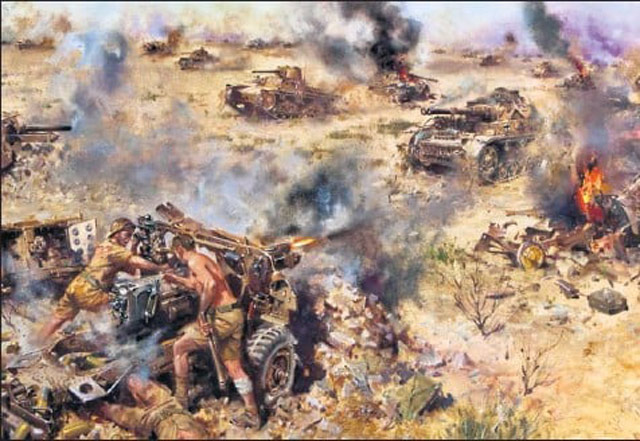
"Battle of Knightsbridge 6th June 1942" worldwartwo.filminspector.com
"The Battle of Knightsbridge, 6th June 1942," by Terence Cuneo (1907-1996). Shown are the 426th Battery of the 107th Regiment Royal Horse Artillery and the South Nottinghamshire Hussars, panzer of the Afrika Korps attacking. The 426th ultimately was forced to surrender.

Battle of the Mediterranean: After a wild day of attack and counter-attack between German and British troops on 5 June, the front settles down again today. However, German General Erwin Rommel retains command of the battlefield after his forces destroyed dozens of Allied tanks. He sends out armed reconnaissance to test the British lines and maintains pressure on the surrounded Free French garrison at Bir Hakeim. For their part, the British engage in harassing attacks against the German supply lines using the 7th Motor Brigade and 29th Indian Infantry Brigade.

The main action of the day is an attack at 11:00 by the German 90th Light Division against Bir Hakeim. This involves a determined effort by troops and pioneers to clear a way through the minefields surrounding the fortress, which are divided into two perimeters. By nightfall, the Germans manage to get through the outer minefield and into the inner minefield to within 800 meters (900 yards) of the fortress. The advance, while threatening to the Free French, also leaves the German troops exposed to Desert Air Force attacks on the 7th.

The Battle of Knightsbridge proceeds as the 15th Panzer Division attacks northward. The British 22nd Armoured Brigade continues to give ground after having lost dozens of its tanks. The German objective is El Adem, but the 201st Guard Brigade is ferociously defending the approaches to Tobruk.

Operation Aberdeen, the Eighth Army's counterattack begun on 4/5 June against the German Afrika Korps panzers, ends today after having accomplished nothing but the loss of numerous British troops and tanks. British Eighth Army commander General Neil Ritchie and Middle East Commander-in-Chief Claude Auchinleck now face the prospect of not only losing the battle but also all of Libya and much of Egypt unless they can find some way to stop Rommel's attacks. Among the desperate options considered are withdrawing the Free French from Bir Hakeim to free up the 7th Motor Brigade. However, this is rejected as the French seem to be in a good defensive situation.

Oblt. Hans-Joachim Marseille of 3./JG 27, currently operating in North Africa, receives the Eichenlaub for achieving 75 victories. Marseille once was considered a disciplinary problem but now is revered by his colleagues as a legend.
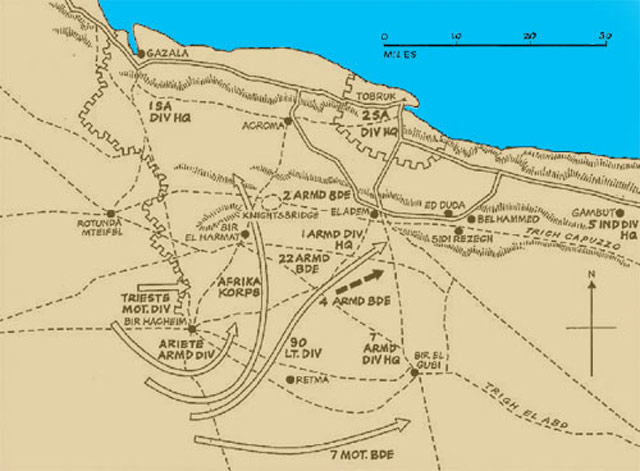
Battle of the Gazala Line, 6 June 1942" worldwartwo.filminspector.com
A map showing the military situation in Libya ca. 6 June 1942. The 15th Panzer Division thrust through the British Knightsbridge defensive position is shown by the upward arrow in the center, with a separate thrust to the south of Tobruk at the upper right. The map makes clear the extreme jeopardy of the Allied position at Tobruk, though nobody on either side is thinking about it just yet.

American Homefront: At the Belmont Stakes, the third jewel of the Triple Crown, the chestnut stallion Shut Out is the winner. Having also won the Kentucky Derby, Shut Out just misses immortality by having lost the Preakness Stakes to Alsab. Shut Out continues racing until 1944, when it is retired and put out to stud until passing away in 1964.

Future History: Klaus Bednarz is born in  Falkensee, Province of Brandenburg, Germany. Bednarz becomes a popular West German correspondent, author, and television host, particularly of the TV show Monitor. Klaus Bednarz passes away on 14 April 2015.
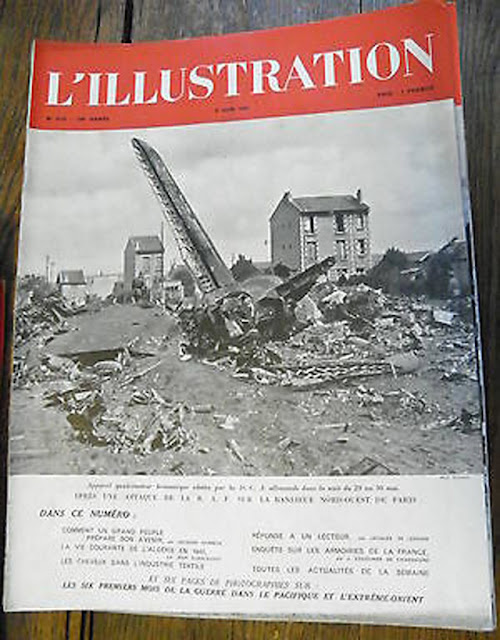
L'Illustration, 6 June 1942" worldwartwo.filminspector.com
L'Illustration, 6 June 1942.

2021

Sunday, October 3, 2021

June 3, 1942: Start of Battle of Midway

Wednesday 3 June 1942

Dutch Harbor on fire, 3 June 1942 worldwartwo.filminspector.com
Fires burning at Dutch Harbor after the 3 June 1942 Japanese air raid (US Army).

Battle of the Pacific: At 09:04 on 3 June 1942, Ensign Charles R. Eaton, patrolling 470 miles from Midway Island, spots three Japanese ships. The Japanese quickly fire on him with anti-aircraft guns but he escapes and radios in his sighting. This is the first encounter of what will become the Battle of Midway.

At about the same time, another airman, Ensign Jack Reid, is patrolling 500 nautical miles (580 miles, 930 km) southwest of Midway in his PBY-SA when he also spots some ships in the distance. At 09:25, he radios in, "Sighted main body." He follows up with more details, ultimately reporting 11 ships at 11:00 before being ordered to return to base. Reid has not spotted the main Japanese force but rather transport ships commanded by Admiral Tanaka.

Lt. Col. Walter C. Sweeney leads a force of nine B-17 bombers stationed at Midway against the ships spotted by Reid at 12:30. Sweeney's force scores no hits and barely makes it back to Midway, landing at 21:45.

Another U.S. strike departs at 21:15, this time four PBY Catalinas bent on a night attack. Arriving over the target at 01:00 on 4 June, they score one hit on the Japanese force, a torpedo strike on the bows of tanker Akebono Maru that kills 13 sailors. Transport Kiosumi Maru also sustains some strafing damage that kills four crewmen. This attack features the only successful U.S. air-launched torpedo strike of the Battle of Midway.
Battle of Midway painting, 3 June 1942 worldwartwo.filminspector.com
"Battle of Midway, 3 June 1942" - "US Navy aircraft carrier USS Yorktown and its escorts defend themselves from incoming Japanese aircraft, one of which has splashed down into the ocean" (Rodolfo Claudus ca. 1950) (Naval History and Heritage Command).

The second prong of the Japanese strategy (Operation AL) is an invasion of some of the Aleutian Islands. The Americans know about this from their codebreaking but have concentrated the bulk of their naval forces at Midway. Planes from two light Japanese aircraft carriers (Ryujo and Junyo) under the command of Vice-Admiral Boshiro Hosogaya take off in a dense fog and rough seas to raid the Dutch Harbor Naval Operating Base and Fort Mears at Dutch Harbor on Amaknak Island, Alaska. Only about half of the planes make it to the target. Despite some heavy anti-aircraft fire, the Japanese Nakajima B5N, Navy "Kate," Bombers drop 16 bombs on Fort Mears, then get clean away before P-40s stationed at Cold Bay arrive. There are 25 dead and many other casualties, while the Japanese lose only one plane.

The attack on Dutch Harbor is only a distraction from the main Japanese objective in the Aleutians, which is to occupy islands Kiska and Attu further down the chain. During this raid, the Japanese planes sink the 3497-ton U.S. passenger ship Northwestern (no casualties). Japanese cruisers launch four Nakajima E8N2 Navy Type 95 reconnaissance seaplanes, Allied Code Name "Dave," to fly over Umnak, losing one to U.S. ground fire. A PBY-5A Catalina of VP-42 locates the Japanese ships, while the Japanese shoot down another PBY and take three of its crew as prisoners aboard the cruiser Takao. A Japanese "Zeke" bomber crashlands in a bog on Akutan Island and U.S. forces later recover it and the dead pilot.

The five Japanese submarines waiting off the coast of Australia near Sydney to pick up the crews of the mini-submarines that attacked Sydney Harbour give up hope and disperse. The mini-sub crews are all dead, though two men nearly made it to the rendezvous point before being killed by troops. I-24, one of these five submarines, then torpedoes and sinks 4812-ton Australian ore carrier Iron Chieftain in the Tasman Sea 35 miles east of Manly (there is a monument to the 12 dead crewmen of Iron Chieftain outside Newcastle railway station). There are 27 survivors. The sinking of Iron Chieftain helps lead to the formation of convoys along the Australian coast between New South Wales, Victoria, and South Australia.

I-20 is the last of the five Japanese submarines to depart from the recovery area. During the afternoon, it surfaces and fires flares and sends radio signals, but nobody appears. Finally, at 18:00, it, too, departs.

U.S. Navy 115-ton patrol boat Vagabond collides with patrol craft PC-569 while patrolling west of the Golden Gate Bridge and sinks. There are no casualties.

U.S. 16-ton fishing trawler sinks in Sitka Sound in the Alexander Archipelago in Southeast Alaska near Saint Lazaria Island off of Cape Edgecumbe in Kruzof Island. The cause of the sinking is unidentified, but it may be due to enemy action.

B-17 bombers of the 5th USAAF Air Force bomb Rabaul. They hit a wharf, a warehouse area, and a military camp.

Marines waiting out the bombing of Dutch Harbor, 3 June 1942 worldwartwo.filminspector.com
"Japanese attack on Dutch Harbor, June 3, 1942. Group of Marines on the "alert" between attacks. Smoke from burning fuel tanks in the background had been set afire by a dive bomber the previous day. Alaska." (National Archives 80-G-12076).

Battle of the Indian Ocean: The 10th USAAF Air Force sends 6 B-25s of the 11th Bombardment Squadron, 7th Bomber Group, from Dinjan, India, to bomb Lashio, Burma. They then continue on to Kunming in perhaps the first example of "shuttle bombing." The mission turns into a disaster when three bombers crash into the Himalayas at 10,000 feet in heavy overcast conditions and a fourth runs out of fuel and crashes near Chan-i, China. Only two of the bombers actually reach Kunming, where they are fired upon by Chinese fighter planes that have not been informed of the operation and one radio operator is killed..

At Diego Suarez, the British complete emergency repairs to the 30x30-foot hole blown in battleship HMS Ramillies from a mini-sub attack and it departs for more permanent repairs at Durban.
Finnish anti-tank gun being used, 3 June 1942 worldwartwo.filminspector.com
Finnish Lahti L-39 anti-tank gun in use on 3 June 1942 (Military Museum of Finland (Kuva)).

Eastern Front: The German artillery fire and air assault on Sevastopol continue today as the Germans try to weaken the Soviet defenses for a full-scale assault. The target area today for the rolling bombardment is the defensive area facing the German 30th Army Corps south of the city.

General Franz Halder at Fuhrer Headquarters notes in his war diary: 
The enemy has reacted to our artillery attack on Sevastopol with counterbattery fire. Work on fortification in progress. Ship movements. No important changes on the other fronts.
General von Manstein, commander of 11th Army, plans to begin his attack on Sevastopol (Operation Sturgeon Catch (Störfang)) on 7 June. He is quickly redeploying troops from the eastern half of Crimea, where some Soviet holdouts in caves are causing trouble, to the west to participate in the Sevastopol assault. It is a very peculiar situation for the Germans on the Eastern Front where the hot spot is to the west and not the east.

Oblt. Siegfreid Freytag of 6./JG 77 claims his 50th victory. He soon will transfer to the Mediterranean Theater.
Dutch Harbor fires, 3 June 1942 worldwartwo.filminspector.com
"Siems Drake warehouse afire, following the attack by Japanese carrier aircraft. Note fire fighting parties at work, and S. S. NORTHWESTERN burning at left." Dutch Harbor, 3 June 1942. (Naval History and Heritage Command 80-G-12056).

European Air Operations: The weather over the Channel Front is clear and warm. There are no major attacks today. RAF No. 403 Squadron (RCAF) moves from Southend to Martlesham. At RAF Chelveston, a small Hotspur glider of the Airborne Forces Experimental Establishment (AFEE) 14th Operational Training Unit breaks up mid-air near Greetham Village, Ruland, and the crew bales out (one killed and one uninjured).
Ore freighter City of Alma, sunk on 3 June 1942 worldwartwo.filminspector.com
U.S. ore freighter City of Alma, sunk by U-172 on 3 June 1942.

Battle of the Atlantic: U-404 (Kptlt. Otto von Bülow), on its third patrol out of Brest, torpedoes and sinks 1345-ton Swedish freighter Anna 210 miles northwest of Bermuda. Von Bülow begins his attack with two torpedoes at 03:09 and 04:50 but misses with both. Finally, at 05:10, he surfaces and uses his deck gun. The attack is a little controversial because von Bülow's crew clearly sees Swedish (neutral) markings, but he decides to attack anyway because the ship is acting suspiciously (zig-zagging and without navigational lights). There are no dead among the 32-man crew, though two men are wounded in the attack. The survivors take to the boats and are picked up within 13 hours by Swiss freighter Saentis, which also picks up survivors of freighter West Notus, sunk by the same U-boat on 1 June.

U-172 (Kptlt. Carl Emmermann), on its second patrol out of Lorient, torpedoes and sinks the 5446-ton U.S. freighter City of Alma 400 miles northeast of San Juan, Puerto Rico. The ship is carrying manganese ore and sinks within three minutes. The radio operator remains on board to send a distress call but the ship sinks so quickly that he goes down with the ship without sending any messages. There are 29 dead and 10 survivors, who survive in a lifeboat and are picked up by U.S. patrol boat USS YP-67. Third Mate Hugh Parks Brown, Jr. the Merchant Marine Distinguished Service Medal for saving other crewmen.

U-156 (Kptlt. Werner Hartenstein), on its third patrol out of Lorient, stops 80-ton British schooner Lillian near Grenada and Barbados (40 miles south of Barbados) after the ship first ignores a command to stop (warning shot through the rigging). A few crew remain aboard the ship and attempt to sail away while others take to the boats. The U-boat chases the fleeing ship after questioning the men in the boats and finally sinks it with gunfire. Hartenstein apparently uses the incident for target practice, or maybe he is just angry (and tired, as he already has sunk or damaged 11 ships on this patrol), as he uses an astounding 52 rounds of 37mm and 270 rounds of 20 mm) to sink the wooden ship. There are three dead and 22 survivors.

U-502 (Kptlt. Jürgen von Rosenstiel), on its fourth patrol out of Lorient, torpedoes and sinks 6940-ton U.S. freighter M.F. Elliott 150 miles northwest of Trinidad (west of St. George's Island). The ship, carrying just water ballast, sinks within six minutes. There are 13 dead and 32 survivors, who are picked up by Brazilian tanker Santa Maria after five days adrift.
Die Wehrmacht magazine, 3 June 1942 worldwartwo.filminspector.com
Die Wehrmacht Magazine, 3 June 1942.

U-432 (Kptlt. Heinz-Otto Schultze), on its fifth patrol out of La Pallice, spots two fishing trawlers 170 miles east of Thatchers Island in the Bay of Fundy (northeast of Boston) and surfaces. After allowing the crewmen to leave their vessels, Schultze uses his deck gun on the trawlers. Sunk are 41-ton Aeolus and 102-ton Ben and Josephine. All of the fishermen (14 men total) survive, making landfall at Mount Desert Coast Guard Light Station after 36 hours.

U-126 (Kptlt. Ernst Bauer), on its fourth patrol out of Lorient, torpedoes and sinks 10,990-ton Norwegian tanker Høegh Giant 400 miles east of Guiana. Bauer attacks at 11:24 and hits with one of three torpedoes, but the ship continues sailing. He then surfaces, but the tanker crew use the deck gun to fire at the U-boat, forcing Bauer to submerge and chase it. A long ordeal results, with Bauer finally getting into firing range at over 14 hours later 01:40 on 4 June. Two torpedoes hit, and the crew abandons the ship. The tanker finally sinks at 04:24 after Bauer has to fire a coup de grâce. Bauer clearly is furious about the entire incident. He surfaces and, when he does not get the answers he wants from the men in the lifeboats, he has his men fire over the boats, wounding one survivor with a stray bullet. The survivors spend at least ten days at sea, with most landing at Devil Island after ten days and the rest being picked up after 15 days. While the survivors are being transported to New Orleans aboard freighter Robert E. Lee, that ship also is sunk (by U-166), but all the survivors of Høegh Giant survive that sinking, too.

U.S. 5686-ton freighter Steel Worker hits a mine and sinks 3000 yards from Mishayampi, Murmansk. The ship has traveled all the way from Philadelphia with foodstuffs only to be sunk less than two miles from its destination. There are no casualties.

German Navy whaler V-1510 Unitas VI, being used as a patrol boat, strikes a wreck and sinks at the entrance of Dieppe, France. No known casualties. This incident is sometimes claimed to have occurred on 2 June 1942.

RAF Vickers Wellington bombers of No. 172 Squadron damage Italian submarine Luigi Torelli near Aviles, Spain. The ship is towed to Aviles and beached. After temporary repairs, it is refloated and taken to Spain for permanent repairs.

Damaged freighter Orari being patched at Malta, 3 June 1942 worldwartwo.filminspector.com
Freighter Orari having a temporary patch installed at Malta on 3 June 1942. © IWM A 10774.

Battle of the Mediterranean: German General Erwin Rommel and the bulk of the Afrika Korps remain bottled up in The Cauldron, a defensive position west of Tobruk. However, while no longer on the offensive, they now have cleared supply lanes to the west and are receiving reinforcements. The siege of Free French forces at the fortress of Bir Hakeim continues with little change in the situation today as the Axis forces bombard the entrenched French with artillery and Luftwaffe attacks.

The air war is going surprisingly poorly for the RAF. The pilots of III./JG 53 claim three victories over the British in the vicinity of El Alamein. One of the issues is that the Luftwaffe has brought elite units to North Africa.

Air activity over the front is ferocious. Oblt. Hans-Joachim Marseille of 3./JG 27 claims 6 Tomahawks of SAAF No. 5 Sqdn. and damage to two others in 12 minutes. Among his victims is an ace with five victories, Captain Botha, who himself had just shot down three Junkers Ju-87 Stuka dive bombers. Marseilles and the other planes clear the skies, opening them up for more Stuka attacks on Bir Hakeim. Joachim Marseilles now has 75 victories and will receive the Eichenlaub (oak leaves) to his Iron Cross on 6 June as a reward. He quickly is becoming a legend, and one of the men in his unit, Hans-Arnold Stahlschmidt, writes in a letter home, "Marseille is able to shoot like a young God. Above all, he is able to do what only a few can - to shoot with perfection while turning."

U-331 (Kptlt. Hans-Diedrich Freiherr von Tiesenhausen), on its seventh patrol out of Messina, torpedoes and sinks Royal Navy trawler HMT Cocker off Bardia, Libya. There are 15 missing/dead, with one wounded man (Ty/Lt D M Engeler RANVR) surviving.

Battle of the Black Sea: German Navy ferry barge (Marinefahrprahm) F 145 hits a mine and sinks in the Black Sea southeast of Odesa. there are nine deaths.
Greek freighter Pindos being commisssioned, 3 June 1942 worldwartwo.filminspector.com
Greek destroyer Pindos being commissioned at Swan Hunters, Wallsend on Tyne, 3 June 1942. © IWM A 8677.

Special Operations: British special forces (No. 6 Commando) stage an overnight raid on the German radar site at Plage-Ste-Cecile, France (between Le Touquet and Boulougne). This is Operation Bristle, one of a number of Commando missions during 1942 designed to give the special forces training and experience. The Germans, however, prevent the Commandos from achieving their objectives. Empty-handed, the Commandos depart and are still at sea at dawn when the Luftwaffe appears overhead and causes damage to two motor launches and a motor gunboat. One Commando and two naval personnel are killed and 19 others are wounded. The force manages to make it back to port only due to the fortuitous arrival of RAF forces to scatter the attacking Luftwaffe planes.

Reinhard Heydrich, shot by British/Czech Special Operations Executive agents on 27 May during Operation Anthropoid, appears to be recovering from the attack when he suddenly collapses while eating lunch around noon. He lapses into a coma from which he never recovers. One theory is that this relapse is caused by a systemic infection, another by a pulmonary embolism.

New Auschwitz prisoner on 3 June 1942 worldwartwo.filminspector.com
Chaskel Bittner, shown, is transferred from Montelupich prison in Cracow to Auschwitz on 3 June 1942. Bittner becomes No. 37249. He perishes at the camp on 26 June (Auschwitz Memorial).

British Homefront: The British government nationalizes the milk industry and coal mines.

American Homefront: The Rodgers & Hart (Richard Rodgers and Lorenz Hart) musical "By Jupiter" premieres at the Schubert Theater on Broadway. Starring Ray Bolger and Vera-Ellen, the play is set in the land of the Amazons, who do battle with a Greek army led by Theseus and Hercules and then engage in romantic complications. Nanette Fabray later joins the cast. The play is a big hit and runs for 427 performances until 12 June 1943. While little remembered, "By Jupiter" is Rodgers and Hart's longest-running Broadway hit and final original full-length work.

Future History: Curtis Lee Mayfield is born in Chicago, Illinois. He begins a musical career in a gospel choir, then joins the vocal group The Impressions in the mid-1950s. He also becomes a songwriter, including the hit "People Get Ready" in 1965. Mayfield turns solo in 1970 and engages in various projects, including creating the soundtrack to the film "Super Fly" in 1972. While performing in 1990, Mayfield is paralyzed during an accident involving lighting equipment, but he continues recording. Curtis Mayfield passes away on 26 December 1999.
Flak guns shown in the 3 June 1942 Die Wehrmacht magazine worldwartwo.filminspector.com
Flak batteries shown in the 3 June 1942 Die Wehrmacht Magazine.


2021

Wednesday, August 11, 2021

May 23, 1942: German Forces Surround Soviet Armies at Kharkov

Saturday 23 May 1942

Jewish deportees in Stropkov, Slovakia, 23 May 1942 worldwartwo.filminspector.com
Jewish residents of Stropkov, Slovakia, being deported to concentration camps (Majdanek and Auschwitz) on 23 May 1942. Yad Vashem Photo Archives 3132/1.

Battle of the Pacific: Following US Naval Intelligence descriptions of Japanese communications, both sides on 23 May 1942 know that a major confrontation soon will occur at Midway Island. The key difference is that the Japanese don't know that the Allies know about their invasion plans. In fact, the Japanese believe that they sunk two US Navy carriers, USS Lexington and Yorktown, at the Battle of the Coral Sea and that the Midway operation will be fairly routine. In fact, only the Lexington sank and the Yorktown has joined up with USS Enterprise to return to Pearl Harbor at high speed in preparation for the battle.

There is still some Allied resistance in the occupied Philippines, though it is gradually dying out. During one of these incidents, Lt. Comdr. Ryland Dillard Tisdale, 47 (who had retired in the 1930s but returned to service in July 1940 due to the contingency of war) perishes at Tamparan. He dies in an action against the Moros, who are collaborating with the Japanese. He receives the Silver Star posthumously. The citation notes that Tisdale was offered passage out of Corregidor on the last plane out but offered up his seat to another. Tisdale escaped from the island along with a few others shortly before the surrender. Tisdale falls today in a "last stand" near Dansalan (Marawi, Lanao del Sur, Philippines, since 1956) along with a small group of officers and enlisted men, including civilians, that includes Lieutenant Colonel Vesy of the Philippine Army.

Five B-25 bombers of the 3rd Bomber Group attack Lae, New Guinea. They damage the airfield and buildings there. Two bombers fail to return.

US Navy patrol boat USS YP-277 hits a mine and sinks at the French Frigate Shoals in the Northwestern Hawaiian Islands. The US Navy is keeping a close eye on this area due to Japanese attempts to use them to bomb Hawaii.

Japanese submarine I-29 launches its Yokosuka "Glen" seaplane for an uneventful reconnaissance mission over Sydney, Australia. This is one of a continuing series of Japanese reconnaissance flights over Allied areas in the southwest Pacific that are rarely noticed.

P-40 of the Flying Tigers in Kunming, China, 23 May 1942 worldwartwo.filmisnpector.com
Curtiss Hawk P-40 Tomahawk with pilot Robert T. Smith at the controls in Kunming, China, 23 May 1942. Photo: akg-images / Robert T. Smith.

Battle of the Indian Ocean: Japanese and Chinese troops clash in inconclusive fighting along the Hsipaw-Mogok road in northern Burma. The Japanese have no intention of invading China from this direction, though the Chinese do not know this. The Japanese in Burma already have achieved their main objectives of closing the Burma Road and establishing a defensive front along the Indian border.

Eastern Front: A carefully laid German trap south of Kharkov springs shut as the Soviet 6th and 57th Armies desperately try to avoid being surrounded near Izyum. Early in the morning, the 16th Panzer Division (Hube) and the 23rd Panzer Division meet ten miles west of Balakleya. This forms a ten-mile wide German corridor from north to south to the east of the Soviet offensive forces. This is generally considered to be the activity that surrounds the Soviets and traps them, though technically the 14th Panzer Division already has formed a thin line to the east.

Soviet Marshal Timoshenko has staked everything on a breakout attempt by these two armies today south of Kharkov, but it fails. At Fuhrer Headquarters, General Franz Halder writes confidently in his diary that "The Izyum pocket is firmly closed." However, things are still a bit more tentative than that.

The Soviets outnumber the Wehrmacht troops at the key points, but the Red Army breakout effort is dissipated today in multiple counterattacks to relieve surrounded formations to consolidate their overall defensive position. In addition, the German forces may be relatively small, but they include elite panzer units hemming the Soviets in on a narrow corridor to the east. The Soviets have by no means given up and are preparing more breakout attempts during the coming days. Halder notes that "Pressure from within [the Izyum] pocket seems to be preparing and will be felt from 24 May onwards." 

German soldiers on the scene remain puzzled that the Red Army forces to the east haven't tried a strong relief effort. Stalin does not like to retreat, especially from such a massive offensive operation. Plus, he tacitly is putting the onus on Timoshenko to prove his worth and regain the initiative - or suffer the consequences personally.

Meanwhile, the other prong of the Soviet offensive north of Kharkov has ground to a complete halt. Halder notes that "the enemy has withdrawn his tanks behind the Donets, but is still holding the western bank with its strong forces." The Soviets are only mounting local thrusts in this area that the Wehrmacht easily parries. Halder concludes this diary entry with a rare dash of emotion, writing, "The bulges shrink!" 

The overriding Wehrmacht concern remains the preparation for the upcoming "decisive" summer offensive on the southern third of the front, Operation Blau. Halder confers with Luftwaffe Colonel Meister about air preparations for this today and with others (including Colonel Balck, a top field commander) about training and personnel issues. All is calm and serene in East Prussia.

Soviet flak on the southern front downs three Henschel Hs 129B-1 ground attack planes belonging to II./SchG 1. The Hs 129B-1 have only arrived in Crimea within the past two weeks and each is equipped with a 30 mm (1.2 inch) MK 101 cannon.

Following a dramatic run of victories during the Crimea campaign, Major Gordon "Mac" Gollob, Geschwaderkommodore of JG 77, receives his reward. He is awarded the Knights Cross (no. 17). Gollob continues to shoot down Red Army planes seemingly at will from his base near Kerch and now has 107 victories.

European Air Operations: Luftwaffe experimental unit Erg.u.Lehr. Kdo 17 (formerly Erg.u.Lehr. Kdo 100) mounts an afternoon daylight raid on the Avonmouth docks using 7 He 111s. The weather is poor, providing some cover, and the real purpose of the missions is to test out planes guided by both X- and Y-Verfahren direction-finding equipment. The raid is not very successful, as one plane is lost and the bombers drop their loads six miles from the target at Severn Tunnel Junction. From the British perspective, the Luftwaffe raid is very meaningful. For the first time, RAF technicians detect the Luftwaffe's X-signals. The RAF immediately begins developing countermeasures.

Saturday Evening Post 23 May 1942 worldwartwo.filminspector.com
The Saturday Evening Post for 23 May 1942 features the beginning of a new serial featuring Perry Mason by Erle Stanley Gardner.

Battle of the Atlantic: U-588 (Kptlt. Victor Vogel), on its third patrol out of St. Nazaire, torpedoes and sinks 4545-ton British freighter Margot southeast of Philadelphia, Pennsylvania. There are one death and 44 survivors. Swedish freighter Sagoland picks up the survivors. After this sinking, U-588 returns to port after a successful cruise during which it has sunk or damaged 27,106 tons of Allied shipping. As things turn out, this is U-588's final victory because it is sunk early on its next patrol.

U-558 (Kptlt. Günther Krech), on its seventh patrol out of Brest, torpedoes and damages 7061-ton US tanker William Boyce Thompson (en route from New York to Curaçao in ballast) at 00:53 about 120 miles south of Kington, Jamaica. While the torpedo opens a hole of 20 feet on the starboard side, tankers are famous for survivability due to their compartmentalized construction. The fact that the tanker is carrying no cargo further helps it. The tanker escapes northward zigzagging at full speed with a smokescreen. There are no injuries, and the tanker makes it to Guantanamo Bay, Cuba.

U-432 (Kptlt. Heinz-Otto Schultze), on its fifth patrol out of La Pallice, torpedoes and sinks 4455-ton British freighter Zurichmoor 400 nautical miles (740 km) east of Philadelphia, Pennsylvania. All 45 men on board perish.

U-155 (Kptlt. Adolf Cornelius Piening), on its second patrol out of Lorient, torpedoes and sinks 2220-ton Panamanian Design 1049 freighter Watsonville in Saint Vincent Passage (in the Caribbean between Saint Lucia and Saint Vincent). Everyone survives.

U-103 (Kptlt. Werner Winter) torpedoes and badly damages 6625-ton US tanker Samuel Q. Brown about 100 nautical miles (190 km) south of Cape Corrientes, Cuba (extreme western tip of Cuba). There are two deaths when the torpedoes hit and 53 survivors. The crew gathers in two lifeboats and the U-boat surfaces to question them. A US Navy seaplane based at Upham, Canal Zone, locates the damaged ship and quickly and lands to pick up five injured crew. The rest have to wait a couple of days to be rescued by USS Goff, which scuttles the flaming tanker.

German 4626-ton freighter Asuncion hits a mine and sinks off the coast in the extreme north of Norway in the general vicinity of Sandland.

German 254-ton trawler/Vorpostenboot V 1808 Dortmund hits a mine and sinks in the southern North Sea. It sinks in an area south of the Dogger Bank off the coast of The Netherlands known as the "Broad Fourteens" due to its consistent 14-fathom (84 feet, 26 m) depth.

Midland Michigan Theater 23 May 1942 worldwartwo.filminspector.cmo
A new movie palace, The Midland Theater, opens on 23 May 1942 in Midland, Michigan. The first film is "Captain of the Clouds" starring James Cagney.

Battle of the Mediterranean: Activity is stirring along the North African front as the temperature rises. Gruppenkommandure of  I./JG 27 Oblt. Gustav Rodel downs two planes to bring his total to 41 kills. His unit downs a total of a dozen RAF Tomahawks and Kittyhawks.

Oberlieutenant Hans-Joachim Marseille also downs two bombers today southeast of Tobruk. This brings his own victory total to 64 planes. His victims are a pair of No. 223 Sqdn Martin "Baltimore" bombers on their first flights with their unit. While unit commands in the Luftwaffe generally go to the most successful pilots, Marseille is considered "trouble" by his superiors despite his obvious talent. Thus, Marseille remains an ordinary pilot who simply continues racking up victories without having to worry about administrative duties.

On Malta, things have quieted down considerably since the arrival of numerous defensive RAF Spitfires recently. There is a raid at 07:16 by five Cant 1007 Italian bombers with a large escort of Italian RE2001s, Macchi 200s, and Luftwaffe Bf 109s. The planes come in from the north and are met by a dozen Spitfires of Nos. 126 and 601 Squadrons based at Luqa. The RAF planes down two Re 2001s, two Bf 109s, one Cant bomber (probable). Two other Cant 1007s are damaged along with a Re 2001 and a Bf 109. The only RAF damage is to a Spitfire that returns safely to base. The Italian bombers do get through, however. They drop ten 100kg bombs apiece on Ta Qali airfield, causing craters.

Liberty magazine 23 May 1942 worldwartwo.filminspector.com
Abbott and Costello grace the cover of Liberty magazine, 23 May 1942. This apparently is to promote their film "Rio Rita," released on 11 March 1942, about wartime spies on the Mexican border.

Battle of the Black Sea: Soviet submarine ShCh-205 torpedoes and sinks Turkish 330-ton freighter Safak off Burgas, Bulgaria. This obviously is a military mistake, as the USSR is not at war with Turkey and has no wish to antagonize it at this time. Then again, there are historical enmities between the two powers that date back centuries and continue after this war.

US Military: The 7th Air Force transfers the 31 Bombardment Squadron's B-17s and B-18s from Hickam Field to Kipapa.

German Government: Adolf Hitler gives a speech to the Reichsleiters and Gauleiters in Berlin in which he justifies the concentration camps. According to Hitler, these are necessary to prevent an uprising. This is part of a very gradual and almost indiscernible trend in Hitler's 1942 speeches toward a defensive, paranoid, and almost fearful tone. British Intelligence has a pioneer social scientist, Mark Abrams, watching Hitler's speeches closely and he notes this tendency in a report marked "Secret." The aim is ""to reconstruct, if possible, what was in Hitler's mind when he composed and delivered the speech."

Abrams asks a fellow academic, Joseph McCurdy, to write up a report on these findings. McCurdy concludes that Hitler's speeches now have a "dull flatness of the delivery" and show "a man who is seriously contemplating the possibility of utter defeat." Hitler also is developing a "Jew phobia" and increasingly sees them as a "universal diabolical agency" versus himself, who represents "the incarnation of the spirit of good."

US Government: Grand Duchess Charlotte of Luxembourg meets with President Roosevelt in Washington, D.C. before returning to her wartime home in Montreal.
The New Yorker 23 May 1942 worldwartwo.filminspector.com
The New Yorker, 23 May 1942. Painting by Ilonka Karasz.

American Homefront: Japanese are not the only enemy aliens being imprisoned at internment camps in the United States. Today, Lt. Colonel Horace Rogers writes a letter to the Provost Marshal General in Washington, D.C., confirming the arrival of 13 new internees, mostly German, at Camp McCoy, Wisconsin. The internees will be at Camp McCoy for the duration of the war.

"Grand Central Murder" opens today, starring Van Heflin and Virginia Grey.

Future History: Peter Frederick Wedlock is born in Bristol, England. He gets some singing experience in the church choir at St. Mary Redcliffe. After becoming a teacher, Fred Wedlock becomes a regular performer on the folk circuit. This leads him to record albums beginning with "The Folker" (1971), "Frollicks" (1973), and, most notably, "The Oldest Swinger in Town" (1981) (the title track becomes a hit single). Fred Wedlock passes away on 4 March 2010 in Bath, Somerset, with his funeral held at St. Mary Redcliffe where he had begun singing.

Colliers 23 May 1942 worldwartwo.filminspector.com
Collier's magazine, 23 May 1942.

May 1942


2021