Showing posts with label Hitler. Show all posts

Thursday, November 18, 2021

June 9, 1942: Nimitz Changes Strategy

Tuesday 9 June 1942

Hitler at Reinhard Heydrich's funeral, 9 June 1942 worldwartwo.filminspector.com
Adolf Hitler at Reinhard Heydrich's funeral (Narodowe Archiwum Cyfrowe, sygn. 2-13241).

Battle of the Pacific: Learning of the Japanese capture of Kiska on 9 June 1942, Admiral Chester Nimitz cancels his orders to Admiral Jack Fletcher to take his three aircraft carriers (USS Enterprise, Hornet, and Saratoga) north to the Aleutians. Nimitz now does not want them exposed to Japanese land bombers operating from Kiska and Attu. This unknowingly frustrates a Japanese plan to ambush them with the reinforced fleet of Admiral Boshirō Hosogaya.

Nimitz now is thinking offensively (as is General Douglas MacArthur in Melbourne, who submitted his own proposal for an advance led by the Army on 8 June 1942). He wants to keep his carrier force intact for a thrust due west across the central Pacific. This Nimitz and his team in Hawaii see as the main Allied strategy from now on. This is contrary to MacArthur's proposal to advance north from Australia, setting up a classic "turf war" between the US Army and Navy.

The Japanese high command, despite the minor successes in the Aleutians, is reeling from the early June results at Midway. The solution is denial and a coverup. The Imperial Japanese Navy prepares a vague and unrealistic summary of the battle to the military liaison conference. Admiral Chūichi Nagumo takes his time preparing an accurate summary of Japanese losses. He remains completely unaware that the Americans knew his complete battle plan in May and thinks his force was only discovered on the 5th. The Japanese public is kept completely in the dark, with media focusing entirely on the Aleutians.
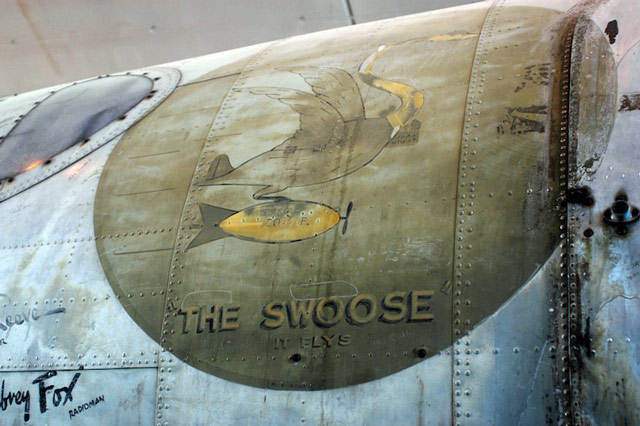
The Swoose ferried LBJ to Port Moresby on 9 June 1942 worldwartwo.filminspector.com
Artwork depicting "The Swoose" on the B-17D aircraft that carried Lyndon Baines Johnson to Port Moresby on 8 June 1942. The aircraft is currently being restored in Dayton, Ohio (U.S. Air Force photo courtesy of the National Museum of the United States Air Force).

Navy Reserve Lieutenant Lyndon B. Johnson, the future President, makes an aerial inspection tour from his location in Townsville, Australia. Johnson already has had an interesting time Down Under, having helped to quell a mutiny by African-African troops on 22 May 1942. The B-26 Marauder flying the mission has engine trouble after departing from Port Moresby and has to return to base, but the USAAF 19th Bombardment Squadron of the 22nd Bomber Group completes its mission (flying from Townsville to Port Moresby for refueling) to bomb Lae, New Guinea. The Port Moresby stage of the mission has to be delayed for an hour to accommodate LBJ, who arrives from Townsville in General Brett's VIP B-17D "The Swoose." 

The mission is hazardous even though Johnson misses out on the actual bombing run. LBJ narrowly escapes death because he switches bombers at the last minute due to a pilot change, and the plane he leaves crashes into the sea off Salamaua, killing everyone on board. LBJ then also escapes potential harm when the B-17 on the flight back to Townsville gets lost and almost runs out of fuel. It has to make an emergency landing at remote Carisbrooke Station near Winton. This B-17D, incidentally, survives and is the property of the National Air and Space Museum in Washington, D.C. The strange sequence of events results in General MacArthur awarding Johnson a Silver Star, the Army's third-highest decoration. Johnson soon after heads back to D.C. in accordance with FDR's requirement that all members of Congress return to their legislative duties. He remains in the US Naval Reserve until January 1964.

The Japanese complete their occupation of the Philippines and declare it secure.

US 24-ton freighter Husky founders two miles off Cape Constantine in Nushagak Bay, Aleutian Islands. Everyone survives.

US submarine USS Trout (SS-202) picks up two survivors of the sunken Japanese heavy cruiser Mikuma.

There is fierce fighting near the town of Chuhsien, China. Both sides take heavy casualties.
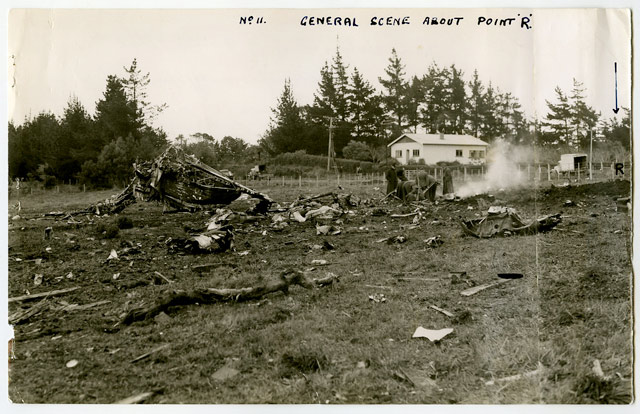
B-17 crash site in New Zealand, 9 June 1942 worldwartwo.filminspector.com
Crash site of a B-17 near Whenuapai Aerodrome, Auckland, New Zealand, 9 June 1942. All 11 men on board are killed (Archives New Zealand Reference: ADQA 17211 AIR1 572 25/2/588).

Battle of the Indian Ocean: The Japanese Divine Dragon Operation No. 2 submarine force, in which the Japanese high command placed high hopes, remains operational in the Mozambique Channel. However,  it is now clear to the local commanders that the operation now has turned into a standard submarine patrol and that initial plans to target the British Far Eastern Fleet are obsolete. Accordingly, Lieutenant Commander Otani Kiyonori of I-18 has his men destroy and jettison mini-submarine M-18b, effectively ending the operation.

Around this time, British divers discover the remains of M-20b, which carried out the most successful attack at Diego Suarez. It is sitting upright on a reef in heavy surf (remnants remain there to this day). They salvage the propellers, now on display at the gravesite of its occupants, Lieutenant (j.g.) Akieda Saburo and POIC Takemoto Masami. They were killed on 2 June 1942 by a British patrol on the mainland while attempting to rendezvous with I-20.

The Japanese have not given up on the Indian Ocean by any means. On 5 June 1942, auxiliary cruisers Aikoku Maru and Hokoko Maru caught 6757-ton British passenger ship Elysia 350 miles northeast of Durban. They torpedoed it, and today it sinks, causing 22 deaths. 

Battleship HMS Ramillies, previously damaged by a Japanese mini-submarine in late May 1942, arrives in Durban for repairs accompanied by light cruiser Emerald and three destroyers. The damage ultimately will require a return to the UK at Portsmouth on 8 September that will last until the summer of 1943.
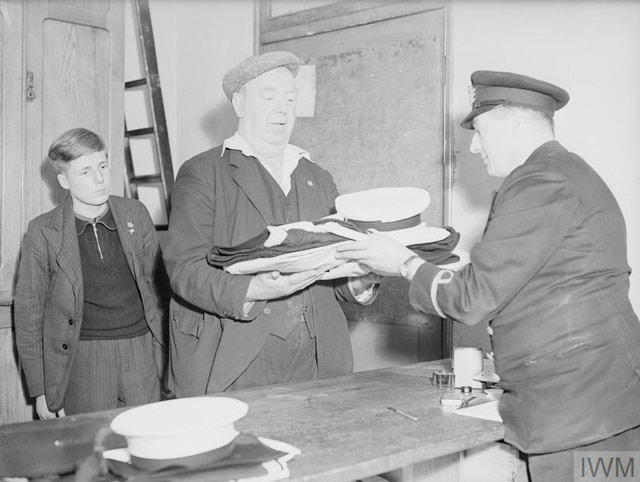
A new recruit for the Royal Navy, age 62, 9 June 1942 worldwartwo.filminspector.com
A new recruit, age 62, joins the Royal Navy, 9 June 1942. ""Owd Bob" drawing his petty officer's rig on board the Armed Merchant Cruiser Depot ship HMS MERSEY. Behind him is Tommy Harding, age 18, another new entry who volunteered for this special naval service." © IWM A 8807.

Eastern Front: German General Erich von Manstein's assault on Sevastopol has shown signs of turning into a battle of attrition, exactly what he didn't want. The priority is to take Sevastopol before the Case Blue offensive on the main front begins, and that now is looking doubtful. Luftwaffe General Wolfram von Richtofen begins changing attack priorities from assisting the front-line troops to attacking Soviet supply lines, a bad sign that the plan is faltering. The Luftwaffe is fully committed, flying 1044 sorties and dropping 954 tons of bombs, putting a strain on men, equipment, and logistics.

However, the German offensive is not dead, not by any means. General Franz Halder, remaining in East Prussia while the Fuhrer attends the Reinhard Heydrich funeral (see below), comments:
At Sevastopol, good progress despite strong enemy counter-attacks. Otherwise, all quiet. Army Group Center reports breakout of Cavalry Corps Belov to the south.
Halder does have his own grips about the Storfang operation. Writing about a meeting during the day with General Buhle, he comments acidly, "Report on Sevastopol. My suspicion that the Artillery Command is not of the best is confirmed."

The Red Navy is doing what it can to help its comrades ashore. Early in the morning, Soviet destroyers spot Axis mini-submarines operating from Yalta on their radar screens and unsuccessfully attack them. This new development induces Vice-Admiral Oktyabrskii to order his naval captains to concentrate less on offshore gunfire support of the army and more on keeping the sea lanes to Sevastopol clear. He also tells them to switch to area fire rather than targeted fire and cuts back on the number of surface vessel supply missions. This forces an increase in submarine supply missions. While they don't know it, the Axis mini-submariners thus achieve a tactical victory without sinking a single ship.

LIV Corps continues to make slow progress in the north, assisted greatly by an intense artillery bombardment laid down by the biggest guns ever used in combat. The 132nd Infantry clears a key obstacle, the Haccius Ridge, and the 22nd Infantry Division destroys the elite Soviet 79th Naval Infantry Brigade.

General Paulus' Sixth Army counterattacks against Red Army forces in the Kharkov sector. Paulus has plenty of troops because Sixth Army is fated to lead the Case Blue offensive toward Stalingrad. During this attack, Uffz. Wilhelm Crinius of 3./JG 53 shoots down two Soviet Il-2 Shturmovik ground-attack planes for his first two victories.

European Air Operations: Weather is poor on the Channel Front, with 10/10ths cloud cover down to 1500 feet and getting worse as the day proceeds.

A Polish squadron raids Essen. British Wellington IV R1725 crashes into the North Sea, 20 km west of Texel, Netherlands, while en route to bomb Essen. All six crewmen perish. Another Wellington targeting Essen, IV Z1412, is shot down by the nightfighter pilot Oblt. L.Fellerer of II/NJG 2. it crashlands on the beach 2 km west of St. Maartensvlotbrug. The five crewmen survive. A Wellington manages to make it back for a crashlanding after being attacked three times by Me-110 night fighters from below and astern, and the odds of survival are so iffy that the copilot bails out 20 miles west of Essen after the bombing run.
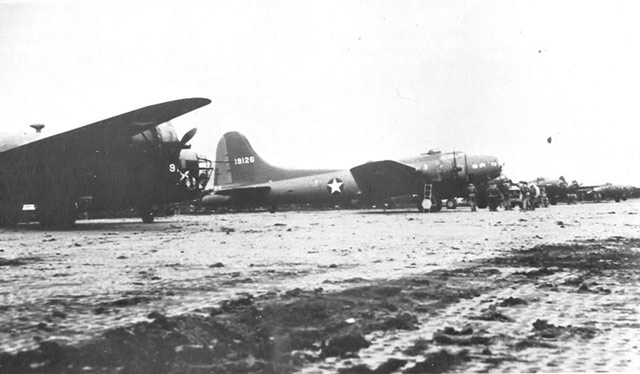
USAAF bombers in Alaska, June 1942 worldwartwo.filminspector.com
"36th Bombardment Squadron LB-30 Liberator and a Boeing B-17E Fortress (41-9126) at Fort Glenn Army Air Base, Alaska, June 1942. 9126 was lost Aug 28, 1942." USAAF photo via Chloe, John Hale, (1984), Top Cover for America. the Air Force in Alaska. 1920–1983, Pictorial Histories Publishing Company, ISBN 0-933126-47-6.

Battle of the Atlantic: U-124 (Kptlt. Johann Mohr), on its ninth patrol out of Lorient, torpedoes and sinks 940-ton French corvette FFL Mimosa (K11, Captain Roger R.L. Birot) 600 miles southeast of Cape Farewell in the British Isles. The Mimosa is an escort for Convoy ONS-100 and sinks within three minutes because the depth charges falling off the ship explode. The other escorts don't even notice the ship is missing until dawn breaks. There are 65-67 deaths and only four surviving French sailors, who are picked up by HMCS Assiniboine.

U-502 (Kptlt. Jürgen von Rosenstiel), on its fourth patrol out of Lorient, torpedoes 6589-ton US tanker Franklin K. Lane 35-40 miles (65 km) northeast of La Guiara and Cape Blanco, Venezuela. It is scuttled by the British destroyer HMS Churchill. The ship, a member of Convoy TO-5, is carrying 73,000 barrels of crude oil to Aruba for processing. There are four deaths and 37 survivors.

U-502 also gets another victim from the same convoy today, 5085-ton Belgian freighter Bruxelles. The ship manages to evade two torpedoes, but a third one blows a seven-meter (yard) hole in the side and the ship sinks within four minutes. The crew acts quickly and manages to launch lifeboats. Destroyer Churchill picks them up quickly. There are 53 survivors and one death.

U-432 (Kptlt. Heinz-Otto Schultze), on its fifth patrol out of La Pallice, torpedoes and damages 7073-ton Norwegian freighter Kronprinsen of Convoy BX-23A south of Cape Sable. The ship is taken in tow and beached at West Pubnico, Nova Scotia. Ultimately, the ship is repaired and returned to service.

U-432 also damages 8593-ton British freighter Malayan Prince with a torpedo that misses the Kronprinsen. The ship manages to remain with the convoy and is later repaired and returned to service in July 1942.
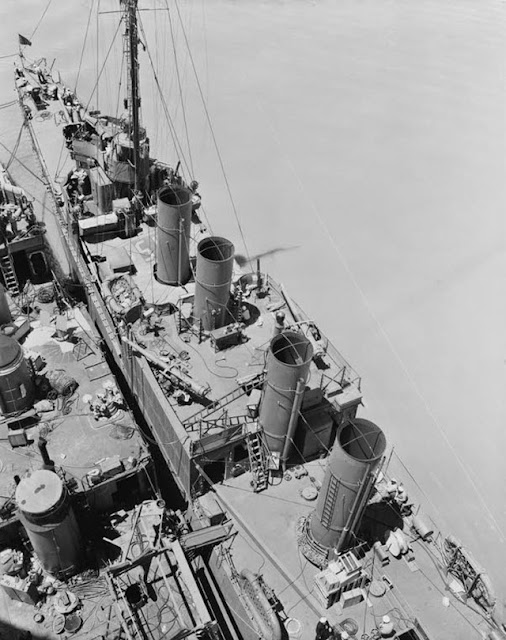
USS Southard at Mare Island, 9 June 1942 worldwartwo.filminspector.com
Four-stack destroyer USS Southard (DMS-10), Mare Island, 9 June 1942. She has just been converted into a minesweeper (Rickard, J (15 September 2018), USS Southard (DMS-10), Mare Island, 9 June 1942).

Battle of the Mediterranean: Early in the morning, the Luftwaffe sends 20 Junkers Ju 88 and 40 Ju 87 Stukas escorted by 50 Bf 109 and Me 110 fighters against the Free French in Bir Hakeim. However, thick smoke and dust force them to turn back. A second attack around noontime by 124 Stukas and 76 Ju 88s, escorted by 168 Bf 109s, has more luck. During this attack, Oblt. Hans-Joachim Marseilles of 3./JG 27 downs four RAF planes.

German artillery also opens up on the fortifications in the morning as General Erwin Rommel readies a final assault. After the planes and big guns have softened up the defenses, units of the 15th and 21st Panzer Divisions, the 90th Light Division, and Italian infantry launch a two-pronged attack.

Rommel's objective is the "high ground" near the fortress, a small rise called Point 186. The Italian Trieste Division makes good progress, overrunning a reinforced French force that is hampered by supply issues. The German advance gains steam in the afternoon when the 15th Panzer breaches the French line in the center, forcing a desperate counterattack with Bren Carriers that succeeds. Oberstleutnant Ernst-Günther Baade leads the Rifle Regiment 115 to within 200 meters (yards) of the fortress by dusk.

Overhead, the Luftwaffe establishes dominance due to previous losses in the RAF Desert Air Force despite frantic pleas for cover from French General Kœnig. The French are low on supplies and everyone can see the writing on the wall. British Major-General Frank Messervy, commander of the 7th Armoured Division, reports that a breakout should be attempted, and at 23:00 Kœnig signals for permission to evacuate the fortress. Lieutenant-General Neil Ritchie, commander of the 8th Army, replies that he'll prepare a thrust from the south but the fortress will have to hold out for another day or two. 

With water and ammunition running out and casualties mounting, Kœnig orders a breakout anyway. The French formation quickly loses coherence in the darkness and the Axis forces react quickly. The retreat turns into desperate hand-to-hand combat but does make progress into the early morning hours of the 10th.

Italian Caproni bombers catch 1584-ton Swedish freighter Stureborg in the eastern Mediterranean and sink it with torpedoes and bombs. There are 20 deaths and only one survivor, whose raft reaches land near Gaza. Ten men in total started out on the raft but nine perished because it drifted for 19 days and they had no food or water.

U-83 (Kptlt. Hans-Werner Kraus), on its eighth patrol out of Salamis, shells and sinks 175-ton Palestinian sailing ship Typhoon four miles southeast of Sidon, Lebanon. Everyone survives.

RAF Catalinas of No. 240 Squadron sinks Italian submarine Zaffiro in the western Mediterranean southeast of Palma de Mallorca, Balearic Islands. There are no survivors.
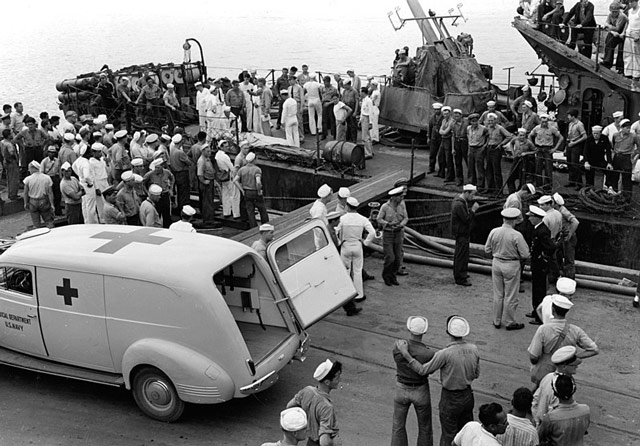
USS Hammann survivors arrive at Pearl Harbor, 9 June 1942 worldwartwo.filminspector.com
Survivors of the destroyer USS Hammann (DD-412), torpedoed and sunk on 6 June 1942 at the Battle of Midway, are brought ashore at Pearl Harbor, 9 June 1942 (Naval History and Heritage Command 80-G-312064).

Joint Allied Planning: The United States and British governments form the Combined Production and Resources Board. The purpose is to plan and coordinate production in each country to best serve war needs. It operates independently and competes with the Combined Munitions Assignment Board, which is under the jurisdiction of the Combined Chiefs of Staff. President Roosevelt's crony Harry Hopkins is the American leader behind the scenes, though Donald Nelson is the chair. 

While sometimes criticized as ineffective, the Board changes the military procurement process based on statistical analysis and perceived priorities. It provides some order to the former chaotic ordering system directly to industry used by the militaries of the respective countries. British representatives tend to feel the Board favors the US and prefer to exert their influence through the Munitions Board because they feel the Combined Chiefs give them more of an equal say. Canada feels left out and eventually is admitted to the Board as an equal partner. 

The real weakness of the Board is that its leaders don't really have much of an idea themselves of what the war effort needs or where the war is going until it is really too far along to matter. As the military strategy and objectives change - sometimes at the last minute - the Board must follow along and thus always is a step behind actual needs. Its findings also have to be implemented by the respective governments which may not necessarily agree completely with its decisions and thus may not treat them with a sense of urgency.

US Military: The Navy establishes a naval operating base at Kodiak, Alaska.
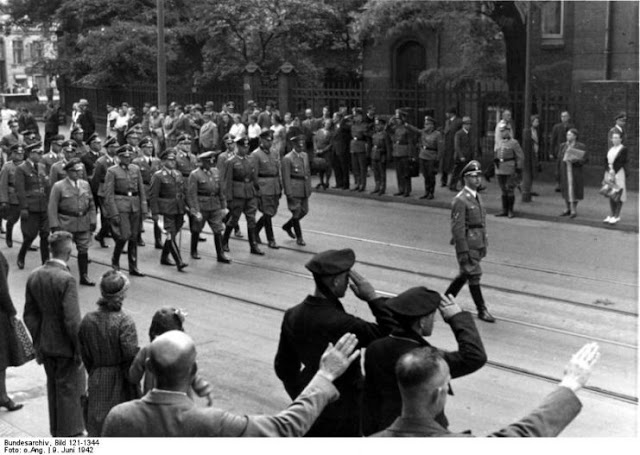
Heinrich Himmler leads the parade at the Reinhard Heydrich funeral, Berlin, 9 June 1942 worldwartwo.filminspector.com
Reichsfuhrer-SS Heinrich Himmler leads the procession at Reinhard Heydrich's Berlin funeral on 9 June 1942. Visible in the front row from left are Robert Ley, Karl-Hermann Frank, Erhard Milch, Sepp Dietrich, Sergeant Heinz Heydrich (Reinhard's younger brother), police chief Kurt Daluege (Heydrich's successor in Bohemia and Moravia), and Wilhelm Frick (Federal Archive Picture 121-1344).

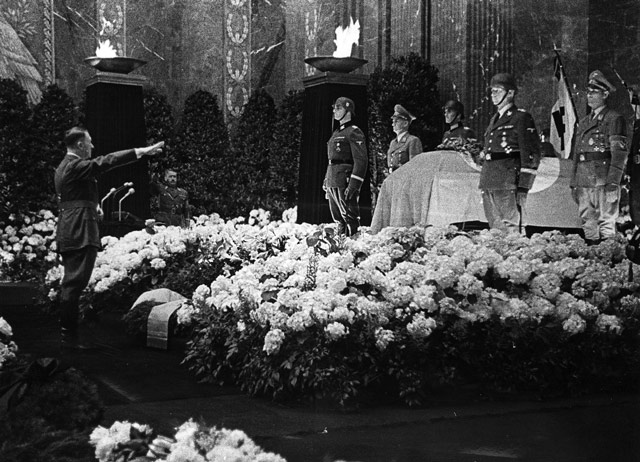
German Homefront: The government holds the second funeral for Reinhard Heydrich, who was shot by British agents on 27 May 1942. This second funeral is in Berlin (the first, on 7 June, was in Prague). All of the top Reich officials attend, including Adolf Hitler and Hermann Goering. Hitler awards Heydrich the German Order, the highest honor in the Third Reich, posthumously. After the ceremony, Heinrich Himmler tells his subordinates to ramp up the Holocaust.

Heydrich is interred in a plot at the Invalidenfriedhof in Berlin. The location, once well known, since the war has become secret to prevent fascist gatherings.

Privately, Hitler blames Heydrich's own lax security precautions on his demise. He tells his cronies that a man as important to the war effort as Heydrich never should have been driving in an unguarded open-air car through streets filled with people. Hitler, of course, is (rightly) paranoid about his own personal security and routinely changes his routes and timing to frustrate would-be assassins. This already has saved his life at least once, when he evaded a bomb planted at the Munich Brown House (Braunes Haus) on 8 November 1939.

Due to the Gestapo's mistaken belief that the Heydrich assassins operated from the town of Lidice, the local German authorities begin to obliterate it today. Today and tomorrow, they kill 199 men and deport 195 women to the Ravensbrück concentration camp. There are 95 children in the town, 81 of whom later perish at the Chelmno camp. Eight are adopted by German families. The German security forces also prepare to destroy the town of Ležáky.

The two agents who assassinated Heydrich, Jozef Gabčík and Jan Kubiš, remain at large despite a massive German manhunt. The local authorities make it clear to the Czech people that if they are not turned over, more blood will be spilled. They also promise a bounty of a million Reichsmarks. Since everyone knows the German threats are not just empty words and Lidice is the proof, this reaches some receptive ears.
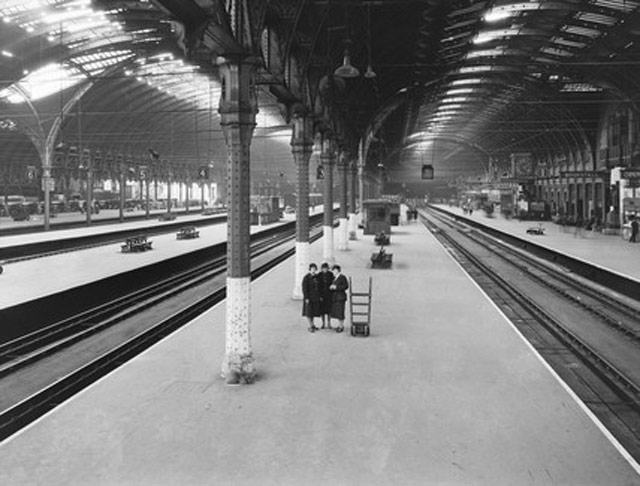
Paddington Station, London, UK, 9 June 1942 worldwartwo.filminspector.com
Platforms 2 and 3 of Paddington Station, London, UK, 9 June 1942 (Science & Society 10442395).

American Homefront: Lord Louis Mountbatten, Chief of the British Commandos, arrived in Washington for tactical conversations with US officers. Also returning from London are Generals Dwight D. Eisenhower, Henry "Hap" Arnold, and Mark Clark.

Ronald Reagan, who enlisted in the USAAF on 15 May 1942 as a private, receives a transfer to become the public relations officer for the First Motion Picture Unit in Burbank, California, under director John Ford. In this role, Reagan will be instrumental in "discovering" a young aviation worker in Burbank who will turn into film star Marilyn Monroe. He ends the war with the rank of Captain.

Future History: Heydrich's death leads to a series of prolonged court cases in the 1950s by his widow, Lina. She successfully argues to the West German government that she is entitled to a full pension as she widow of a German general. She writes a 1976 memoir, Leben mit einem Kriegsverbrecher (Living With a War Criminal), remarries, and passes away in 1985. Three of their four children survive the war.

Raymond "Ossie" Clark is born in Warrington, Lancashire, England. He becomes a top fashion designer during the "Carnaby Street" height of British fashion in the Swinging Sixties. He passes away on 6 August 1996 after being stabbed by a former lover.
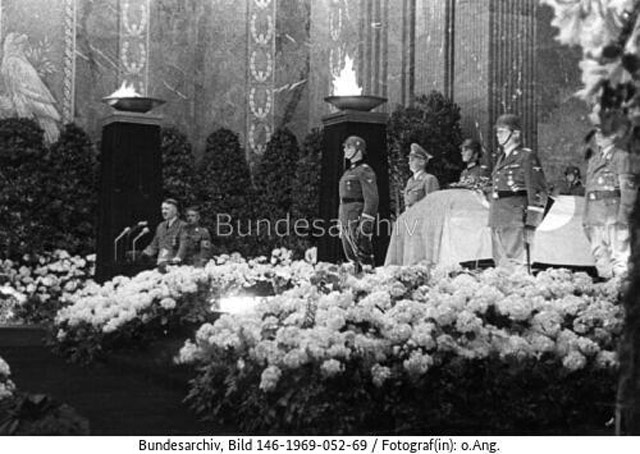
Adolf Hitler speaks at the Reinhard Heydrich funeral, 9 June 1942 worldwartwo.filminspector.com
Adolf Hitler gives a memorial address at the funeral of Reinhard Heydrich in the New Reich Chancellery, 9 June 1942 (Federal Archive Image 146-1969-052-69).

2021

Tuesday, October 5, 2021

June 4, 1942: Japanese Lose Four Carriers to One U.S. Carrier

Thursday 4 June 1942

USS Yorktown sinknig 4 June 1942 worldwartwo.filminspector.com
"The U.S. Navy aircraft carrier USS Yorktown (CV-5) lists heavily after she was abandoned during the afternoon of 4 June 1942. Note that two Grumman F4F-4 Wildcat fighters of Fighting Squadron 3 (VF-3) are still parked on her flight deck, aft of the island." Naval History and Heritage Command 80-G-21666.

Battle of the Pacific: Japan loses three aircraft carriers on 4 June 1942 during one of the pivotal days of World War II.

The day begins with the Japanese Fleet approaching Midway Island and three U.S. Navy aircraft carriers, unknown to the Japanese, waiting for them to the northeast of the island. Reveille on Midway sounds a 03:00, with battle stations ordered. At 04:00, six F4F Wildcats of VMF-221 (Major Floyd B. “Red” Parks) take off, followed by 11 PBY Catalinas of VP-44. In addition, 16 B-17 bombers get in the air, ready to bomb the Japanese.

Initial Japanese Carrier and Midway Island Aircraft Attacks

On the Japanese side, Vice Admiral Chuichi Nagumo’s First Striking Force, composed of fleet carriers Akagi, Kaga, Hiryu, and Soryu, begin launching their aircraft at 04:30. By 04:45, 36 Nakajima B5N2 Kate torpedo bombers, 36 Aichi D3A1 Val dive bombers, and 36 Mitsubishi A6M2Zero fighters were on their way to Midway.

A U.S. pilot, Lieutenant Howard P. Ady, spots the approaching Japanese planes at 05:30 and gets off a detailed radio report. Radar on Midway picks up the Japanese planes at 05:53. This alerts the defenders, who rush to man their positions. Twenty-one Buffalo fighters, six Wildcats, six TBFs, and four B-26 bombers follow suit, along with all available dive bombers. Every one of the 66 planes based at Midway is in the air by 06:16.

The Buffaloes and Wildcats intercept the approaching Japanese bombers. The Japanese Zeros make quick work of the first six Buffaloes, destroying all but one that barely limps back to Midway. The Zeroes then begin picking off the remaining Buffaloes, opening a path for their bombers, losing three Kate bombers in the process.
Midway Island fires, 4 June 1942 worldwartwo.filminspector.com
Oil tanks burning on Midway Atoll after the Japanese attack, 4 June 1942. Note the birds in the foreground. (US National Archives).

At 06:31, the Japanese are over Midway Island and the anti-aircraft guns on the island open fire. The Kate bombers destroy three oil tanks and set fire to a seaplane hanger while losing two of their number. Val dive bombers attack the airfield, killing four mechanics and setting off eight 100-lb bombs and some .50-caliber ammunition. The island's electricity goes out when a Val bombs Eastern Island's powerhouse. This causes a real interruption of the island's water supplies, as opposed to the fake problem radioed by Midway Island in May that enabled U.S. Navy cryptographers to pinpoint Midway as the Japanese objective.

The attack is over by 06:48, and the all-clear sounds at 07:15. Only six Buffalo fighters make it back to the island and only 20 of the original force of U.S. fighter planes. They are almost all badly damaged, with one Buffalo and one Wildcat still serviceable. Casualties on the ground are 11 dead and 18 wounded.

Meanwhile, Midway's own bombers find the Japanese carriers and launch their own attack at 07:10. Six TBFs attempt a torpedo run but five are shot down by defending Zero fighters. Only one TBF launches its torpedo at a cruiser and then barely makes it back to the island.

Four B-26 Marauder bombers then attack. Two get within 850 yards and 450 yards, respectively, of carrier Akagi and launch their torpedoes.  Only two of the Marauders survive the defending fighters. The torpedo attacks have done one thing extremely well, however, in that they have drawn the defending fighter cover down to sea level.

At 07:48,  sixteen Dauntless and Vindicator dive bombers of VMSB-241 (Major Lofton Henderson) arrive at the scene and begin their attacks. The fighters quickly get up to 4000 feet and begin shooting down the arriving planes, but there is enough cloud cover for the U.S. planes to evade most of the attacks. The Zeros shoot down Henderson's Dauntless, but ten get through to drop their bombs at low altitude. The planes then return to Midway, losing eight SBDs in total and with only six making it back to base.

Next, 15 B-17 Flying Fortress bombers led by Lt. Col. Walter C. Sweeney arrive at 08:10, just as the Dauntlesses are completing their attacks. These bombers have no success, finishing their attack by 08:20 and returning to Midway.

Just as the B-17s are completing their bomb runs, 11 Vindicators (Major Benjamin Norris) arrive and are immediately swarmed by Zero fighters. They attack battleship Haruna, losing two planes to anti-aircraft fire and three others on the way back to Midway. These attacks also completely fail.
A damaged Douglas SBD, 4 June 1942 worldwartwo.filminspector.com
A battle-damaged SBD from carrier USS Enterprise on the flight deck of carrier USS Yorktown after having to land there due to fuel exhaustion, 4 June 1942 (US Naval History and Heritage Command).

At this point, in mid-morning, the U.S. attacks have achieved no hits on the Japanese ships despite a wave of attacks. They have lost 19 planes, and only six Dauntlesses, seven Vindicators, one Buffalo, and a single Wildcat remain usable on Midway. The Japanese essentially have beaten the defenders of Midway Island and it is ripe for invasion.

However, the presence of three U.S. Navy aircraft carriers (USS Yorktown, Enterprise, and Hornet) remains unknown both to the island's defenders and to the Japanese. Admiral Nagumo is convinced that he has defeated the Americans, so he throws caution to the winds and has his reserve force armed with contact bombs for use against land targets to soften the island's defenders up for his invasion.

However, midway through this process, at 07:40, a scout plane from cruiser Tone reports that it has sighted a U.S. fleet to the east. Critically, the pilot does not mention that there are any aircraft carriers, and the report does not reach Nagumo until 08:00. He immediately orders the bombs changed to general-purpose bombs. 
 
Massive confusion now overcomes the Japanese commanders. Nagumo knows he has must recover his planes from the morning strike against Midway Island before launching any attacks on the U.S. ships, which he thinks are almost all non-carriers (the Tone pilot eventually reports seeing only one carrier). Bringing up his reserve planes from the hangar to the flight deck and launching them would take 30-40 minutes, and the strikes still would go off in a ragged fashion. Torn between sending an immediate strike or recovering his planes from the Midway raid, Nagumo ultimately decides on the latter. This also would give his crew time to arm the reserve planes with torpedoes.
An SBD ditches, 4 June 1942 worldwartwo.filminspector.com
"U.S. Navy LCdr Maxwell F. Leslie, commanding officer of Bombing Squadron 3 (VB-3), ditches his Douglas SBD-3 Dauntless next to the heavy cruiser USS Astoria (CA-34) after successfully attacking the Japanese carrier Soryu during the Battle of Midway, 13:48 hrs, 4 June 1942." Naval History and Heritage Command 80-G-32307.

U.S. Navy Carrier Attacks

Meanwhile, on the U.S. Navy side, there is no indecision at all. Admiral Frank Fletcher launches his planes beginning at 07:00 and completes this by 07:55 for Enterprise and Hornet and by 09:08 for Yorktown. The planes are well on their way toward the Japanese ships while Nagumo is making up his mind.

The U.S. carriers are roughly 155 nautical miles (287 km, 178 miles) from the Japanese carriers at launch. The planes from Enterprise and Hornet do not form up, but instead, fly piecemeal toward the targets. Some of the planes follow an incorrect heading and miss the carriers, having to ditch, but one formation of TBD Devastator torpedo bombers (Torpedo Squadron 8, or VT-8 (Lt Cdr John C. Waldron) heads on the correct heading.

Waldron's planes arrive over the Japanese carriers at 09:20 and immediately attack. Unfortunately, they have no fighter escort and the defending Japanese Zeros shoot down all 15 Devastators before they can make any hits (one ensign survives after launching a torpedo that misses carrier Sōryū).

At 09:40, VT-6 from Enterprise, composed of 14 Devastators, arrives and attacks. It fares only a little better, losing nine planes without any hits. At 10:10, another wave of Devastators (VT-3 from Yorktown) arrives and 10 of these 12 planes also are shot down. So far, the defending Japanese combat air patrol is having a field day and the Japanese fleet remains unscathed despite all the attacks. Zero fighters clearly outclass the obsolete U.S. Navy torpedo bombers. Another problem for the attackers is that their torpedoes seem surprisingly ineffective given how close some of the planes get to the carriers.

However, everything is not as it seems. As in the earlier attacks, the torpedo attacks have drawn the defending Zeros down to sea level. The carriers, meanwhile, have had to execute extreme maneuvers to evade the torpedo attacks and are out of position. Furthermore, the defending fighters are low on fuel and ammunition.
A Wildcat takes off from USS Yorktown, 4 June 1942 worldwartwo.filminspector.com
Lt. (jg) William Leonard’s F4F-4 Wildcat taking off from carrier USS Yorktown during Battle of Midway, 4 June 1942 (US National Archives).

The stage is now set for one of the epic attacks in naval history.

Air Group Commander C. Wade McClusky, Jr. from Yorktown commands three dive-bomber squadrons from U.S. carriers (VB-6, VS-6, and VB-3). McClusky knows his SBD dive bombers are running low on fuel due to heading on the incorrect course. However, he does not give up looking and by chance spots a lone Japanese destroyer sailing toward the Japanese fleet and pointing at it like an arrow. The planes are so low on fuel that some have to ditch before they make it to the Japanese carriers.

However, fortune smiles on McClusky. He splits his planes up to attack carriers Kaga and Akagi. Despite some confusion and miscommunication, the dive bombers attack both carriers within minutes of each other. Basically, Kaga is attacked by two squadrons of dive bombers while Akagi is attacked by one.

It is at this point that the Japanese luck runs out. Their defensive aircraft are out of position, the carriers are full of planes being fueled and armed, and the carriers themselves are poorly protected by their accompanying ships because of the evasive maneuvers they have been forced to make to evade torpedo attacks.

Three to five 500-lb bombs hit their mark on Kaga, starting fires and hitting the bridge, killing Captain Jisaku Okada and most of Kaga's senior officers. This leaves the ship leaderless and out of control. The carrier deck tears and bends into the air, exposing the hangar deck and its fueling aircraft to more bombs.
The End of Akagi, 4 June 1942 worldwartwo.filminspector.com
"The End of Akagi." Painting by John Hamilton (1919-1993), original is displayed in The Pentagon, Washington, D.C.

Due to miscommunication, only three dive-bombers led by Lieutenant Richard H. Best, who has decided not to attack Kaga because it is blowing up, attack Akagi. The bombers have unbelievable luck, as there is almost no defensive fire. One of the bombs hits the edge of the mid-ship elevator and penetrates to the hangar deck, where it explodes. The armed and fueled aircraft there detonate in a fireball, creating an explosion that rips the interior of the carrier apart. The crew has no hope of bringing the raging inferno under control.

VB-3 (Max Leslie) sees Kaga and Akagi blowing up and, still armed, now turns its attention toward a third carrier, Sōryū. They achieve at least three hits, igniting the gasoline being used to fuel the planes and detonating ammunition as with the other two carriers. VT-3 attacks the fourth carrier, Hiryū, but has no luck.

The fires on Akagi, Sōryū, and Kaga seal their fates. The fires expand and cause more bombs and fuel to explode and burn. Admiral Nagumo leaves Akagi and transfers his flag to light cruiser Nagara. The Japanese give up on all three carriers and scuttle them.
USS Yorktown sinking, 4 June 1942 worldwartwo.filminspector.com
USS Yorktown listing and about to sink, 4 June 1942 (US Navy).

Japanese Counterattack

With three of his four carriers gone, Nagumo orders Hiryū to launch its own immediate attack on the U.S. carriers with whatever is available. It sends 18 D3A Vals and six fighter escorts, a relatively small attack considering the forces battling earlier but the most the Japanese fleet can now muster. The planes follow the retreating U.S. planes back to their carriers and immediately attack when within range. The dive bombers sight Yorktown first and attack it, hitting it with three bombs. The Japanese lose 13 dive bombers and three fighters in this attack.

The damage does not seem too bad at first, with all but one boiler put out of operation and a hole in the flight deck. However, it is bad enough for Fletcher to transfer his own flag to heavy cruiser Astoria.

Yorktown's crew works quickly. They patch the flight deck and get several boilers back in operation within an hour. Soon, Yorktown is steaming at 19 knots (22 mph, 35 km/h) and everything seems under control. It resumes air operations and Captain Buckmaster gets a little cocky, hoisting a huge American flag from the foremast and returning operations to normal.

An hour later, the second wave of Hiryū planes arrives. This is composed of ten Nakajima B5N torpedo bombers and six escorting Zeros. Again, this is not much of an attacking force, but the U.S. defense are strained from the earlier attacks and they hit Yorktown with two torpedoes. The Japanese lose five more bombers and two Zeroes in this attack. Yorktown is left afloat but in very poor condition.

The few Japanese planes that make it back to Hiryū report having sunk two U.S. carriers. They mistakenly believe that the first and second waves attacked different carriers, when, in fact, both hit Yorktown. Nagumo believes that if he can launch one more coordinated attack, he can sink the third and last U.S. carrier, leaving him with the sole remaining carrier near Midway and able to complete the invasion of the island.
Map of Battle of Midway. 4 June 1942 worldwartwo.filminspector.com
The general outline of the Battle of Midway. Source: United States Military Academy, Department of History.

The Final U.S. Counterattack

Fletcher and Admiral Spruance, in tactical command of Enterprise and Hornet, are ready to launch their own attack on Hiryū, but first they have to know where it is. Fortuitously, a Yorktown scout plane sights it late in the afternoon and the Enterprise immediately gets a strike force in the air. It is composed of 24 dive bombers (six SBDs from VS-6, four from VB-6, and 14 of VB-3 recovered from Yorktown.

The 24 dive bombers finish the day's work by blowing through the defending 12 Zero fighters and hitting Hiryū with four or five bombs. The same pattern as earlier repeats, with the bombs setting the Japanese carrier ablaze and the fires quickly getting out of control. The damage is so obviously bad that a later raid by Hornet's aircraft decides to skip Hiryū and attack other ships, though with no success.

All four Japanese carriers are now flaming wrecks and must be scuttled (Akagi, Kaga, Soryu) or sink unaided (Hiryū). On the U.S. side, the only carrier that has been hit is Yorktown, but, following the two torpedo strikes, it now is a total loss. The crew abandons ship and it, too sinks. That leaves the score at one U.S. Navy carrier lost to all four Japanese carriers sunk. The U.S. still has two carriers completely undamaged and incorporating planes recovered from Yorktown in addition to their own.

As night falls, the Japanese ships attempt to find the U.S. ships and bring them to battle. Spruance, now in command of operations because Fletcher cannot command from a cruiser, decides the better part of valor is a hasty retreat to the east. The day ends with Yamamoto's heavy ships chasing the U.S. carriers to the east but never spotting them.
USS Enterprise operating at flank speed. 4 June 1942 worldwartwo.filminspector.com
"The U.S. Navy aircraft carrier USS Enterprise (CV-6) steaming at high speed at about 0725 hrs, 4 June 1942, seen from USS Pensacola (CA-24). The carrier had launched Scouting Squadron Six (VS-6) and Bombing Squadron Six (VB-6) and was striking unlaunched SBD aircraft below in preparation for respotting the flight deck with torpedo planes and escorting fighters. USS Northampton (CA-26) is in the right distance, with SBDs orbiting overhead, awaiting the launch of the rest of the attack group." Naval History and Heritage Command 80-G-32225.

Aleutians Campaign

Things go much better for the Japanese further north.

Following a successful raid on Dutch Harbor in the Aleutian Islands on 3 June, Japanese Vice Adm. Boshiro Hosogaya sends off a second raid from his carriers Junyō and Ryūjō. The attacking planes get through again, destroying oil storage tanks and damaging a hospital and a beached barracks ship. U.S. Navy Task Force 8, under the command of Rear-Admiral Robert A. Theobald, is nearby but does not intervene. Only late in the day do U.S. forces locate the two light Japanese carriers, but their attempts to sink them fail due to poor weather. The weather does help the Americans, though, because it causes the Japanese to cancel plans to invade Adak Island. Instead, they now plan only to land troops at Attu and Kiska. U.S. 3094-ton passenger/barracks ship Northwestern, bombed and damaged during the 3 June raid, is declared a total loss.

U.S. 15-ton halibut schooner King Fisher sinks from unknown causes five nautical miles (9.3 km, 5.8 miles) off Lazaroff Island and Pilot Point, Alaska. There are one survivor and three dead, the survivor rescued by a U.S. Navy patrol boat.

I-27 torpedoes and sinks 3353-ton Australian iron-ore carrier Iron Crown in the Bass Strait. There are 37 deaths. This sinking, combined with one on 3 June by I-24, convinces the Australian authorities to restrict shipping north of Melbourne until they can institute a convoy system on the east coast.

Battle of the Indian Ocean: HMS Trusty (Lt. Cdr. E. F Balston) torpedoes and sinks the 7031-ton Japanese merchant cargo ship Toyohashi Maru in the Strait of Malacca. Casualties are not recorded.

The Tenth Air Force sends two heavy bombers to attack Rangoon, Burma. The ten defending Japanese fighters shoot down one of the bombers and badly damage the other. This is the last raid on Rangoon for some time, as the monsoon rains ground the heavy bombers on their dirt runways.

The 11th Bombardment Squadron (Heavy), 7th Bombardment Group (Heavy) is established with B-25 bombers at Kunming, China.
Mannerheim, Hitler, and Ryti. 4 June 1942 worldwartwo.filminspector.com
Field Marshal Carl Mannerheim, Adolf Hitler, and Finnish President Ryti walk to Mannerheim's command train parked in a forest, 4 June 1942 (Finnish Military Museum SA-Kuva).

Eastern Front: At Sevastopol, the Wehrmacht bombardment continues unabated. The rolling barrage shifts today to the line facing the Romanian troops in the east. the Luftwaffe remains very active, flying hundreds of sorties.

Overall, it is a quiet day on the Eastern Front. With Hitler away and nothing going on, General Franz Halder doesn't even bother listing a daily summary in his war diary, simply noting that he is flying to Berlin. When the Fuhrer's away, the mice will play.

Of much greater importance is what Adolf Hitler is doing. While seemingly an informal visit to a friend, it actually is a calculated attempt to shore up the Reich's fraying "co-belligerency" with Finland. The Finns are fighting the same enemy, the Soviet Union, but increasingly are refusing to engage in battles desired by the German high command. Hitler decides a little personal diplomacy is in order.
Hitler and Keitel walk to Mannerheim's command train. 4 June 1942 worldwartwo.filminspector.com
Adolf Hitler, followed by Field Marshal Keitel, "walks the plank" to Finnish Field Marshal Carl Mannerheim's command train. Mannerheim can be seen smirking in the background (SA-Kuva).

Hitler, seemingly on a whim and with only one day's notice, flies to Finland to wish Field Marshal Carl Mannerheim a happy birthday on 4 June 1942. It is Mannerheim's 75th birthday. The visit is a very rare journey outside the Reich for Hitler, who almost never leaves areas of German control. While Hitler does eventually establish a headquarters in the occupied Soviet Union and visited Vichy France in 1940, German troops are always nearby. Finland is a co-belligerent but by no stretch of the imagination is under German control except in isolated areas such as the far north.

Hitler is greeted warmly by Mannerheim and treated properly, but the visit causes the Finns a great deal of anxiety. For one thing, it complicates Finland's diplomatic relations with the United States, with whom Finland is not at war. Mannerheim purposefully does not greet Hitler at his headquarters, but rather says that he is "in the field" and that Hitler should visit him where his command train is parked, at Imatra in Southern Finland.

Hitler's Focke-Wulf Fw 200 Kondor flies across the Gulf of Finland in great secrecy. When it lands at the small Immola Airfield (about 9 kilometers (6 mi) northeast of Imatrankoski), hard use of the brakes causes an issue with the left landing gear. A fire breaks out, apparently caused by brake fluid spraying over the hot brakes. The Kondor is known to have poorly designed brake hubs, causing the brakes to lock sometimes. Fortunately for Hitler, the fire is quickly extinguished with a fire extinguisher, the damage is slight, and the aircraft is quickly repaired (new bolts are quickly manufactured and installed). Hitler completely ignores the incident and may, in fact, not even know about it.
Hitler, Keitel, Mannerheim, and Ryti. 4 June 1942 worldwartwo.filminspector.com
June 4, 1942. Dining in the train wagon: Adolf Hitler (left), Finnish Prime Minister Jukka Rangell, President Risto Ryti (back toward the camera), Finnish military commander, Marshal Carl Gustav Mannerheim (right). Source: Finnish Military Museum SA-Kuva.

There are some odd moments during the visit, which lasts much of the day. For one thing, Mannerheim has Hitler and Field Marshal Wilhelm Keitel walk a plank from a hillside to his command train. Both men navigate it without incident, but this could have ended in an embarrassing disaster. Another peculiar moment is when an SS officer bursts into the carriage where Hitler and Mannerheim (along with Finnish State President Risto Ryti and Keitel) are discussing strategy to inform them that Finnish intelligence has been taping their conversation with a hidden microphone. The microphone is located and disabled.

Fortunately for posterity, the 11-minute recording (on a phonograph record) survives the war despite Finnish assurances that it will be destroyed or remain sealed. It is rediscovered (mislabeled) and later released to the public. It is a rare recording of Hitler using his normal speaking voice, as opposed to the louder and more strident voice he uses during speeches. While there is some question whether the recording is genuine, an official investigation verified it.

During the conversation, Hitler confides why he invaded the Soviet Union. He says that he had nightmares of the Romanian oil fields, the source of most of the Reich's oil, "burning from end to end" due to Soviet attacks. To Hitler, Operation Barbarossa is a defensive operation to protect essential assets from a Soviet attack. He admits to being surprised by the Soviet ability to produce so many tanks.

Hitler leaves the meeting and flies back to Germany late in the day, blissfully unaware of the fateful events occurring in the Pacific.
Hitler arrives in Finland. 4 June 1942 worldwartwo.filminspector.com
Adolf Hitler arrives in Finland and is greeted by President Ryti on 4 June 1942. Hitler's Focke Wulf Fw-200 Kondor is in the background.

European Air Operations: The Luftwaffe engages in scattered bombing and mine-laying around Durham County, Yorkshire, and in general the northeast of England. The bombers show poor accuracy and drop bombs in fields west of Ryhope and at Tunstall Poultry Farm and the Turnstall Burdon District in Durham. Other bombs fall on a golf course and along the foreshore at Seaton Carew and Seaton Snooks. Many of these bombs are delayed-action bombs that must be handled by bomb experts and safely exploded. Other bombs fall in the riverside area near Sunderland. There are two men wounded and minimal damage, though an unexploded bomb does delay the loading of two coaling ships.

Both sides lose a plane over the Waddenzee today. The RAF shoots down a Junker Ju 88 over the Waddenzee 1 km south from Ameland Island. All four men aboard perish. Meanwhile, night-fighter pilot Oblt. Zur Lippe Weissenfeld of II/NJG 1 shoots down a British Wellington III from Marham on a raid to Bremen. All five crewmen perish.

Luftwaffe bombers attack and sink 555-ton British patrol boat HMY Sona (FY 027) off Poole Quay, Dorset, England. The ship poses a hazard to navigation, so it later is raised and sunk at Handfast Point.
USS Yorktown hit during the Battle of Midway. 4 June 1942 worldwartwo.filminspector.com
USS Yorktown (CV-5) immediately after an aerial torpedo hit, 4 June 1942. The sky is full of planes and anti-aircraft bursts (U.S. Navy).

Battle of the Atlantic: German raider Stier, operating 200 miles east of St. Paul's Rocks off the coast of Brazil, spots 4986-ton British freighter Gemstone. It fires a warning shot across the bow, but Gemstone does not stop. Instead, it heads directly away from Stier and tries to make a run for it. However, Stier does not give up and continues firing. Eventually, the Gemstone's crew abandons the ship, which is carrying iron ore. The Stier makes the crew prisoners of war and sinks Gemstone with a torpedo.

U-158 (Kptlt. Erwin Rostin), on its second patrol out of Lorient, torpedoes and sinks 2647-ton Norwegian freighter Nidarnes in the Yucatan Strait (southwest of Cuba). Nidarnes is carrying military stores to Brazil and sinks within a minute, with the 11 survivors (13 dead) having to literally jump for their lives as the ship goes under. Someone manages to launch a raft, which the survivors reach a few hours later. They are picked up later in the day by U.S. freighter Curaca.

German 7978-ton freighter Katharina Dorothea Fritzen hits a mine and sinks near Borkum. Casualties are not recorded.
Japanese carrier Hiryu dodges bombs. 4 June 1942 worldwartwo.filminspector.com
Japanese carrier Hiryu successfully evading bombs dropped by B-17 bombers early on 4 June 1942. The war in the Pacific proves the futility of using level bombers against agile ships. 4 June 1942 (U.S. Navy).

Battle of the Mediterranean: The two opposing field commanders in Libya, German General Erwin Rommel and British General Neil Ritchie, spend the day resupplying and preparing offensive operations. RAF Desert Air Force (DAF) fighters and fighter-bombers have a mixed day, scoring some success against Luftwaffe Junkers Ju-87 dive bombers and destroying some Axis vehicles, but losing seven planes.

The Free French troops under General Kœnig continue to hold out at Bir Hakeim, disrupting Rommel's plans to sweep east toward Tobruk. He is grateful for the support of the DAF, which is destroying Axis vehicles surrounding his fortress, so he sends Air Vice-Marshal Arthur Coningham the message, "Bravo! Merci pour la R.A.F" Coningham responds in kind, "Merci pour le sport." However, all is not rosy on the Allied side, as Kœnig's men are surrounded and running low on water and other supplies.

German submarine S-57 torpedoes and sinks 305-ton Royal Navy anti-submarine ship HMS Cocker off Tobruk, Libya. There are 15 dead and 16 survivors.

RAF aircraft torpedo and badly damage 6837-ton Italian freighter Reginaldo Giuliani 120 miles northeast of Benghazi. An Italian destroyer, Partenope, later scuttles it. Casualties are not recorded. 
Badly damaged aircraft at Midway Island. 4 June 1942 worldwartwo.filminspector.com
 The badly damaged aircraft of Lt(jg) Albert Earnest, the sole survivor of VT-8 during a morning attack on the Japanese Fleet, after landing at Midway (U.S. Navy).

Special Operations: Eight days after being wounded during an assassination attempt, Reinhard Heydrich dies in a Prague hospital. Heydrich for a time appeared to be improving, but lapsed into a coma on 3 June and never regained consciousness. The cause of death is variously attributed to sepsis and an embolism. The Germans plan a massive funeral for 7 June.

Heydrich's death makes the British/Czech Operation Anthropoid a resounding success. The two Special Operations Executive agents who staged the attack on him, Jan Kubiš and Jozef Gabčík, remain at large but are the subject of an intense manhunt. The two men are hiding out in Czech safe houses, but the Germans have offered both inducements and threats for his capture. At least one Czech resistance member knows their whereabouts and is planning to reveal it to the Germans.

U.S. Military: Brigadier General Lucian K. Truscott, Jr. (Chief of the American  Section attached to the Combined Operations Headquarters) completes an inspection of Northern Ireland. He submits a report on plans to activate the 1st Ranger Battalion at Carrickfergus. Lieutenant General Breton Somervell, Commanding General of the Army Service Forces, also carries out an inspection in Northern Ireland.

American Homefront: Metro-Goldwyn-Mayer releases "Mrs. Miniver," starring Greer Garson, Walter Pidgeon, and Teresa Wright. It is the highest-grossing film of 1942 and earns six Academy Awards, including Best Picture, Best Director (William Wyler), and Best Actress (Garson). Teresa Wright, who was nominated for a Best Supporting Actress Oscar for her debut film "The Little Foxes" and also as Best Actress for 'Pride of the Yankees" for work in 1941, this time earns the Best Supporting Actress Oscar. It is one of the most dazzling debuts by any actor or actress in history, but her success quickly peters out after this and "Mrs. Miniver" is her last nomination.
Japanese carrier Hiryu dodges bombs from B-17 bombers on 4 June 1942 worldwartwo.filminspector.com
Japanese aircraft carrier Soryu circles while under high-level bombing attack by USAAF B-17 bombers from the Midway base, shortly after 8AM, 4 June 1942. This attack produced near misses, but no hits. U.S. Air Force Photograph.


2021

Tuesday, September 28, 2021

June 1, 1942: Hitler at Poltava

Monday 1 June 1942

Hitler at Poltava 1 June 1942 worldwartwo.filminspector.com
Hitler at Poltava, 1 June 1942. From left to right: Lieutenant General Adolf Ernst Heusinger, General of the Infantry von Sodenstern, Colonel General Max Freiherr von Weichs, Adolf Hitler, General of the Panzer Force Friedrich Paulus, Colonel General Eberhard von Mackensen and Field Marshal Feodor von Bock. Federal Archive Image 183-B24543.

Battle of the Pacific: On 1 June 1942, a Japanese invasion force departs from Kashiwabara on Paramushiru Island in the Kurile Islands heading for Kiska Island in the Aleutians. Meanwhile, the US Navy sends Task Force 8.6 centered around the light cruiser USS Nashville (CL-43) to patrol 400 miles (741 km) south of Kodiak Island. The US 11th Air Force now has 12 P-40s, six B-26 bombers, and a B-17E at Otter Point on Umnak Island.

Pursuant to Admiral Nimitz's orders, aircraft carrier Saratoga sails from San Diego for Pearl Harbor following repair of torpedo damage suffered on 11 January 1942 and some modernization. It carries 14 Wildcats of VF-2 Detachment and 23 Dauntlesses of VS-3, along with four Wildcats, 43 Dauntlesses, and 14 Avengers as cargo. The cargo aircraft are carried as future replacements for aircraft expected to be lost at Midway Island by carriers Enterprise, Hornet, and Yorktown.

Five Japanese submarines (I-21, I-22, I-24, I-27, and I-29) lie off Port Hacking, Australia, waiting for the crewmen of the mini-submarines that attacks Sydney Harbour on 31 May to reach their rendezvous point. The men never arrive, having all been killed either during the attack or afterward.

The US Fifth Air Force sends B-17s to attack the Japanese base at Rabaul, while others raid Lae and Salamaua, New Guinea.
Hitler at Poltava 1 June 1942 worldwartwo.filminspector.com
Hitler driving from the airfield to his meeting with the leaders of Army Group South in Poltava, Ukraine, 1 June 1942.

Battle of the Indian Ocean: Following their successful mini-sub attack on the British fleet at Diego Suarez, Madagascar, two Japanese sailors (Lt Akieda Saburo and PO1C Takemoto Masami) have abandoned their mini-sub at Nosy Antalikely (Antali Keli) islet. Having gotten to the mainland on the boat of some friendly locals, they are proceeding on foot to the pickup point at Cape Amber. Hungry, they stop at a village, Anijabe village, to buy some food. They obtain the food from the friendly locals, but one of them contacts the British in hopes of getting a reward.

Japanese submarine I-10 launches its "Glen" seaplane for a reconnaissance mission over Diego Suarez, Madagascar. Even though this is the third straight day of such flights, the British do not notice it.

The US 10th Air Force raids the Rangoon dockyards with five bombers. The bomber crews claim to sink one tanker and damage another.  
Hitler at Poltava 1 June 1942 worldwartwo.filminspector.com
Adolf Hitler, center, greets soldiers after getting off of his Focke Wulf Fw 200 Kondor at Poltava airfield, 1 June 1942.

Eastern Front: Adolf Hitler makes a rare visit to Army Group Center headquarters at Poltava in the Reichskommissariat Ukraine. He is there to discuss the upcoming Case Blue with Field Marshal Fedor von Bock. Hitler flies in at 9 a.m. and is gone by noon. Afterward, everyone is a little mystified why he visited, but Hitler shows a bit of wanderlust in early June 1942, flying to Poltava, then to Finnland to wish Marshal Mannerheim a happy 75th birthday, and then down to Berchtesgaden for a holiday. This is the first of Hitler's two visits to Poltava, the second being on 3 July.

These visits accomplish nothing that could not also be done via simple teletype messages and phone calls. However, they serve Hitler's purposes in terms of reminding the generals and soldiers at the front who is really in charge. They also serve as good propaganda tools to show the same thing to the German public. Hitler fully expects Case Blau to be a resounding victory and the final German triumph over the USSR, so he wants to be seen prominently at the point of its inception.

At Sevastopol, General von Manstein's 11th Army bombards the Soviet holdouts throughout the day. He is preparing to finally take the port. The Red Army troops know they have no hope of relief and Stalin has not authorized a withdrawal using ships.

The action is heating up in the air over Sevastopol, too. II./JG 77's Lt. Ludwig-Wilhelm Burckhardt is shot down near enemy lines while flying an escort mission for Generaloberst Wolfram Freiherr von Richthofen's Fiesler Storch. He crash-lands near the Soviet lines, gets out of the plane, and runs for his life from advancing Soviet infantry. Burckhardt barely survives and makes it back to German lines but gets chewed out by his commander, Major Gordon Gollob, for not destroying his Bf 109 before leaving.

Back at Fuhrer Headquarters, General Franz Halder simply writes "Unchanged" in his war diary, adding "The mopping-up operation in the rear of Fourth Army [anti-partisan operation Hannover] is making good progress." Halder talks to General Hoth, the new commander of the 4th Panzer Army, about his role in Case Blue.
Hitler at Poltava 1 June 1942 worldwartwo.filminspector.com
Adolf Hitler exits his Focke-Wulf 200 in Poltava, Ukraine, 1 June 1942.

European Air Operations: German flak batteries at Ostend down an RAF Spitfire. The Belgian pilot survives two days and three nights in his dinghy before being picked up by the Germans and imprisoned.

RAF Bomber Command takes a rest after two major raids on consecutive nights, one against Cologne and the other over Essen. It considers the Cologne raid a success although the RAF lost 40 bombers. The Essen raid by 956 bombers, however, achieved little due to poor bombing accuracy.

Fires rage in Canterbury, England, after the latest "Baedeker Blitz" attack by the Luftwaffe.

 Lt. Heinz-Wolfgang Schnaufer of NJG 1 gets his first victory during the Essen raid. He will become known as "The Night Ghost of St. Trond."

Battle of the Baltic: German 981-ton freighter Malmö hits a mine in the Drogden area of the Skagerrak and sinks in Øresund southwest of Malmö, Sweden. On 8 August 1942, a Danish salvage company raises it, brings it to Copenhagen, repairs it, and returns it to service. It survives the war.

Hitler at Poltava 1 June 1942 worldwartwo.filminspector.com
Hitler arrives at the headquarters of Army Group South, 1 June 1942.

Battle of the Atlantic: U-156 torpedoes and sinks 5970-ton Brazilian freighter Alegrete between St. Lucia and St. Vincent. The attack is made after dark at 23:51, making the (neutral) Brazilian flag difficult to see. The crew quickly abandons ship and the U-boat uses its deck gun to send it under by 03:00 on the 2nd. All 64 on the freighter survive, with three lifeboats making landfall in Trinidad and Venezuela and the fourth being rescued by USS Tarbell (DD 142).

U-158 (Kptlt. Erwin Rostin), on its second patrol out of Lorient, torpedoes and sinks 5686-ton US freighter Knoxville City near the Isle of Pines and 50 miles southeast of Cape Corrientes, Cuba. This sinking is sometimes listed as having sunk early in the morning on 2 June. A torpedo strikes the engine room, killing two men instantly and stopping the ship. After an hour the ship is still afloat, so Rostin fires another torpedo that sinks it. Aside from the two men in the engine room, all 53 other crewmen survive. The crew's story is a little unusual because a Brazilian freighter, Jamaica, stops and asks the men in the boats if they want to be rescued, but they decline because they fear that this ship will be torpedoed, too. They ultimately make landfall in La Calina, Cuba, after 48 hours.

U-106 (Kptlt. Hermann Rasch), on its sixth patrol out of Lorient, sinks 2689-ton US freighter Hampton Roads northwest of Cape San Antonio, Cuba. Rasch fires two warning shots with his deck gun, causing the freighter to stop. He waits for the crew to disembark, then fires one torpedo that sinks the ship. Five men remain on board and perish, but the other 23 men take to the boats and are picked up seven hours later by Alcoa Pathfinder.

U-404 (Kptlt. Otto von Bülow), on its third patrol out of Brest, torpedoes and sinks 5492-ton US freighter West Notus 320 miles east of Cape Hatteras, North Carolina. The U-boat chases the ship for two hours and 45 minutes, using its deck gun and scoring about 20 hits in 55 shots. The crew is unable to send a distress call because one of the first shells destroys the radio. Finally, one of the shots disables the steering, causing the ship to sail in circles. The crew abandons ship after firing some rounds with a machine gun that causes minor damage to the U-boat. The U-boat then surfaces, questions the men, gives them some Perrier mineral water bottles, and directs them to Cape Hatteras. The burning freighter, meanwhile, takes a long time to sink, so in an unusual move, von Bülow sends a party on board to plant scuttling charges. There are four dead and 36 survivors, who are picked up after a couple of days by two separate freighters (Greek Constantinos H. and Swiss Saentis).

U-566 (Kptlt. Dietrich Borchert), on its fifth patrol out of Brest, torpedoes and later uses gunfire to sink 9512-ton British freighter Westmoreland northeast of Bermuda 240 miles northeast of Bermuda. The ship takes a long time to sink, and remains afloat even after a coup de grâce torpedo is used, so Borchert surfaces and uses the deck gun to sink it after a five-hour ordeal. There are three dead and 65 survivors, who are picked up by two different freighters (Canadian Cathcart and U.S. Henry R. Mallory). This is U-566's only victory on this patrol.

Some sources place the sinking of 4536-ton Panamian freighter Bushranger today by U-107, but others do so on 31 May 1942, so I covered it there.

Luftwaffe Junkers Ju 87 Stuka bombers sink 6850-ton British freighter Empire Starlight in Murmansk Harbor. The Soviets refloat and repair it in 1945, renaming the freighter Murmansk. The planes also sink 235-ton Soviet freighter Subbotnik in the harbor, with eight dead.
USS Juneau, 1 June 1942 worldwartwo.filminspector.com
The U.S. Navy light cruiser USS Juneau (CL-52). "Photographed off New York City, 1 June 1942. She has a barge alongside her starboard quarter. Her superstructure retains its original camouflage scheme, but her hull has been repainted to a different pattern." Juneau will be sunk on 13 November 1942 at the Naval Battle of Guadalcanal with the loss of 687, including the five Sullivan brothers. Naval History & Heritage Command 19-N-31264.


Battle of the Mediterranean: Following heavy Stuka attacks on British defenders of the 150th Infantry Brigade at the Sidi Muftah box (Got el Ualeb, due west of Tobruk), German soldiers of the Afrika Korps resume their attack west against them that began on the 31st of May. The British Eighth Army attempts to relieve the embattled soldiers, without success. Fierce fighting continues throughout the day into the early afternoon, when the last British soldiers surrender. The Germans claim 3000 prisoners, the destruction of 101 tanks and armored cars, and the capture or destruction of 124 artillery pieces. 

This enables the Germans to make contact with the Italian X Corps, advancing through the minefield from the west. This Axis victory clears two desperately needed pathways through the British minefields to the west so that supplies can be trucked in by the Italian Ariete and Trieste divisions.

Spy Stuff: The Wehrmacht begins a secret disinformation campaign, Operation Kreml (Kremlin). Working on the assumption that the Red Army has sources within the German army, Operation Kreml involves a phony plan by Army Group Center to mount a large-scale offensive to capture Moscow. The plan is put in motion today with the Army Group's distribution down to the regimental level of sealed maps of Moscow with instructions not to open them until 10 June, when meetings to discuss the offensive will be held. In fact, the only Wehrmacht offensive planned for the summer is the one in the south, Case Blau. Kreml is a classic misdirection counterintelligence operation.
Hermann Goering as shown in Time Magazine, 1 June 1942 worldwartwo.filminspector.com
A photo of Hermann Goering in the 1 June 1942 issue of Time Magazine.

German Military: Generals Hermann Hoth of 17th Army and Richard Ruoff of 4th Panzer Army switch commands. Hoth is considered a top panzer general is tasked with preparing the 4th Panzer Army for its critical role in the upcoming Case Blue offensive into southern USSR toward Stalingrad.

Oblt. Heinrich Kraft of 8./JG 51 becomes Gruppenkommandeur of I./JG 51.

US Military: Headquarters, United States Army Northern Ireland Force and Headquarters, V Corps (both commanded by MG Hartle) transfer from Wilmont House to Lurgan. Meanwhile, the Headquarters of Northern Ireland Base Command (Provisional) is activated at Wilmont House under the command of BG Leroy P. Collins.

Brazilian Homefront: Companhia Vale do Rio Doce (CRVD) is founded in Itabira, Minas Gerais, Brazil. It is a metals and mining corporation that eventually evolves into Vale S.A., one of the most valuable companies in Latin America. It is also is controversial due to its impact on the environment and various accidents resulting in deaths and injuries.
Time magazine, with Chiang Kai-shek on the cover, 1 June 1942 worldwartwo.filminspector.com
Chinese leader Chiang Kai-shek on the cover of Time magazine, 1 June 1942.

Holocaust: Carl Oberg officially takes up his post as Higher SS and Police Leader (Höherer SS-und Polizeiführer, HSSPF) "Frankreich" (France) with authority over German police and security forces in France, including the SD and the Gestapo. Oberg now is the ultimate authority in France for anti-partisan operations and Holocaust activities. He will earn the nickname "Butcher of Paris." 

Reinhard Heydrich accompanied Oberg to his new post in France in early May (before the Heydrich assassination attack on 27 May). Already, even before his official installation, Oberg has instituted the policy of requiring Jews in Paris to wear a yellow badge. One of Oberg's defining characteristics will be ordering mass executions of hostages as reprisals for Resistance activities.

American Homefront: The Grand Coulee Dam, which has been under construction since the ceremonial driving of the first stake on 16 July 1933, opens on the Columbia River. The reservoir fills completely and the first waters overtop the spillway. Over 21,000 acres (85 square km) of land have been flooded

The dam's first generator has been in operation since January 1941. Getting the dam into full operation is a very slow and gradual process, with the last of its 18 generators not being switched on until 1950. The total cost of the dam in 2020 dollars: $2 billion.

Future History: Thomas Frank Mankiewicz is born in Los Angeles, California. The son of Joseph Mankiewicz and nephew of Herman Mankiewicz, both power players in Hollywood, Tom Mankiewicz goes on to become an American screenwriter, director, and producer of motion pictures and television. His most famous credits include "Superman: The Movie" (1978) and some James Bond films, including "Live and Let Die" (1973). Tom Mankiewicz was famous within Hollywood insider circles as a "script doctor" brought in to "fix" shaky movie scripts. He passes away in Los Angeles on 31 July 2010 from pancreatic cancer.

Cecil Randolph Hundley Jr. is born in Martinsville, Virginia. He becomes a top catcher, particularly defensively, in Major League Baseball from 1964-1977. He is most famous for playing with the Chicago Cubs. His son, Todd, also becomes a Major Leaguer. Hundley originated the idea of baseball "fantasy camps," where fans get to play with former pros. He apparently still operates some as of this writing in 2021.

Fernando Atzori is born in Ales, Province of Oristano, Italy. He goes on to become a champion boxer before retiring in 1975. He passes away on 9 November 2020.
Life magazine with Hedy Lamarr on the cover, 1 June 1942 worldwartwo.filminspector.com
Life magazine, 1 June 1942, with actress Hedy Lamarr on the cover.

May 1942


2021