Showing posts with label U-157. Show all posts

Sunday, April 17, 2022

June 13, 1942: British Disaster in North Africa

Saturday 13 June 1942

Bf-109 of Luftwaffe ace Hans-Joachim Marseille 13 June 1942 worldwartwo.filminspector.com
The Bf-109F4Trop of Luftwaffe ace Hans Joachim Marseilles (WNr 10137) of 3.JG27 near Bir Hackeim in North Africa, 13 June 1942. Note planes taking off in the background (Optiz, Richard, Federal Archive Picture 101I-443-1567-19).

Eastern Front: The Germans continue grinding forward toward the port of Sevastopol on 13 June 1942. In the northeast sector, the German 22nd Infantry Division attacks at 03:00 with the goal of taking the important Soviet fortress Fort Stalin. The Soviets have just 200 men to hold it. After brutal hand-to-hand fighting, the Germans take the critical fort, which controls the way to Severnaya Bay.

The Soviets counterattack, but the Germans, now in possession of the fort, hold it and wipe out a company of Soviet soldiers. The Germans lose 32 dead, two missing, and 126 wounded and now have a clear path into the port of Sevastopol. At Fuhrer Headquarters in East Prussia, General Halder notes with satisfaction that "According to reports from frontline commands, the enemy is beginning to soften." This is a good thing for 11th Army Commander General Erich von Manstein (undoubtedly the source of this "news") because Hitler has been threatening to withdraw attack forces and convert the battle into a siege due to its slow progress. This would rob Manstein and the 11th Army of the glory of a quick, victorious campaign, so he needs results soon.

Local Luftwaffe commander Wolfram Von Richtofen, though, is more concerned about turf wars. His flak guns (primarily 88mm) are also useful against ground targets, so the army keeps "borrowing" them without asking his permission. This has been a constant source of friction throughout the campaign that has reached the highest levels of local leadership. He vents his frustration in his diary today:
I keep all flak guns subordinate and deploy them together in great concentration at Schwepunkte [the point of attack] against ground targets. The army wants formally to control them and spread them throughout divisions and, therefore - as always, like last time at Kerch - fritter them away. The most basic reason: the competitive jealousy of the army's artillery [soldiers], to whom I cannot give my flak guns because they have obsolete ideas and want to deploy them according to the tactical viewpoints of Wallenstein [from the 17th Century]. I remain stubborn, and the army continues to rage.
While this sort of thing may seem minor, it is a vivid illustration of the inter-service rivalries and jealousies that characterize the Wehrmacht (and other armies to one extent or another).

In general, the Luftwaffe is having a great time over Crimea. The front is so confined that Richtofen can actually see the remaining Soviet airfields from his observation tower. He personally can see when they are preparing to take off (dust clouds erupt when the engines start) and alerts his own fighter units, which can shoot them down as they take off. "Destroyed 18 Russian [aircraft] in this manner today," he writes today in his diary, "four by bombing. It is great fun!"

P-40E in the Aleutian Islands, 13 June 1942 worldwartwo.filminspector.com
P-40 "Aleutian Warhawk," 13 June 1942. This 11th Fighter Squadron Curtiss P-40E, ship #19 and named "Ruthie Babe," taxis out on Umnak's steel matting to takeoff for patrol duty in the Aleutian Islands.

Farther north on the front, the Germans have been trying to corner a large partisan force led by Soviet General Mayor Belov in the vicinity of Bryansk. Operating in a heavily wood area, Belov has a heterogeneous force composed of partisans, airborne troops, regular army soldiers, trucks, wagons, and tanks. The weak link in the German effort is a thinly held road on the east (the Rollbahn) which Belov's forces have been able to cross basically at will because the Germans do not have enough troops to close it. The Germans finally succeed in building a screening line along the entire road about this date and await a breakout attempt.

The main concern among German leadership, though, is not these minor operations, but the looming main offensive on the southern front. General Halder notes with satisfaction success in one of the preliminary operations for Operation Blau. Operation Wilhelm is a shallow pincer operation launched by the Sixth Army on June 10th east of Kharkov by VIII Corps in the north near Volchansk and III Panzer Corps in the south near Chuguyev. The aim was to cross the Donetsk River and meet near Belyy Koloez. Today the pincers meet after III Panzer Corps fights through several lines of Soviet tanks. Halder notes with satisfaction, "Operation Volchansk has scored a fine success. Large enemy bodies encircled, 20,000 PWs [prisoners] so far." The total POW count after all the counting is done comes to 24,800. Another preliminary attack, Operation Fridericus II, is planned to begin in about a week.

Not everything is rosy in Rastenburg, however. Halder records a meeting with General Quartermaster (supply chief) Eduard Wagner regarding Blau. "Fuel problems. Computations indicate that the fuel reserve for 'Blau' will last only until mid-September." He also has a meeting with General Blumentritt about "Preparations for next winter," though nobody has any idea where the front will be then.

A more ominous entry is a meeting that Halder has with General Ochsner about the Crimean campaign. "Approach to chemical warfare of the part of the enemy powers (increasing interest)," Halder writes,  and the conversation then turns to "Conditions for gas warfare on the Volkhov river." The implication here is that Allied preparations for chemical warfare (some is being manufactured in Canada, for instance) may be used by the Germans as a pretext for actually using gas on the battlefield.

Luftwaffe reconnaissance of Sevastopol, 13 June 1942 worldwartwo.filminspector.com
Luftwaffe aerial reconnaissance of Sevastopol (Karantinna Bay, Artilleryskaya Bay, scale 1:8000), 13 June 1942 (Federal Archive Picture 168-278-020).

Battle of the Pacific: The victorious U.S. Navy carriers of Task Force 11 from the Battle of Midway return to Pearl Harbor, now commanded by Admiral Frank Fletcher aboard USS Saratoga. Fletcher's command is short-lived, however, as he disembarks today and is soon replaced. The Japanese fleet - what remains of it - is still a day away from a safe anchorage at Hashirajima.

The Japanese send 27 "Betty" bombers against the RAAF airfield at Port Darwin. Led by Lieutenant Commander Goro Katsumi of the Takao Ku, the bombers leave Koepang at 08:12, escorted by 45 "Zeke" fighters of the 3rd Ku. They are intercepted by 36 P-40 Warhawks of the 49th Fighter Group. The Americans lose three planes in the encounter, while the Japanese lose two Zekes. There are multiple accusations by American pilots that the Japanese strafed U.S. pilots in parachutes, though everyone survived. The bombers do get through and drop 19,980 kgs of bombs on the airfield, damaging the runways, water pipeline, fuel dum, and telephone poles. One Lockheed Hudson is damaged on the ground.

In Alaska, the USAAF 11th Air Force continues to harass the new Japanese presence on Kiska Island. Despite bad weather, it sends five B-17s three B-24 Liberators, and PBY Catalinas to bomb shipping there.

US submarine USS Sargo torpedoes and sinks Japanese troopship Konan Maru off Yap, Caroline Islands.

US Submarine Drum (SS-228) torpedoes and sinks Japanese freighter Shonan Maru northeast of Mikimoto, Honshu.

Japanese freighter Nagasaki Maru hits a Japanese mine and sinks off Nagasaki, Japan.

RAAF Hudsons attack Japanese shipping off Ambon, NEI (Indonesia), sinking auxiliary patrol boat Taifoku Maru and damaging gunboat Taiko Maru.

The USAAF 5th Air Force once again sends B-17 bombers to attack Lakunai Airfield at Rabaul.

Battle of the Indian Ocean: An unidentified Japanese submarine torpedoes and sinks 3748-ton Yugoslavian freighter Supetar in the Mozambique Channel about 100 nautical miles (190 km) south of Beira, Mozambique.

Crashed P-40, 13 June 1942 worldwartwo.filminspector.com
A downed P-40 after the 13 June 1942 Japanese raid on Port Darwin (Credit: "49th Fighter Group: Aces of the Pacific" by William N Hess).

European Air Operations: The weather continues to be poor on the Channel Front ("10/10ths" in pilot-speak). Many RAF units occupy themselves throughout the day with practice bombing, gas drills, aerobatics and formation flying, and similar exercises. There are some convoy patrols that do not find any enemy ships. 

Luftwaffe planes find 345-ton Dutch freighter Brabant off the coast of north Cornwall and sink it. there are no known casualties.

Battle of the Baltic: Soviet submarine Shch-405 has hit a mine and sinks in the Gulf of Finland off Someri Island, and today the Soviet Navy writes it off. The wreck is found in 2018. The Finns have an observation post on the island and the Soviets are considering sending a force to occupy it.

Battle of the Atlantic: US Coast Guard cutter USS Thetis drops depth charges on U-157 (KrvKpt. Wolf Henne), on its second patrol out of Lorient, northeast of Havana, Cuba, sinking it with all hands. All 52 aboard perish. U-157 ends its career with one victory of 6401 tons.

Italian submarine Leonardo Da Vinci torpedoes and uses its deck gun to sink 6438-ton British freighter Clan Macquarrie in the general vicinity of Freetown. There is one death, the Chief Engineer.

Before dawn, U-159 (Kptlt. Helmut Friedrich Witte), on its second patrol out of Lorient, pumps two torpedoes into 4693-ton US passenger ship / freighter Sixaola 50 miles off Bocas Del Toro, Panama. There are 29 deaths and 172 survivors. Most of the survivors are picked up by American gunboat USS Niagara (PG-52) and US Army tug Shasta, while 42 make landfall in a lifeboat.

U-159 gets another victim at sunset when it sends another two torpedoes into 6762-ton American freighter Solon Turman 100 miles north of Cristobal, Canal Zone. There are one death and 52 survivors. In both of these sinkings, the U-boat surfaces and offers assistance to the survivors before departing.

U.S. tanker Gulfprince has a close call six miles south of the Ship Shoals Sea Buoy off the coast of Louisiana when U-506 attacks it. The tanker evades two torpedoes, then evades a third. A fourth hits it but does not explode. Gulfprince scoots into New Orleans.

The Vichy French agree to immobilize aircraft carrier Béarn, light cruiser Emile Bertin, and training cruiser Jeanne D'Arc at Martinique, French West Indies.

Allied convoy forming up, 13 June 1942 worldwartwo.filminspector.com
An Allied convoy forms up to cross the Atlantic Ocean, 13 June 1942. (Naval Supply Corps Newsletter/Library of Congress).

Battle of the Mediterranean: German General Erwin Rommel's forces break out of the "Cauldon," routing British and South African forces trying to hold the Gazala Line. This becomes known as "Black Saturday" in the British Army.

The breakout begins when the 21st Panzer Division uses the cover of a sandstorm to attack the 2nd Scots Guards and 6th South African Anti-tank battery (eight guns) at Rigel Ridge, a key defensive position on the "Knightsbridge Box." The Guards Brigade is forced to withdraw after dark. Ultimately, the South African artillery unit is overrun, with the gunners firing at the approaching panzers over open sights. The Germans capture over 3000 prisoners and destroy 138 Allied tanks. 

British 8th Army now has only 75 armored vehicles remaining. This disaster compels British commander General Auchinleck to order a general retreat from the Gazala Line. This once again exposes Tobruk to attack. Auchinleck also is quickly falling out of favor with Prime Minister Winston Churchill.

At sea, Axis forces continue their attacks on two Royal Navy convoys converging on Malta from opposite ends of the Mediterranean. The convoy heading from Gibraltar is Operation Harpoon, while that from Palestine and Egypt is Operation Julius.

The three separate convoys of Operation Julius assemble off of Mersa Matruh, Egypt, during the afternoon as the weather deteriorates. As a side effort, a submarine accompanying the convoy lands five commandos on Crete, and they destroy about 20 Luftwaffe aircraft at Maleme Airfield. This does not stop Axis air attacks, however, which begin after dark and last through the night, with the convoys illuminated by flares.

U-83 (Kptlt. Hans-Werner Kraus), on its eighth patrol out of Salamis, while patrolling off Al-Ramkin Island, Lebanon, uses its deck gun to sink 91-ton British schooner HMS Farouk. There are nine deaths and nine survivors.

Allied convoy heading toward Malta, 13 June 1942 worldwartwo.filminspector.com
Scene from one of the convoys to Malta on or about 13 June 1942 (© IWM A 10853).

Battle of the Black Sea: The Luftwaffe, which is once again permitted to operate over the Black Sea due to a secret deal between the local Luftwaffe commander and the head of local naval forces (and contrary to a standing order of overall Luftwaffe commander Wolfram von Richthofen), bombs and sinks Soviet transports Gruzyia and TSch-27, patrol boat SKA-092 and minesweeper T-413 off Cape Fiolent, motor ship SP-40, five barges, and a floating crane, most in Sevastopol Harbor.

The Soviets get one back with a pre-dawn attack on the German naval base at Yalta. Bombers hit the port while a Soviet MTB slips in and fires three torpedoes at the crowded port. It sinks the Italian mini-submarine CB-5 and causes damage to other vessels. This attack alarms local naval commander Konteradmiral Schweinitz and causes the Germans to send additional flak batteries to the port and for the Kriegsmarine to install anti-torpedo nets.

Spy Stuff: The four German saboteurs landed by U-2020 on Amagansett Beach (Operation Pastorius) on 12 June arrive in New York City and book hotel rooms in Manhattan. Up to now, they have strictly followed protocol and assumed that everyone else in their unit is devoted to the Third Reich. However, during the evening two of the men have a heart-to-heart and confess to each other that they oppose the regime and the mission.

Meanwhile, the Coast Guardsman who spotted the Germans during his normal foot patrol as they arrived, Seaman 2nd Class John C. Cullen, alerts his superiors. A search of the beach reveals their buried uniforms and equipment. The Coast Guard alerts the FBI and the White House. This begins a manhunt, but the authorities have no idea where to look. The incident is kept secret so as to not alarm the public.

The U.S. O.S.S. is formed by Executive Order on 13 June 1942 worldwartwo.filminspector.com
The OSS, the predecessor of the CIA, is created on 13 June 1942.

Applied Science: The US Navy uses non-rigid airship K-2 to test the Long Range Navigation (LORAN) system from the airship base at Lakehurst, New Jersey. This first airborne test is a success, as the equipment guides the airship from 50-75 miles offshore to, as the pilot says, "the middle of the hangar." 

US Military: The first issue of Yank magazine is published, dated 17 June 1942. The final issue is 28 December 1945.

The US 1st Armored Division in Northern Ireland receives the last of its tanks. The Americans hold a parade through town, and Sir Archibald Sinclair gives a speech. The US presence in Ireland is intended not just to build up an American military presence in the British Isles, but also to play on Irish sympathies for America. Americans, for instance, financed much of the Irish fight for independence and there are many Irish-Americans in the U.S. armed forces.

The Bureau of Navigation is renamed the Bureau of Naval Personnel.

German Military: Munitions Minister Albert Speer, General Adolf Galland, and General Erhard Milch visit Peenemunde to observe a test flight of the Me 163A. Three aircraft take off at once in a formation takeoff. The Me 163 Komet is a revolutionary rocket plane already has set a new world speed record (on 2 October 1941). While very fast, the plane still has some issues, such as a jettisonable undercarriage that makes landing an adventure.

US Government: President Roosevelt issues Executive Order 9182, creating the Office of Strategic Services (OSS) and Office of War Information (OWI). The former, which coordinates overseas espionage activities, is ultimately succeeded by the Central Intelligence Agency (CIA). The latter is a major propaganda initiative that results in the Voice of America (VOA), numerous patriotic radio programs that glorify the new U.S. ally Russia (such as "An American in Russia,"), and pro-war effort films and documentaries (such as "This is Our Enemy").  

Typical ad in the The New Yorker, 13 June 1942 worldwartwo.filminspector.com
Advertisement in The New Yorker, June 13, 1942 p. 9.

American Homefront: In her syndicated "My Day" column, First Lady Eleanor Roosevelt writes:
In the morning paper I read that, not satisfied with wiping out the village of Lidice, the Germans have gone further and killed 34 more people in the cities of Prague and Bruenn ‘in reprisal.’ It does not seem to cross their minds that they are imprinting the name of this village on the minds of the people of the world. None of us will ever forget a little village named Lidice. Reprisals of this kind only bring more reprisals, so that it is an unending spiral of murder.
Roosevelt is correct that the name of Lidice will be long-remembered. The Germans have placed a bounty on the assassins of Reinhard Heydrich and given local communities until 18 June to turn them in.

Future History: Abdulsalami Abubakar is born in Minna, Northern Region, British Nigeria. He joins the new Nigerian Air Force in 1964, later transfers to the Nigerian Army, and becomes the 11th President of Nigeria in 1998 due to the military coup of 1983.

The Saturday Evening Post, 13 June 1942 worldwartwo.filminspector.com
The Saturday Evening Post of 13 June 1942.


2022

Friday, December 24, 2021

June 11, 1942: U.S-Soviet Lend-Lease Agreement

Thursday 11 June 1942

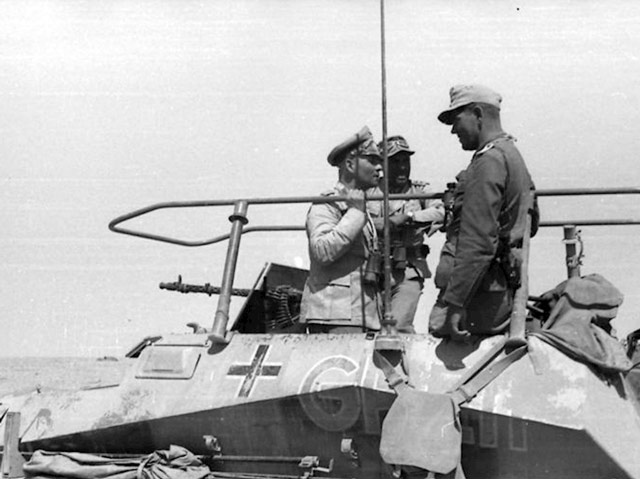
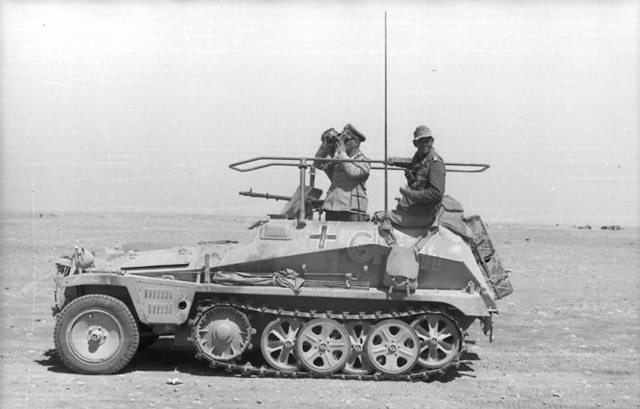
Rommel in North Africa worldwartwo.filminspector.com
German General Erwin Rommel in his command vehicle in North Africa, 11 June 1942 (Zwilling, Ernst A., Federal Archive Image 101I-443-1589-08).

Eastern Front: General Erich von Manstein's 11th Army continues battering away at Red Army defenses outside Sevastopol, Crimea, on 11 June 1942. His troops of the LIV Corps are having the most success north of the port, where the heaviest German artillery is located. The Soviet 345th Division counterattacks on the borderline between the Wehrmacht 132nd and 50th Divisions, but quick Luftwaffe intervention (1070 sorties while dropping 1000 tons of bombs today) prevents a rupture. The Red Army and LIV Corps, however, continue taking heavy casualties.

While progress is still being made at Sevastopol, the local commanders are getting concerned at the high cost of the small local gains. Luftwaffe General Wolfram von Richthofen, in command at Fliegerkorps VIII, comments sourly in his war diary that his forces have "only enough left for 1.5 more days of bombing." His mood is black, and he adds that "the specter of failure now seriously looms." On the spur of the moment, Richthofen decides that his bombers are dispersing their efforts too widely. He thus changes bombing procedures to conserve resources. The new tactic of "column bombing" involves bomber attacks on only specifically designated targets while the aircraft fly one after another in narrow air corridors.

The Red Air Force also is proving to be a nuisance, though not to the Luftwaffe. Instead, the Soviets are making nightly raids on German positions in the "rear" to the east at places like Simferopol, Theodosiya, Eupatoria, and Yalta. The Luftwaffe can see the attacks coming on their radar but do not have any night fighters to intercept them. Fortunately for the Germans, the Red Air Force bombing runs are very inaccurate, so the raids for the most part are ineffective.

Off the Crimean coast, a mini-war at sea also is brewing. The Soviets are running fast convoys to Sevastopol every night, and early in the morning, the Kriegsmarine decides to do something about it. For the first time, Axis small craft (MTBs and motorboats) manned by Italians attack a Soviet convoy near Cape Khersones. It is believed, but not absolutely certain, that they sink a Soviet ship.  

Back at Fuhrer Headquarters in East Prussia, General Halder also is getting impatient with Manstein's progress. He notes that the Soviet artillery at Sevastapol "is quite troublesome." However, further north, "The Voshansk attack is making very satisfactory progress." Meanwhile, the situation at Ninth Army is "unclear," with the Soviets "unaccountably" abandoning territory. This new Red Army tactic of not fighting for every inch of ground but instead trading space for time and tactical regrouping will befuddle and mislead the German High Command throughout the summer.

Battle of the Black Sea: Soviet submarine A-5 torpedoes and sinks 5695-ton Romanian freighter Ardeal off Odessa. Ardeal's captain beaches the ship to avoid sinking but is later repaired and returned to service.

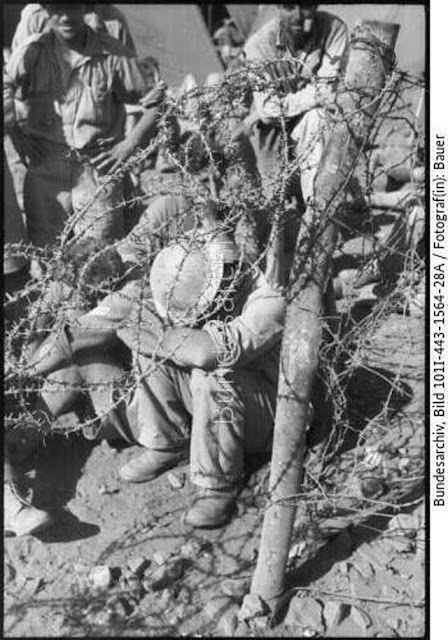
British POWs in North Africa worldwartwo.filminspector.com
British POWs in North Africa, 11 June 1942 (Farmer, Federal Archive Image 101I-443-1564-28A).

Battle of the Pacific: USS Saratoga rendezvouses with fellow carriers Enterprise and Hornet. It transfers 19 SBD Dauntless, five TBD Devastator of VT-5, and 10 VT-8 Avenger planes to the two other carriers to replace their losses at the Battle of Midway. The ships then turn head to Pearl Harbor in foul weather.

Reinforcements for the Pacific Fleet are on the way. USS Wasp and battleship North Carolina, along with escorting destroyers, pass through the Panama Canal. Battleships just barely fit through the channel with mere feet (sometimes only inches) to spare on each side. The Japanese know the importance of the Canal and have plans to block it throughout the war.

The U.S. 11th Air Force make their first attack on the Japanese on Kiska Island in the Aleutian chain. The attack is made by five B-24 and five B-17 bombers flying from Cold Bay and loading their bomb racks at Umnak Island. PBY Catalinas also participate in the attack. on Kiska Harbor. The attack only scores some near misses on the Japanese ships while losing a B-24 (Captain Jack F. Todd) to anti-aircraft fire. This begins a 48-hour period during which the Catalinas make repeated attacks without much success.

British POWs in North Africa worldwartwo.filminspector.com
British and South African POWs in North Africa, 11 June 1942 (Zwilling, Ernst A., Image 101I-443-1589-34A).

Battle of the Indian Ocean: German raider Michel (HSK-9) uses its guns to sink 5186-ton British freighter Lylepark southeast of Cocos Islands (northwest of Perth, Australia). Michel is on her way from Japan for a hunting raid off the coast of South America.

Japanese submarine I-20 torpedoes and sinks 7926-ton British freighter Mahronda in the Mozambique Channel. There are two deaths and 40 survivors. The survivors are rescued by the Royal Indian Navy ship HMIS Orissa. This is an unusual situation where a German ship sinks a ship further west than a Japanese submarine in the Indian Ocean on the same day.

Australian corvette HMAS Wallaroo (J 222) sinks after colliding with a ship it is escorting, U.S. Liberty Ship Henry Gilbert Costin. The sinking ironically occurs because the ships are sailing without navigation lights in overcast weather to avoid detection by the enemy. Wallaroo sinks while trying to return to Fremantle, while the other ship makes it back. There are three deaths.

European Air Operations: The foul weather that has characterized the spring of 1942 continues today. It is 10/10ths clouds during the morning, but visibility clears a bit by noon. RAF fighters attack Koksijde and the Furnes Canal, sinking and damaging barges. The attacks are broken off after encountering heavy anti-aircraft fire at Nieuport. These attacks in low visibility are quite hazardous, and several planes narrowly avoid collisions or hitting ground obstructions.

Battle of the Baltic: German support ship MRS-11 Osnabruck hits a mine and sinks off Tallinn, Estonia. There are 84 deaths. The ship is later salvaged.

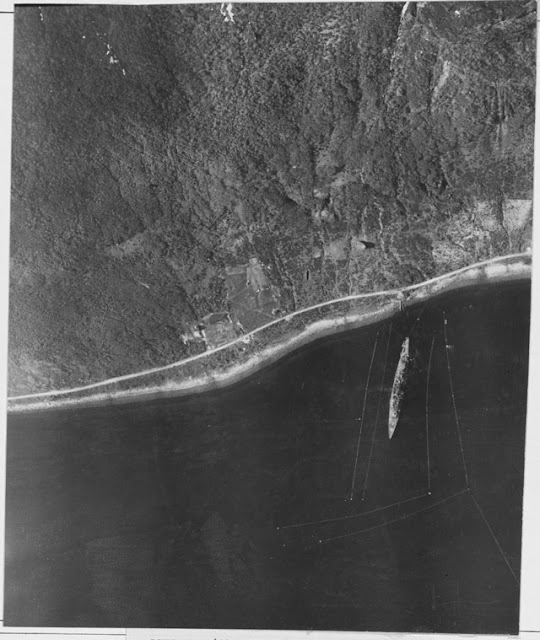
German cruiser Lutzow spotted by Allied air reconnaissance 11 June 1942 worldwartwo.filminspector.com
German heavy cruiser Lutzow photographed by Allied air reconnaissance, 11 June 1942 (Naval History and Heritage Command NH 110843).

Battle of the Atlantic: Italian submarine Leonardo da Vinci uses torpedoes and gunfire to sink 5483-ton Dutch freighter Alioth in the Atlantic Ocean near Freetown, Sierra Leone. Everyone survives.

U-504 (Kptlt. Hans-Georg Friedrich Poske), on its third patrol out of Lorient, torpedoes and sinks 4282-ton Dutch freighter Crijnssen 85 miles southwest of the Cayman Islands. There are one death and 93 survivors, who abandon the ship in four lifeboats and a gig. The sinking is especially traumatic for some on board because there are a dozen survivors of Sylvan Arrow (sunk by U-155 on 20 May 1942) and one from U.S. tanker T.C. McCobb (sunk by Italian submarine Pietro Calvi on 31 March 1942). The survivors in one lifeboat and the gig from Crijnssen are picked up by the U.S. freighter Lebore, which itself is sunk by U-172 a few days later. The other lifeboats make landfall in Mexico aside from four crewmembers on a raft who are picked up by the Panamanian tanker J.A. Mowinckel.

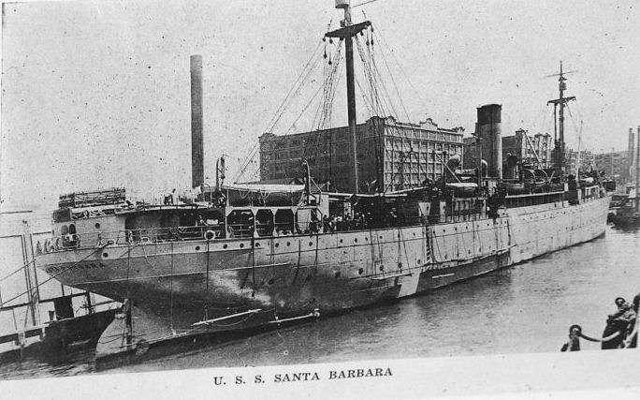
Freighter American sunk on 11 June 1942 worldwartwo.filminspector.com
SS American, originally the Santa Barbara, was sunk by U-504 on 11 June 1942. 

Much later in the day, U-504 also torpedoes and sinks 4846-ton U.S. freighter American off Honduras. The ship is hit by two torpedoes and sinks within 25 minutes. There are four deaths and 34 survivors, who are picked up by British freighter Kent. One survivor perishes after being picked up.

U-159 (Kptlt. Helmut Friedrich Witte), on its second patrol out of Lorient, torpedoes and sinks 7130-ton British freighter Fort Good Hope northwest of Colon, Panama. Two torpedoes hit and sink the freighter (carrying wheat, timber, lead, and zinc) within half an hour. There are two deaths and 45 survivors, who are picked up by U.S. gunboat USS Erie (PG 50).

U-455 (Kptlt. Hans-Heinrich Giessler), on its third patrol out of St. Nazaire, torpedoes and sinks 6914-ton British tanker Geo H. Jones northeast of the Azores. The tanker is a straggler from Convoy SL-111 heading from Aruba to Freetown. There are two dead and 40 survivors, who are picked up by HMIS Orissa (J 200).

U-157 (KrvKpt. Wolf Henne), on its second patrol out of Lorient, torpedoes and sinks 6401-ton U.S. tanker Hagan five miles off the north coast of Cuba. Hagan is simply steaming a straight course independently and thus is an ideal target. Two torpedoes hit the engine room and fuel bunkers, sinking the ship, which is carrying 2,676 barrels of blackstrap molasses, fairly quickly. There are six dead and 38 survivors, who make landfall in Cuba in two lifeboats. This is the only victory for U-157 in its career, which ends a couple of days later when it is sunk.

U-94 (Oblt. Otto Ites), on its ninth patrol out of St. Nazaire, torpedoes and sinks 4458pton British freighter Pontypridd northeast of St. John's, Newfoundland. Pontypridd is a straggler from Convoy ONS-100. There are two dead and 46 survivors, who are picked up by HMCS Chambly (K 116).

U-158 (Kptlt. Erwin Rostin), on its second patrol out of Lorient, torpedoes and sinks 13,467-ton Panamanian tanker/transport Sheherazade 20 miles west of Ship Shoal Buoy, Louisiana. Sheherazade is a French ship turned over to the U.S. War Shipping Administration (WSA). There are one dead and 58 survivors, who are rescued by shrimp boat Midshipman and fishing vessel 40 Fathoms. The rescue happens quickly enough that nine men are found swimming after having jumped overboard.

Norwegian 6049-ton freighter Haugarland hits a mine and sinks off Terschelling, Netherlands. It appears that everyone survives.

U.S. 9310-ton tanker F.W. Abrams hits a U.S.  defensive mine and sinks east of Morehead City, North Carolina (near Cape Hatteras). The 36 men on board make it to shore near Morehead City. A tug ("Relief") attempts salvage of the floating wreck without success.

U-87 mines the waters off Boston, Massachusetts, while U-373 mines the area near Delaware Bay.

Rommel in North Africa worldwartwo.filminspector.com
General Rommel in his Sd.Kfz. 250 command truck, 11 June 1942 (Zwilling, Ernst A., Federal Archive Image 101I-443-1589-09).

Battle of the Mediterranean: German General Erwin Rommel's Afrika Korps occupies the fortress of Bir Hakeim, which has been a roadblock in his advance toward Tobruk. The Free French defenders have almost all escaped to British lines to the south save for a small rear guard left to delay the attackers. The French and British pull back from their advanced position outside the fortress to Gasr-el-Arid early in the morning, completing the breakout by 2700 men and women (there are some female nurses).

After finally clearing this obstacle, about which he later comments "seldom in Africa was I given such a hard-fought struggle," Rommel quickly resumes his offensive, sending the 15th Panzer and 90th Light Divisions toward El Adem. The British 201st Guard Brigade in the Knightbridge Box, which blocks the way to Tobruk to the east, comes under severe pressure. While the Allied defense of Bir Hakeim has seriously disrupted Rommel's overly ambitious timetable, his advance now regains momentum.

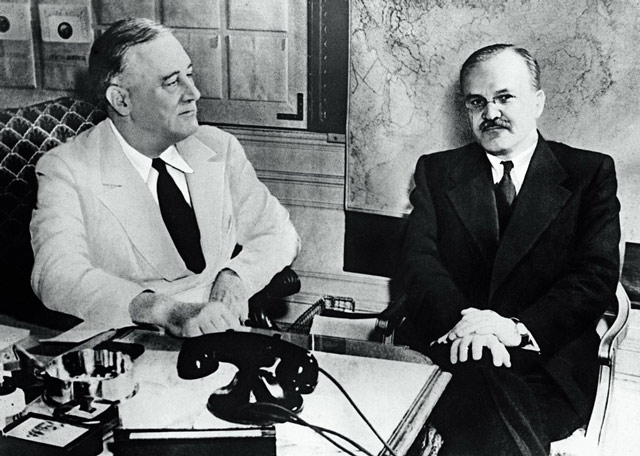
Molotov and FDR in Washington on 11 June 1942 worldwartwo.filminspector.com
Soviet Foreign Minister Vyacheslav Molotov and U.S. President Franklin D. Roosevelt meet in Washington, D.C., to finalize the lend-lease agreement, 11 June 1942 (Alliance.rusarchives.ru).

US/Soviet Relations: The United States and Soviet Union sign a lend-lease agreement. The agreement contemplates "mutually advantageous economic relations" between the two powers, with the agreement to continue in force "until a date to be agreed upon by the two governments." U.S. Secretary of State Cordell Hull and Soviet Ambassador Maxim Litvinov sign for their respective governments.

Article 1 sets out the main purpose of the agreement:
The Government of the United States of America will continue to supply the Government of the Union of Soviet Socialist Republics with such defense articles, defense services, and defense information as the President of the United States of America shall authorize to be transferred or provided.
This agreement, however, is not specific on certain key points. These become a lingering bone of contention during the post-war era. Significantly, the title to the equipment supplied by the U.S. is not transferred to the Soviet Union. The U.S. believes it still "owns" the items and retains rights to them, while the USSR believes it now owns them because they were freely given.

Technically, under the U.S. interpretation of the agreement, the Soviet Union is obligated to return any intact equipment or compensate the United States for it after the war. The USSR, perhaps understandably, has a vastly different interpretation. This leads to awkward exchanges between the two governments in the late 1940s in which the United States demands either the return of the intact equipment or payment for them, including limitations on the equipment's transfer to other countries. Ultimately, the United States simply demands payment for the "civilian-type articles remaining in existence."

Of course, the United States already has abandoned military equipment of its own at bases around the world because it is obsolete and considered too expensive to return to the homeland. Thus, there seem to be deeper reasons underlying the disagreement. It is entertaining to ponder the reactions of the Soviets when they receive these petty and abrasive demands for payment for goods they always assumed were given for free to win the war at the cost of Soviet blood. These pointless and unproductive "negotiations" help to poison the relations between the two nations and contribute to the growth of the Cold War, a hostile relationship that more or less continues to the present day.

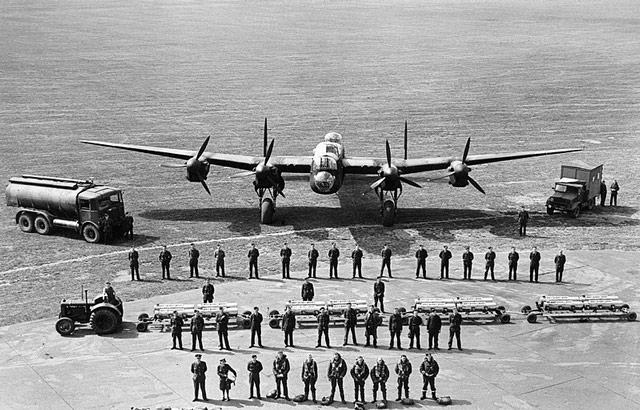
An Avro Lancaster and its crew on 11 June 1942 worldwartwo.filminspector.com
An Avro Lancaster and the personnel and equipment needed to keep it flying. This photograph was taken at Scampton, Lincolnshire, on 11 June 1942.  © IWM CH 15362.

German Military: Adolf Hitler issues Führer Directive 32. It sets out operations to be undertaken after the defeat of the Soviet Union, including the capture of Gibraltar with or without Spain's cooperation and resumption of the "siege of England." It is a curious mixture of far-sighted planning and mundane objectives such as the capture of Tobruk. It presupposes the quick defeat of the USSR in the coming Case Blue summer offensive and, like many of Hitler's grand strategies, assumes launch conditions that do not yet exist.

U.S. Military: With the threat to the U.S. west coast vastly reduced due to the Japanese defeat at Midway, the 97th Bombardment Group deployed for emergency purposes on the coast is transferred back to New England for eventual movement to join the Eighth Air Force in Great Britain.

Holocaust: Adolf Eichmann holds a meeting for his underlings controlling Jewish Affairs in France, Belgium, and Holland. This meeting sparks a systemic deportation scheme for Jewish residents of those areas to the extermination camps in the East that affects tens of thousands of people.

German Homefront: Michael Kitzelmann, 26, is executed at Orel Prison after being court-martialed and convicted of crimes against the state. Kitzelmann, a Wehrmacht lieutenant, was denounced by a sergeant for saying things that "undermined the military." He was in a hospital being treated for wounds when the allegations against him were made, but apparently, he made them previously while serving on the Eastern Front. The statements apparently concerned certain atrocities that Kitzelmann witnessed against the Russian population. While Kitzelmann became outspoken, he also had earned the Iron Cross Second Class and the Wound Badge in Gold.

TheGerman Bundestag rehabilitated Kitzelmann on 8 September 2009. A plaque in his memory is at the Johann-Michael-Sailer-school in Dillingen an der Donau.

American Homefront: The New England Journal of Medicine reports a case of "internal anthrax," which is considered quite novel because the vast majority of cases are of the cutaneous type. The patient died after showing progressively worse symptoms and a full autopsy was performed. Penicillin, still in its experimental phase, will become the accepted treatment for anthrax in 1944. 

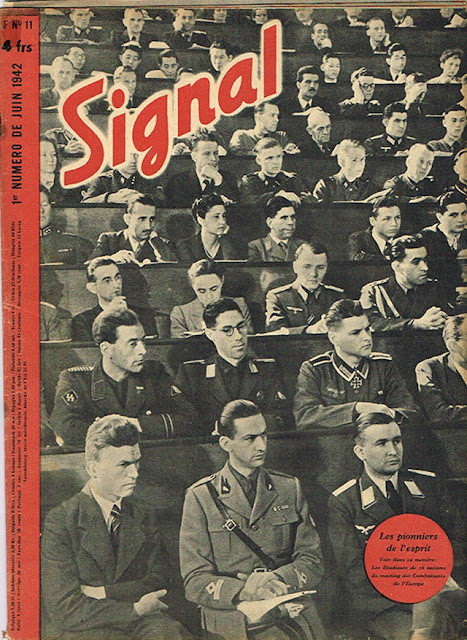
German Signal magazine from June 1942 worldwartwo.filminspector.com
Signal magazine, June 1942.

2021