Showing posts with label U-455. Show all posts

Sunday, August 21, 2022

June 16, 1942: German Breakthrough in Crimea

Tuesday 16 June 1942

Focke Wulf Fw 190A, 16 June 1942 worldwartwo.filminspector.com
Focke Wulf Fw 190A 3.JG2 Yellow 13 Josef Heinzeller WNr 325 France June 16 1942.

Eastern Front: As 16 June 1942 begins in Crimea, General Manstein's 11th Army is still blocked on the approaches to Sevastopol. However, there are glimmers of hope for the Wehrmacht in the northern axis of attack. The main remaining obstacle there is the Soviet Maxim Gorky fort. At dawn, 27 Stukas from II./StG 77 attack, and then the 132nd Division breaks through the decimated Soviet line and takes the fort in a stunningly swift attack. The Soviet holdouts, unwilling to accept defeat, do as others before they have done at Kerch, Brest-Litovsk, and elsewhere and retreat to underground galleries rather than surrender. They hold out until the 20th.

This begins a general crumbling of the entire Soviet line. Using heavy artillery and remote-controlled Goliath tracked bombs and Nebelwerfer rockets, the 22nd, and 24th Infantry Divisions capture the nearby forts named Molotov, Schishkova, Volga, and Siberia. 

Soviet commander Petrov is horrified. he rushes the newly arrived 138th Naval Brigade to the breach, and this is the only thing that prevents the Germans from reaching Severnaya Bay on the 16th. But now the Soviets are badly outnumbered in the sector - the Brigade only has 2600 men - and the path into the port is now open for the Germans.

German III Panzer Corps of Field Marshal von Bock's and General Paulus' Sixth Army completes Operation Wilhelm, a small preliminary offensive across the Burluk River begun on 10 June. It meets up with VIII Corps near Belyy Kolodez. While the firstsuccessful preliminary operations sete stage for Case Blau, Wilhelm does not live up to expectations because the jaws of the pincer movement are too shallow. This allows most of the Soviet defenders of the 28th Army to escape to the east. The Germans count 24,800 prisoners. 

The German Sixth Army and First Panzer Army are now preparing for Operation Fridericus II, a similar operation slightly to the south toward Gorokhvatka on the Oskol River northeast of Izyum. It is scheduled to begin on the 17th, but Hitler is still vacationing at the Berghof, and the generals kind of assume it will be forgotten about. Hitler, however, is sending messages that he wants it done anyway, so preparations are underway to begin it on the 22nd - which is uncomfortably close to the planned start date for Blau, which was to be ready to start beginning on the 23rd.

Luftwaffe General Wolfram von Richthofen, architect of the successful (so far) air campaign in Crimea, hands over command to Oberst von Wild (he remains in the theater until 23 June), as Richthofen is heading to the main front to help with Case Blau. The two men have a meeting in which Richthofen insults von Wild, telling him he "lacked experience in every respect" and needs to share power with Richthofen's (and von Wild's) subordinate Oberstleutnant Christ. Von Wild, who has been in charge of anti-shipping operations, agrees to place Christ in charge of daily operations.

Jewish residents of Lazy, Poland, being deported, 16 June 1942 worldwartwo.filminspector.com
Deportation of Jewish residents of the mining town of Lazy, Poland (near Katowice) on 16 June 1942. They are destined for Auschwitz or, for a few, to labor camps in Bedzin and Sosnowiec (as the photo caption shows). Yad Vashem Photo Archives 757/1.  

With the Fuhrer off in Berchtesgaden and victory messages pouring in from all fronts, General Franz Halder, writing in East Prussia, is in a good mood. He captions his daily diary entry "Fuhrer away. Victories in Africa and the Mediterranean." He notes:
Notwithstanding Eleventh Army's contention that the assault had little chance of success in the absence of infantry reinforcements, the enemy's situation at Sevastopol seems to deteriorate progressively. Good gains in the southern sector. Sixth Army is regrouping preparatory to Fridericus II. They are quite short on infantry. Romanian participation is rather embarrassing. 

He also notes that General Belov's partisan force "has again broken out," which is "Nothing that we could brag about!"  The Germans have a certain admiration for Belov, who has evaded multiple attempts to catch him.

Battle of the Baltic: Soviet submarine ShCh-317 torpedoes and sinks Finnish  2513-ton freighter Argo in the Gulf of Finland between Bogskär and Utö, Finland. There are nine deaths.

Lt. Chester Namola, KIA 16 June 1942 worldwartwo.filminspector.com
Lt. Chester Namola a few days before his death on 16 June 1942. he had previously survived another crash landing on 28 March 1942, but today his luck runs out. There is a plaque dedicated to him at the Berridale State School in Australia, the site of that previous crash landing.

Battle of the Pacific: Japanese forces near Middleton Island, 75 nautical miles (139 km) south of Cordova, Alaska, destroy 5094-ton U.S. freighter Coldbrook. It is unclear what happens to her, either outright sunk or beached and written off.

27 Japanese Zero A6M2 fighters of the Tainan Kokutai make a sweep over Port Moresby, accompanied by an equal number of B4M ("Betty") bombers. 32 P-39 and P-400 (export version) Aircobras of the 39th and 40th Fighter Squadrons rise to the bait. A wild dogfight ensues, during which the Japanese Zeros shoot down four Aircobras and heavily damage two others (the Japanese pilots claim 17 victories) while losing none themselves (some sources say they lose two bombers and two fighters). One Allied pilot (Lt. Chester Namola) is lost (officially MIA) and the three others return to duty.

B-26 bombers of the 22nd BG and B-17s of the 19th BG bomb Lae, while B-25s of the 3rd BG attack Salamaua. The target is airfields, and good results are achieved. One escorting P-39 is lost.  

European Air Operations: The mid-war lull continues with no major operations.

U-455 returning from a mission, 16 June 1942 worldwartwo.filminspector.com
U-455 returns to Saint-Nazaire, France after its third wartime patrol, 16 June 1942, during which it sunk 13,908 tons of shipping (two British freighters, British Workman and Geo H. Jones, off the coast of Canada). As is customary, the commander (Kptlt. Hans-Heinrich Giessler) is presented with a bouquet of flowers. Waiting for the submarine would be mothers, wives, girlfriends, etc. (Kramer, Federal Archives Bild 101II-MW-6435-38A).

Battle of the Atlantic: U-87 (Kptlt. Joachim Berger), on its third patrol out of St. Nazaire, torpedoes and sinks 5896-ton U.S. passenger ship Cherokee northeast of Cape Cod and Provincetown, Massachusetts, using two torpedoes. There are 86 deaths and 83 survivors, who are rescued by USCGC Escanaba and freighter Norlago.

U-87 gets a second victim, 8402-ton UK freighter Port Nicholson, in the same general vicinity 30 nautical miles (56 km) east of Provincetown. This is an "accidental" sinking because Berger was firing at another ship and missed - but the errant torpedo apparently hit this ship. The Port Nicholson and Cherokee are part of Convoy XB 25. Carrying automobile parts and military stores, the Port Nicholson is a major loss. It sits in 700 feet (210 m) of water. There are six deaths and 85 survivors.

A slight mishap aboard U-455 as it enters port, 16 June 1942 worldwartwo.filminspector.com
Somewhat embarrassingly, one of the crew of U-455 falls into the water as it sails into port in front of the crowd of onlookers, the brass band, and top naval brass on 16 June 1942 (Kramer, Federal Archive, Bild 101II-MW-6435-34A).

U-126 (Kptlt. Ernst Bauer), on its fourth patrol out of Lorient, torpedoes and sinks 6997-ton U.S. freighter Arkansan 70 nautical miles (130 km) west of Grenada in the Caribbean. The freighter crew was alert and spotted the surfaced U-boat at 02:30. Almost immediately, however, a torpedo hit, and the ship sinks in 20 minutes. There are four deaths and 36 survivors, who are picked up by USS Pastores.

U-126 gets a second victim when it torpedoes and sinks 6062-ton U.S. freighter Kahuku west of Grenada. There are 17 dead and 92 survivors, who are picked up by USS Opal, USS YP-63, and Venezuelan freighter Minataora.

U-67 (Kptlt. Günther Müller-Stöckheim), on its fourth patrol out of Lorient, torpedoes and sinks 2220-ton Nicaraguan freighter Managua southeast of Key West in the Strait of Florida. The torpedo is spotted about 300 feet away but there is nothing the crew can do. The U-boat approaches a lifeboat, takes two men aboard to question them, and then returns the men and departs. All 25 aboard survive when the two lifeboats make landfall in Cuba and Pigeon Key.

U-161 (Kptlt. Albrecht Achilles), on its third patrol out of Lorient, comes across Dominican Republic 30-ton sailing vessel Nueva Altagracia northeast of Curacao and shells and sinks it. All eight crew survive because the U-boat takes them (and their cargo of fresh fruits and chickens) aboard and releases the crew to another Dominican sailing vessel they encounter, the Comercio.

Royal Navy trawler 294-ton HMT Tranquil sinks after colliding with freighter Deal east of the town of Deal in "The Downs."

German 2449-ton freighter Plus hits a mine and sinks in the Weser River.

HMAS Pribilof shortly before being scuttled, 16 June 1942 worldwartwo.filminspector.com
HMAS Nestor sitting low in the water with bomb damage prior to being scuttled south of Crete, 16 June 1942 (Australian War Memorial 301085)

Battle of the Mediterranean: The British disaster that is Operation Vigorous is heading back toward Alexandria in tatters, but before it reaches safety it suffers another crushing loss. U-205 (Korvettenkapitän Franz-Georg Reschke) torpedoes and sinks the Royal Navy cruiser HMS Hermione south of Crete. The cruiser quickly capsizes, with 88 dead and about 400 survivors. 

Air attacks (unclear if by Stukas or the Italians) during the evening of the 15th crippled the Australian destroyer HMAS Nestor. While under tow on the 16th, the ship settles too low in the order and the tow line breaks twice - due to fears of enemy action, it must be scuttled. Built by a Scottish shipbuilding company on the Clyde, Nestor never sees Australia, the only major HMAS warship with that claim. 

After this, Operation Julius (the combined convoy operation from both ends of the Mediterranean to Malta) is over. Only two of six freighters sailing from Gibraltar as part of Operation Harpoon have made it to Malta, while none from Operation Vigorous sailing from Alexandria have made it. The shattered remnants reach port in the evening. While quickly forgotten like a bad dream by the British, it is the greatest victory of the war for the Italian Navy. Admiral Harwood writes today that "We are outnumbered both in surface ships and Air Force and very gallant endeavor of all concerned cannot make up for...the deficiency." He later blames the loss on insufficient RAF support.

Polish Navy destroyer OPR Kujawiak hits a mine near Malta and sinks. There are 13 deaths and 147 survivors.

On land, the German advance toward Tobruk is achieving its objectives. Today, it forces British defenders at Point 187 to evacuate and puts two other defensive positions at El Adem and Sidi Rezegh under extreme pressure. This is the last line of defense before the port itself.

South African Major John Frost, the highest-scoring ace of the SAAF with 15 victories (some South Africans flying with the RAF have more), goes missing after being shot down while escorting Douglas Bostons near Bir Hakeim. He may have fallen victim to Luftwaffe ace Hans-Joachim Marseille, who is credited with 6 victories during the day, or Günter Steinhausen with 4 victories today. Frost and his plane have never been found.

US Military: Congress authorizes an increase in the number of US Navy airships to 200. These are used primarily for coastal reconnaissance and convoy protection, and sometimes for tasks such as the one that delivered important supplies to the ships heading for Japan during the Doolittle Raid in April 1942.

Refugees of the Pribilof Islands being taken to camps in Alaska, 16 June 1942 worldwartwo.filminspector.com
Unangan people from the Pribilof Islands travel to Southeast Alaska aboard the USAT Delarof, 15-16 June 1942. These evacuations to internment camps are "for their own protection." (Image titled “nara_80_g_12163”: National Archives and Records Administration, NARA-80-G-12163).

US Government: Executive Order 9181 is published in the Federal Register today. It provides for the administration of federal government services in Alaska, specifically the establishment of the Alaska War Council to be headed by the Governor. EO 9181 orders that military leaders "to the fullest extent possible, give consideration to civilian needs and problems arising from the war situation in Alaska." It is obvious from the text that the military now has the final say over policy in Alaska.

U-455 returning from a mission, 16 June 1942 worldwartwo.filminspector.com
The crew of U-455 assembled for its return to port, 16 June 1942 (Kramer, Federal Archive Image 101II-MW-6434-27).

American Homefront: Universal Pictures releases "Eagle Squadron," a standard patriotic offering for the time based on a story by C.S. Forester (of Horatio Hornblower fame). The film, directed by Arthur Lubin and starring Robert Stack, Diana Barrymore, and John Loder, is a big success. Alan Hale Jr. (later star of "Gilligan's Island"), who enters the U.S. Coast Guard around this time, appears in a small role.

Future History: John Rostill is born in Birmingham, England. He begins performing with bands in the 1950s and achieves his greatest fame as bassist and composer for The Shadows. John Rostill passes away on 26 November 1973, aged 31, after overdosing on barbituates in a death ruled a "suicide while in a depressed state of mind." 

Giacomo Agostini is born in Brescia, Italy. He becomes a top motorcycle racer, with 122 Grand Prix wins and 15 World Championship titles in the 1960s and 1970s. He appears to be retired as of this writing.

Eddie Levert is born in Bessemer, Alabama. He becomes the lead vocalist of the singing group The O'Jays and currently still performs with that group.

German patrol boats off St. Nazaire, 16 June 1942 worldwartwo.filminspector.com
A German patrol vessel at sea off St. Nazaire, 16 June 1942 (Kramer, Federal Archive Picture 101II-MW-6435-04A).


2022

Friday, December 24, 2021

June 11, 1942: U.S-Soviet Lend-Lease Agreement

Thursday 11 June 1942

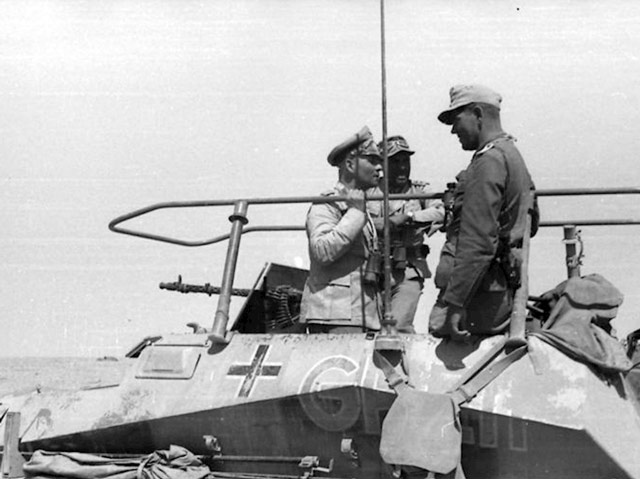
Rommel in North Africa worldwartwo.filminspector.com
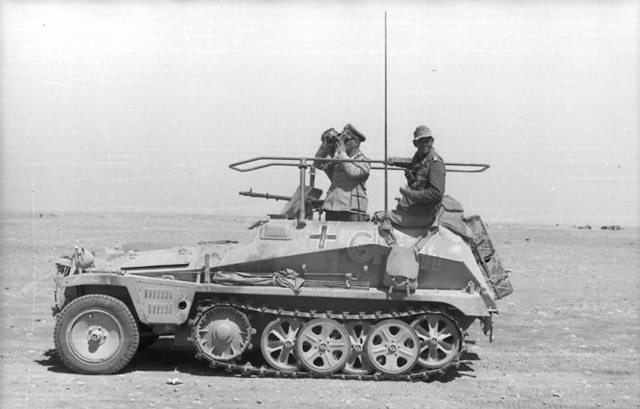
German General Erwin Rommel in his command vehicle in North Africa, 11 June 1942 (Zwilling, Ernst A., Federal Archive Image 101I-443-1589-08).

Eastern Front: General Erich von Manstein's 11th Army continues battering away at Red Army defenses outside Sevastopol, Crimea, on 11 June 1942. His troops of the LIV Corps are having the most success north of the port, where the heaviest German artillery is located. The Soviet 345th Division counterattacks on the borderline between the Wehrmacht 132nd and 50th Divisions, but quick Luftwaffe intervention (1070 sorties while dropping 1000 tons of bombs today) prevents a rupture. The Red Army and LIV Corps, however, continue taking heavy casualties.

While progress is still being made at Sevastopol, the local commanders are getting concerned at the high cost of the small local gains. Luftwaffe General Wolfram von Richthofen, in command at Fliegerkorps VIII, comments sourly in his war diary that his forces have "only enough left for 1.5 more days of bombing." His mood is black, and he adds that "the specter of failure now seriously looms." On the spur of the moment, Richthofen decides that his bombers are dispersing their efforts too widely. He thus changes bombing procedures to conserve resources. The new tactic of "column bombing" involves bomber attacks on only specifically designated targets while the aircraft fly one after another in narrow air corridors.

The Red Air Force also is proving to be a nuisance, though not to the Luftwaffe. Instead, the Soviets are making nightly raids on German positions in the "rear" to the east at places like Simferopol, Theodosiya, Eupatoria, and Yalta. The Luftwaffe can see the attacks coming on their radar but do not have any night fighters to intercept them. Fortunately for the Germans, the Red Air Force bombing runs are very inaccurate, so the raids for the most part are ineffective.

Off the Crimean coast, a mini-war at sea also is brewing. The Soviets are running fast convoys to Sevastopol every night, and early in the morning, the Kriegsmarine decides to do something about it. For the first time, Axis small craft (MTBs and motorboats) manned by Italians attack a Soviet convoy near Cape Khersones. It is believed, but not absolutely certain, that they sink a Soviet ship.  

Back at Fuhrer Headquarters in East Prussia, General Halder also is getting impatient with Manstein's progress. He notes that the Soviet artillery at Sevastapol "is quite troublesome." However, further north, "The Voshansk attack is making very satisfactory progress." Meanwhile, the situation at Ninth Army is "unclear," with the Soviets "unaccountably" abandoning territory. This new Red Army tactic of not fighting for every inch of ground but instead trading space for time and tactical regrouping will befuddle and mislead the German High Command throughout the summer.

Battle of the Black Sea: Soviet submarine A-5 torpedoes and sinks 5695-ton Romanian freighter Ardeal off Odessa. Ardeal's captain beaches the ship to avoid sinking but is later repaired and returned to service.

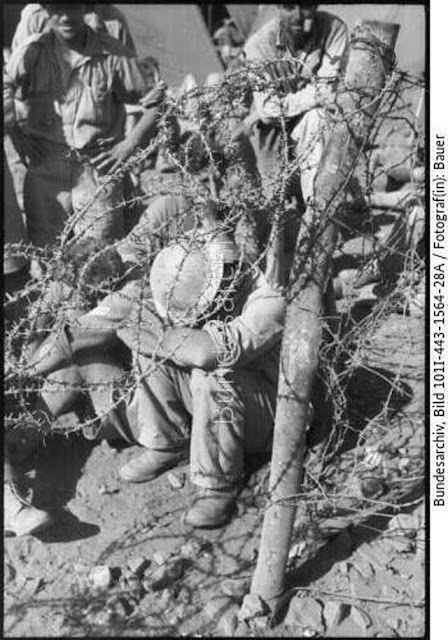
British POWs in North Africa worldwartwo.filminspector.com
British POWs in North Africa, 11 June 1942 (Farmer, Federal Archive Image 101I-443-1564-28A).

Battle of the Pacific: USS Saratoga rendezvouses with fellow carriers Enterprise and Hornet. It transfers 19 SBD Dauntless, five TBD Devastator of VT-5, and 10 VT-8 Avenger planes to the two other carriers to replace their losses at the Battle of Midway. The ships then turn head to Pearl Harbor in foul weather.

Reinforcements for the Pacific Fleet are on the way. USS Wasp and battleship North Carolina, along with escorting destroyers, pass through the Panama Canal. Battleships just barely fit through the channel with mere feet (sometimes only inches) to spare on each side. The Japanese know the importance of the Canal and have plans to block it throughout the war.

The U.S. 11th Air Force make their first attack on the Japanese on Kiska Island in the Aleutian chain. The attack is made by five B-24 and five B-17 bombers flying from Cold Bay and loading their bomb racks at Umnak Island. PBY Catalinas also participate in the attack. on Kiska Harbor. The attack only scores some near misses on the Japanese ships while losing a B-24 (Captain Jack F. Todd) to anti-aircraft fire. This begins a 48-hour period during which the Catalinas make repeated attacks without much success.

British POWs in North Africa worldwartwo.filminspector.com
British and South African POWs in North Africa, 11 June 1942 (Zwilling, Ernst A., Image 101I-443-1589-34A).

Battle of the Indian Ocean: German raider Michel (HSK-9) uses its guns to sink 5186-ton British freighter Lylepark southeast of Cocos Islands (northwest of Perth, Australia). Michel is on her way from Japan for a hunting raid off the coast of South America.

Japanese submarine I-20 torpedoes and sinks 7926-ton British freighter Mahronda in the Mozambique Channel. There are two deaths and 40 survivors. The survivors are rescued by the Royal Indian Navy ship HMIS Orissa. This is an unusual situation where a German ship sinks a ship further west than a Japanese submarine in the Indian Ocean on the same day.

Australian corvette HMAS Wallaroo (J 222) sinks after colliding with a ship it is escorting, U.S. Liberty Ship Henry Gilbert Costin. The sinking ironically occurs because the ships are sailing without navigation lights in overcast weather to avoid detection by the enemy. Wallaroo sinks while trying to return to Fremantle, while the other ship makes it back. There are three deaths.

European Air Operations: The foul weather that has characterized the spring of 1942 continues today. It is 10/10ths clouds during the morning, but visibility clears a bit by noon. RAF fighters attack Koksijde and the Furnes Canal, sinking and damaging barges. The attacks are broken off after encountering heavy anti-aircraft fire at Nieuport. These attacks in low visibility are quite hazardous, and several planes narrowly avoid collisions or hitting ground obstructions.

Battle of the Baltic: German support ship MRS-11 Osnabruck hits a mine and sinks off Tallinn, Estonia. There are 84 deaths. The ship is later salvaged.

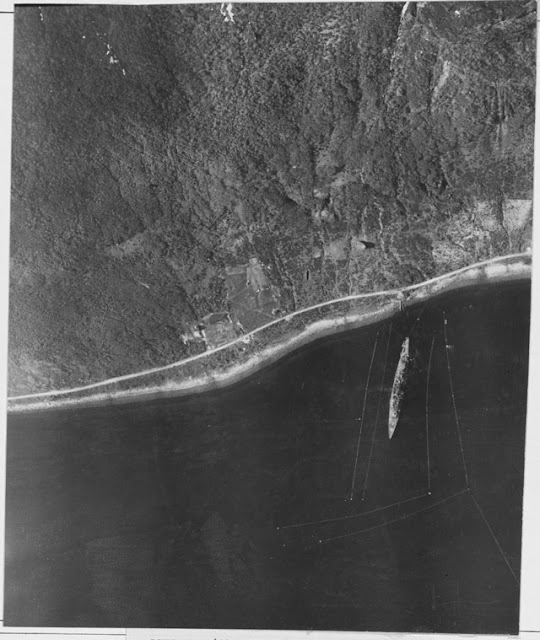
German cruiser Lutzow spotted by Allied air reconnaissance 11 June 1942 worldwartwo.filminspector.com
German heavy cruiser Lutzow photographed by Allied air reconnaissance, 11 June 1942 (Naval History and Heritage Command NH 110843).

Battle of the Atlantic: Italian submarine Leonardo da Vinci uses torpedoes and gunfire to sink 5483-ton Dutch freighter Alioth in the Atlantic Ocean near Freetown, Sierra Leone. Everyone survives.

U-504 (Kptlt. Hans-Georg Friedrich Poske), on its third patrol out of Lorient, torpedoes and sinks 4282-ton Dutch freighter Crijnssen 85 miles southwest of the Cayman Islands. There are one death and 93 survivors, who abandon the ship in four lifeboats and a gig. The sinking is especially traumatic for some on board because there are a dozen survivors of Sylvan Arrow (sunk by U-155 on 20 May 1942) and one from U.S. tanker T.C. McCobb (sunk by Italian submarine Pietro Calvi on 31 March 1942). The survivors in one lifeboat and the gig from Crijnssen are picked up by the U.S. freighter Lebore, which itself is sunk by U-172 a few days later. The other lifeboats make landfall in Mexico aside from four crewmembers on a raft who are picked up by the Panamanian tanker J.A. Mowinckel.

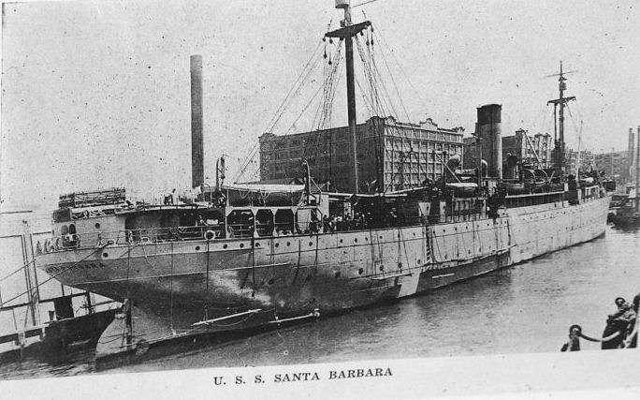
Freighter American sunk on 11 June 1942 worldwartwo.filminspector.com
SS American, originally the Santa Barbara, was sunk by U-504 on 11 June 1942. 

Much later in the day, U-504 also torpedoes and sinks 4846-ton U.S. freighter American off Honduras. The ship is hit by two torpedoes and sinks within 25 minutes. There are four deaths and 34 survivors, who are picked up by British freighter Kent. One survivor perishes after being picked up.

U-159 (Kptlt. Helmut Friedrich Witte), on its second patrol out of Lorient, torpedoes and sinks 7130-ton British freighter Fort Good Hope northwest of Colon, Panama. Two torpedoes hit and sink the freighter (carrying wheat, timber, lead, and zinc) within half an hour. There are two deaths and 45 survivors, who are picked up by U.S. gunboat USS Erie (PG 50).

U-455 (Kptlt. Hans-Heinrich Giessler), on its third patrol out of St. Nazaire, torpedoes and sinks 6914-ton British tanker Geo H. Jones northeast of the Azores. The tanker is a straggler from Convoy SL-111 heading from Aruba to Freetown. There are two dead and 40 survivors, who are picked up by HMIS Orissa (J 200).

U-157 (KrvKpt. Wolf Henne), on its second patrol out of Lorient, torpedoes and sinks 6401-ton U.S. tanker Hagan five miles off the north coast of Cuba. Hagan is simply steaming a straight course independently and thus is an ideal target. Two torpedoes hit the engine room and fuel bunkers, sinking the ship, which is carrying 2,676 barrels of blackstrap molasses, fairly quickly. There are six dead and 38 survivors, who make landfall in Cuba in two lifeboats. This is the only victory for U-157 in its career, which ends a couple of days later when it is sunk.

U-94 (Oblt. Otto Ites), on its ninth patrol out of St. Nazaire, torpedoes and sinks 4458pton British freighter Pontypridd northeast of St. John's, Newfoundland. Pontypridd is a straggler from Convoy ONS-100. There are two dead and 46 survivors, who are picked up by HMCS Chambly (K 116).

U-158 (Kptlt. Erwin Rostin), on its second patrol out of Lorient, torpedoes and sinks 13,467-ton Panamanian tanker/transport Sheherazade 20 miles west of Ship Shoal Buoy, Louisiana. Sheherazade is a French ship turned over to the U.S. War Shipping Administration (WSA). There are one dead and 58 survivors, who are rescued by shrimp boat Midshipman and fishing vessel 40 Fathoms. The rescue happens quickly enough that nine men are found swimming after having jumped overboard.

Norwegian 6049-ton freighter Haugarland hits a mine and sinks off Terschelling, Netherlands. It appears that everyone survives.

U.S. 9310-ton tanker F.W. Abrams hits a U.S.  defensive mine and sinks east of Morehead City, North Carolina (near Cape Hatteras). The 36 men on board make it to shore near Morehead City. A tug ("Relief") attempts salvage of the floating wreck without success.

U-87 mines the waters off Boston, Massachusetts, while U-373 mines the area near Delaware Bay.

Rommel in North Africa worldwartwo.filminspector.com
General Rommel in his Sd.Kfz. 250 command truck, 11 June 1942 (Zwilling, Ernst A., Federal Archive Image 101I-443-1589-09).

Battle of the Mediterranean: German General Erwin Rommel's Afrika Korps occupies the fortress of Bir Hakeim, which has been a roadblock in his advance toward Tobruk. The Free French defenders have almost all escaped to British lines to the south save for a small rear guard left to delay the attackers. The French and British pull back from their advanced position outside the fortress to Gasr-el-Arid early in the morning, completing the breakout by 2700 men and women (there are some female nurses).

After finally clearing this obstacle, about which he later comments "seldom in Africa was I given such a hard-fought struggle," Rommel quickly resumes his offensive, sending the 15th Panzer and 90th Light Divisions toward El Adem. The British 201st Guard Brigade in the Knightbridge Box, which blocks the way to Tobruk to the east, comes under severe pressure. While the Allied defense of Bir Hakeim has seriously disrupted Rommel's overly ambitious timetable, his advance now regains momentum.

Molotov and FDR in Washington on 11 June 1942 worldwartwo.filminspector.com
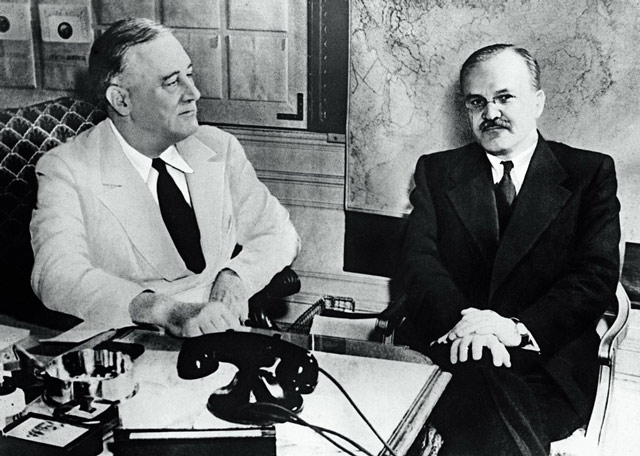
Soviet Foreign Minister Vyacheslav Molotov and U.S. President Franklin D. Roosevelt meet in Washington, D.C., to finalize the lend-lease agreement, 11 June 1942 (Alliance.rusarchives.ru).

US/Soviet Relations: The United States and Soviet Union sign a lend-lease agreement. The agreement contemplates "mutually advantageous economic relations" between the two powers, with the agreement to continue in force "until a date to be agreed upon by the two governments." U.S. Secretary of State Cordell Hull and Soviet Ambassador Maxim Litvinov sign for their respective governments.

Article 1 sets out the main purpose of the agreement:
The Government of the United States of America will continue to supply the Government of the Union of Soviet Socialist Republics with such defense articles, defense services, and defense information as the President of the United States of America shall authorize to be transferred or provided.
This agreement, however, is not specific on certain key points. These become a lingering bone of contention during the post-war era. Significantly, the title to the equipment supplied by the U.S. is not transferred to the Soviet Union. The U.S. believes it still "owns" the items and retains rights to them, while the USSR believes it now owns them because they were freely given.

Technically, under the U.S. interpretation of the agreement, the Soviet Union is obligated to return any intact equipment or compensate the United States for it after the war. The USSR, perhaps understandably, has a vastly different interpretation. This leads to awkward exchanges between the two governments in the late 1940s in which the United States demands either the return of the intact equipment or payment for them, including limitations on the equipment's transfer to other countries. Ultimately, the United States simply demands payment for the "civilian-type articles remaining in existence."

Of course, the United States already has abandoned military equipment of its own at bases around the world because it is obsolete and considered too expensive to return to the homeland. Thus, there seem to be deeper reasons underlying the disagreement. It is entertaining to ponder the reactions of the Soviets when they receive these petty and abrasive demands for payment for goods they always assumed were given for free to win the war at the cost of Soviet blood. These pointless and unproductive "negotiations" help to poison the relations between the two nations and contribute to the growth of the Cold War, a hostile relationship that more or less continues to the present day.

An Avro Lancaster and its crew on 11 June 1942 worldwartwo.filminspector.com
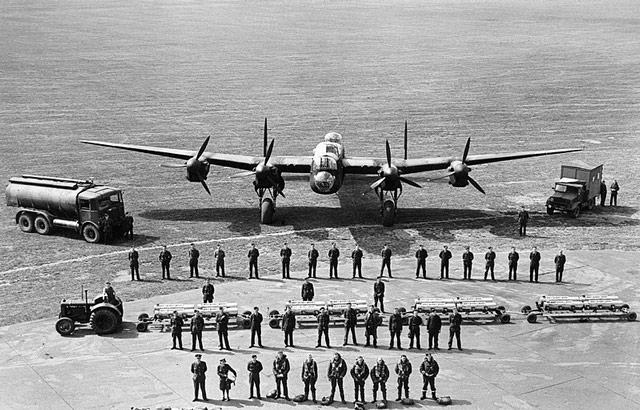
An Avro Lancaster and the personnel and equipment needed to keep it flying. This photograph was taken at Scampton, Lincolnshire, on 11 June 1942.  © IWM CH 15362.

German Military: Adolf Hitler issues Führer Directive 32. It sets out operations to be undertaken after the defeat of the Soviet Union, including the capture of Gibraltar with or without Spain's cooperation and resumption of the "siege of England." It is a curious mixture of far-sighted planning and mundane objectives such as the capture of Tobruk. It presupposes the quick defeat of the USSR in the coming Case Blue summer offensive and, like many of Hitler's grand strategies, assumes launch conditions that do not yet exist.

U.S. Military: With the threat to the U.S. west coast vastly reduced due to the Japanese defeat at Midway, the 97th Bombardment Group deployed for emergency purposes on the coast is transferred back to New England for eventual movement to join the Eighth Air Force in Great Britain.

Holocaust: Adolf Eichmann holds a meeting for his underlings controlling Jewish Affairs in France, Belgium, and Holland. This meeting sparks a systemic deportation scheme for Jewish residents of those areas to the extermination camps in the East that affects tens of thousands of people.

German Homefront: Michael Kitzelmann, 26, is executed at Orel Prison after being court-martialed and convicted of crimes against the state. Kitzelmann, a Wehrmacht lieutenant, was denounced by a sergeant for saying things that "undermined the military." He was in a hospital being treated for wounds when the allegations against him were made, but apparently, he made them previously while serving on the Eastern Front. The statements apparently concerned certain atrocities that Kitzelmann witnessed against the Russian population. While Kitzelmann became outspoken, he also had earned the Iron Cross Second Class and the Wound Badge in Gold.

TheGerman Bundestag rehabilitated Kitzelmann on 8 September 2009. A plaque in his memory is at the Johann-Michael-Sailer-school in Dillingen an der Donau.

American Homefront: The New England Journal of Medicine reports a case of "internal anthrax," which is considered quite novel because the vast majority of cases are of the cutaneous type. The patient died after showing progressively worse symptoms and a full autopsy was performed. Penicillin, still in its experimental phase, will become the accepted treatment for anthrax in 1944. 

German Signal magazine from June 1942 worldwartwo.filminspector.com
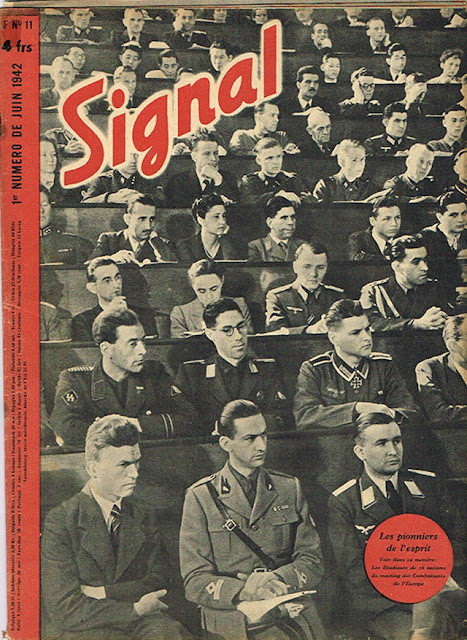
Signal magazine, June 1942.

2021

Sunday, April 11, 2021

May 3, 1942: Japanese Take Tulagi

Sunday 3 May 1942

HMS_King_George_V_3_May_1942_worldwartwo.filminspector.com
Royal Navy battleship HMS King George V arrives in Seidesfjord, Iceland, on 3 May 1942 after a collision that sank the destroyer Punjabi on 1 May 1942. The battleship must proceed to Gladstone Dock, Liverpool, for repairs (© IWM A 9495). 
Battle of the Pacific: The Japanese score their first major success of Operation Mo on 3 May 1942 when they capture the island of Tulagi. Just before they arrive 08:00, all Allied personnel at the seaplane base there evacuate on two small ships bound for Vila, New Hebrides. The 3rd Kure Special Naval Landing Force occupy the island soon after the Australian troops leave and immediately begin building their own infrastructure on Tulagi and nearby Gavutu-Tanambogo, where the seaplanes actually dock. While Tulagi is a pinprick on the map of the Solomon Islands, its location is ideal for a seaplane base to cover future landings on nearby Guadalcanal and other islands.

With the Tulagi operation completed, the Japanese aircraft carriers covering the landings under the command of Rear Admiral Aritomo Goto depart at 11:00 for Queen Caroline Harbor, Buka Island, to refuel. Once that is completed, the carriers will sail on to the northwest to cover the next phase of Operation Mo.
Photo of officers that seized Tulagi on 3 May 1942 worldwartwo.filminspector.com
Officers and petty officers of the 3rd Kure Special Naval Landing Force that seized Tulagi and Gavutu on 3 May 1942.
The Allies have been following the Japanese movements both via coastwatchers and radio decrypts. US Admiral Frank Jack Fletcher controls two fleet aircraft carriers, USS Yorktown (Task Force 17) and Lexington (TF 11), and is stationed about 300 nautical miles (350 miles, 560 km) northwest of New Caledonia. Informed of the Japanese moves late in the afternoon, Fletcher brings his TF 17 closer to Tulagi in order to launch airstrikes against Tulagi at dawn on the 4th. Lexington and TF 11, meanwhile, are still refueling and will not be available to join him until sometime on the 4th.

The Japanese have bigger plans than just the capture of Tulagi. They also intend to send the Operation Mo Invasion Force from the fleet base at Rabaul. Scheduled to leave early on the 4th, it will sail for the Australian base at Port Moresby with five thousand soldiers of the South Seas Force and five hundred of the 3rd Kure Special Naval Landing Force. Japanese Admiral Isoroku Yamamoto, in overall command, hopes to bring the US Pacific Fleet to battle over the invasion of Port Moresby and decisively defeat it. Fletcher, privy to many of Yamamoto's plans, aims to grant his wish of a major battle.

Air battles continue over Port Moresby as the Japanese try to soften the base up for the upcoming landings. The RAAF loses a P-39D in the melee.
Malinta Tunnel on Corregidor 1942 worldwartwo.filminspector.com
The hospital in Malinta Tunnel on Corregidor, 1942 (US Army Center of Military History).
US Navy submarine USS Spearfish (SS-190) arrives at Corregidor during the evening of 3May 1942. It can only take aboard 27 lucky people of the thousands left on the fortress island, 13 of them nurses. Navy nurse and Legion of Merit recipient Ann A. Bernatitus is among the 27 rescued by Spearfish. Most of the remaining personnel are crowded together in Malinta Tunnel because shells and bombs continually rain down on the island.

The Spearfish's visit is a major event for the garrison. Everyone knows it is possibly the last ride out for anyone (and that turns out to be the case), as visits from the outside world have become increasingly rare. Commanding officer General Jonathan M. Wainwright sees the submarine off. He tells the submarine's skipper "They will have to come and get us… They will never get us any other way." However, supplies of food and water are running short, and Wainwright knows he only has five more days of potable water available.

The Japanese air attacks are gradually whittling away at Wainwright's remaining resources. Today, they bomb and damage 1130-ton U.S. Army mine planter Colonel George F.E. Harrison off Corregidor. The ship is a write-off and is scuttled on the fourth in Mariveles Bay, Luzon. There are four deaths. The Japanese later raise and repair the ship and put her back into service as the Harushima.

Elsewhere in the Philippines, the Japanese land troops on the north coast of Mindanao Island.

The US Navy sends light cruiser Nashville (Cl-43) from Pearl Harbor to the Japanese fishing grounds off the Kamchatka Peninsula. Its first stop is at Midway Island to refuel. Submarines S-34 (SS-139) and S-35 (SS-140) are to operate in support of this operation.
The Wacky Wabbit released 3 May 1942 worldwartwo.filminspector.com
"The Wacky Wabbit" from Merrie Melodies is released on 3 May 1942, starring, of course, Bugs Bunny.
Battle of the Indian Ocean: After the Japanese have been held up for several days at the bridge over the Shweli River by scratch troops of the Northern Shan States Battalion, Burma Frontier Force, and also elements of a detachment of the Chin Hills Battalion, they finally break the stalemate. The Japanese are able to bring up a column of trucks equipped with machine guns that disperses the defenders. While the bridge is rigged with demolition charges, none of the defenders knows how to activate them and, in any event, they are damp and cannot ignite. Thus, the Japanese troops capture the critical bridge intact and the way is open to the regional center Bhamo to the northwest.

The Japanese 33rd Infantry Division at Monywa, Burma, counterattacks against the 1st Burma Division, which has been trying to break through to rejoin the main Allied forces north of Mandalay. The Japanese press the Allied troops back in the opposite direction, to the Alon area to the southwest.

Eastern Front: General Franz Halder once again notes an eerily quiet front, writing, "Situation: No change. All quiet along the entire front." In the afternoon, he has a meeting about the upcoming operation Case Blue with his supply chief. He notes cryptically that, 

As to trucks, we shall somehow be able to manage. But we shall not be able to cover our requirements for prime movers, even if our targets are scaled down to the utmost.

Halder ends the entry by noting that certain artillery units are going to have to be reduced from four guns to three, an ominous sign before a decisive campaign.
Raising HMS Caledonia from the Firth of Forth on 3 May 1942 worldwartwo.filminspector.com
Salvaging HMS Caledonia from the From Firth of Forth on 3 May 1942 for scrap metal. © IWM A 9766.
European Air Operations: After a lull in operations lasting several days, the Luftwaffe resumes its Baedeker Blitz raids with an attack on Exeter. As usual with these moderately sized raids, the attack causes an unusually large number of casualties and 164 deaths. There is extensive damage to the city center.

After sending half a dozen Boston bombers to attack the Dunkirk docks during the day without loss, RAF Bomber Command sets Hamburg as the night's major objective. The weather is a bit sketchy, so only 81 aircraft (43 Wellingtons, 20 Halifaxes, 13 Stirlings, and 5 Hampdens) are sent. The RAF loses five bombers (3 Halifaxes, 2 Wellingtons) on this raid. Hamburg is covered with clouds and only 54 bombers actually make attacks, but the results are better than expected. The Reeperbahn area, a dockside warehouse, and a street junction in an old residential area take the most punishment. There are 77 deaths and 243 injured, with 1,624 people made homeless.

In subsidiary operations, the RAF also sends nine bombers to raid the U-boat pens at St. Nazaire, an additional four Blenheims as Intruders, two minelayers off Heligoland, and eight bombers on leaflet flights, without loss.
Battleship USS Washington on patrol in the Barents Sea ca. 3 May 1942 worldwartwo.filminspector.com
USS Washington, as seen from HMS Victorious, ca. 3 May 1942. She was damaged in the collision between King George V and Punjabi but the damage was relatively minor and she was able to remain on station (© IWM A 9486).
Battle of the Atlantic: The Arctic sun provides enough light at 01:30 for six Heinkel He 111 torpedo bombers of 1. Gruppe, Kampfgeschwader 26, to attack Convoy PQ 15, which is passing south of Bear Island on the way to Murmansk. This is the first Luftwaffe torpedo bomber attack of the war, and it achieves significant results. The bombers hit three British freighters:
  1. Botavon (5848 tons) badly damaged and later sunk by convoy escort
  2. Cape Corso (3807 tons) sunk
  3. Jutland (6153 tons) badly damaged and later sunk by U-251 (Kptlt. Heinrich Timm), one dead and 61 survivors rescued by HMS Badsworth.
The Germans lose three planes, a not-insignificant number considering they only have a dozen Heinkels available.

After this attack, the weather begins to turn. An Arctic gale leads to a snowstorm which provides Convoy PQ 15 with much-needed cover. Convoy QP 11 also is in the vicinity headed in the opposite direction, and it, too, is helped by this fortuitous weather event.

U-455 (Kptlt. Hans-Heinrich Giessler), on her third patrol out of St. Nazaire, torpedoes and sinks 6994-ton British tanker British Workman southeast of Cape Race, Newfoundland. There are six deaths and 47 survivors, who are picked up by HMCS Alberni and Assiniboine.

U-109 (Kptlt. Heinrich Bleichrodt), on her fifth patrol out of Lorient, torpedoes and sinks 5825-ton Dutch freighter Laertes southeast of Cape Canaveral, Florida. There are 18 deaths and 48 survivors, who either make it to shore themselves or are picked up by a patrol aircraft. The wreck is in shallow water and must later be reduced with demolitions to cease being a hazard to navigation.

U-564 (Kptlt. Reinhard Suhren), on her fifth patrol out of Brest, torpedoes and sinks 7174-ton freighter ("Ocean Ship") Ocean Venus about 12 nautical miles (22 km) southeast of Cape Canaveral, Florida. There are five deaths and 42 survivors. This wreck, too, must later be reduced to allow safe passage. "Ocean Ships" are 60 freighters obtained by the British Purchasing Commission.

U-506 (Kptlt. Erich Würdemann), on her second patrol out of Lorient, torpedoes and sinks 567-ton Nicaraguan freighter Sama southeast of Miami, Florida, roughly a third of the way to the Bahamas. All 14 crewmen survive, picked up by British freighter Athelregent.

U-125 (Kptlt. Ulrich Folkers), on her fourth patrol out of Lorient, torpedoes and sinks 1973-ton Dominican Republic freighter San Rafael midway between Jamaica and the Cayman Islands. There are 37 survivors and one death.

RAF aircraft of No. 608 Squadron bomb and sink 5843-ton German freighter Konsul Carl Fisser near Ålesund, Norway, at the entrance to the Geirangerfjord. Everybody survives.
Portrait of Diekmann 3 May 1942 worldwartwo.filminspector.com
A 3 May 1942 portrait of First Lieutenant (Oberleutnant) Diekmann, serving with the Afrika Korps in North Africa (Zwilling, Ernst A., Federal Archive Image 101I-442-1491-13).
Battle of the Mediterranean: The daily air raids begin at noon on Malta, The Axis targets continue to be the RAF's airstrips, damaging several fighters on the tarmac.

US Military: Admiral Chester Nimitz completes his visit to Midway Island and returns to Hawaii.

USS Radford (DD-446), a Fletcher-class destroyer, is launched at Kearny, New Jersey. It goes on to earn 12 battle stars for World War II service and serves into the Vietnam War.

US Government: The War Department provides a summary of the Doolittle Raid of 18 April 1942 to President Roosevelt, who was not informed of the raid at the time. It provides the particulars of the raid and notes that:

At 1:30 P.M., in the midst of an English propaganda broadcast from Japan in which a woman was telling how safe Japan was from bombing, the broadcast was cut off and another broadcast made giving information that fast, low flying bombers were at that time bombing Japan.

The report notes that Tokyo Radio later stated that "casualties amounted to three to four thousand.

Holocaust: Pursuant to an order of 29 April 1942, all Dutch Jews henceforth are required to wear a six-pointed yellow Star of David with the word "Jew" in the middle. All Jews are ordered to buy four of the badges, and children from the age of 6 are required to wear them.

Colombian Homefront: In Presidential elections, Alfonso López Pumarejo of the Liberal Party receives 58.6% of the vote. Pumarejo also receives the support of the Communist Party.
Christening USS Fletcher 3 May 1942 worldwartwo.filminspector.com
"USS Fletcher (DD-445), May 1942. Mrs. Frank Friday Fletcher, Ship’s Sponsor, christening the lead-ship destroyer on May 3, 1942, at Federal Shipbuilding and Drydock Company, Kearny, New Jersey. Official U.S. Navy Photograph, now in the collections of the National Archives 80-G-1049792."
American Homefront: The Western Defense Command and Fourth Army Wartime Civil Control Administration (General DeWitt) orders all persons of Japanese ancestry to evacuate from large sections of Los Angeles, California. They are to depart by noon on 9 May 1942. "No pets of any kind will be permitted." This is Civilian Exclusion Order 34. A resident, Fred Korematsu, refuses to comply with this order and is later arrested on 30 May 1942. His case becomes the basis for Korematsu v. United States, 323 U.S. 214 (1944), which upholds his conviction. This case begins a decades-long legal battle that culminates in the overturning of his conviction in the 1980s and an award of the Congressional Gold Medal, awarded posthumously after Korematsu's death in 2005.

Tonight's Jack Benny Program features actress Ann Sheridan.

It's the opening night of the 1942 racing season at the West Side Speedway in Wichita, Kansas.

Future History: Věra Čáslavská is born in Prague, Czechoslovakia. She becomes the most decorated gymnast in Czech history and also a symbol of resistance to Soviet rule when she looks down and away while the Soviet national anthem is played after one of her victories. This act of defiance leads to her enforced retirement and various other penalties by the Soviet regime. Věra Čáslavská passes away on 30 August 2016.
Evacuation Order of 3 May 1942 worldwartwo.filminspector.com
Evacuation Order for Los Angeles dated 3 May 1942.

May 1942


2021